Duped By Fake Marvis Toothpaste In Cambodia

One great thing about living in Siem Reap is all the stuff catering to Western expats; it’s one of the reasons I chose to establish my home base here. But where there’s money, there’s fraud, and defrauding Western expats is an acceptable business practice. One aspect of that is the prevalence of counterfeit Western products.

Sometimes, I don’t care much. For example, I don’t care much if market sellers move fake YSL and Goyard bags. I would never buy them, but I don’t mind terribly if other people do. That’s not to say I tacitly approve– these bags are destined for the landfill, usually plastic crap, and possibly produced by workers toiling in terrible conditions. I don’t give a shit about the billionaire owners of these brands and I still don’t support knocking them off. But at least the end user isn’t directly harmed by it.

Fake alcohol and cosmetics, on the other hand, are dangerous. And they are extremely common throughout Asia. Any luxury brand, Western or Eastern, gets knocked off and sold as authentic in reputable stores where they mix with other genuine products– it’s maddening.

I wasted $23 on fake Marvis toothpaste this month, and that’s not nothing, it’s an hour and a half of labor tutoring online. but at least I realized it was fake before I used it, and I’m thankful for that.

I’ve been buying Marvis toothpaste for 20 years, certainly not exclusively, but whenever I see it– yes it’s relatively expensive, but the flavors are lovely, the packaging is beautiful, and it cheers me up. A couple months ago I saw they had quite a range at Damnak Supermarket, and bought Dreamy Osmanthus flavor, and loved it. Great flavor, pretty limited edition packaging, what’s not to love?

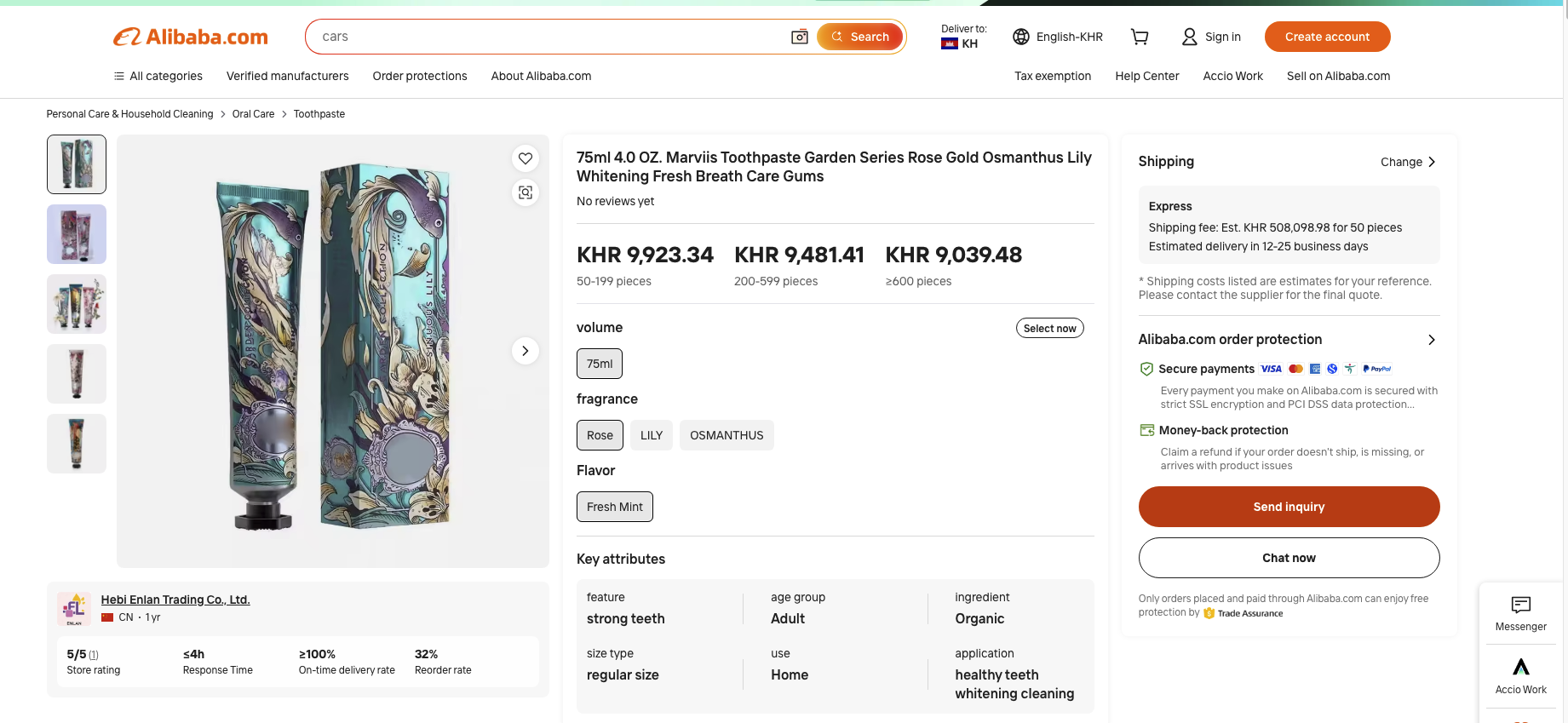
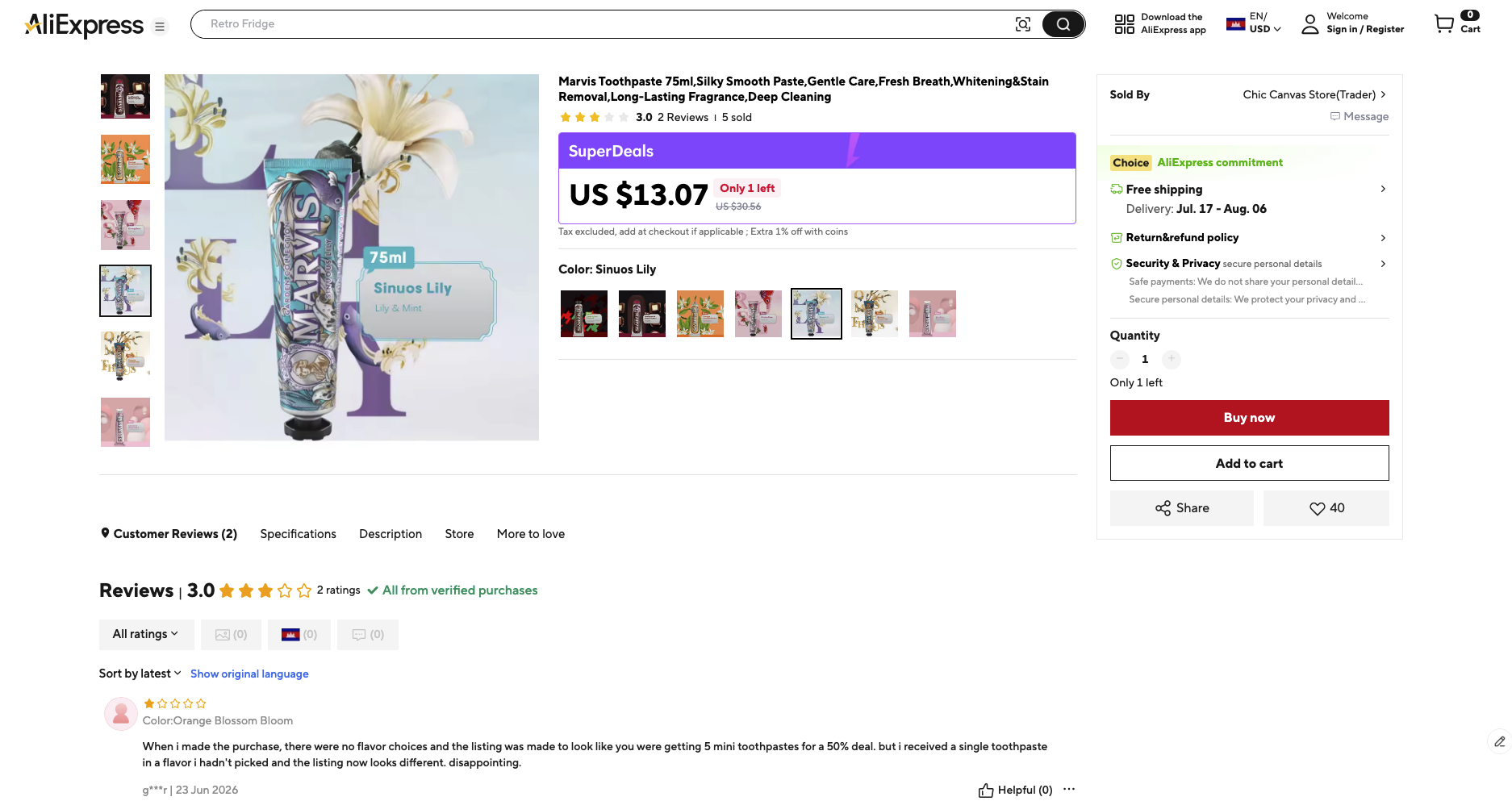
When I saw Dreamy Osmanthus, among others, at Bayon Market, I thought how wonderful that the brand has become popular in town, and decided to round out my Garden Collection with Sinuous Lily and Kissing Rose. I had no idea that Gen Z has latched onto this brand, it’s gone viral on Tiktok, and there are now fakes on Shopee, Lazada, Aliexpress etc., that in turn have made their way onto Amazon, Walmart, eBay, and, I’m sure, Asian minimart shelves. I didn’t realize until two weeks later when I opened the Sinuous Lily box that it was a fake! To be clear, Damnak Market sells (what I think, at least, is) real Marvis, Bayon City Market sells the fakes.

That freaks me out. Is their Gordon’s gin fake too? Their Bonne Maman jam? Their Skin Aqua sunscreen? What have I been eating and drinking and putting on my face? I’ve always liked that store, the staff are lovely and the prices are fair (and to be clear, fair, NOT low, especially for imports), but now I’ll probably avoid it.

Anyway, I headed back to Damnak Market today, and stood for about twenty minutes in the toothpaste aisle tampering with boxes and checking the Marvis tubes I wanted were authentic, while suspicious staff repeatedly walked past and hovered next to me. It’s Cambodia, so they obviously didn’t say anything; I see people blatantly shoplift here and nothing happens, it seems to be part of their non-confrontational norms. I don’t blame the staff by the way– they’re not paid enough to chase after thieves– it’s just much more laissez-faire than the norm in New York, where a) the products aren’t fake and b)the staff would walk right up and ask what you thought you were doing if you were tampering with products, and file a police report on anyone the security guard couldn’t (or wouldn’t) physically restrain if you stole them.

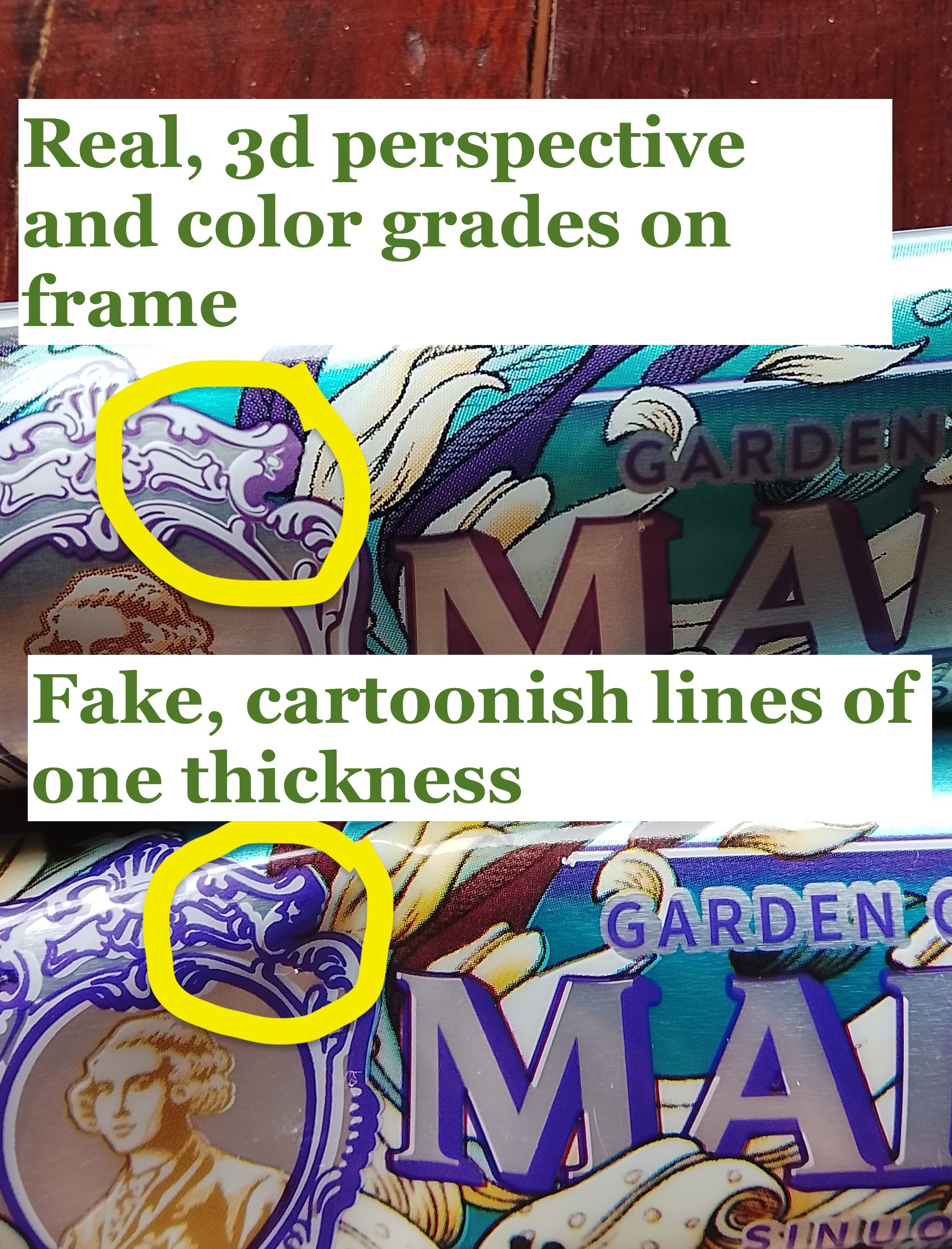
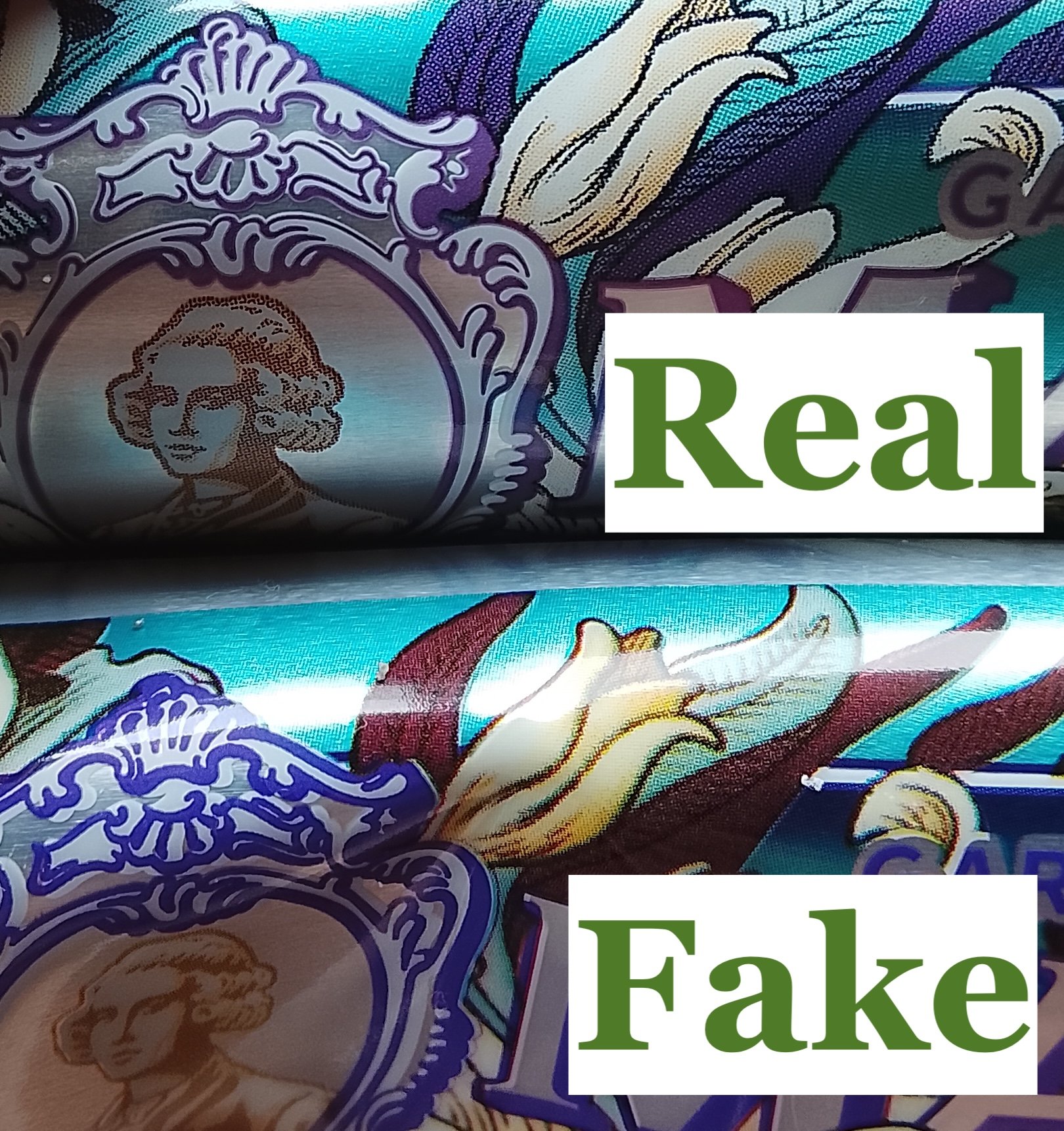
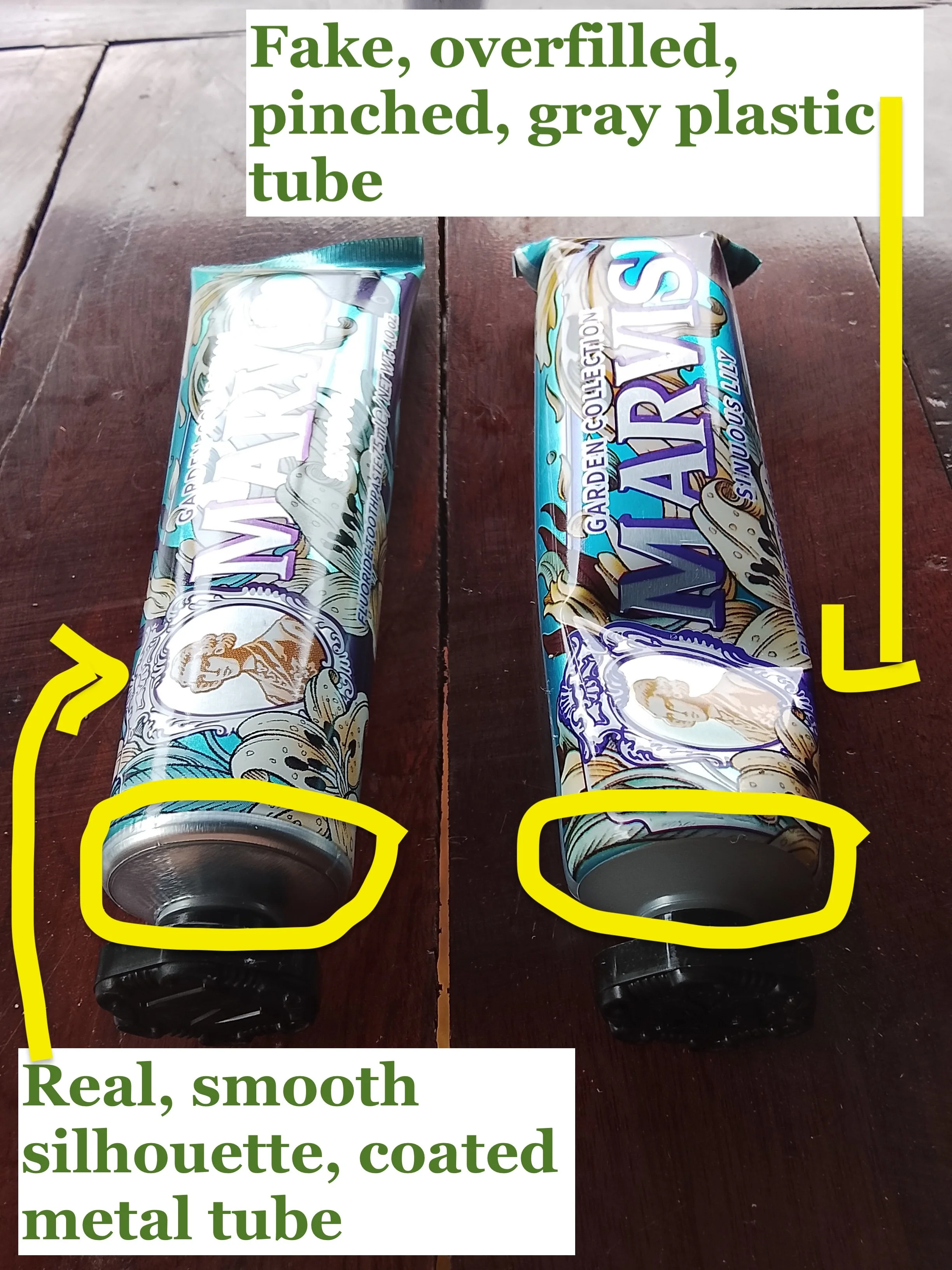
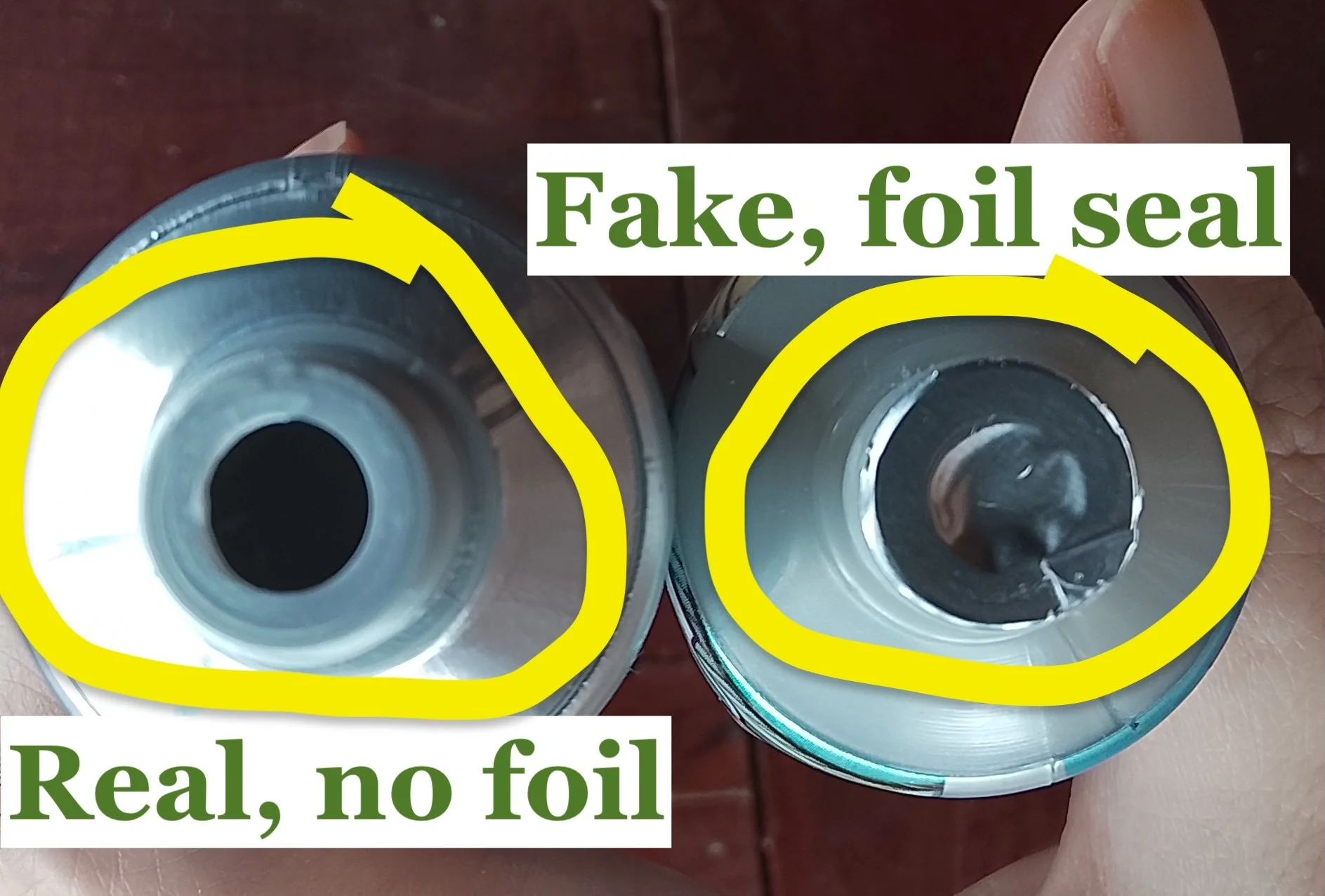
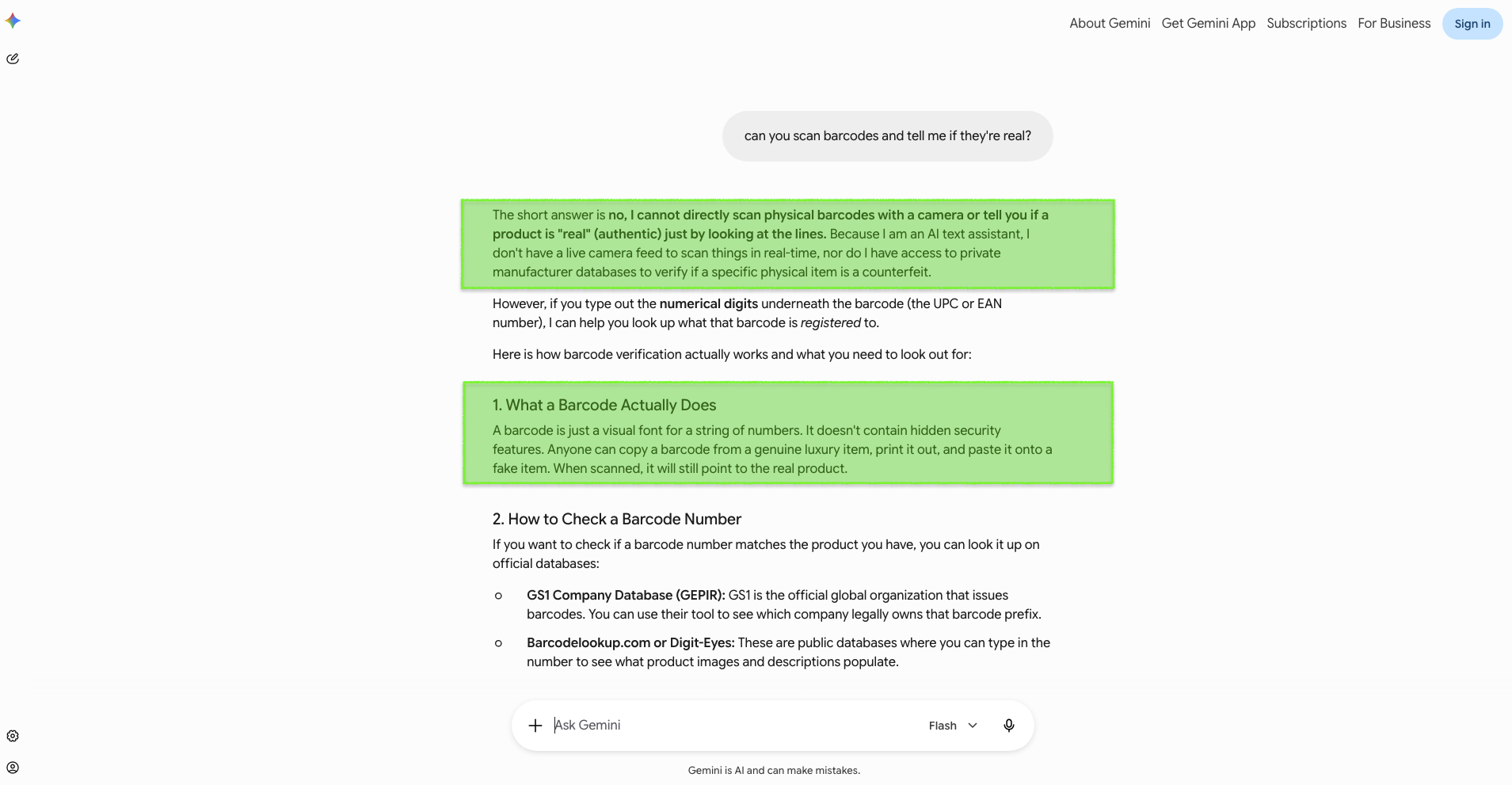
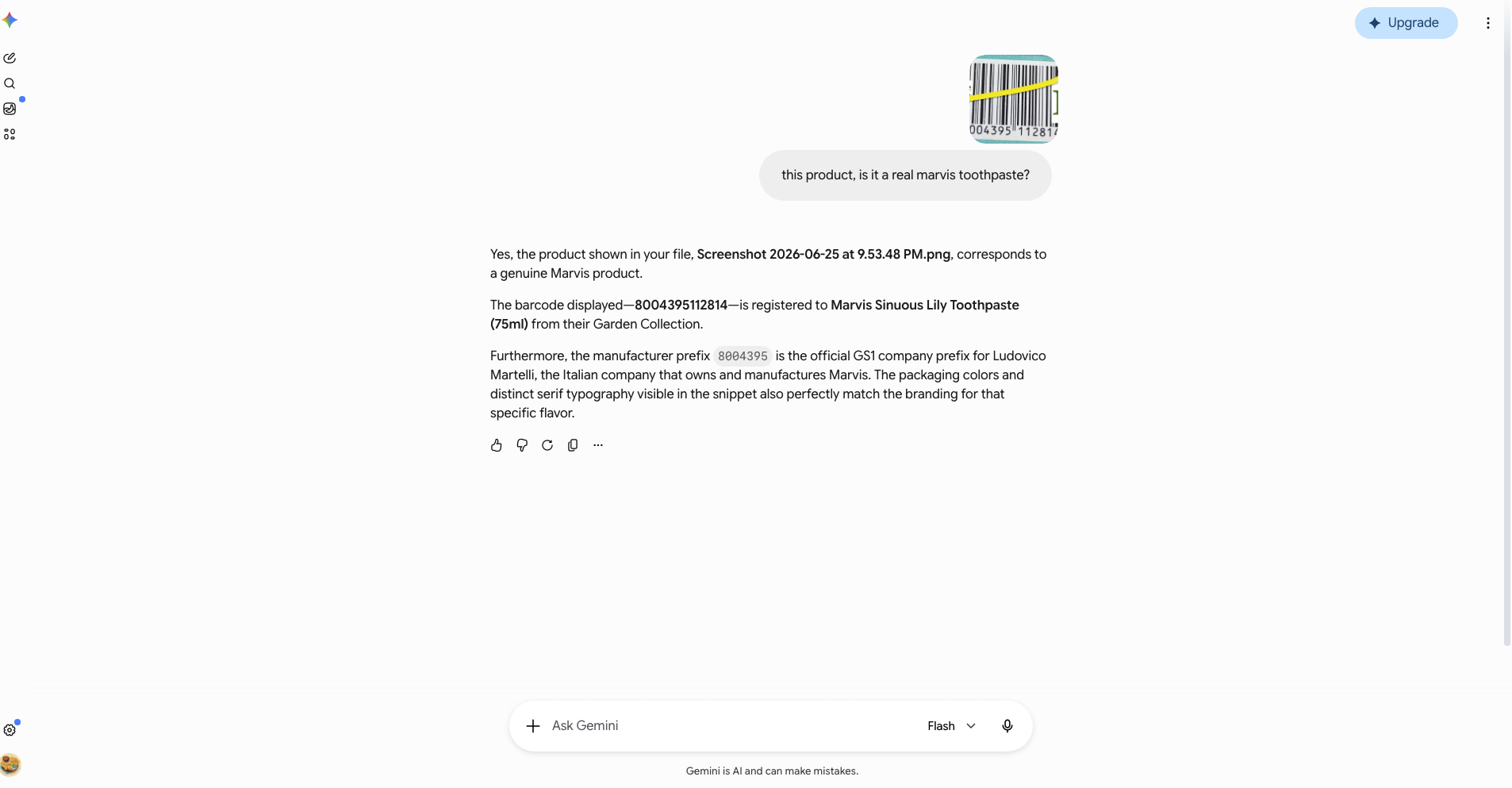
I was horrified when a quick online search brought up real v. fake Marvis tiktok videos– ICK, that’s how you know a niche brand has gone mainstream. I’m such an, ahem, legacy customer (read: old) that I remember when the tubes were metal in the 90s, and so I found myself questioning the real v. fake advice too. Frankly, I’m still not fully convinced the Damnak Market Marvis is authentic, it might just be a higher quality fake than the Bayon City Market Marvis. I’d say I’m 85, 90% sure it’s authentic, but would honestly have to go home, buy an inarguably authentic tube from Anthropologie or Bigelow, and compare them to reassure myself I’m not going mad. That’s not going to happen though, so I thought I’d offer the side-by-side photos and explanations I wish were available to me earlier this afternoon!
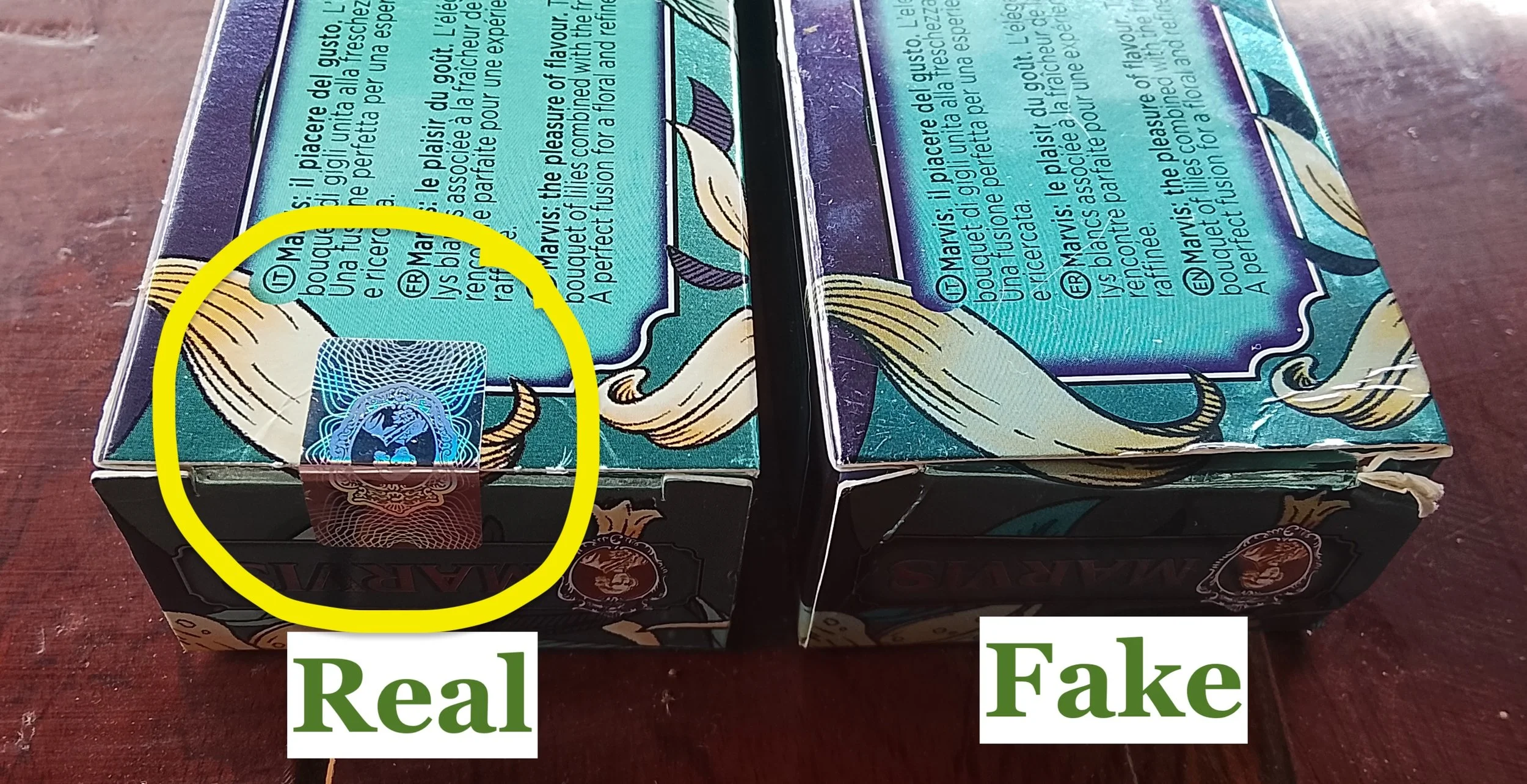
This Marvis holographic sticker has me questioning my sanity. I don’t remember ever seeing a tamper label on a Marvis box before– but that’s not to say they’re fake, just that I don’t remember! I can’t find a single photo of a Marvis box with a sticker seal online, but there are two on either end of this box. This is the #1 thing making me question the authenticity of what I’ve called the ‘real’ toothpaste in this post.
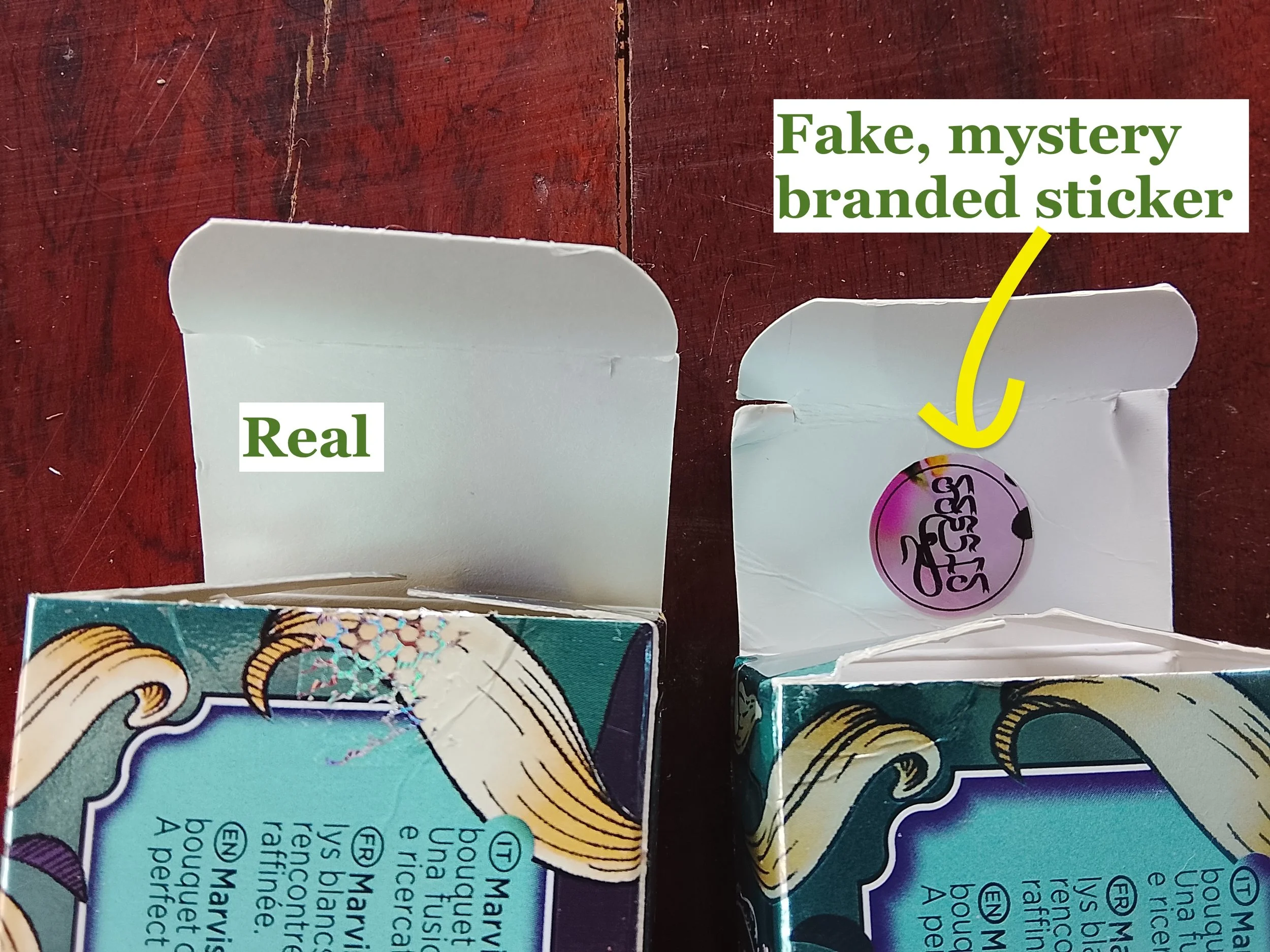
Google translate can’t figure out what language this mystery pink sticker is. I’m guessing stylized Khmer but could be anything. It’s really audacious of a manufacturer/distributor of fakes to brand themselves like this!
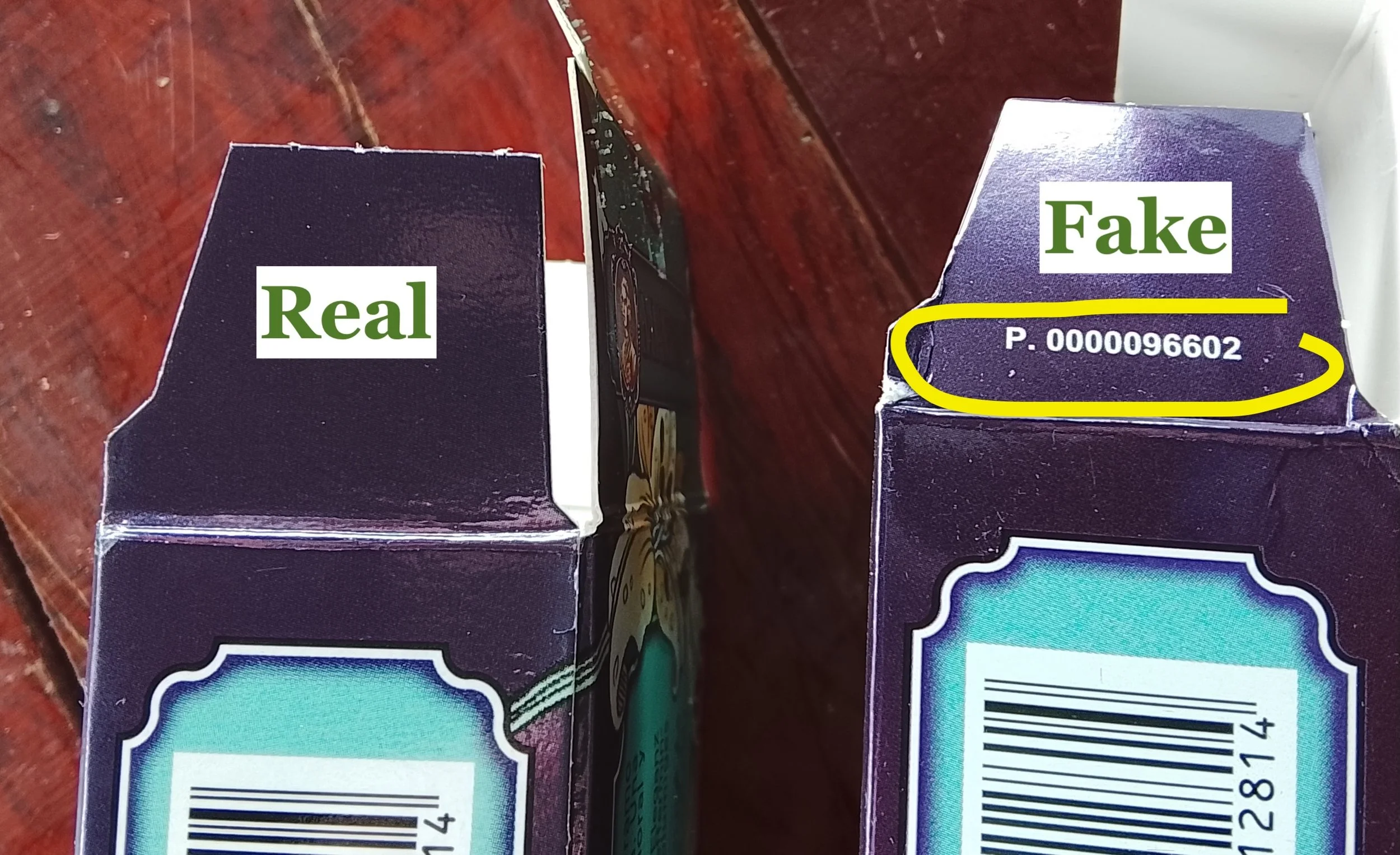
Batch or order number on the fake box that’s not on the real one.
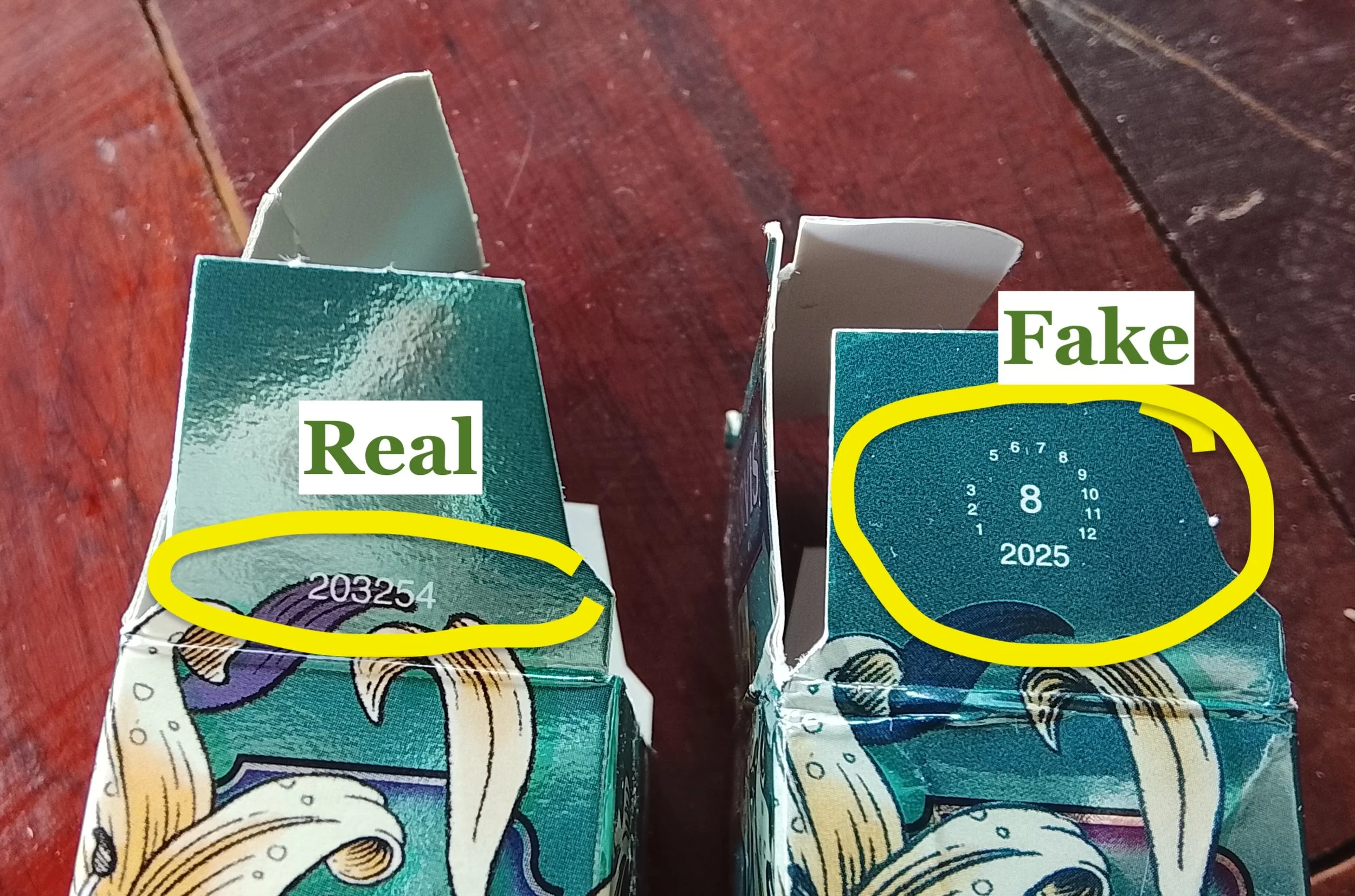
The real box has some sort of batch code that looks quite different from the fake box
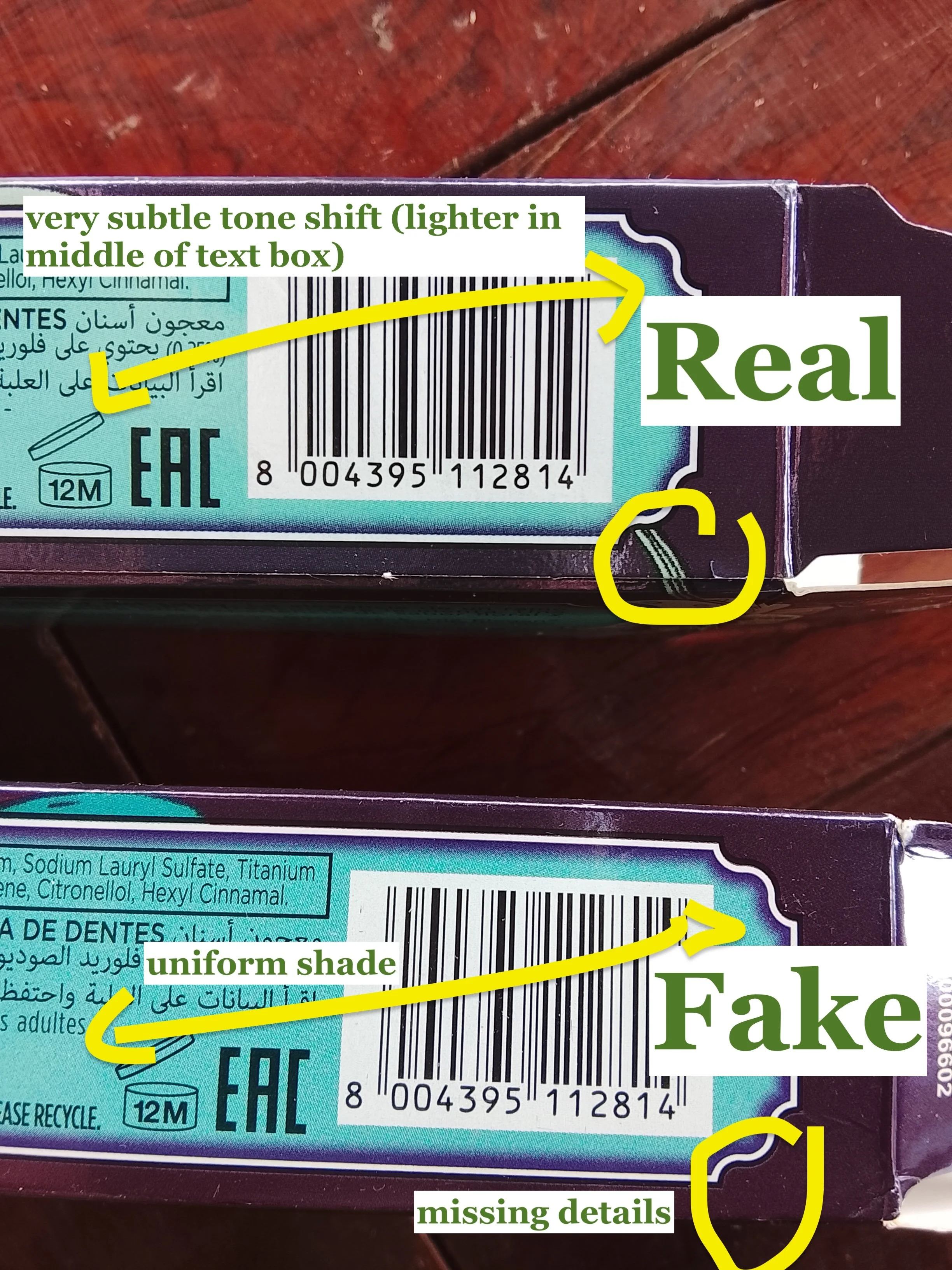
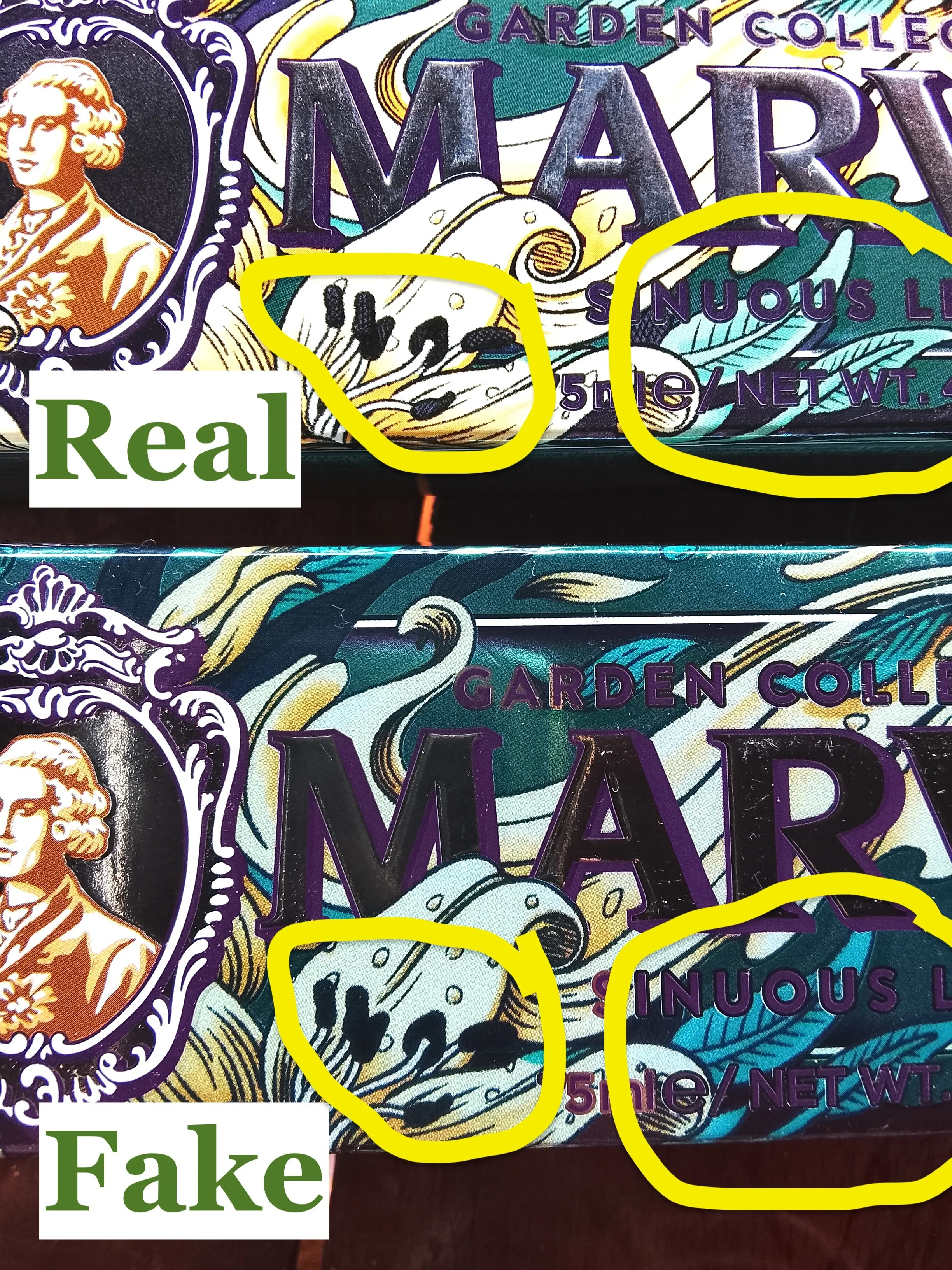
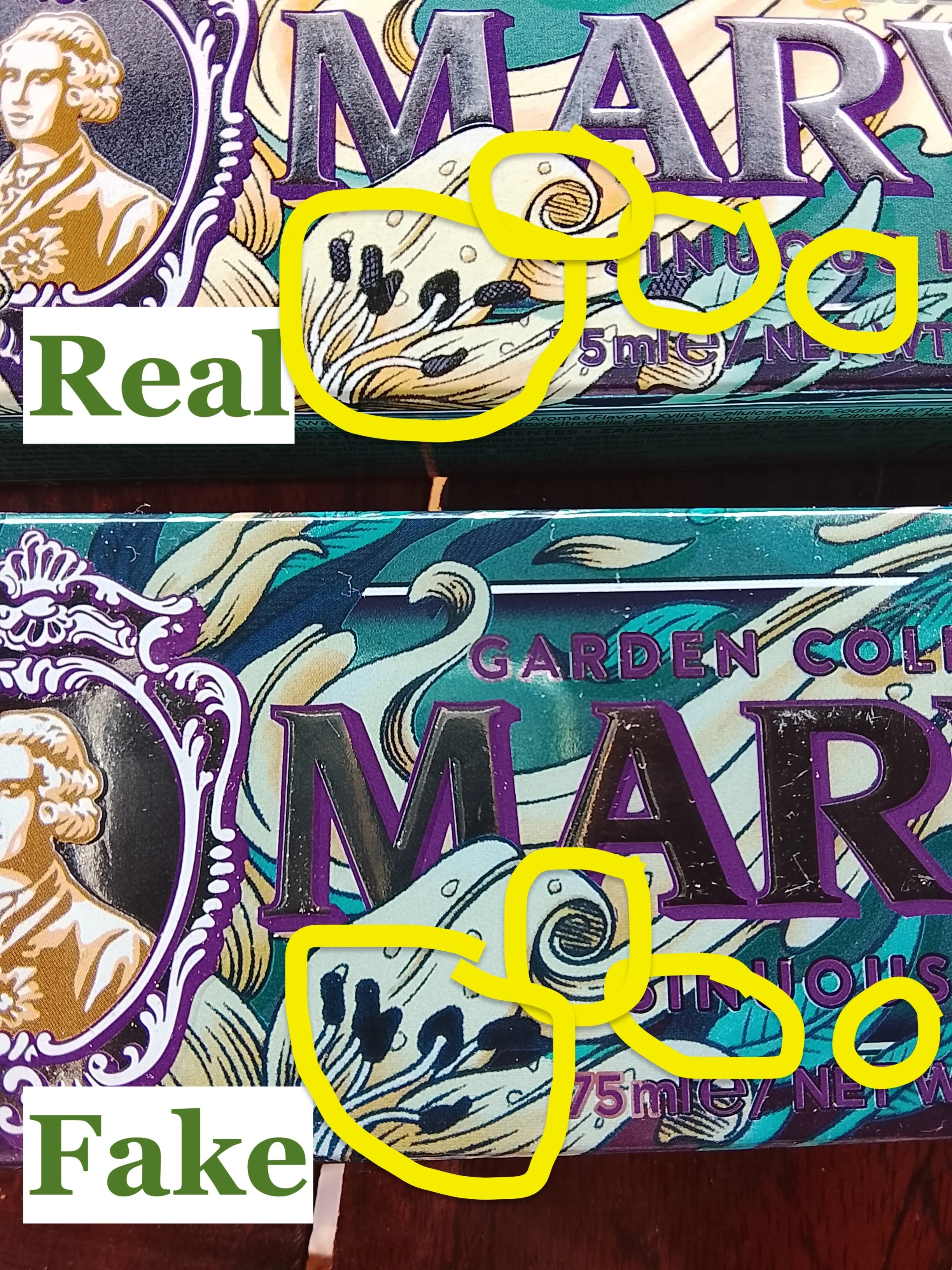
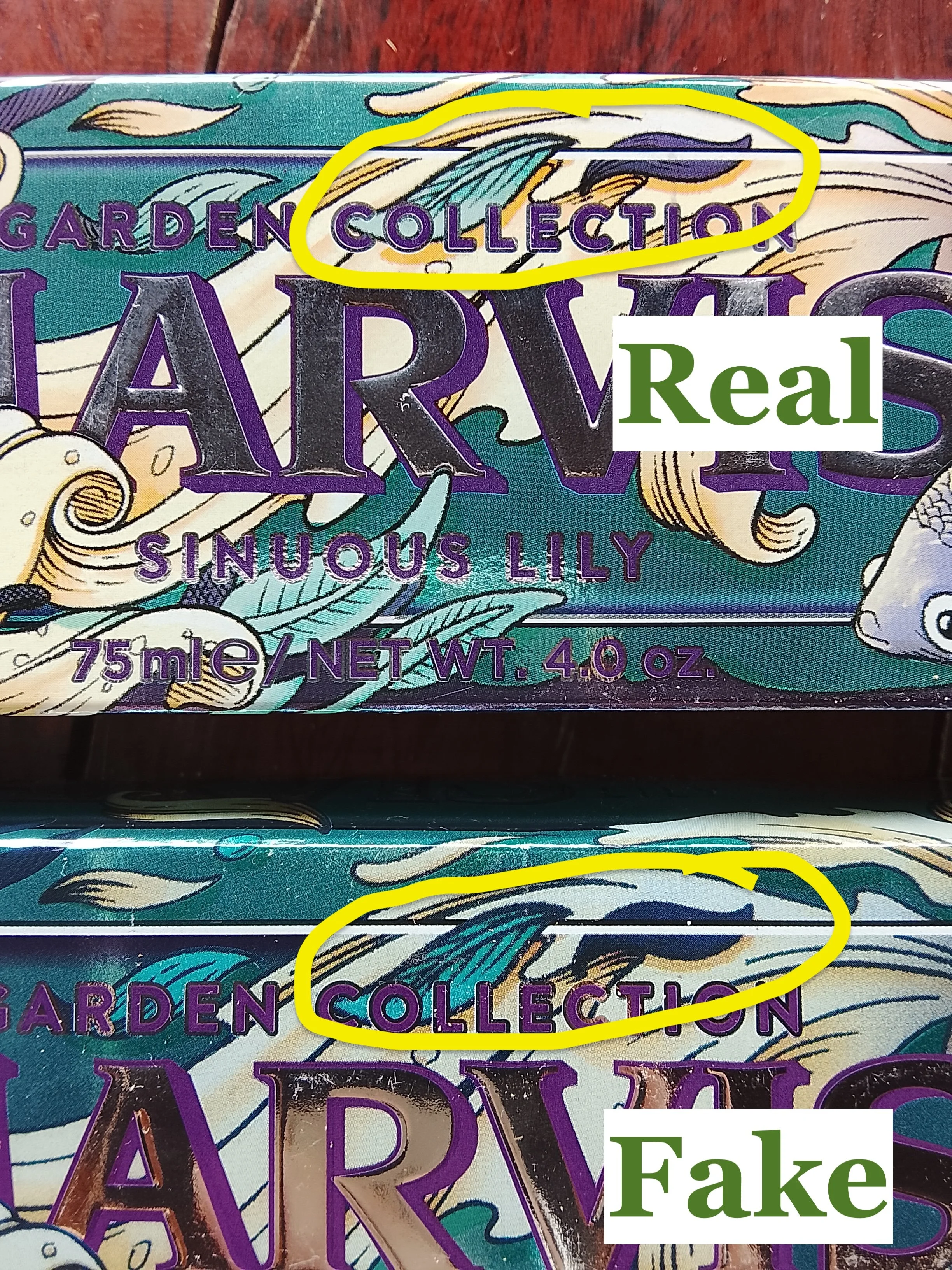
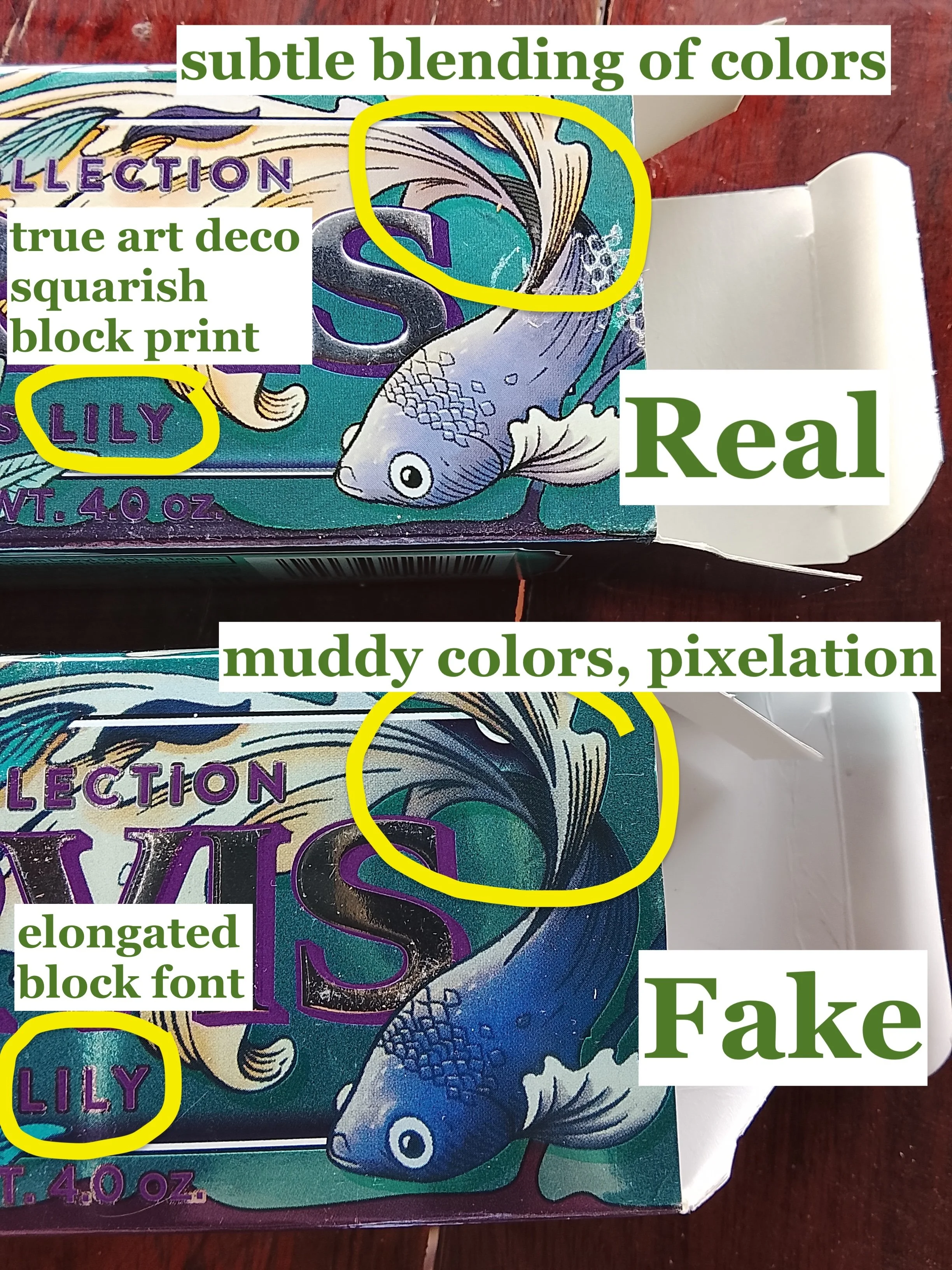
The fake box looks like a low quality photocopy of the real box
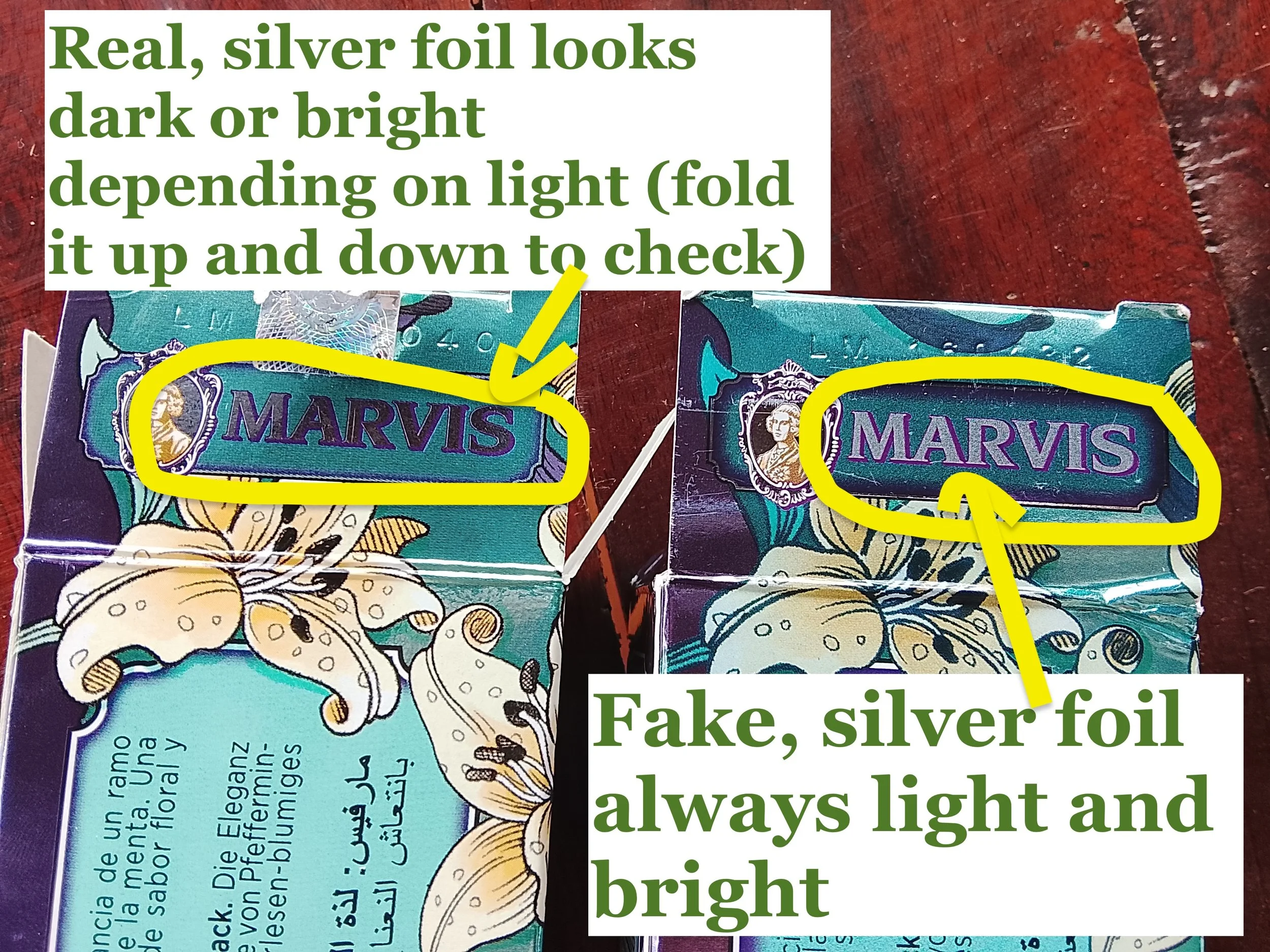
I don’t know enough about printing to have the vocabulary to describe this, but whatever makes the shiny silver parts of these boxes is different. On the real Marvis box, the silver really shines if the light hits it at the correct angle, but darkens in shadow. The silver on the fake box is light and bright regardless.
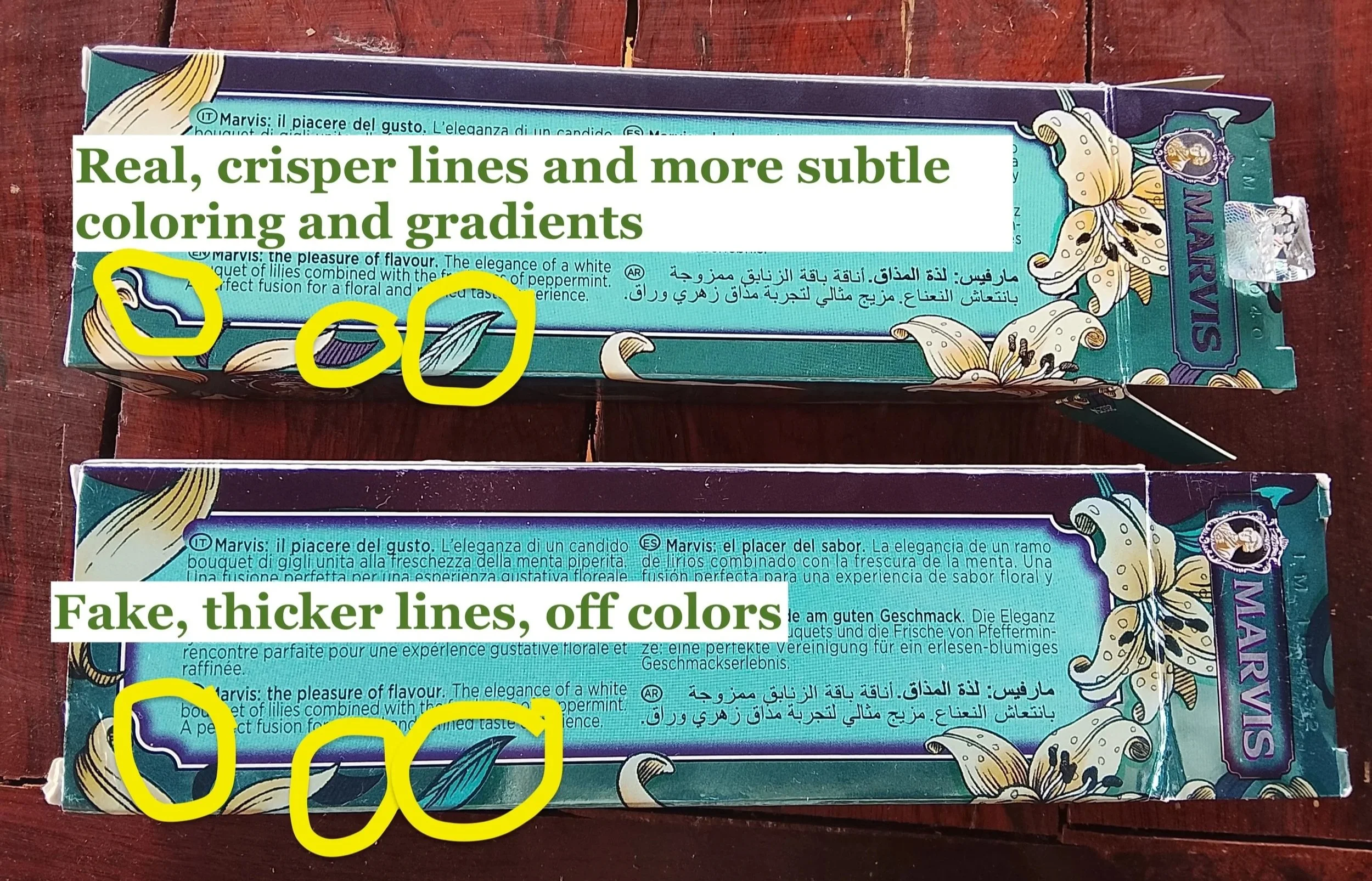
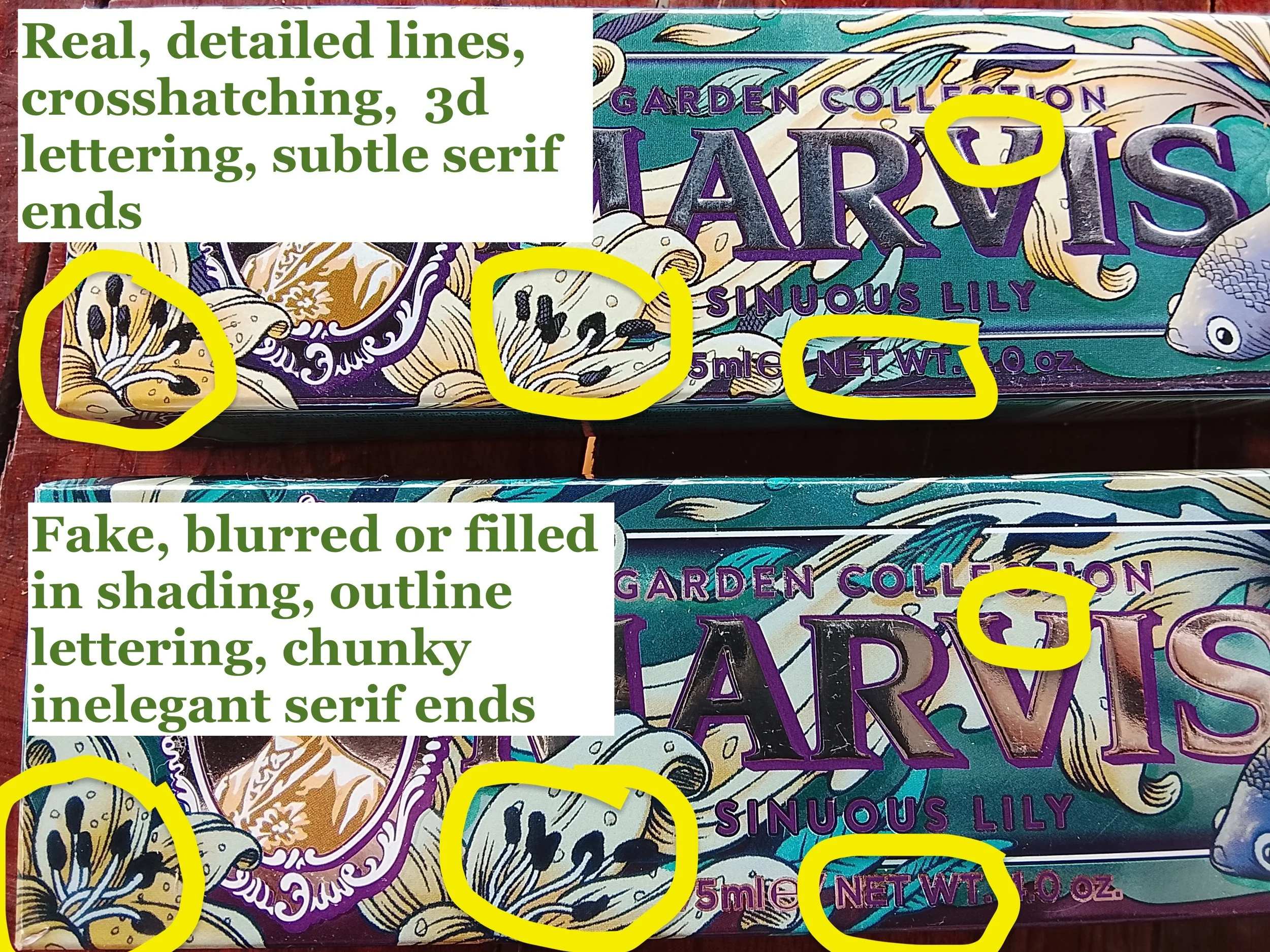
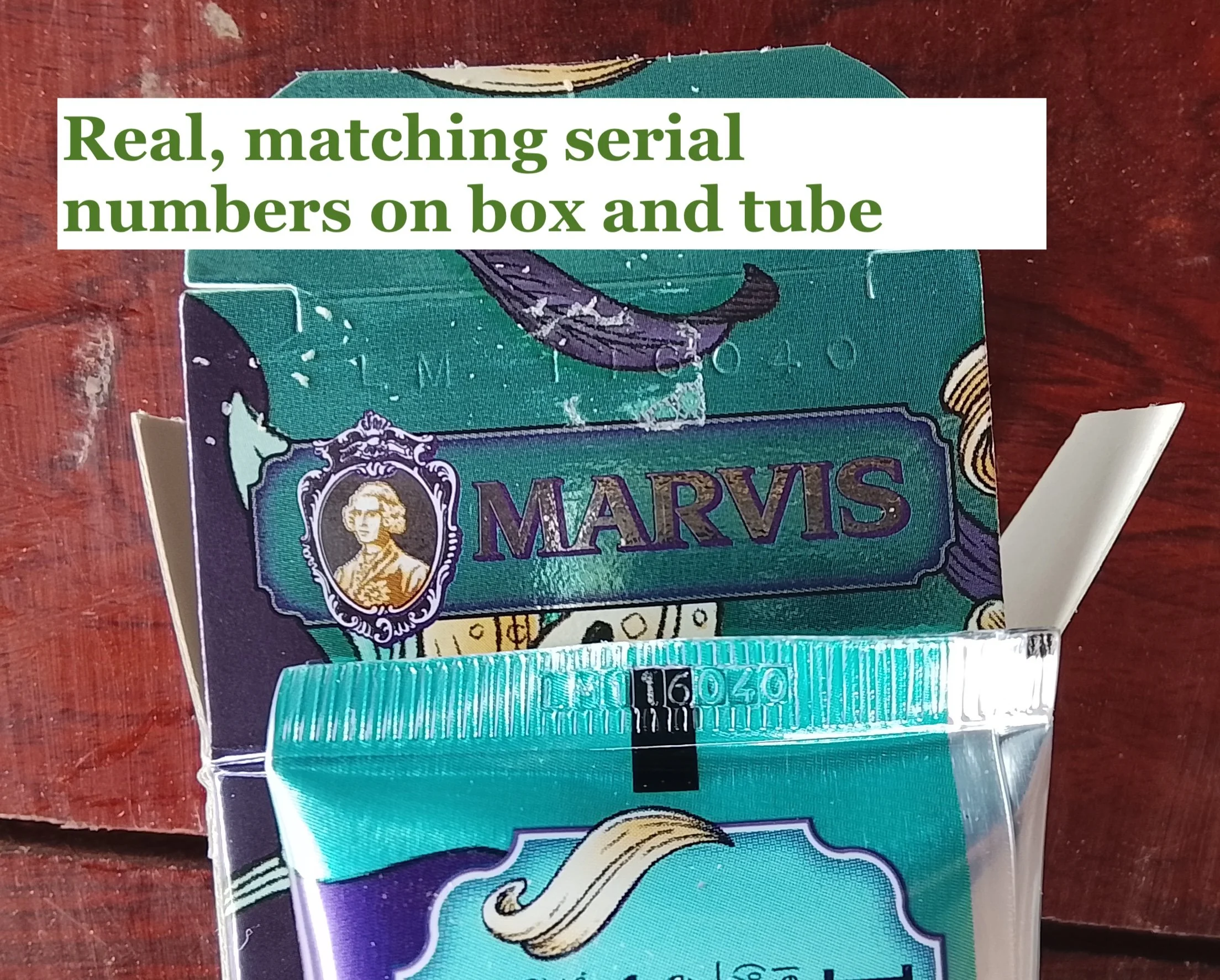
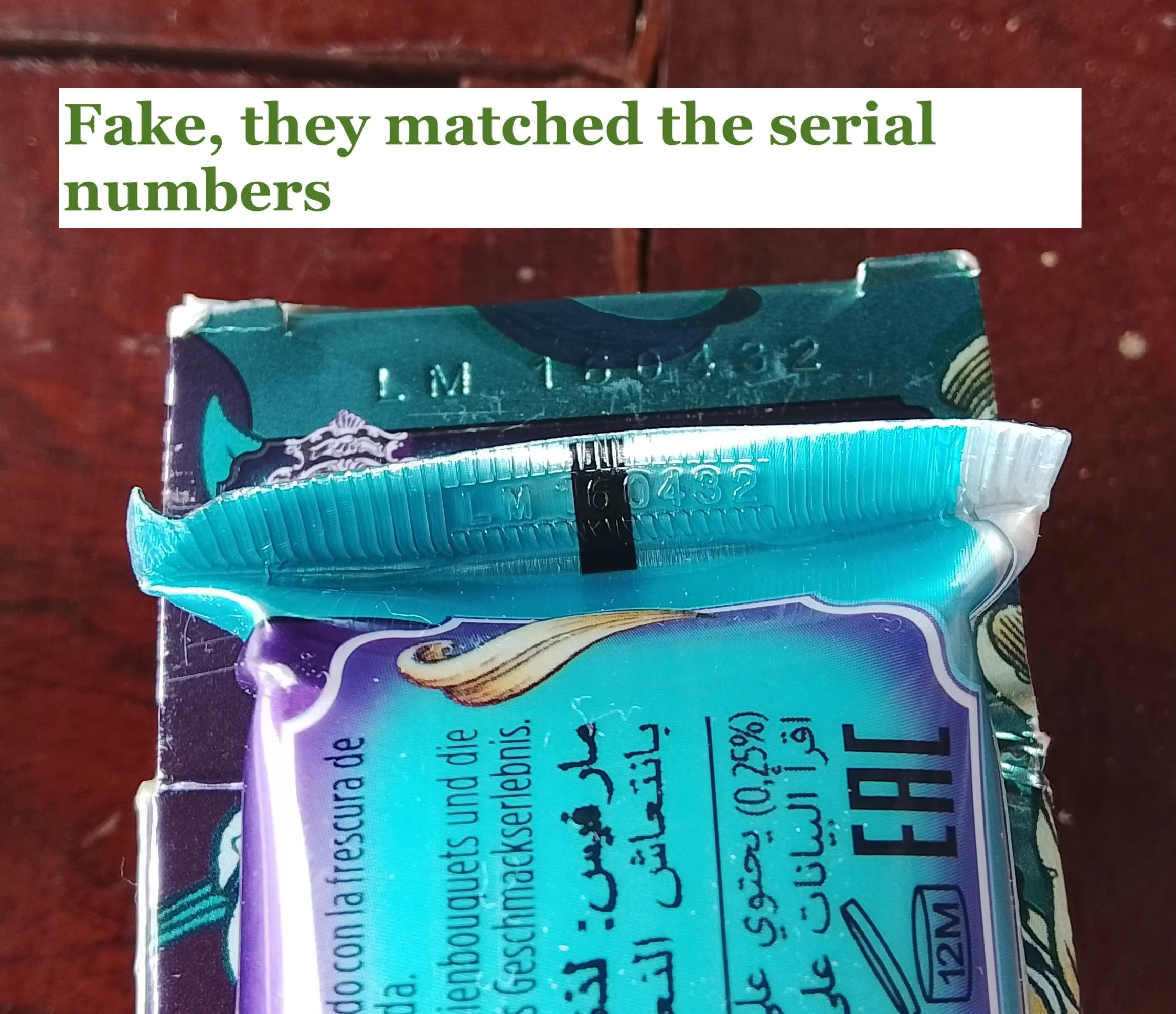
Lots of ‘how to spot fake Marvis’ reviews noted that the serial numbers on fakes wouldn’t be there, or wouldn’t match the serial number on the box. They matched them on this fake.
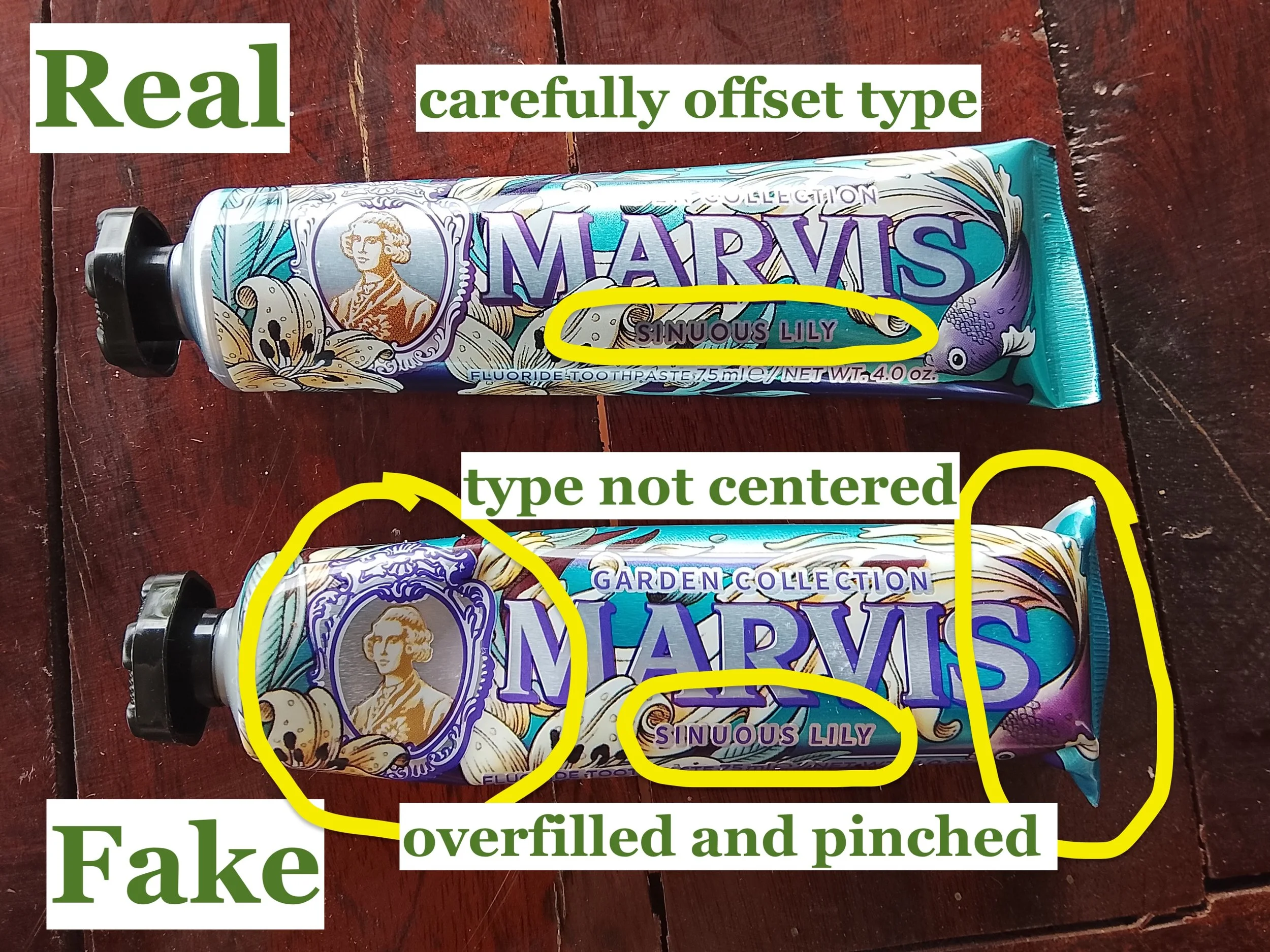
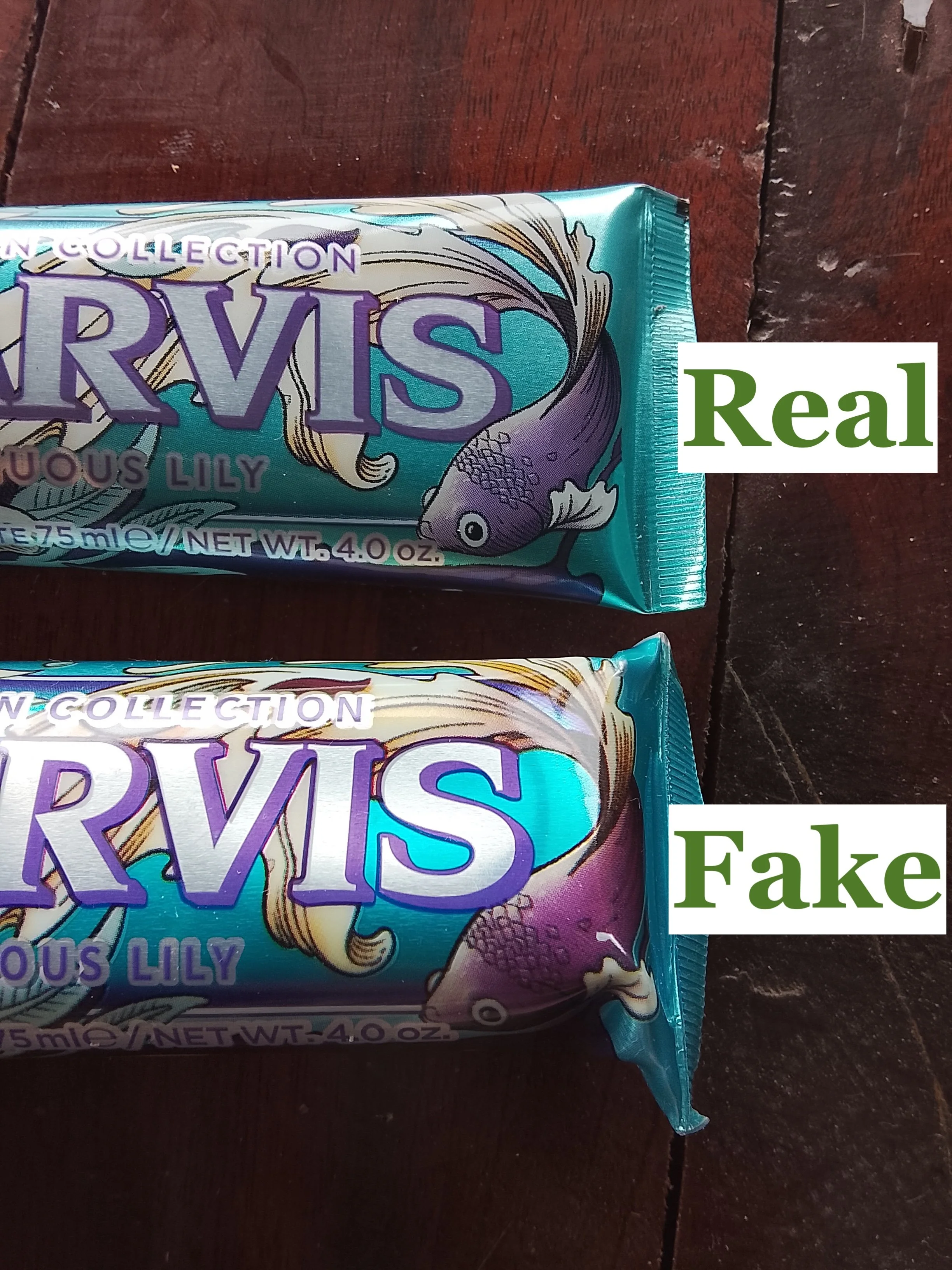
I should say, it’s not metal coated with plastic, it’s ‘aluminum look’ plastic
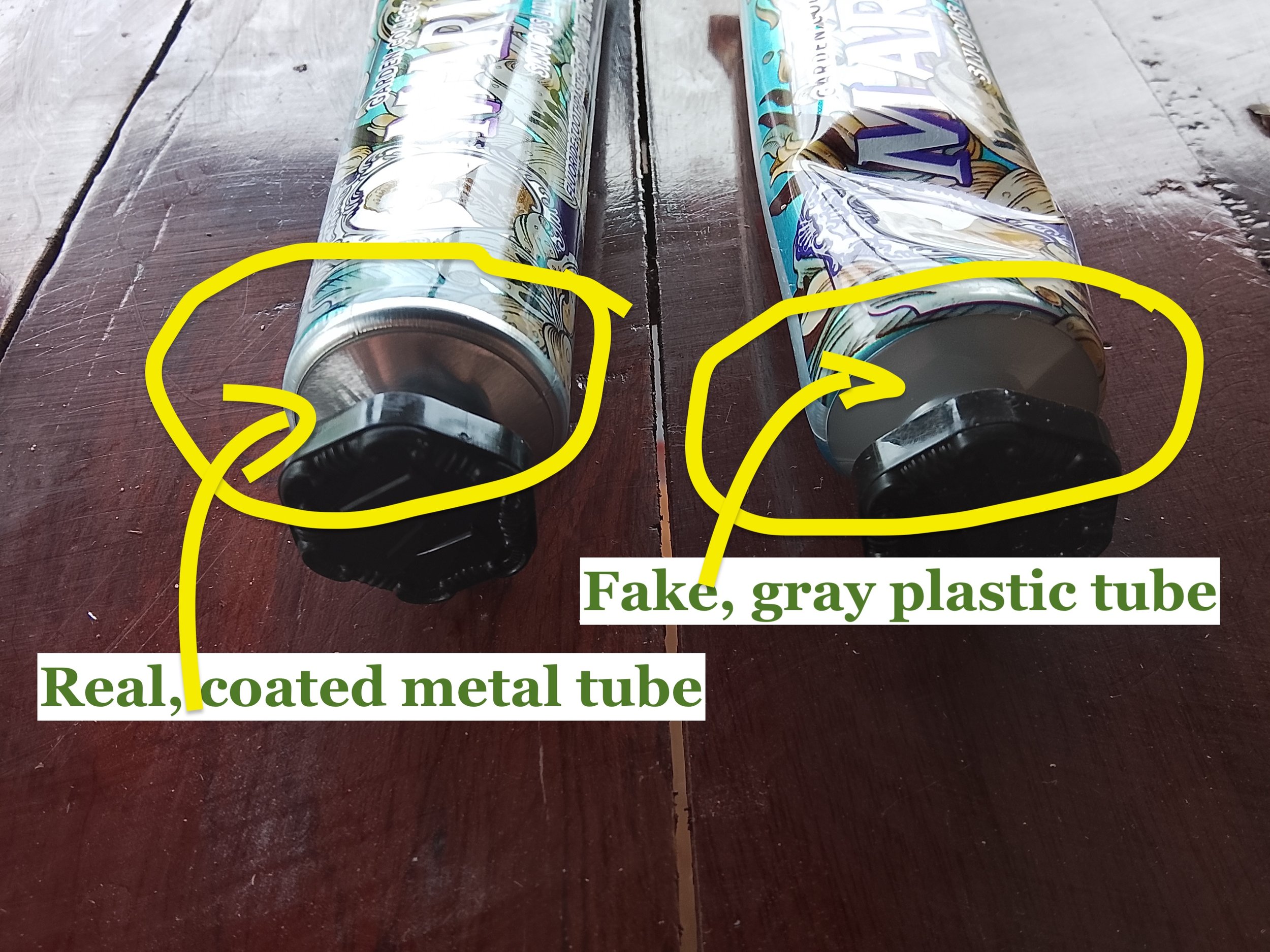
Apparently Marvis tubes are unsealed in the EU, and used to be unsealed in the US too. Now, they do seal tubes for certain markets depending on local law, but in SEA (where it’s safe to say there are almost no laws) a sealed tube more likely indicates a fake.
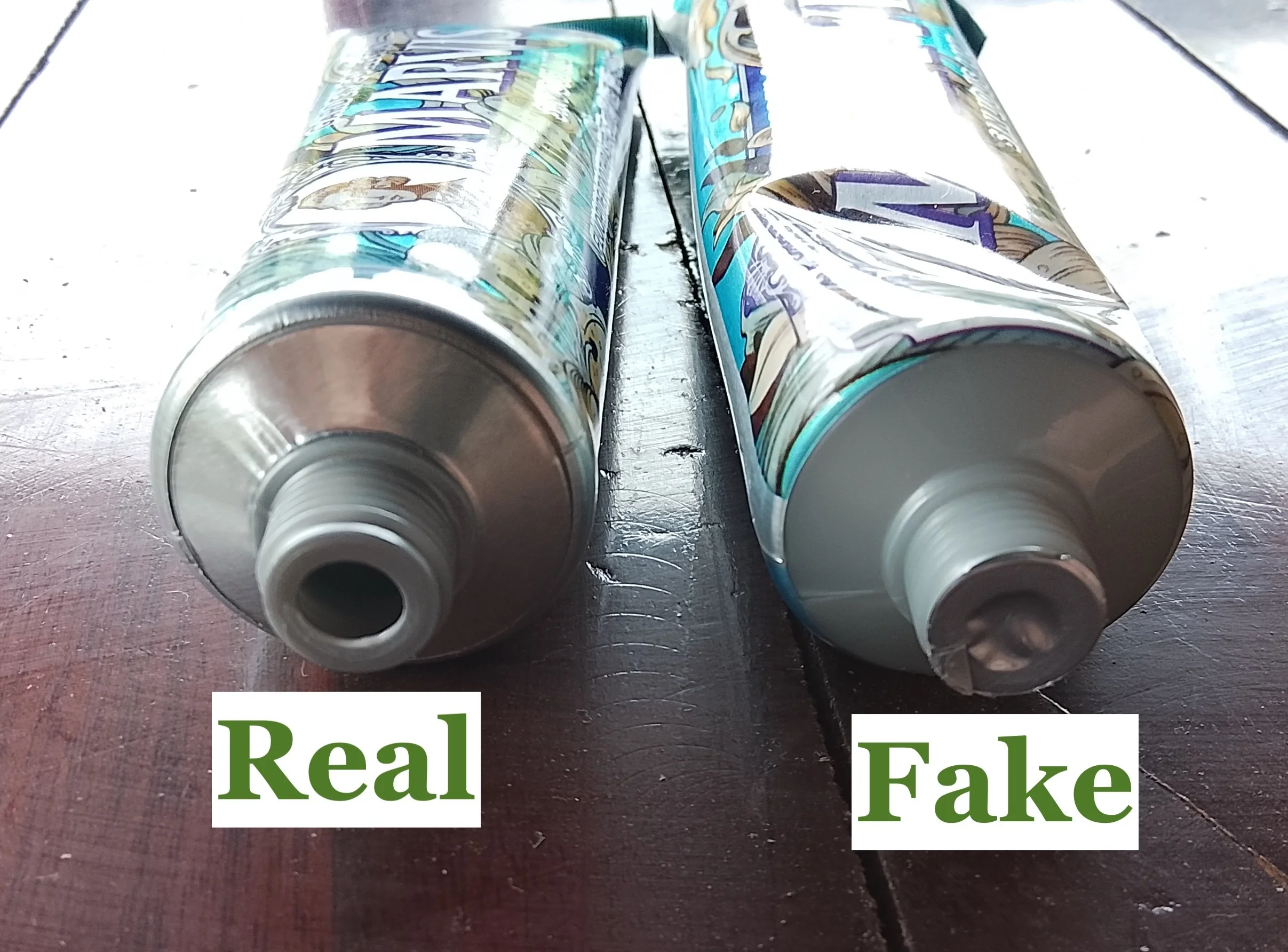
This is the the #2 thing making me question the authenticity of what I’m calling the ‘real’ tube of toothpaste in this post. It has plastic threads. I remember Marvis having metal threads. But that was years ago– at least a decade. Maybe they’ve gotten cheaper, or EU laws have changed? Maybe that’s only for the classic tubes, not the limited editions? Not sure, but this really bothers me.
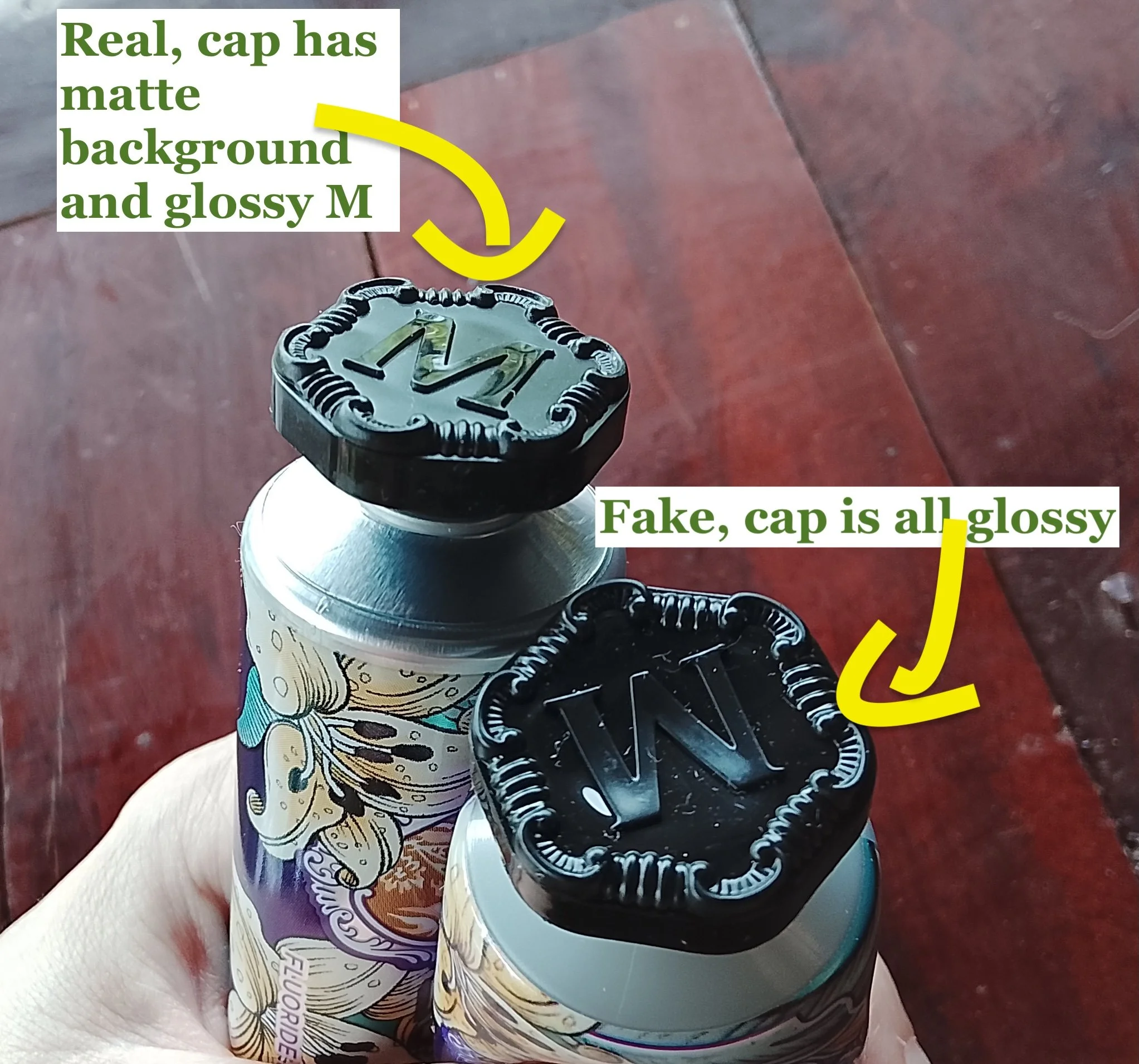
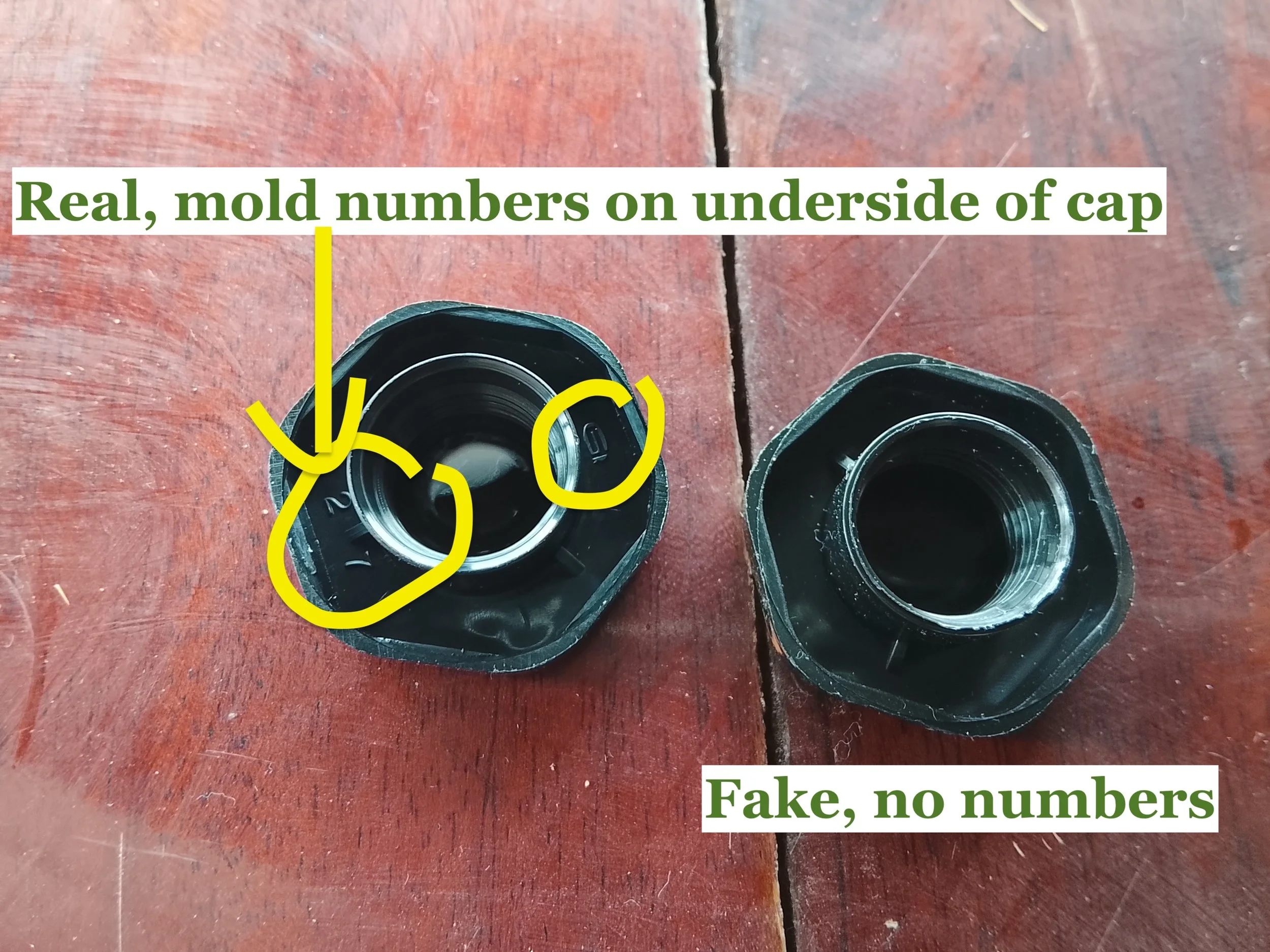
I’d say the #1 giveaway that a Marvis tube is fake is not what you can see, it’s what you (can’t) smell– the fake tube of Sinuous Lily just smelled like generic mint toothpaste, not even a hint of floral. The real toothpaste smells strong and lovely.

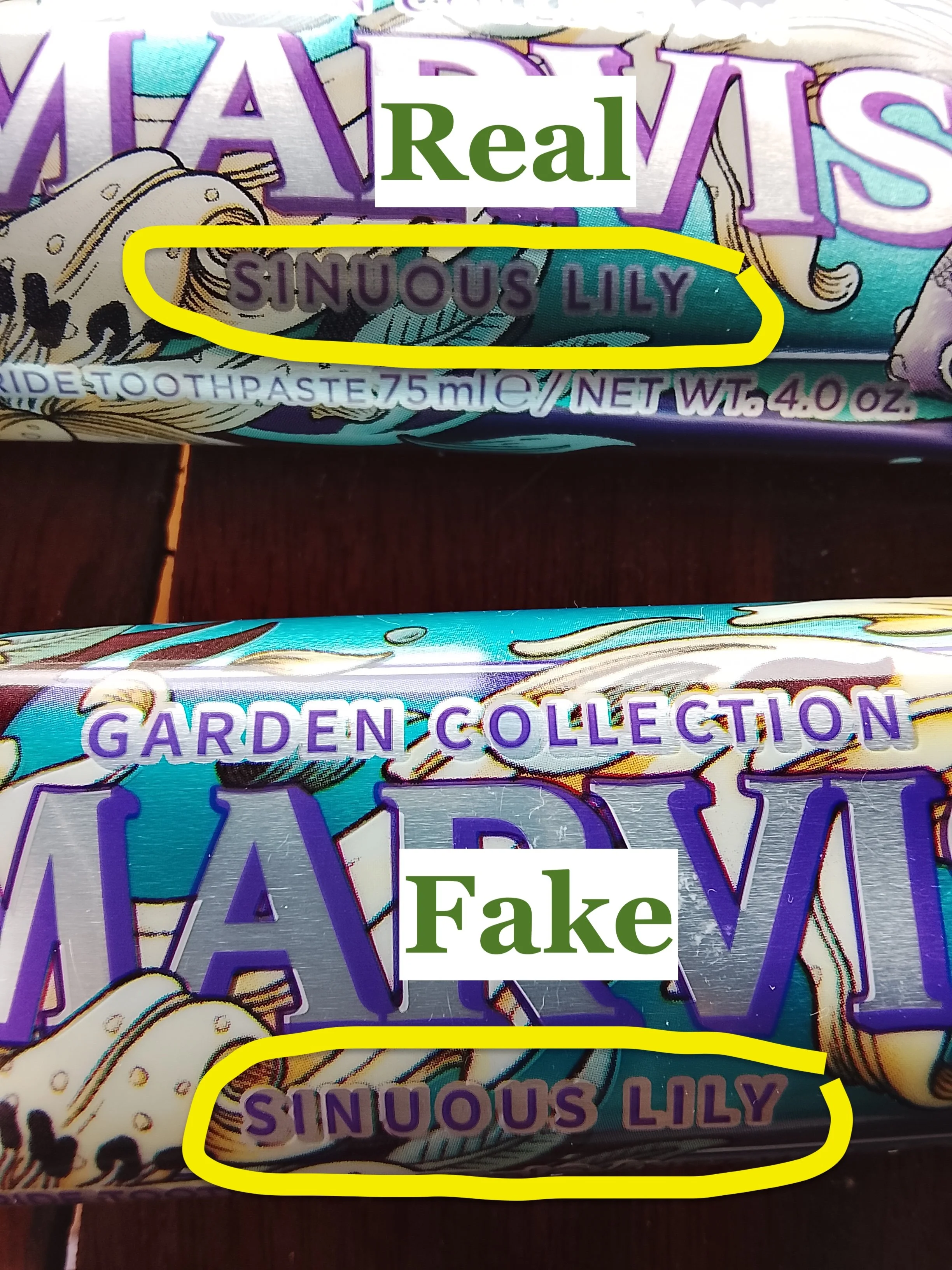
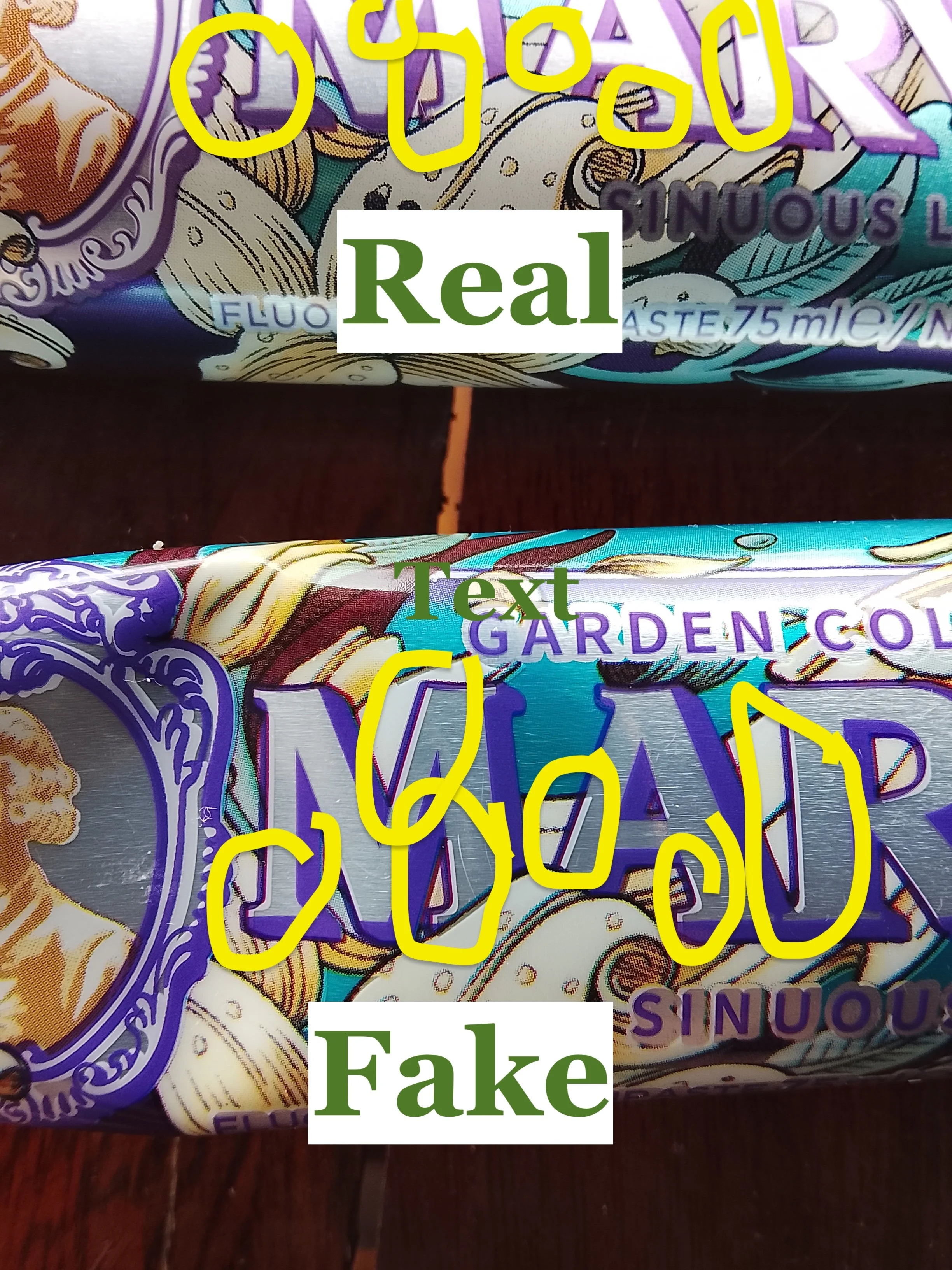
Big giveaway #2 is that gray plastic tube. #3 is the overfilling. It’s clearly hand stuffed and pinched in a way you’ll never see in a new factory filled tube from any brand. #4 the printing fuckups, the type not being centered inside its own outlines. #5 the threads not screwing smoothly. This is another thing you wouldn’t notice in isolation, but when comparing the authentic tube to the inauthentic tube, the cap screws on easily the first time on the authentic tube. On the fake tube, I found myself trying three or four times to not screw the cap on at an angle.

My best piece of advice is open the box and look at the tube, even if shop employees stare you down. Worst comes to worst, just tell them you accidentally bought a fake before and want to make sure it’s real. Side by side with the real one, the fake box is clearly inferior; but at a glance, trusting in my local shop, grabbing and going, it passed. The colors are pretty, the design is right, and it’s embossed like the real one, so it passes the touch test. It was only when I opened the box and saw the tube that I knew something was wrong.

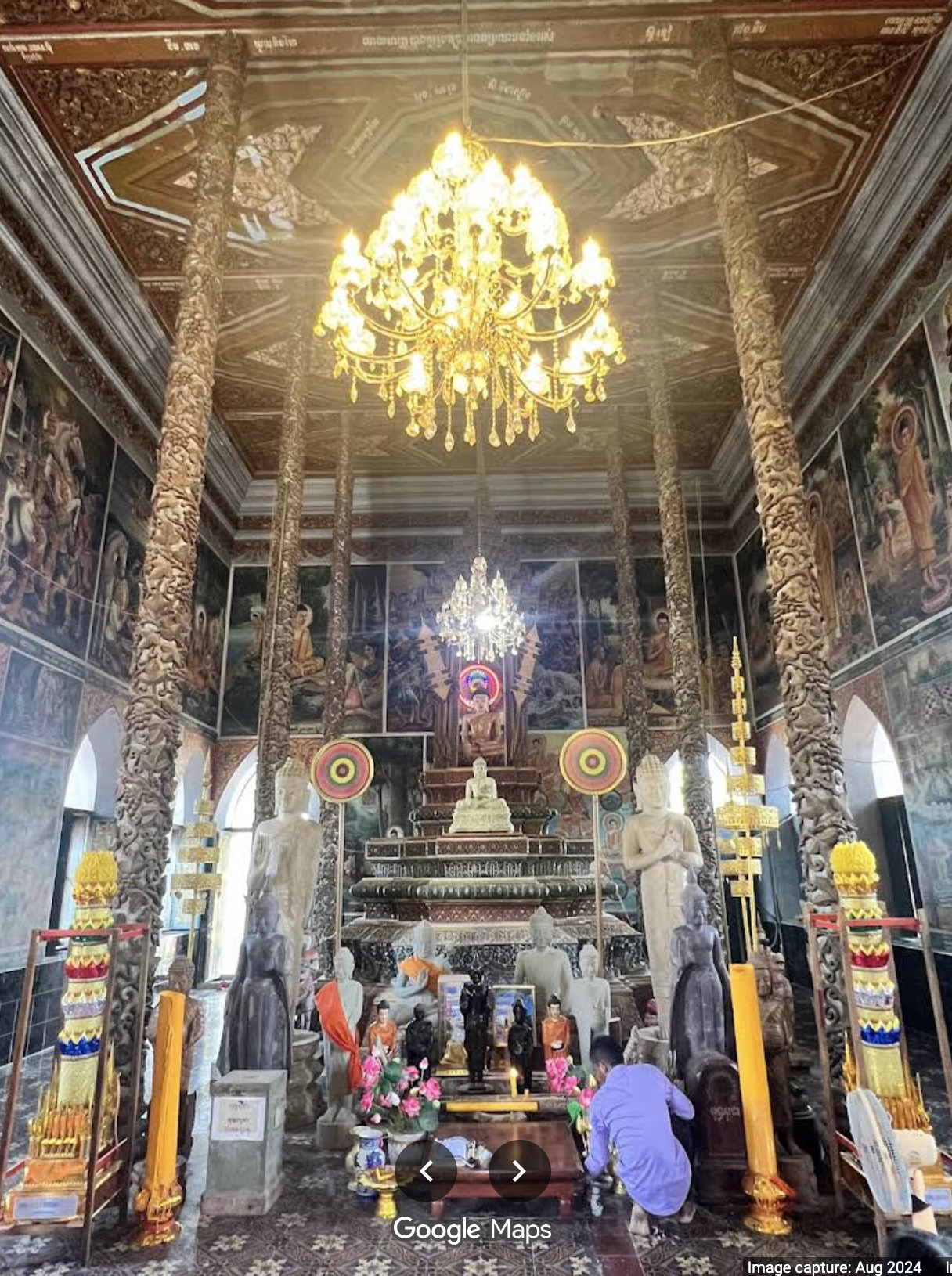
Battambang Provincial Museum | Cambodia

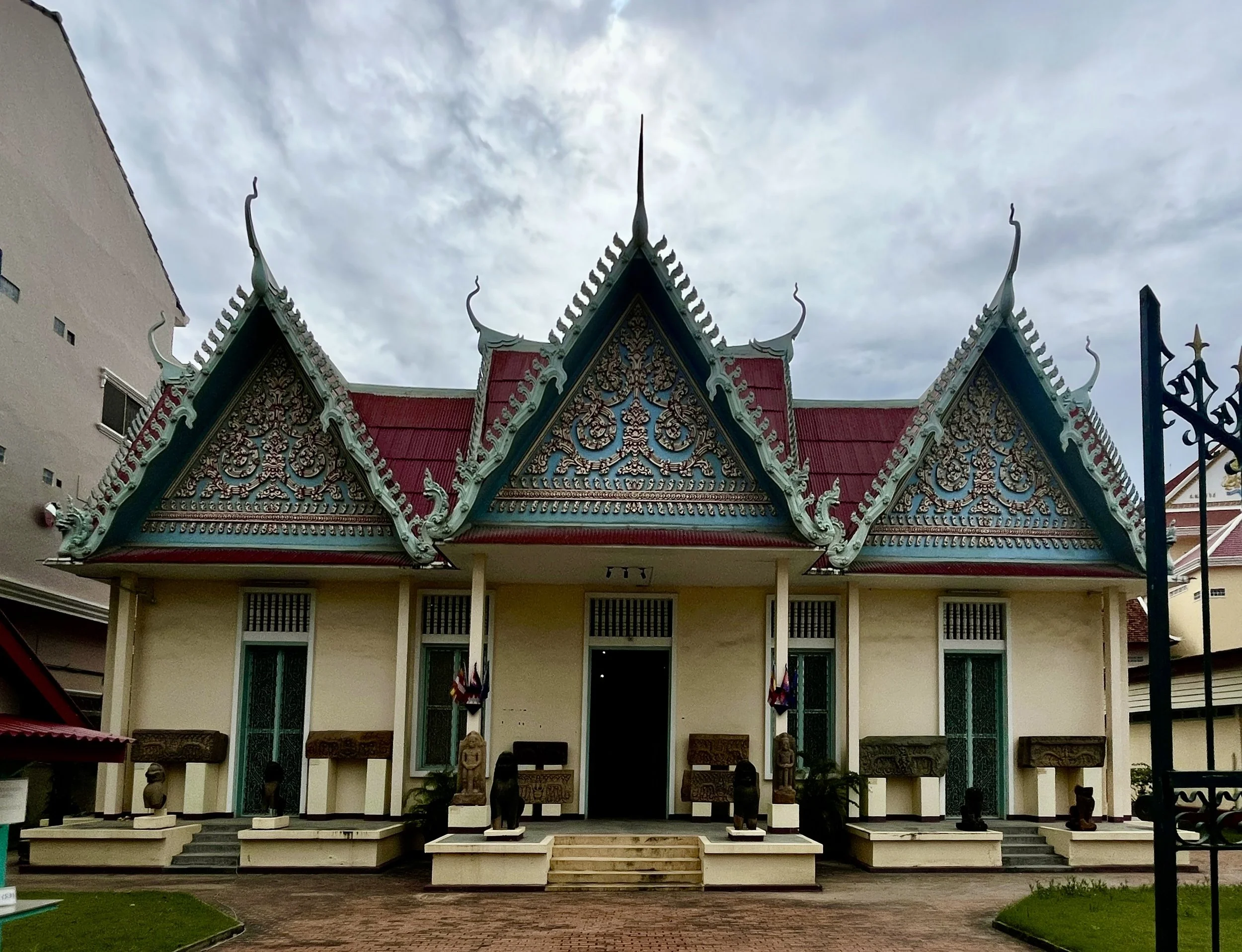
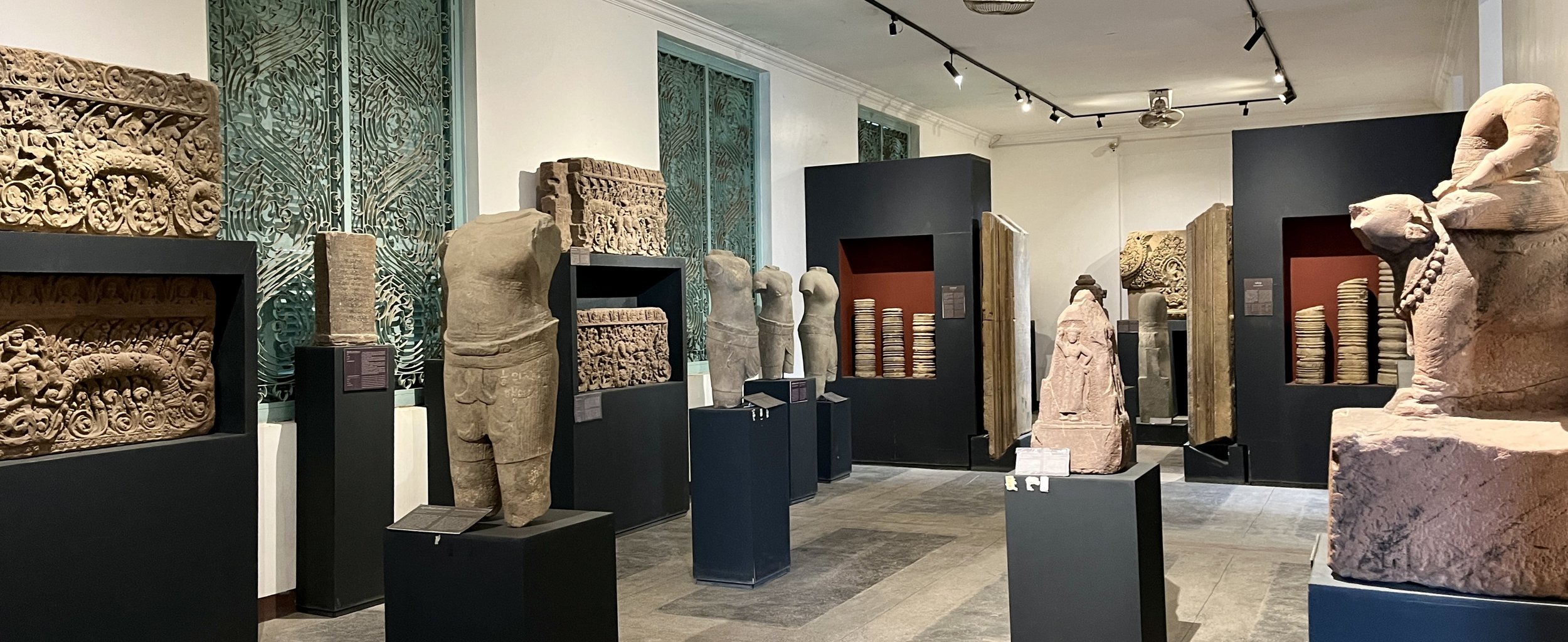
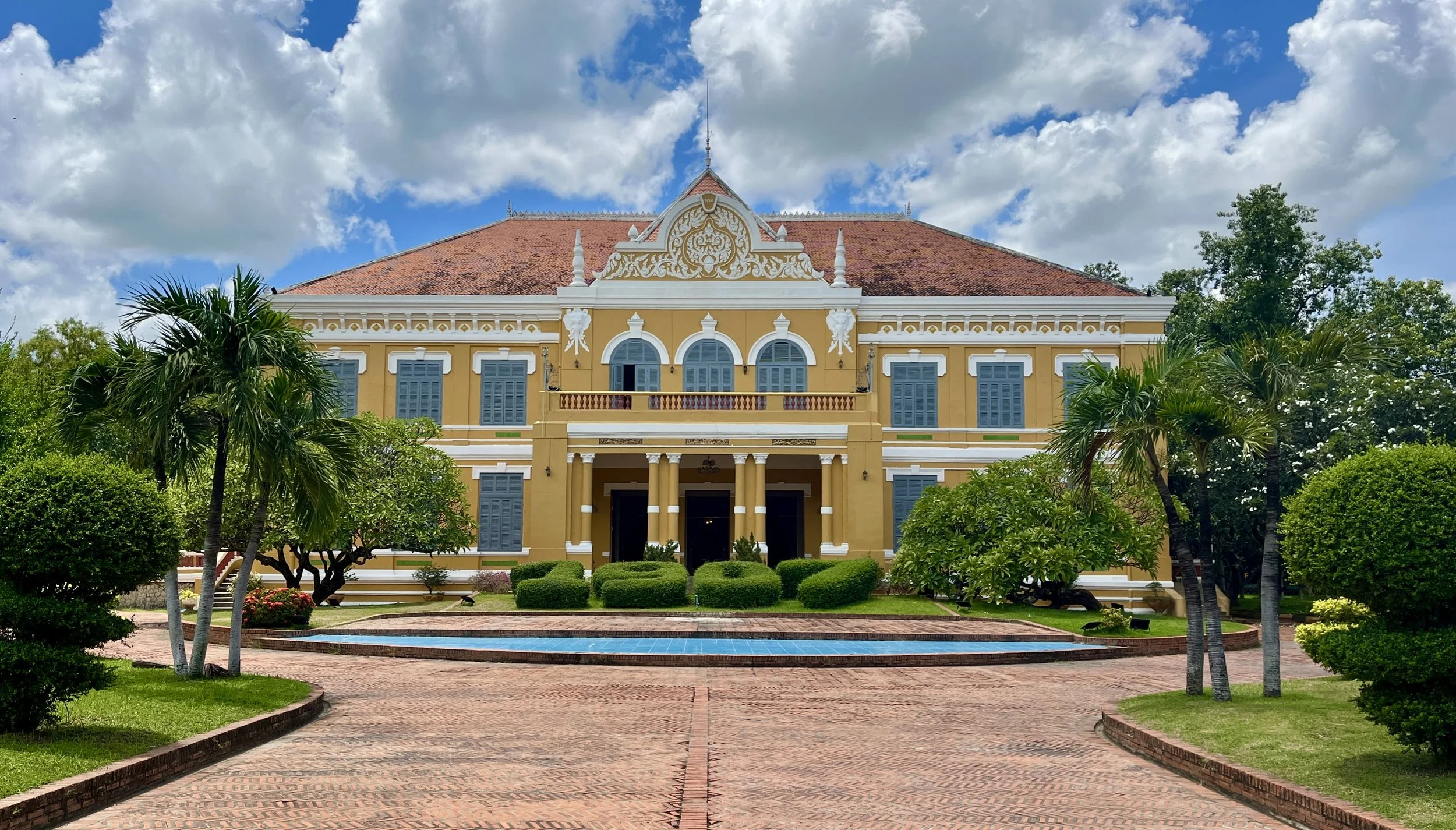
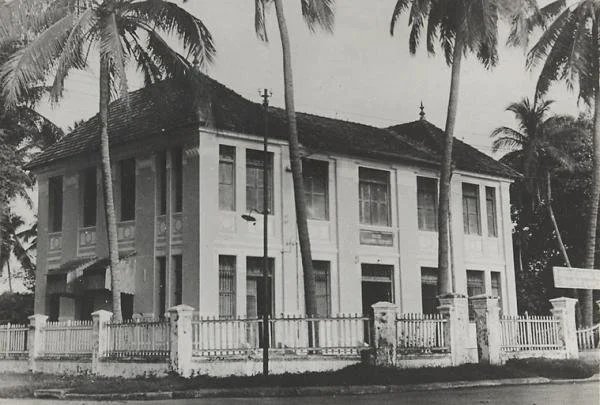
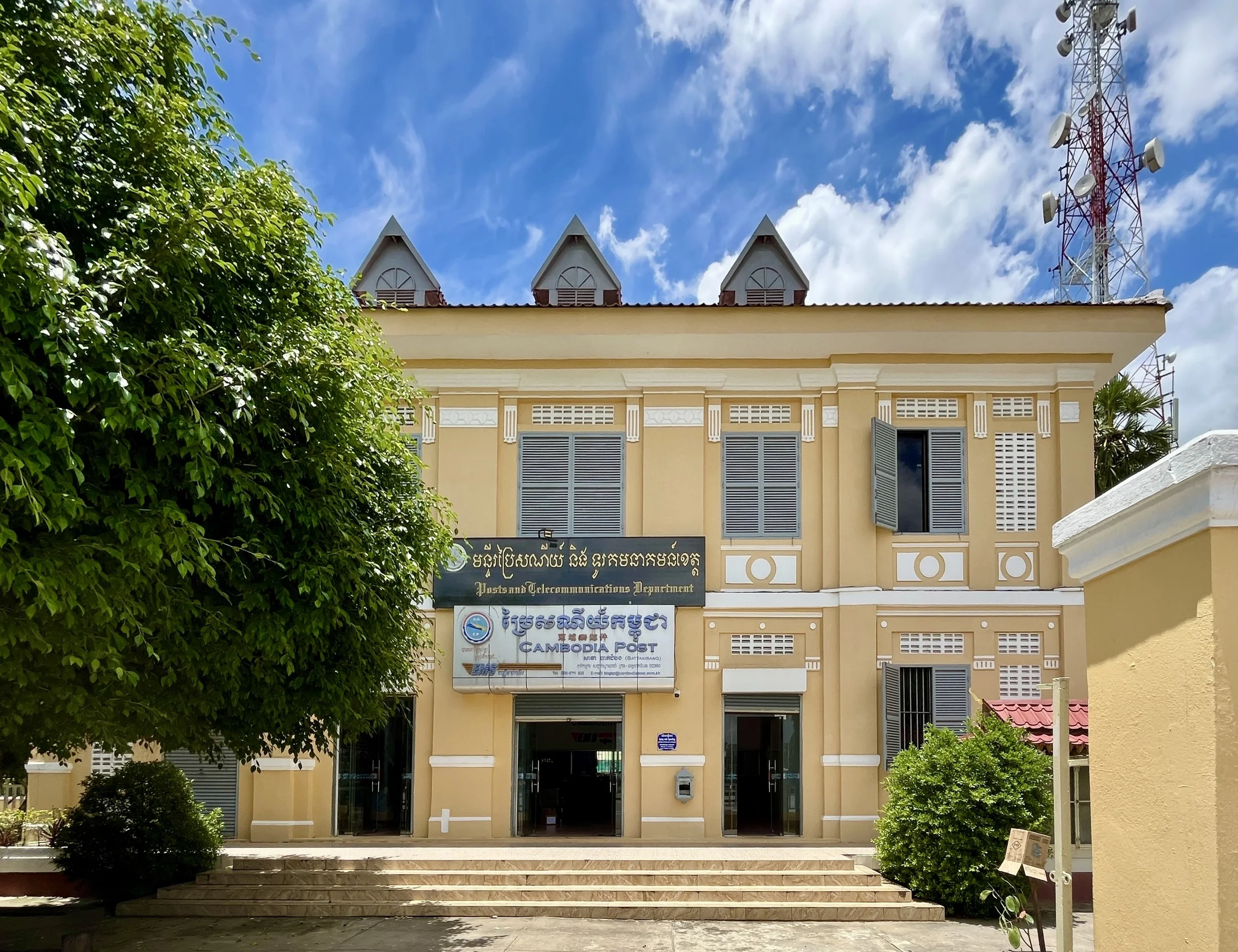
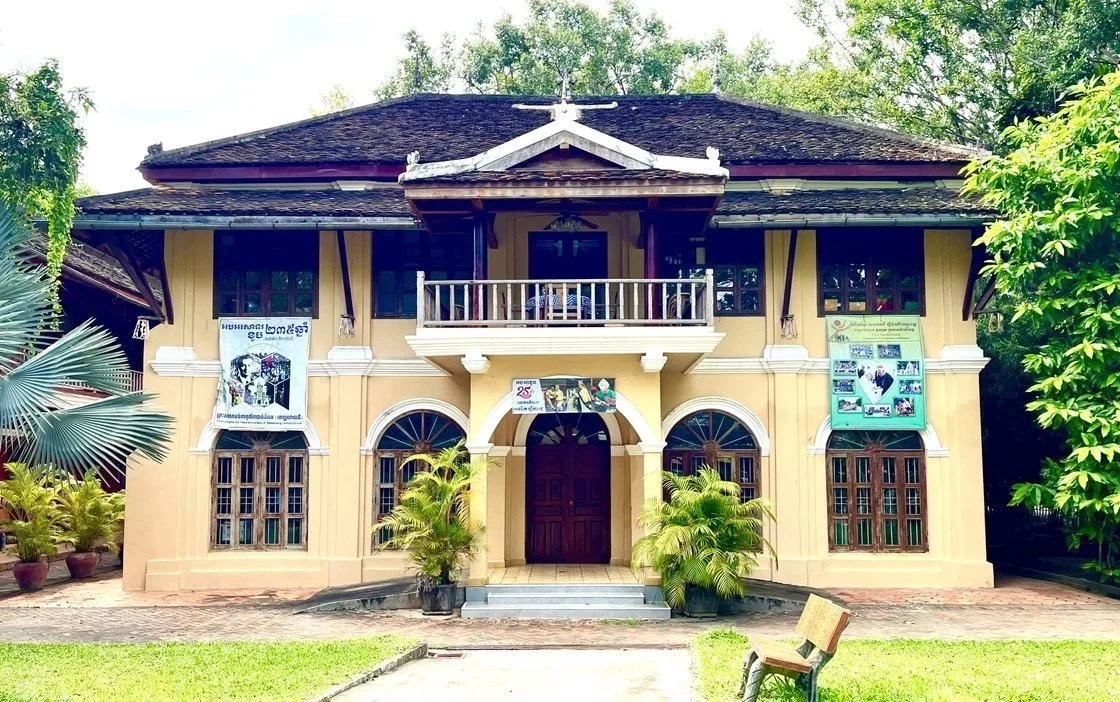
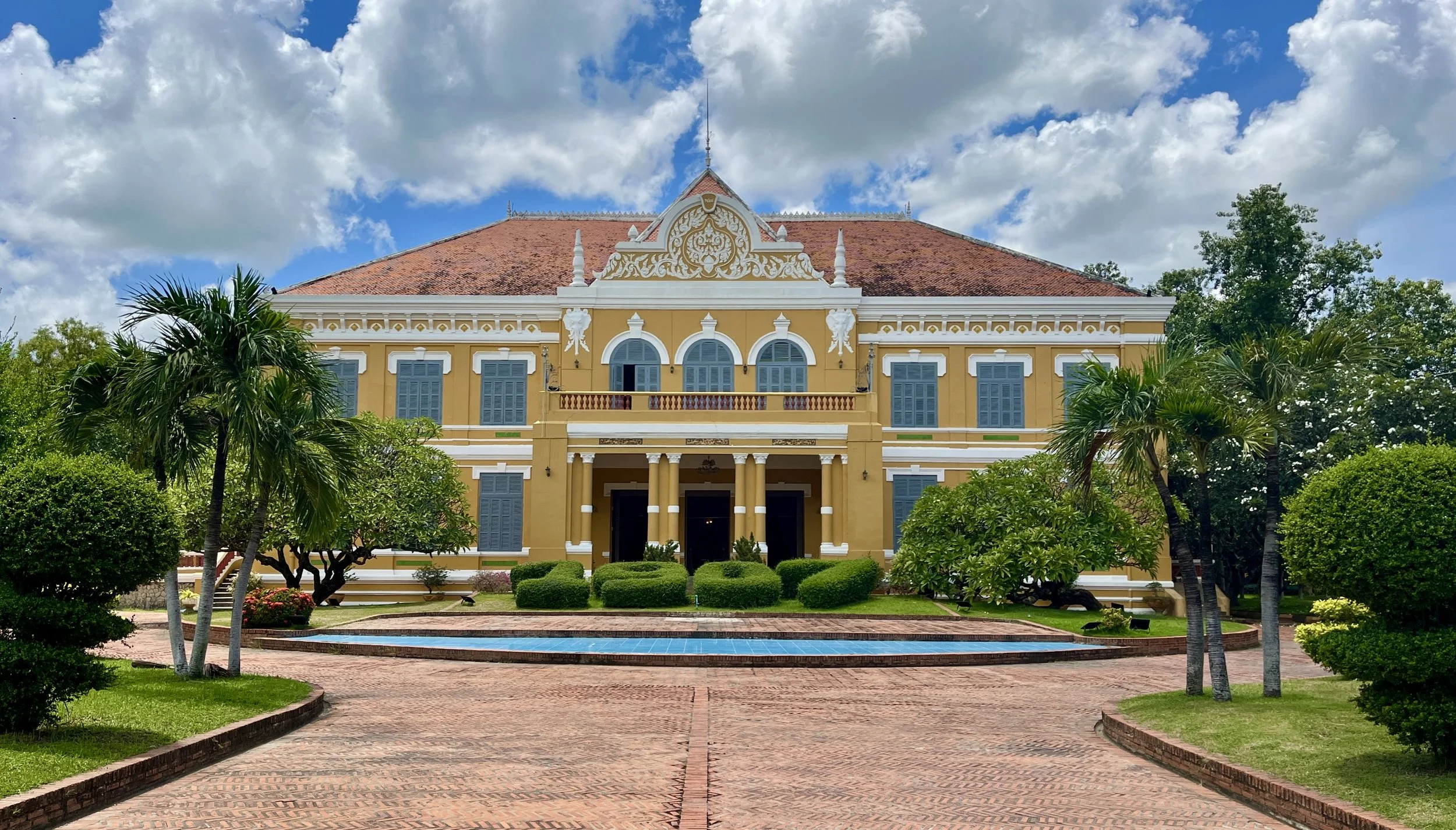
I really fell in love with the Battambang Provincial Museum. It’s a small museum, with one open continuous space holding fewer than 250 objects. The entrance fee is forgettable, the ticket seller is absolutely lovely, there are no tours or crowds.

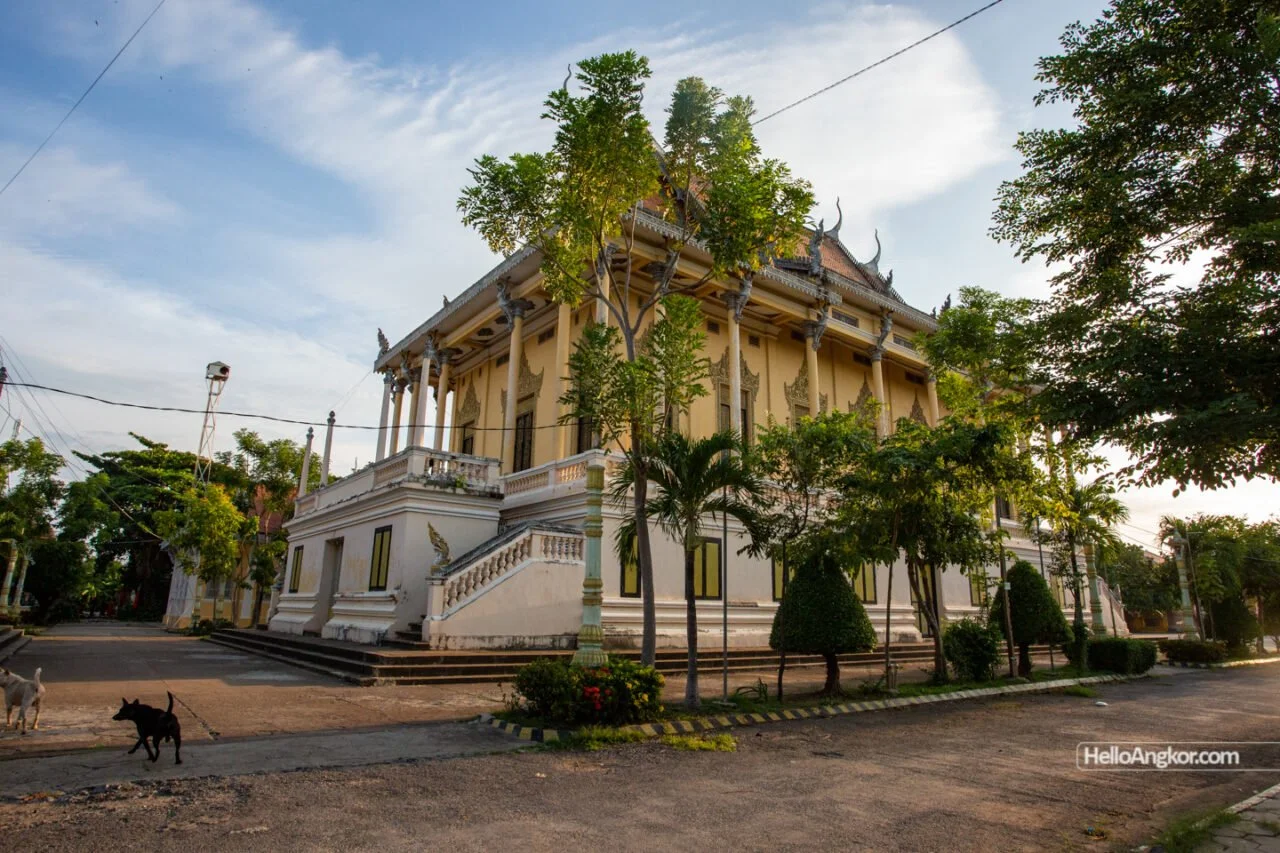
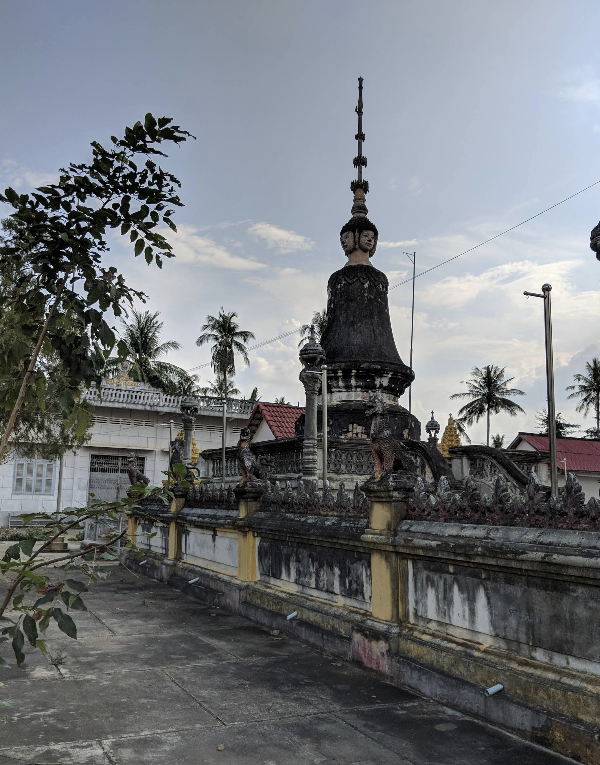
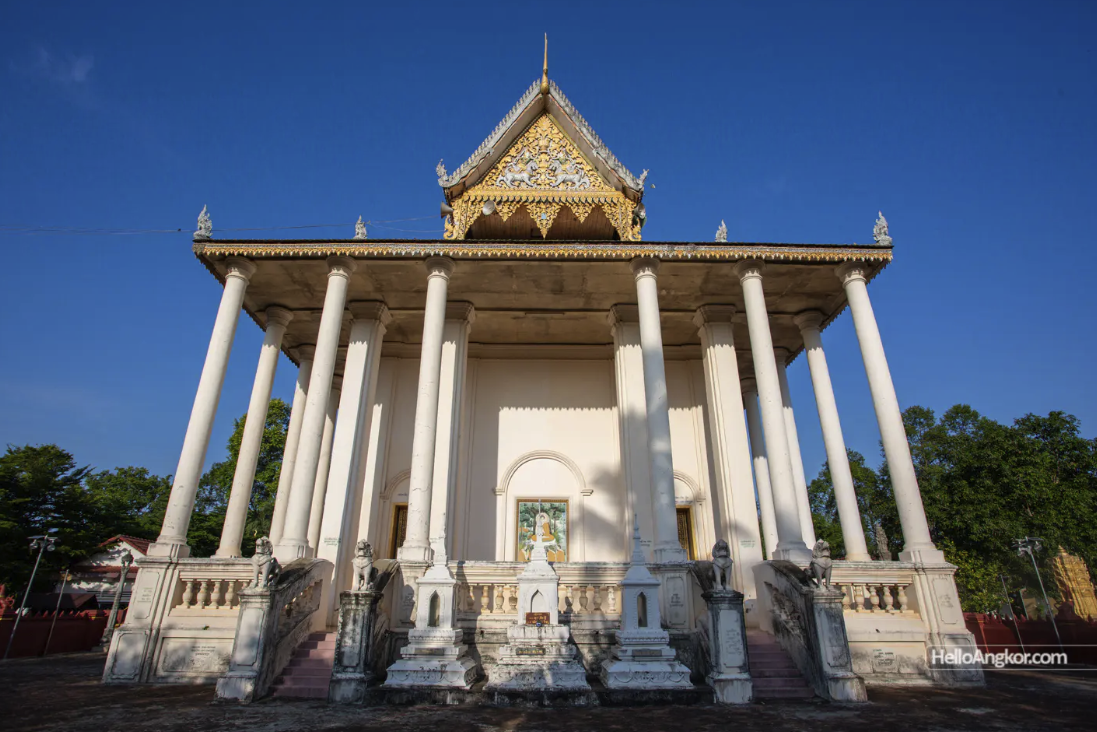
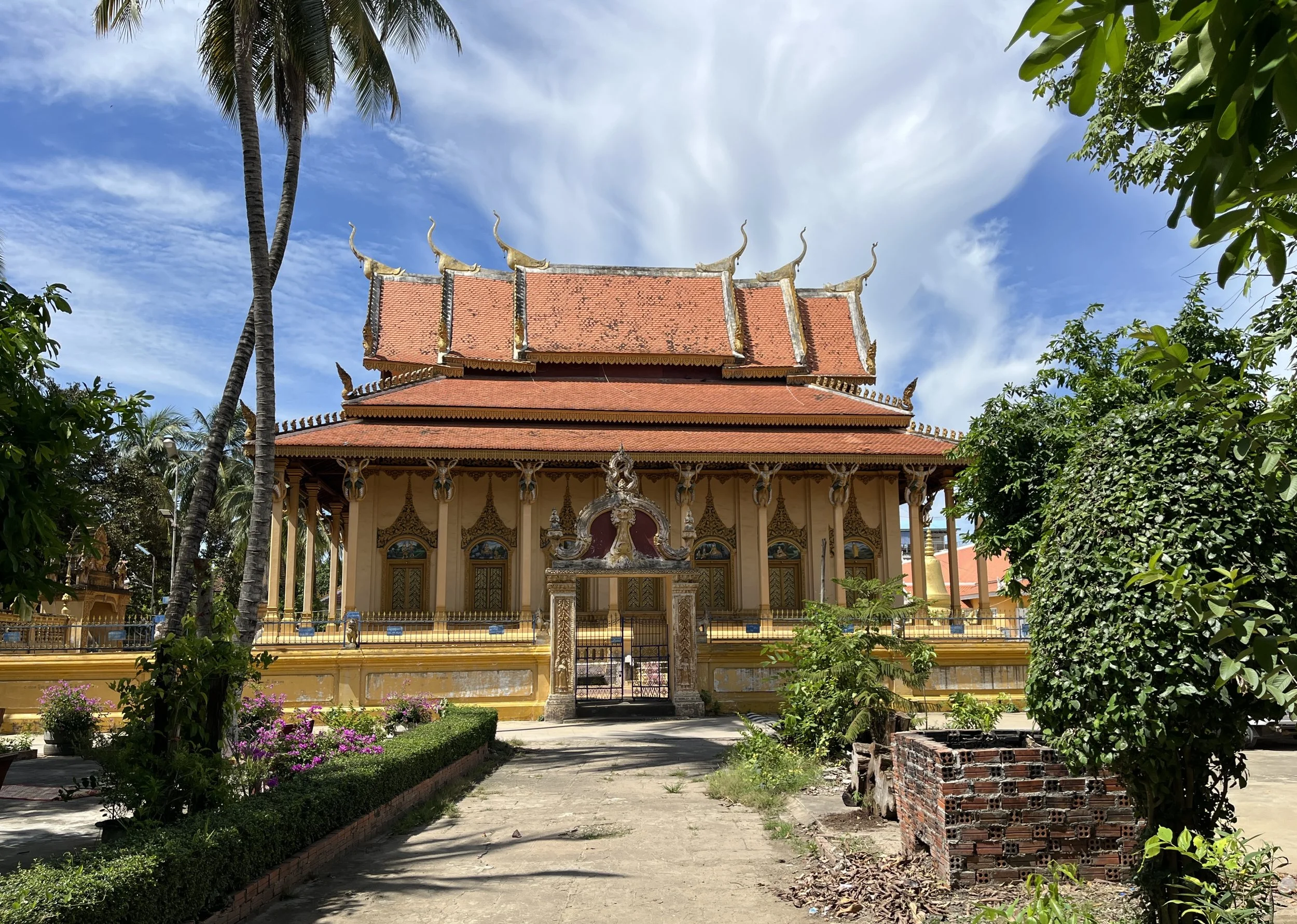
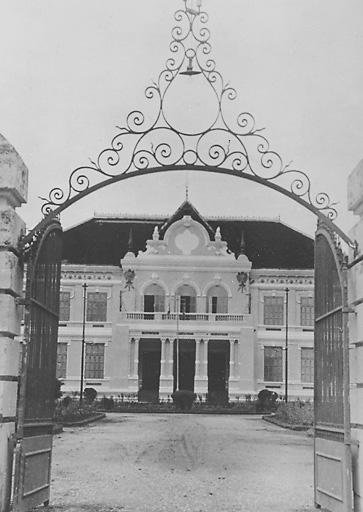
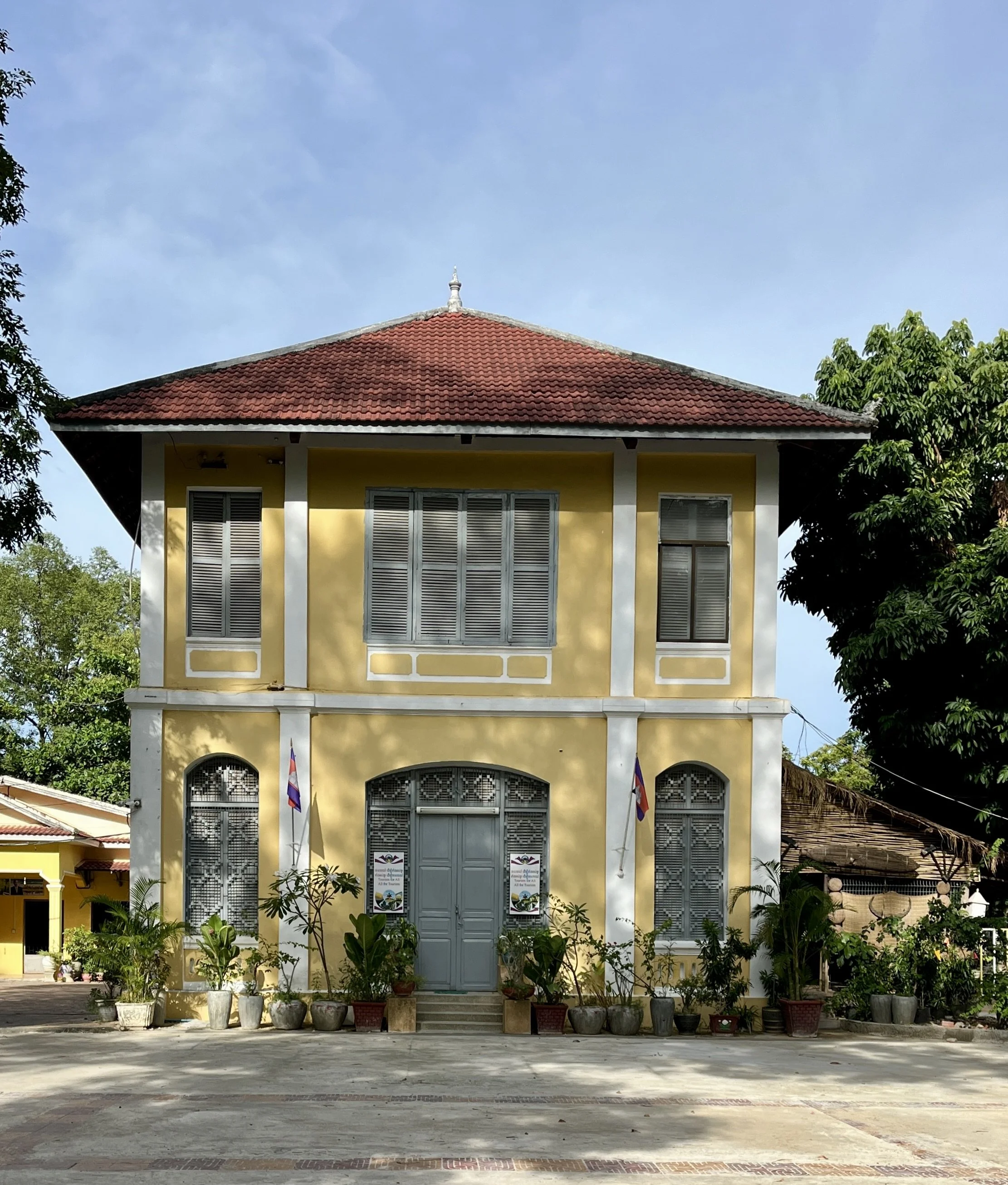
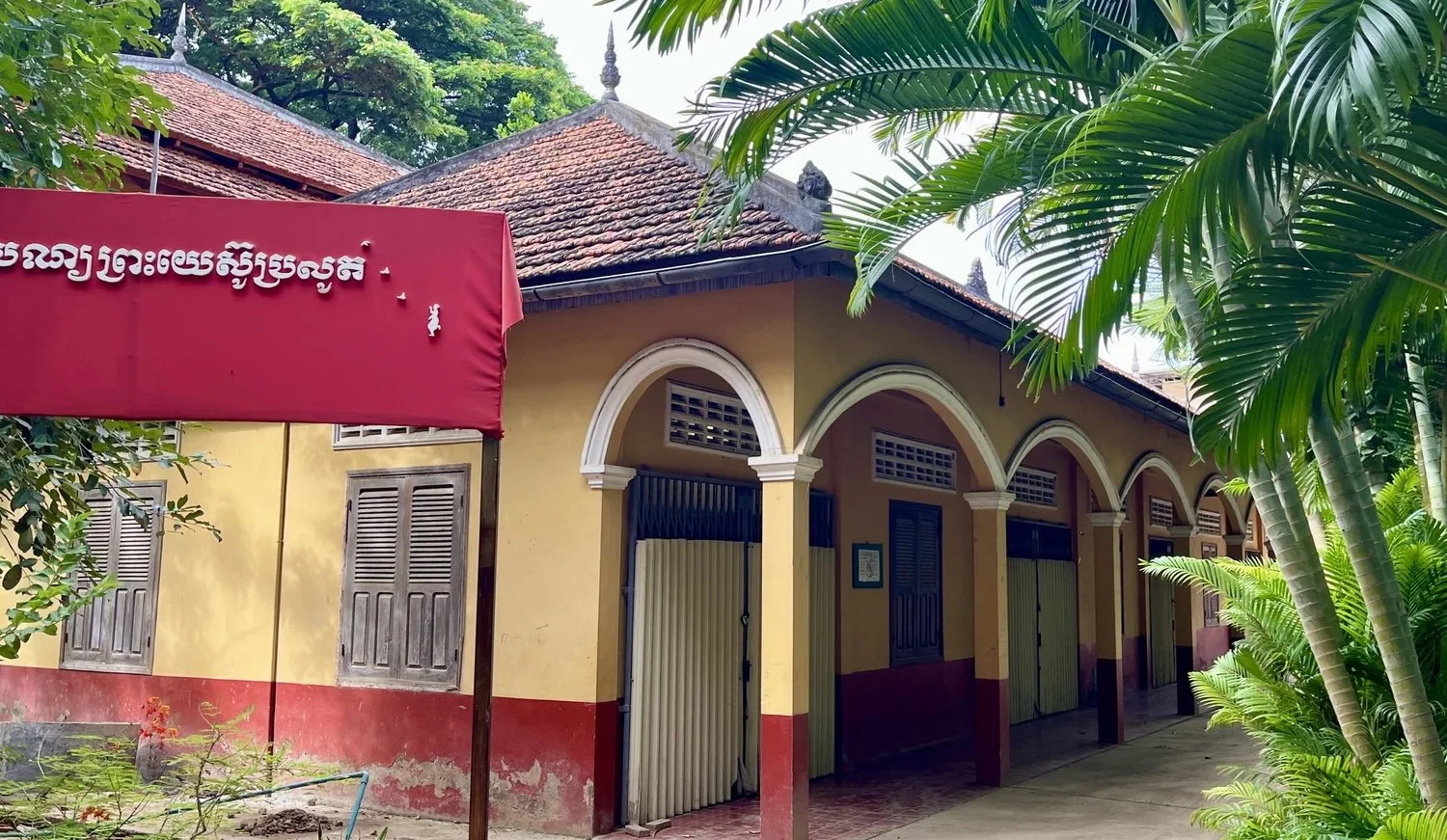
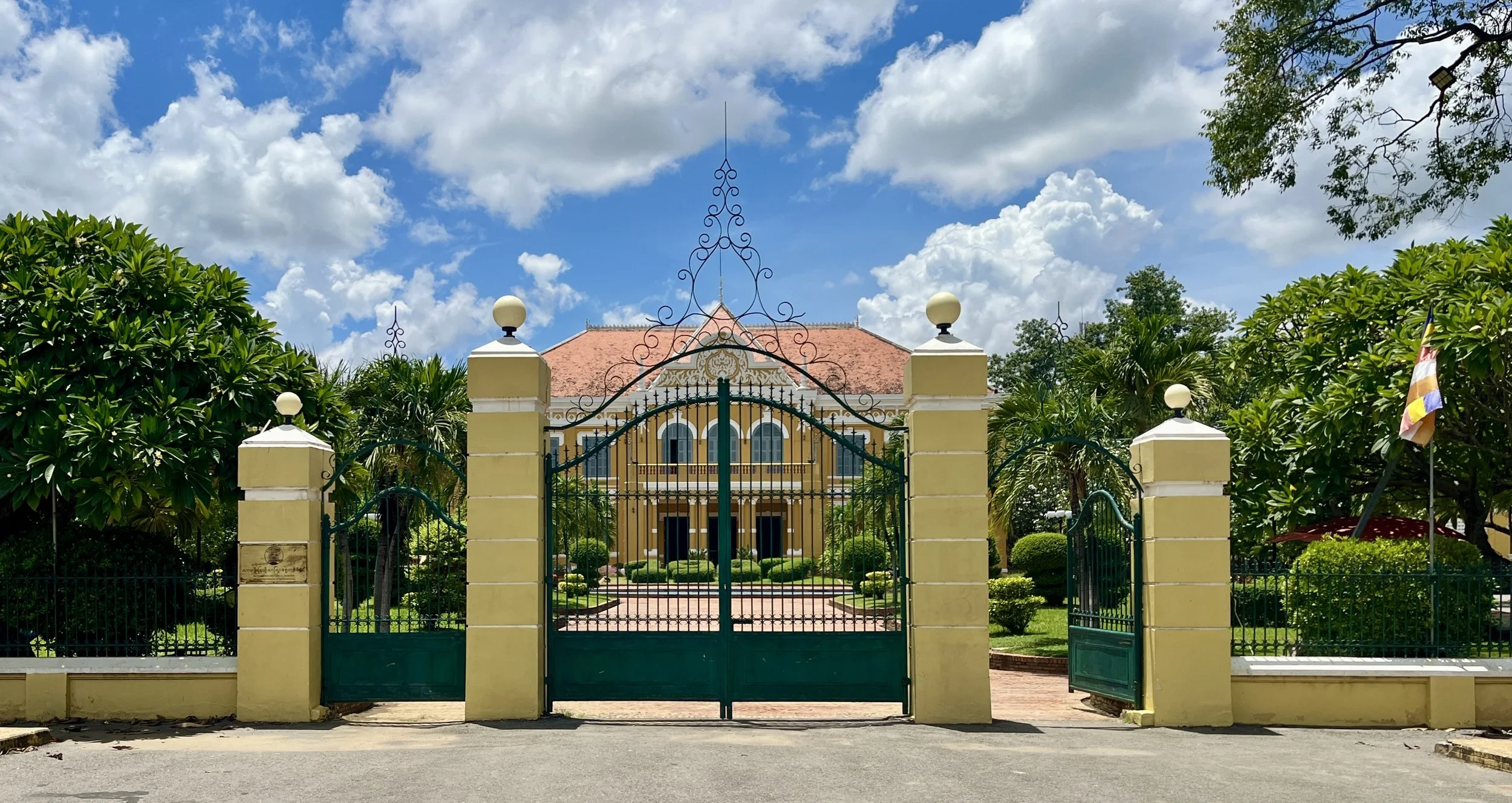
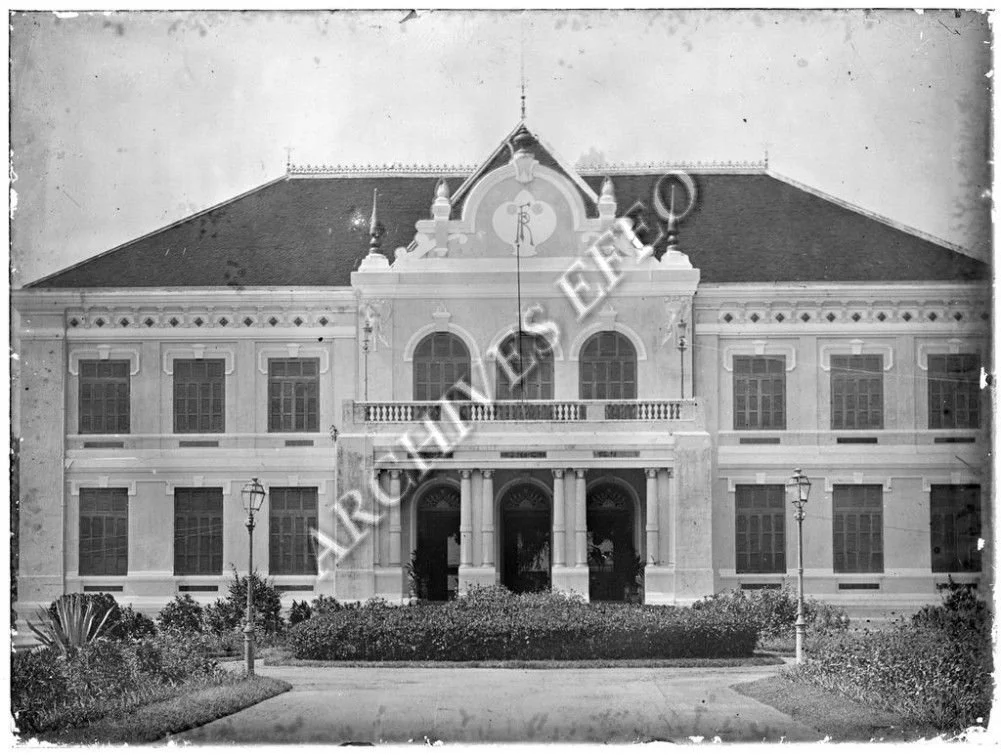
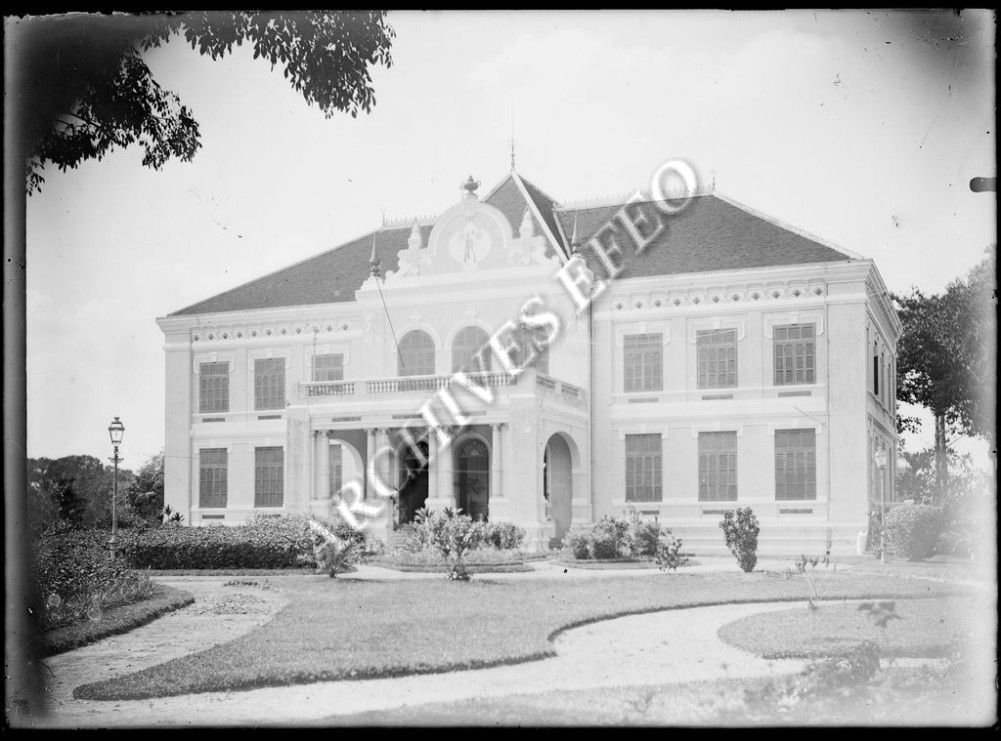
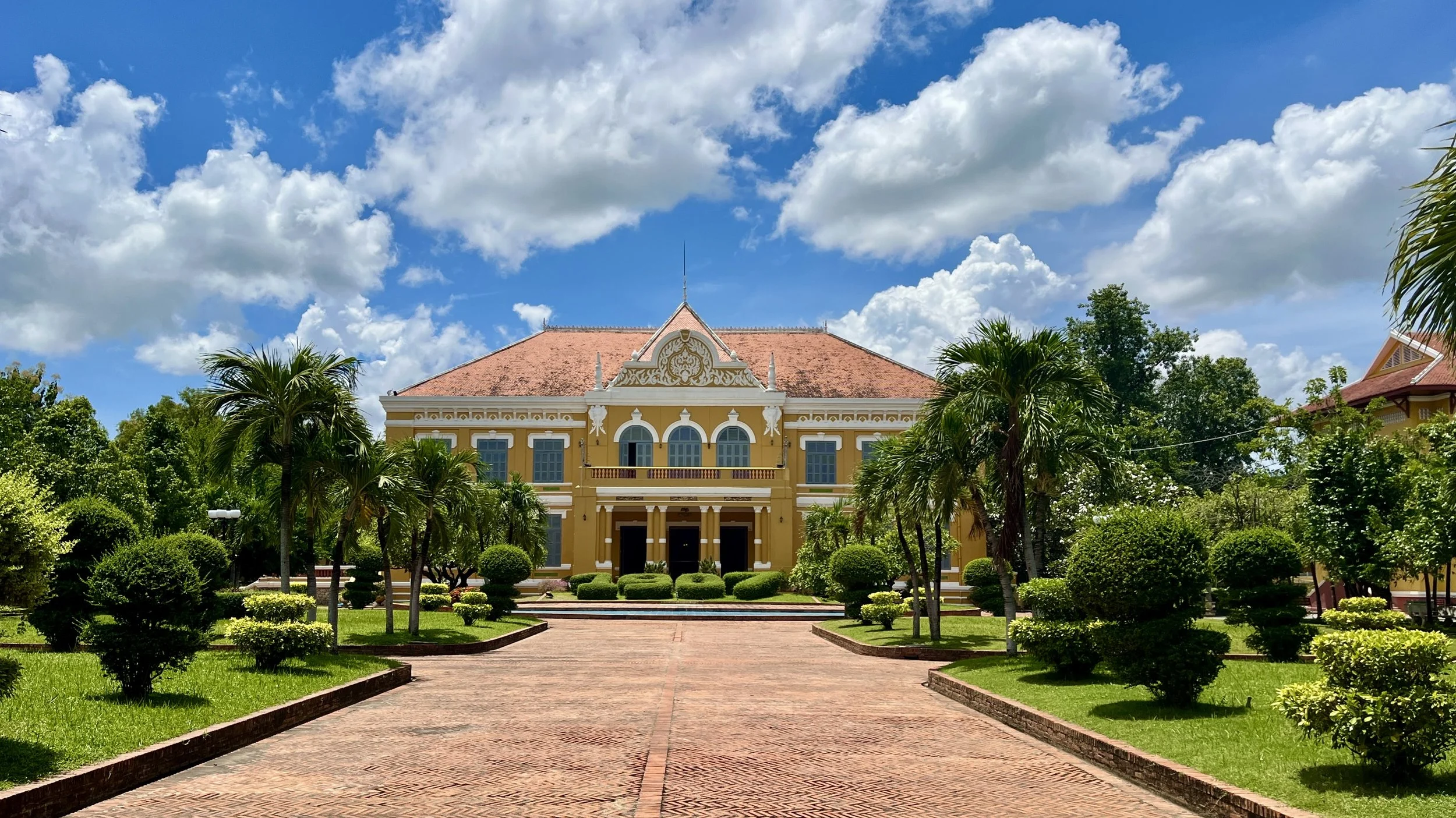
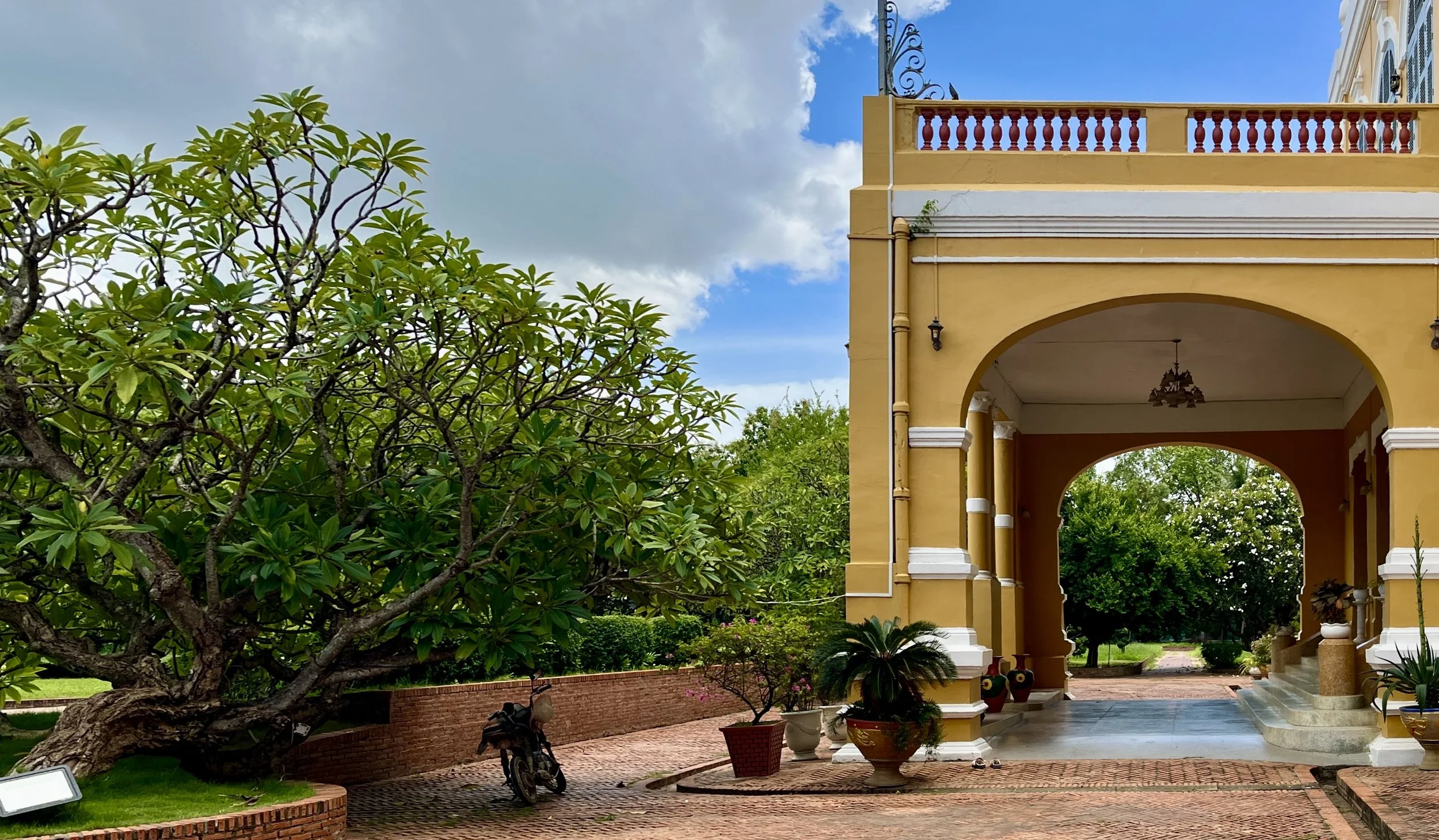
The front of the museum

One interesting aspect of the museum is its cagey autobiography!

This is the information provided about the museum, its history and displays, as written on the placard within the museum itself (grammar and spelling very lightly corrected):

Originally built in a T shape, Battambang Provincial Museum was inaugurated and opened its door to the public under the auspices of Preah Borom Ratanak Kaudh (Late King Norodom Sihanouk) in 1968. During the Pol Pot regime, from 1975 to 1979, the museum was closed, and was used as a prison leaving most of the collections piled up on the floor. Many important works of art were transferred to the National Museum in Phnom Penh for safety reasons, most of which were bronze objects.

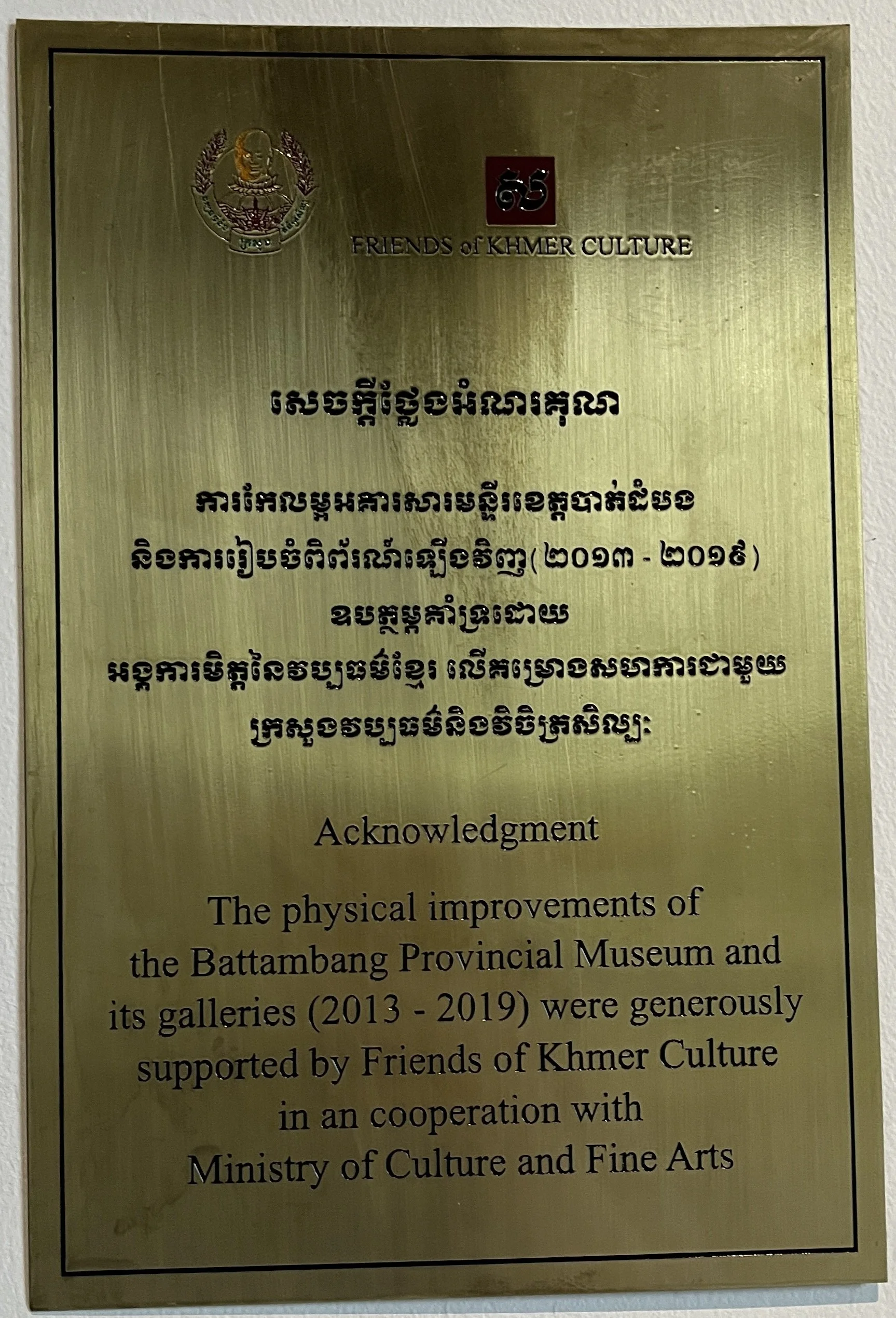
Since then until 1997, with financial support from Seila-Carere Programme, the Ministry of Culture and Fine Art restored some parts of the museum building and built a new storage area which is located right behind the museum. In 1999-2000, as the collections grew, the Royal Government of Cambodia decided to expand the museum space by extending display halls on both sides of the front gallery. Due to the condition of the museum building as well as the display arrangement, in 2015, the Ministry of Culture and Fine Arts with financial contribution from the Friends of Khmer Culture Inc., a non-profit cultural organization based in New York, began to renovate the building and re-organize the display as we see today.

The exhibition is organized with a new display concept which focuses on collections originating from Battambang province. The purpose of the exhibition aims to provide general evidence of the civilization in this region such as Laang Spean, one of the oldest prehistoric inhabitant sites in the country, and other archaeological remains dated from Angkorian period to the mid-20th century.

Through this exhibition, one could help to preserve, conserve and promote this invaluable cultural heritage. In addition, this exhibition also aims to restitute objects from this museum and the Wat Poveal museum (another museum on the eastern bank of the Sangker River, in front of Central market) that went missing during the war in 1970s.

There are 233 objects on display, most of which are sandstone. They are arranged in chronological order from the pre-historical period to the mid-20th century. Some sections of the museum display different themes according to mythology episodes of Brahmanism and Buddhism, the two main religions originating from India. And yet, there are a variety of stories carved on Buddhist steles. The display is organized in 5 different sections as following:

1. Outside of the museum

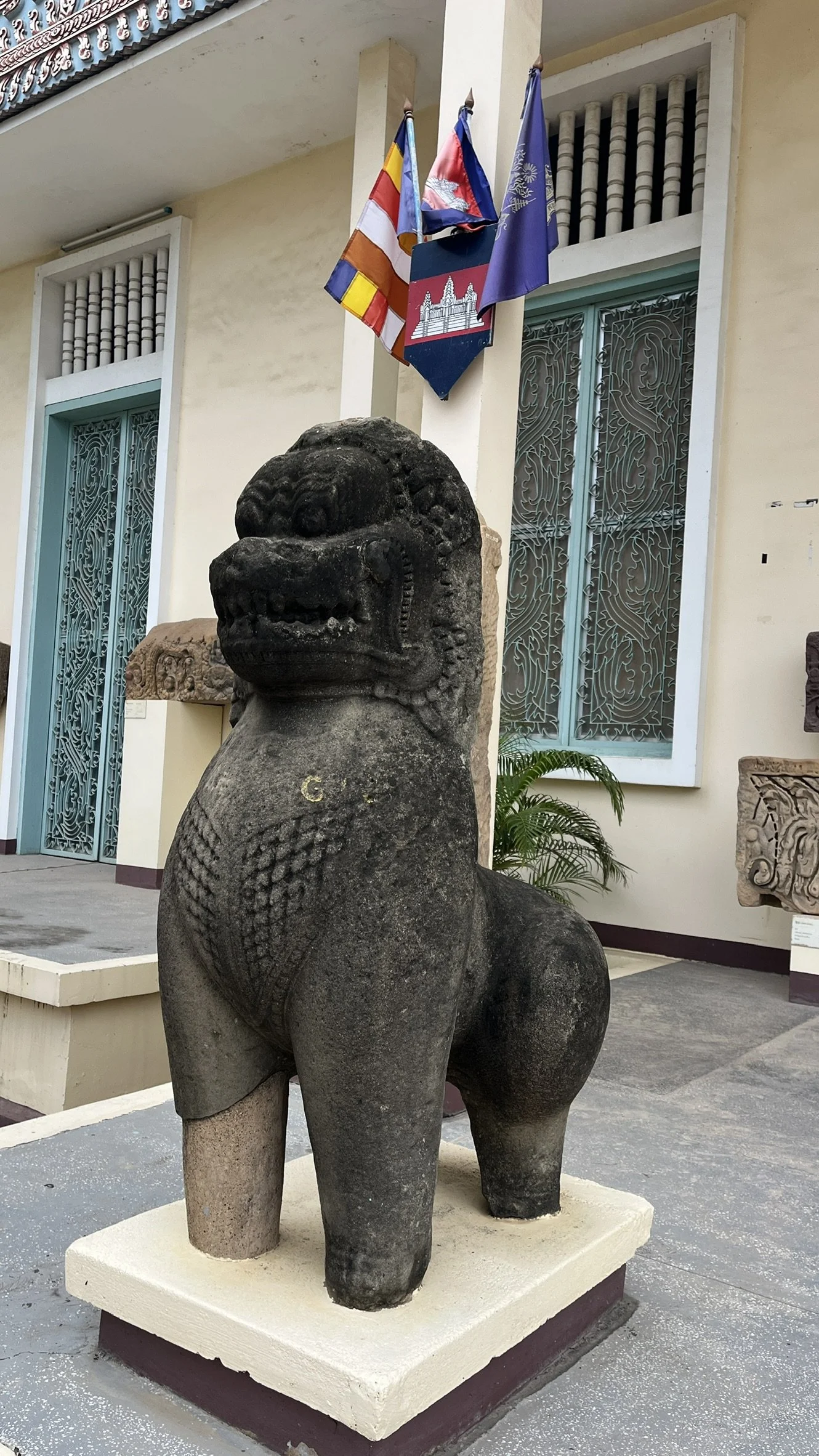
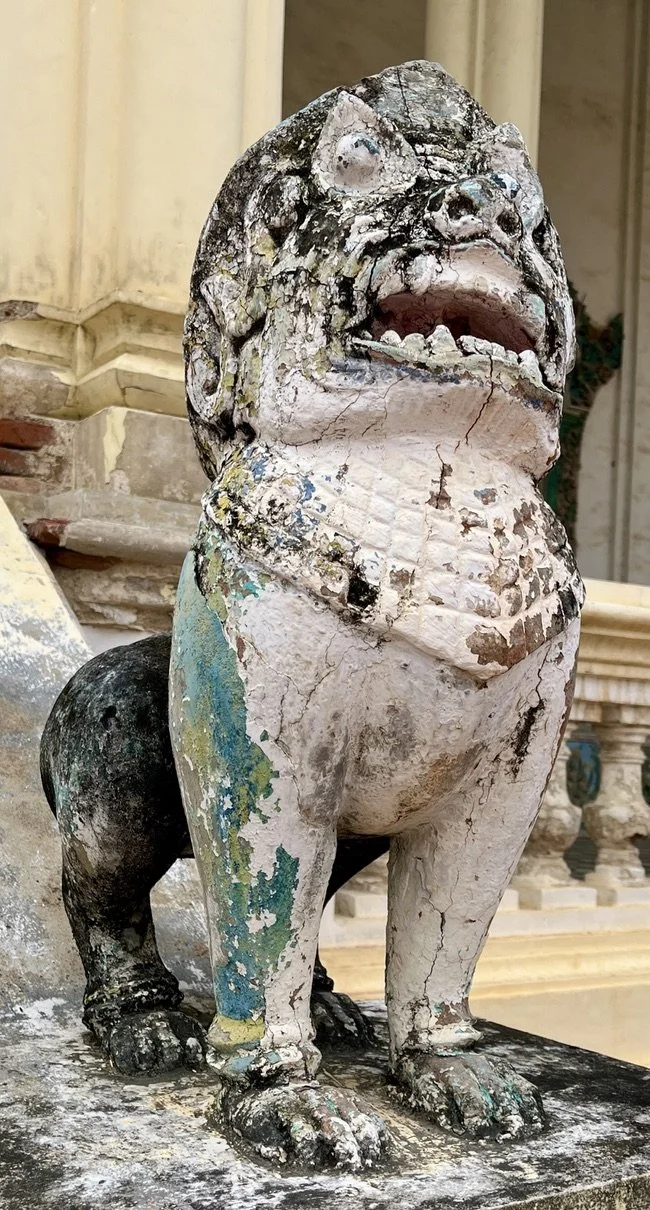
Right in front of the museum displays architectural elements such as lintels, guardians, and lions from the Angkorian period

2. The 1st room

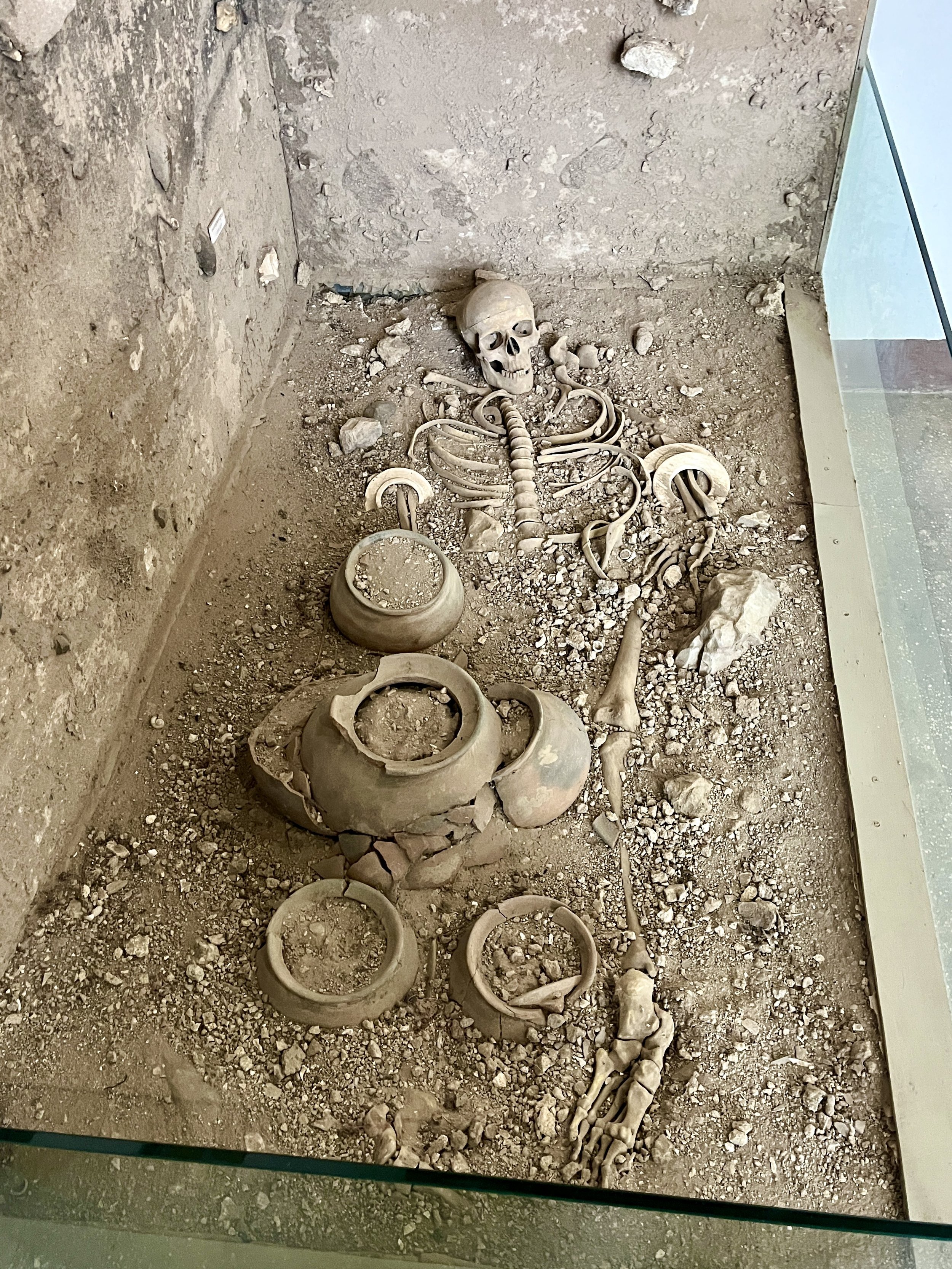
On the left-hand side displays a reconstruction of part of the cave and archaeological findings from the Laang Spean pre-historical site, and on the right-side displays pottery from pre-history, through the Angkorian period to the nineteenth century.

3. The 2nd room, on the left side

Displays different objects such as inscriptions, sculptures in Brahmanism including Yama, Ganesha, Krishna, Indra, Varuna etc., as well as some architectural elements. These artifacts can tell us about ancient society, politics and religions during the 10th to 12th century.

4. The 3rd room

The central part displays different types of objects from the two main religions, Brahmanism and Buddhism, and they are dated from the pre-Angkorian and Angkorian periods. The front part displays the three main gods of Brahmanism: Brahma at the front door as a welcome sculpture, Vishnu figures depicted in form of bas-relief on lintels and as sculpture, and Siva appearing in phallus and anthropomorphic forms. Back side of this gallery displays a group of Buddhist triad steles, consisting of three main deities: Prajna Paramita, Buddha and Lokesvara.

5. The 4th room on the right side

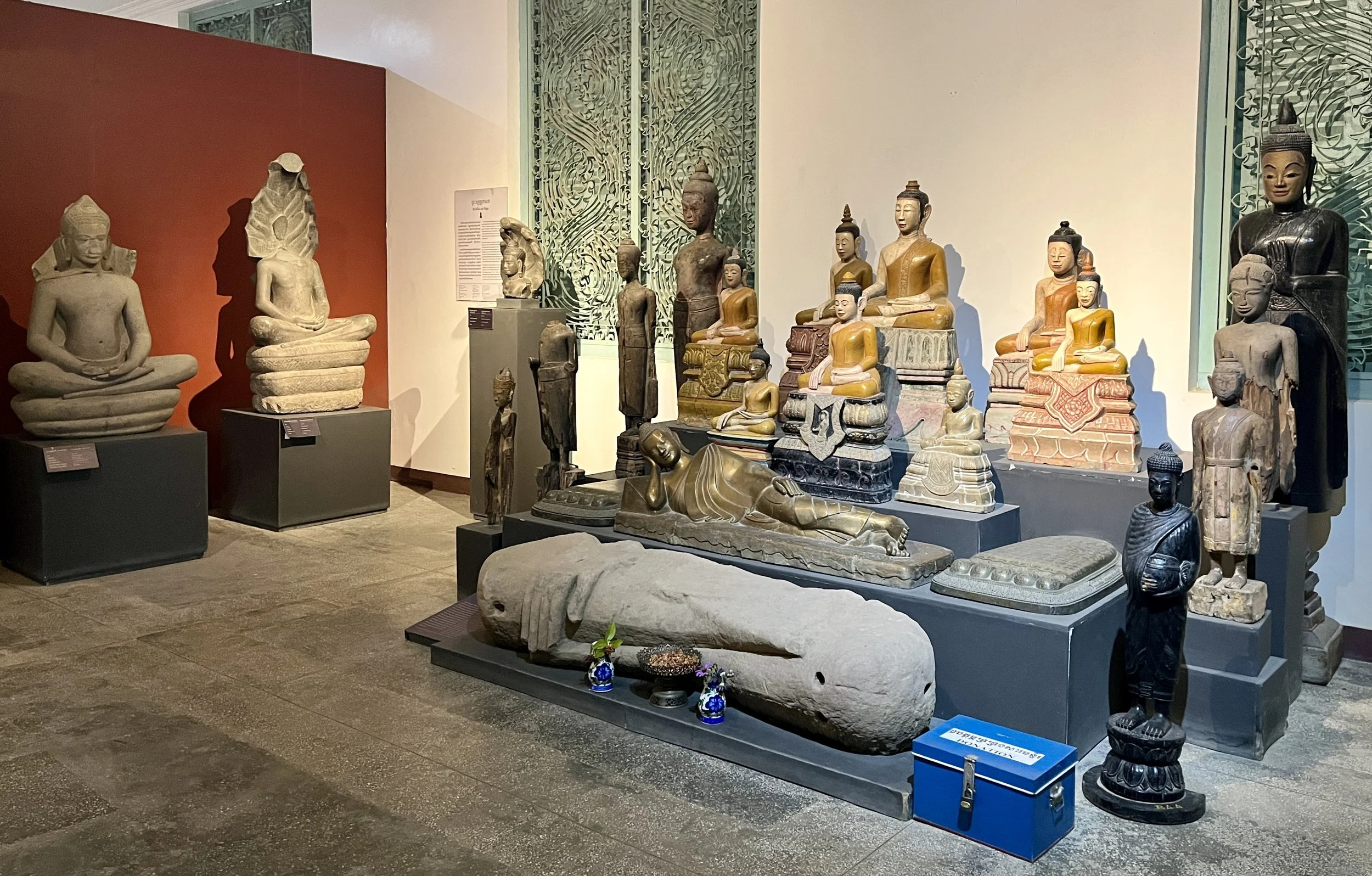
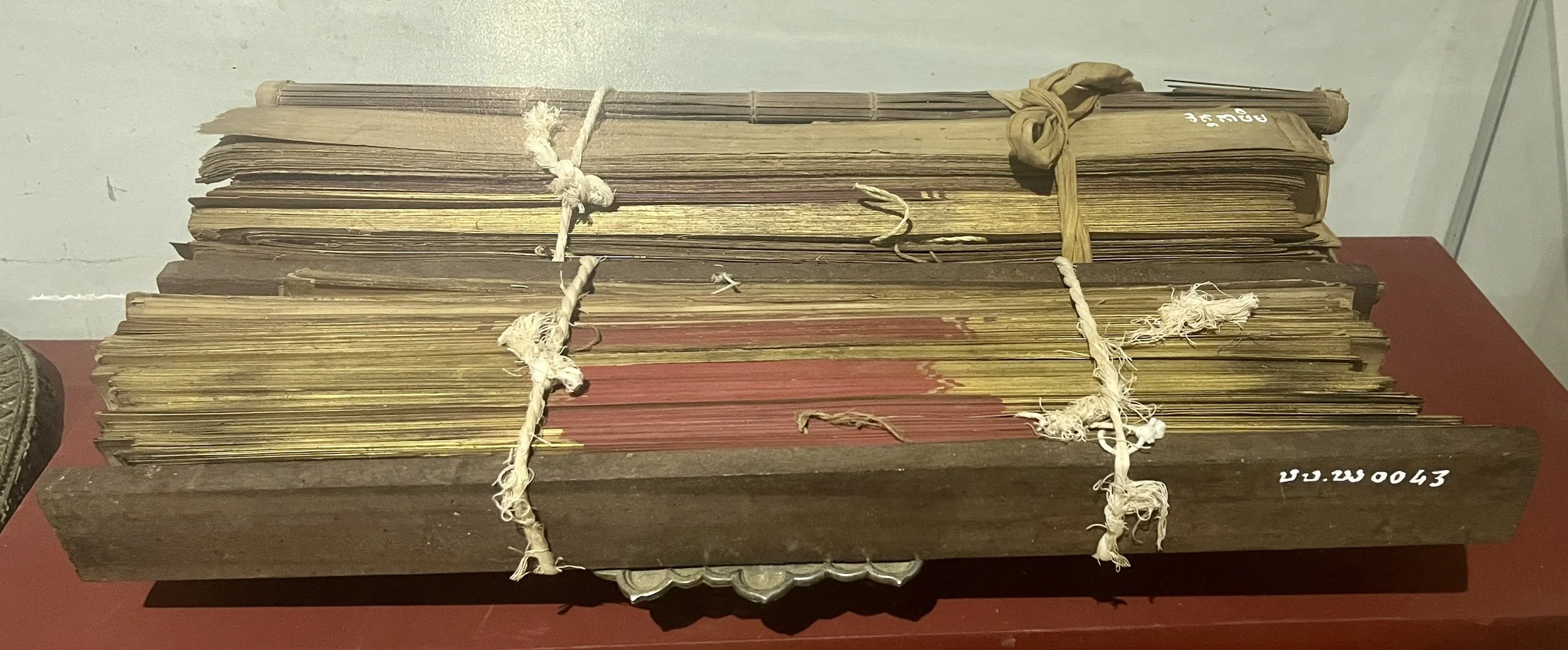
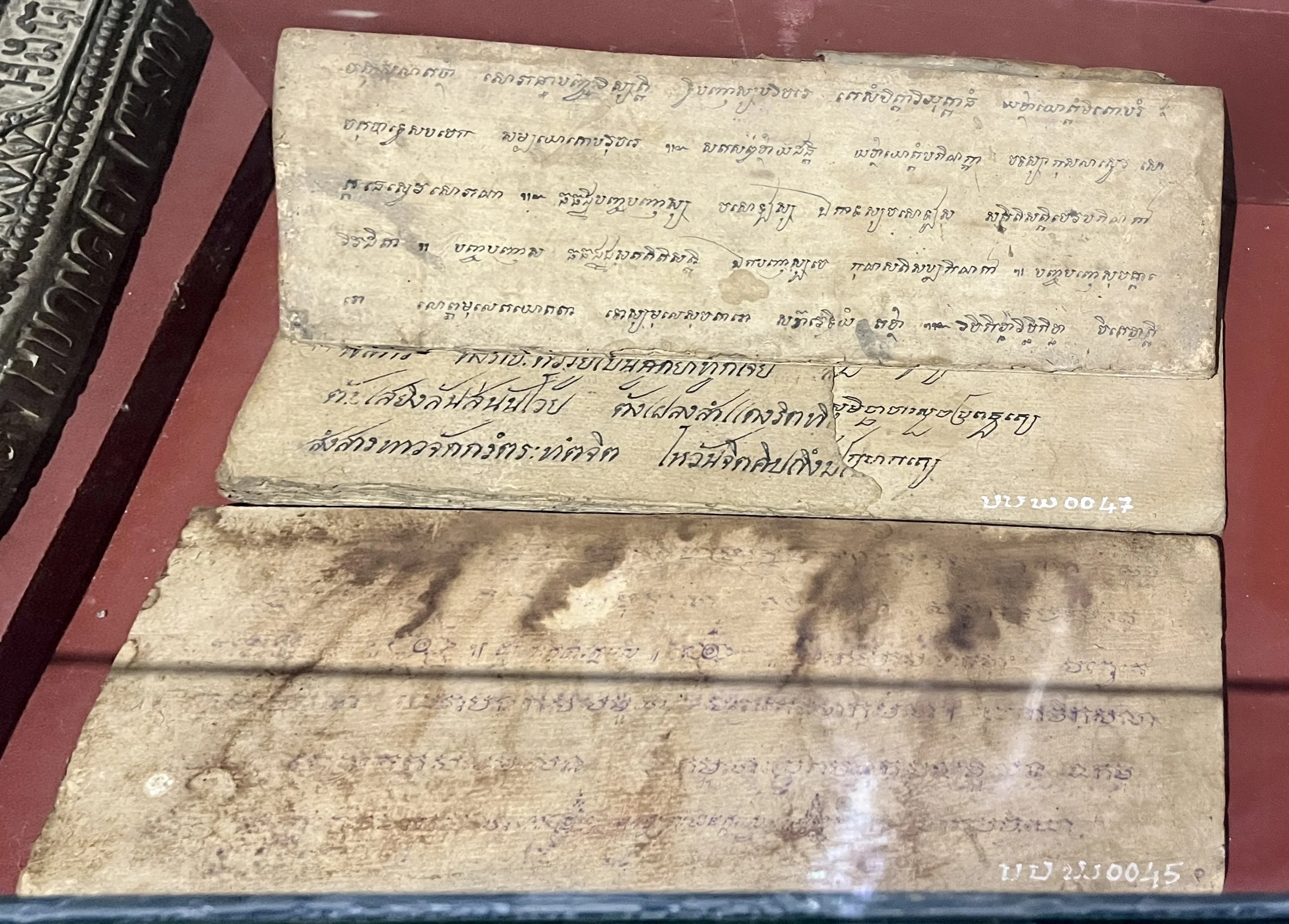
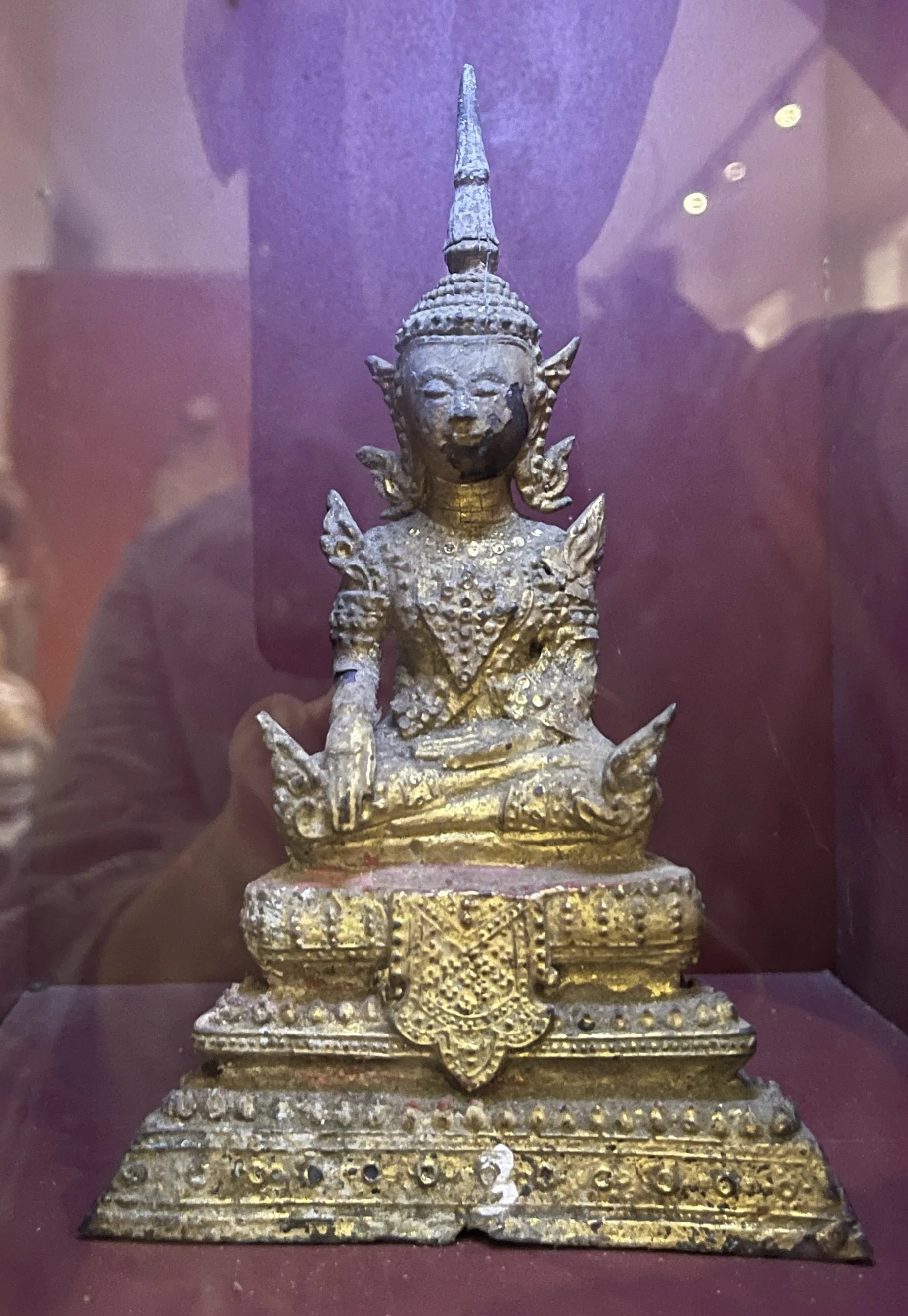
Continues from the back side of central room, this gallery displays deities from Mahayana Buddhism in the 13th century during the reign of King Jayavarman VII, along with God and Demons' heads representing the scene of the churning ocean of milk. The last part of this section displays a mixture of Buddha statues which are made of different materials such as stone, metal and wood from different periods, and Buddhist scriptures. This section represents a Buddhist monastery where Buddhist followers come to visit and pray.

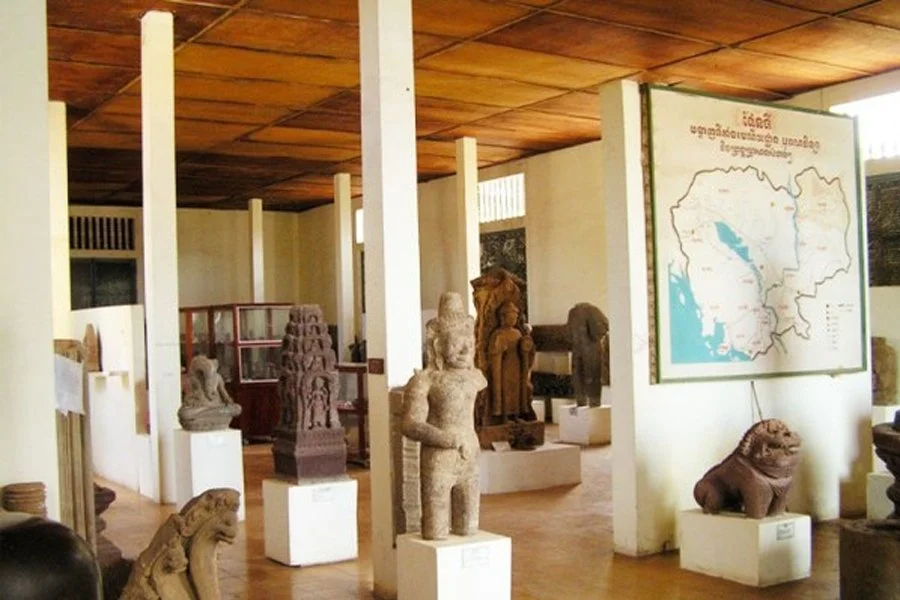
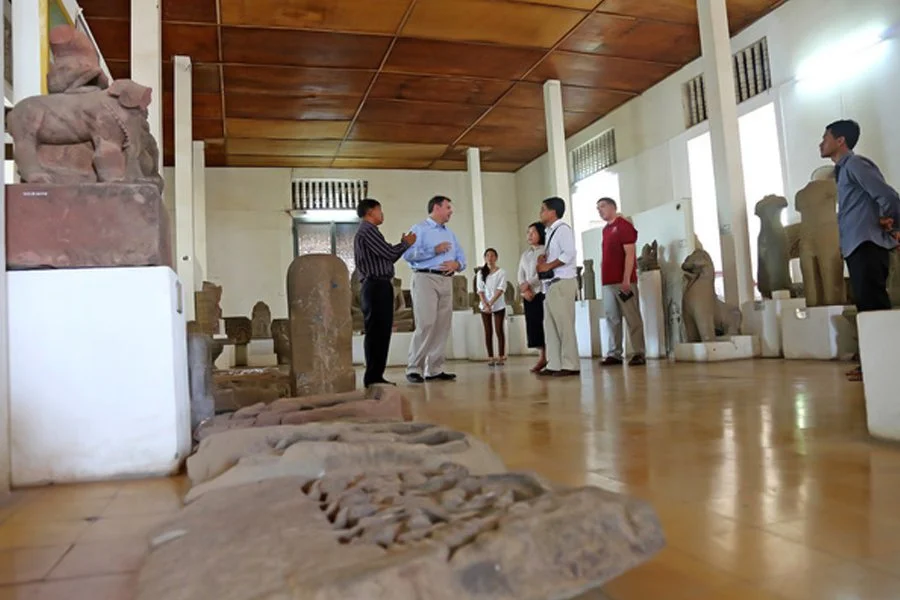
early 2010s, before the 2015 renovation

early 2010s, before the 2015 renovation

So what’s missing?

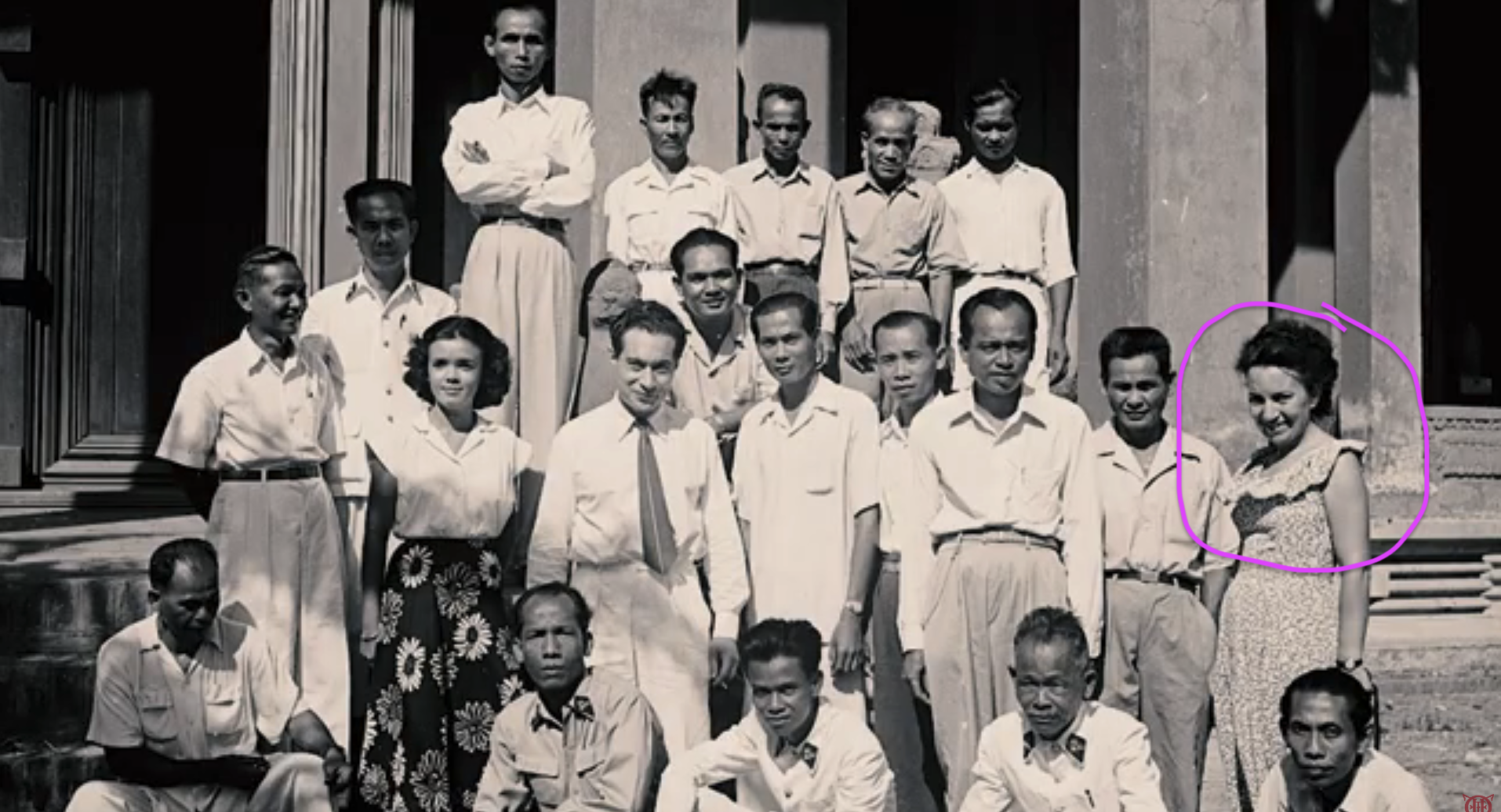
First, they’ve totally erased the role of the French– in particular the eminent French scholar Madeleine Giteau– from the museum’s history.

EFEO video about Madeleine Giteau’s work and legacy

Madeleine Giteau with the team at the National Museum in Phnom Penh

Giteau deserves a blog post of her own (and I hope I eventually get around to it), but to summarize:

  • She was an EFEO historian, and the last French curator of the National Museum in Phnom Penh, from 1956 to1966.

  • She wrote seminal works on history and art history in the region: her 1956 History of Cambodia, for example, is still used as a textbook today, as is her 1965 Khmer Sculpture, 1974 History of Angkor, 1975 Iconography of Post-Angkorian Cambodia, etc. Further, she was engaged with the subject for over 50 years; her first paper with the EFEO was published in 1950, and her final book, (which she published at 82 years old) is the equally important 2001 Art and Archaeology of Laos.

  • She spent over 20 years in Cambodia, prior to and following the Khmer Rouge Era. She was undeniably responsible for the establishment of the Battambang Museum, and arguably the most impactful individual in its history. She did everything including: collaborating on the architecture and supervising construction (which began in1963); assembling the collection and meticulously archiving photographs and notes on each piece; training local Cambodian curators and handing it over to their management in 1966; returning during and after the Khmer Rouge era (throughout the 80s and 90s), to record what had been moved or gone missing; and supervising the 2000 reopening.

  • Born in 1918 and passing away in 2005, she was the generational link between the original French colonial specialists/explorers and the present system, having begun her career working with Henri Parmentier; continued during the unlivable KR years as a lecturer in SEA art and history at the Sorbonne; and ended as an esteemed collaborator of the Royal Archaeological Faculty of Cambodia.

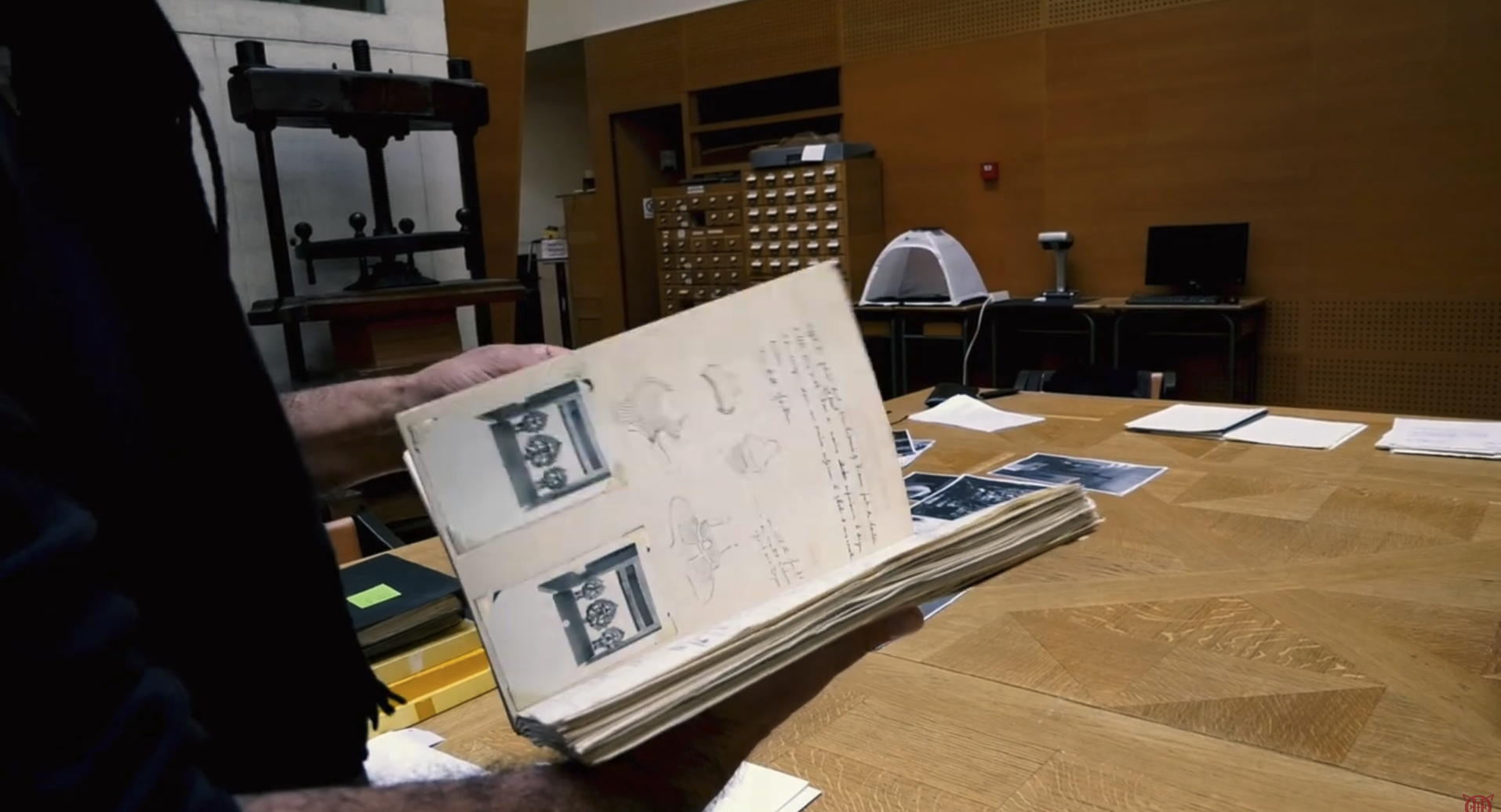
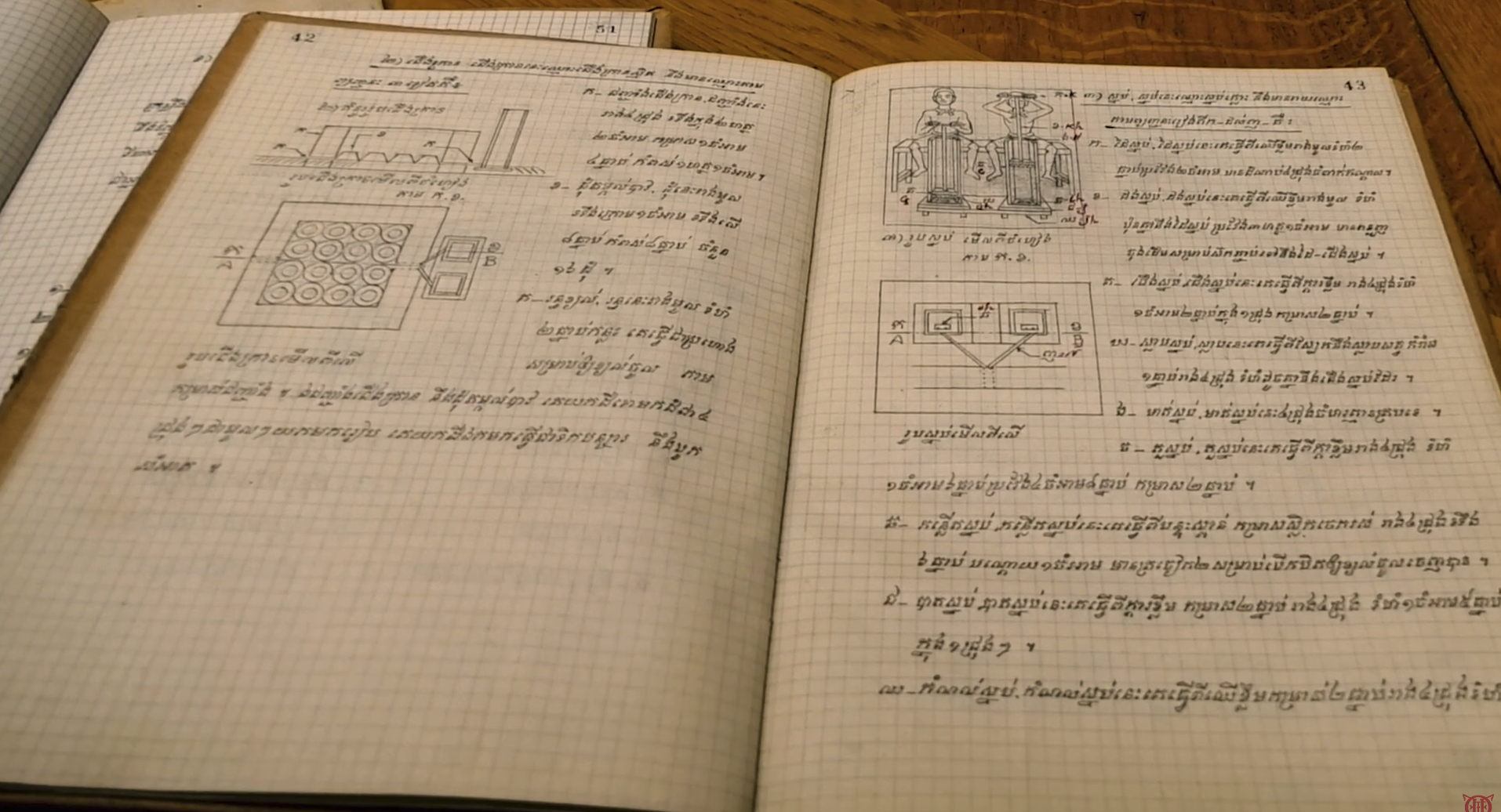
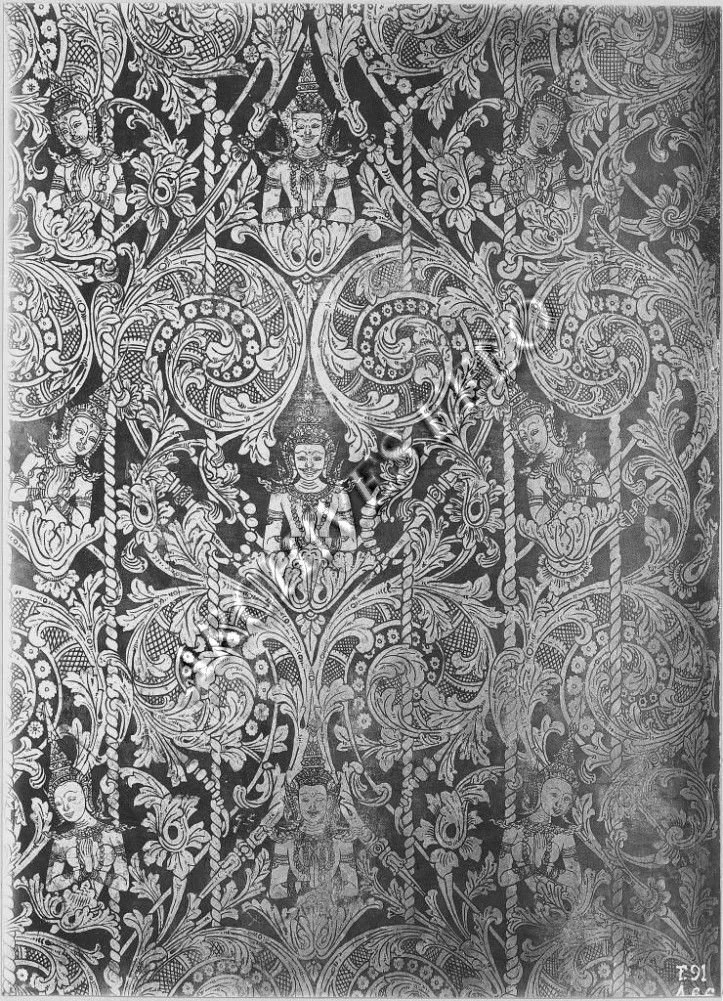
One of Giteau’s notebooks detailing the collections in Phnom Penh and Battambang, held at EFEO

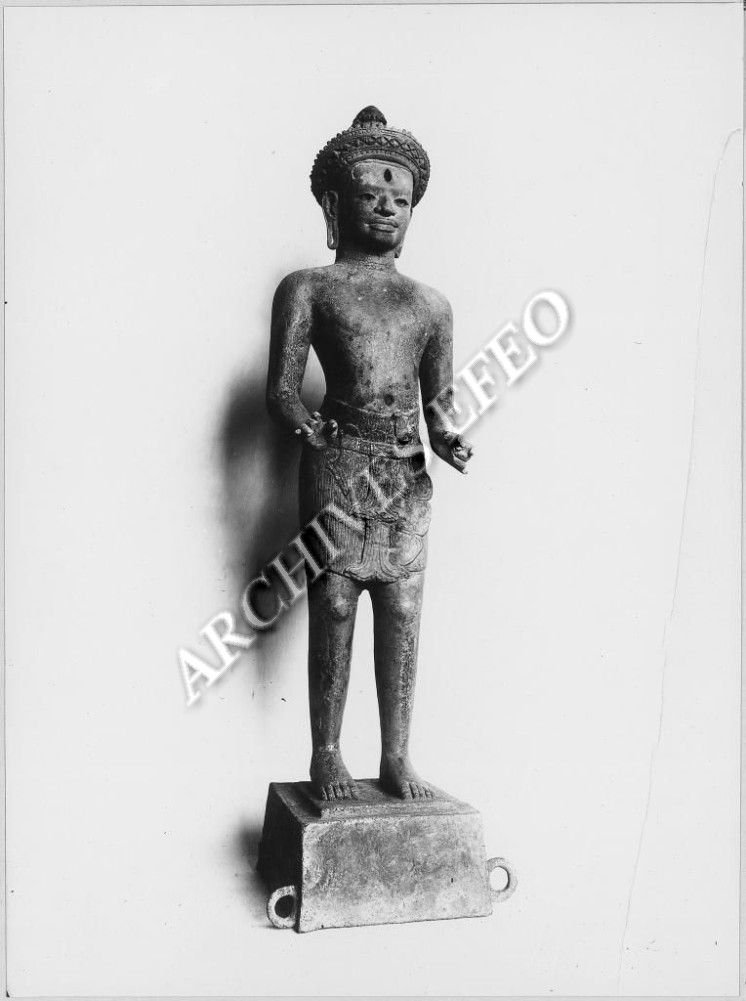
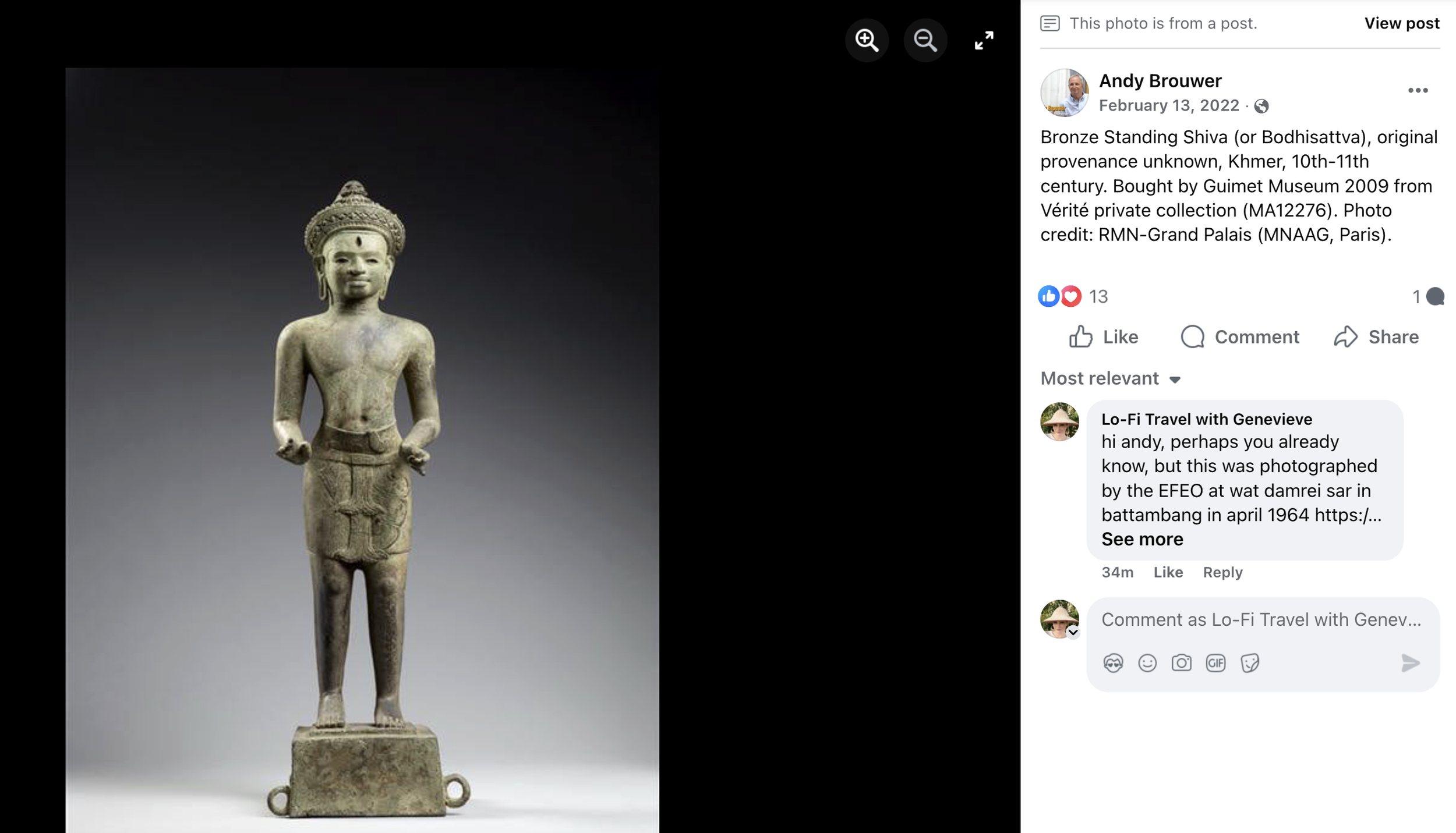
In the Giteau era, the original siting of artifacts was carefully and scientifically recorded wherever possible. This obviously disappeared later on.

Second, they’ve omitted the thievery the collection suffered, likely at the hands of Douglas Latchford.

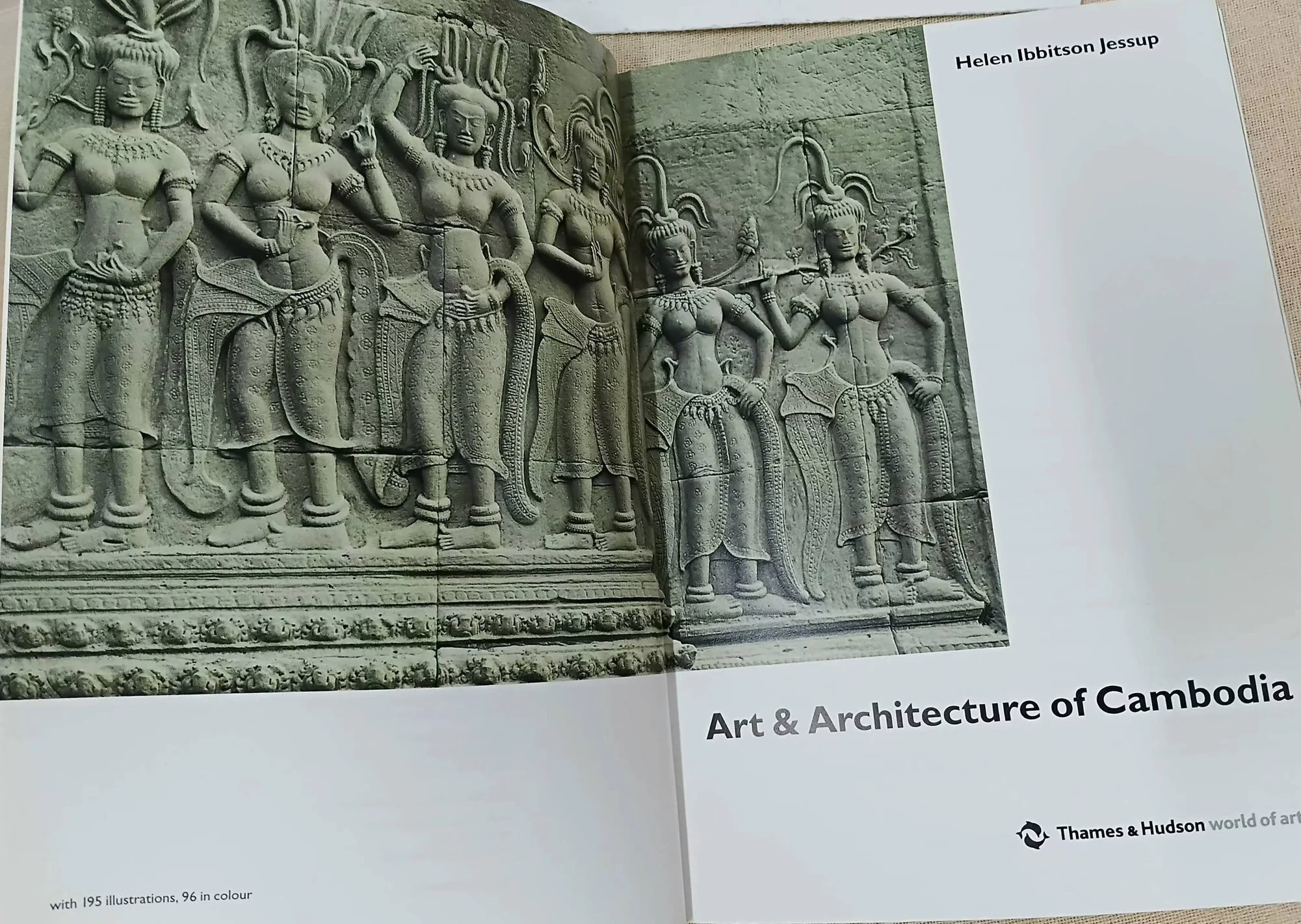
The aforementioned Friends of Khmer Culture Inc. (founded by Helen Ibbitson Jessup to publish scholarly works, fund conservation efforts, and create educational resources) ostensibly ran a program to prevent looting by cataloguing the holdings of Cambodian Provincial Museums, including the Battambang Museum. In reality, Latchford served as the organization's primary art advisor and acquisition agent, in charge of using their money wisely to repatriate Khmer art. He sold stolen Khmer artifacts to Friends of Khmer Culture Inc., who would then donate them to Cambodian institutions, primarily the National Museum of Cambodia.

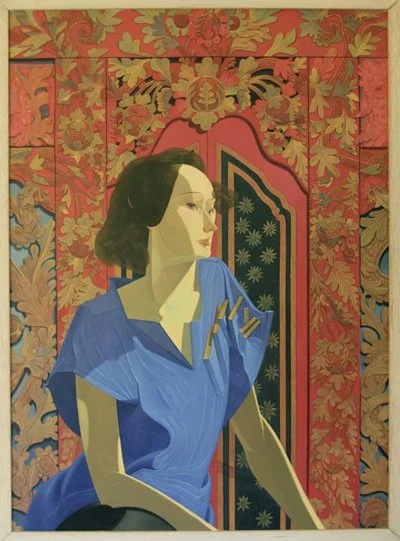
Portrait of Helen Jessup by Lawrence Preece

Plaque commemorating the now disbanded FOKCI

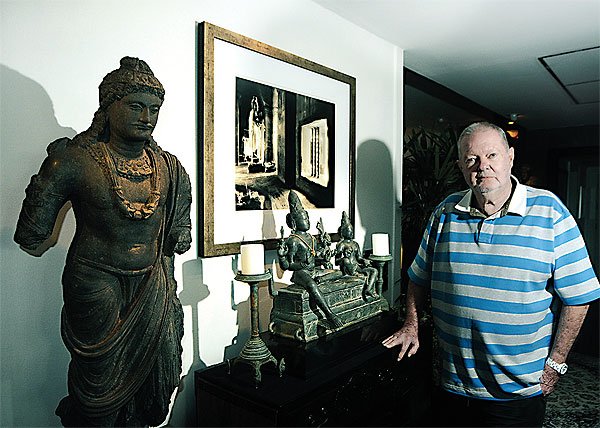
Douglas Latchford in his London apartment

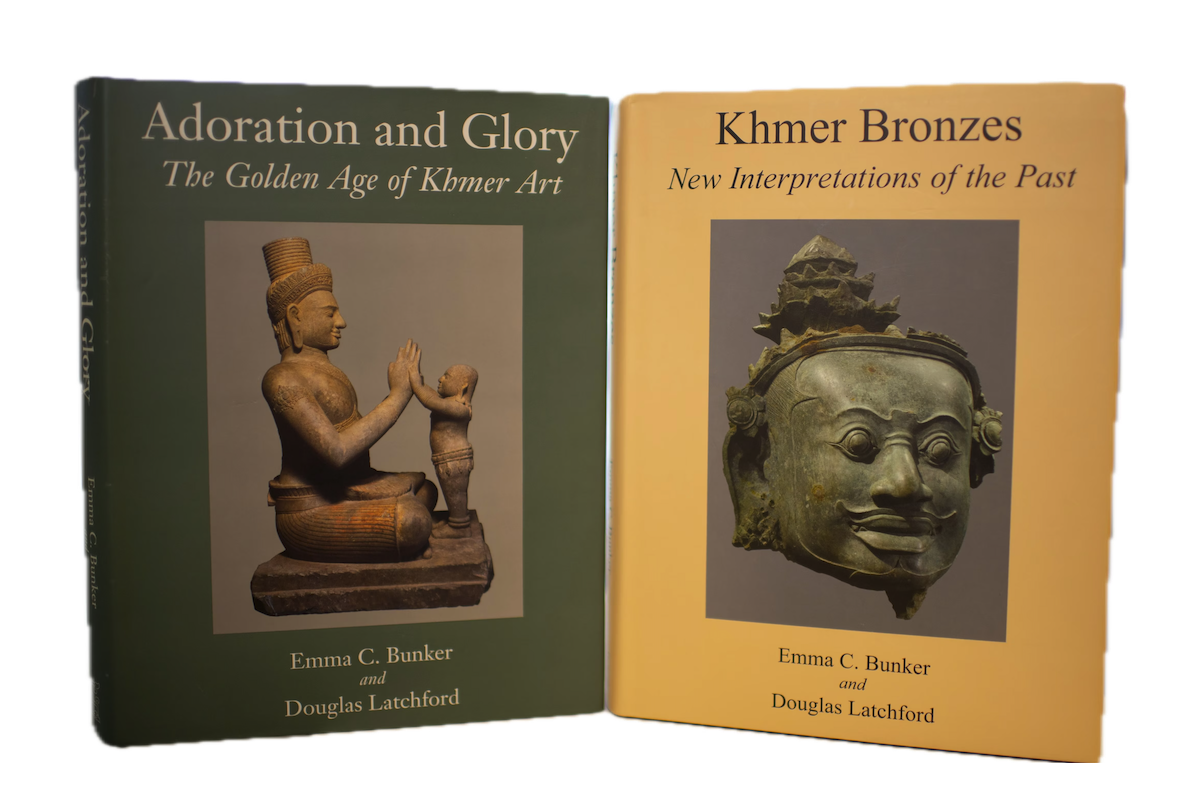
So, Latchford triple dipped: first he profited from looting Cambodian artifacts and selling them abroad; then he profited from participating in various ways in the repeated trades, sales, auctions, and donations of these objects abroad; and finally he profited from selling them back into Cambodia. Emma Bunker’s academic credentials provided scholarly legitimacy to his collection and activities on the way out, and Helen Jessup’s did the same on the way back in. The expansion of the Battambang Museum’s collection in the ‘90s and 2000s was, ironically, funding continued looting and illicit trading in Khmer artifacts.

In addition to inventorying the collection, Friends of Khmer Culture Inc.’s 2015 makeover of the Battambang Museum fixed roof leaks, installed a new lighting system, reorganized displays, and installed the current (unforgivably flawed) Khmer/English signage . . . but 29 objects detailed in Giteau’s original inventory were recorded as missing, and as of May 2026 remain so. As of my 2026 visit, I’m also a bit confused; there are supposedly 1000+ objects in the collection, so why are fewer than 250 on display? It’s very clear that the same objects have been on display for over a decade, probably longer. Where are the rest?

Was Jessup a victim, a conspirator, an intentional or unintentional money launderer? She’s still a respected academic, supposedly working on a book titled Angkor and Beyond since 2010. Friends of Khmer Culture Inc., however, quietly ceased operations and publishing in the lead-up to Latchford’s 2019 indictment, and as of 2026 the company’s website has disappeared.

November 1993

November 1993

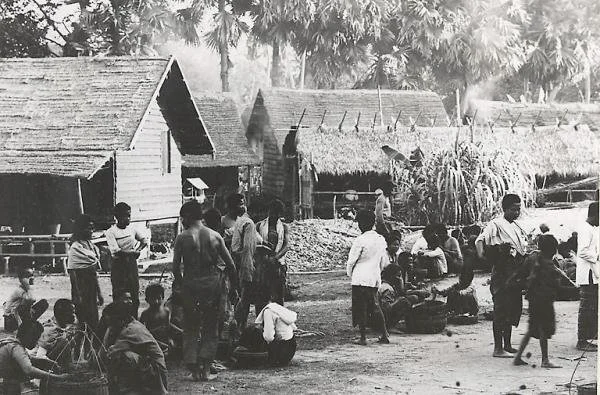
Lastly, the historic relationship the museum has had with the Wat Po Veal museum is unmentioned, which I think does tourists a disservice. When locals in the province come across an artifact accidentally (usually digging a plumbing system, plowing a field, draining a pond etc.) and don’t attempt to sell it, they always bring it first to Wat Po Veal, and only to the Battambang Museum if rejected by Wat Po Veal . . . if they go to the Battambang Museum at all.

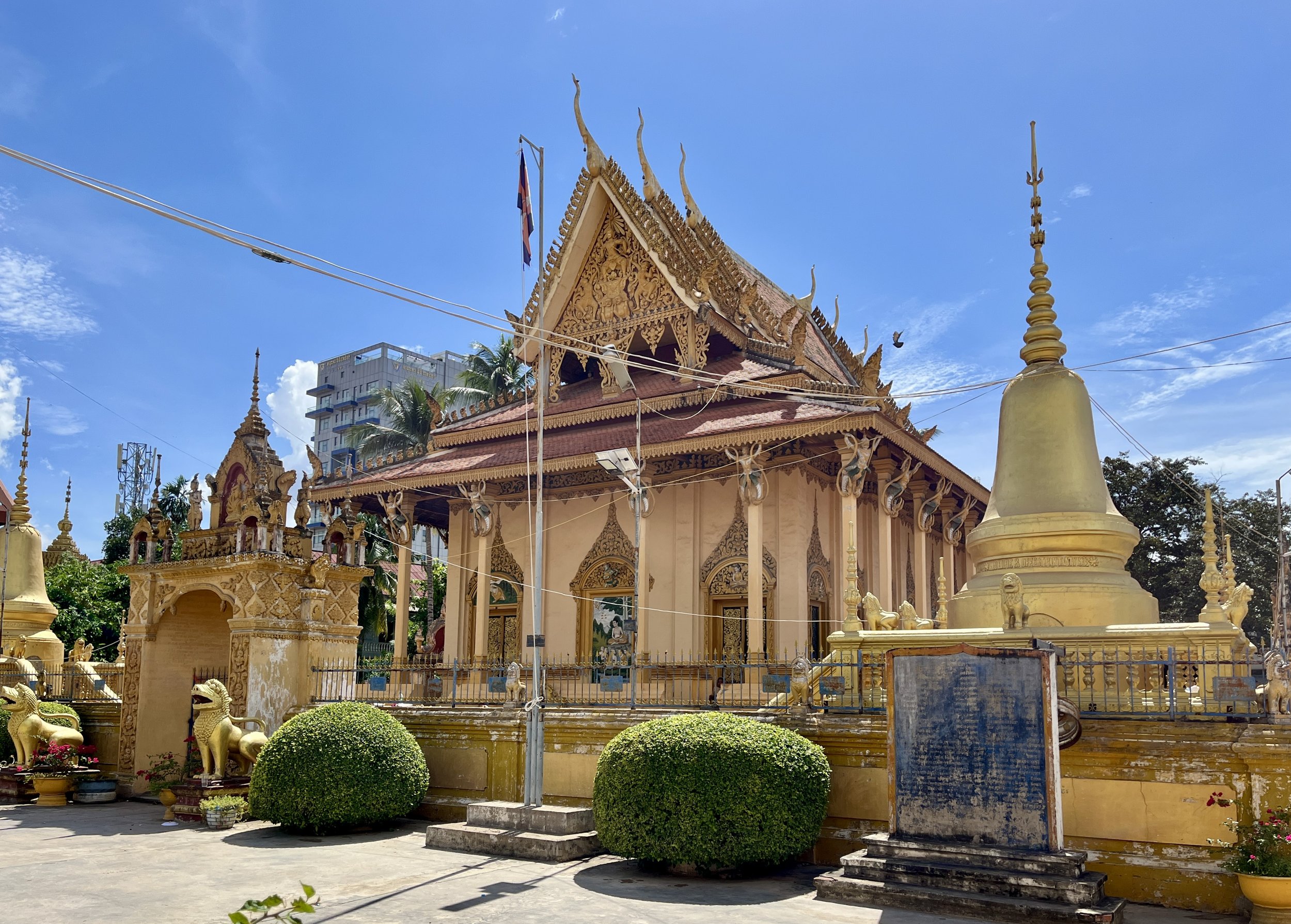
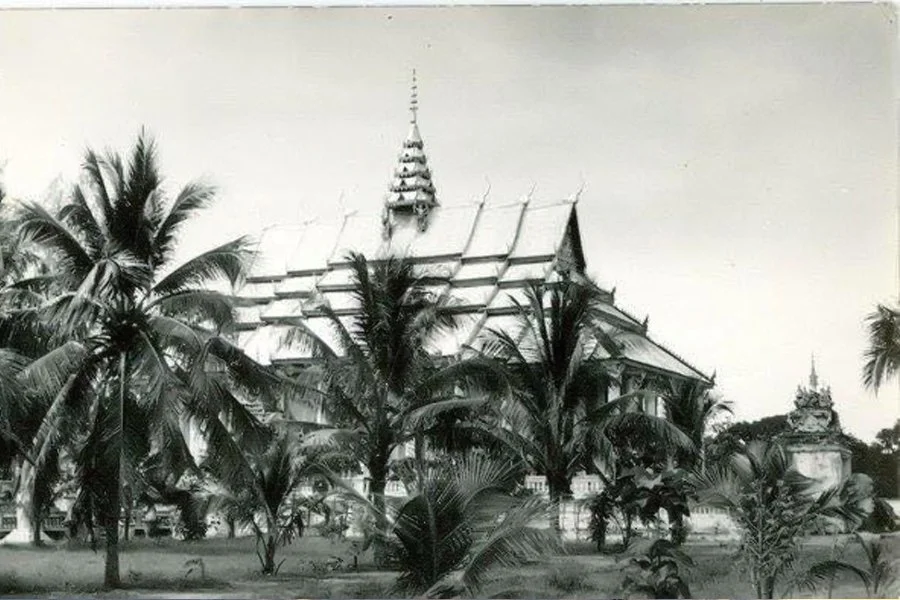
Wat Po Veal

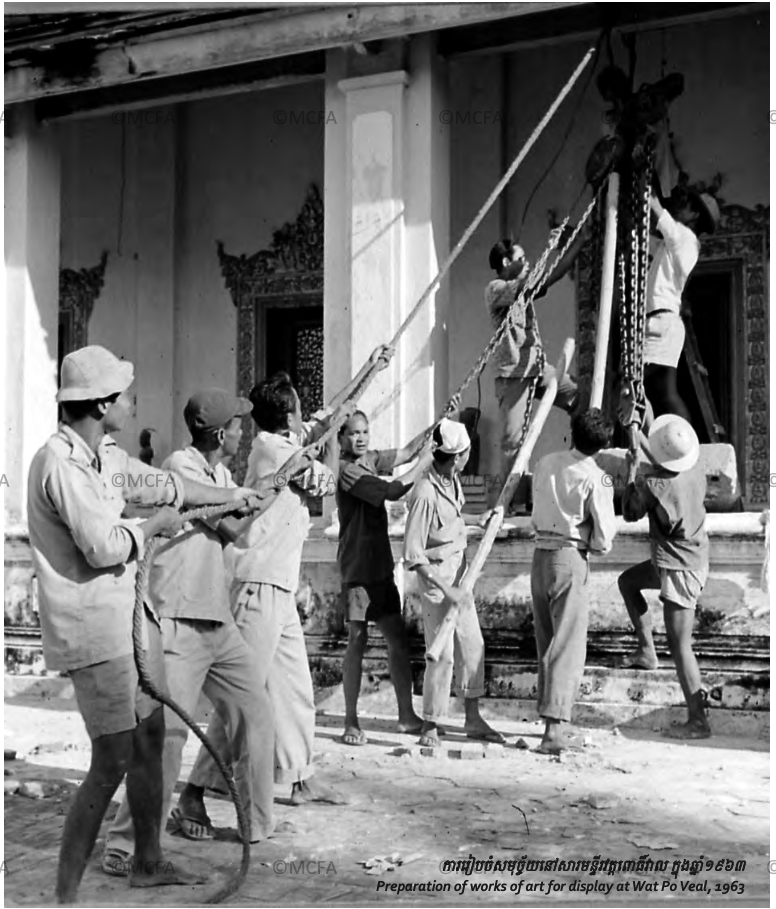
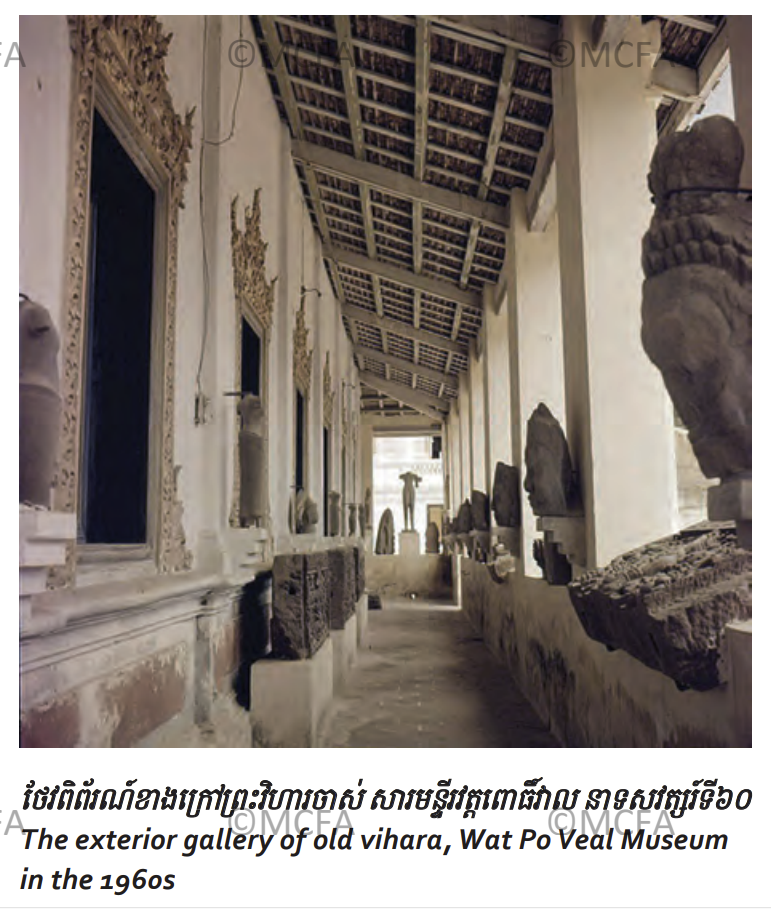
In the 1920s, Samdech Vannarath Iv Tuot put out the word among locals that Wat Po Veal was the place to bring any artifacts, to make merit and keep them safe. By the 50s, under Tuot’s leadership, the displays at Wat Po Veal had become arguably the best museum in Cambodia, with a collection rivaling if not surpassing the National Museum in Phnom Penh; in 1957 a new, two-story Vihear was constructed solely for its display. Valuable artifacts Tuot deemed redundant or of relatively lower quality were turned away with some frequency.

Then and now, if the villagers finding artifacts can’t make merit, many would at least like to make money; the local police and village chiefs have been equally as likely to connect them with looters for a cut as to connect them with academics in Phnom Penh. In the eyes of the newly independent (as of 1953) Cambodian government and the French administrators of museums and archaeological sites invited to stay on (until 1966) for a smooth transition, the number and quality of objects rejected by Wat Po Veal necessitated the founding of the Battambang Provincial Museum, whose collection was initially comprised entirely of unwanted Wat Po Veal donations.

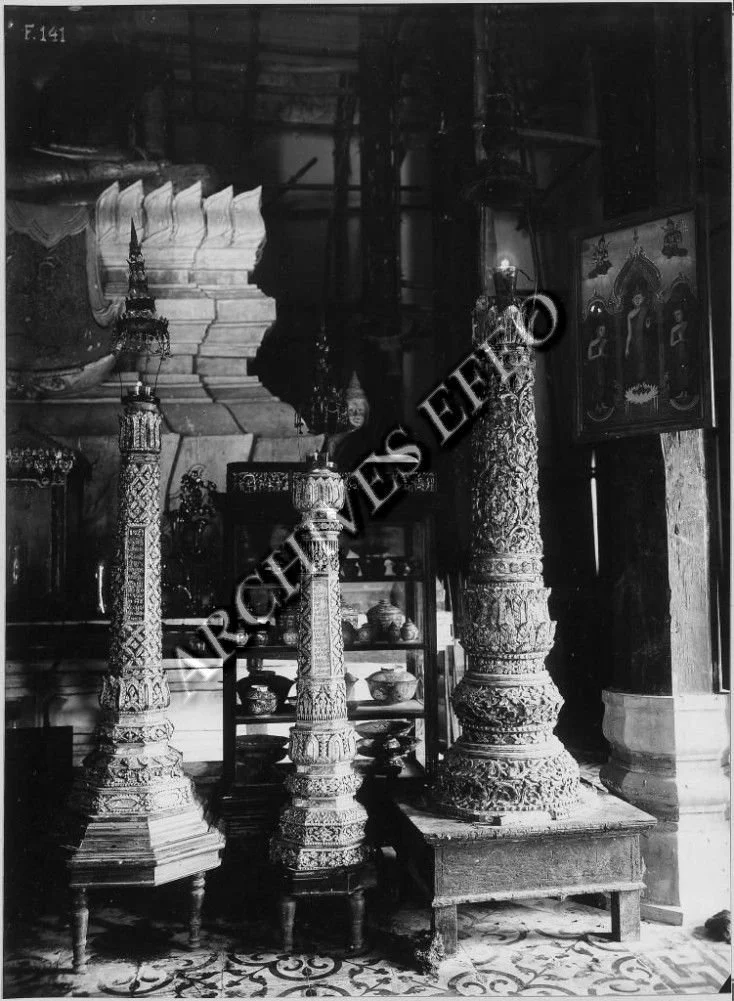
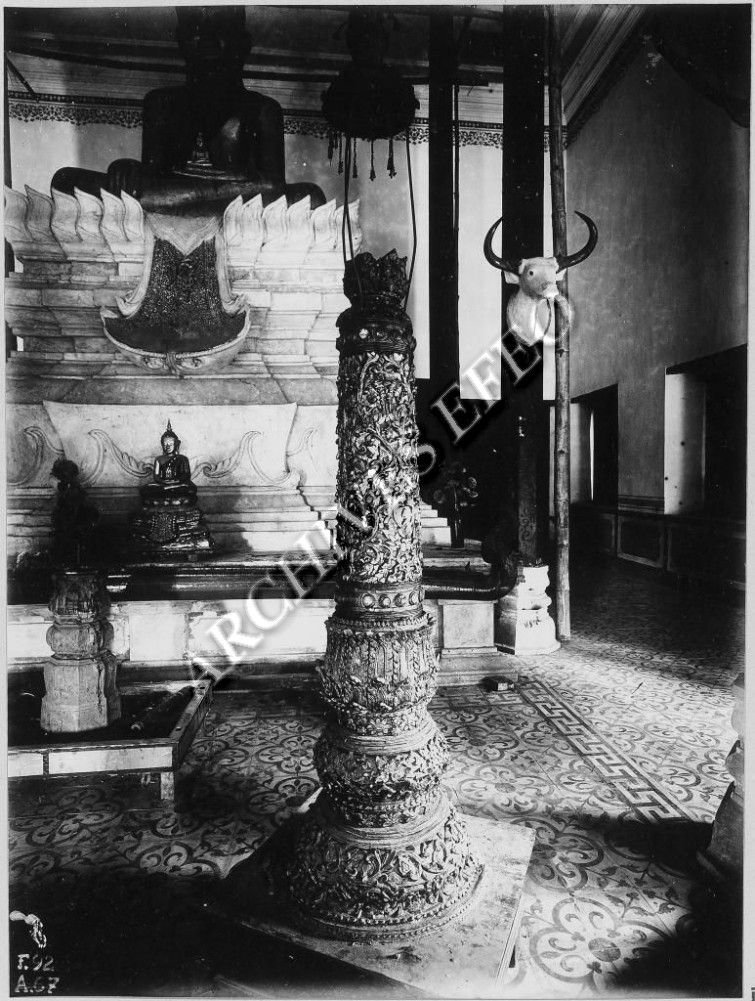
Wat Po Veal in 1934

Wa Po Veal in 1937

In his later years, having seen the progress and investment in the provincial museum, Tuot petitioned to have Wat Po Veal also officially recognized as a state museum. Madeleine Giteau, already in Battambang, was dispatched to organize and catalogue Wat Po Veal’s collection and get the displays ready for the public, which she did in 1965. The Wat Po Veal Museum officially opened in 1967, and the Battambang Provincial Museum in 1968.

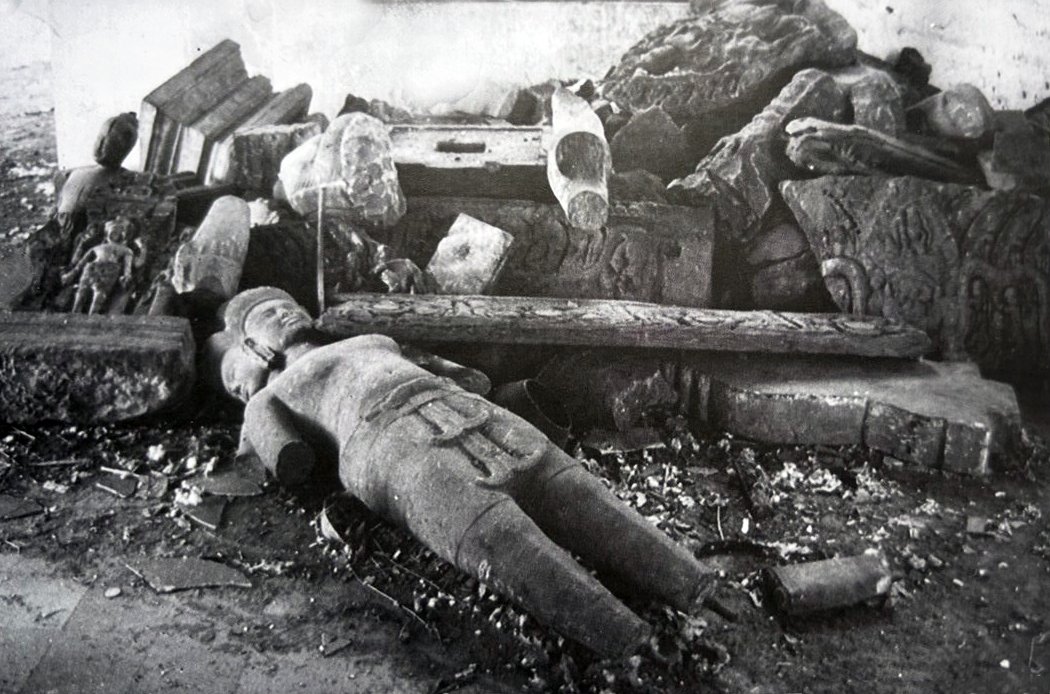
Unfortunately, Wat Po Veal’s once vast collection has been inaccessible to the public since the beginning of the Cambodian Civil War in 1967, and was totally decimated by the 1980s. Artifacts suffered various fates: many were transported to the National Museum at various points; others looted; still more were buried for safekeeping, then lost when whoever buried them was murdered by the Khmer Rouge.

Wat Po Veal in the 1980s

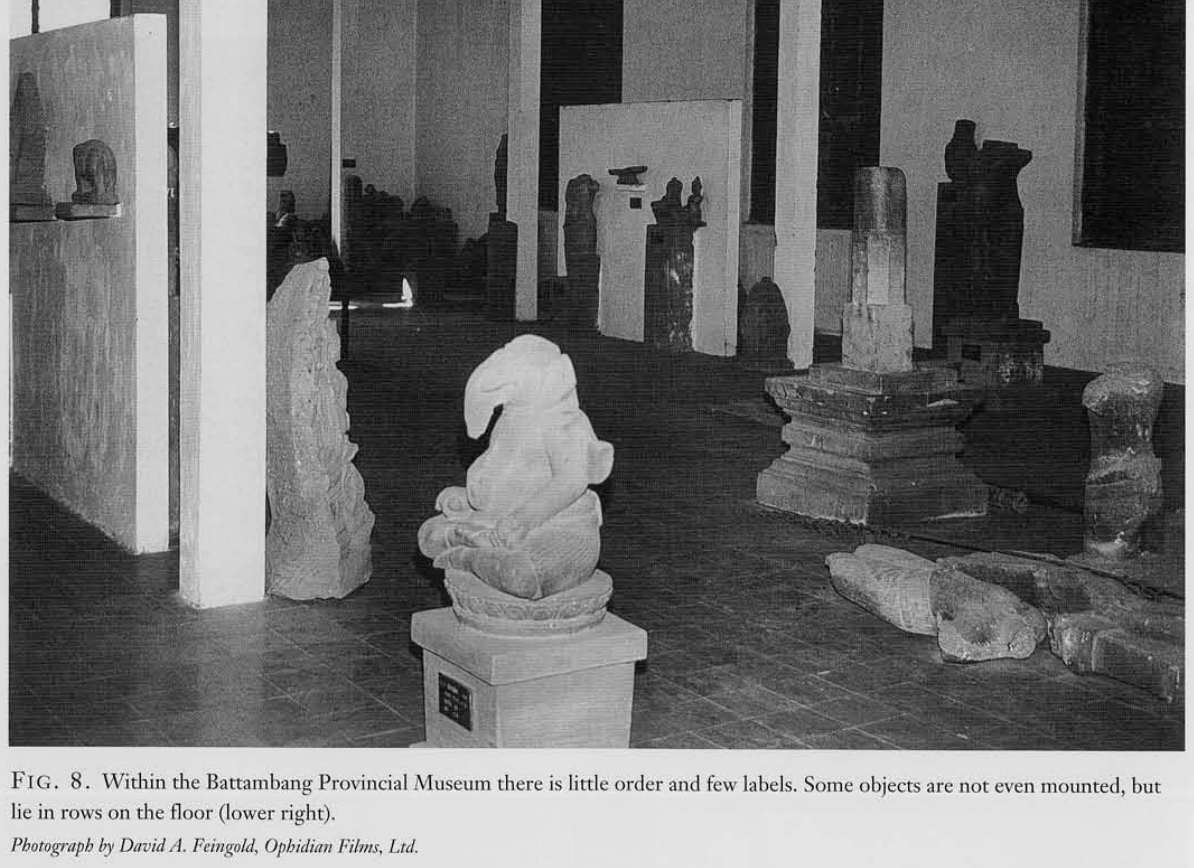
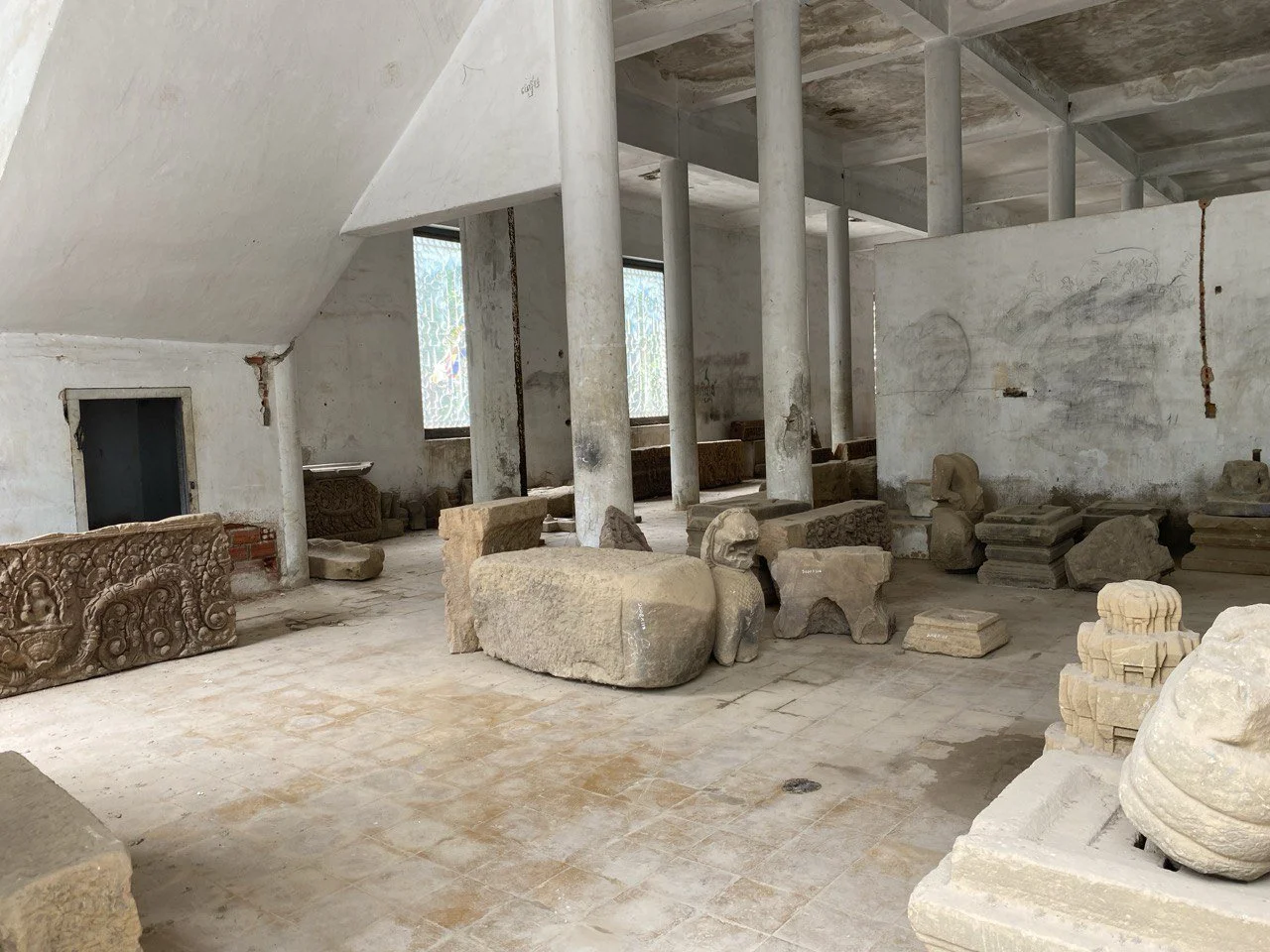
In 2015, a reporter from the Phnom Penh Post who gained access to the Vihear said it had just become a messy pile of artifacts and antiques, many broken, most not even propped up but piled haphazardly on the floor. He estimated there were around 300 objects there, but wasn’t able to access the upstairs where most of the collection was once held. He wrote that the door hadn’t been opened in so long the lock was stiff and had to be forced.

Most disturbingly, when asked what she said to people looking for the museum, the caretaker, Huon Nin, said no one ever asked. When pushed as to what she would say to anyone who did ask, she replied: “I don’t care about it so I haven’t tried to find out. It’s the history of people who lived here a long time ago.” That’s wilful neglect at best, the lady doth protest too much at worst, unacceptable either way, and nothing has changed over a decade later.

photos by Andy Brouwer September 2025

photo by Andy Brouwer September 2025

photo by Andy Brouwer September 2025

38 objects from Giteau’s initial inventory of Wat Po Veal remained unaccounted for as of the 2015 publishing of Missing Objects from the Wat Po Veal and Battambang Provincial Museums (a collaborative effort between the National Museum in Phnom Penh and UNESCO, click here for pdf). I believe a couple objects or parts of them have since been dug up locally, but who’s to say others haven’t gone missing?

I think acknowledgment and spreading awareness at Battambang Provincial Museum (the museum the public can access) would promote repatriation of objects to both Wat Po Veal and the Battambang Provincial Museum, encourage moral handling of any future discoveries by locals, and maybe even encourage charities or sponsoring businesses to get involved in fixing up and reopening the Wat Po Veal museum, or at least relocating its collection to safety. Although visitors can’t access the Wat Po Veal museum at the moment, they can take clear photos of its treasures through broken glass windows, like the ones taken by Andy Brouwer above. Hardly a secure situation.


Anyway, on to the collection. I took WAY TOO MANY photos here. It was really an hour or two of zen in an otherwise mostly joyless 3 weeks in Battambang.

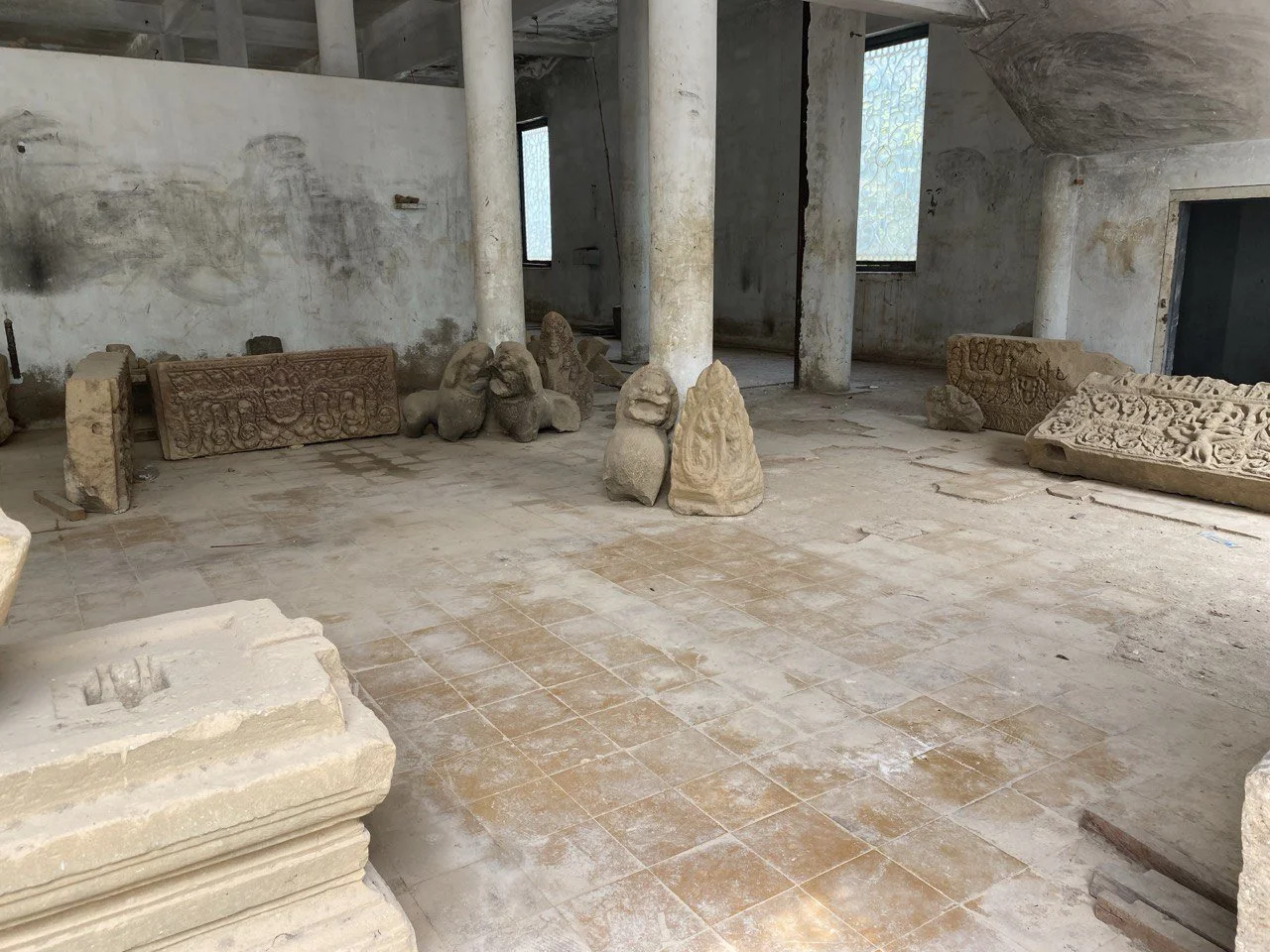
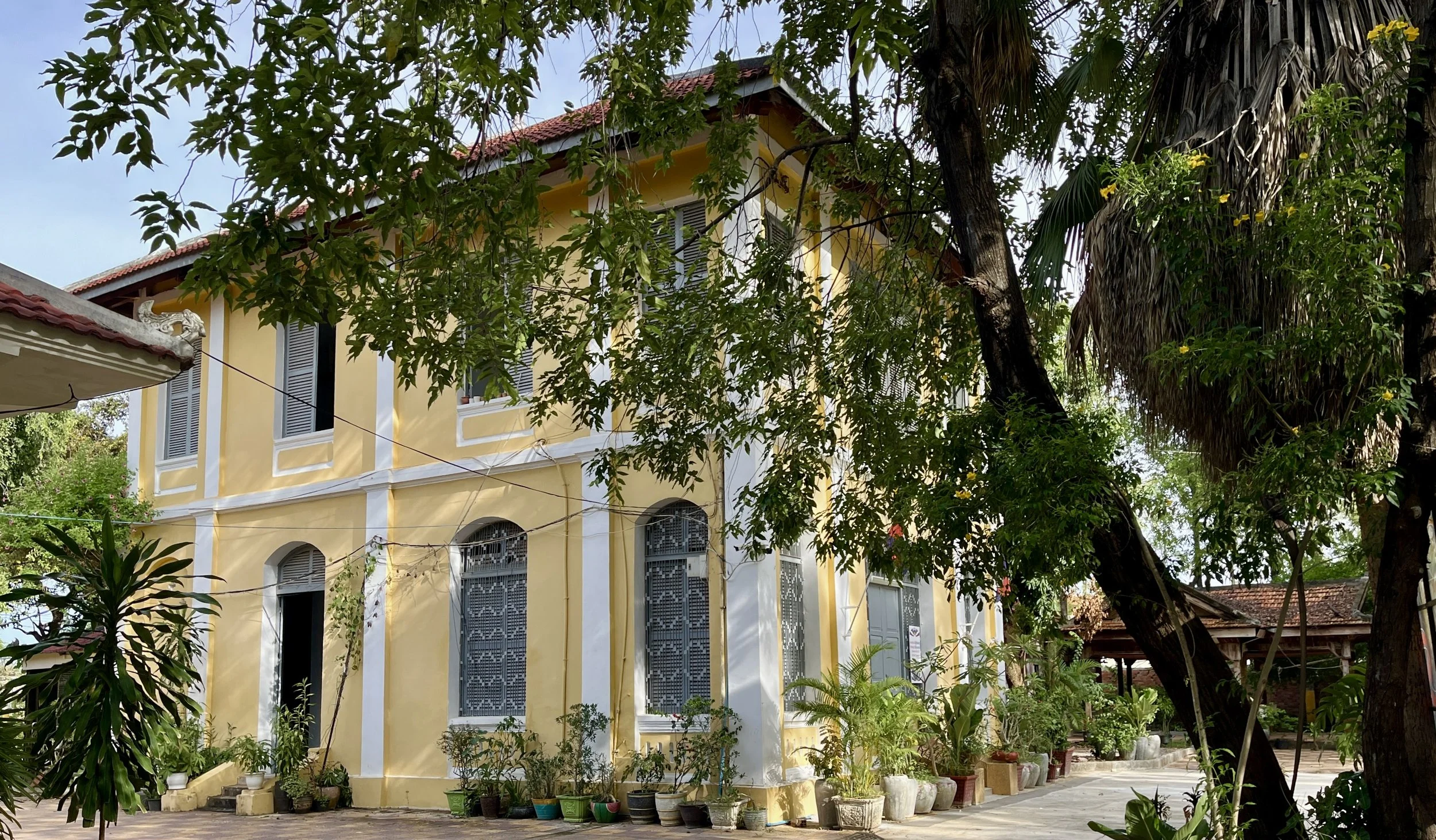
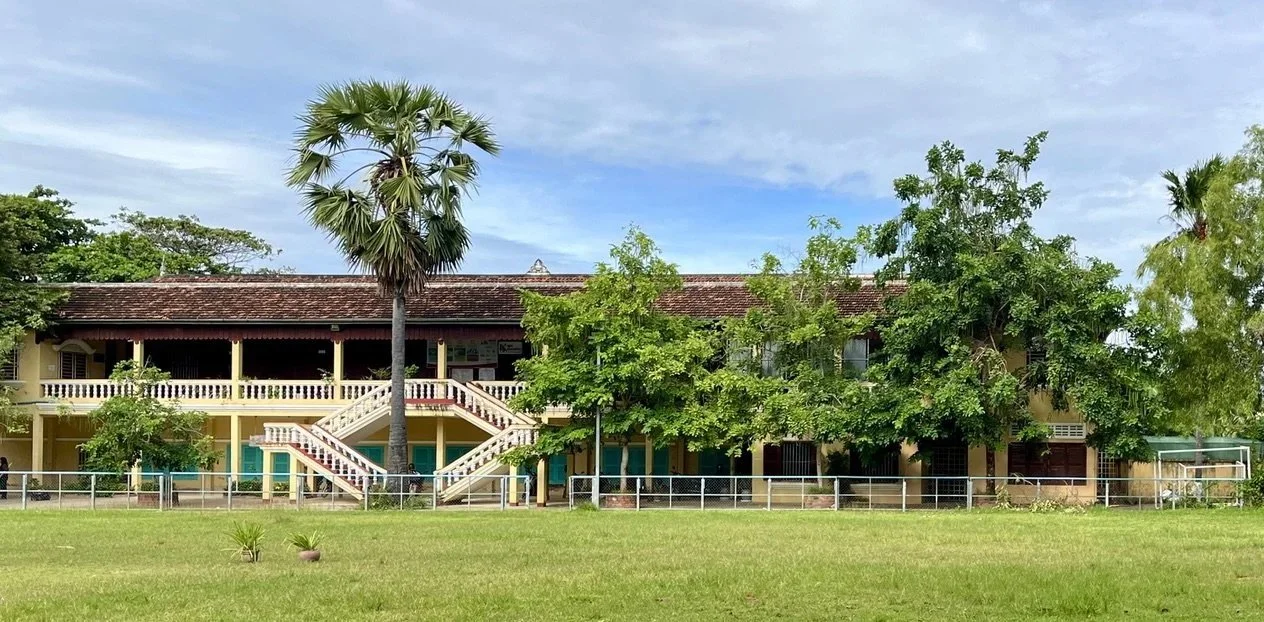
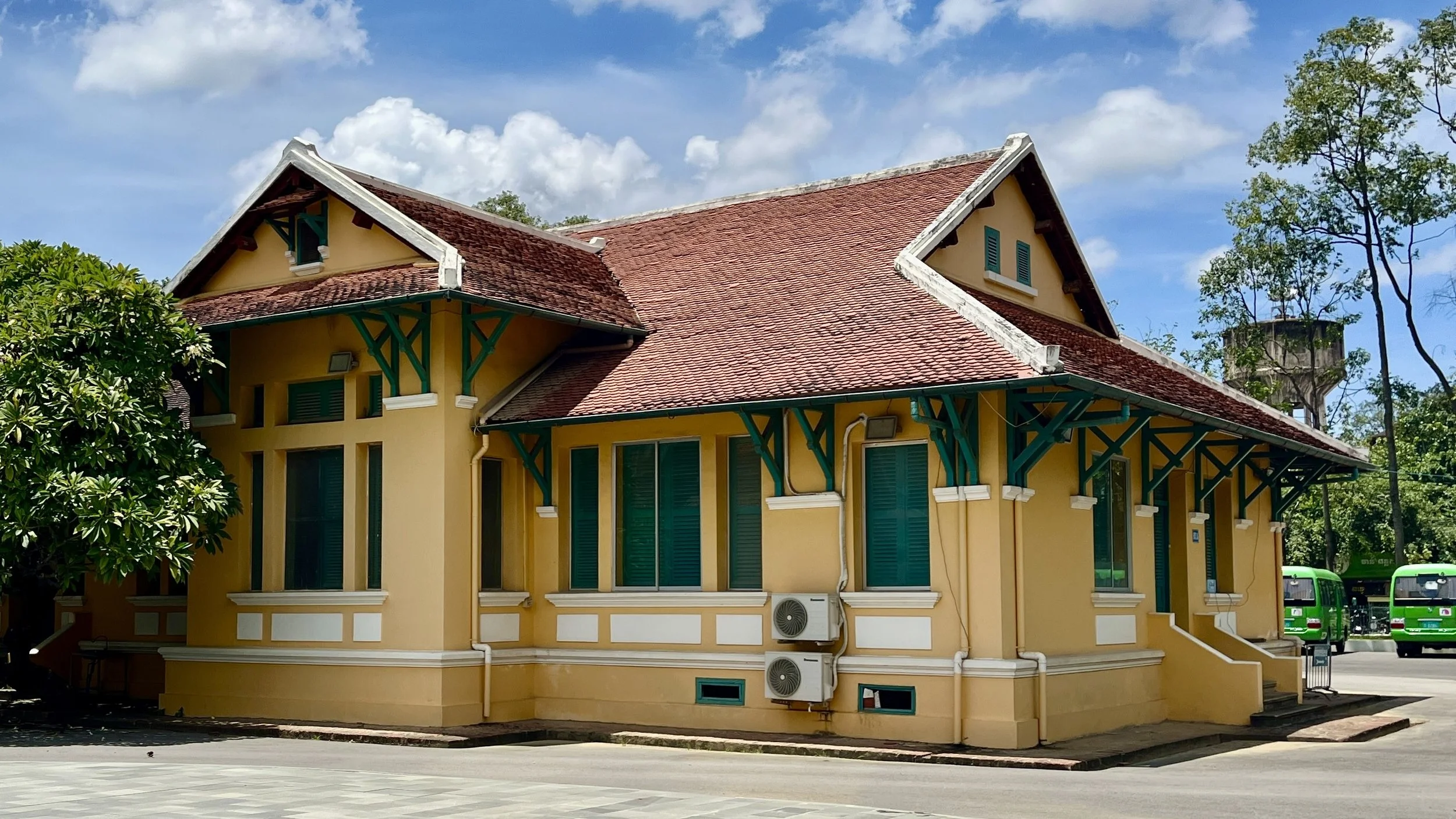
The museum is one big building, one floor. Next door on the same property is another building that’s closed; I’m unclear on whether this was once the storage building, still is, or has a different use. There are people in and out. Outside are lions and lintels.


Please note, these captions are as they appear on the museum placards, with just enough editing to make them comprehensible, or at least as comprehensible as possible. There may very well be a couple substantive mistakes/mixups/omissions; I did my best.

The grammar is shit and spelling and formatting are inconsistent because correcting this is time consuming and boring, so I just left much of it as-is. I honestly can’t fathom how they failed to get a native English speaking archaeologist to write these, especially considering the money and involvement of Seila-Carere, Jessup, Latchford, et. al., but they did!

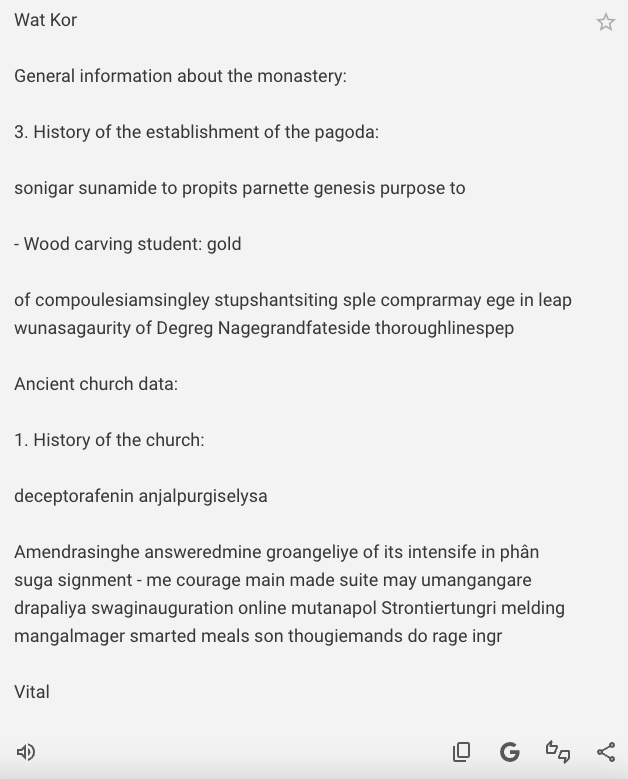
Here is an example of one of the most HUH? placards, to give you an idea:

Linga

Sandezone PreAngmlie, Ta» Ba Cal

Pon Sargine Samambaro

This Linge was lound during at Bases tamale resto ration on 2017 lie the lower fart of the pediment in this rasm. In ancient Cambadia. Shiva ling had variaus shapes and was made from vandus materato such an metal sangazane, and grante Tha partcuto: linga represents not only the Sawa, but the unan of the

Ehres main Pndu gofs. the cuoc case rortaEnas

Brahma, the octagoral madie section represenss Vame end the hemisphere sectan at la Los

(etc.)


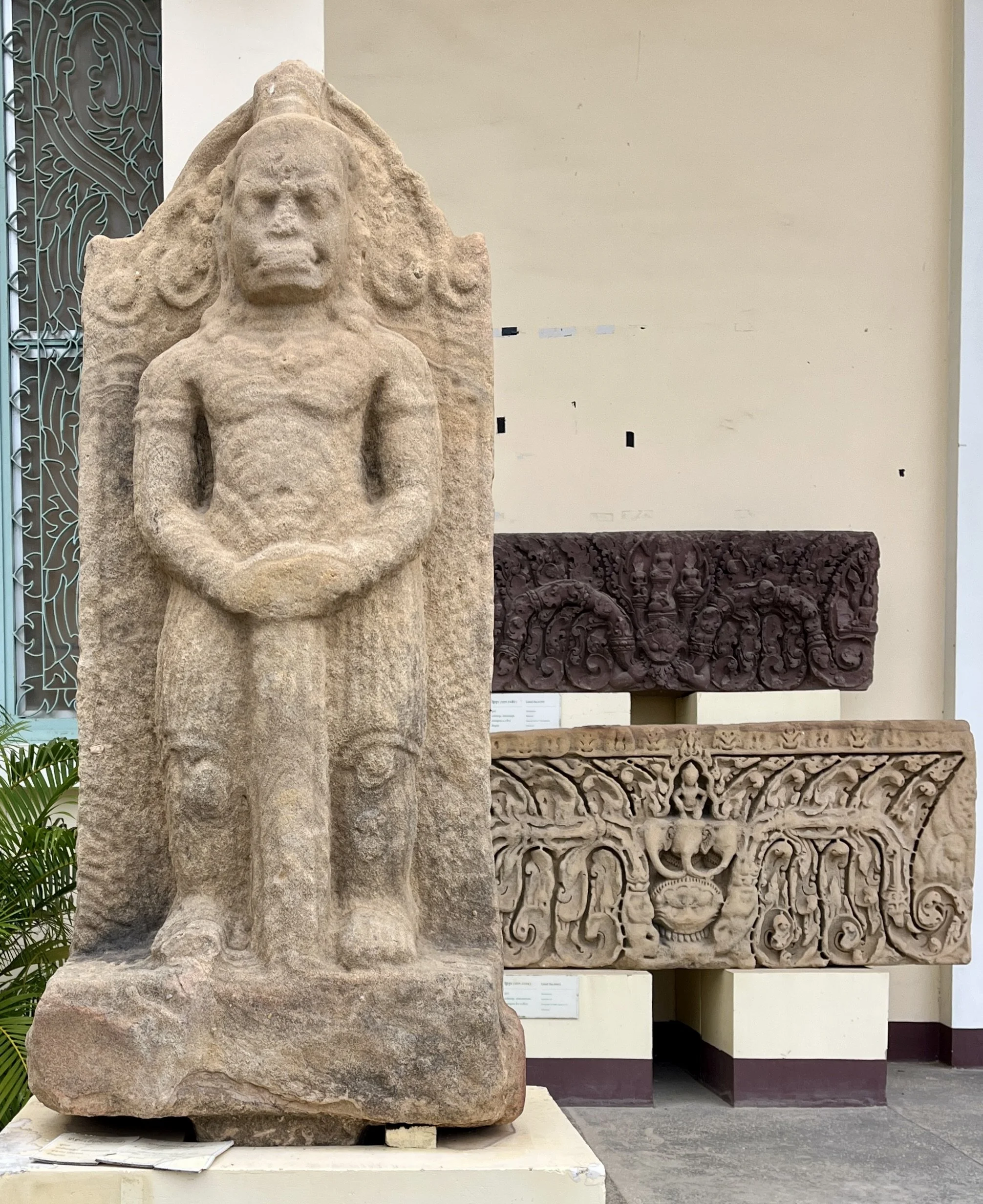
Dvarapala

Sandstone

Angkor period Bayon style

late 12th to early 13th c.

Lintel

Sandstone

Pre Rup

Second and third quarters of the 10th century

Sheng Khang Koet

Lintel

Sandstone

Khleang

Late 10th to early 11th centuries

Toul Prasat Kampong Sema

Lintel

Sandstone

Bakheng

Late 9th to early 10th centuries


Inside, the centerpiece is the now headless Brahma from Wat Po Veal.

I did the museum roughly clockwise. The first exhibit is all about the prehistoric Laang Spean site.

MINISTRY OF CULTURE AND FINE ARTS

LAANG SPEAN

PREHISTORIC SITE

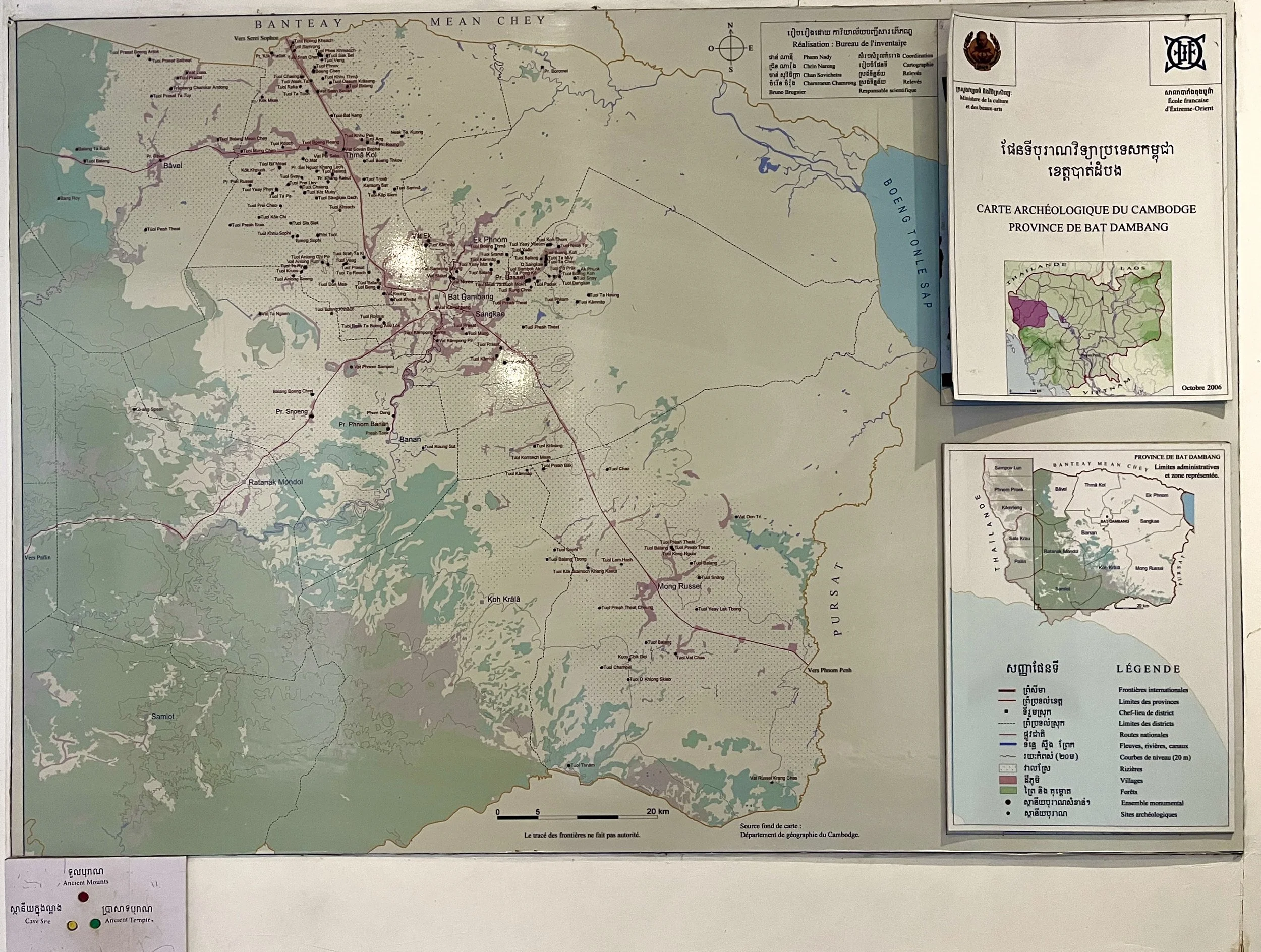
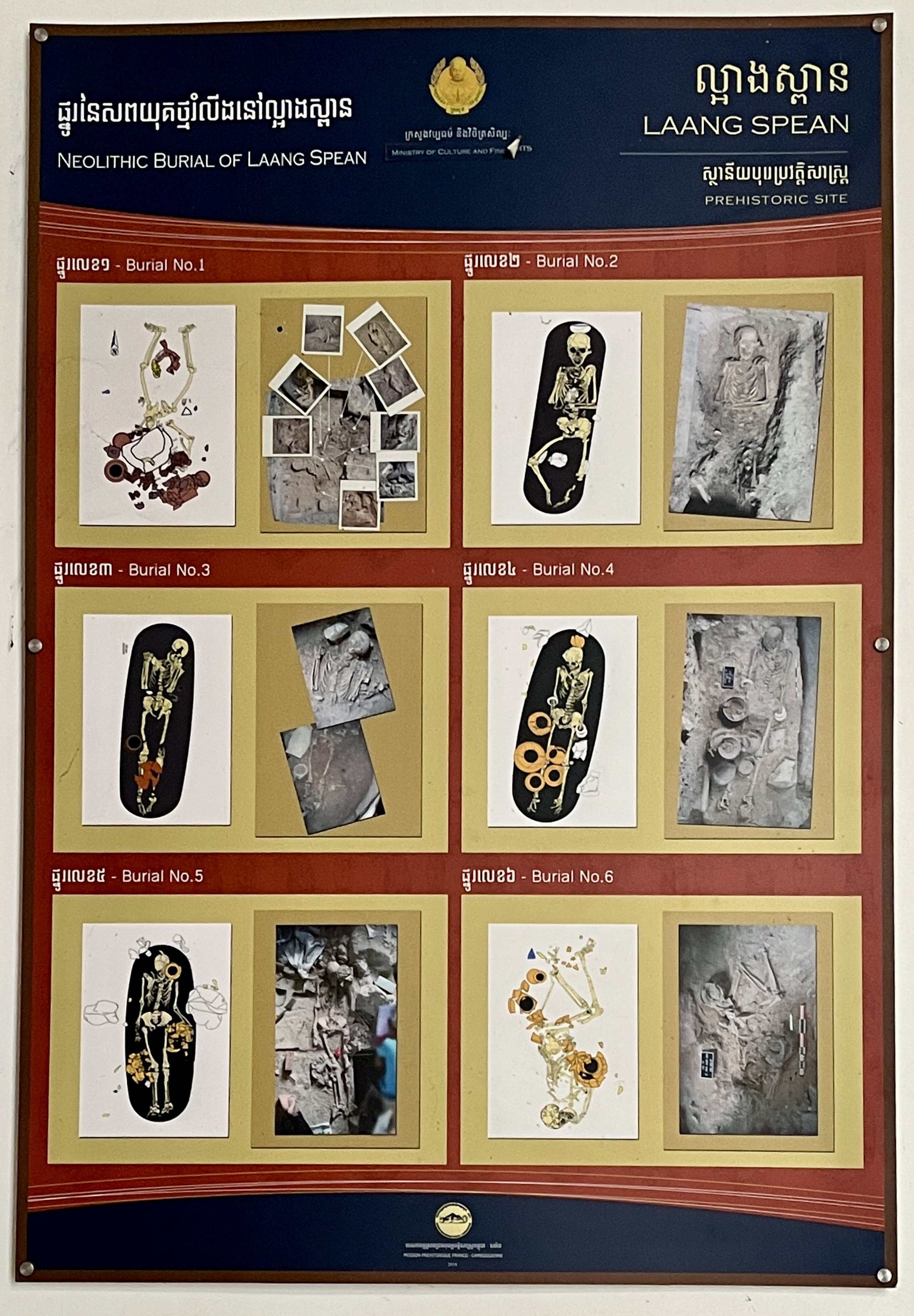
Laang Spean is the biggest known prehistoric cave site in Cambodia and is situated on top of the limestone mountain known as Phnom Teak Treang in the Treng Commune, Ratanakmundul district, southwest of Battambang province, northwest Cambodia. It is approximately 330 km from Phnom Penh, on the right-hand side of National road No. 57, half way between Battambang and Pailin. It is around 40 km southwest of the provincial capital of Battambang and around 7 km from the public gathering place of Sdao village. The name Laang Spean refers to the limestone found on the upper part of the back of the cave forming arches which looks like a stone bridge. It formed naturally after a big block in the middle of the cave's ceiling collapsed. The mountain lies on the west side of the Sangke River, one of the tributaries feeding the great Lake of Tonle Sap.

The site can be reached by different routes with vehicles. The easiest way is by the laterite road connected to the National road No. 57 at the Meas Pitou primary school to the west about 3 km from the main road.

Lang Spean Cave was formerly recognized as an important archaeological site as early as 1965 by two French archaeologists, Cécile and Roland Mourer, during their survey of northwest Cambodia.

They arrived precisely at the site on July 28th 1965 and began the first excavation at the same year. The last excavation campaign was at the end of 1970 and early 1971.

The excavations were carried out at three different locations and followed the configuration of the cave sections. The first location was at the right side of the cave entrance ( section 1 or room 1). The second location was in the central part of the cave ( section 2 or room 2), near the west wall. The third location was located at the upper level of the cave (section 3 or room 3), under a limestone bridge, close to the eastern cave wall.

Following these pioneering years of archaeological field research, Laang Spean became a famous cave site throughout Cambodia as well as in Southeast Asia due in particular to the discovery of the Hoabinhian industry and also a rich cord-marked pottery from a Neolithic level. Beside stone artefacts and fauna, shells were also present in large quantities in the archaeological layers of the last hunter-gatherers who lived in the cave.

After about 50 years, research was stopped for security reasons, but the research and the archaeological collaboration was started again by the French-Cambodia Prehistoric Mission from 2009 with Pr. Hubert Forestier (MNHN) and Dr. Heng Sophady (MCFA) as the principle researchers.

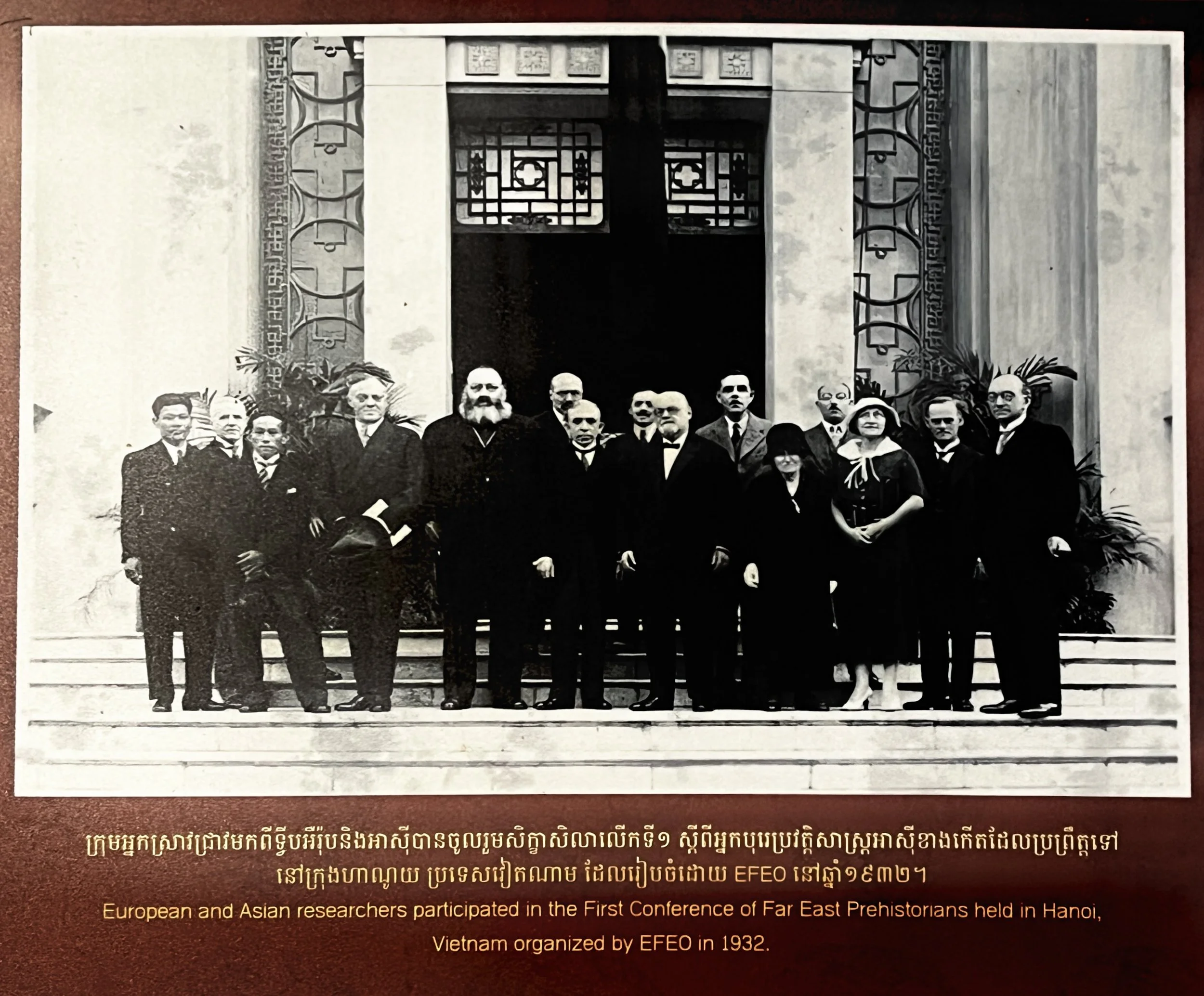
Early in 1932, the First Congress of Pre-historians of the Far East was held in Hanoi, and the term 'Hoa Binh Culture' proposed by M. Colani was agreed to define a specific culture that inhabited the region.

The location of Hoabinhian sites in Southeast Asia

The term Hoabinhian comes from 'Hoa Binh' Culture named after Hoa Binh province in Northern Vietnam. French archaeologist Madeleine Colani from EFEO, excavated many Hoa Binh culture sites in Vietnam during the period 1926-1932. Early in 1932, the First Congress of Pre-historians of the Far East was held in Hanoi, and the term 'Hoa Binh Culture' proposed by M. Colani was agreed to define a specific culture that inhabited the region.

In Southeast Asia it has easily become a common term to describe stone artefact accumulations with a limited time period from Late Upper Pleistocene to Middle Holocene with a distinctive settlement pattern, subsistence economy, and technology. Additionally, in Western Indonesia was also noted Hoabinhian artifacts with unifacial pebble tools call "Sumatralith" which correspond to efficient cultural markers.

Different types of pebble tools (Hoabinhian techno-complex or Sumatraliths) have been found in many archaeological sites in Southeast Asia, both on the mainland such as Cambodia, Myanmar, Laos, Malaysia, Thailand, Vietnam, and few on islands such as Sumatra, Indonesia sharing similar cultural complexity on pebble/cobble utilization.

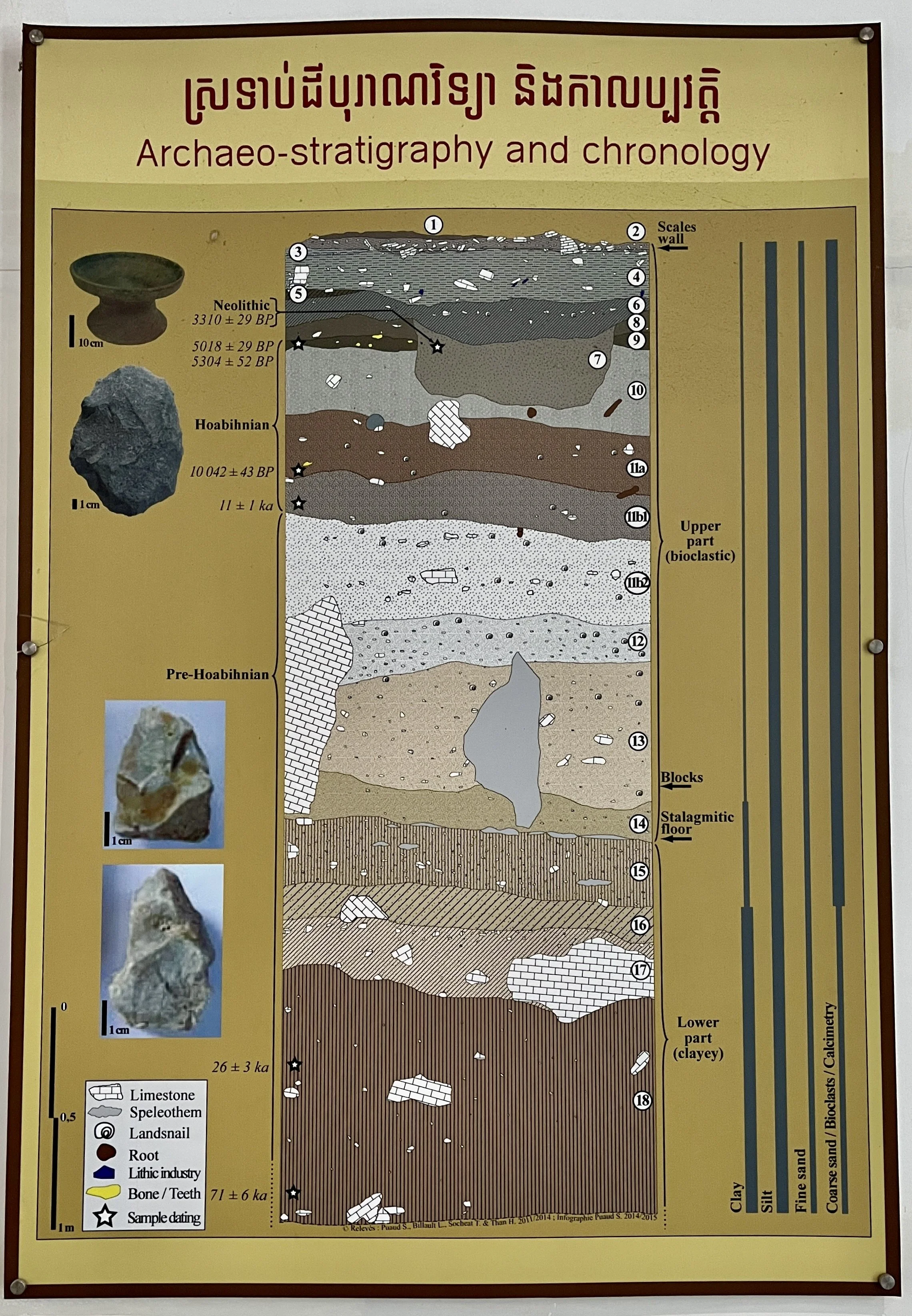
In Cambodia only one prehistoric site, Laang Spean cave in Battambang province, was excavating since 2009 by the Franco-Cambodian Prehistoric Mission ( FCPM). The Hoabinhian level was well dated and stratified with numerous archaeological remains including typical stone tools made from river cobble in hornfels, sandstone and limestone raw materials. The tools were always associated with abundant animal remains of different species as well as fresh water shells that were the main diet for prehistoric people between 11,000 and 5,000 years B.P.

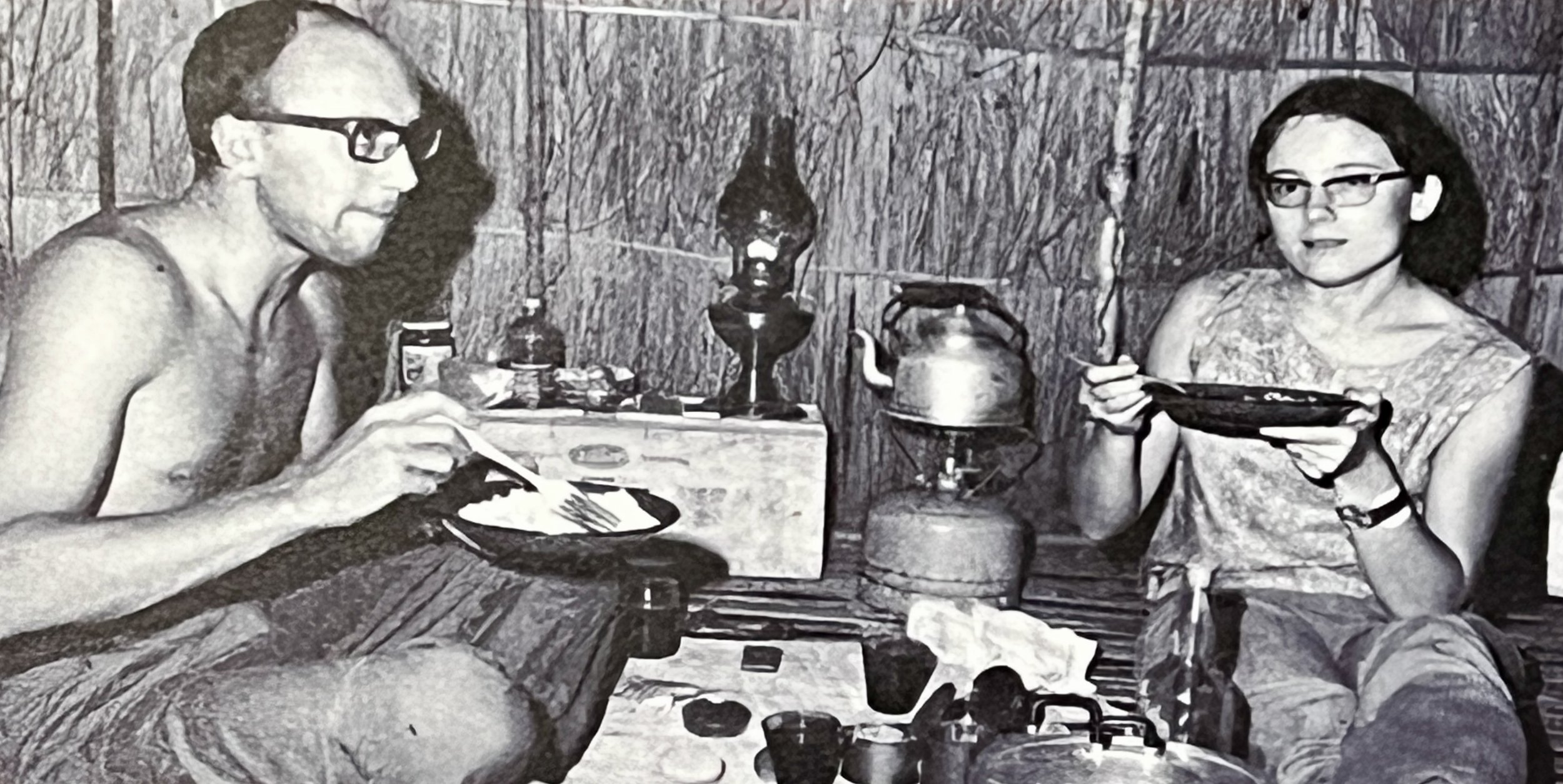
Roland Mourer and Cécile Mourer-Chauviré. The museum caption is “The enjoyment of dinner of Mr. Roland Mourer and his wite at Laang Spean in January 1967”. and his wife. As if she wasn’t a degreed, experienced, published paleontologist, a professor of geology at the Royal University of Phnom Penh prior to and during this dig, with her own name, equally deserving of an honorific, working on the site for a decade! Though of little interest to me personally, her work since has been even more esteemed; she is a founder of the Society of Avian Paleontology and Evolution (SAPE) and has 8 avian fossil species or genera named for her (by her colleagues; she has named 18 herself but never after herself!) The misogyny of most Cambodians remains appalling, and I experience it daily.

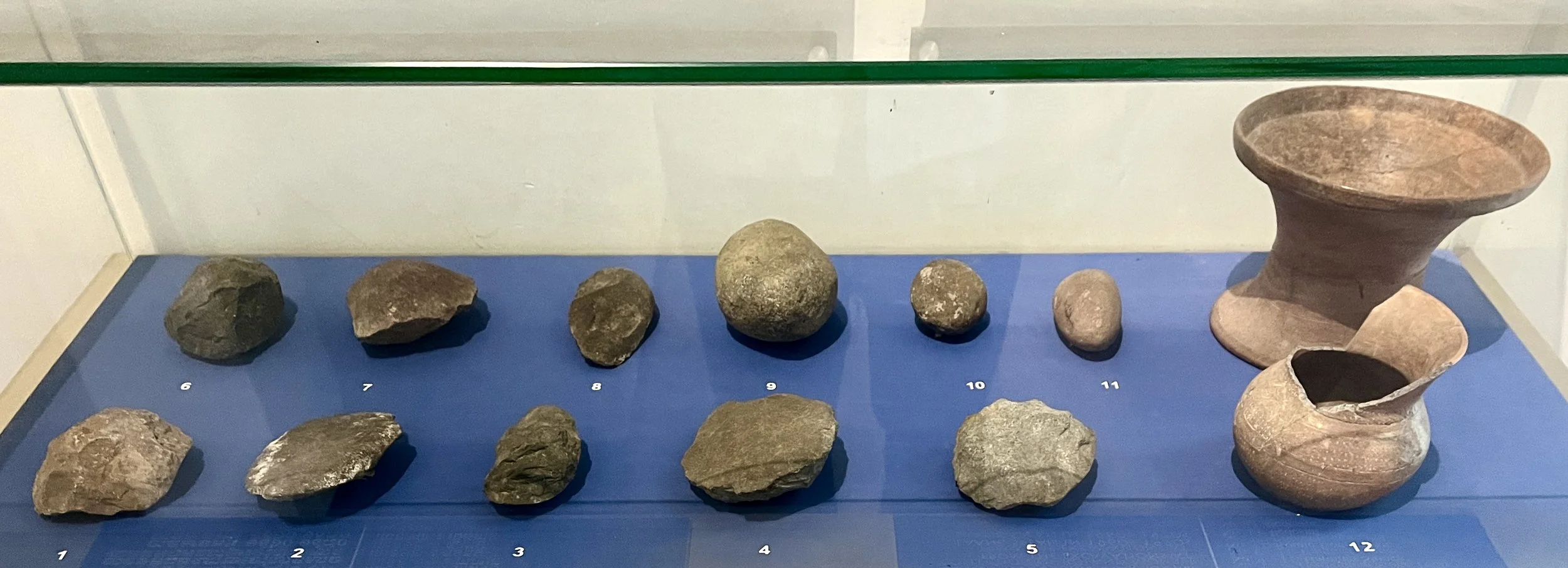
COLLECTION OF ROLAND MOURER

FROM THE EXCAVATIONS AT LAANG SPEAN IN 1965-1975

No. 1 - 8: Hoabinhian Stone Tools

No. 9 - 11: Hammer Stones

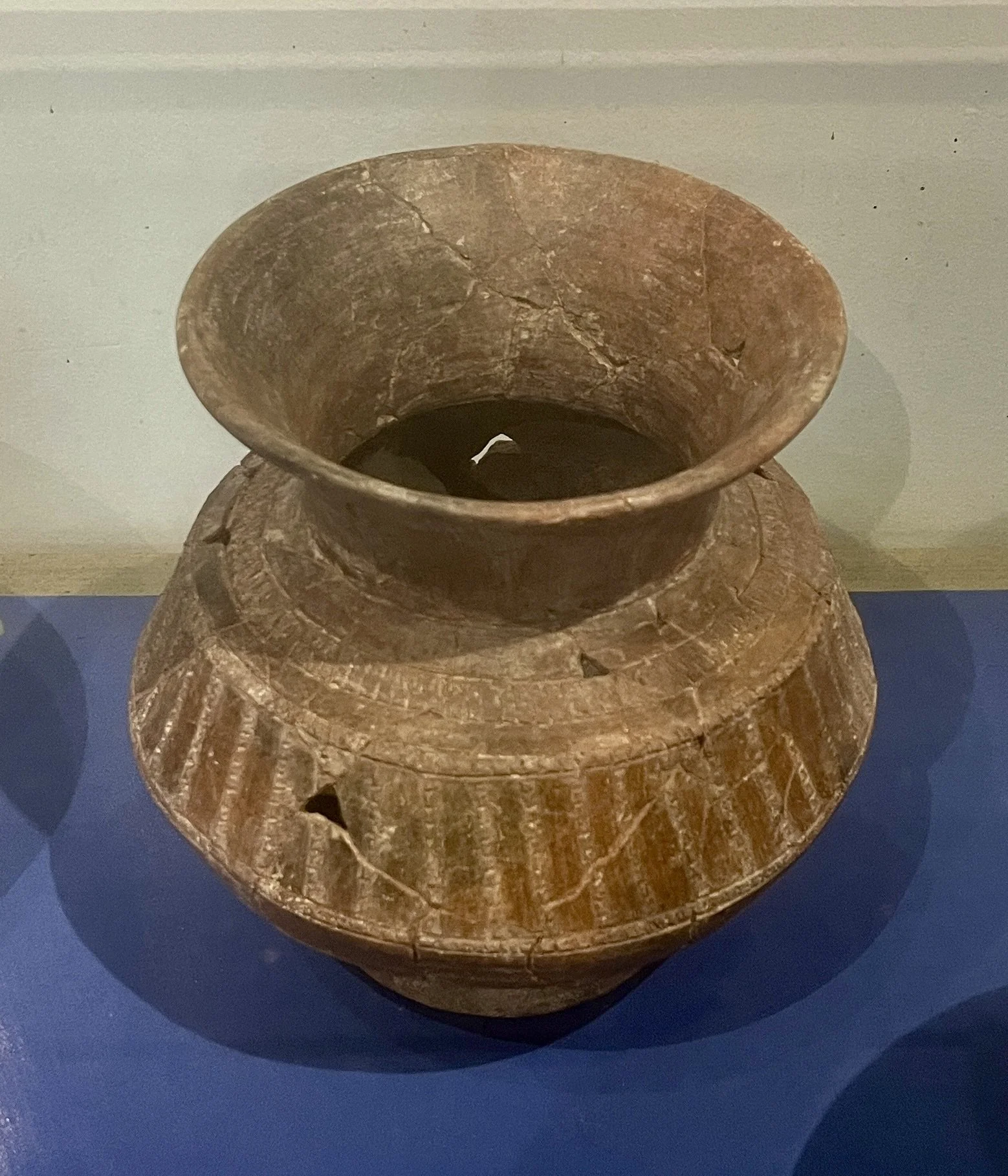
No. 12: Round Bottom Pot

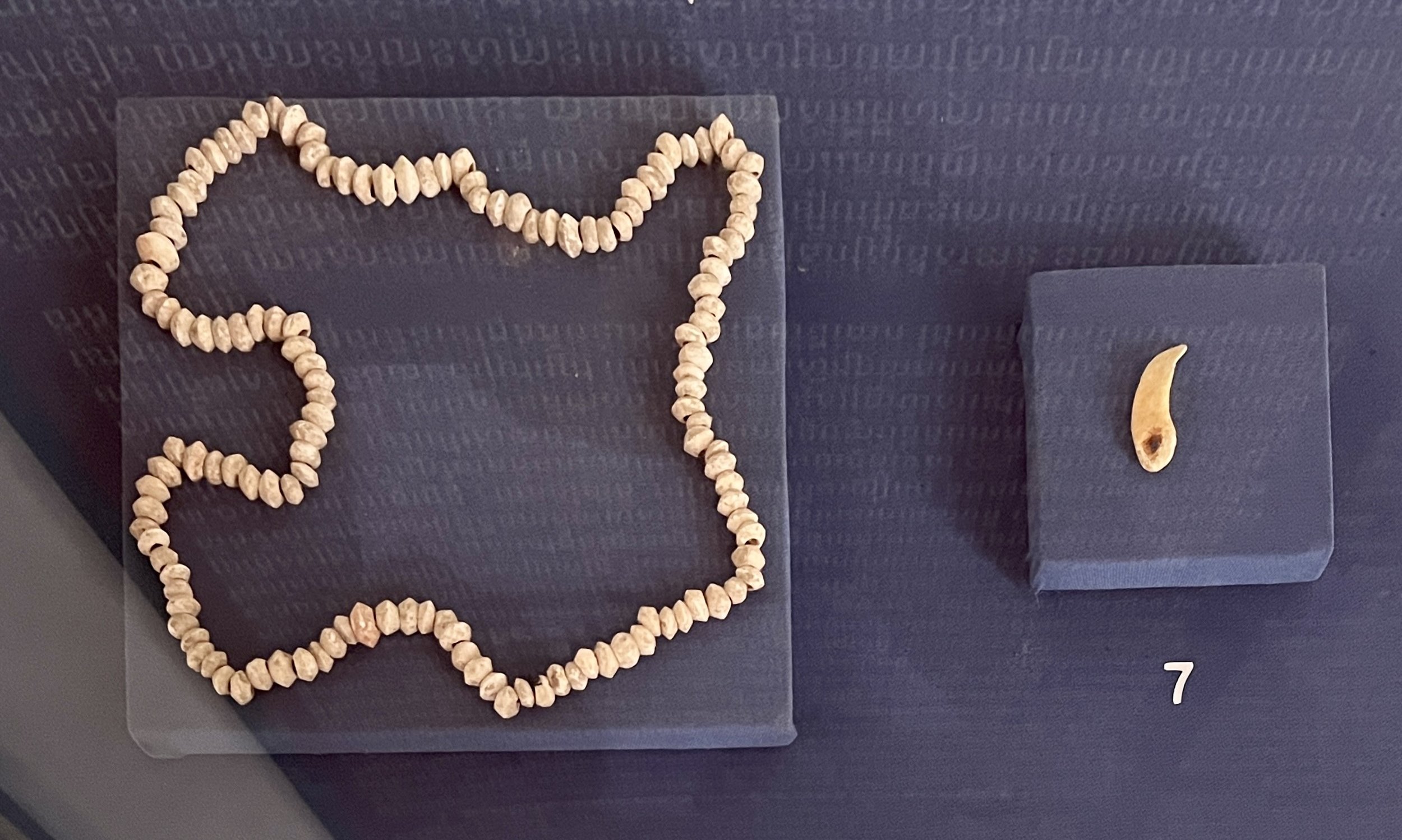
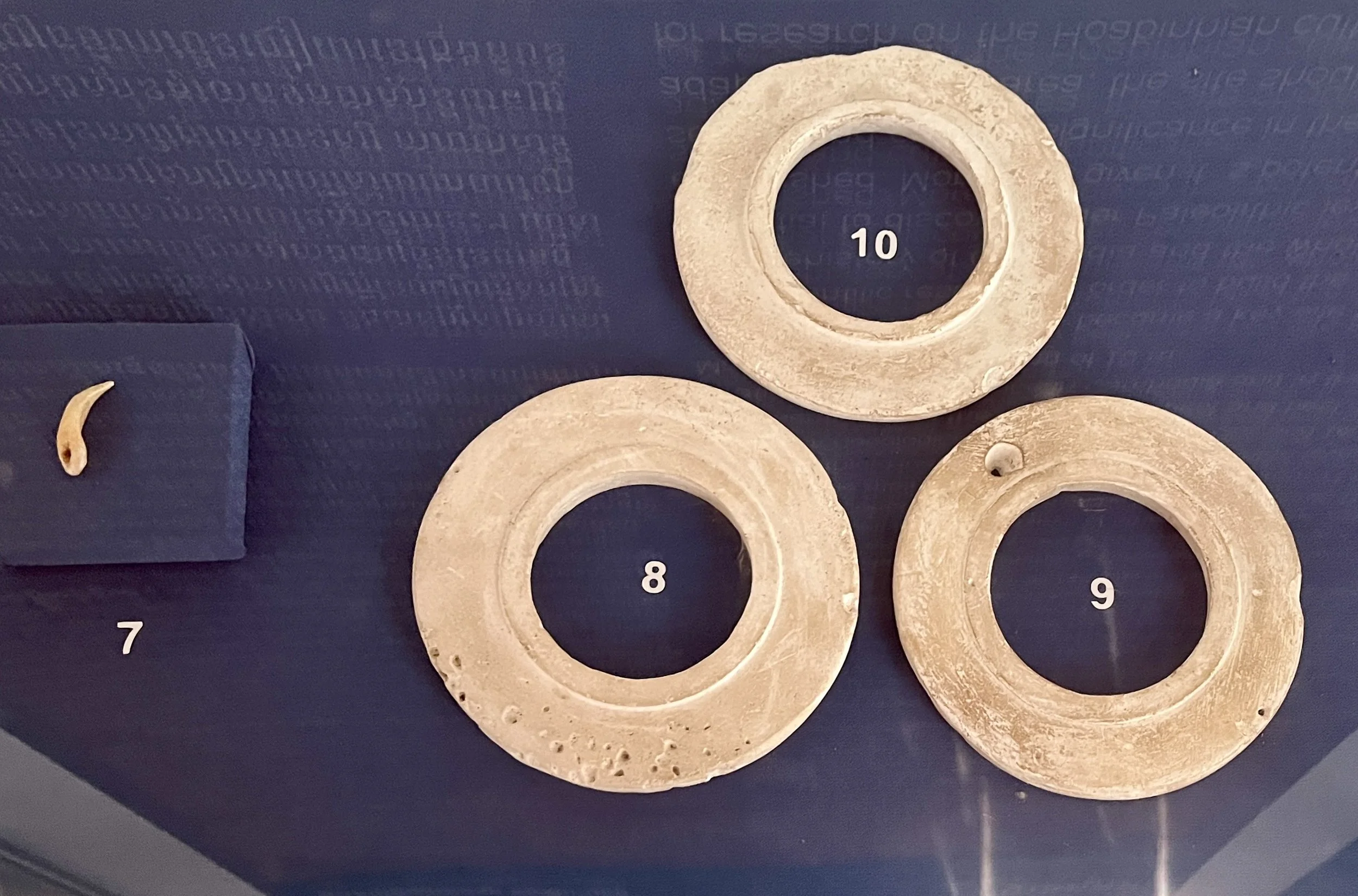
Limestone beads; pendant made from canine of wild boar

Limestone bangles


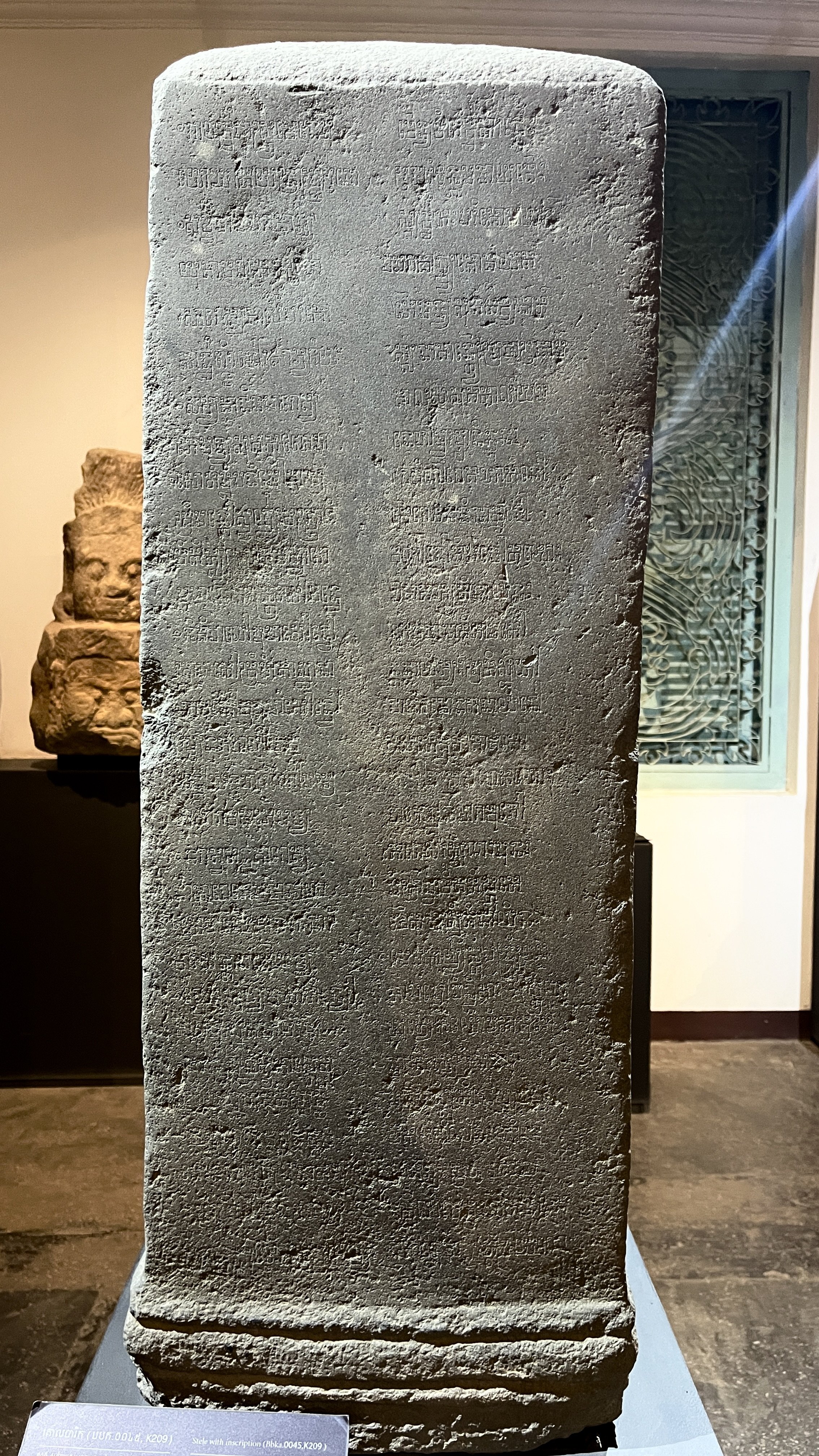
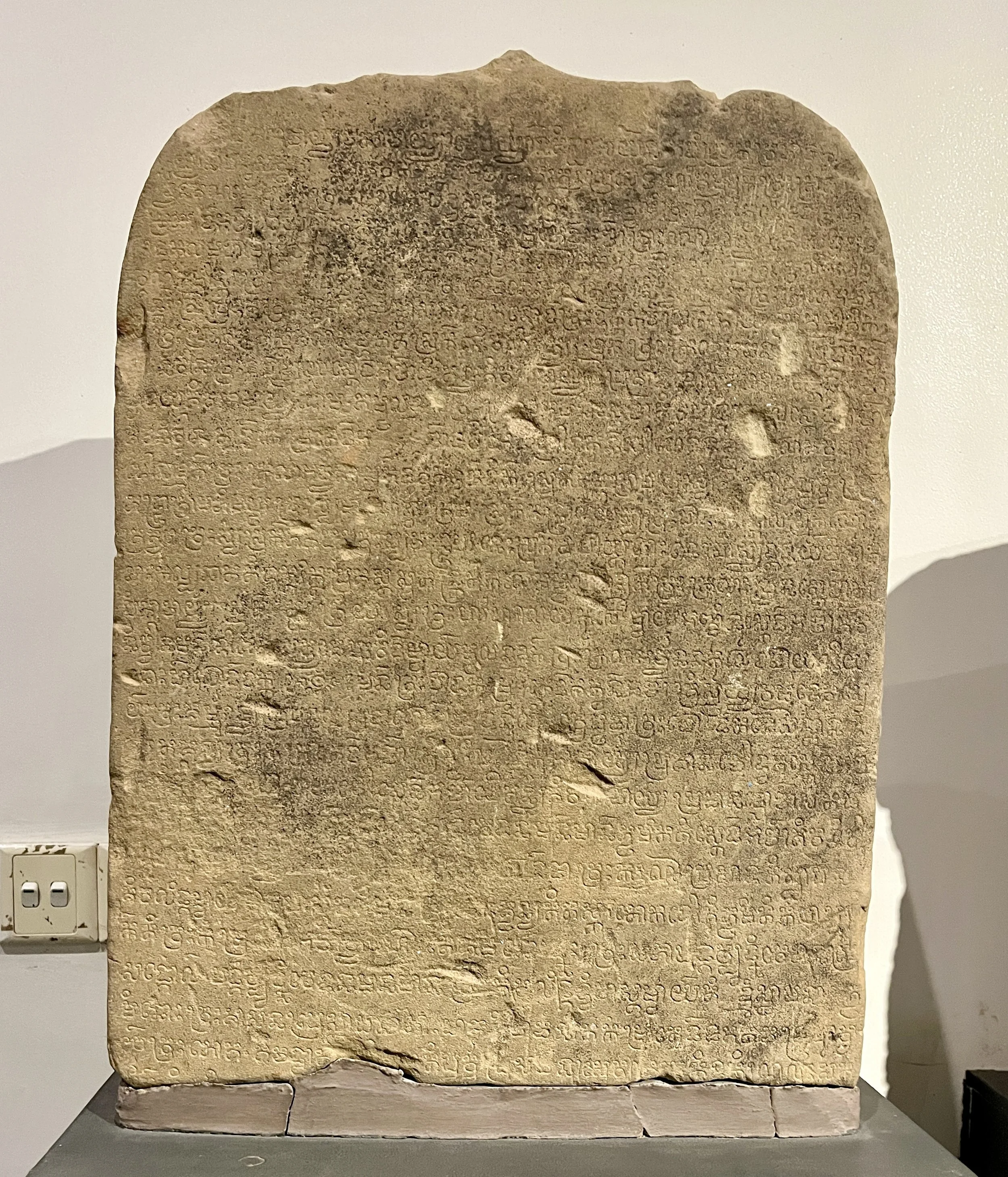
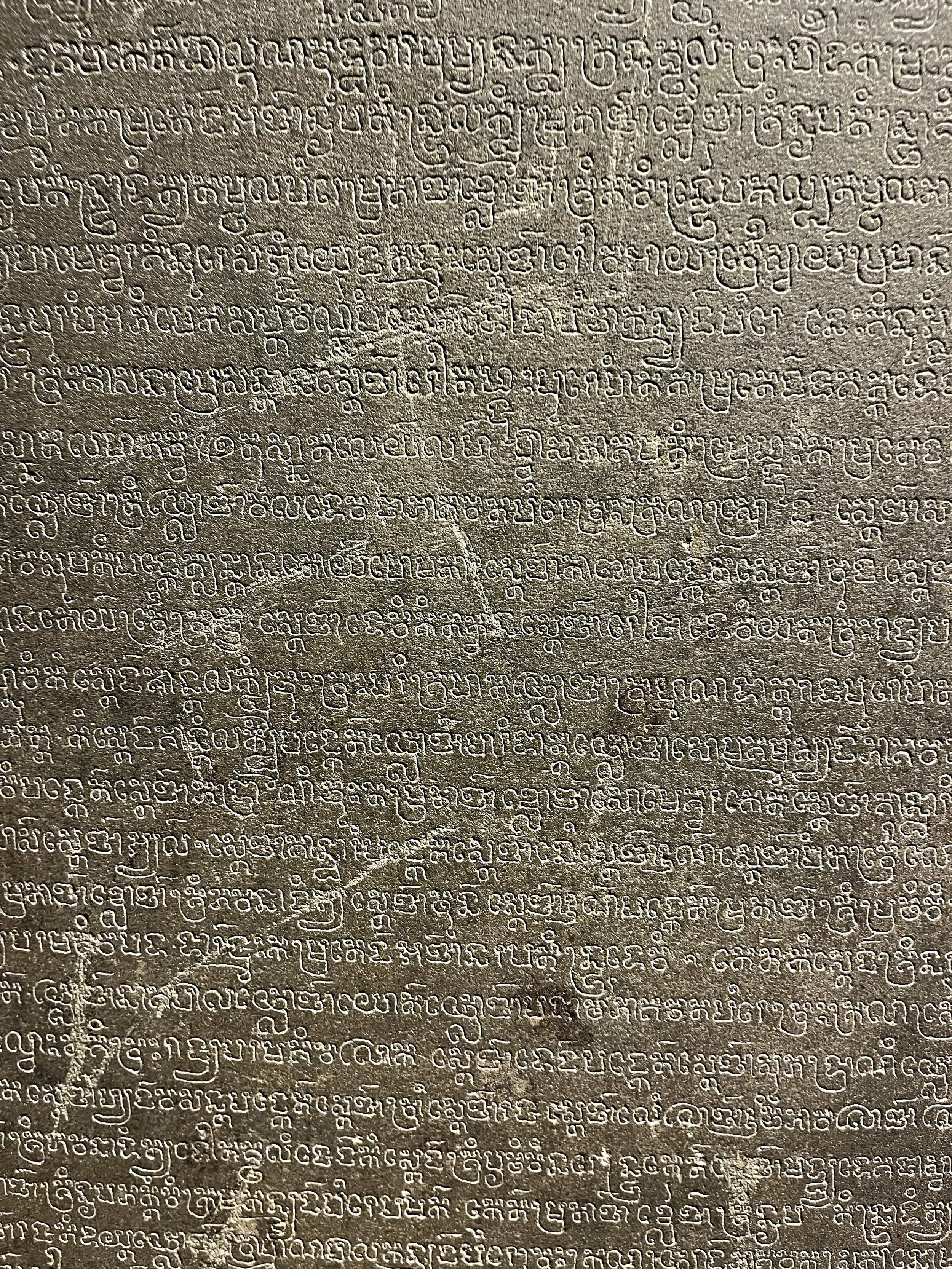
Stele with inscription

Sandstone: Angkorian period, Bayon style. 13th c.

This stele belongs to a hospital of the Jayavarman VII era, is written in sanskrit on its fours sides

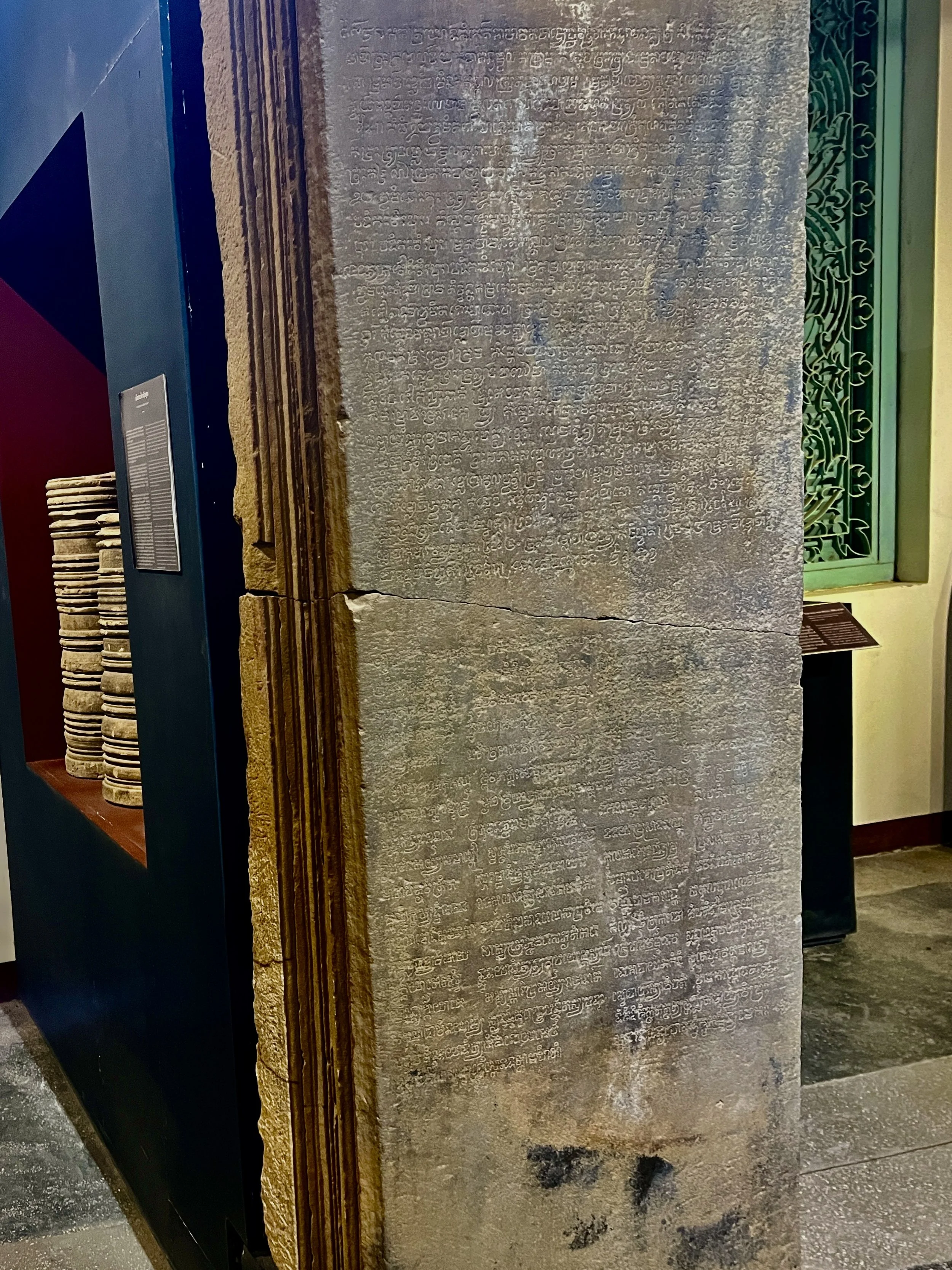
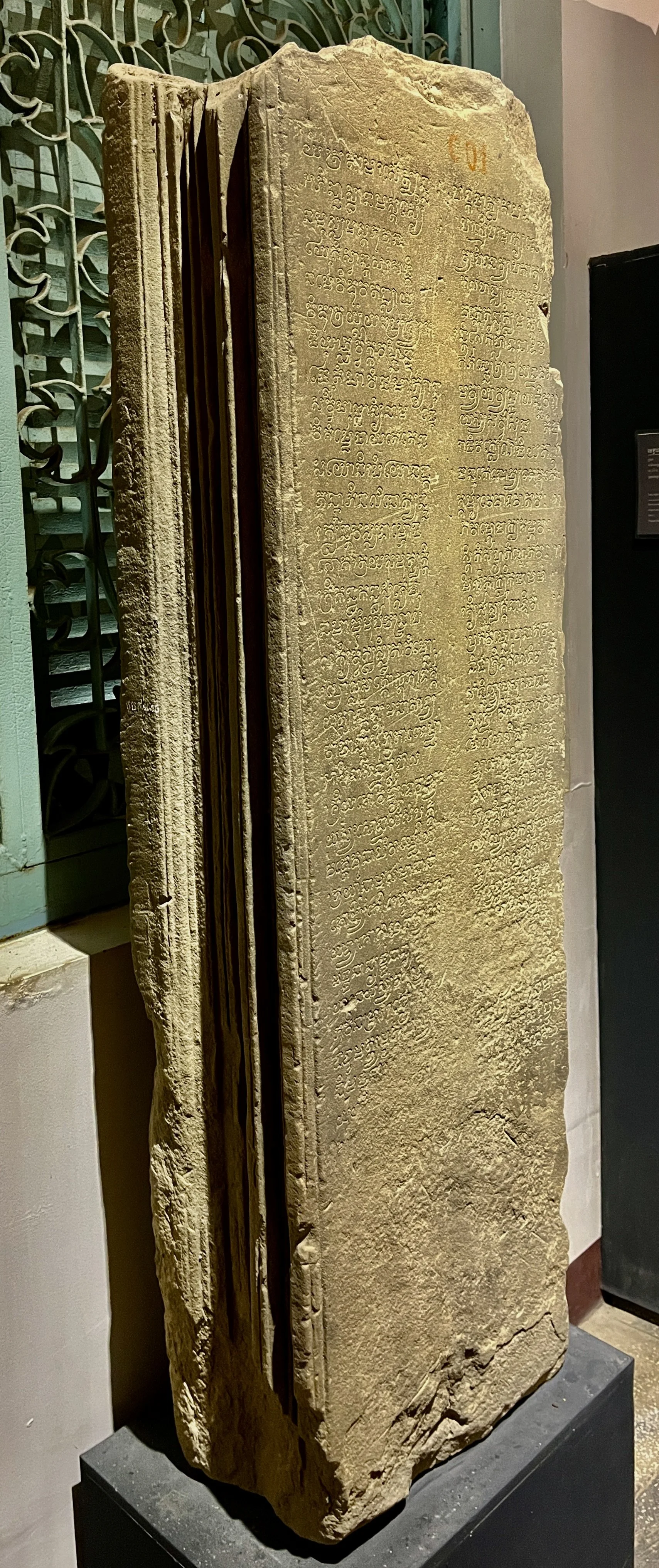
These two door frames with inscriptions are from the southern gate of Baset tower, engraved 6 years apart from one another during the reign of King Surya Varman I. They described a family of dignitaries who bought land and offered it to the gods at Cri Jaya Khsetr (the field of victory).

They are written into two languages, one has 25 lines in old Khmer and 18 lines of 16 verses in Sanskrit which is dated to 1036 A.D., the other has 45 lines engraved in old Khmer in 1042 A.D.

The old Khmer text mentions a dignitary named Frigunapativarman who purchased some of the land from five regional chiefs by exchanging it for a metal jar, metal spittoon, silver bowl, textiles, etc., offered to the god at Jayakse-tra (the field of victory). After that, he gave the land to his three children. The text also names those who perform duties in the temple and those in the court who witnessed the purchase and the boundary drawing of the land.

The Sanskrit text is a verse invoking Trimurti and describing a royal palace workshop chief named Vrah Visvakarma and his family who served King Suryavar-man I, King Udayadityavarman Il and King Harshavarman III.

Among his achievements were constructing the Western reservoir, Baphuon temple, and other palace buildings, so King Udayadityavarman II gifted his family land in the south, some gold and the title of “royal artist.”

The text of the second doorframe talks about a dignitary named Mratan, a relative of the above-mentioned Frigunapativarman, who bought some of the land from three people and their nephew with rings, gold, a large silver bowl, lots of metal, spittoons, clothes, textiles, a cart, an elephant, and a horse. The blundaries of the land are clearly described and witnesses named. After purchasing the land, he then give it to his son, titled Kamsten Asor, originally named Lon Hiraya.

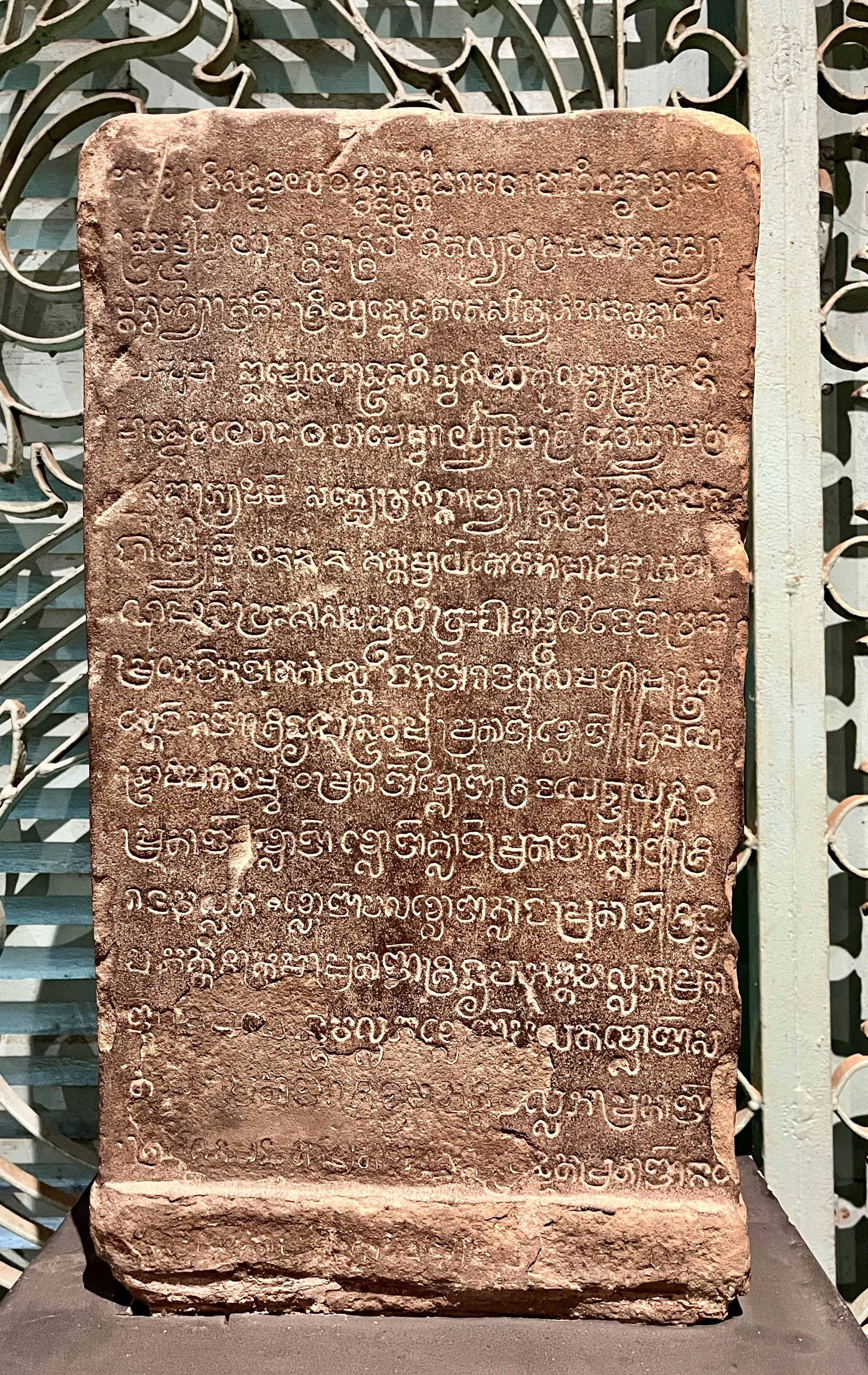
Inscription on door frame

Sandstone,

966A.D.

Dontri temple, Battambang

This stele comes from a ruined temple reported by Étienne Aymonier in 1901, which has since disappeared. It was then found back in a Buddhist monastery near the site.

Three faces are engraved; the first has six lines written in Sanskrit followed by 11 lines in old Khmer of the Angkorian period. The text in old Khmer begins on the left side (20 lines) and ends on the right side (19 lines). The introduction in Sanskrit mentions an Upendra, a nephew of King Rajendravarman's servants, Yud-dhoddhatakesari, who gave land and slaves to two gods, Paramesvara and Aryamaitri.

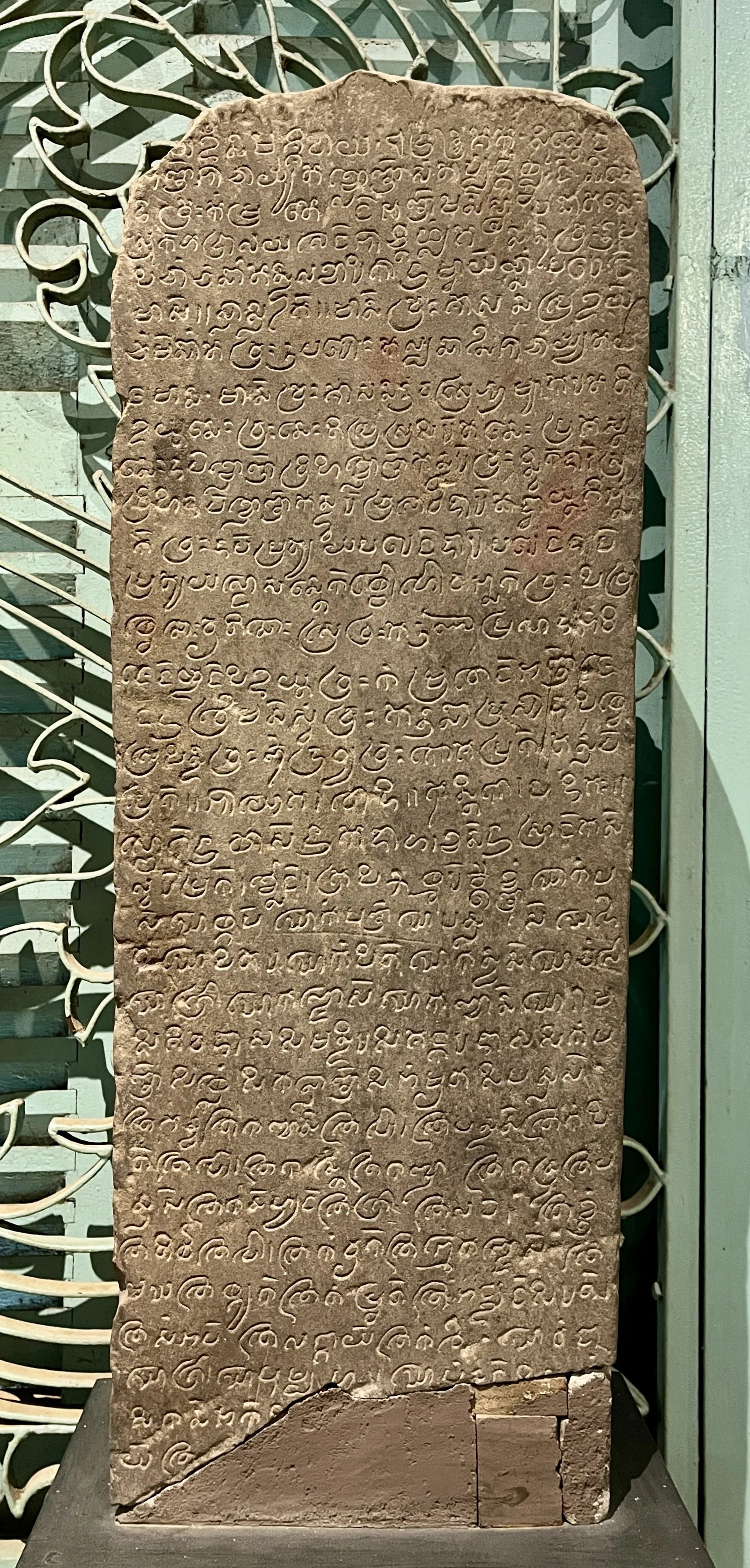
Inscription on door frame

Sandstone,

Angkorian period / 843 saka or 901 A.D.

Prei Khpos Village, Bovel District,

Battambang Province

Apart from a brief Sanskrit invocation to the God Siva, the text is entirely in Old Khmer. It informs us that in year 901 of our era, an "Acarya" (master) asked for the king's agreement to found community and a temple called Bhadralaya, the foundation accompanied by a supply of rice, oil and areca nut for offerings dedicated to the divinity of the sanctuary.

From line 9, this foundation is confirmed by a royal order which exempts the property of this foundation and certifies its ownership. It is also ordered to install this inscription to publicize this royal decision. From line 14 to the end, the text indicates that the king has handed over rice paddies located along the river and forest plots intended for rice cultivation for the foundation. There are still more mentioned gifts, of clothing, objects of worship (a large water vase, a teapot, a pitcher, a tray, a bowl), cattle, and slaves– men and women whose names are specified.

It should be noted that the gift of a kosa, a term that often refers to sheaths intended to cover the linga, confirms that the shrine was dedicated to Siva.

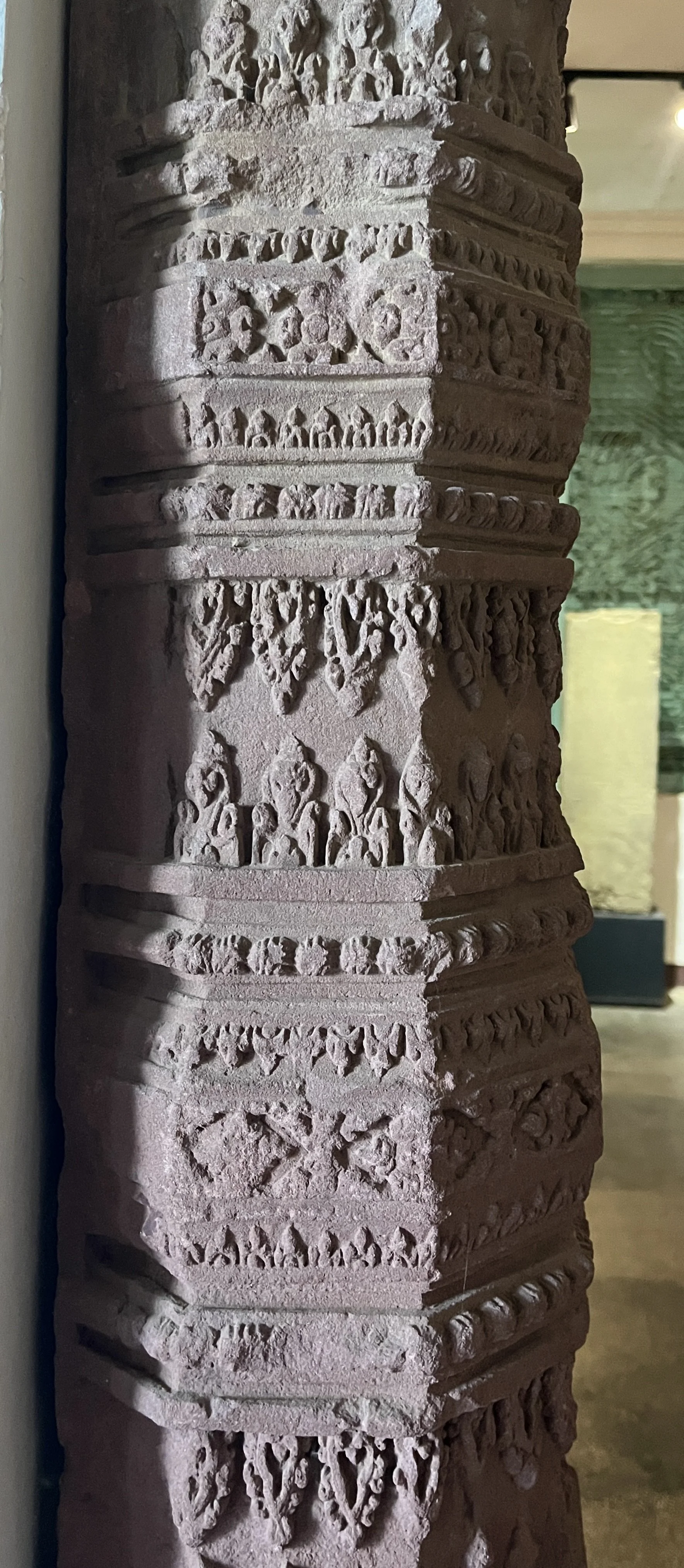
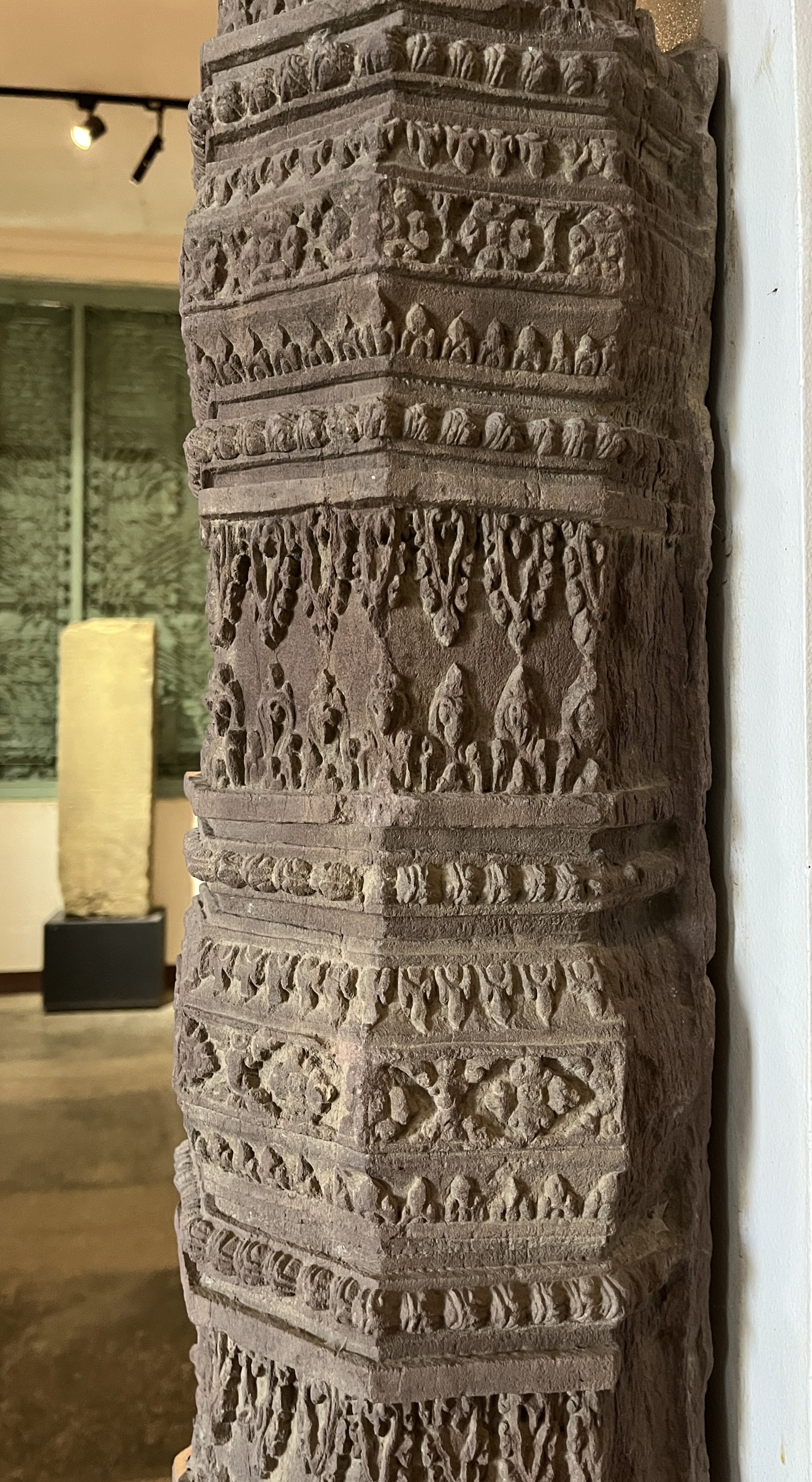
Fragment of Column

The colonette is an essential element in temple architecture to support lintels. A colonette is divided into three sections; the capital, shaft and base. In the pre-Angkorian period, the column has a round shape, while in the Angkorian period it is either heptagonal or octagonal in shape, usually with a square-shaped capital and base carved with different motifs, or in an animal shape, or depicting an episode of a myth.

Colonette

Sandstone

Angkorian period, Koh Ker style,

10th C.?

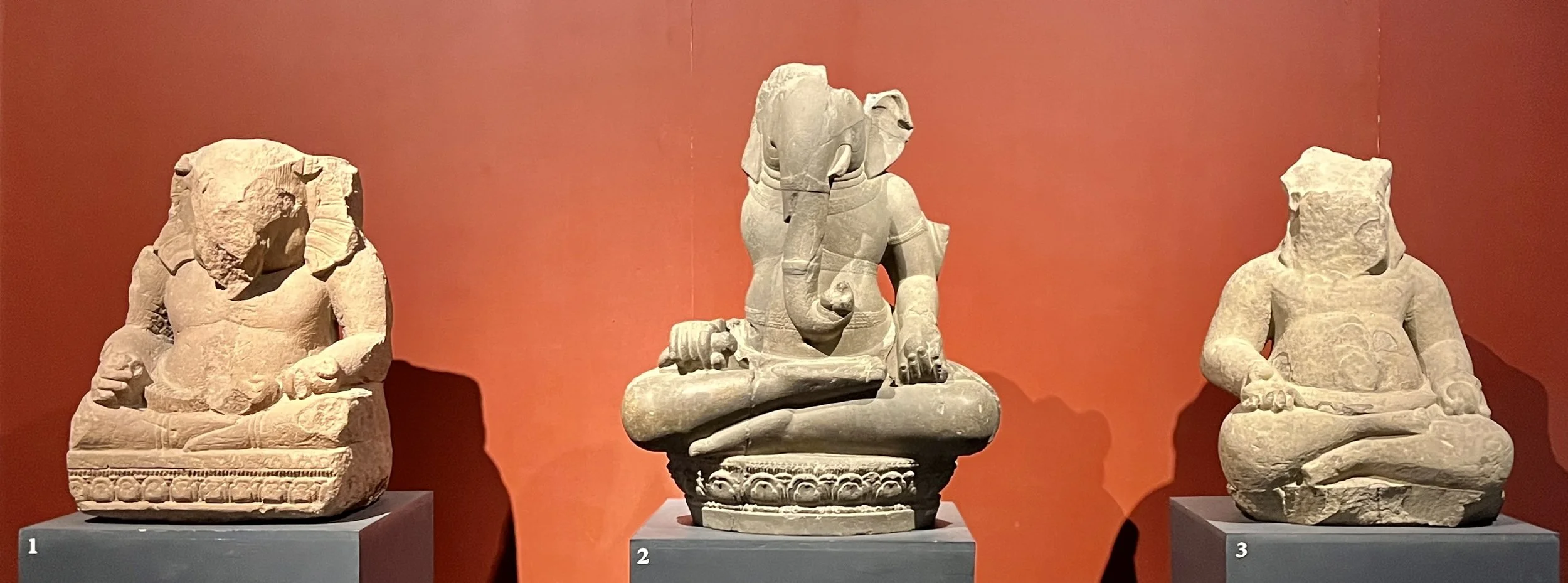
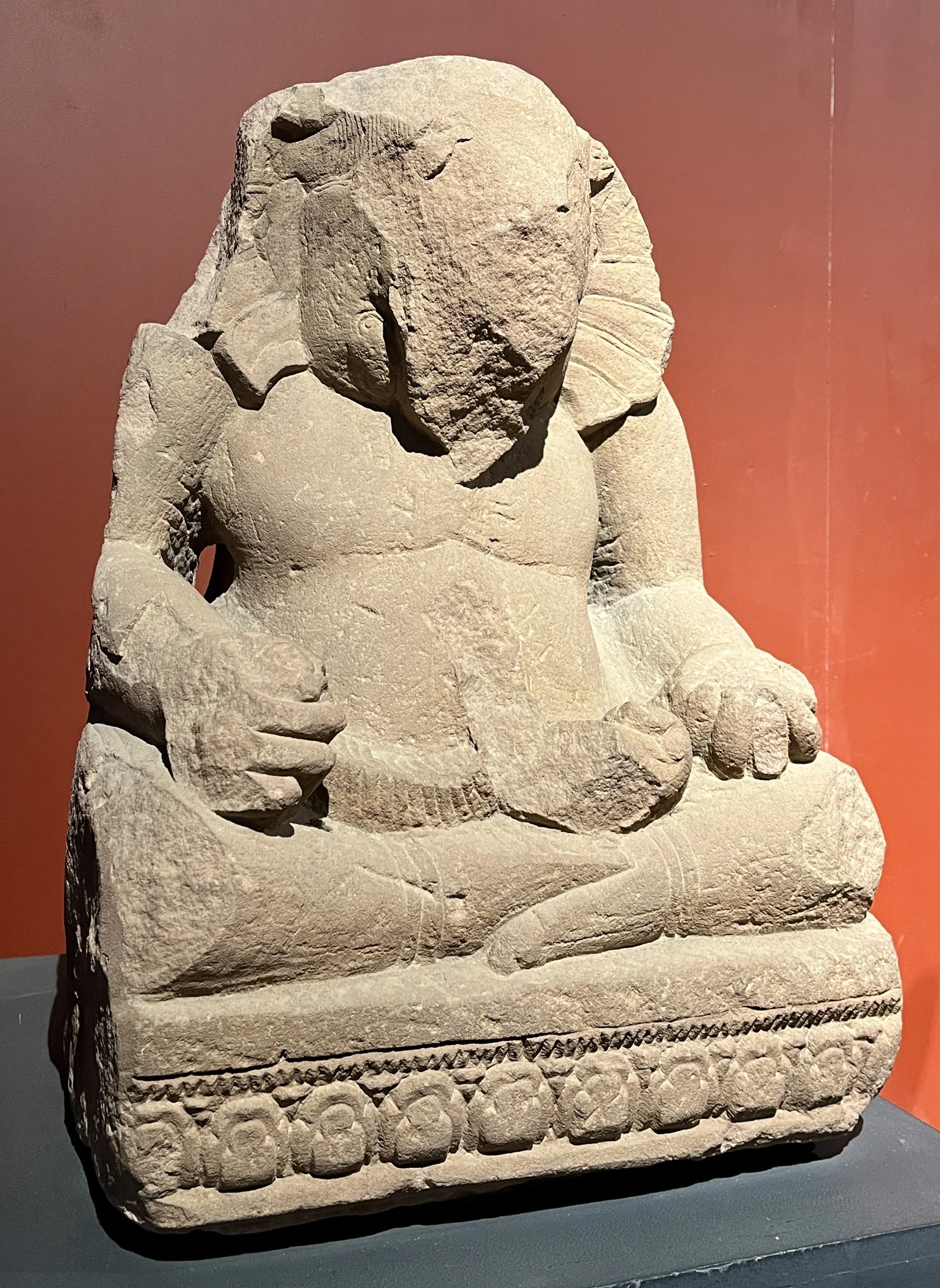
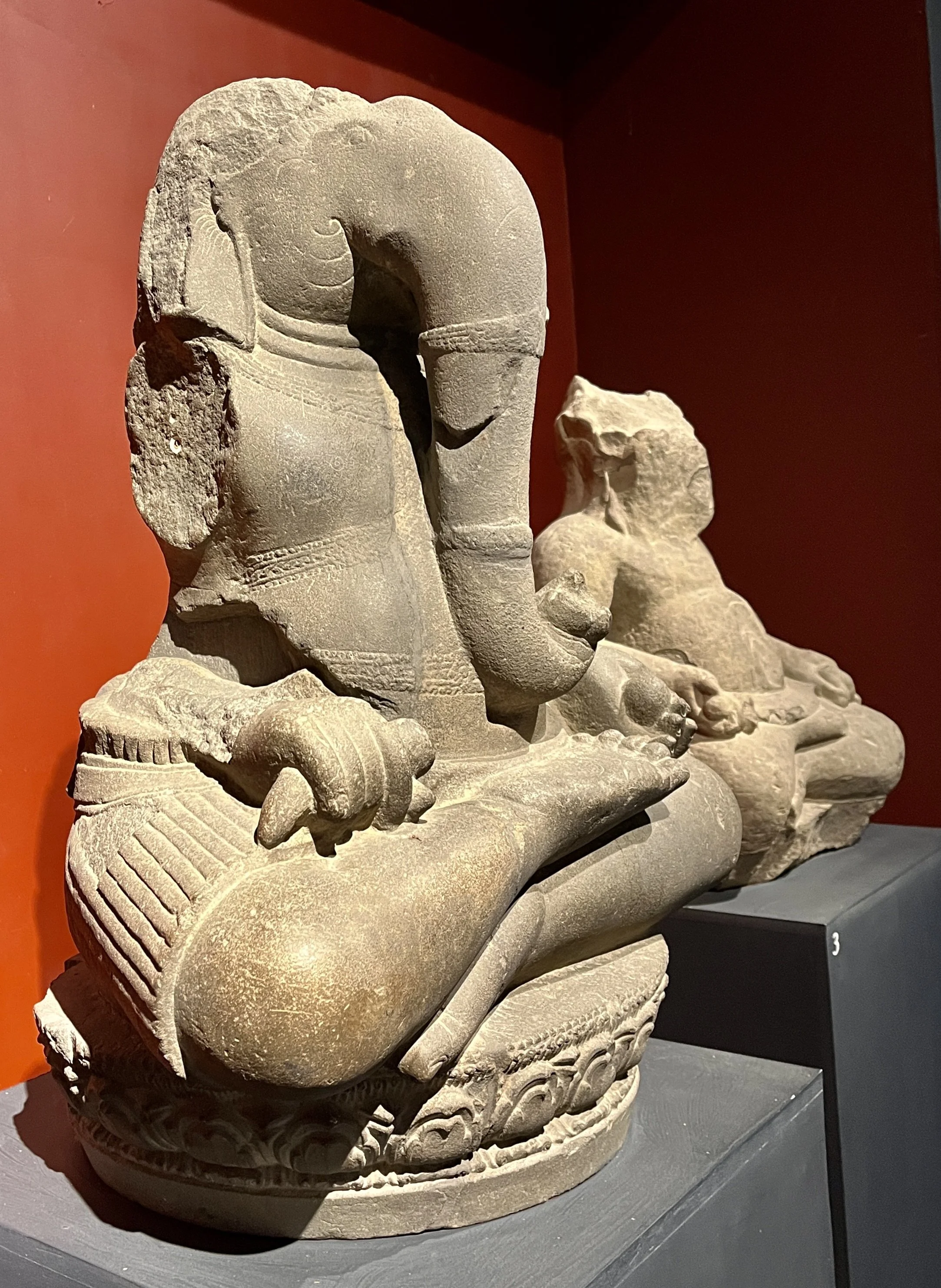
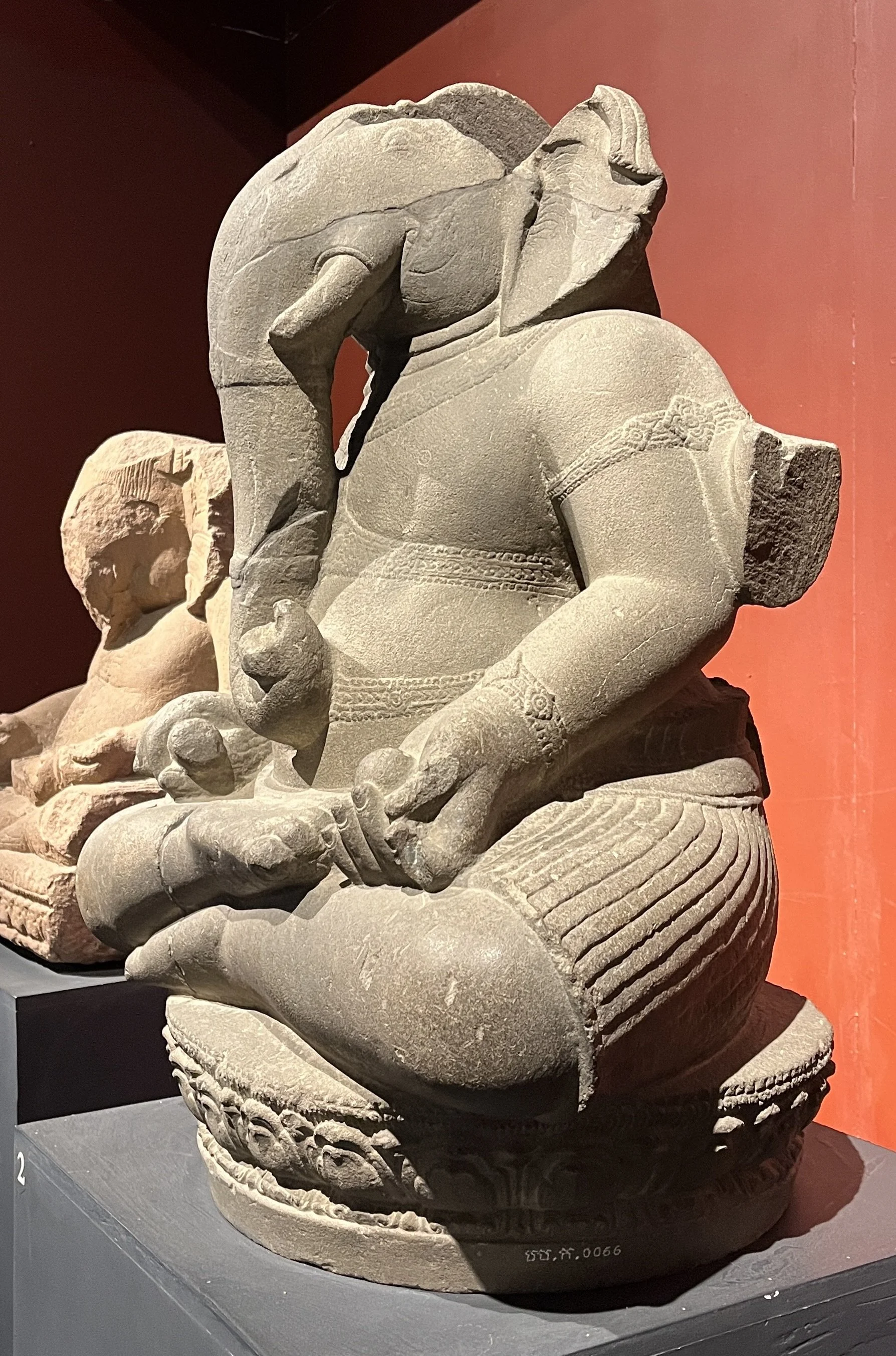
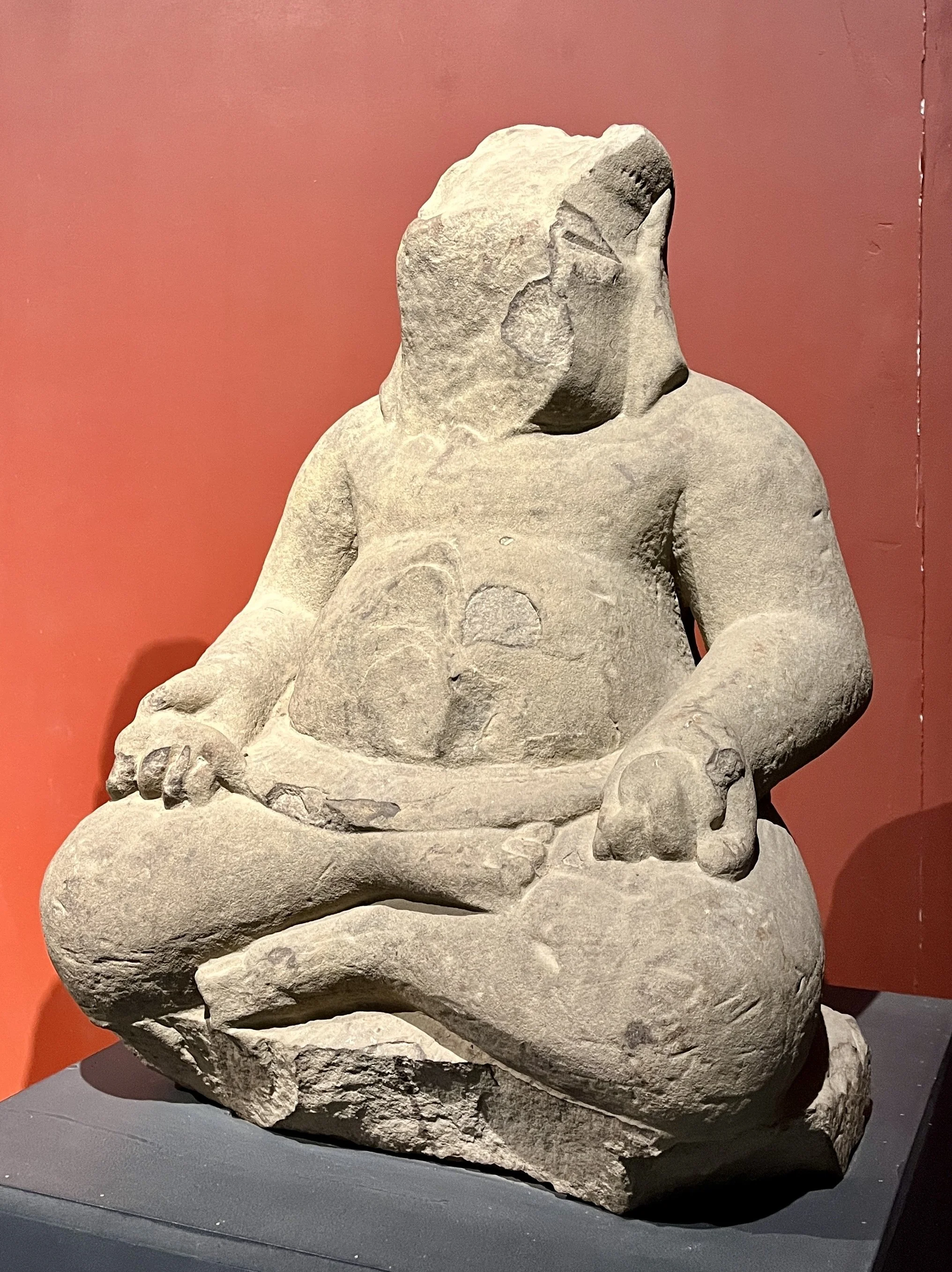
Ganesha

The Ganesha is a deity with the body of a human and the head of an elephant. He is generally known as the remover and creator of obstacles, the lord master of intellect, wisdom, science, and art. He is the most prestigious and the most honored God in various ritual ceremonies. The depiction of Ganesha in stone began in India in the first century BC. Ever since, his role and importance in society have continuously grown in India and Southeast Asia.

Images of Ganesha have appeared in sculpture in the round and in reliefs on walls and other architectural elements of ancient Khmer temples since the Pre-Angkor period, 6thC., onward. He was usually presented in either seated or standing posture with two, four or eight arms.

These three Ganesha probably date to the 10th c. A.D. Only the Ganesha in the middle is Koh Ker style, identifiable by its ornaments such as the necklace, torso belt, abdomen belt, armbands, bracelets and his cloth. The damage and lack of noticeable features such as garments and ornaments prevent the style analysis of the other two Ganesha.

Ganesha Left

Sandstone, Style: (?),

10ch to 11th centuries (?)

Ganesha Middle

Sandstone, Koh Ker first half of 10th century

Ganesha Right

Sandstone, Angkorian period

10th C. (?)

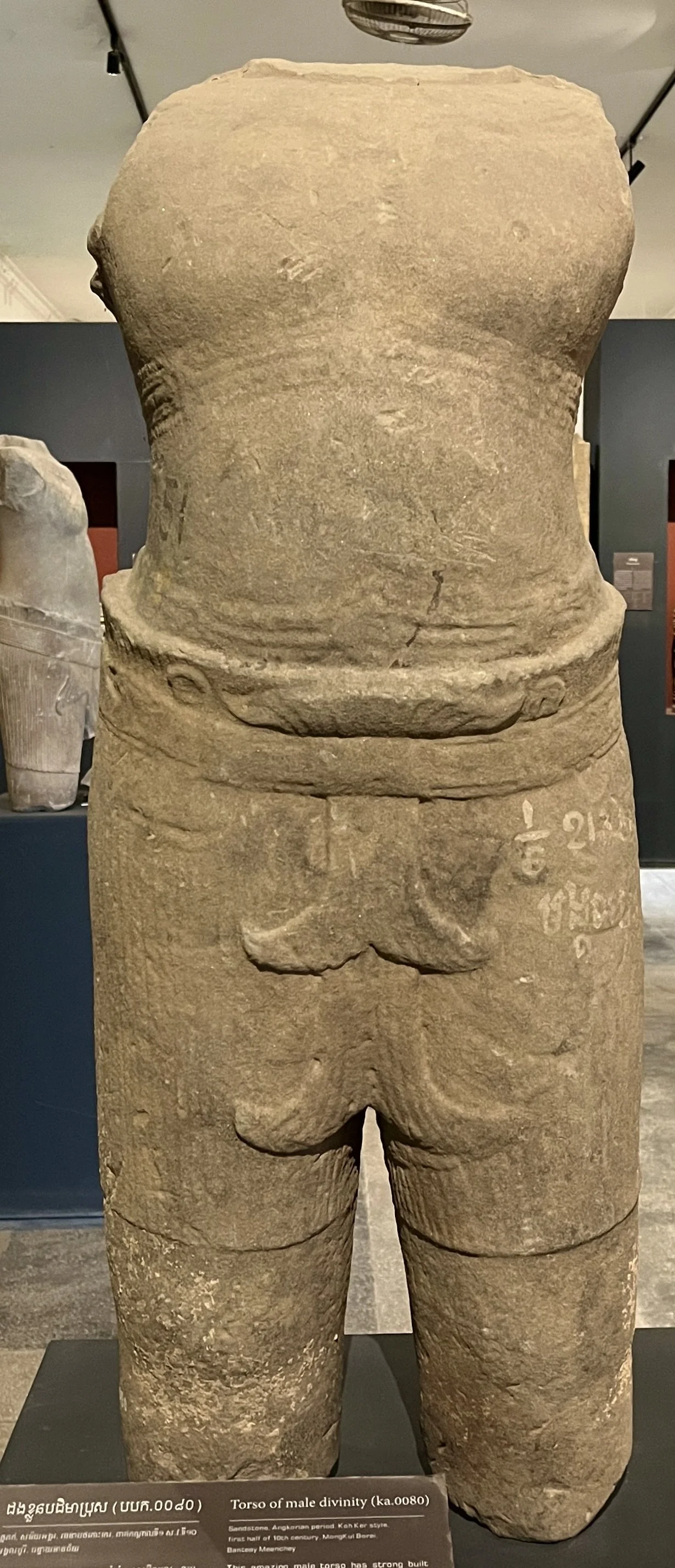
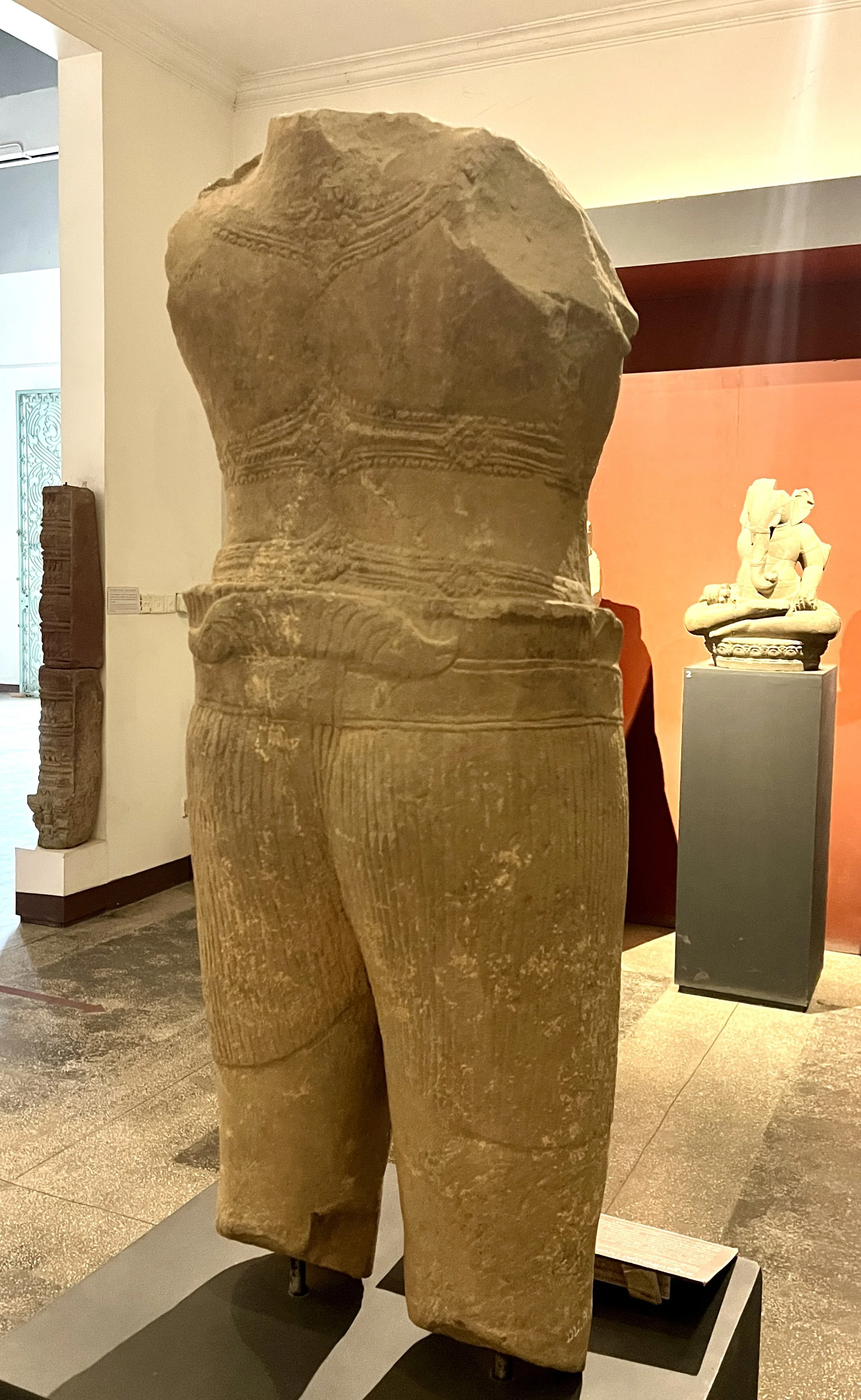
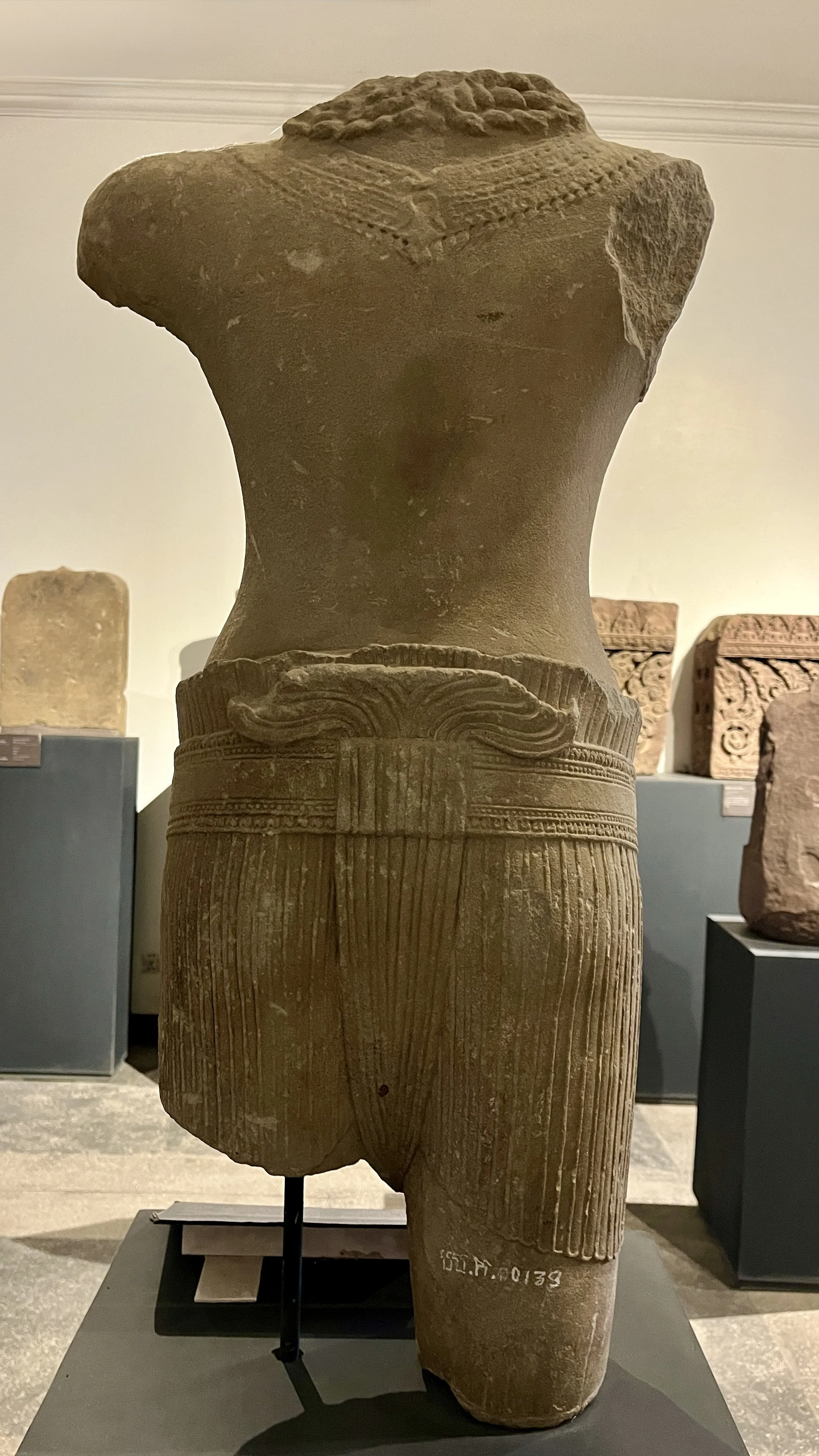
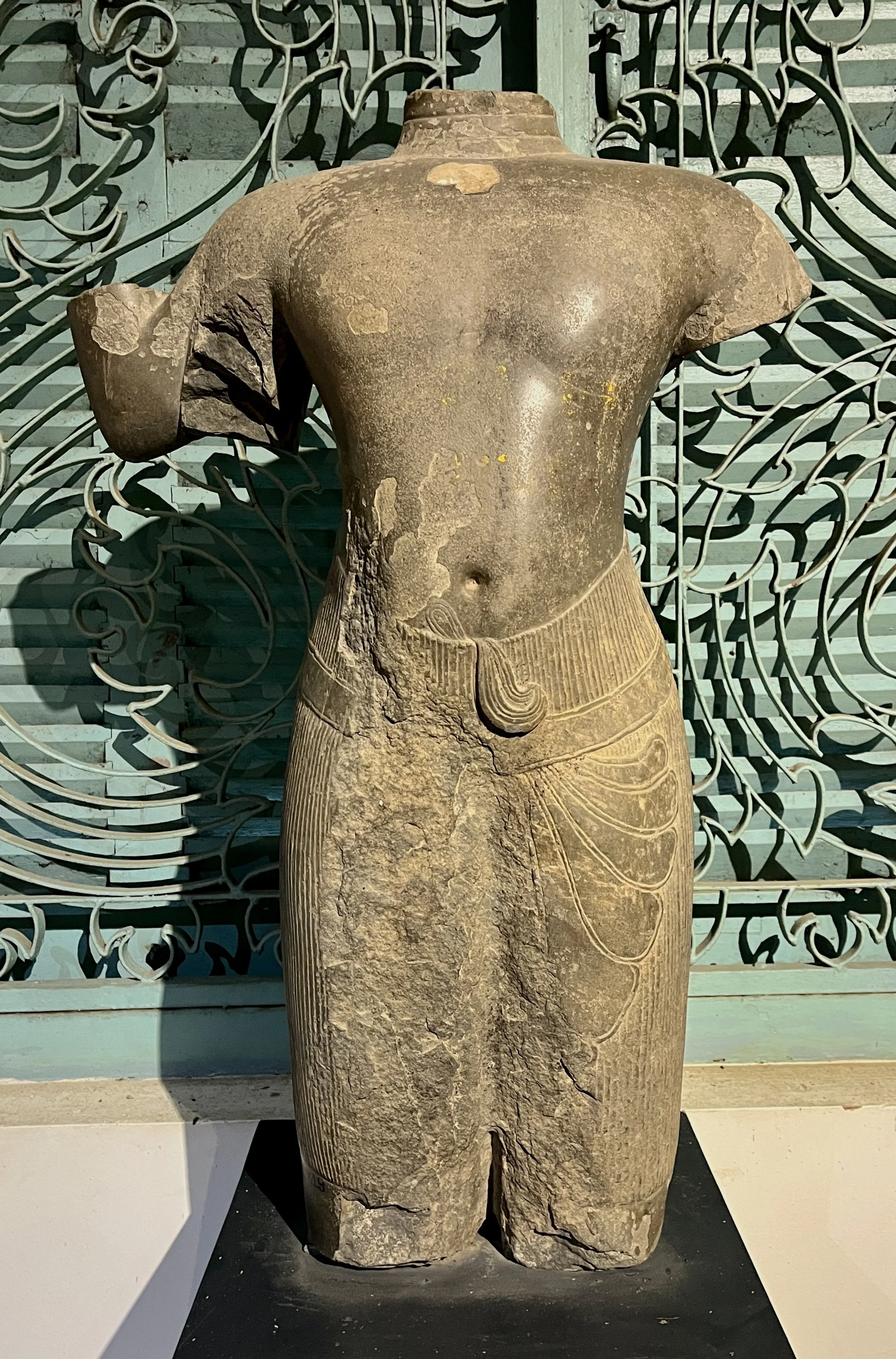
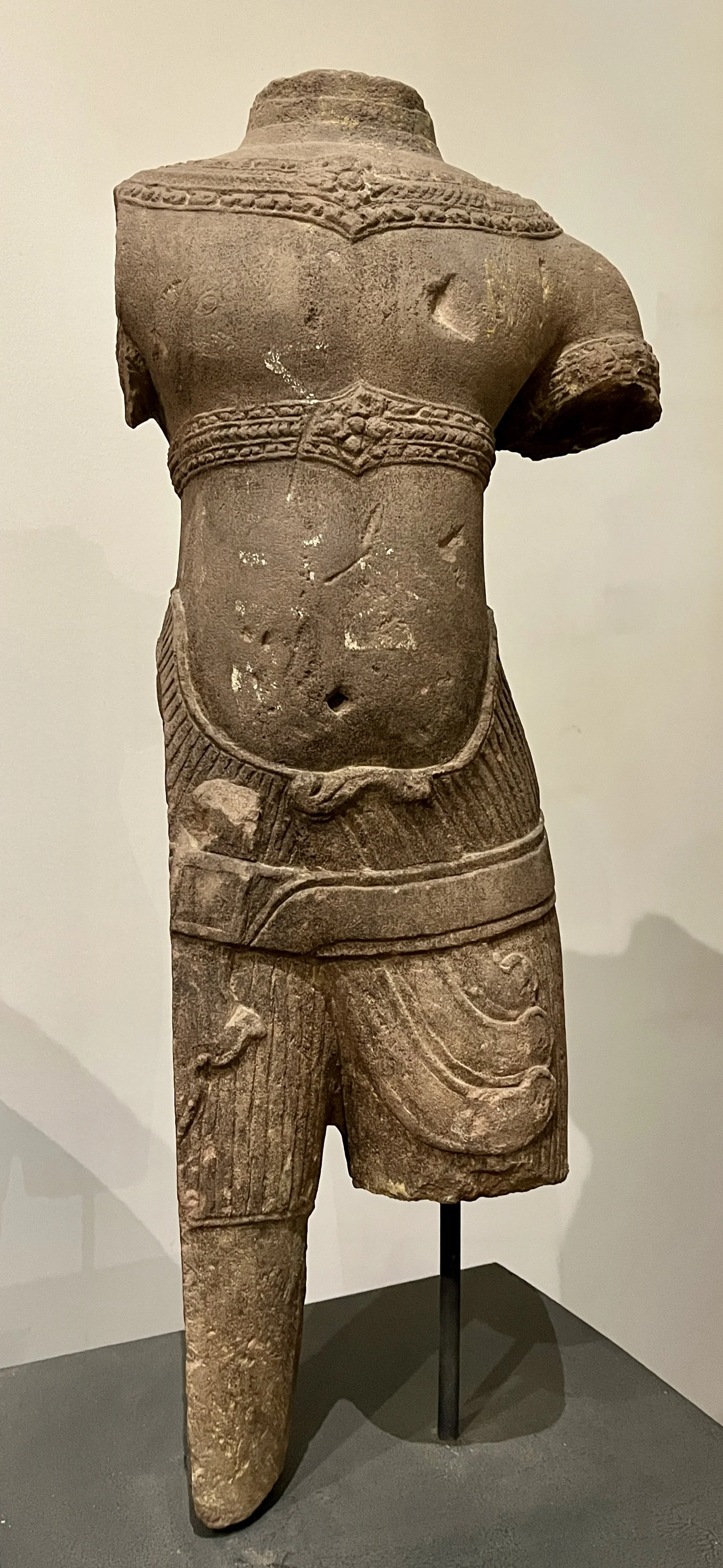
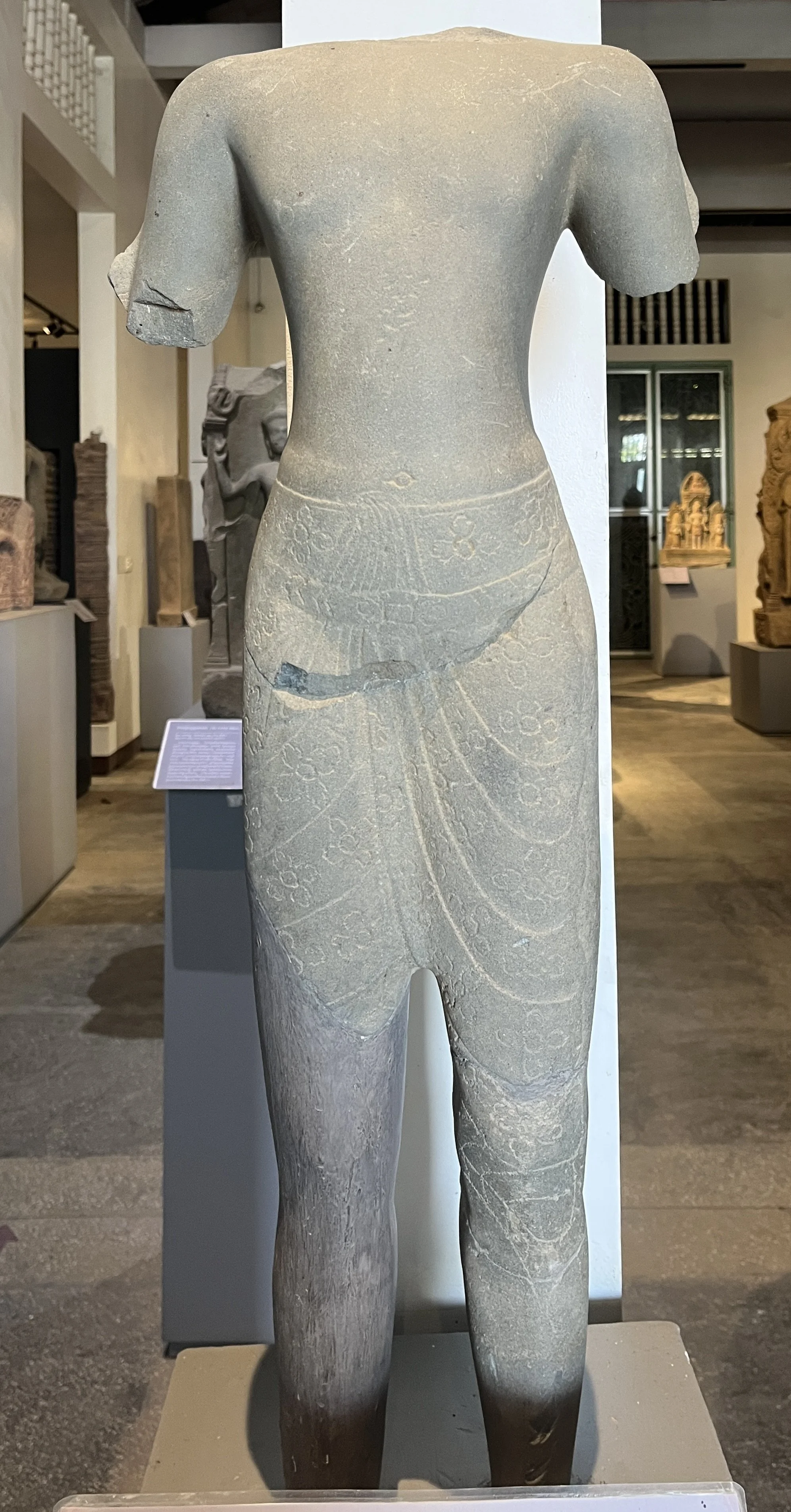
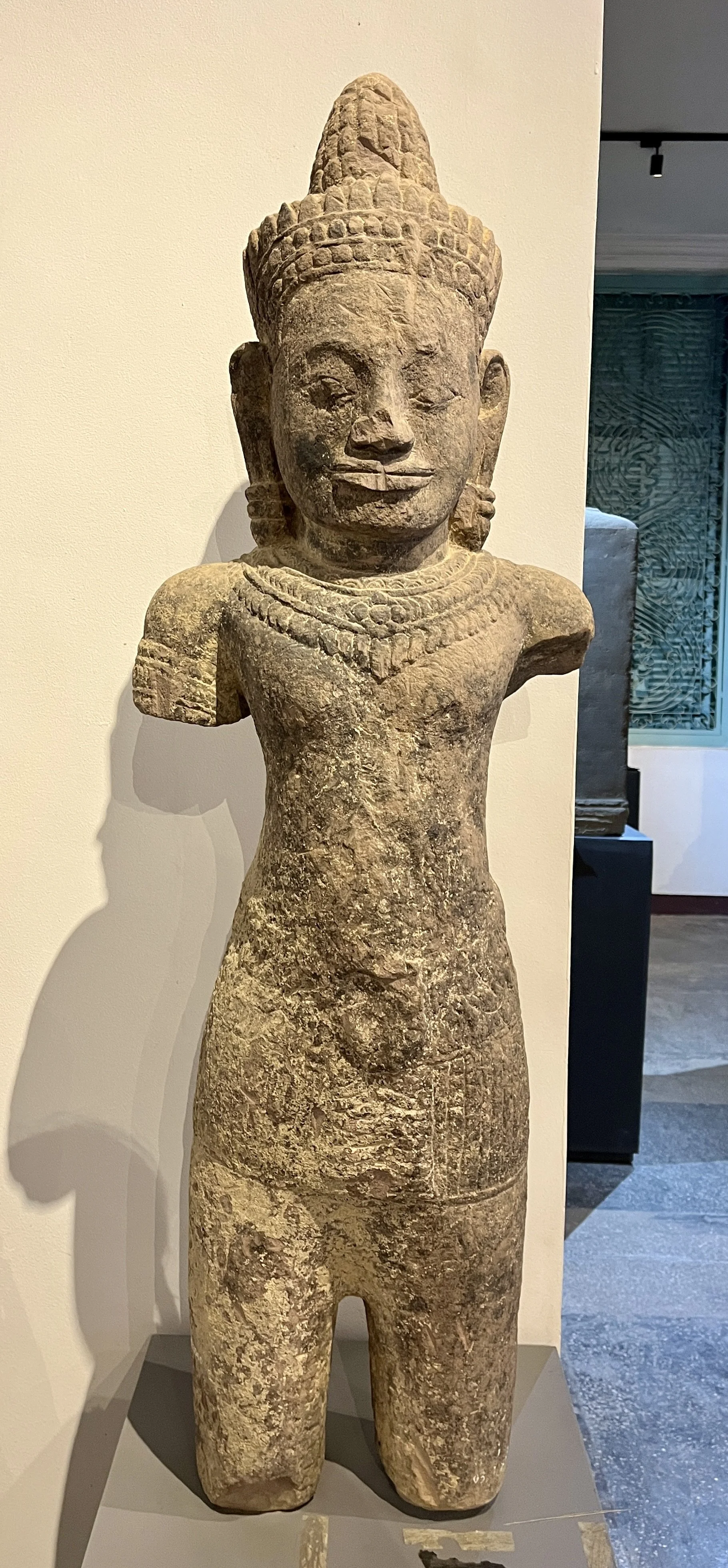
Torso of male divinity

Sandstone, Angkorian period, Koh Ker style, first half of 10th century, MongKul Borei, Banteay Meanchey

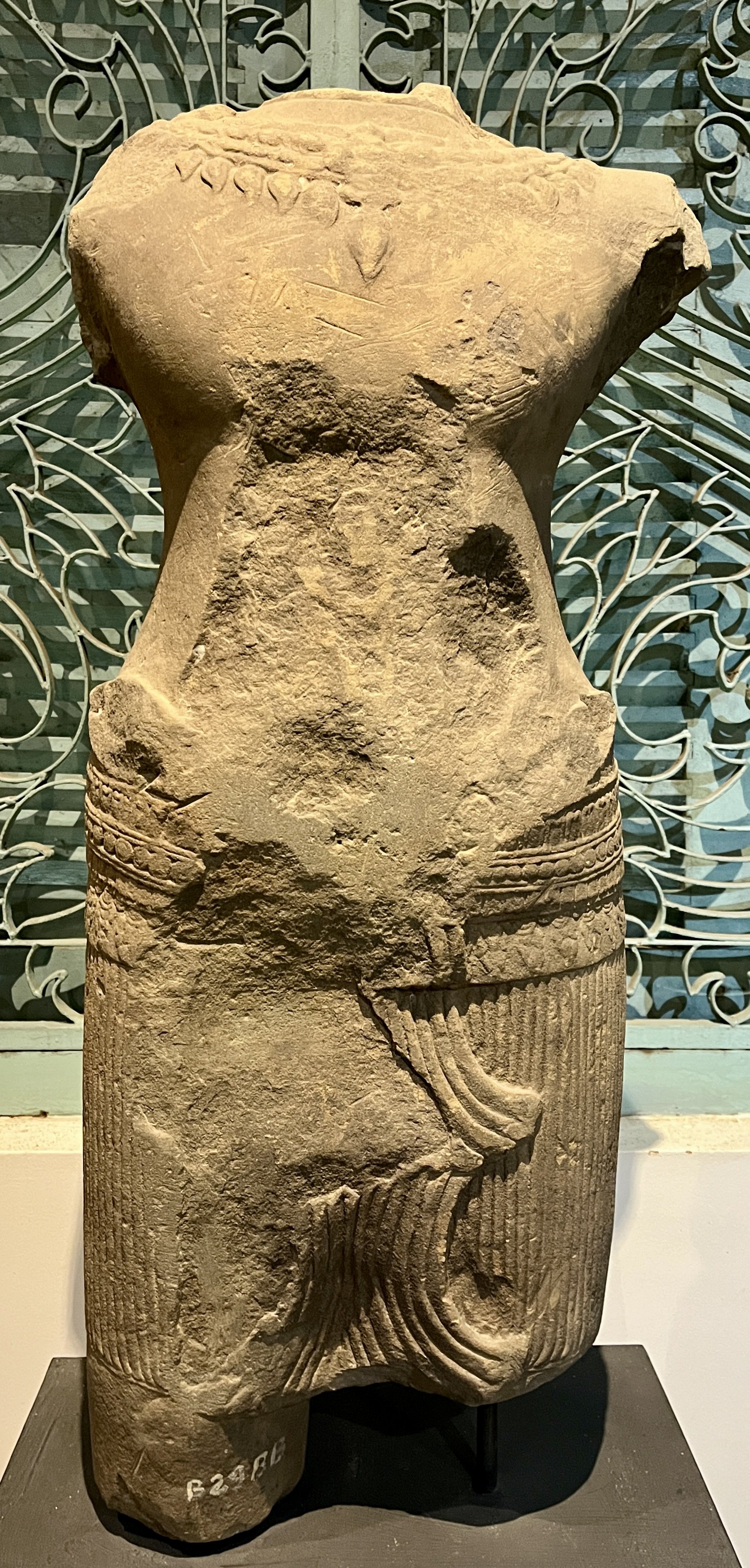
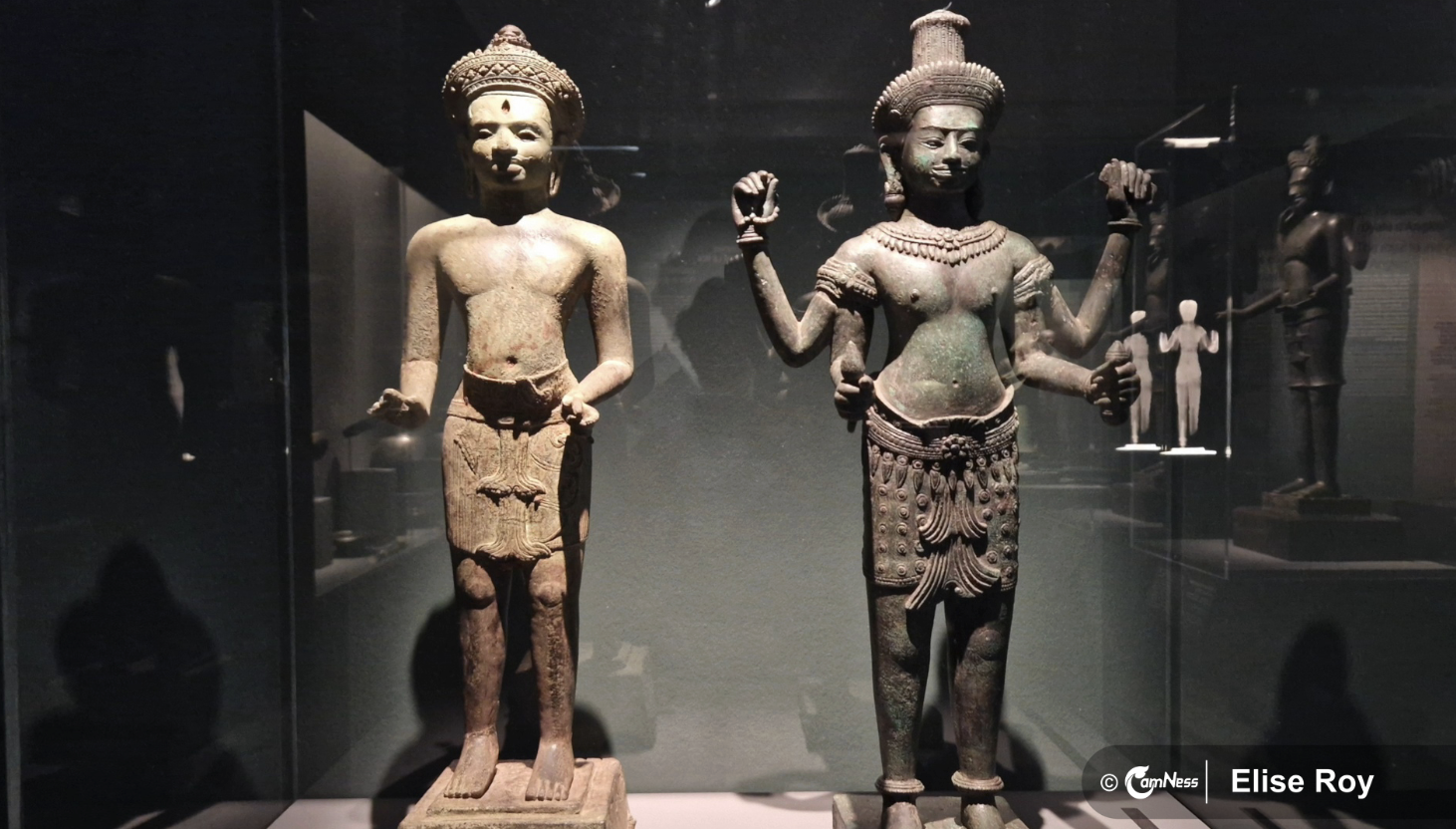
This amazing male torso has a strongly built body with broad shoulders. (editors note: AMaaayaYSSZinng/s. these descriptions are so repetitive, superficial, and even sexist, it’s annoying.) He is decorated with beautiful jewelry such as necklace, chest and waist band. He wears a short pleated skirt, Sampot Can Kbin, fastened with a plain belt of which both ends are folded ins such a way that the edges fall to form a fish tail shape on the upper part of both thighs. Below the belt, on the left thigh, a large piece creates a pleated eggplant like shape (again, editor’s note: they keep using ‘fishtail’, ‘eggplant’ and ‘oyster’ to describe common depictions of folds and knots; I have no idea if that’s standard but have never read such things elsewhere). At center, a separate folded cloth forms a double fish tail, with the shorter one overlaying the longer one.

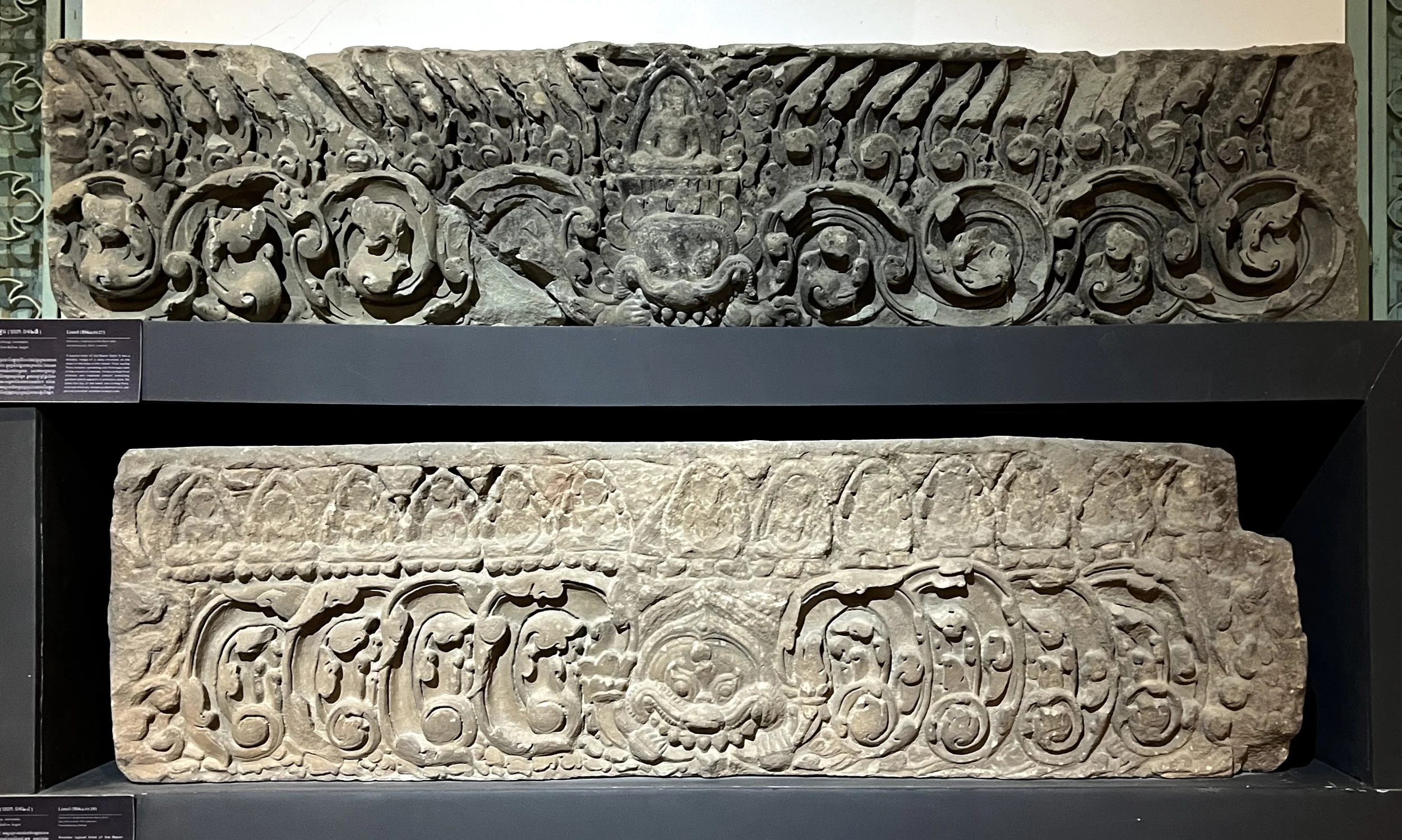
bottom lintel:

Sandstone, Angkorian period, Bayon style late 12th to early 13th centuries

Prasat Bantnay Chhmar

Another typical lintel of the Bayon Style, It has a heraldic image of a large Kala head in the center. Four curling flora protrude from the Kala on each side. The frieze has a row of ascetics, each seated on a lotus throne.

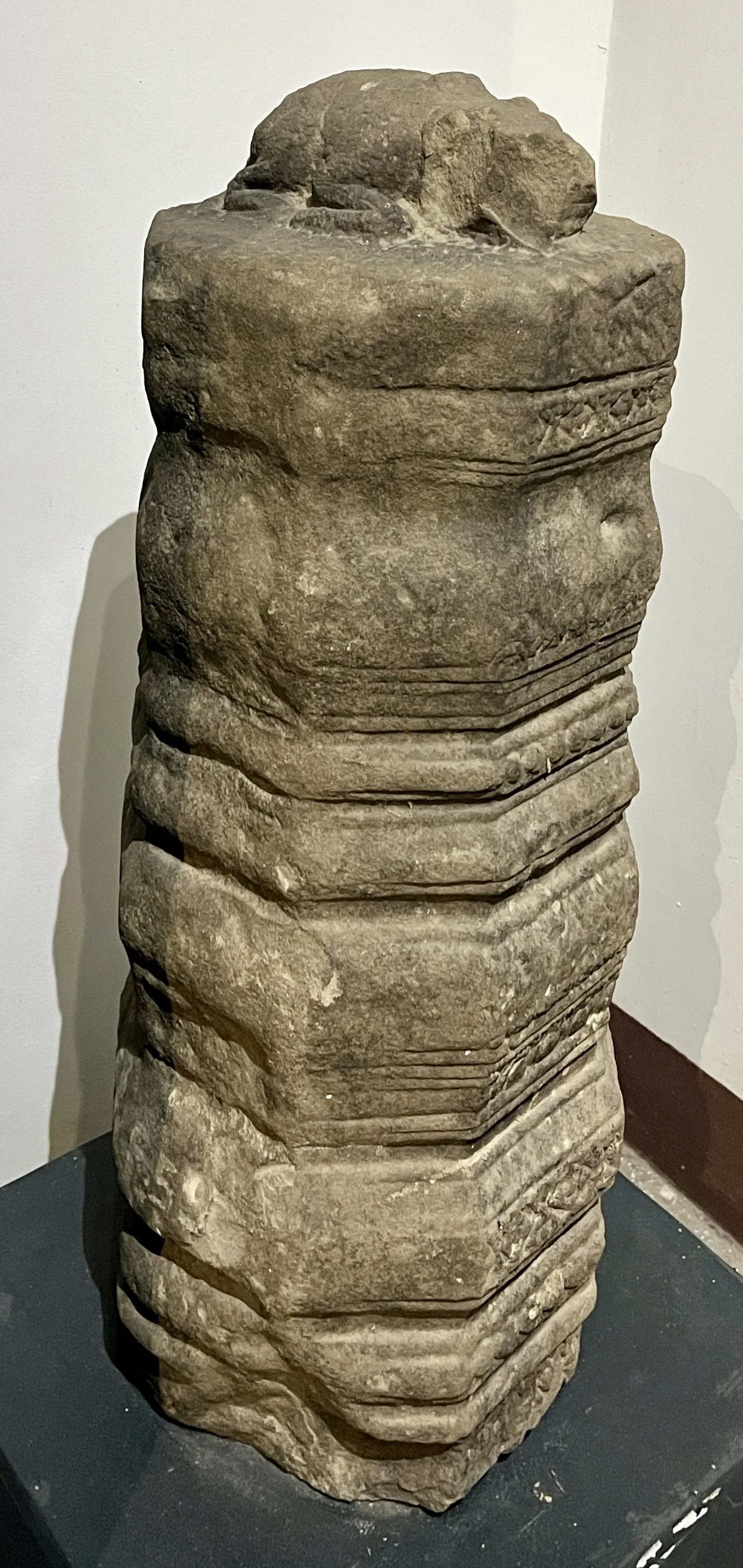
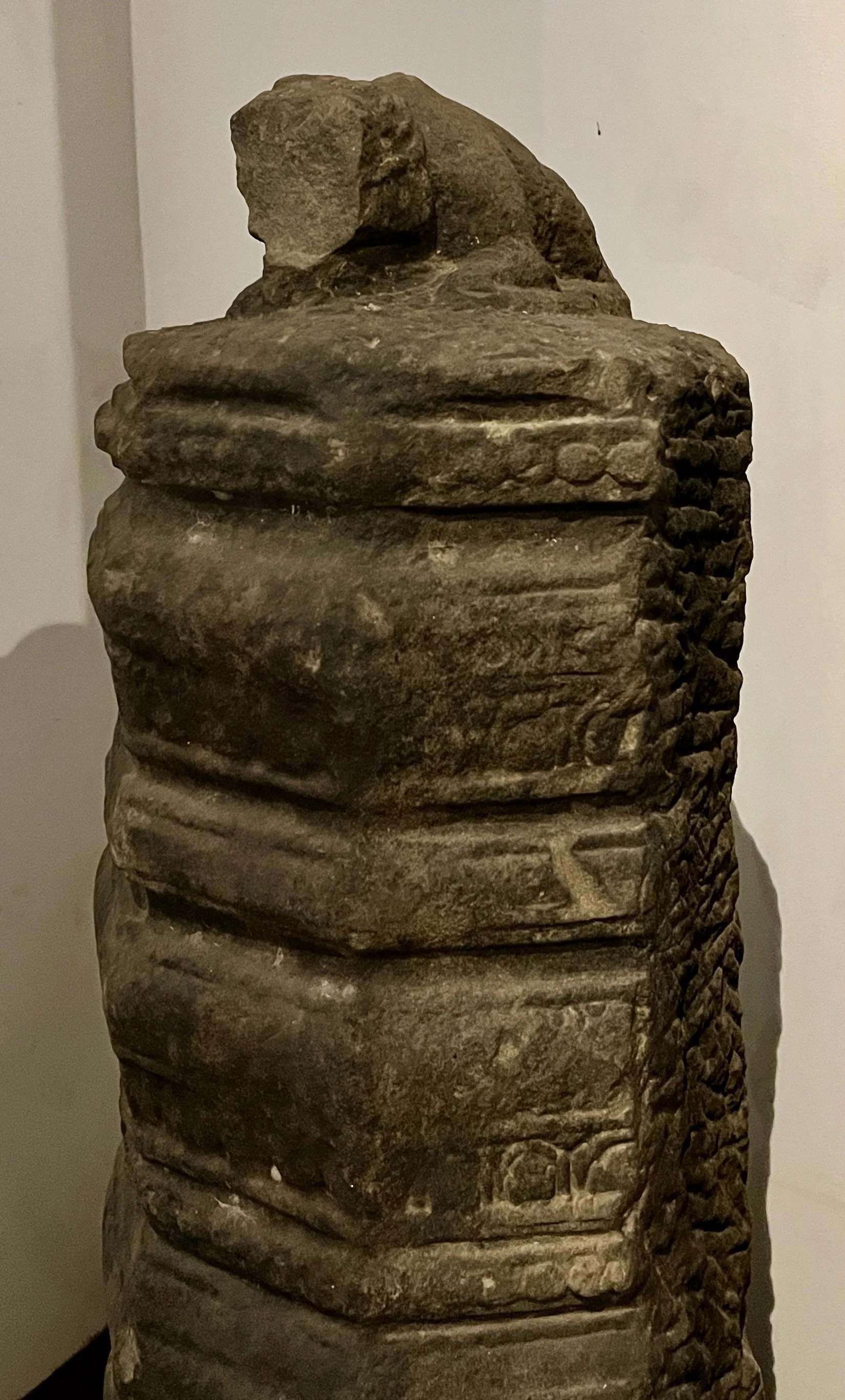
Fragment of Column

These two octagonal shape fragments of a colonette (BBK.0647 probably part of a shaft, and BBK. 0748 is a base) are dated to 10th C., probably in Koh Ker style, with tops later modified into elephant or bull like shapes

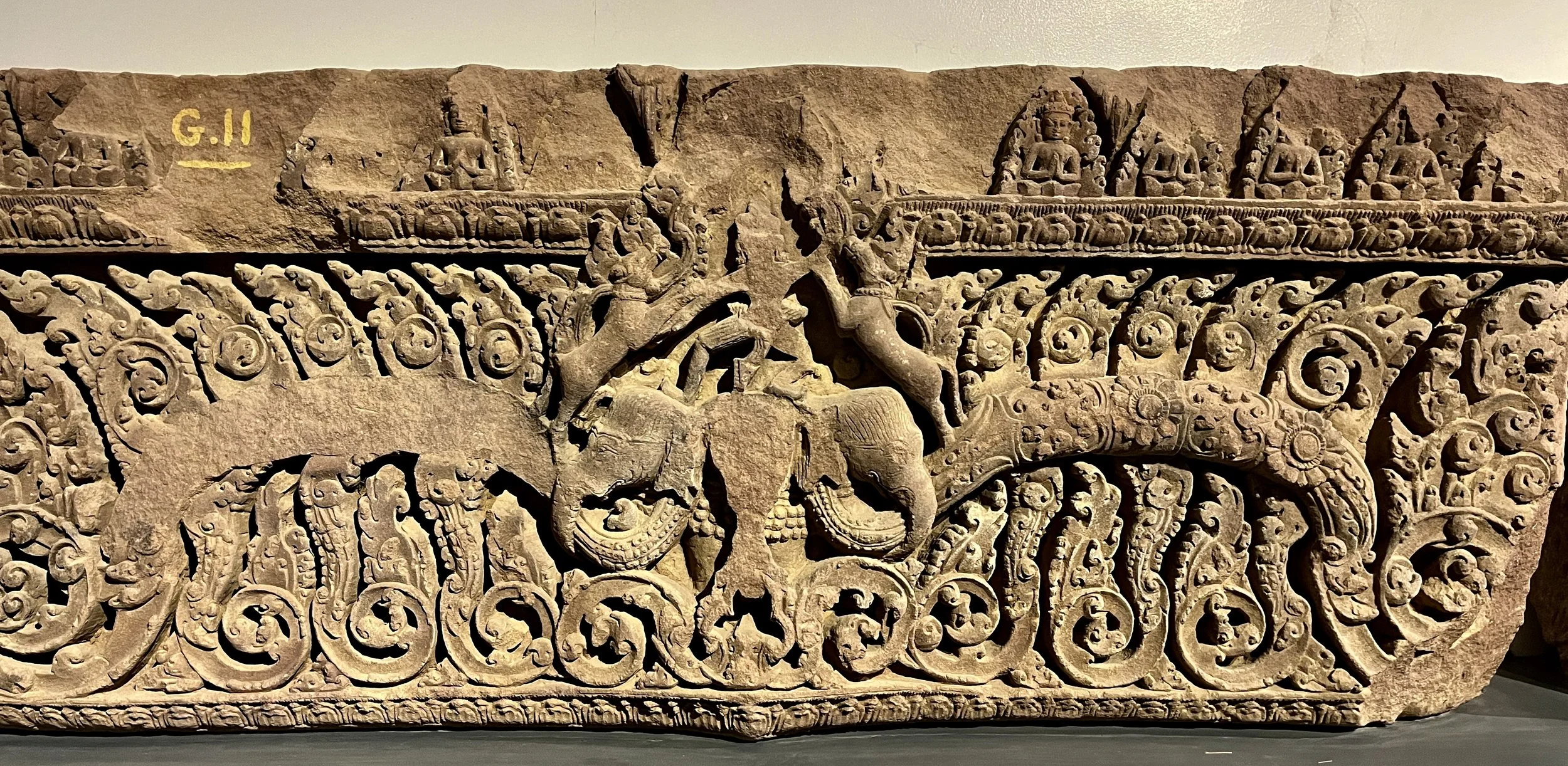
Lintel

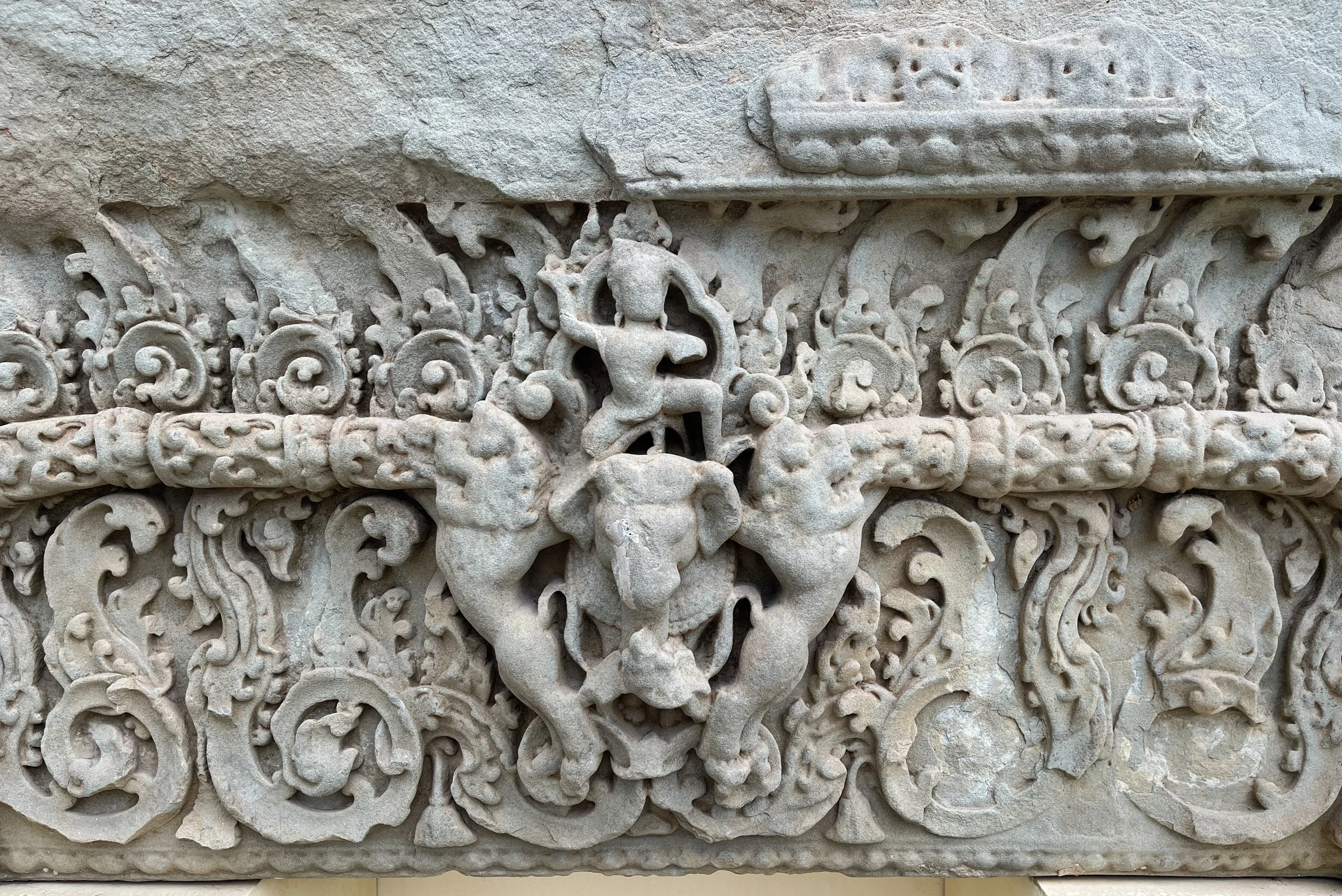
Sandstone, Angkorian period, Pre Rup style,

Second and third quarters of 10ch century (?)

Another tenth-century lintel depicts a deity fighting an elephant and a lion at the center.

The deity is usually identified as Krishna.

Two foliate branches are connected to each other underneath the deity to form a bow shape; either end forms a lion mounted on an elephant. The leaves motif of the joint between the two branches belongs to the styles of the tenth and early eleventh centuries. The frieze has a row of floral motifs; an intricate lotus petal motif is at the center flanked on each side by four foliage motifs.

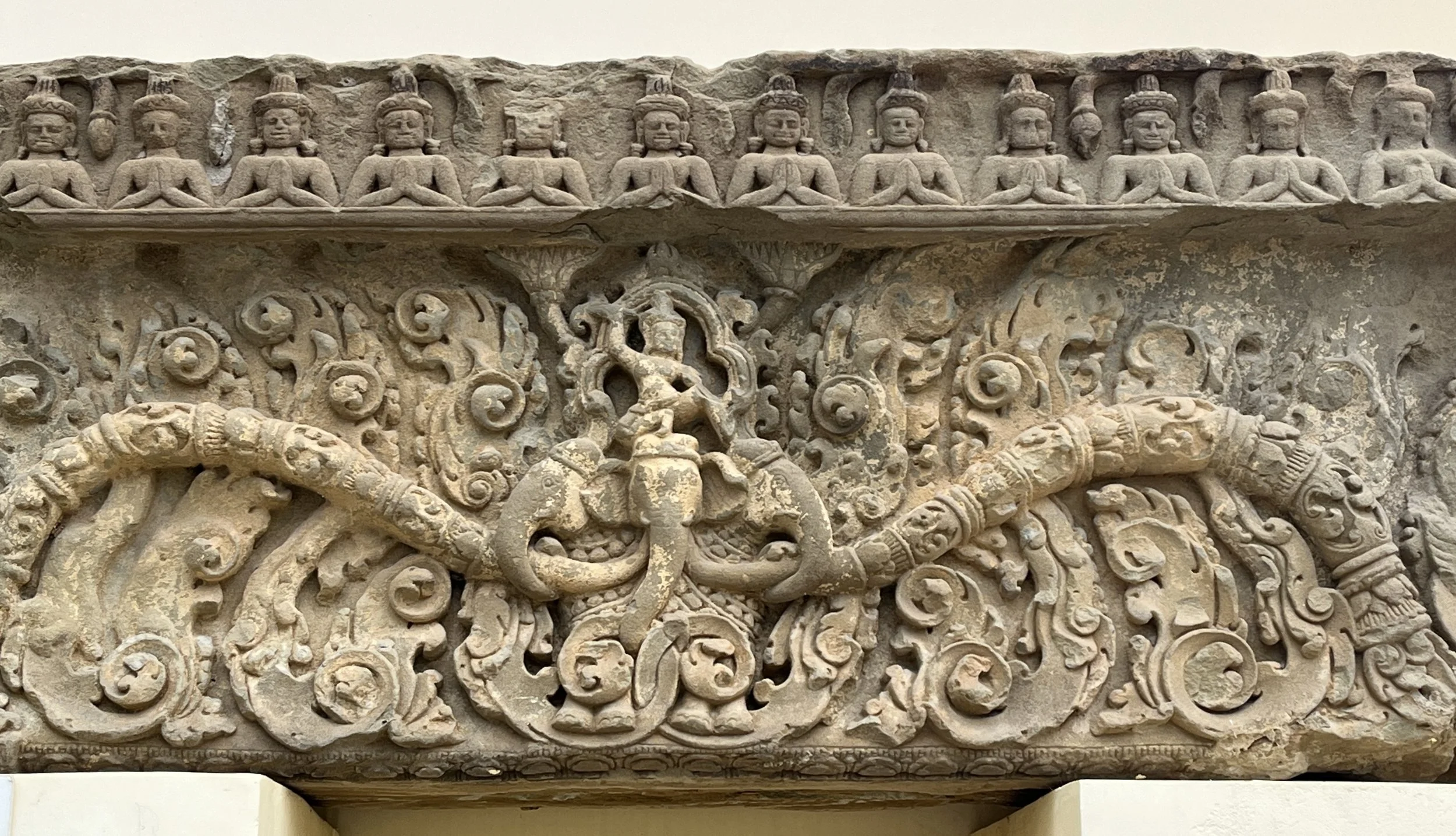
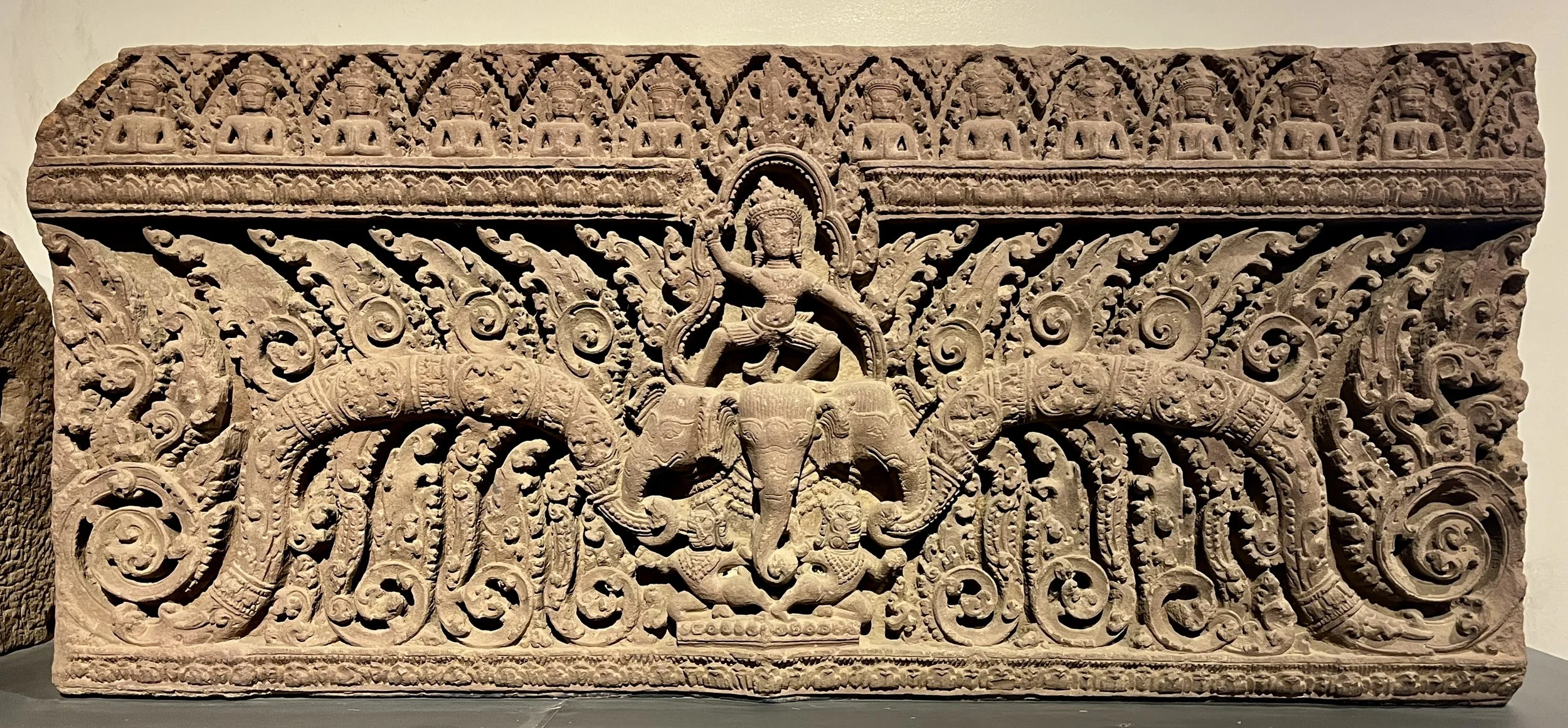
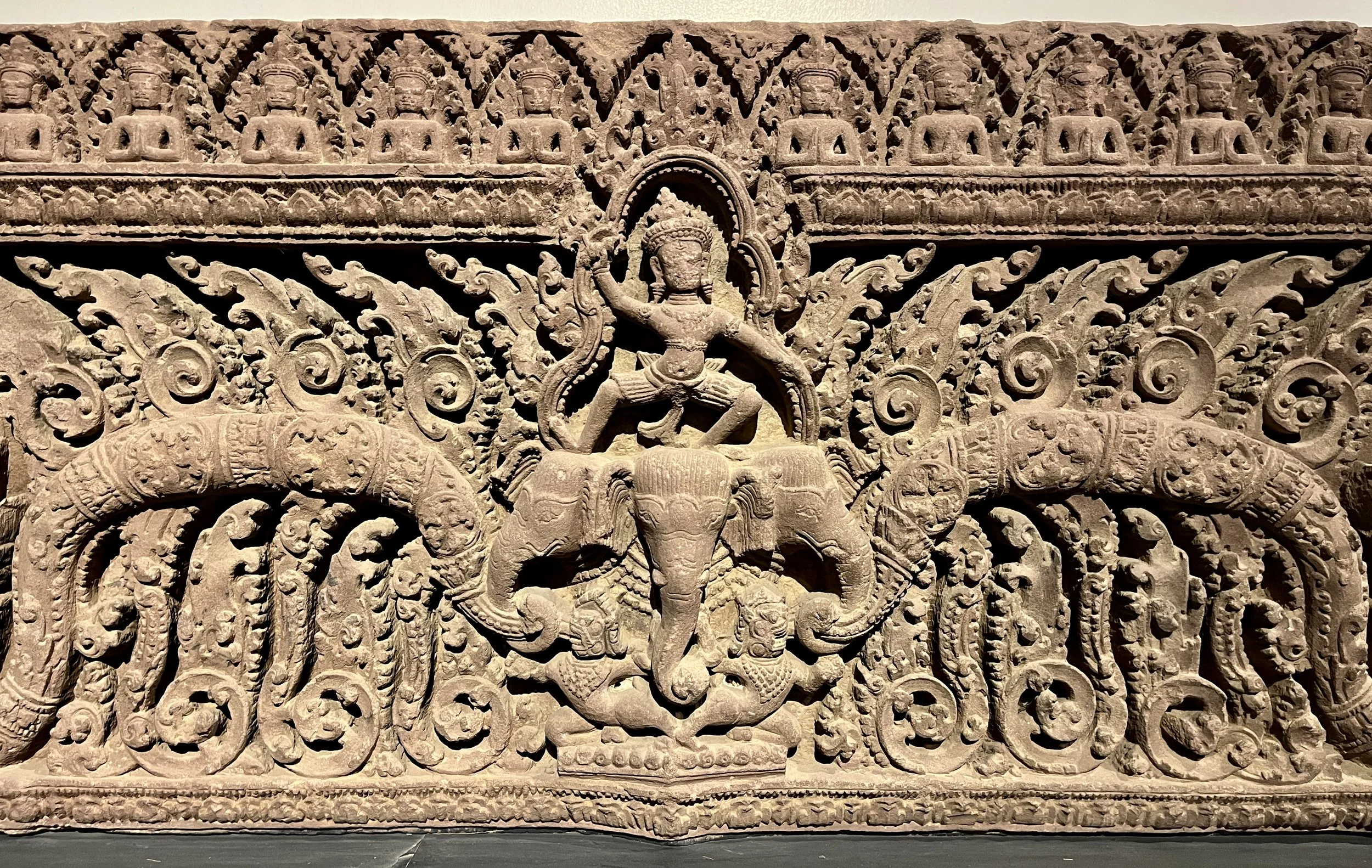
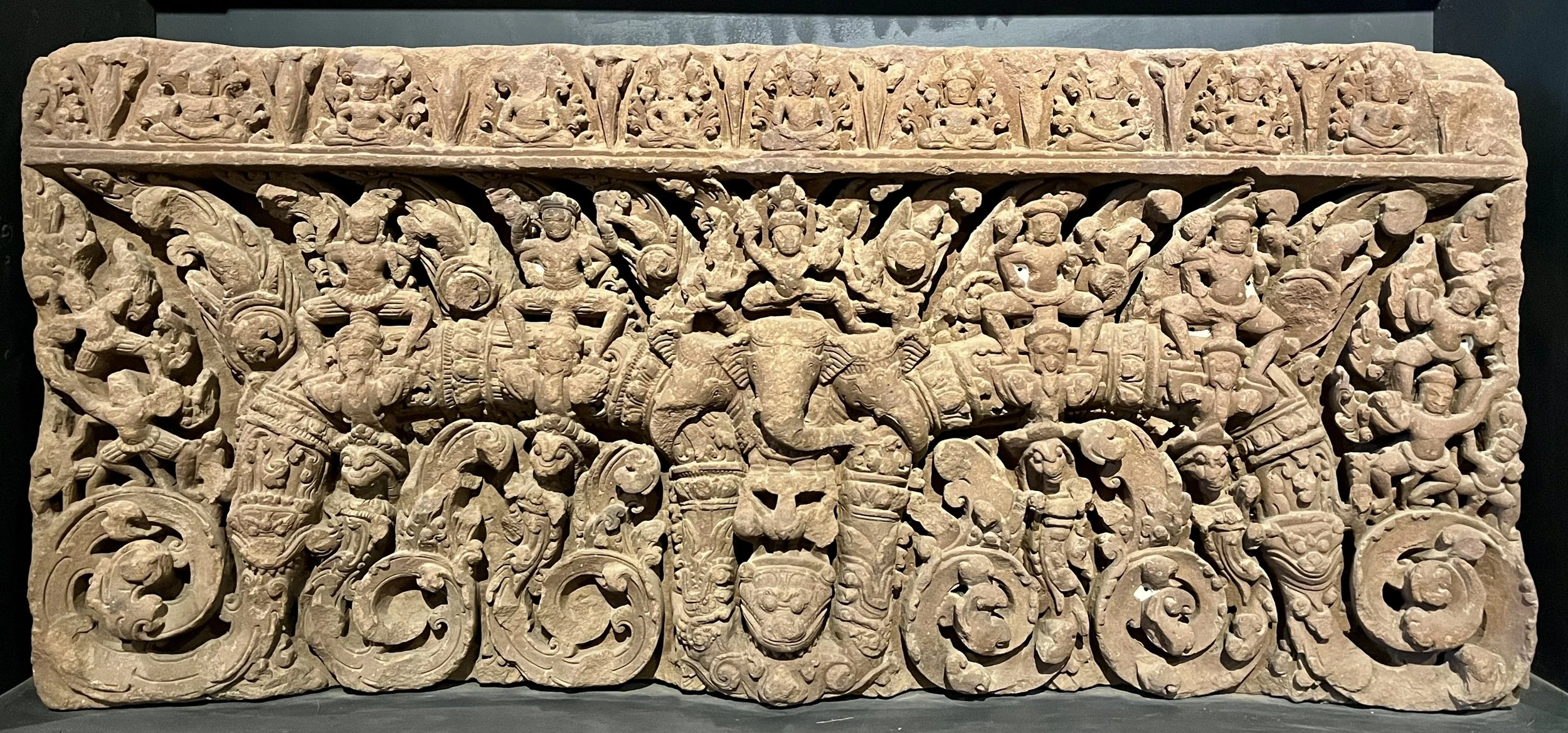
Lintel

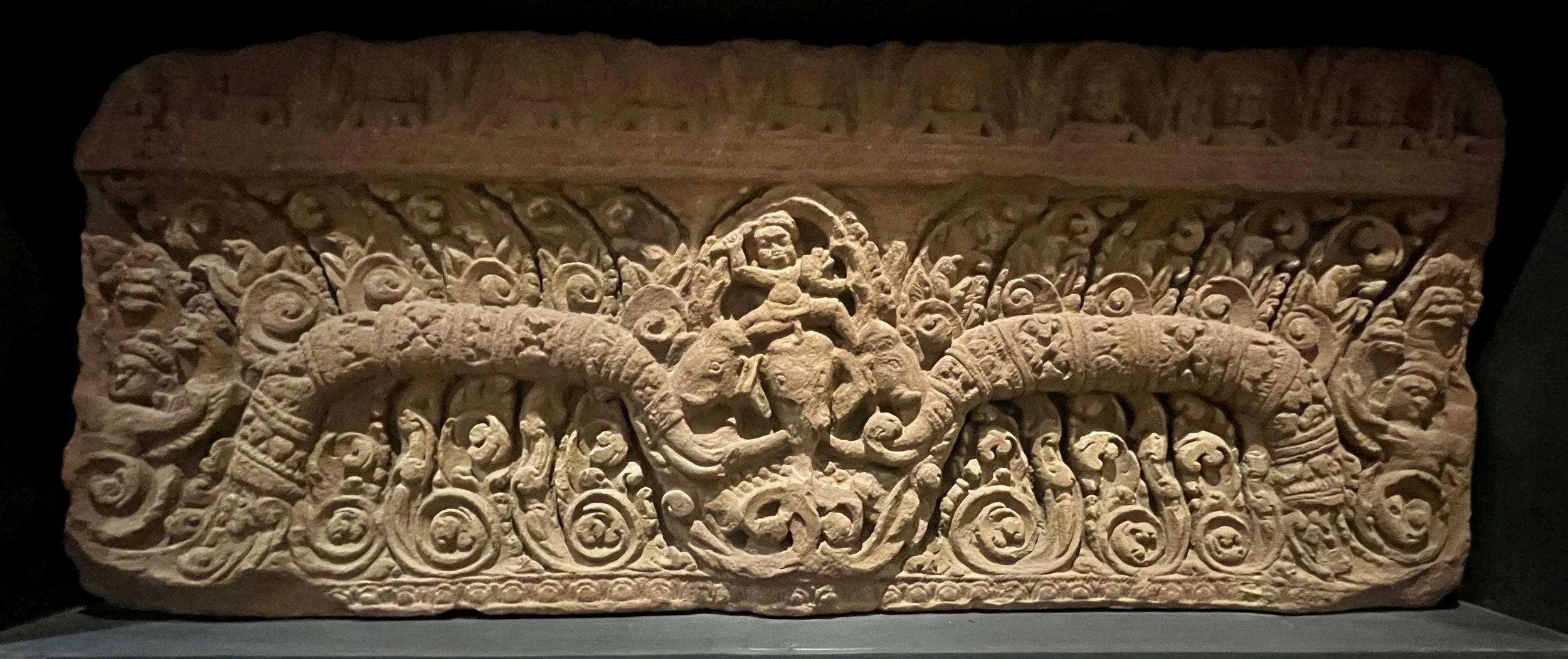
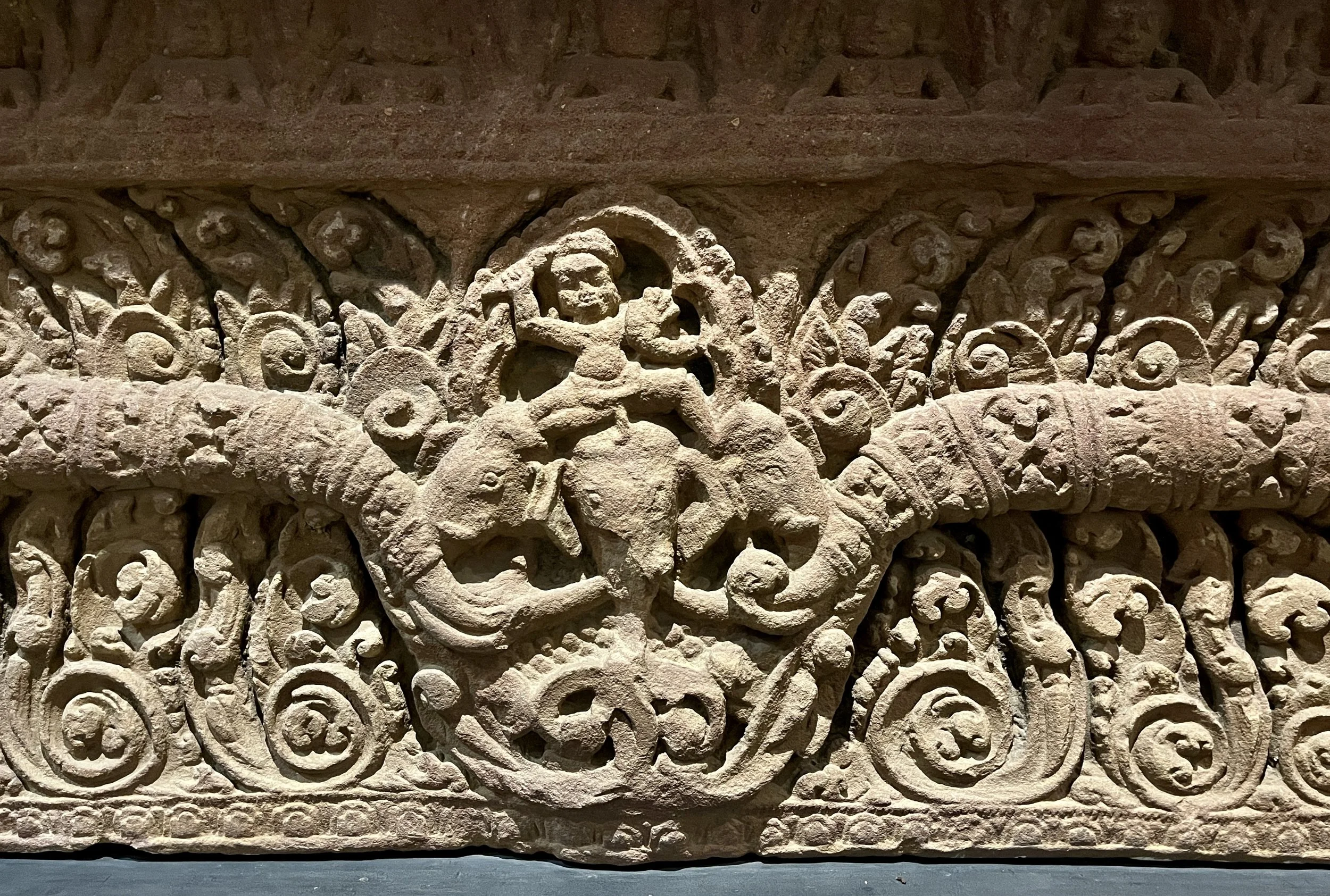
Sandstone. Angkorian period, Koh Ker style

Second half of 10th C. Toul Roka, Phum Roka, Sangkae

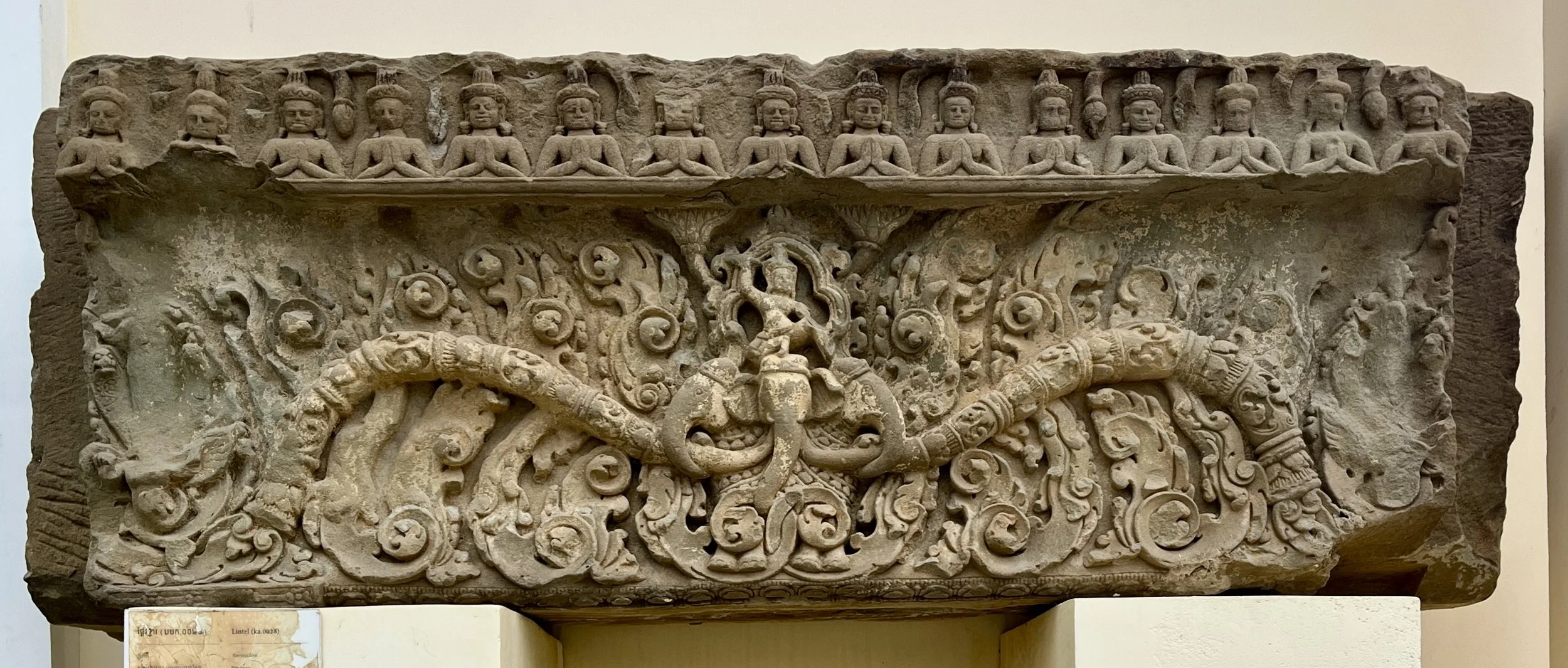
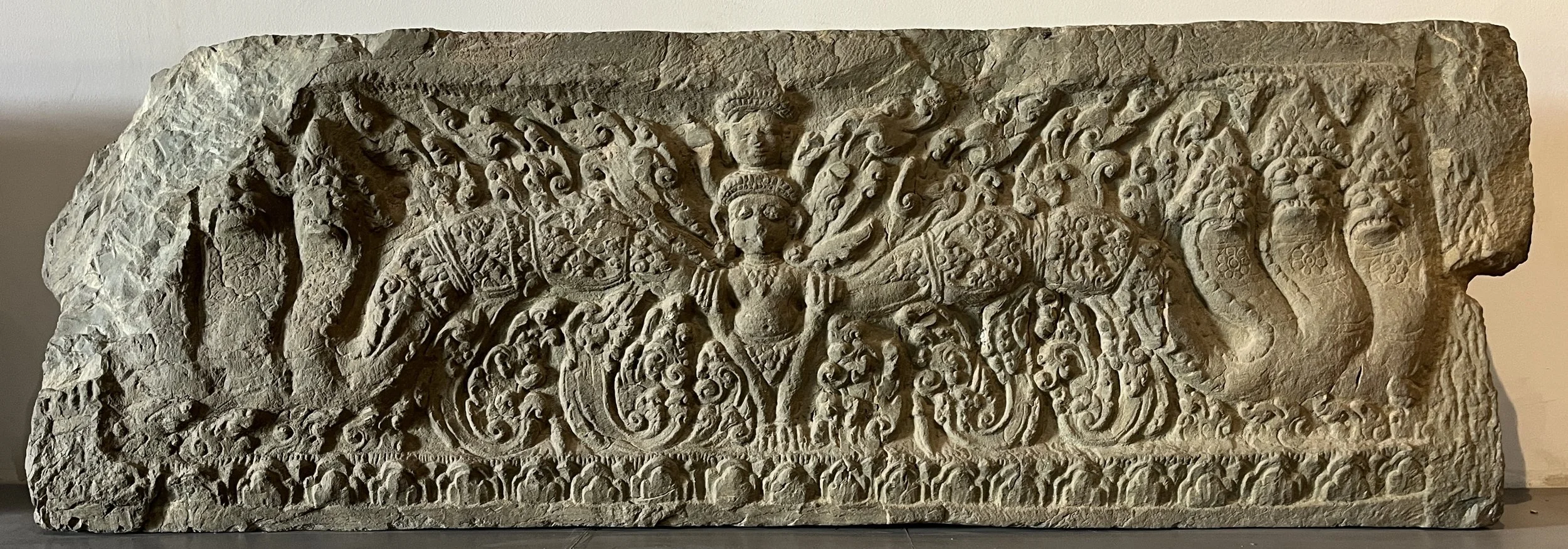
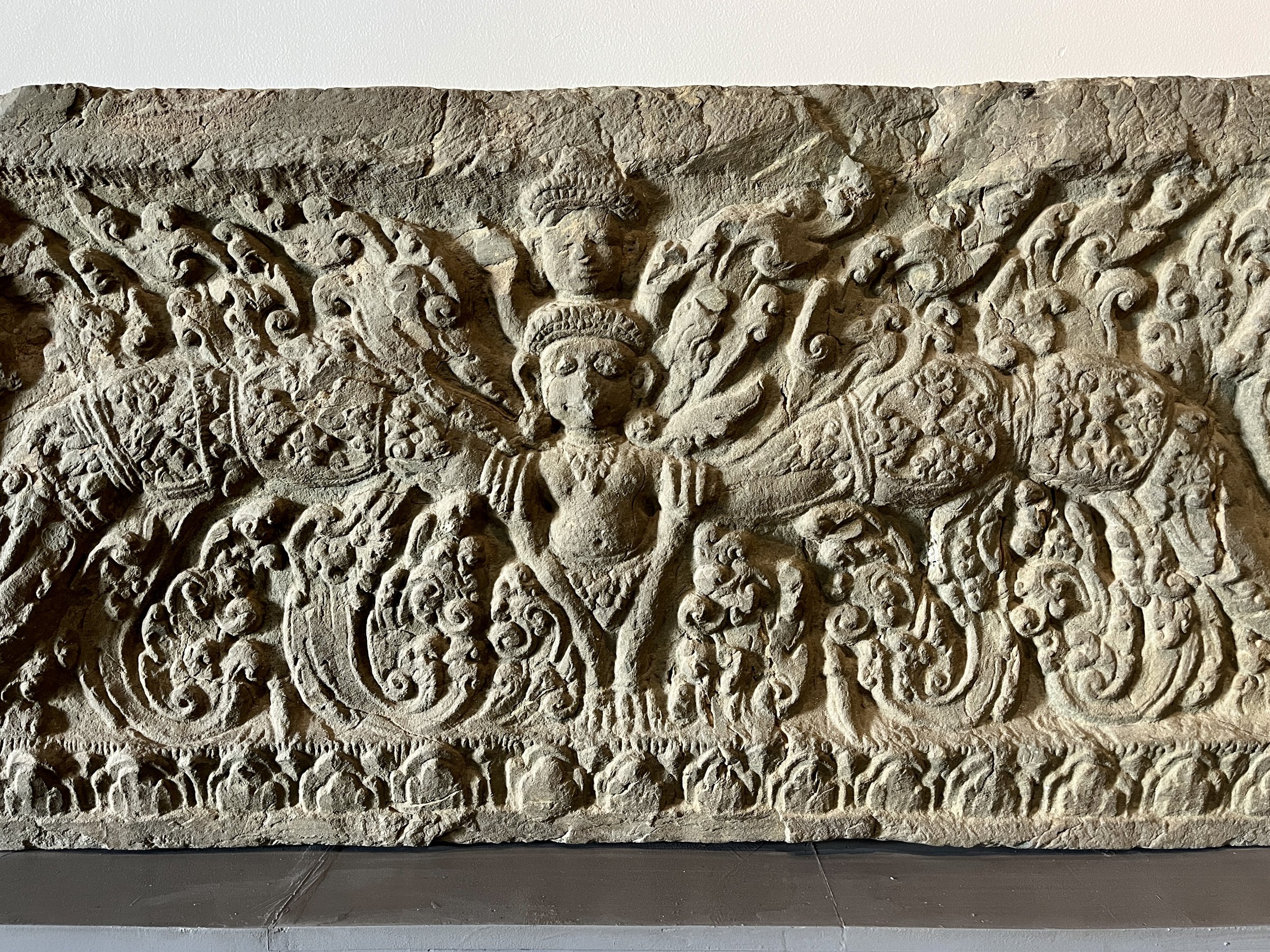
This Koh Ker lintel depicts the God Indra mounted on Airavata, the three-headed elephant. A bow shape feature is formed by two foliate branches, connected below the elephant. Both ends of the bow form a Garuda hooded by five-headed Naga. The frieze has a row of eleven seated figures joining their hands as a mark of worshipping

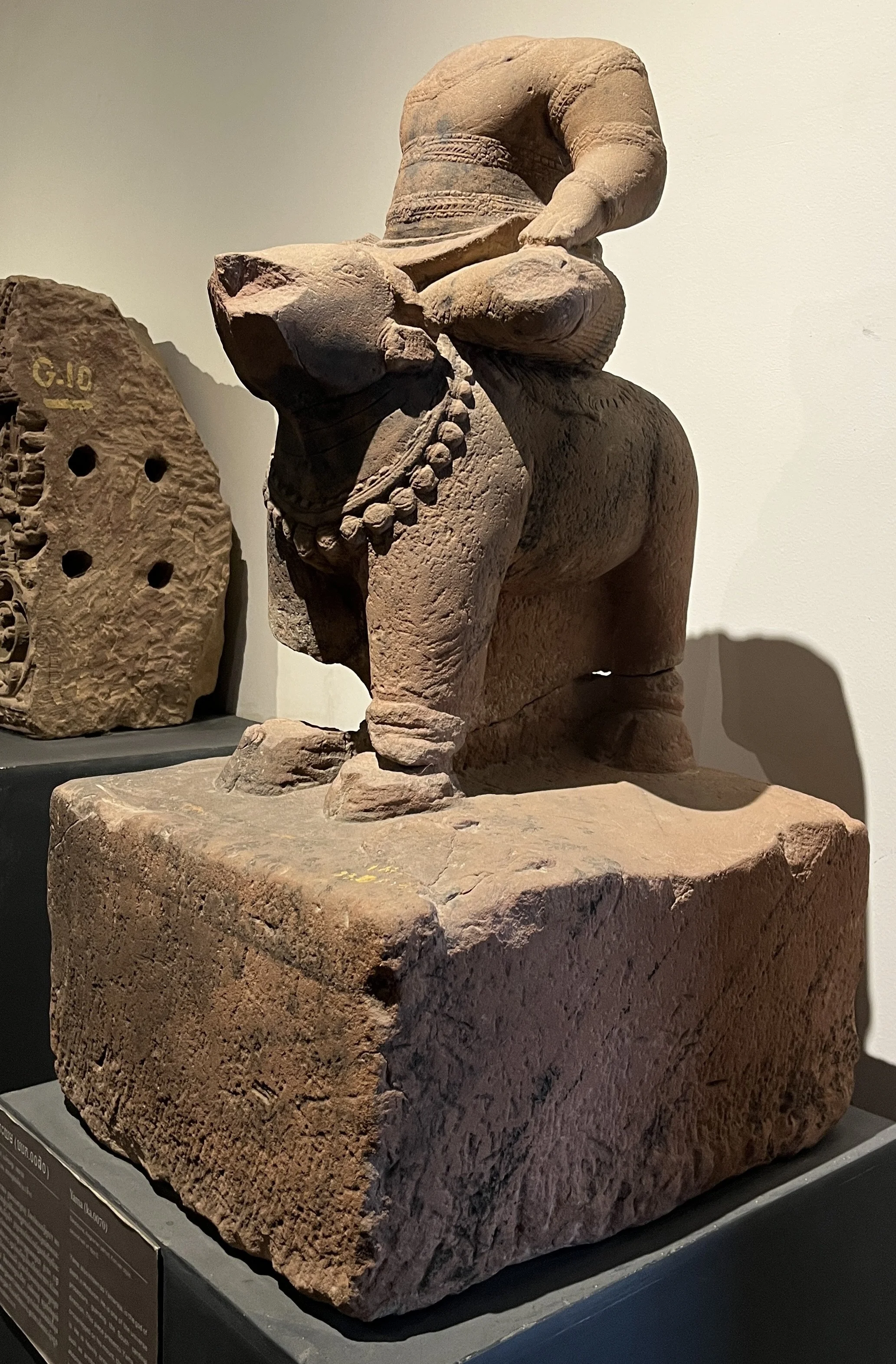
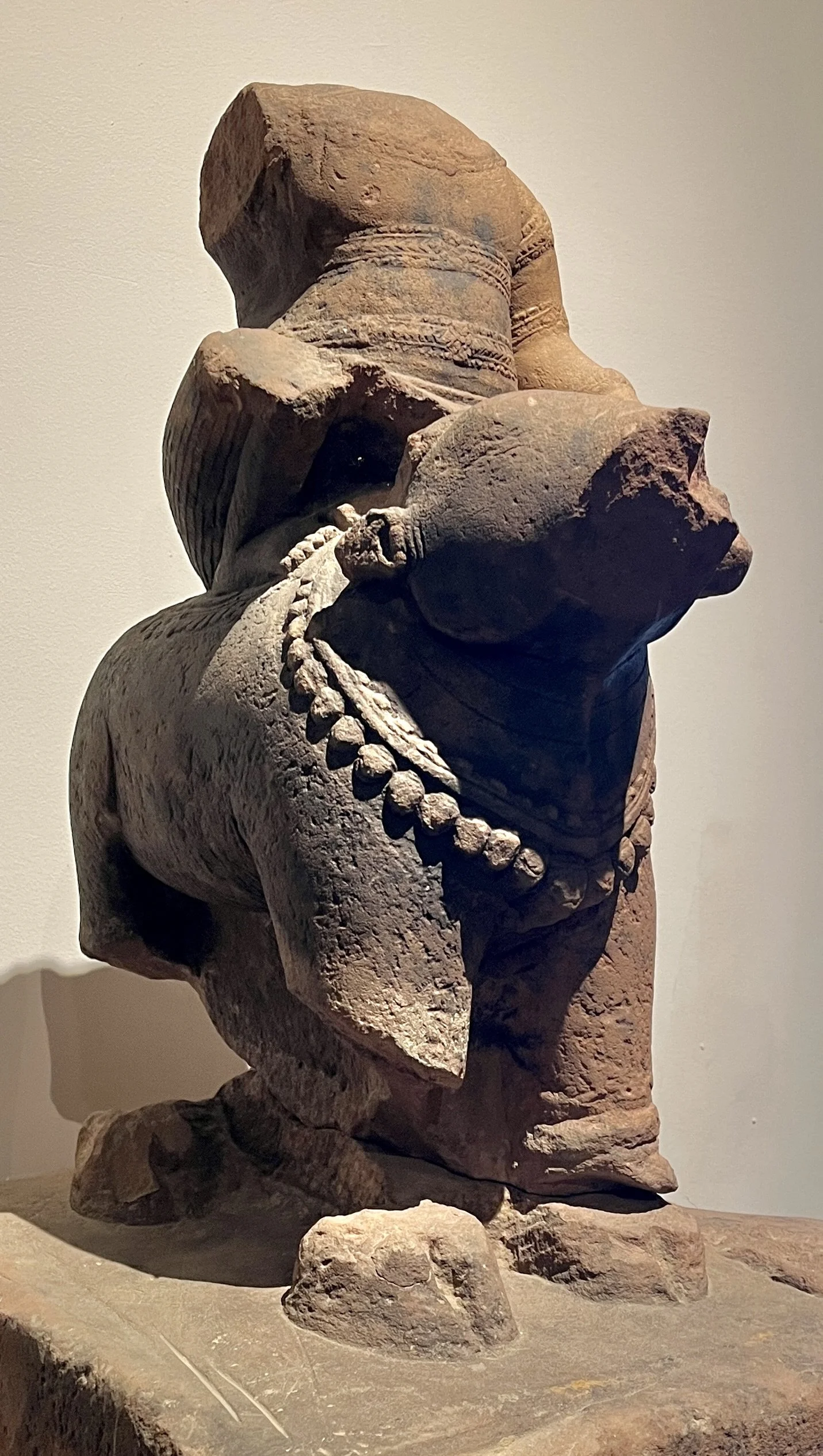
Yama

Sandstone, Angkorian period, Koh ker style, second half of 10th C.

Yama, also known as Yamaraja, is the god of death in Hinduism. He is one of the universe protectors, guarding the South. This piece presents Yama sitting cross-legged on his mount, the water Buffalo. He is heavily ornamented with jewelry such as armbands, bracelets, torso belt, abdomen belt, and necklace, like other statues of the Koh Ker style.

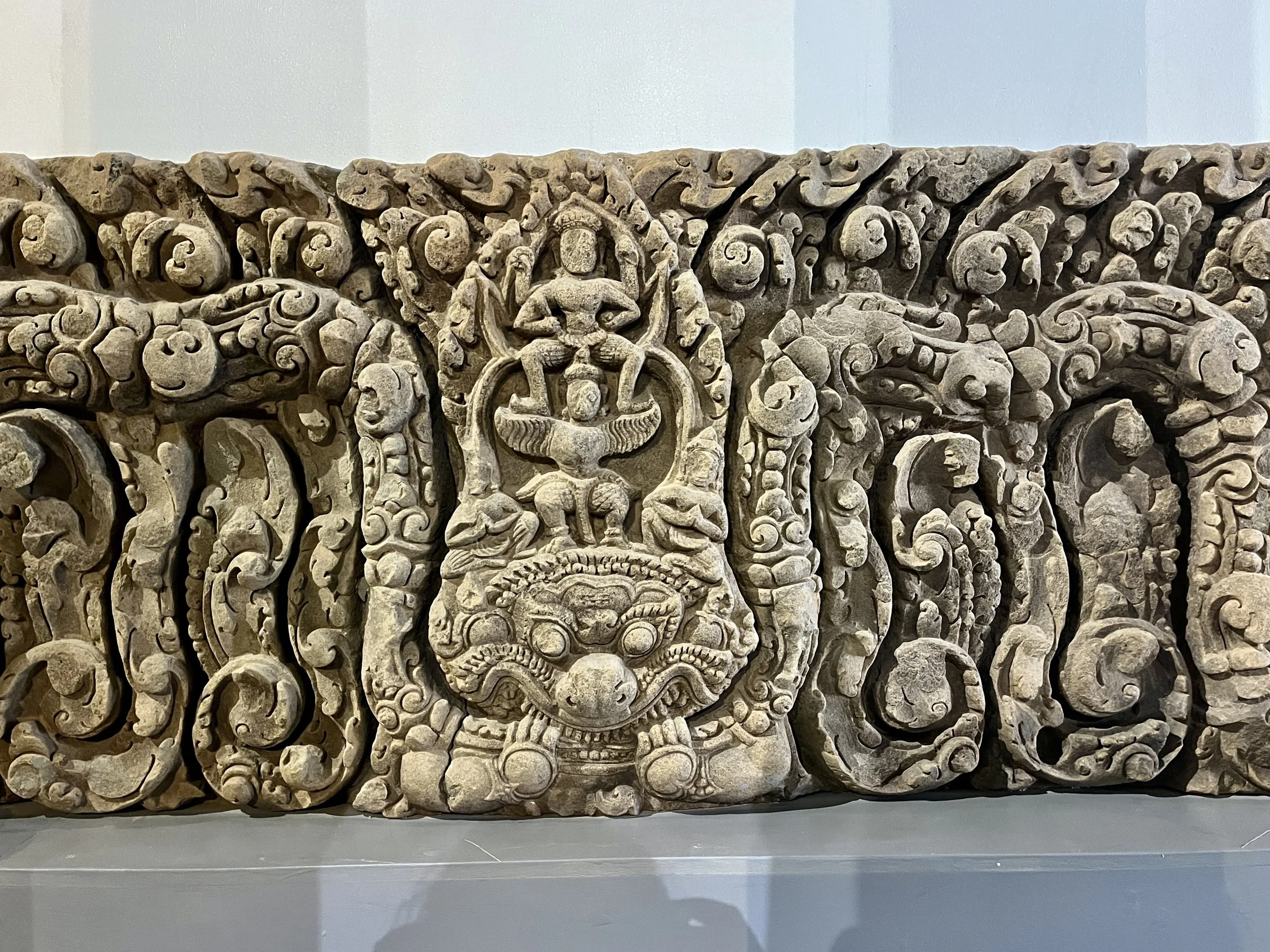
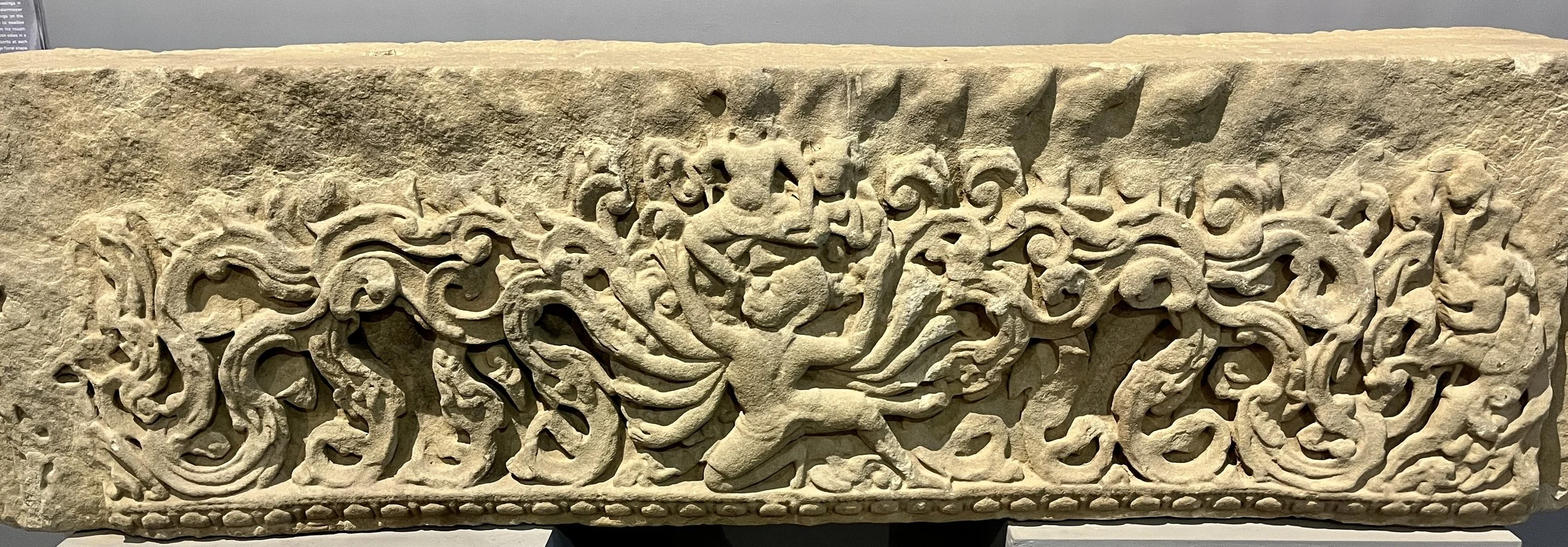
This lintel belongs to the Pre Rup Style. At its center is the God Krishna (?) mounted on Airavata, the three-headed elephant holding two horses with both hands. The depiction is of Krishna slaying the Keshin demon who transformed himself into horses. From the elephant's mouth, two foliate branches protrude out to form a bow shape, which forms at both ends a curling foliate in the shape of Naga. In this style, the curling foliage under the branch is usually more elegant and thinner than other styles. The frieze has a row of twelve seated figures joining their hands as a mark of worshipping.

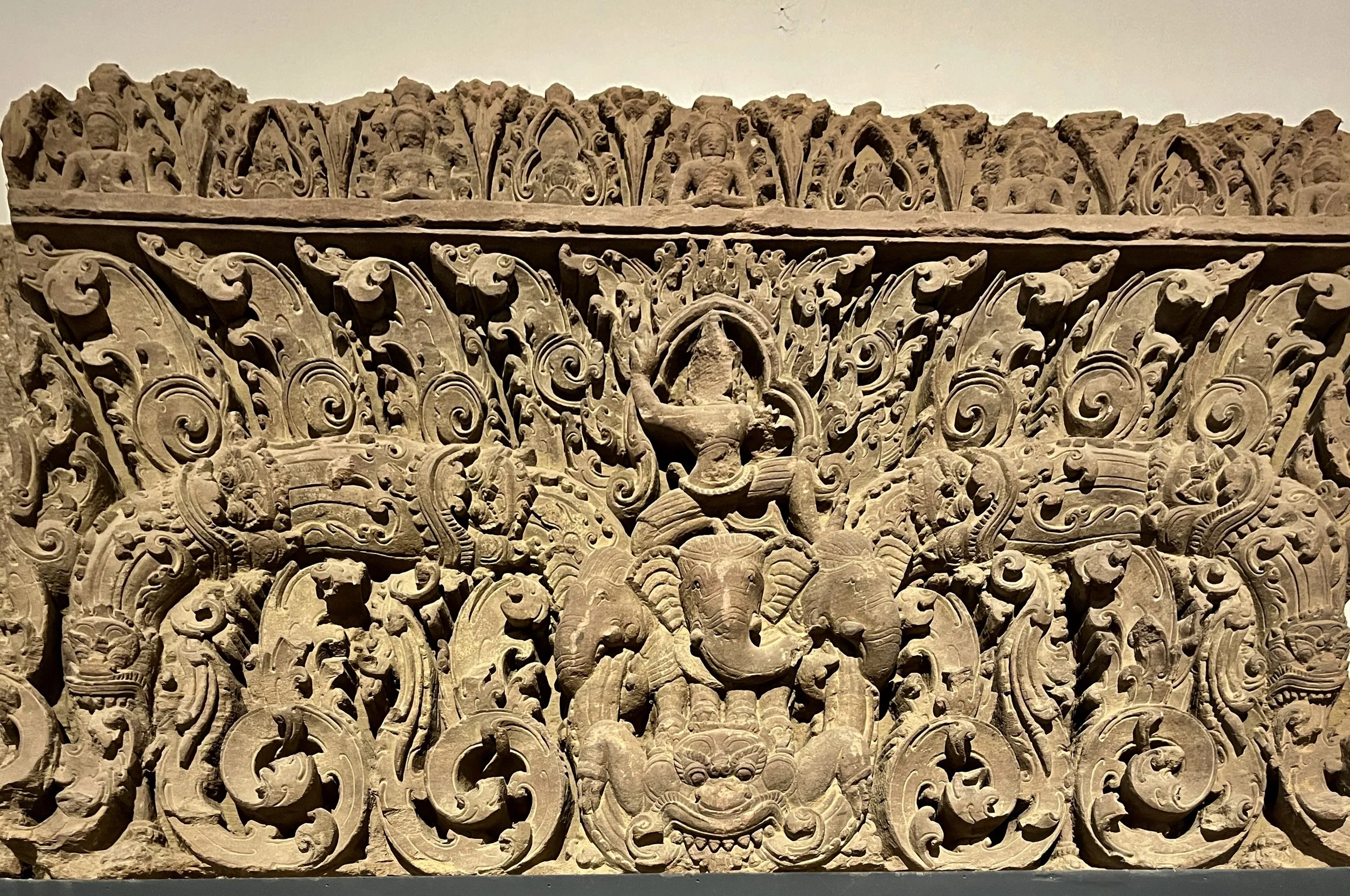
Lintel

Sandstone, Angkorian period, Pre Rup, Second and third quarters of 10th century

This lintel is another typical piece in the Pre Rup Style. At its center is the God Indra mounted on Airavata, the three-headed elephant. The foliate branches protrude from two lions at the base of the center. The curling foliage under the branch is elegant and thin. The frieze has a row of twelve seated figures joining their hands as a mark of worshipping.

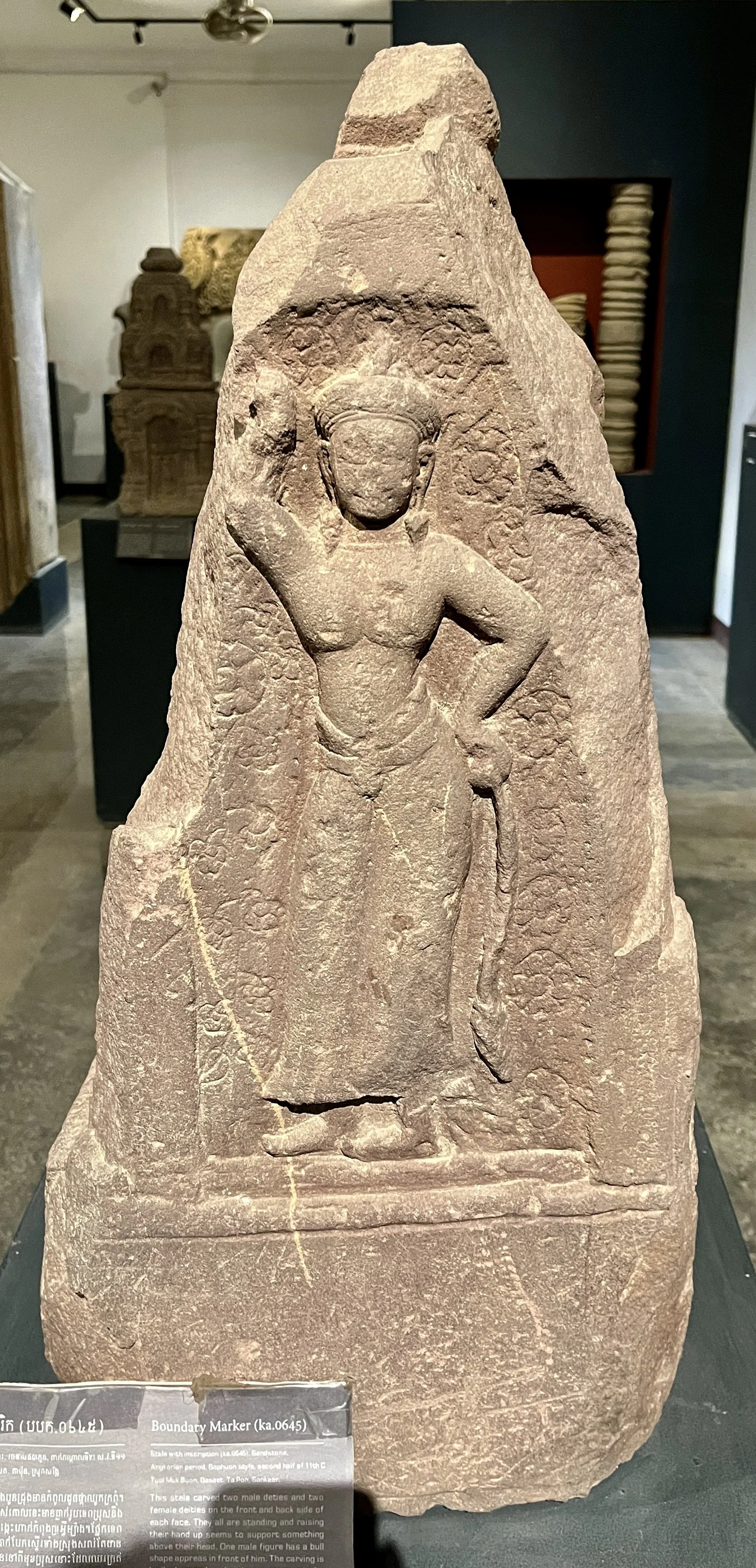
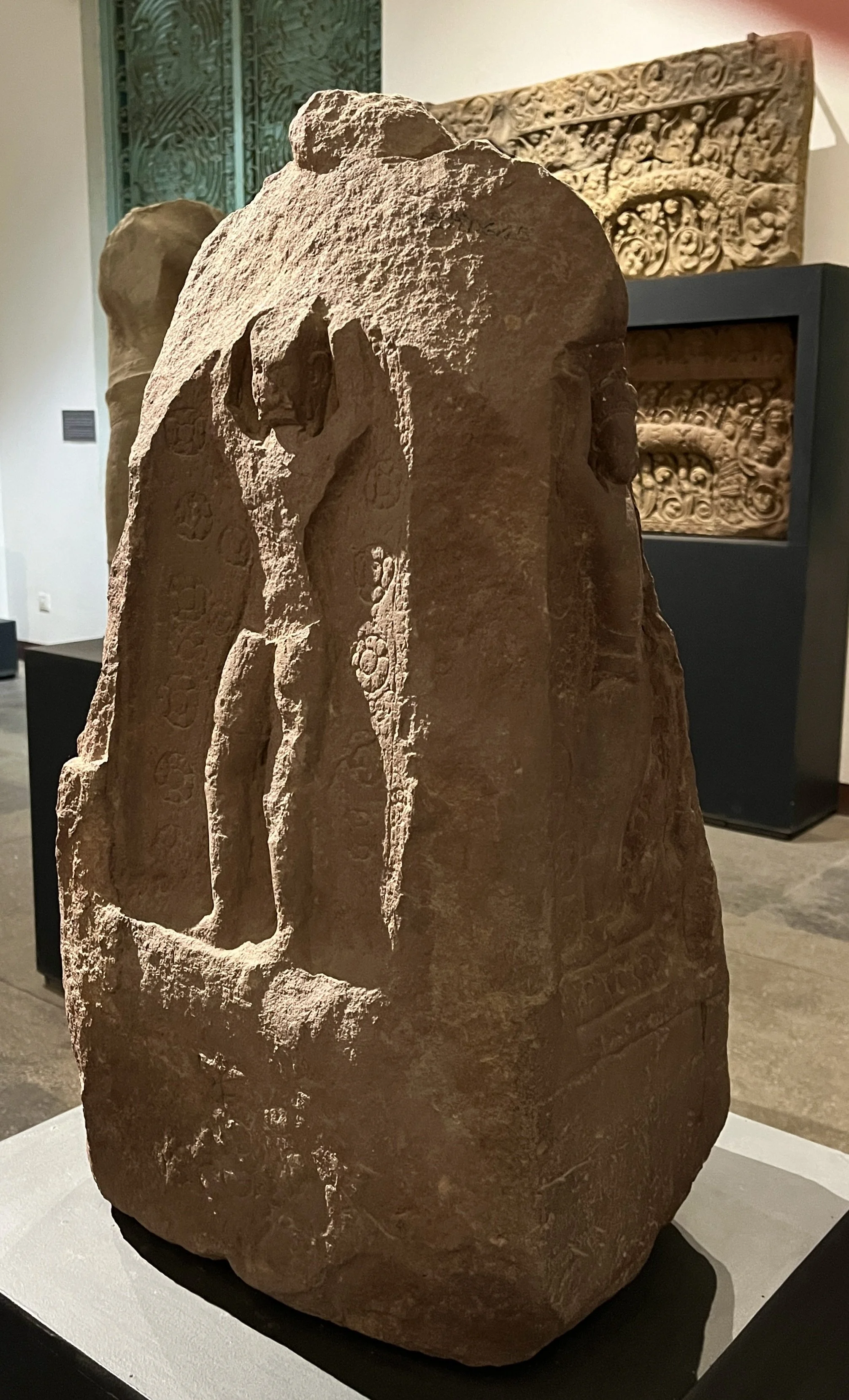
Boundary Marker

Stele with inscription, Sandstone

Angkorian period, Baphuon style, second half of 11th c. Tuol Muk Buon, Basaet, Ta Pon, Sankaer.

This stele is carved with two male deties and two female deities, one per face. They are standing and raising their hands up, seemingly to support something above their head. One male figure has a bull shape in front of him. The carving is badly damaged, and a clearer engraving of a bull is visible below. The female figure with similar posture on the opposite side has three engraved lines of inscription below her.

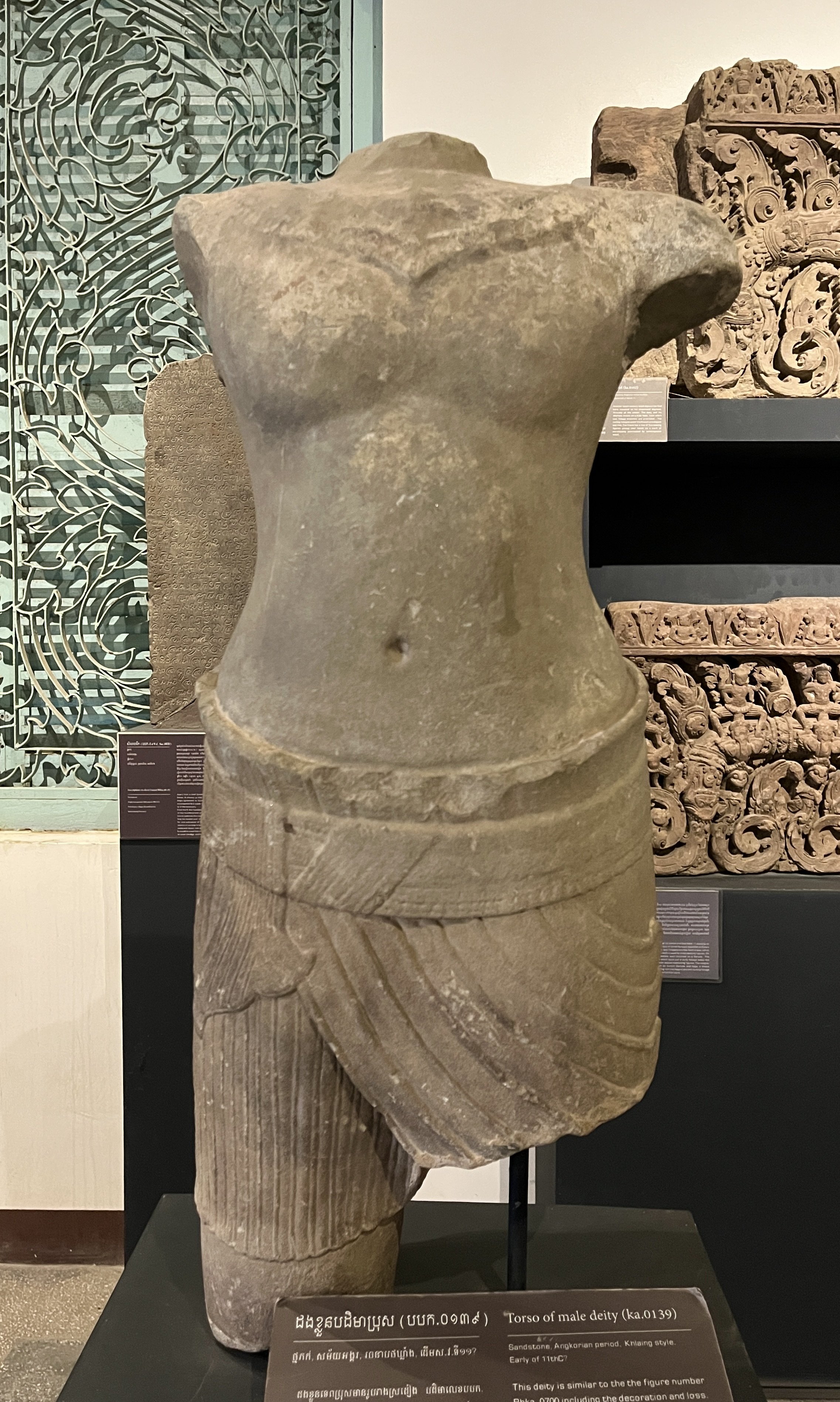
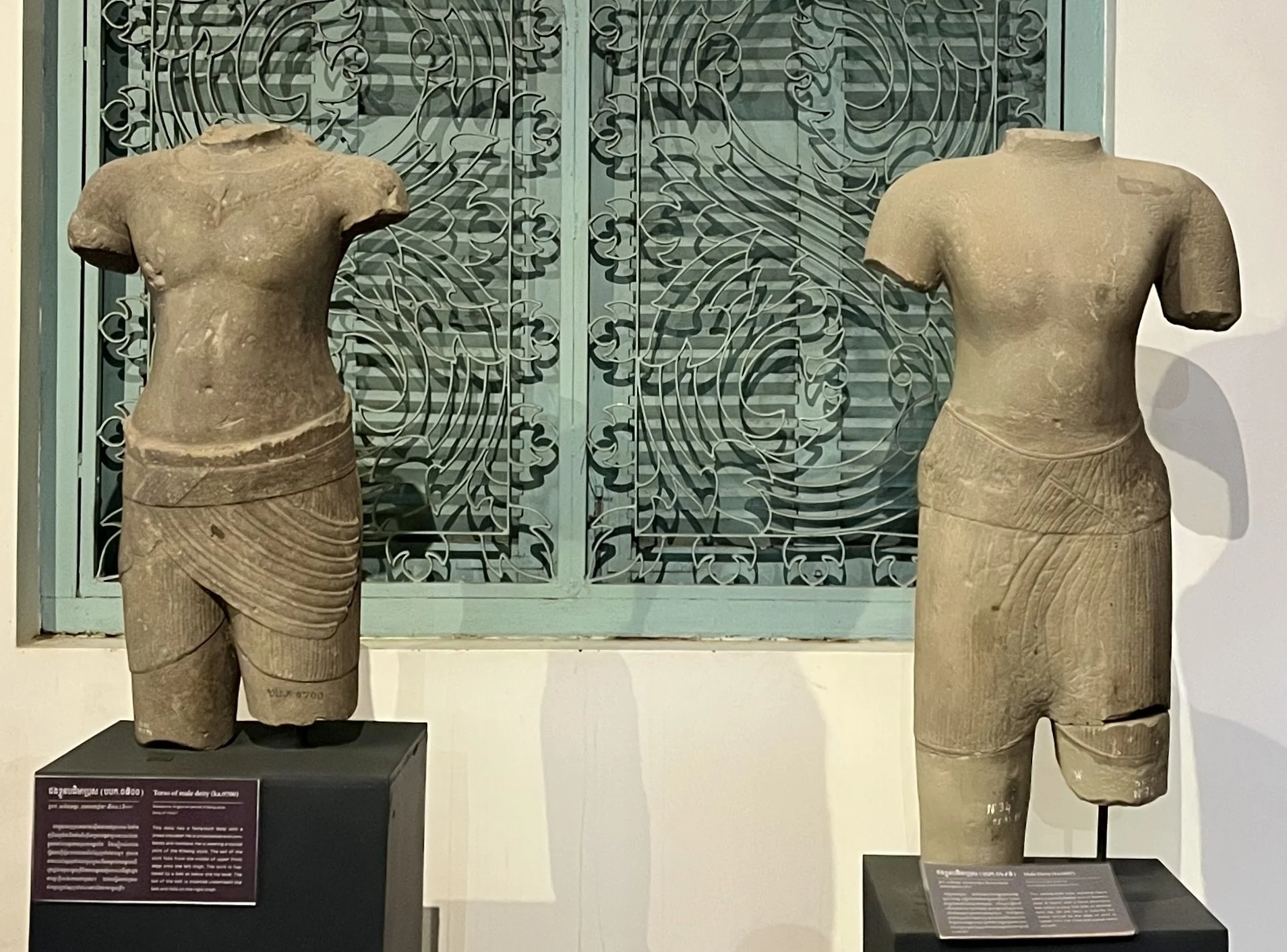
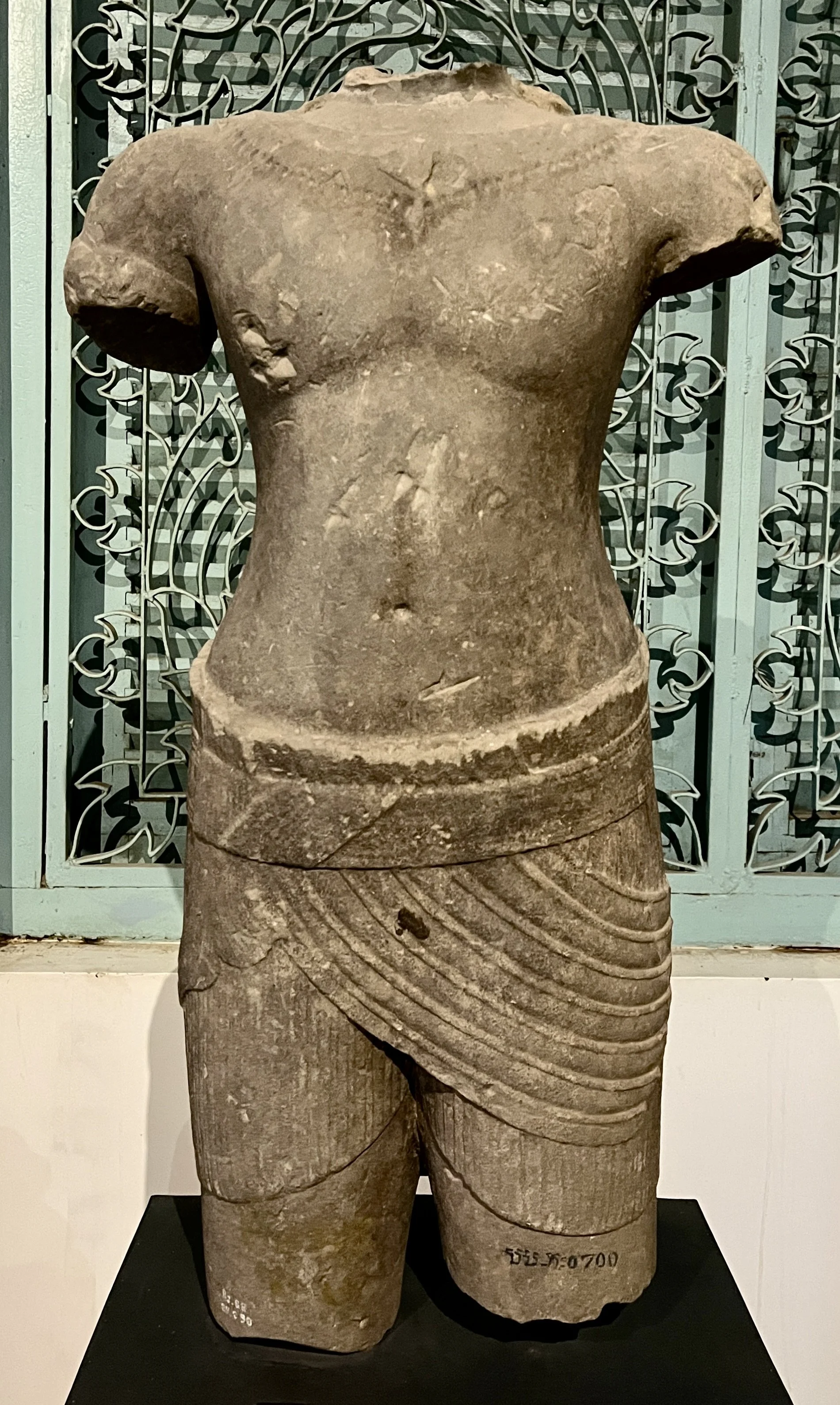
Torso of male deity

Sandstone, Angkorian period, Khlaing style,

Early 11thC?

He is ornamented with armbands and necklace. He is wearing a typical skirt of the Khlaing style. The tail of the skirt falls from the middle of upper front edge onto the left thigh. The skirt is fastened by a belt below hip level. The tail of the belt is inserted underneath the belt and falls on the right thigh.

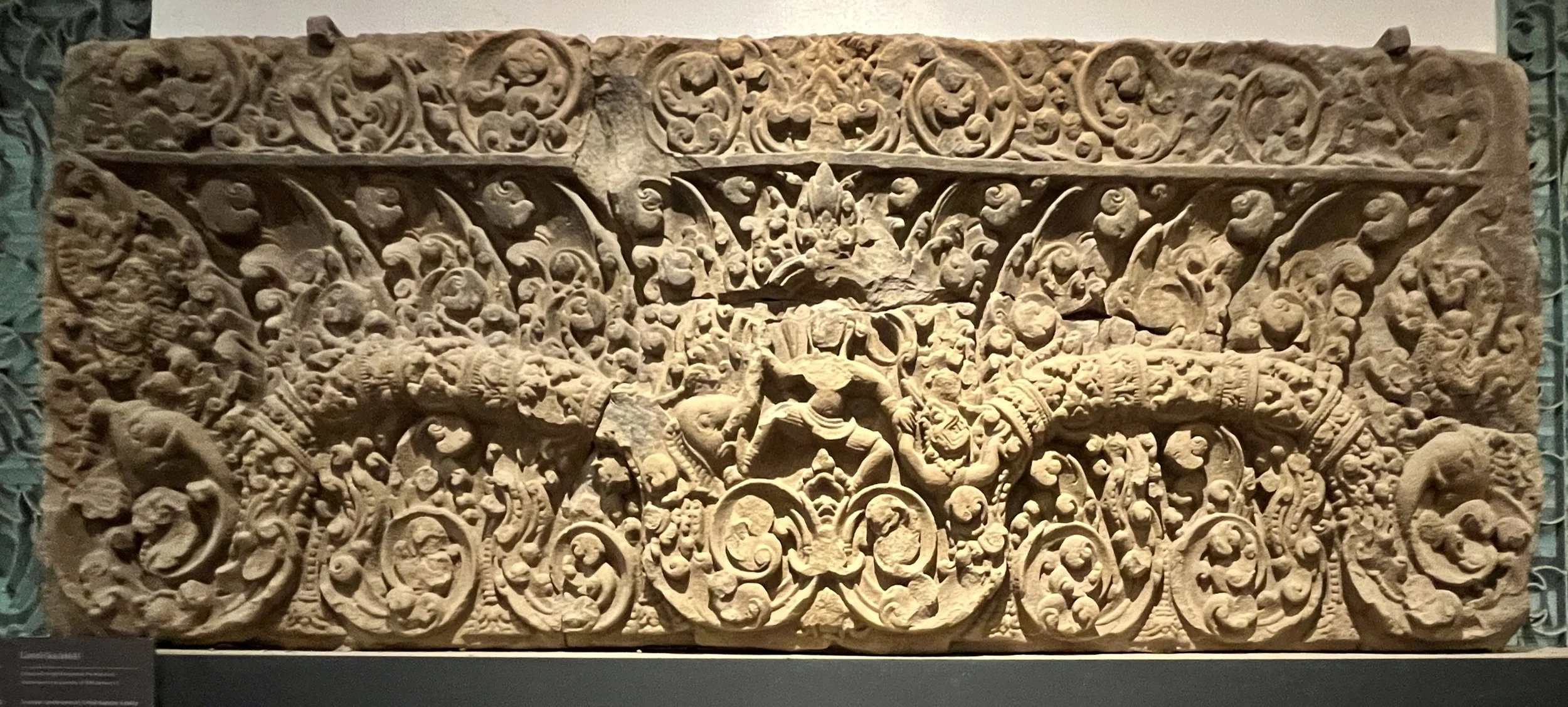
Another tenth-century lintel depicts at its center the God Indra (?) dancing on his three-head elephant, Airavata, on top of three Hamsas mounted on Kala's head. Coming out from Kala's mouth, two foliate branches form a bow, which at either end forms curly vegetations, each topped by three dancing figures. On each branch are two four-armed deities, each mounted on a Garuda. The Garuda carries in its beak a Naga which spits out a curly foliate below the branch. The frieze has a row of eleven seated meditating figures. The integration of several small figures such as human, Garuda, and Naga is a theme belonging to the Preah Ko style; coupled with the elegant and thin curling foliage, this suggests that this piece belongs to the Koh Ker style.

Lintel

Sandstone, Angkorian period, Koh Ker second half of 10th C. (?)

Another tenth-century lintel depicts the God Indra mounted on his three head elephant Airavata at the center. The deity and his elephant mount a Kala head from which two foliate branches protrude. The curling foliage under the branch is elegant and thin. The frieze has a row of five seated figures joining their hands as a mark of worshipping punctuated by an unrecognized motif.

Inscription on door frame

Sandstone,

Angkorian

966A.D.

Prei Khpos Village, Bovel District,

Battambang Province

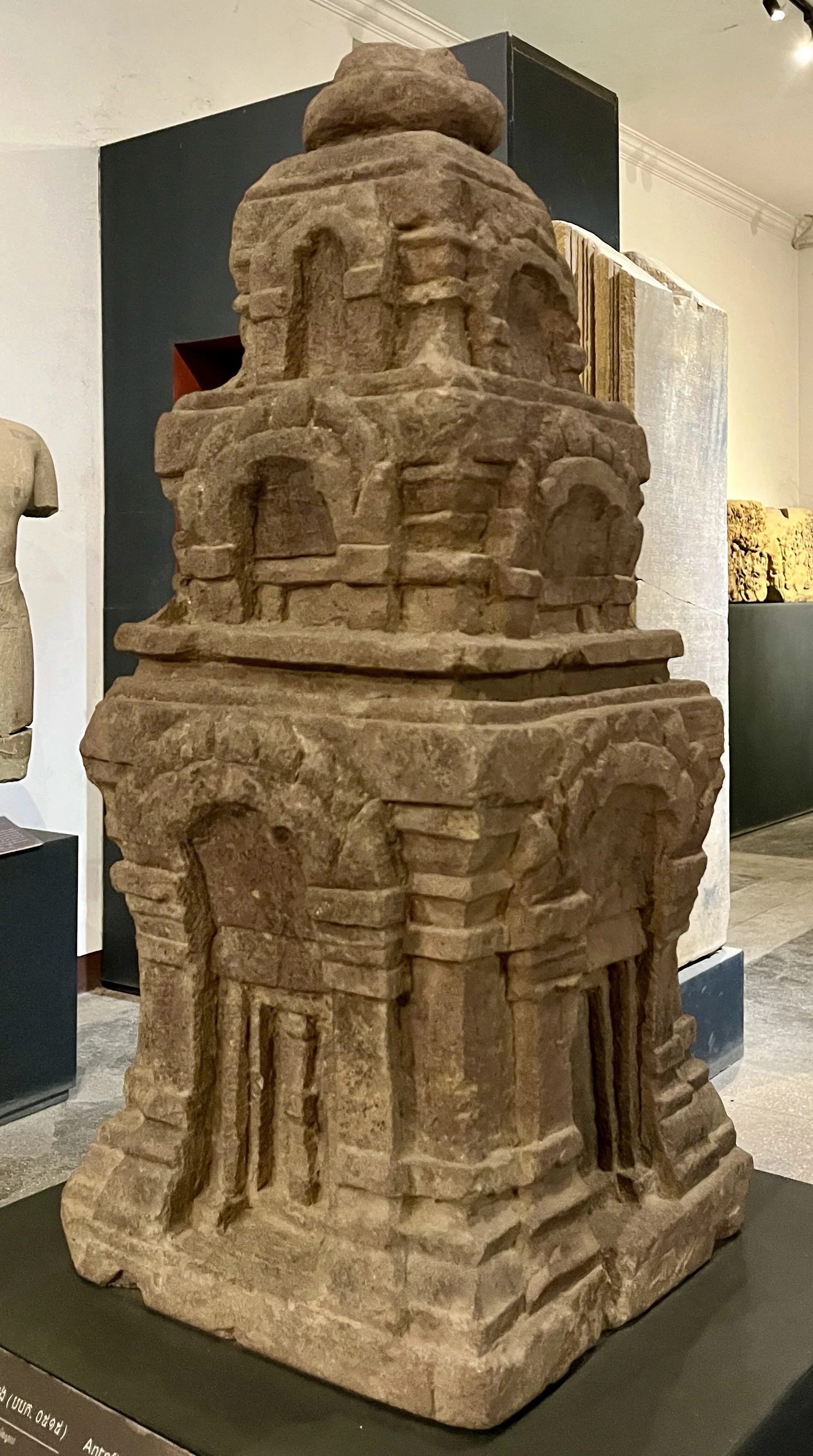
Antefix

Sandstone, Angkorian period, 10th c. (?). Unknown

Antefixes like this one in the form of a miniature temple are frequently placed at the corner of each level of a large temple tower.

This miniature has three levels indicating a larger temple. In Khmer art history, this presentation appeared in the 10th c. at Banteay Srei temple, and later in other temples built in the 11th c.

Torso of male deity

Sandstone, Angkorian period, Khlaing style,

Early 11thC?

This deity has a fairly-built body with broad shoulders. He is ornamented with arm-bands and necklace. He is wearing a typical skirt of the Khlaing style. The tail of the skirt falls from the middle of the upper front edge onto the left thigh. The skirt is fastened by a belt at below the hip level. The tail of the belt is inserted underneath the belt and falls on the right thigh.

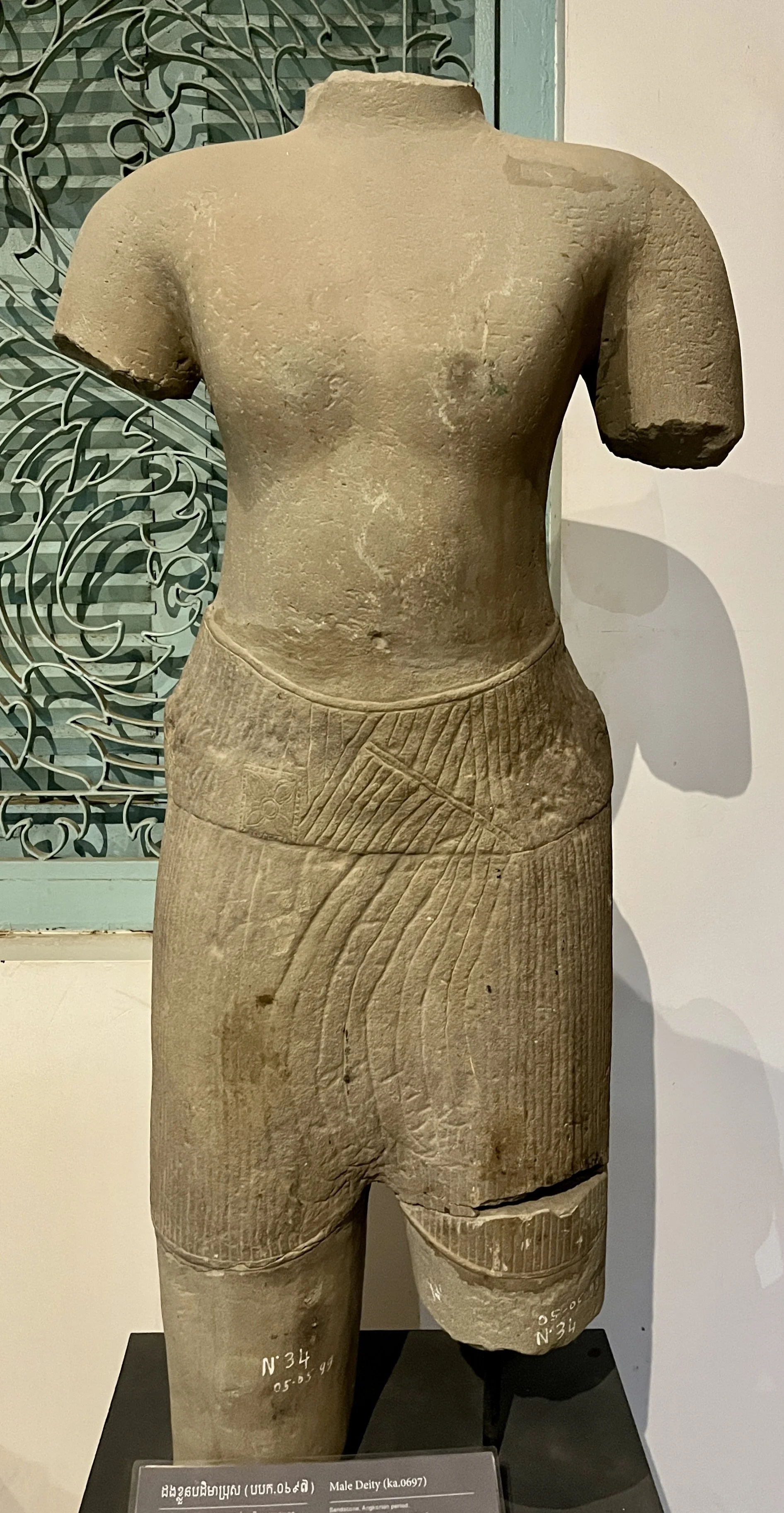
Male Deity

Sandstone: Angkorian period, late Khleang to Early Baphuon 11th C.

This strongly built standing figure wears a typical pleated skirt in the Baphuon style. It is fastened with a floral decorative belt; a wavy fold falls between both legs. On the back, a butterfly like shape is formed by the edge of the skirt folded from the front and tucked below the belt.

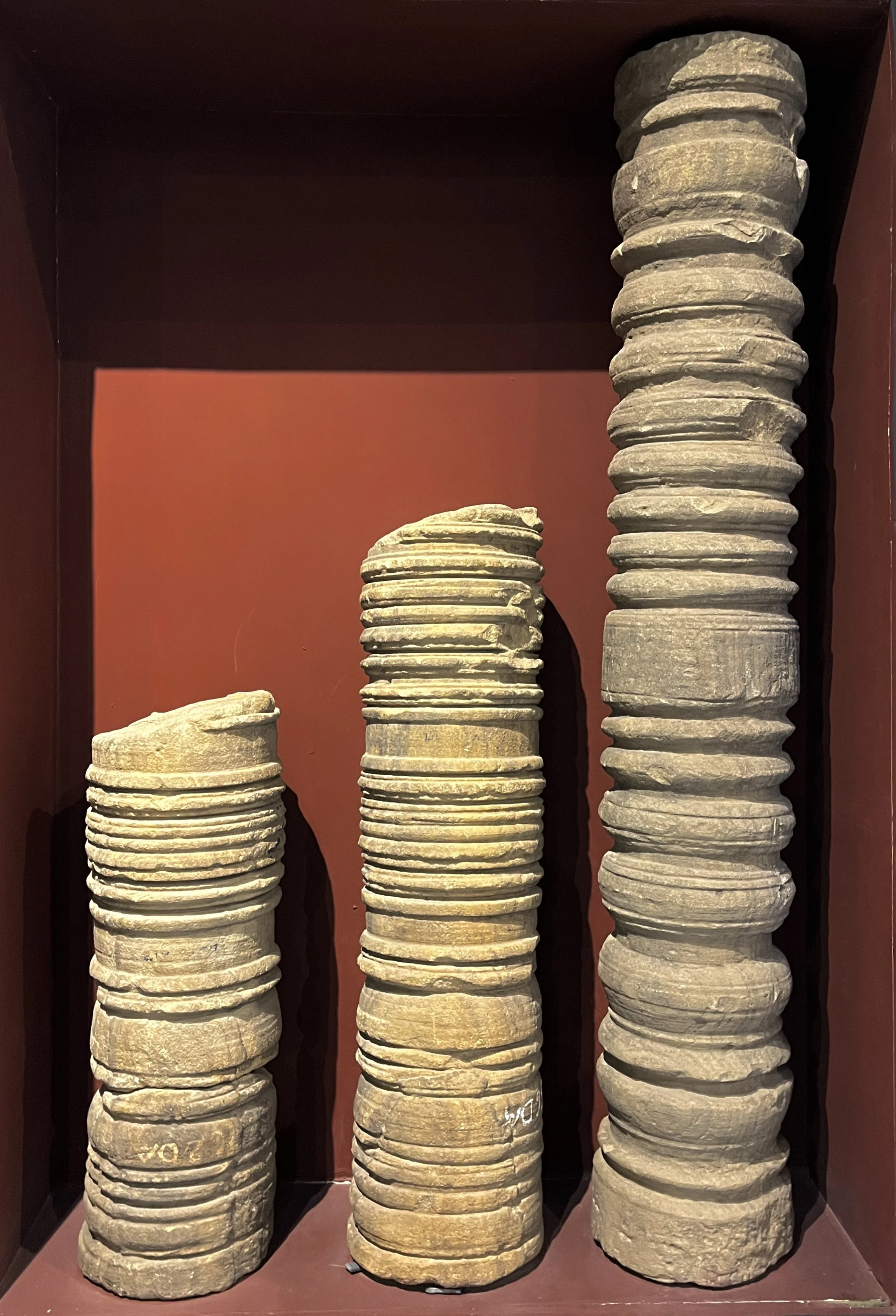
This is a reconstruction of the window baluster of ancient temples. The stone baluster of the window is composed of a base, a capital, and a shaft. The shaft is usually punctuated by rings in various shape and sizes. In a sense, the baluster is similar to the stone column with the exception that the style classification is impossible. Though, both ends of the baluster frequently have a tenon or/and a mortise to fit in the window frame.

Window Baluster (0747)

Sandstone

9th - 13thC

Unknown

Window Baluster (0780)

Material: Sandstone

Style: (?)

9th - 13th C.

Unknown

Window Baluster (0048)

Sandstone

Style: (?)

9th - 13ch C

Unknown

Window Baluster (0746)

Sandstone

Style: (?)

9th - 13th C.

Unknown

Window Baluster (0666)

Sandstone

Style: (?)

9th - 13th C

Unknown

Brahmanic borne

Sandstone, Angkorian Period, Baphuon style, second half of 11th C., Unknown

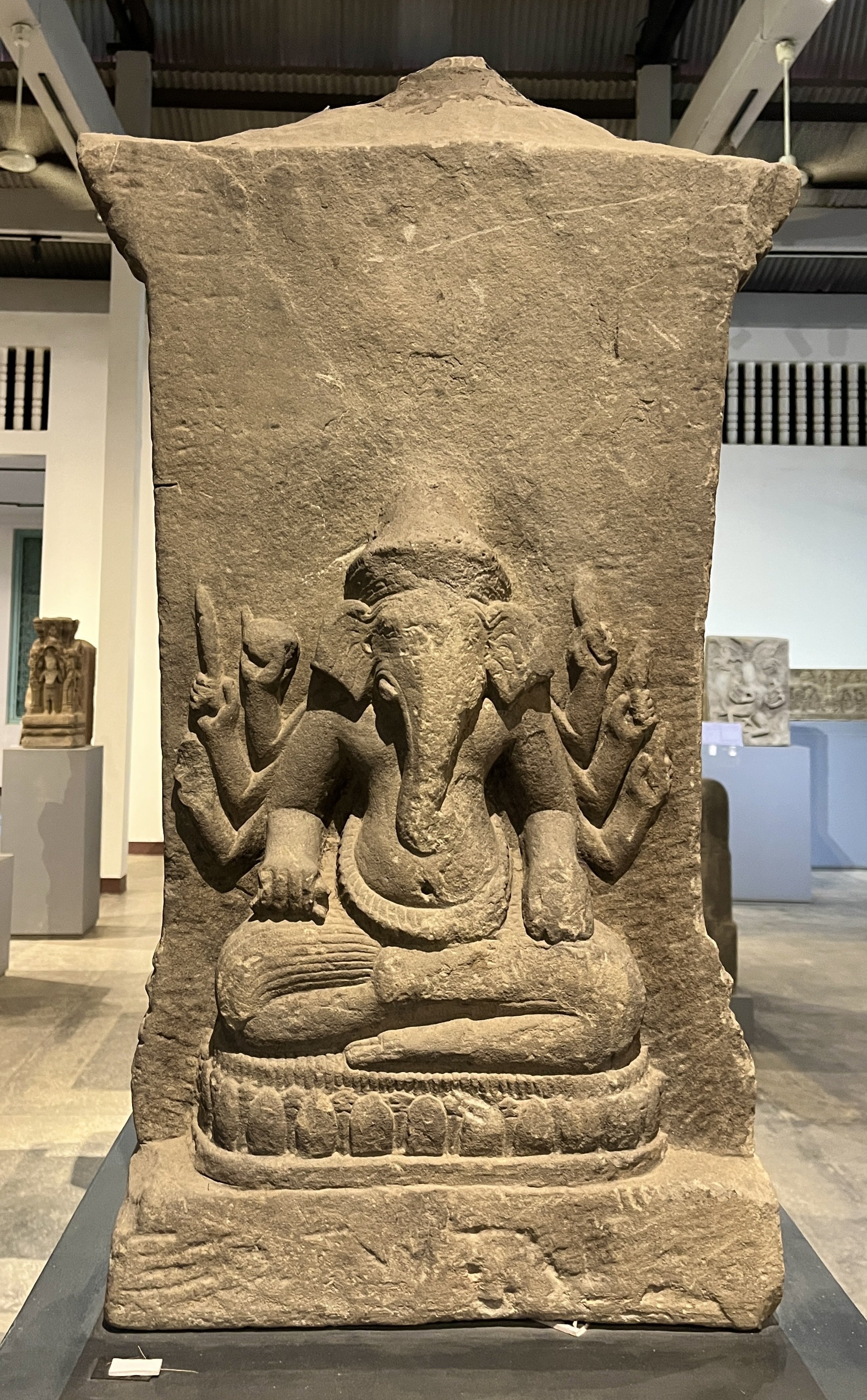
This boundary marker is carved with a standing male deity on one side and a seated eight armed Ganesha on the other. The male deity wears a typical Baphuon skirt, sampot Can Kkhbin. By his left leg are three small standing figures, probably Ganesha flanked by Shiva to the left and Uma to the right. The Ganesha on the other side is seated on a lotus petal base, each hand probably holds different attributes. The one resting on his left knee probably held his broken tusk.

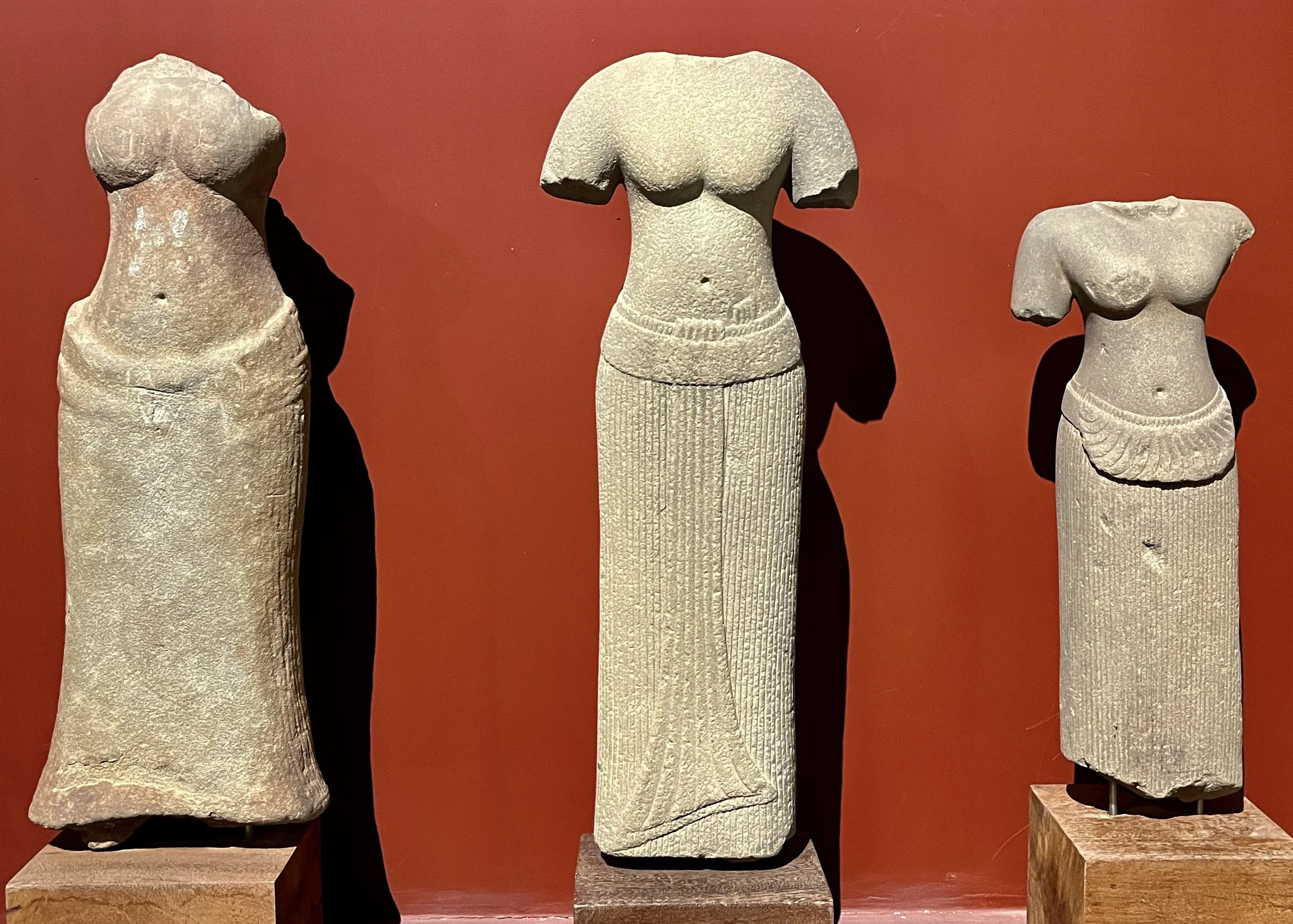
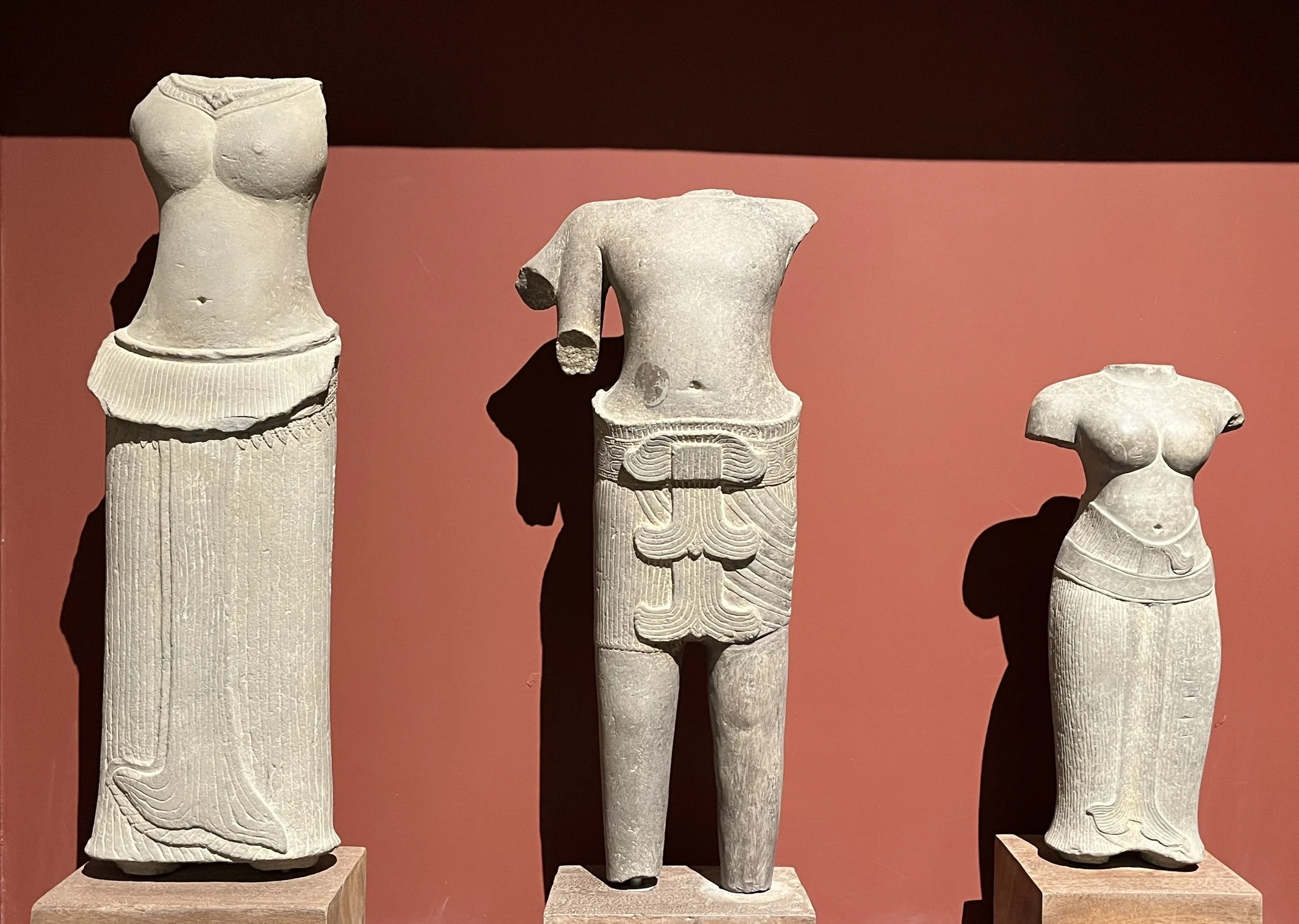
Female Deities

Female Deity (left)

Sandstone

Angkorian period. Baphuon style, Second half of 11th century Tuol Muk Buon, Basaet, Ta Pon, Sankaer.

This statue has a slender body with tight and round breasts. Despite being worn out, the features and shape of the skirt, long, pleated and fastened by a belt, suggest that the piece belongs to the Baphuon style. The dating of this piece is based on the curvy features of the body, which is commonly associated with the Baphuon style.

Female Deity (middle)

Sandstone, Angkorian period,

Khlaing style, early 11th C.

Unknown

This torso of female deity belongs to the Angkor Wat style. She wears a typical garment of the Khleang style. The pleat of the skirt is long and extends from the waist to the lower end.

The upper edge of the skirt is pulled up straight and tight against her abdomen, while another piece is pulled up straight and higher on the left but still below her navel. The style is fasterned by a scarf over the fold falling in between her legs forming a fish tail shape one over another. Such folds in fish tail shape are very popular in the Khleang style.

Female Deity (right)

Sandstone, Angkorian period.

Koh Ker style,

second half of 10th century

Unknown

The statue of this female deity cannot be identified due to severe damage. The statue wears a long pleated sampot. The fold of the skirt is half round and falls to the front in a fan form. The belt is hardly seen from the front. However, the draping of the garment suggests that this piece belongs to the Pre Rup or Koh Ker style.

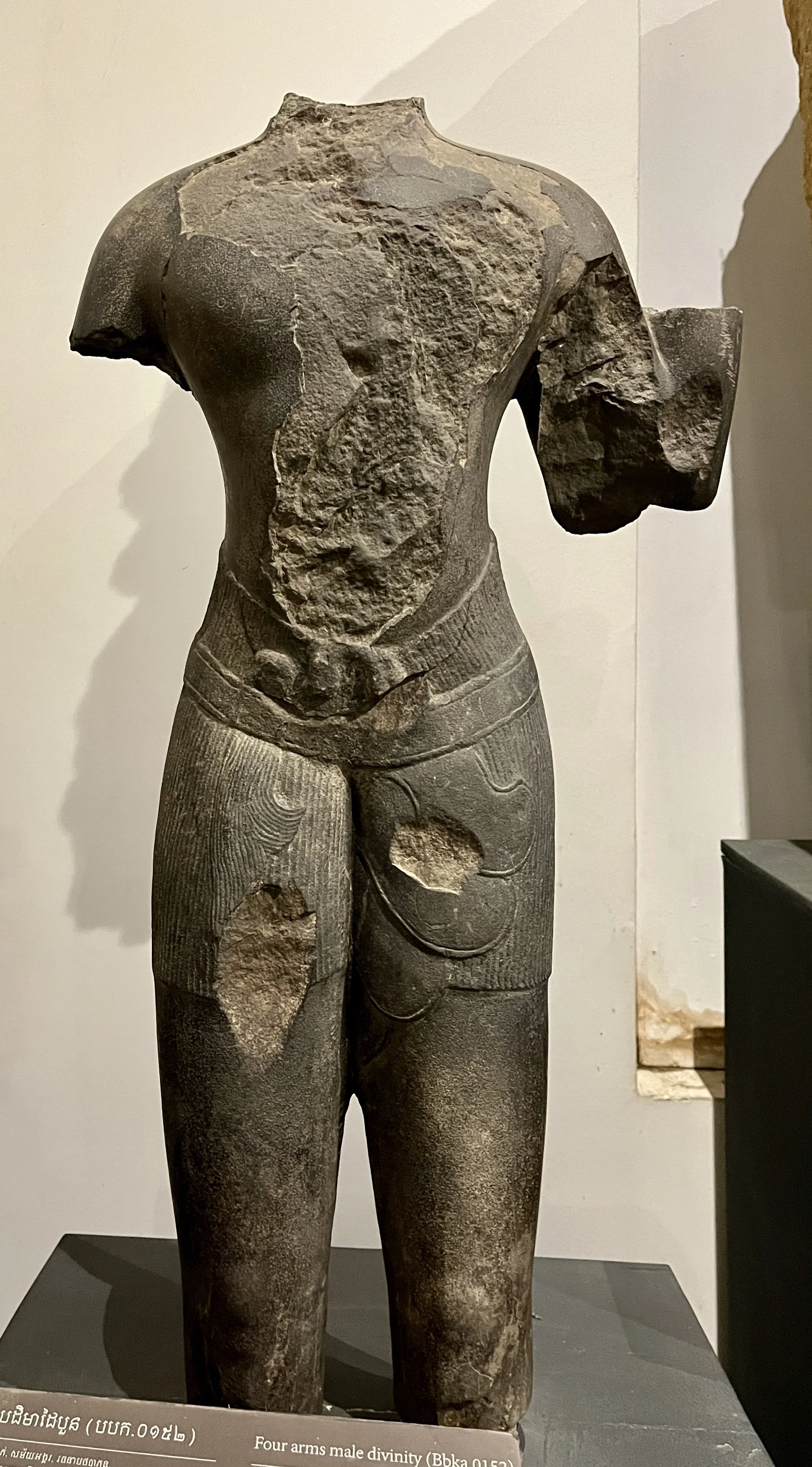
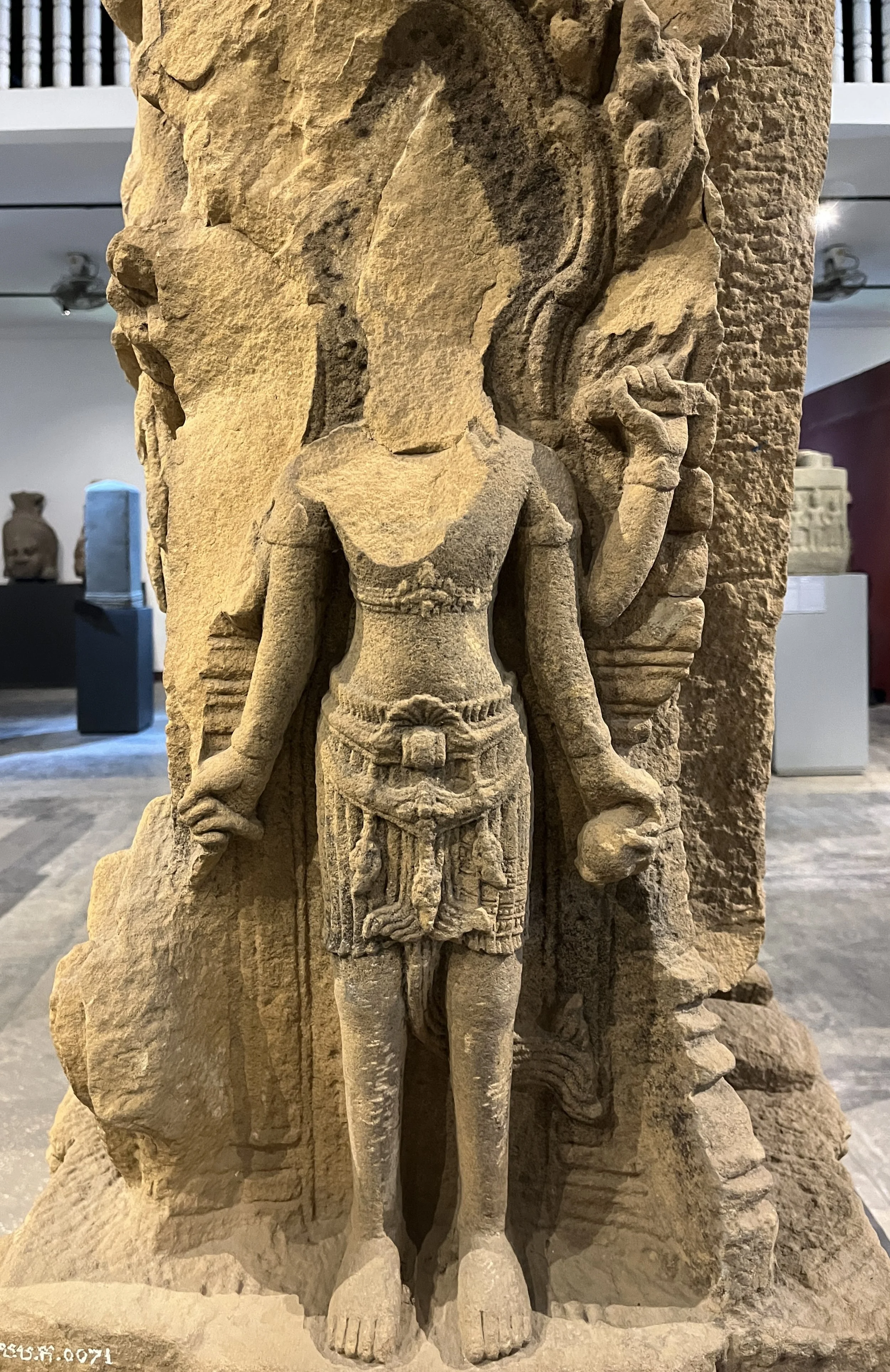
Four armed male divinity

Sandstone, Angkorian period, Baphuon style, second half of 11th c.

This four-armed deity has an elegant body, rounded shoulders, and a rounded stomach.

He is wearing a pleated skirt Sampot Chang Kbin' which is characteristic of the Baphuon style. The skirt is tied by a string in a knot in oyster shell form below his navel.

The skirt is also tied by a belt. The feature on the right thigh cannot be seen due to damage, on the left thigh is the skirt's fold.

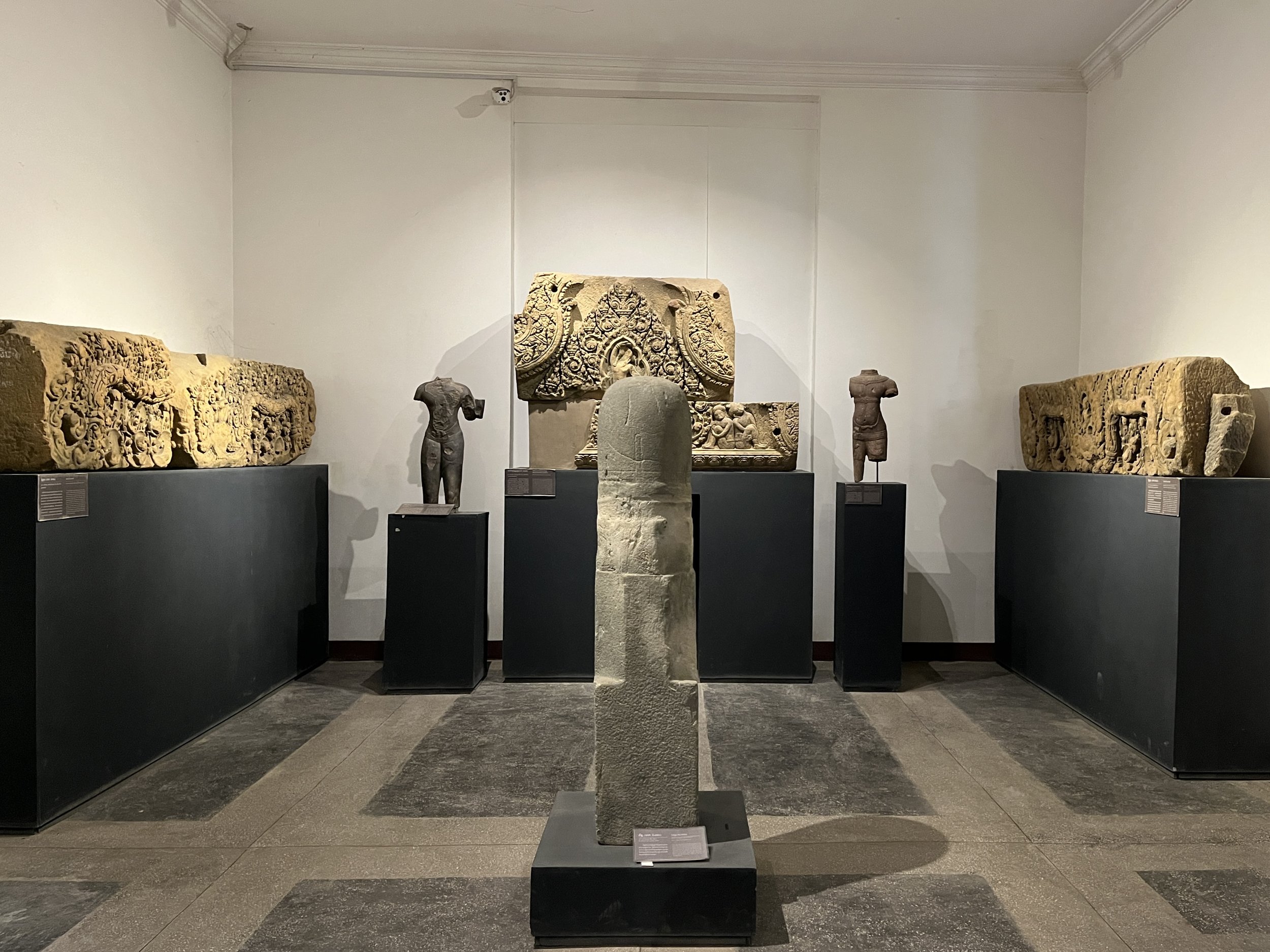
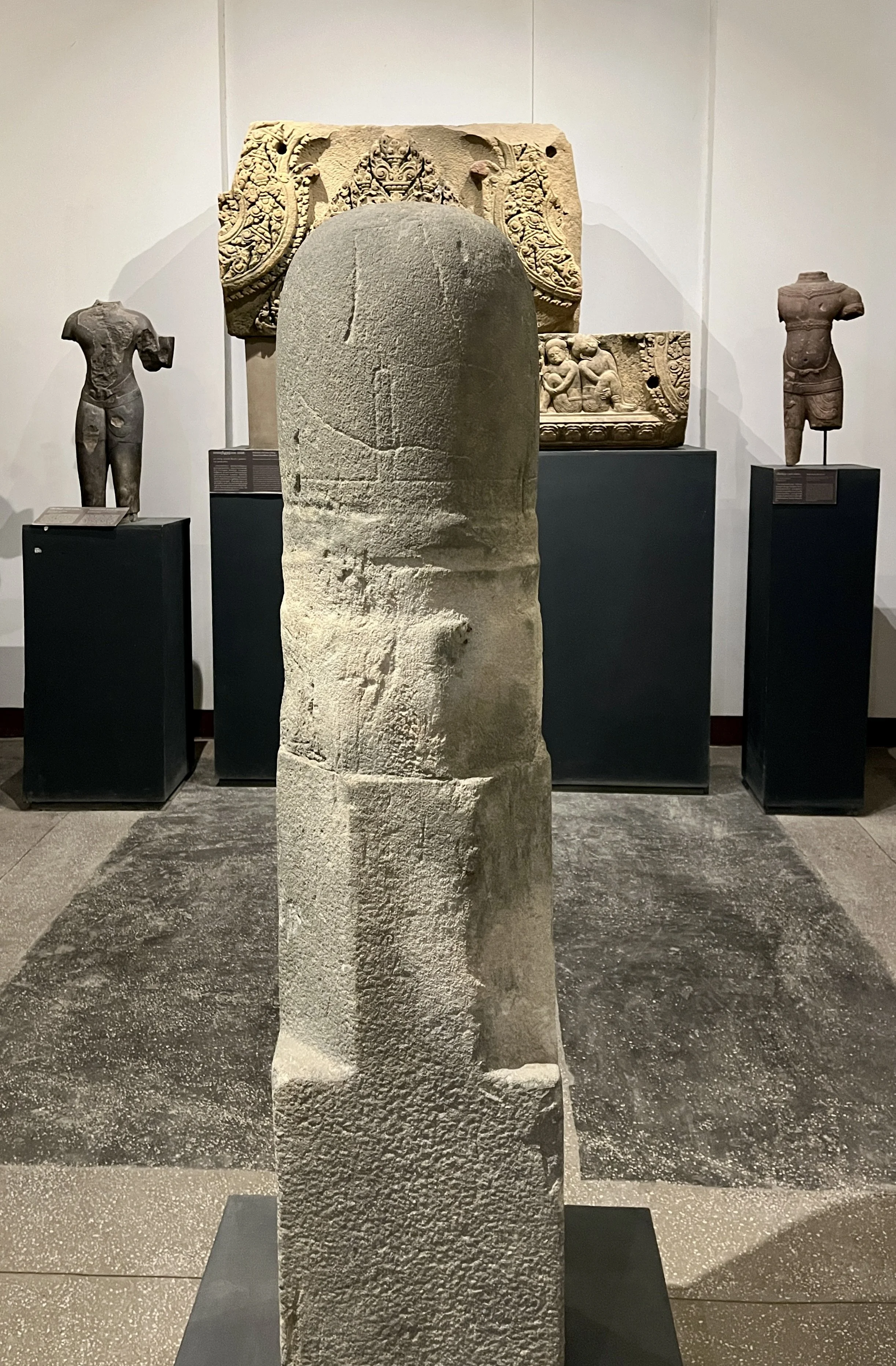
Linga

Sandstone

This Linga was found during the Baset temple restoration in 2017, lying in the lower part of the pediment. In ancient Cambodia, Shiva linga had various shapes and was made from various materials such as metal, sandstone, and granite. This particular linga represents not only Shiva, but the union of the main Hindu gods.

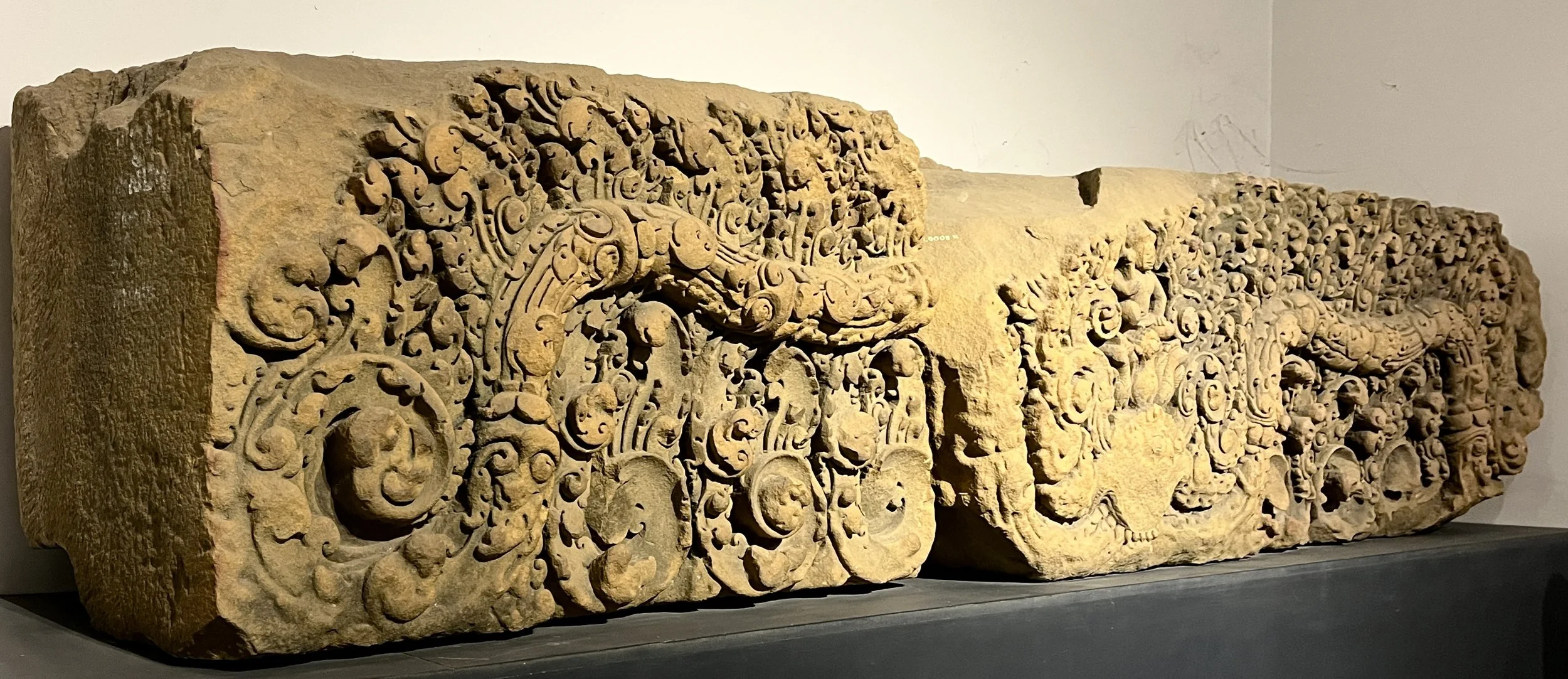
Lintel Sandstone. Khleang, Late 10th to early 11th centuries, Baset

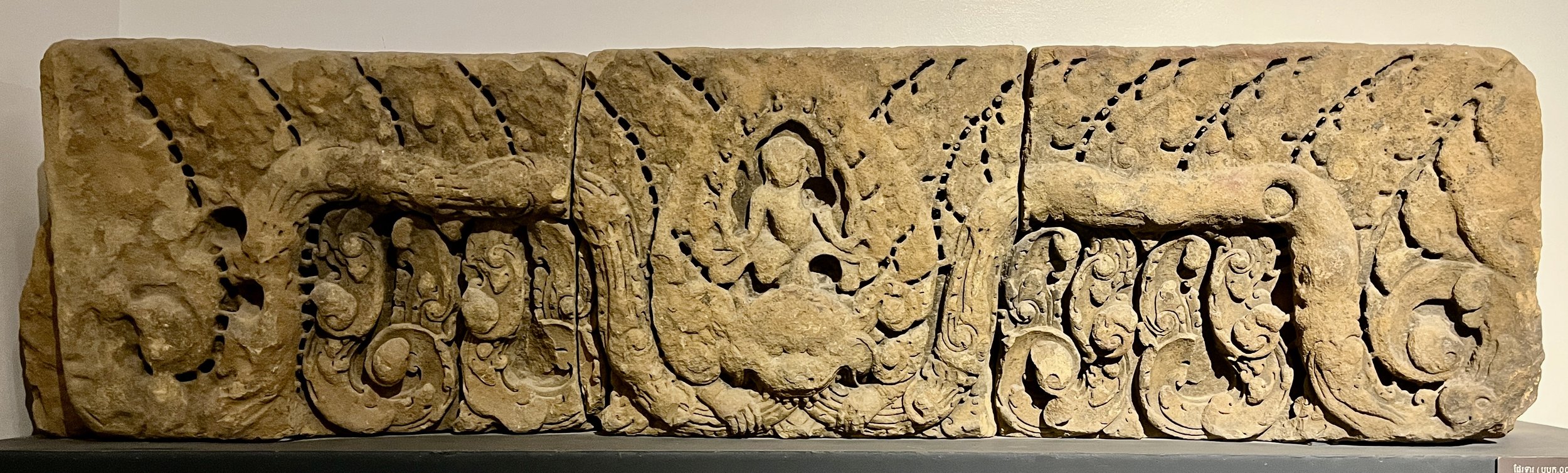
The lintel belongs to the Khleang style. At the center, either Skanda or Varuna, a Hindu god, is depicted sitting on three swans or peacocks set on top of Kala's head. He is probably Varuna as the lintel originates from the western door of the central tower of Baset temple. The deity is a guardian of the west, and is particularly associated with oceans and water. If he is Skanda, he is a son of Shiva and Parvati, carries a club and is mounted on peacocks or roosters. From Kala's mouth, two foliate branches protrude to form a bow shape, which at both ends forms curling foliage in the shape of Naga. The monotonous presentation of heavy vegetation appears to continue from the previous style, Khleang.

Four armed male divinity

Sandstone, Angkorian period, Baphuon style, second half of 11th c.

This four armed male statue with a slender round body wears a typical Baphuon pleated skirt, Sampot Can Khbin, with the backside of the skirt rising up almost to his back, while the front is below his navel. Two edges of a knot of the skirt form a curved green pepper form on the front. It is fastened with a stylish knot where both ends are folded and form a fish-tail shape on the right thigh and a curved eggplant shape on the left.

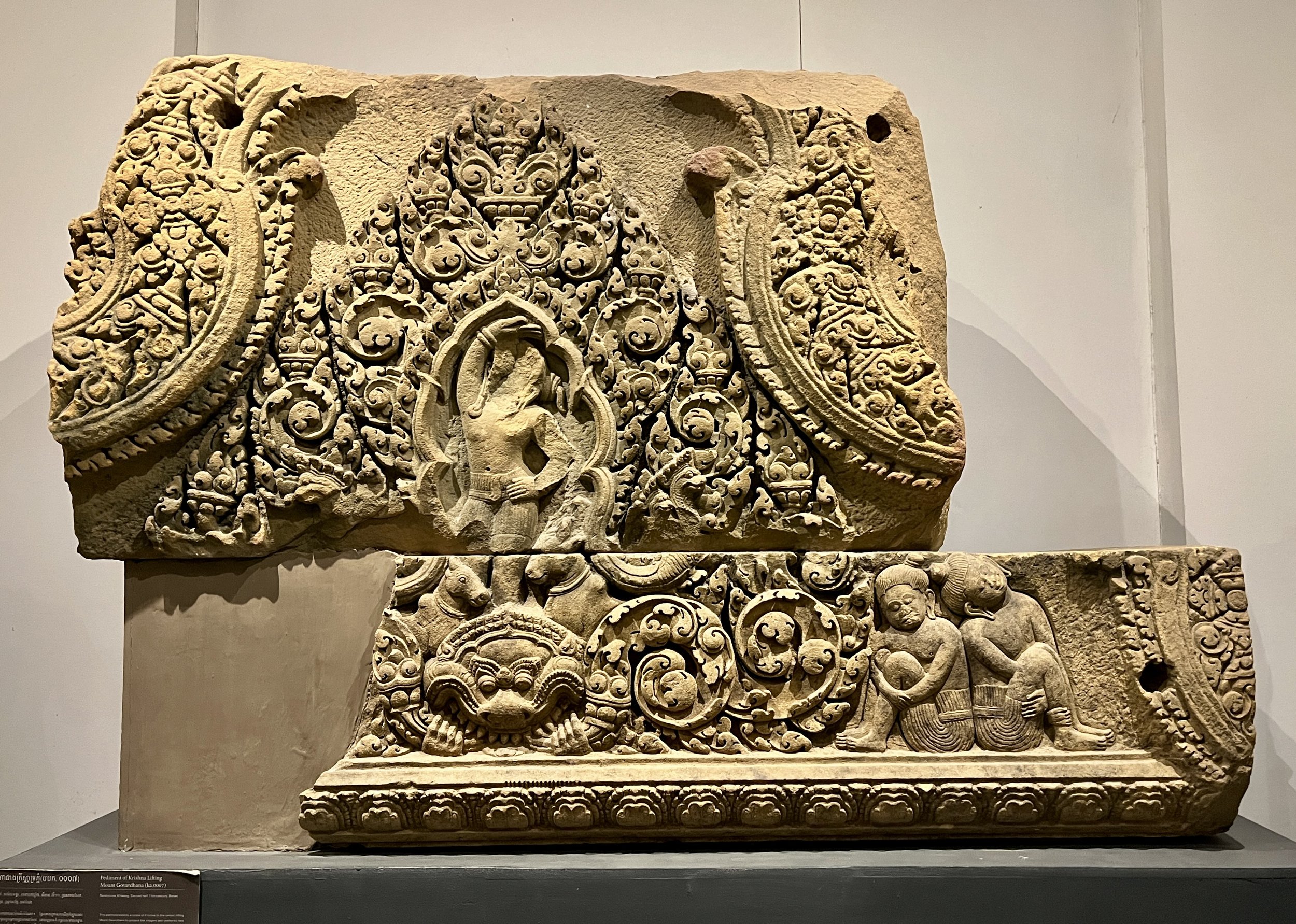
Pediment of Krishna Lifting Mount Govardhana

Sandstone, Khleang, Second half 11th century, Baset

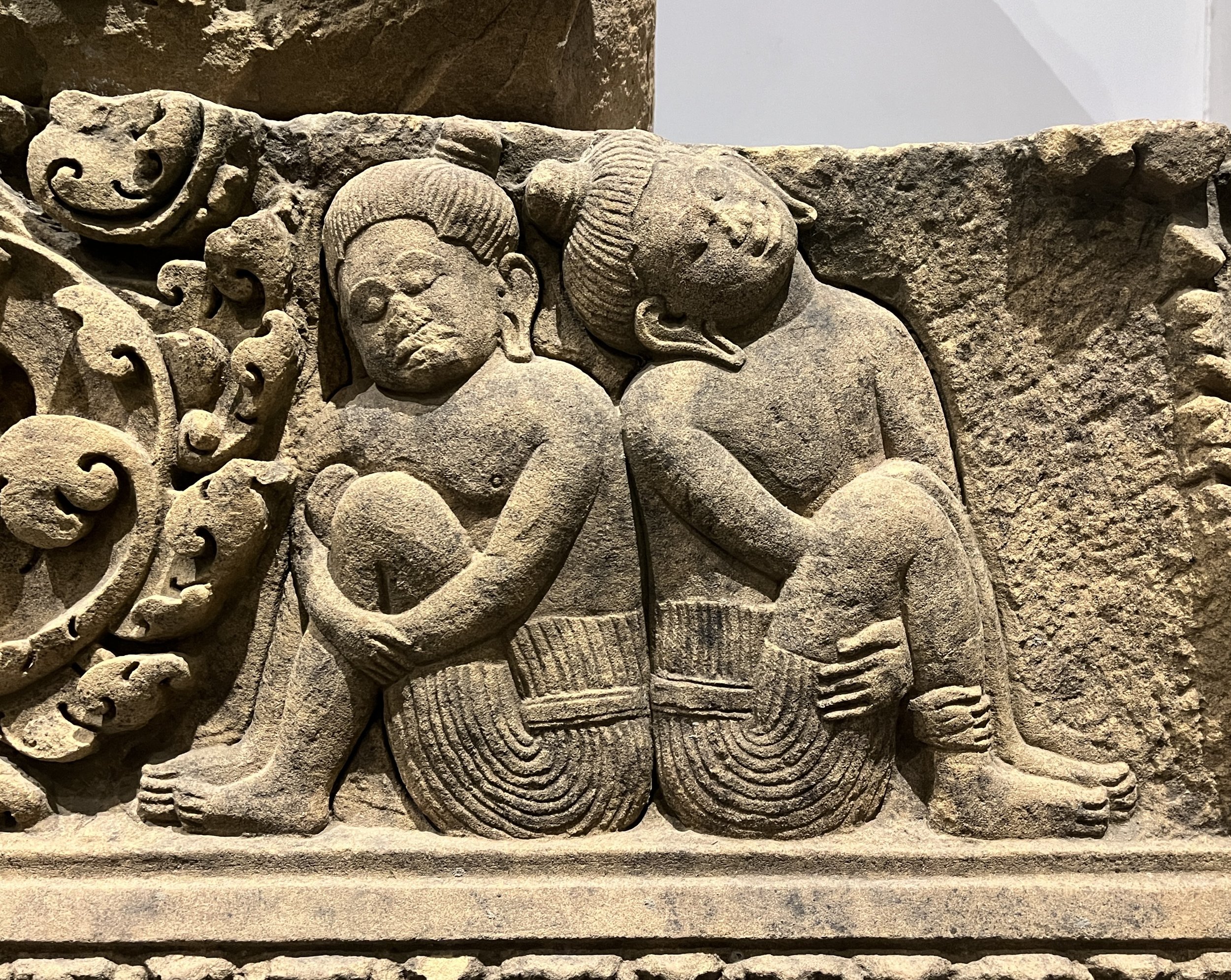
This pediment depicts a scene of Krishna (in the center) lifting Mount Govardhana to protect the villagers and cowherds (two on the right) and animals (in the center) from Indra's wrath.

The villagers were supposed to make a sacrifice to Indra every year.

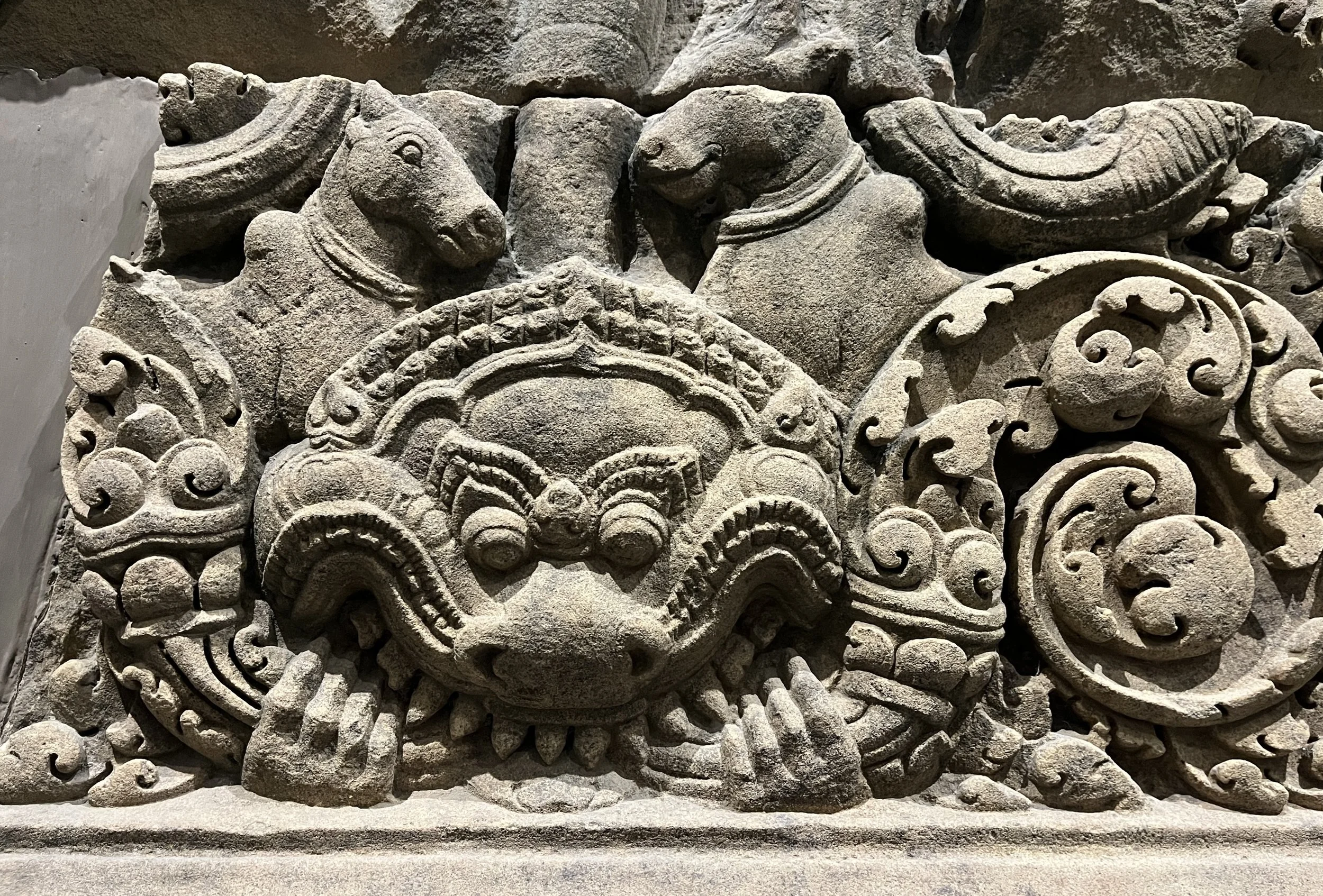
Krishna disliked the act of sacrifice and convinced them to give up the practice. Indra was irate and released torrential rain on the village. To save them, Krishna lifted Mount Govardhana with his right hand to shield the village like an umbrella from the rain. In this piece, the Kala head at the bottom center appears to serve as decoration. Krishna is depicted standing in a relaxed manner with his right hand lifted up and his left hand put on the hip. His skirt, which is tied by a string with a knot in oyster shell form below the navel, suggests that the piece belongs to the khleang style.

Male Deity

Sandstone, Angkorian period. Baphuon style.

Second half of 11th century

This four-armed deity has an elegant body, rounded shoulders, and a rounded stomach. The body is ornamented with a necklace, armbands, and torso belt. The rear upper edge of the skirt is straight horizontally and rises up to the middle of the back while the upper front edge is curved down from both sides and sits under the navel level. The string knot below the navel, commonly seen on statues in the Baphuon style, is absent.

The skirt is fastened by a belt at hip level. The skirt's edge is inserted underneath the belt and falls on the left thigh.

Lintel

Sandstone, Angkorian period, Khlaing style early 11th C. Prasat Baset, Tapon, Sruk Sangkae

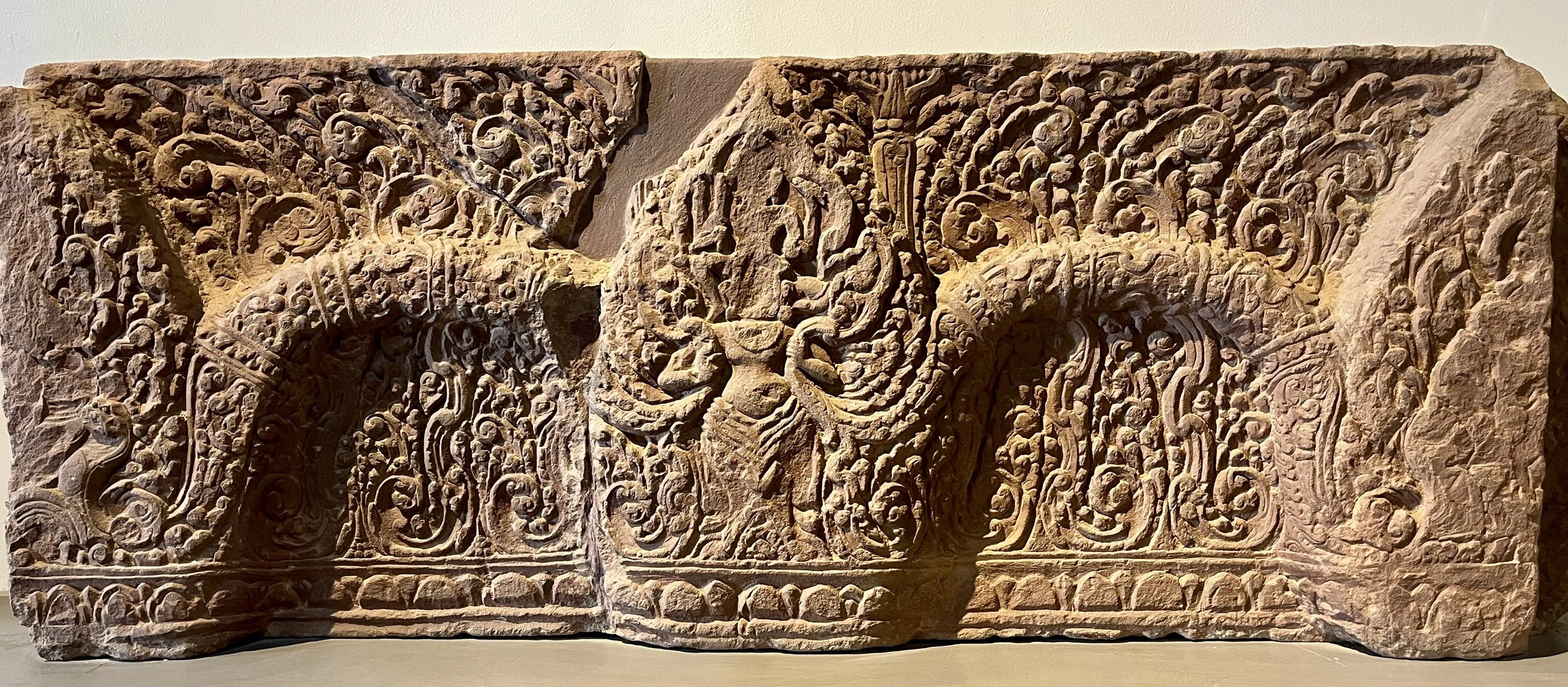
The lintel depicts a deity mounted on Kala in the center; it is probably Krishna with both hands holding a Naga, a poisonous snake living in the Yamuna river. The lintel belongs to the Khleang style. As typical in the Khleang style, the depiction of Kala's head is at the bottom center, surrounded by heavy vegetation. From Kala's mouth, two foliate branches protrude to form a bow shape, at both ends curling into foliage in the shape of Naga.

1. Female Deity

Sandstone, Angkorian period,

Baphuon style,

Second half of 11th C.

Unknown

2. Male Deity

Sandstone, Angkorian period

Angkor Wat style, late 11th to late 12thC.

Unknown

3. Female Deity

Sandstone

Angkorian period, Angkor Wat style late 11th to late 12thC.

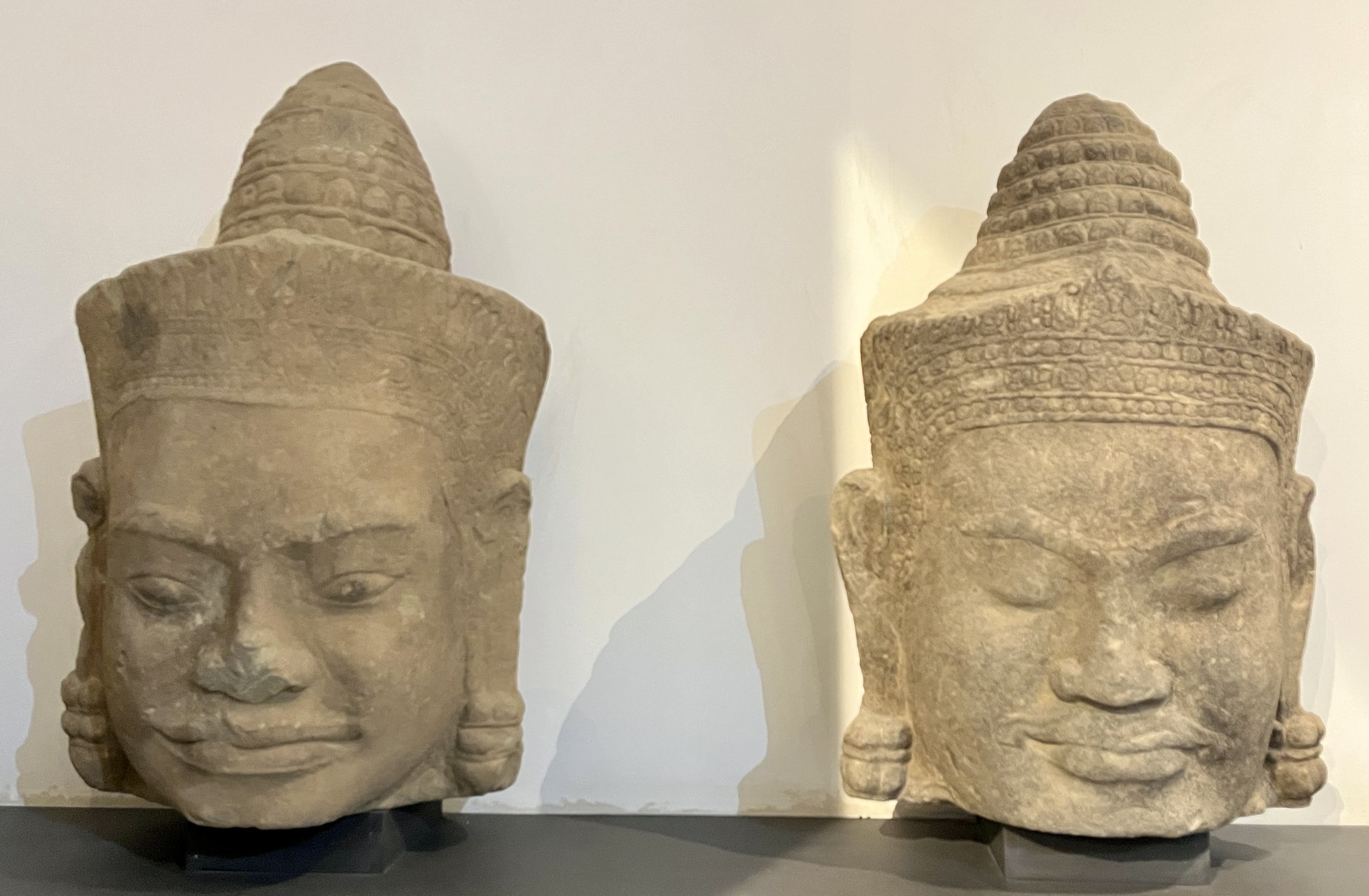
Wat Dorei Sor

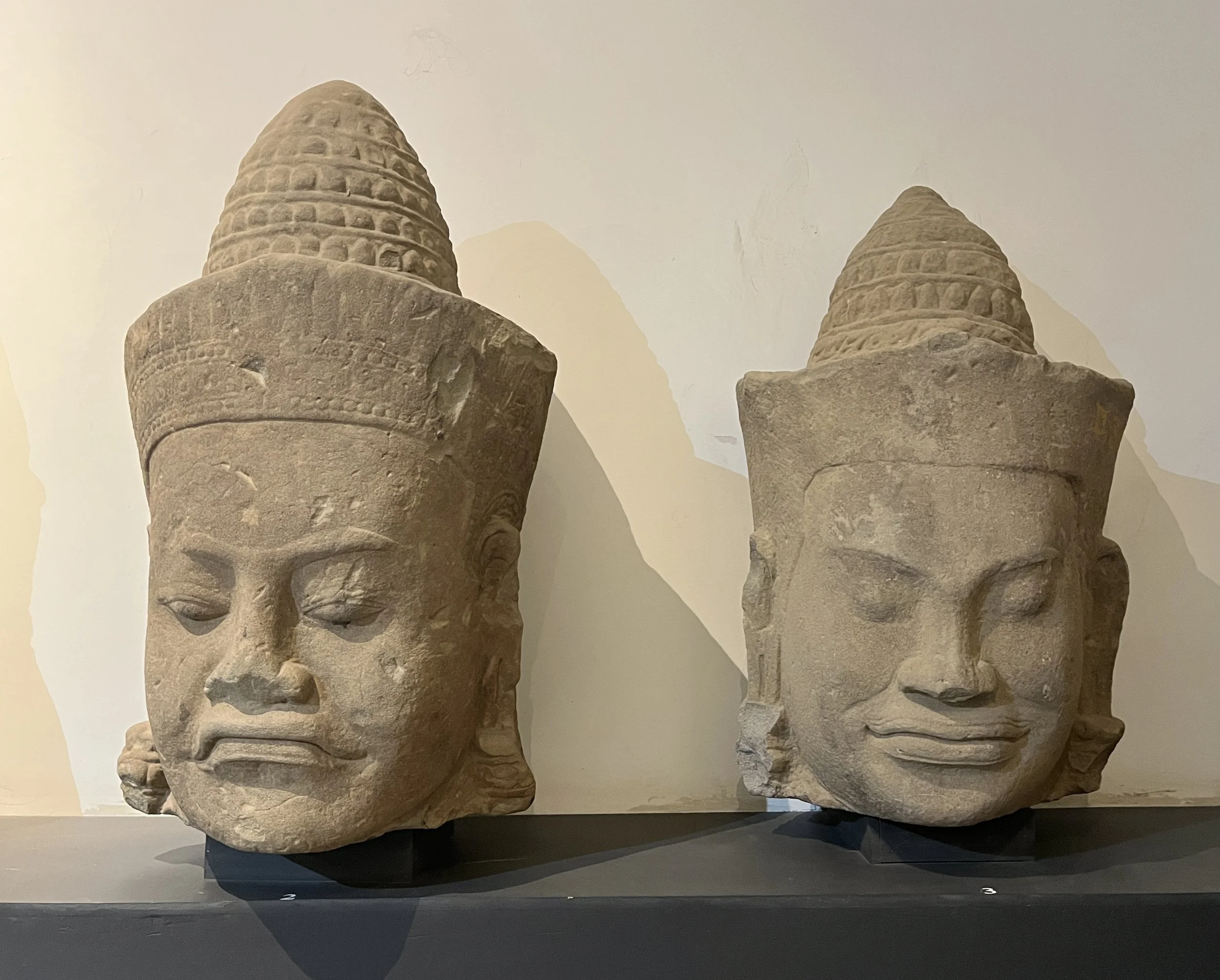
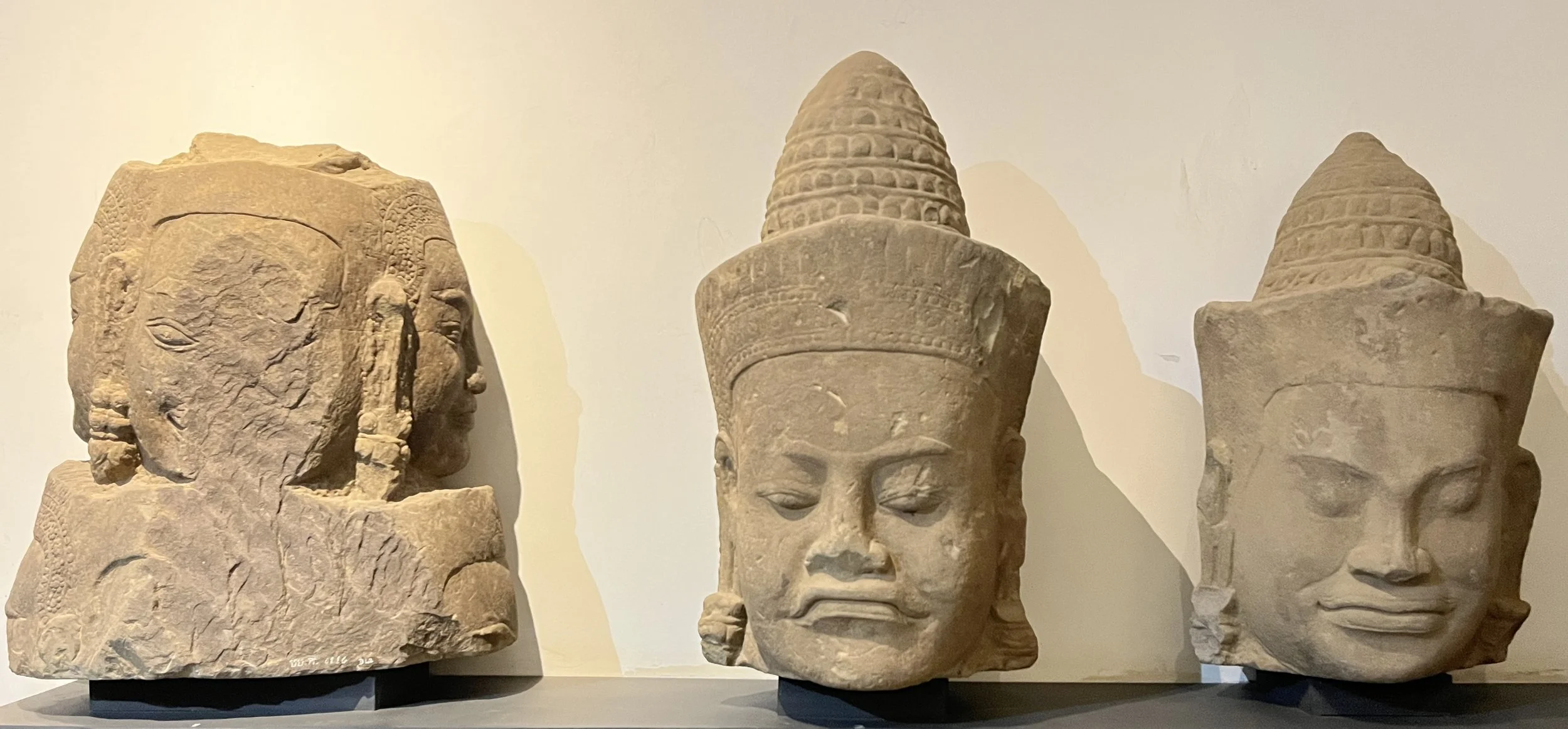
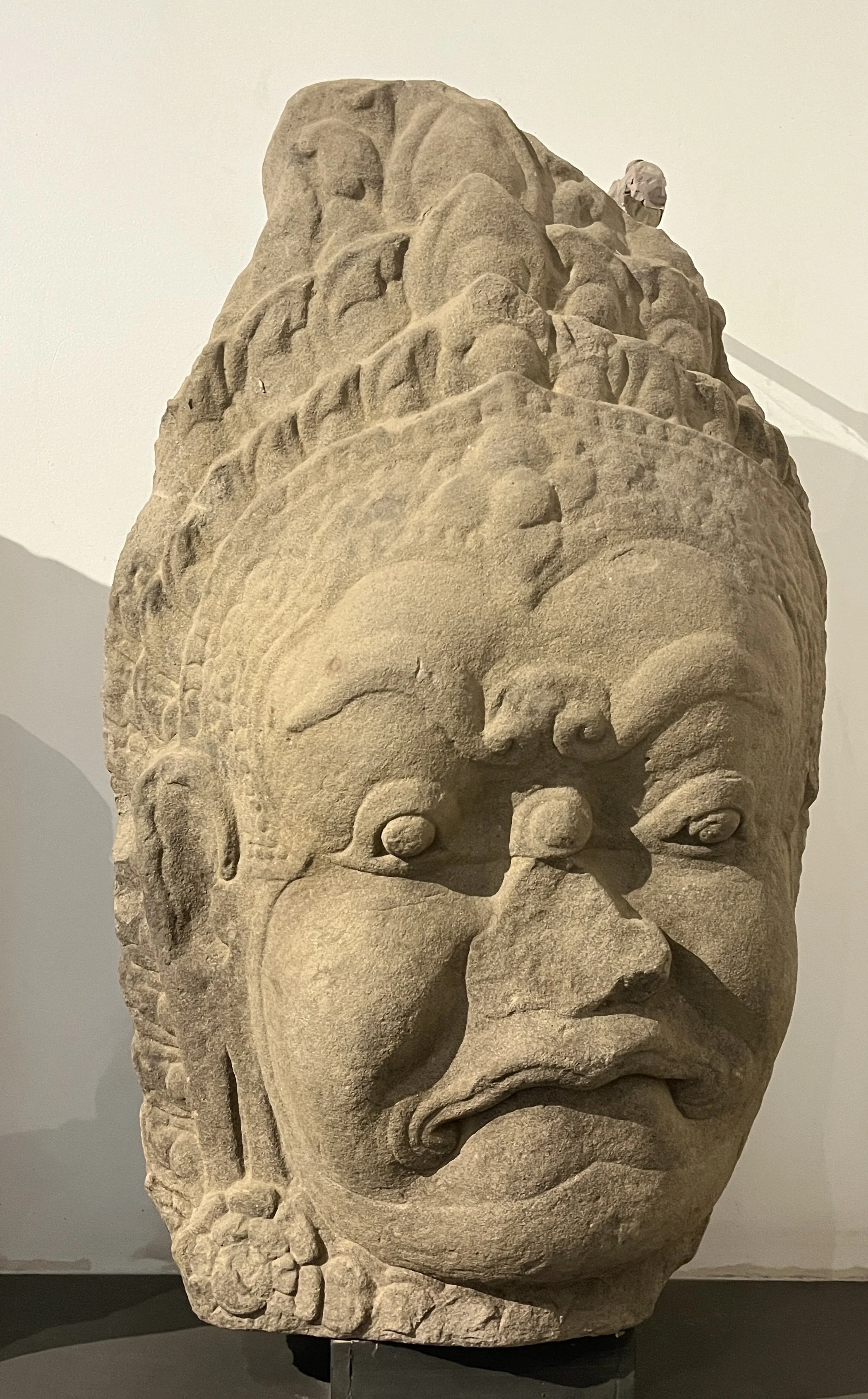
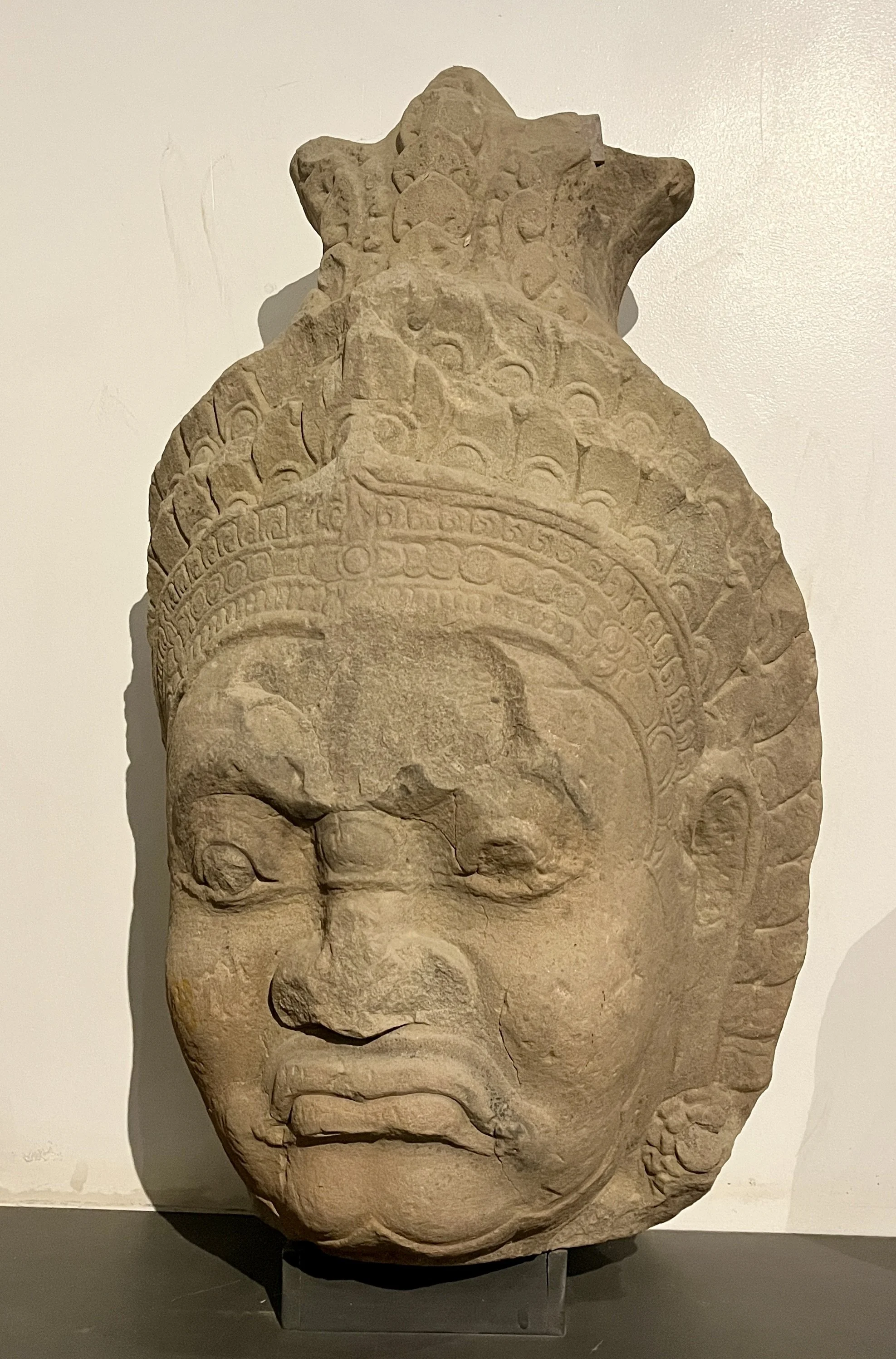
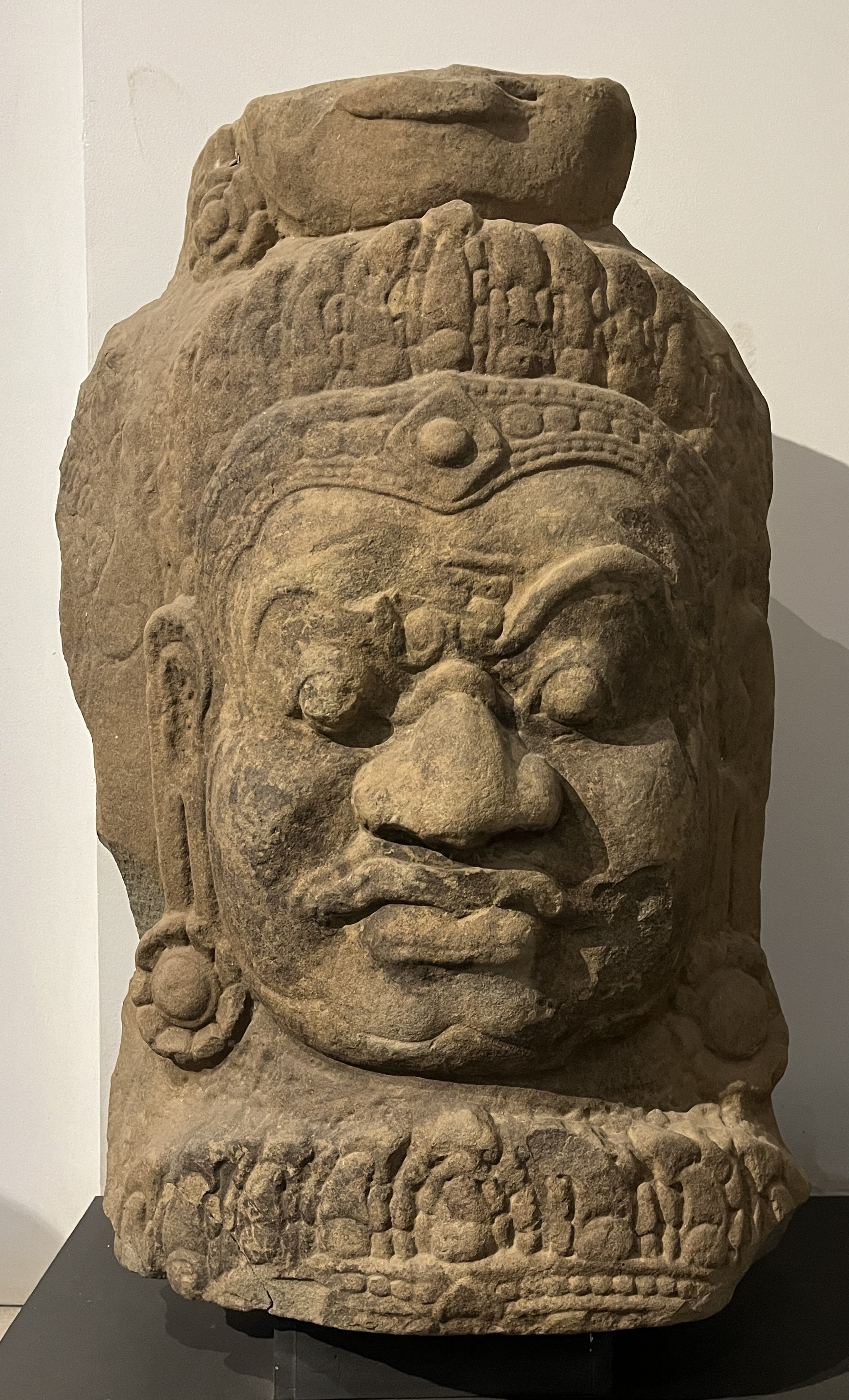
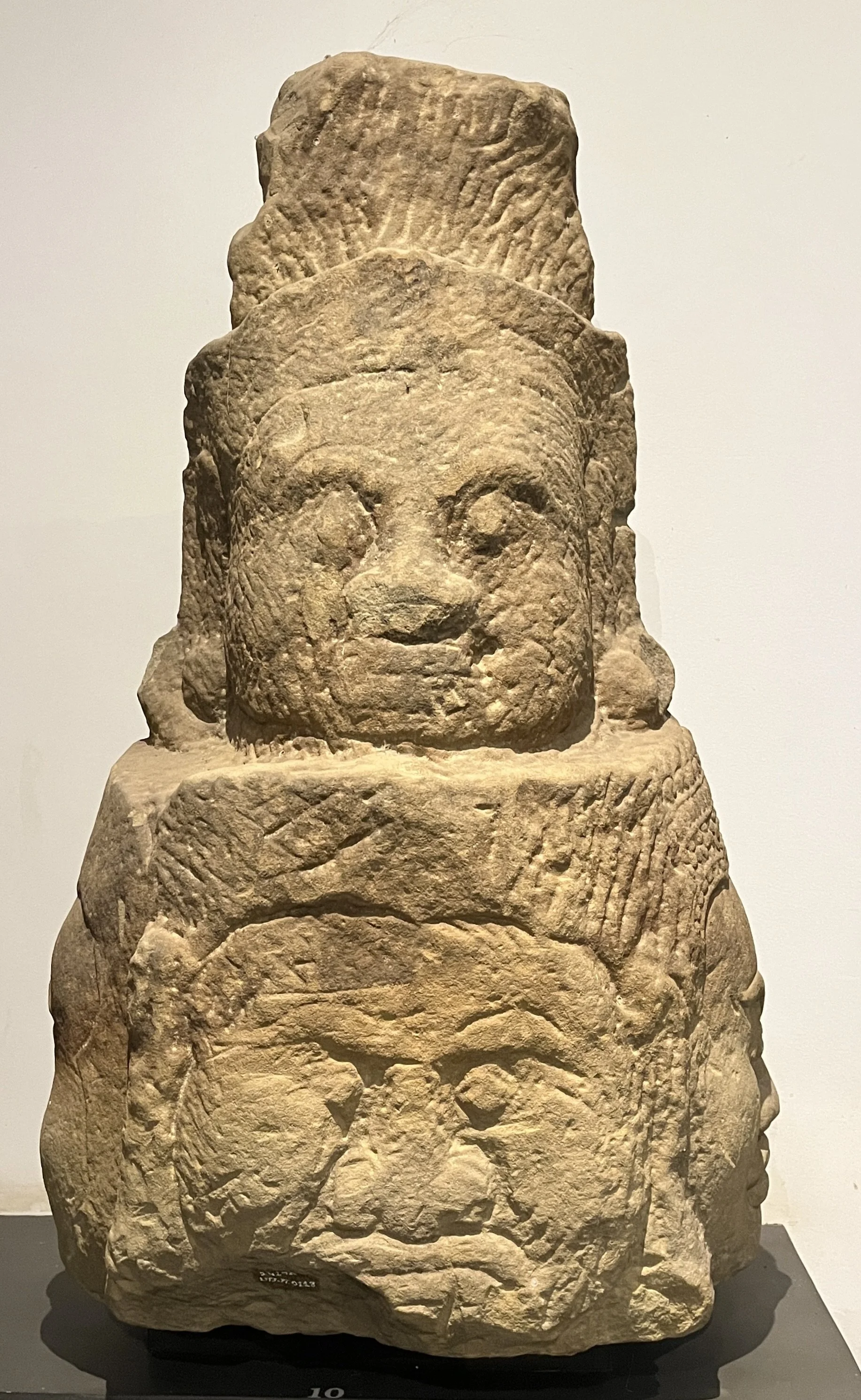
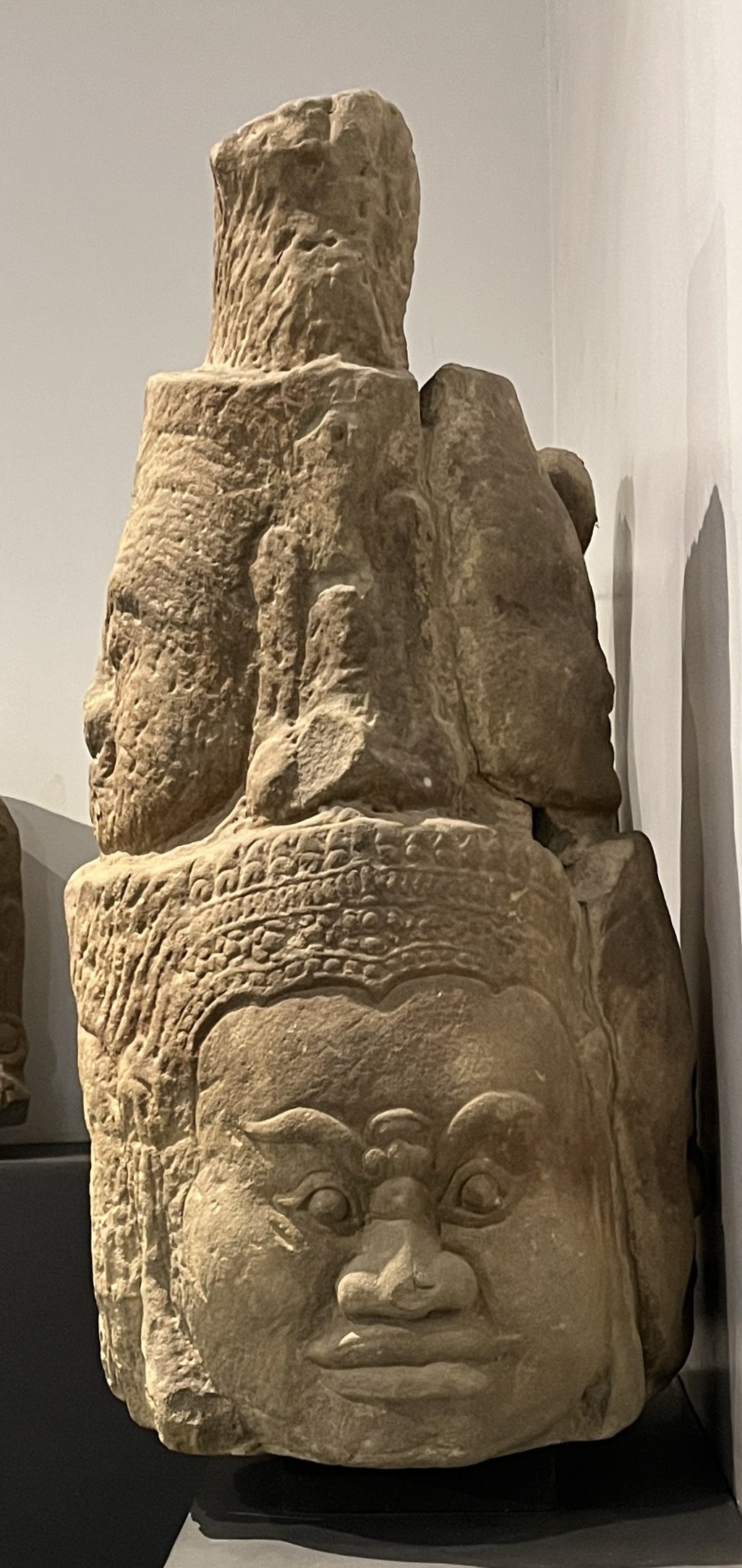
These colossal heads belong to the Deva and Yaksha at the causeway of the Banteay Chhmar temple. The causeway is situated in front of each tower gate. Along the causeway, there are two rows of mythical beings, the Devas on the left and the Yaksas on the right. Each side holds a Naga with a stance that represents a tug of war. This presentation can allude to the famous Hindu mythology, the Churning of the Sea of Milk. Depictions of the myth begin to appear on lintels in the 11th century. A final depiction dates from the late 12th -13th century reign of King Jayavarman VII; he crafted the scene of the Churning of the Sea of Milk by placing Deva and Yaksha holding the snake Vasuki on either side of the four main gates of Angkor Thom city. The work aims to make Angkor Thom an immortal city.

Two kinds of heads are exhibited here, the one-face head and multi-face head. The one-face heads belong to the common Deva (No.7, 8, 10, and 11) and Yaksa (No. 1, 3, 4, and 5). The multi-face, presumably twelve, Deva (No. 9) and Yaksa (No.2) are of higher status and have the role of holding the head and the tail of the Naga.

Heads of Devas and Yaksas

Prasat Banteay Chhmar

Late 12th to early 13th centuries

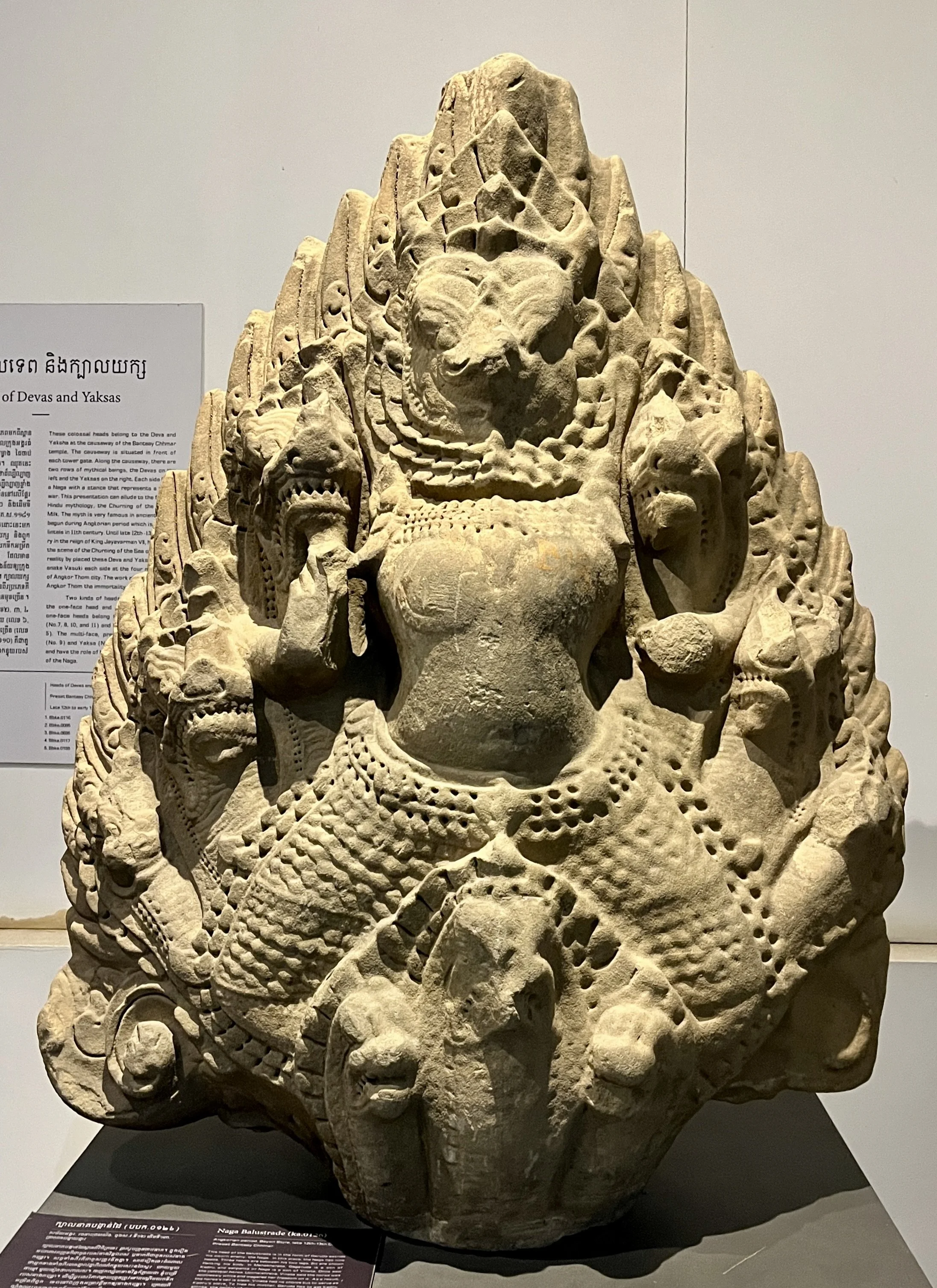
Naga Balustrade

Angkorian period, Bayon Style, late 12th-13th C..

Prasat Banteay Chhmar

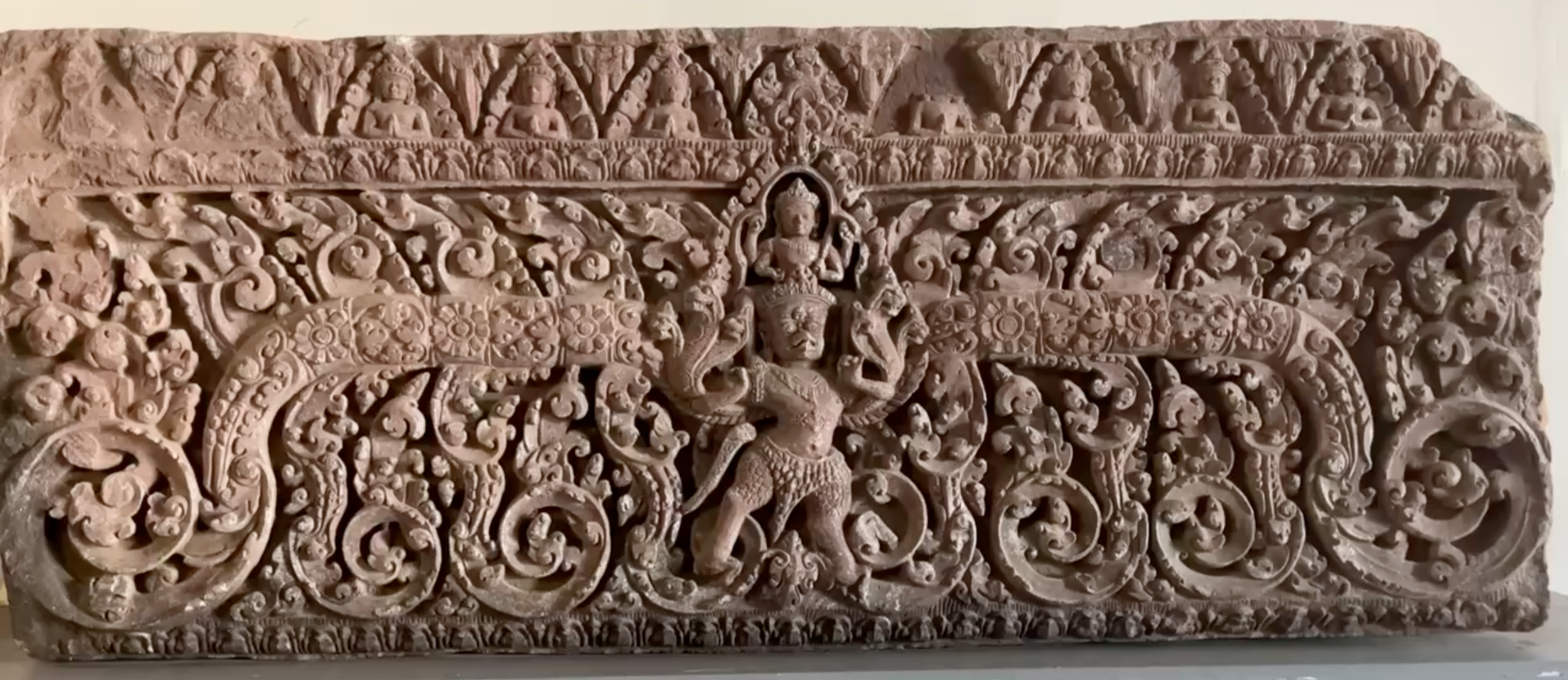
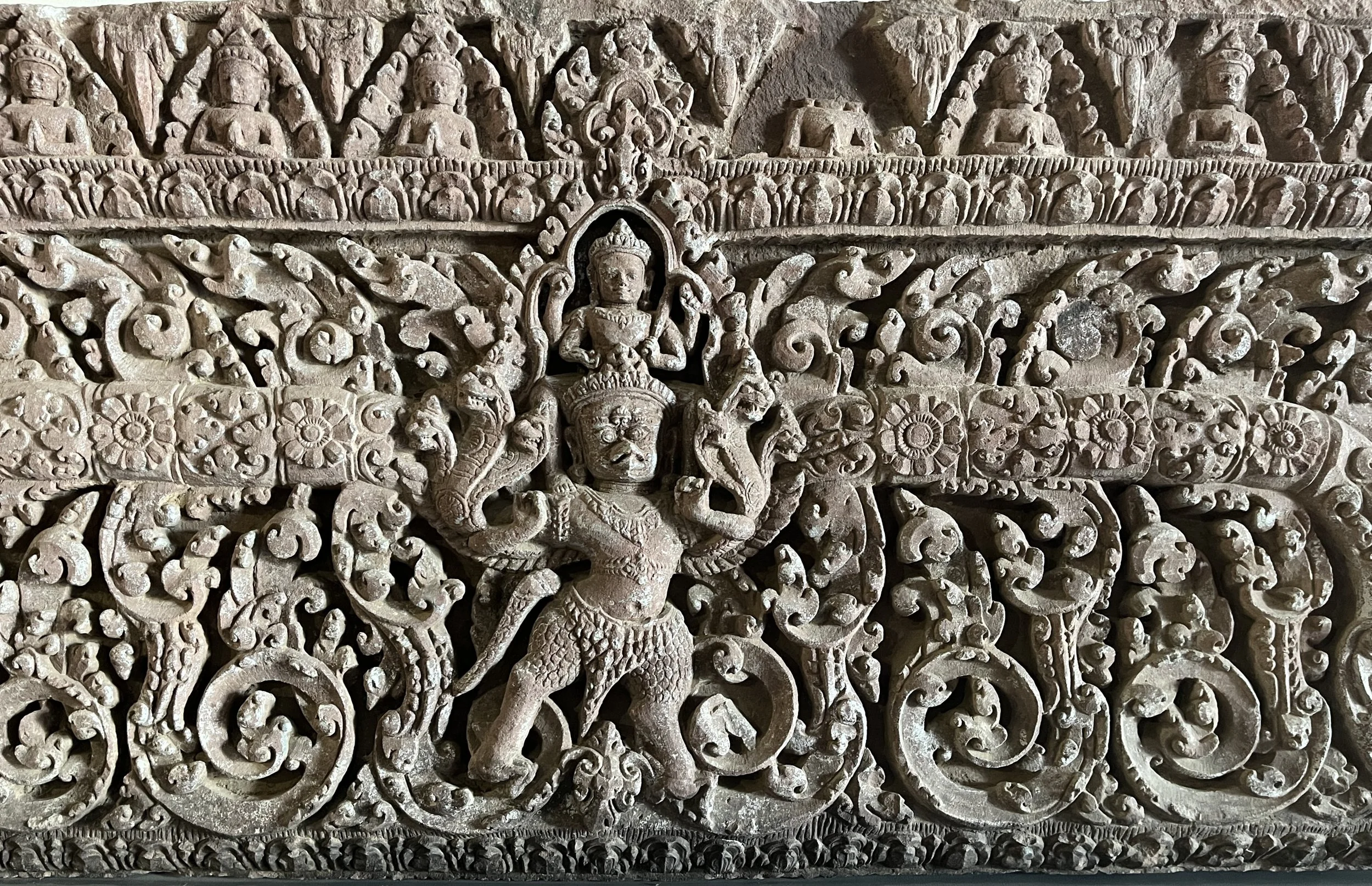
This head of the balustrade is in the form of Garuda astride his sworn enemy, the Naga. In this piece, the Naga has nine heads. Three heads are between his two legs. Six are shown flanking his body. In Mahabharata, Gagaruda is a son of Kadru, and the serpent or Naga is a son of Vinata. Once he saw the celestial horse, Ucchaishrava, Vinata said the horse was spotlessly white and wagered his mother’s freedom on it. In the end, the horse's tail was black, so Vinata had no choice but for her to serve as Kadru's slave. To free his mother, Garuda has to get Kadru amrita, the nectar of immortality which is possessed by the devas at Amravati. He fought the devas and won, and took the amrita. He requested that the nagas drink the amrita only after taking a bath. While they, Kadru and his son were away he let Indra reclaim the nectar and take it back to his celestial city. Impressed by Garuda's strength valor and guile, Vishnu asks Garuda to be his mount, And agreed that Garuda became both his mount and his insignia.

Male Deity

Sandstone, Angkorian period, late Angkorwat style. late 12th to early 13th C., Unknown

This is a typical torso of a male deity in the Bayon Style. His short skirt has two scarf tails, in fishtail shape, at the front, one atop the other. The scarf is tied with a belt decorated with a row of pearls motif.

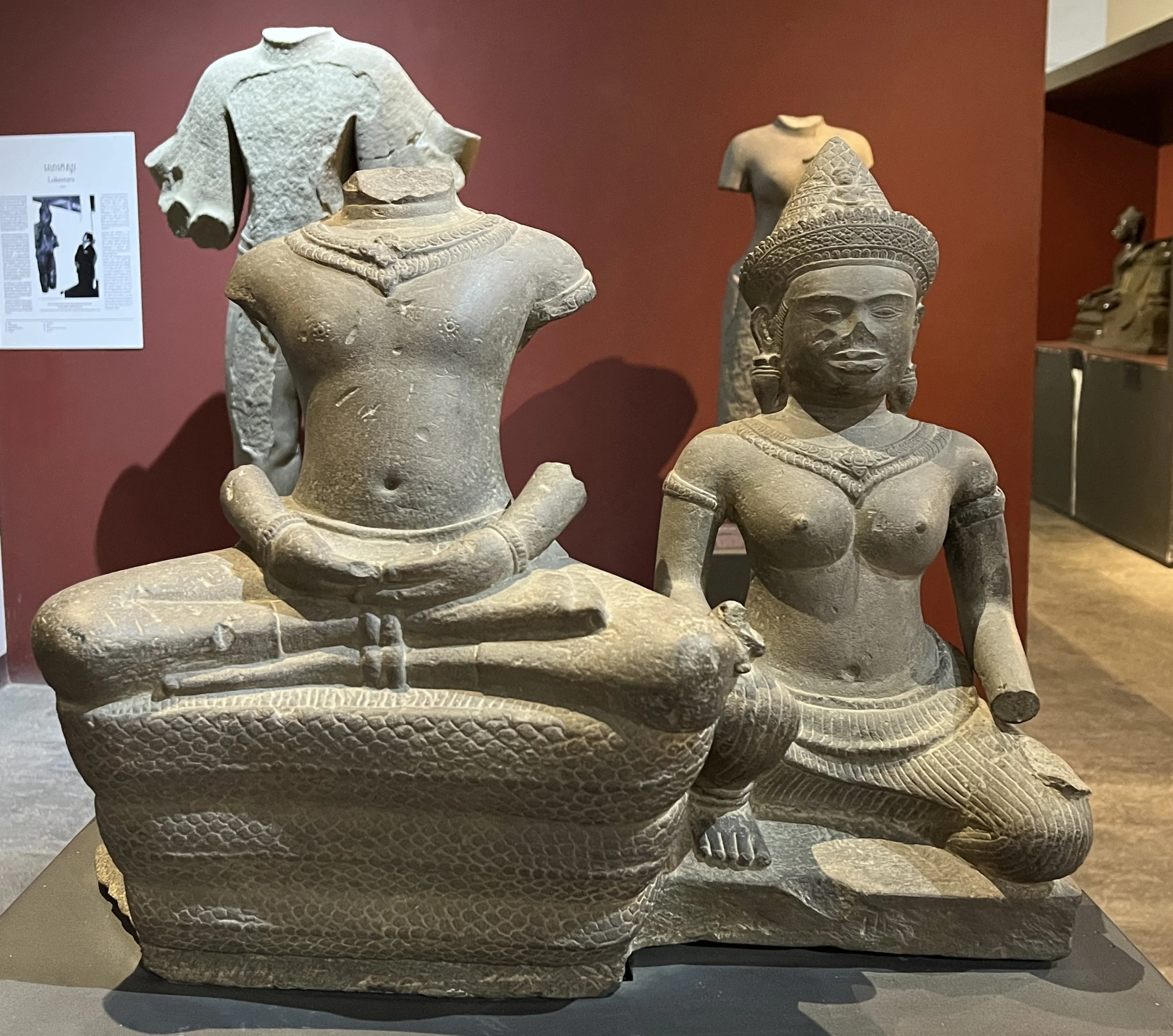
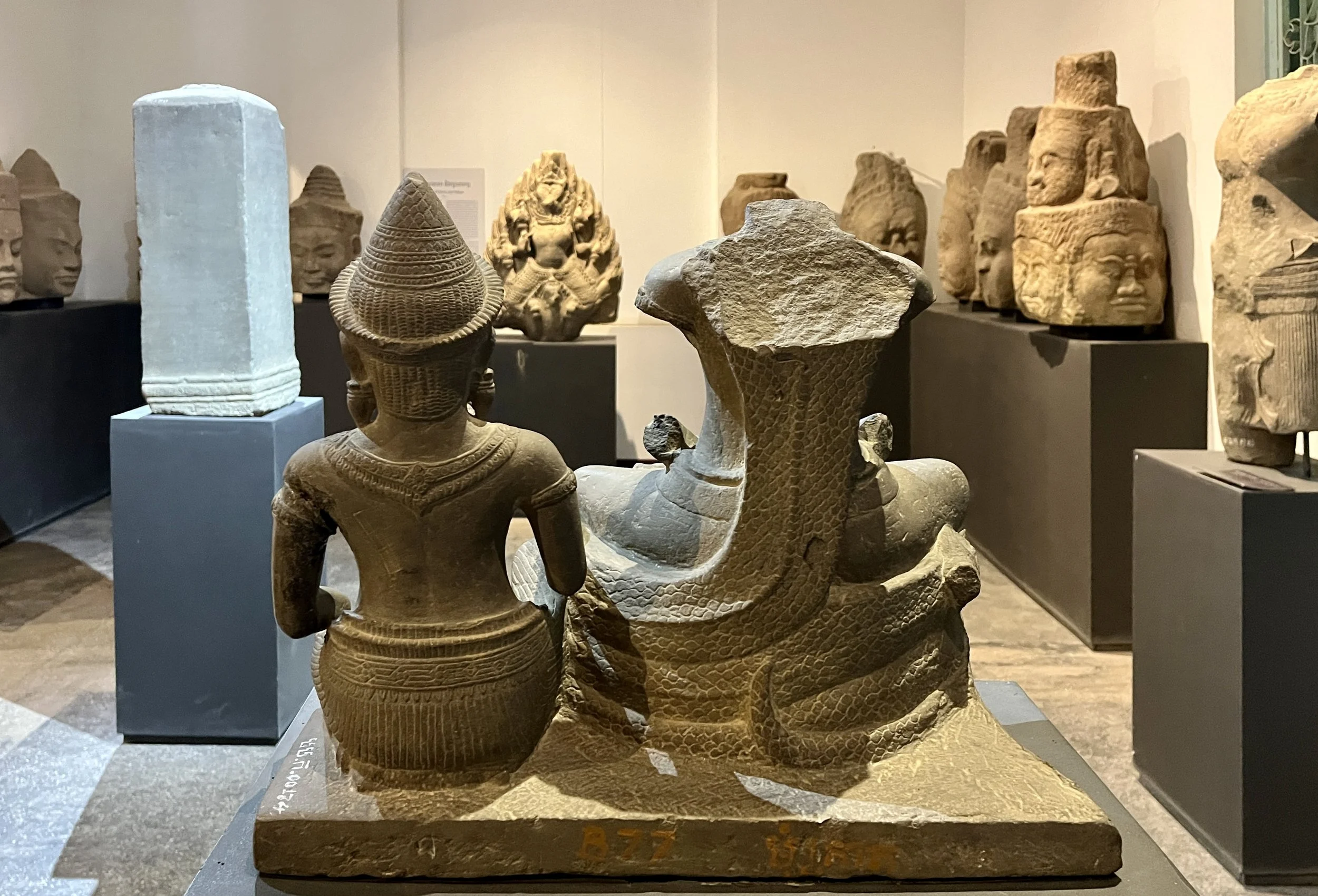
Buddhist Trimurti

Sandstone. Angkorian period, Angkor Wat style, late 12th to early 13th C.. Wat Damey Sar

This piece belongs to the Tantric Buddhist tradition. It presents three Buddhist divinities as a trinity. At the center is the Buddha protected by seven-headed Naga, Mucalinda. He is flanked by Prajnaparamita on his left side and Lokesvara (missing) on his right side. Adornments such as bracelets, armbands, anklets, necklace, diadem, and ear pendants remain on the deities Buddha and Prajnaparamita, allowing us to date this piece to the Angkor Wat style.

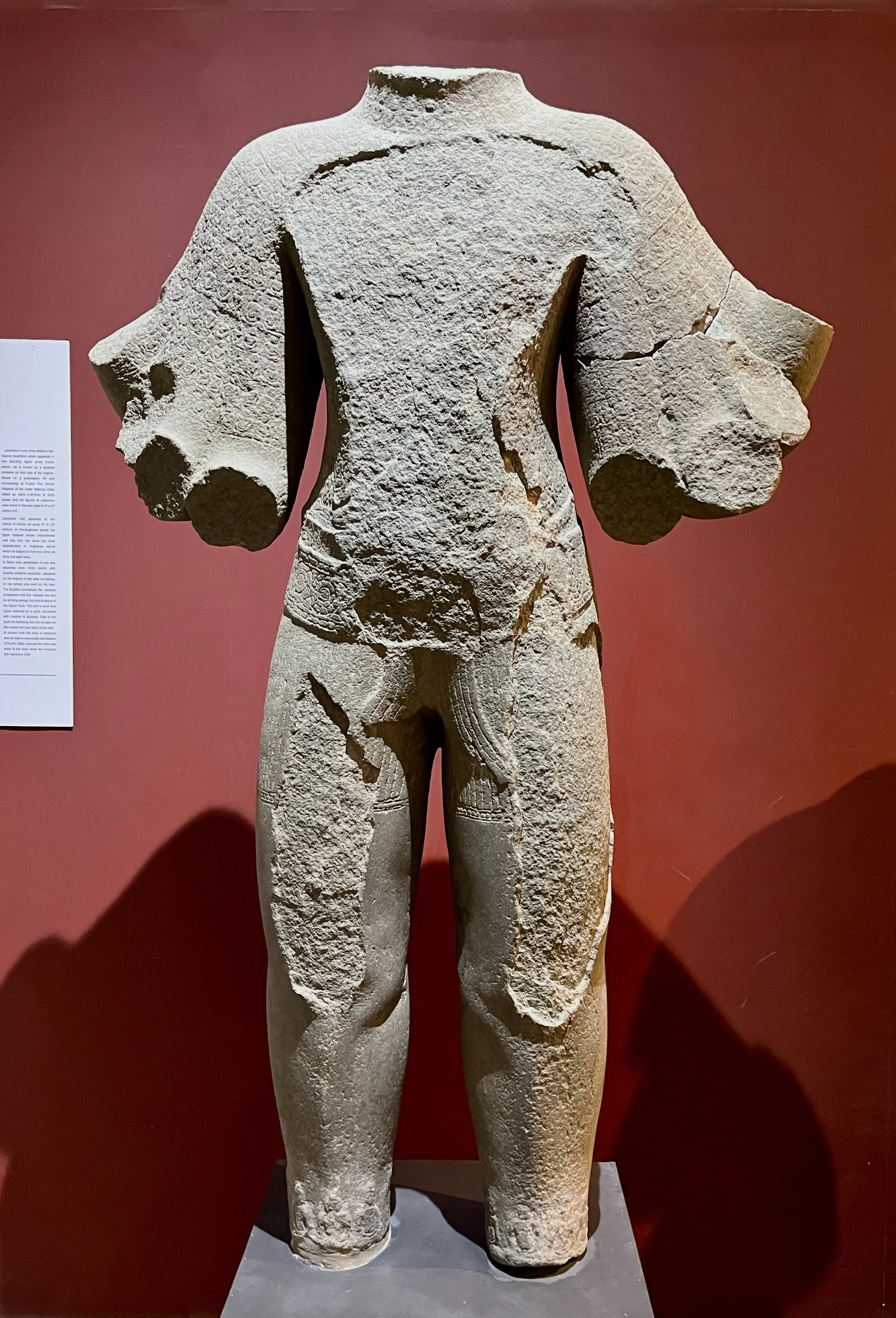
Lokesvara is one of the deities in Mahayana Buddhism who has been depicted as a free-standing figure since the Funan (Kingdom of the Lower Mekong Valley) period (5th or 6th century AD). He can be identified by the Buddha Amitabha on the front of his chignon.

Lokesvara continued to appear in Khmer art through the 13th century. In the Pre-Angkorian period, the figure displays simple characteristic and has only two arms. In the Angkorian period, more sophisticated depictions feature four arms, six arms and eight arms.

In the Bayon style, the presentation of Lokesvara becomes even more stylish, with the Buddha Amitabha previously appearing on his chignon appearing on his body, ankles, and even on his toes.

The Buddha symbolizes the extreme compassion that the blessed one has for all living beings. His skirt is typical of the Bayon Style. The skirt is short and tightly fastened by a scarf, decorated with rosettes in squares. The tails of the scarf are flattened and can be seen at the central front and back of the skirt.

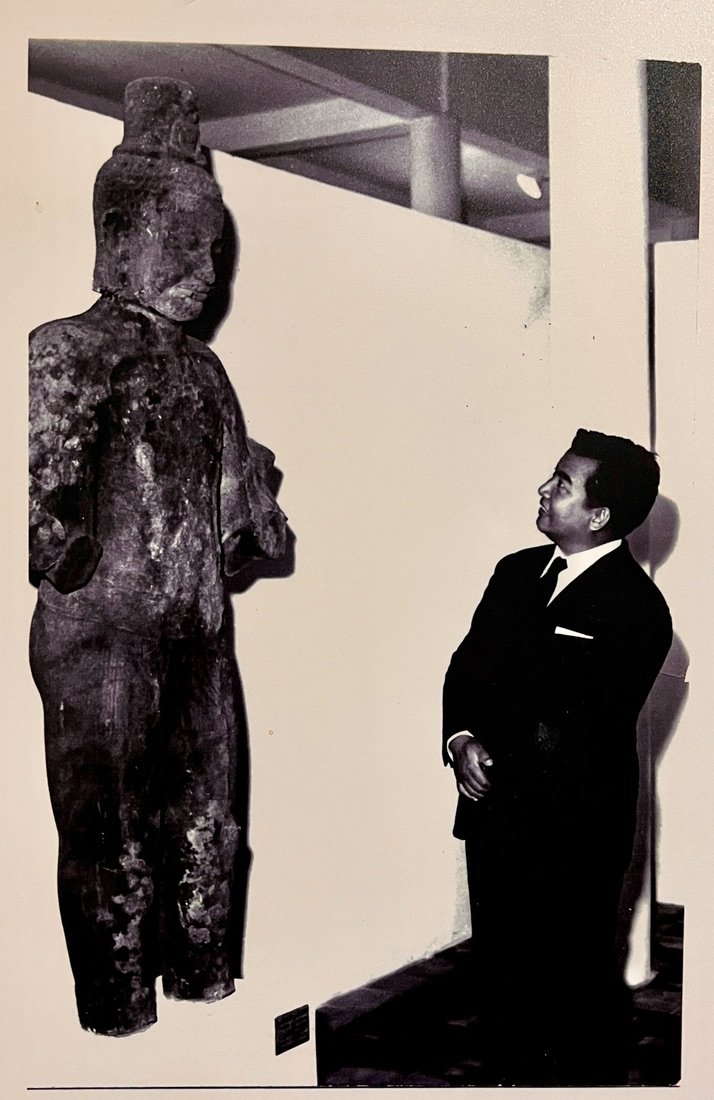
At present only the body remains; the head presumably lost sometime in the 70s or 80s. The head was intact when the museum first opened in 1968.

Prince Sihanouk at the museum opening in 1968, with the intact Lokesvara.

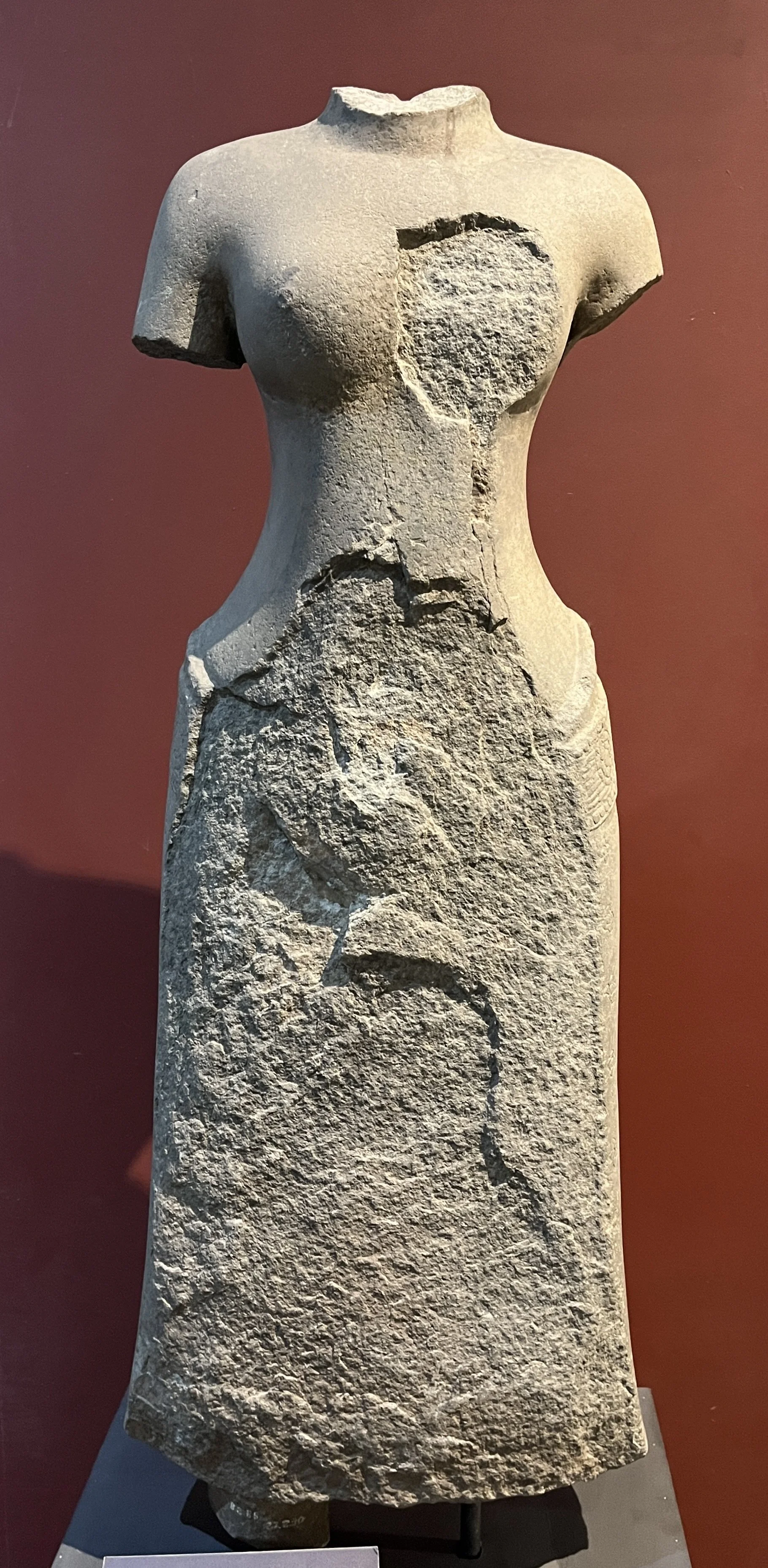
Female Deity

Sandstone. Angkorian period Bayon style, late 12th to early 13ch c. Unkrown

Despite the severe damage, the beauty of this torso can still be seen through the slender waist, elegant body, and round breast.

As a female figure, one could think that she is probably Prajnaparamita as this deity was so popular in the Bayon period. The skirt is fastened at the waist by a scarf decorated with a flower motif. The body shape and the skirt allow the dating of this piece to the Bayon style.

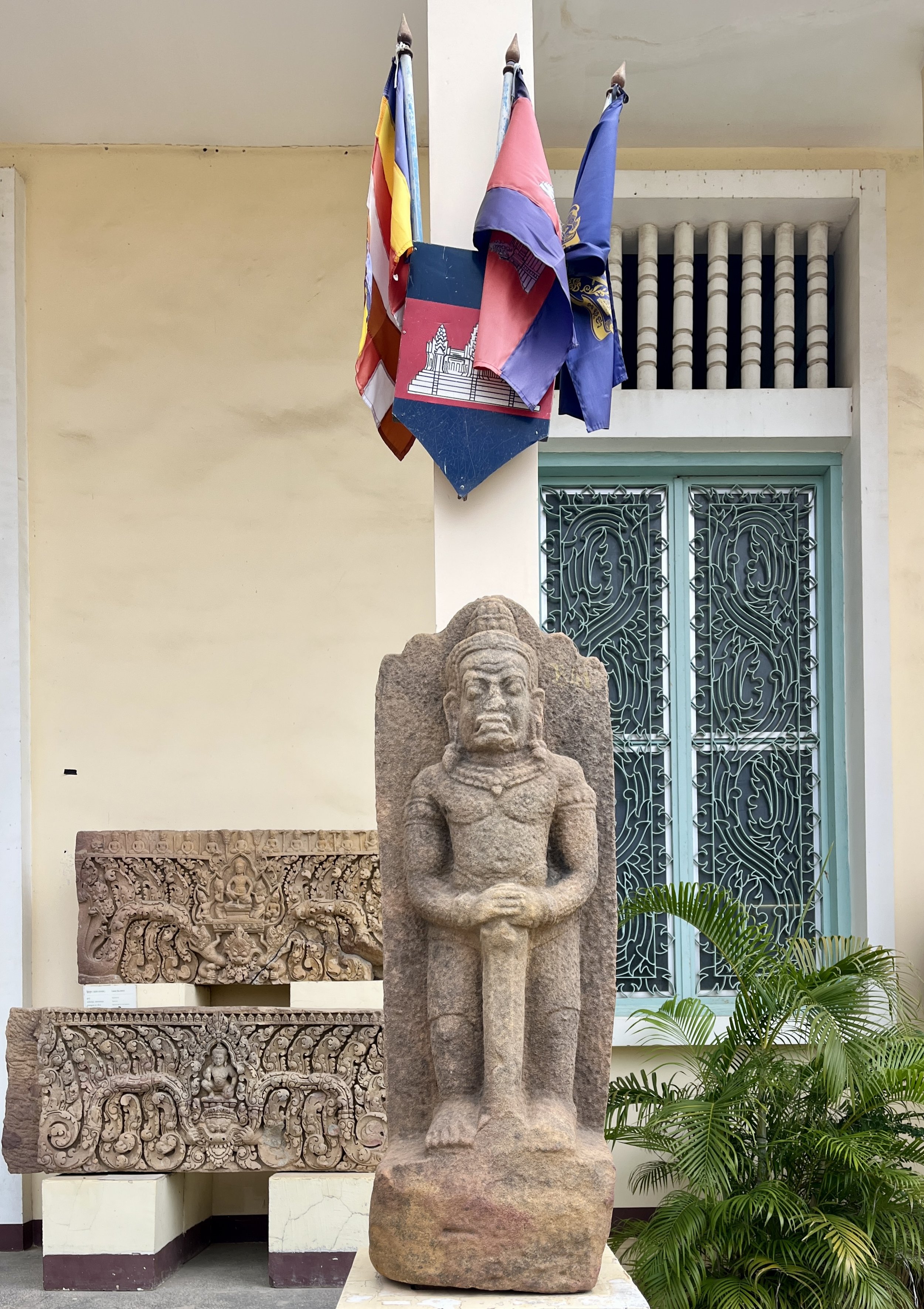
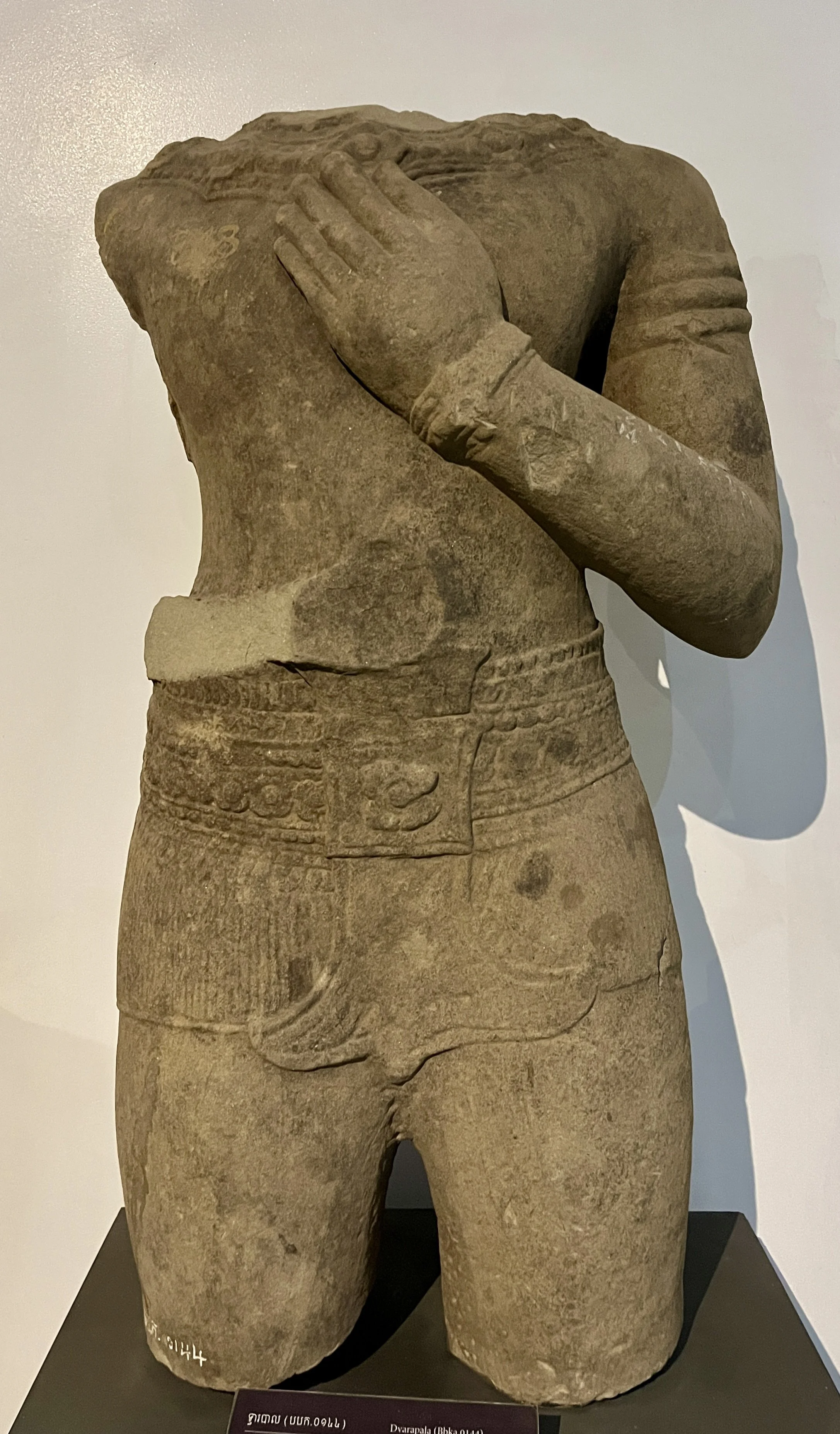
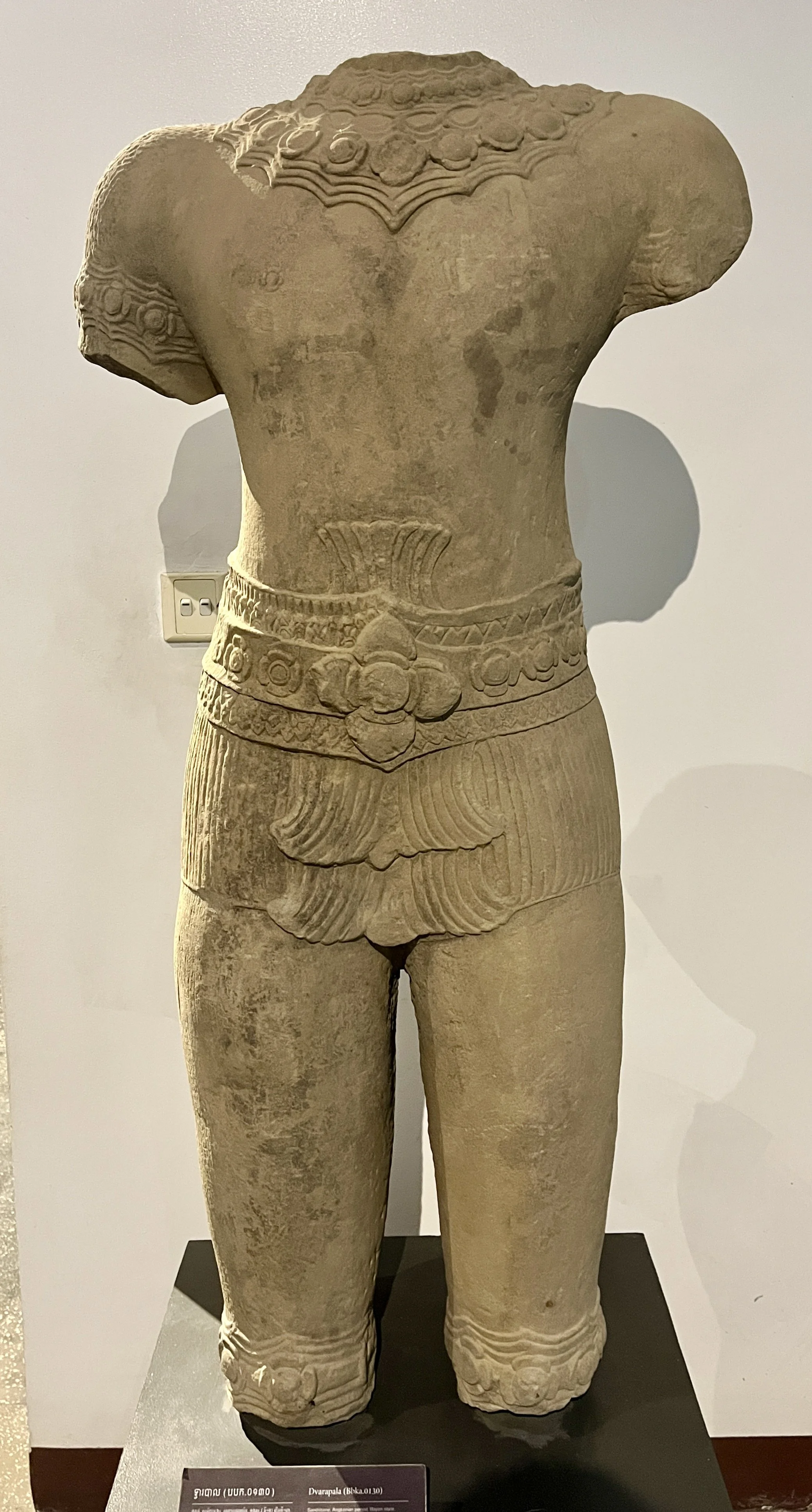
Dvarapala

Sandstone, Angkorian period, Bayon style

This is a typical Dvaropala, a door or gate guardian, of the Bayon style. His left arm is placed on his chest while his missing right arm is presumably placed on the belly with a pole.

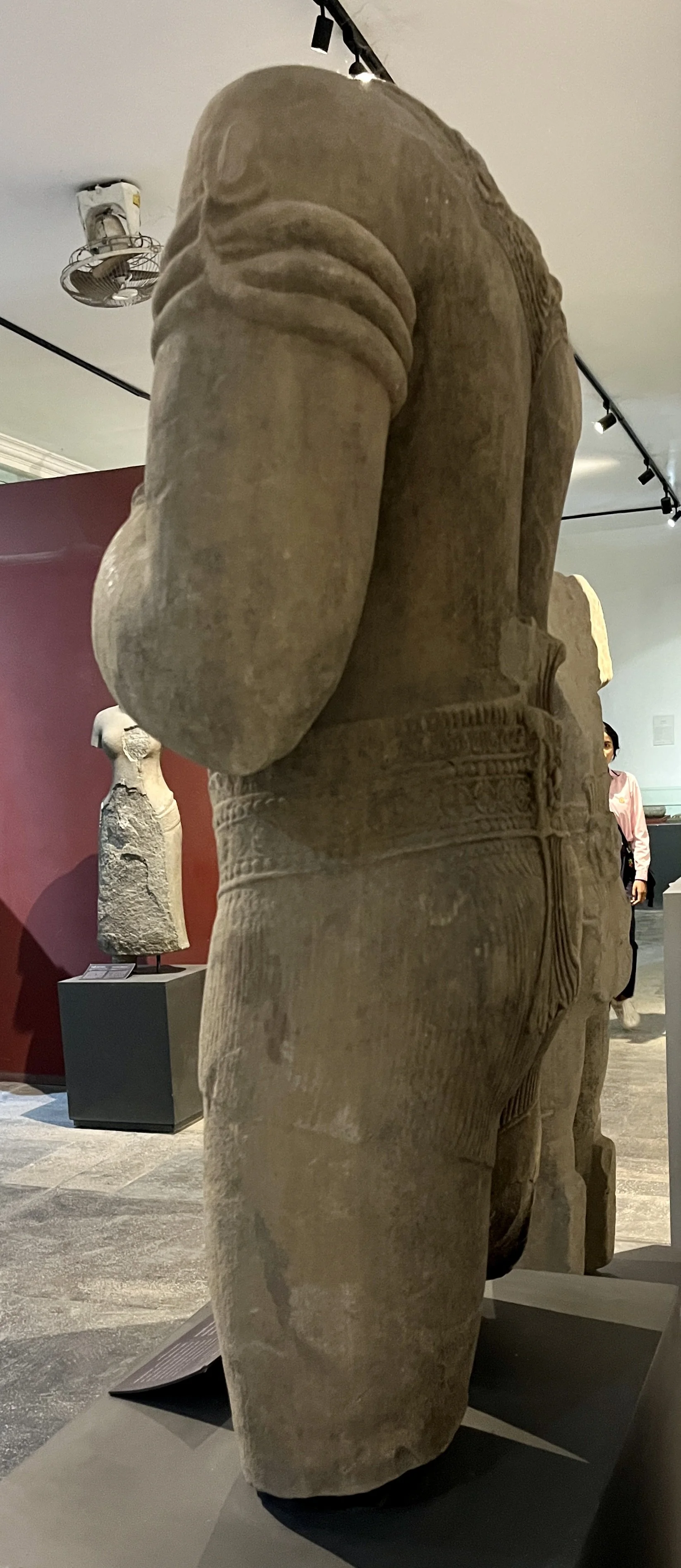
Dvarapala

Sandstone. Angkorian period. Bayon style

late 12th to early 13th c., Unknown

This piece is another typical Dvarapala, a door or gate guardian, of the Bayon style. Both missing hands are presumably placed to the front holding a long club. This posture is a mark of vigilance, His short skirt, has two scarf tails, in fishtail shape, at the front on each other. The scarf is tied by a belt decorated with rosettes.

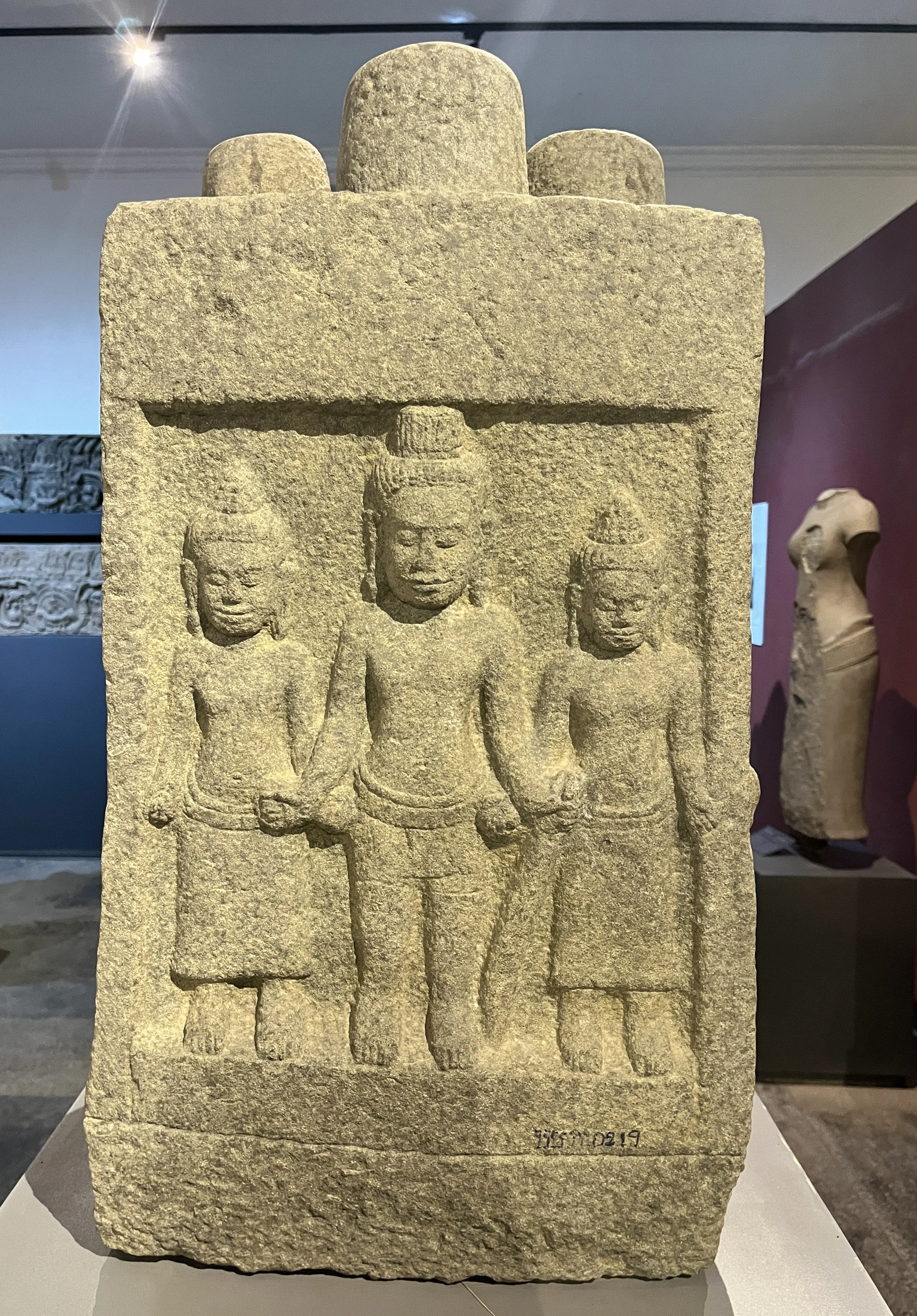
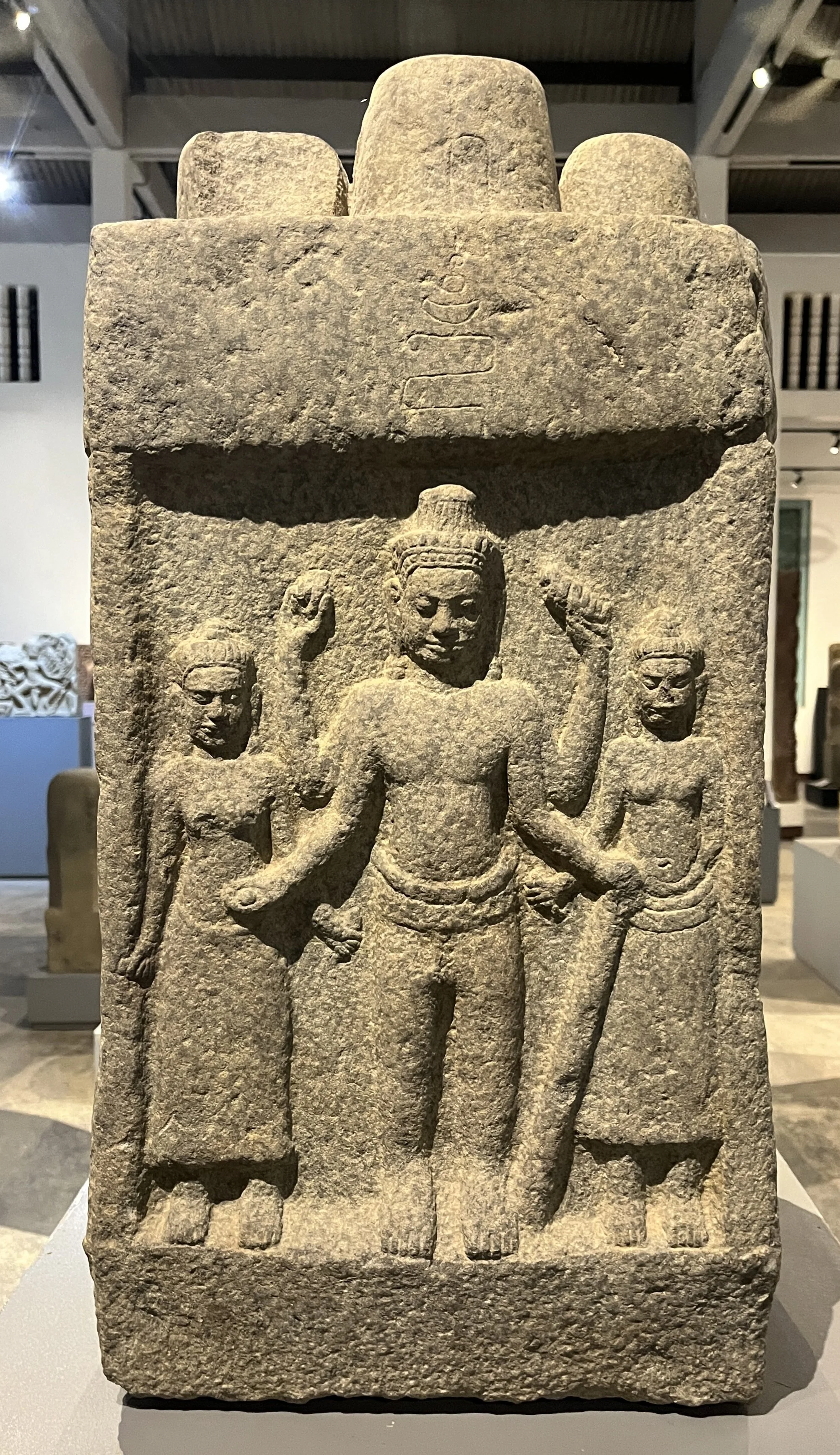
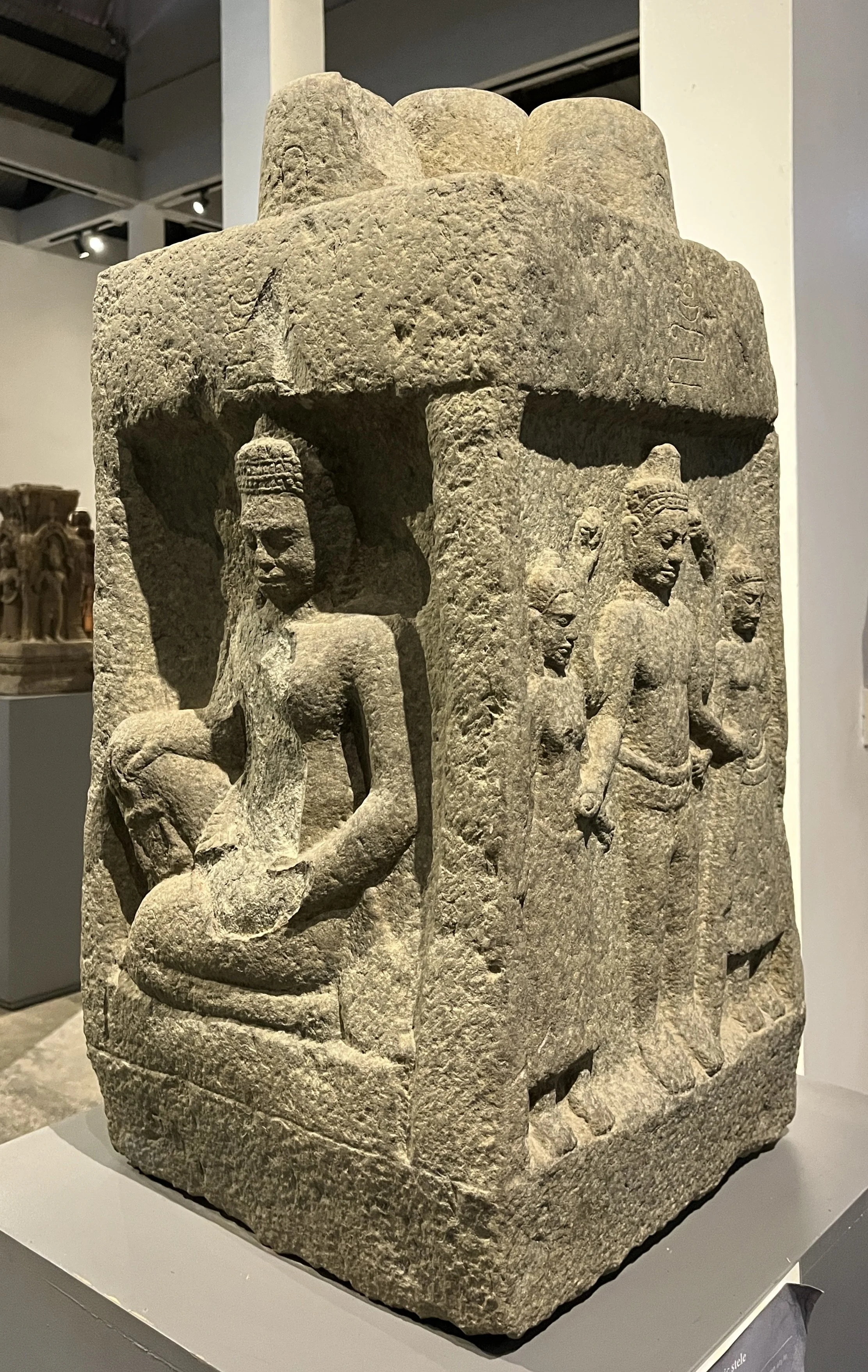
Brahmanic stele

Sandstone, Angkorian period, Bayon style, late 12th-13th c. Tuol Prasat, Kouk village, Bavel commune, Bavel District, Battambang

The stele is a rectangular prism carved on five sides. On top are five small carvings in the form of lingas. Each one has an Um sign which signifies Shiva. Each side features different divinities. The first one consists of a standing male figure holding a club flanked by two female figures, probably Shiva and his consorts because a Brahma figure is on another side, and on the opposite side are Vishnu and his spouses, Laksmi and Ganga. The last one is a seated male deity whose right arm rests on his right knee and is presumably holding a balance.

The figure is probably a judge representing Yama, the god of the dead, though he is normally presented seated on a buffalo mount holding his mace.

Dhyana Buddha

Sandstone,

Angkorian period

Baphuon style

second half of 11th c.,

Samnanh, Phnom Sampau, Battambang

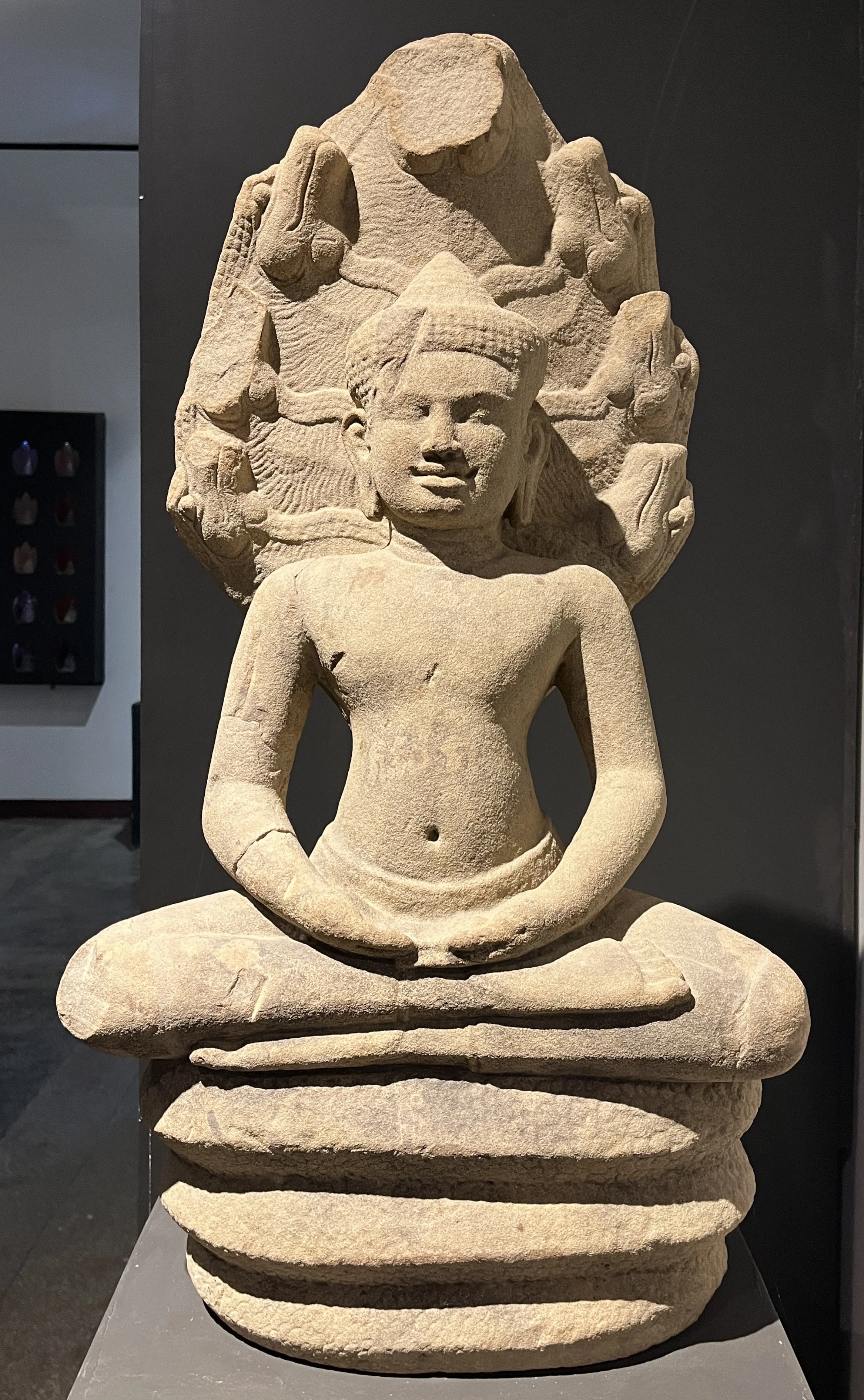
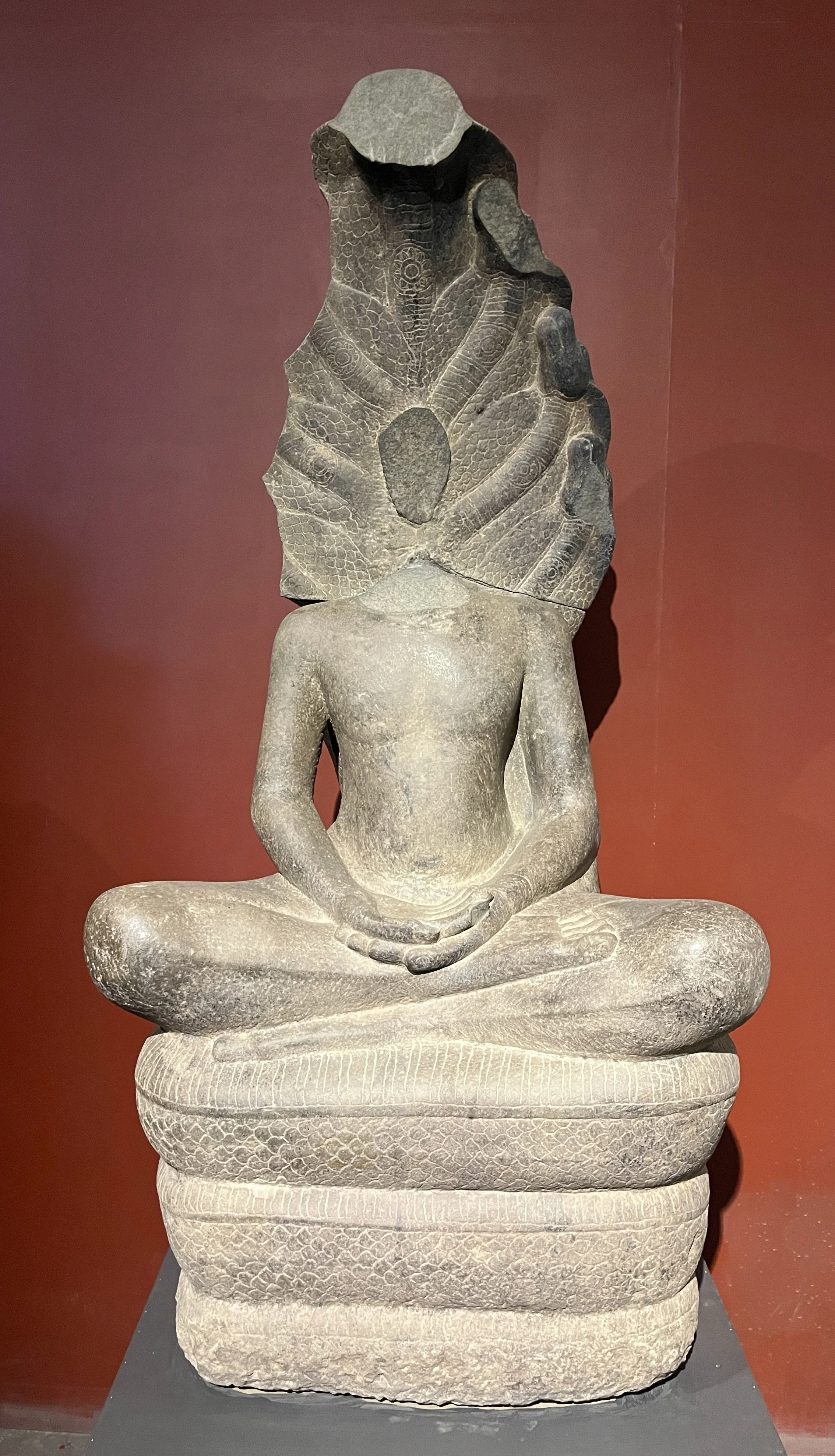
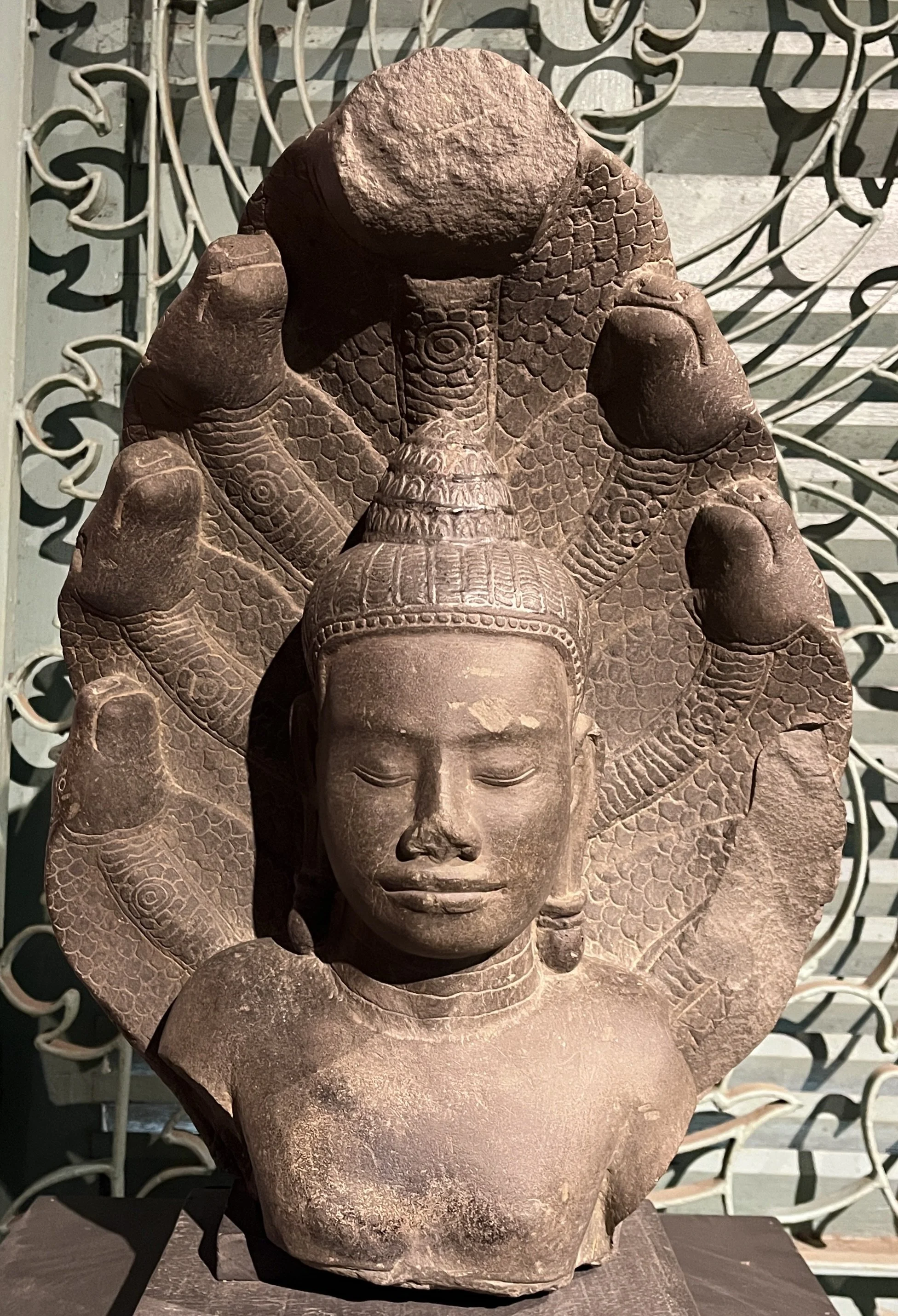
The depiction of Buddha protected by Mucalinda, a seven-headed Naga, was popular during the Angkorian period. 

It refers to the event in which the Buddha began meditation (dhyana) under the Bodhi tree. Immediately after, the sky became dark and heavy rain descended on earth for seven days. The Naga king, Mucalinda, left his palace to protect the Buddha with his hood.

This Dhyana Buddha protected by Mucalinda in the Baphuon style is a testimony to the expertise of Khmer artists, who respected the rules of symmetry, with the axis passing through the nose of the Naga to the joint of the Buddha's thumbs at his stomach level. 

Buddha's smile expresses his supreme knowledge and calm concentration to understand the law of the universe. The hooded Naga, on the other hand, conveys the impression of domination.

Depicting the Buddha in a plain robe, representing the absence of earthly attachments, appears to be the preferred choice of artists in the Baphuon period. This robe allows for the differentiation of the Dhyana Buddha of this style from the later Angkor Wat and Bayon styles

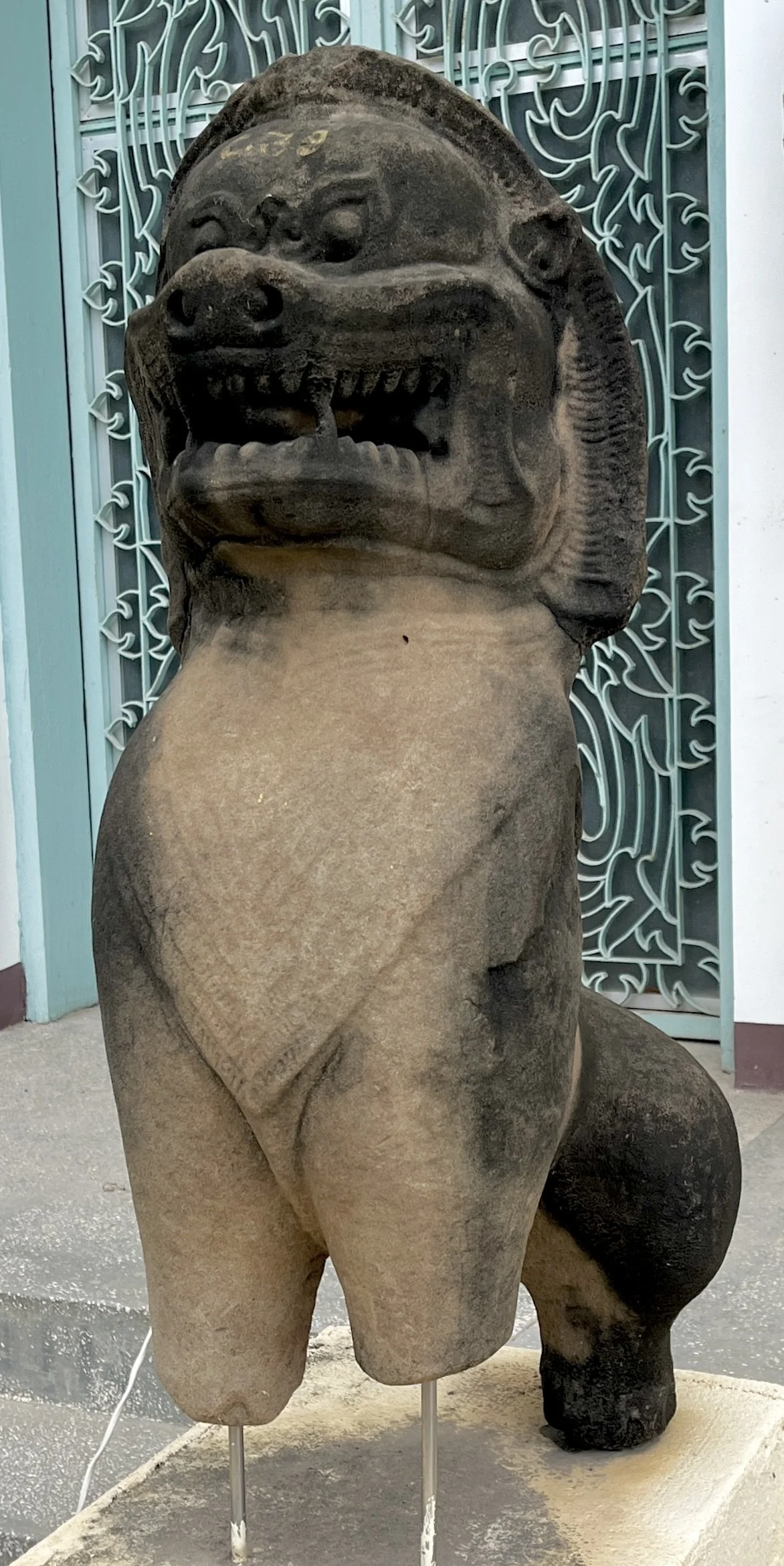
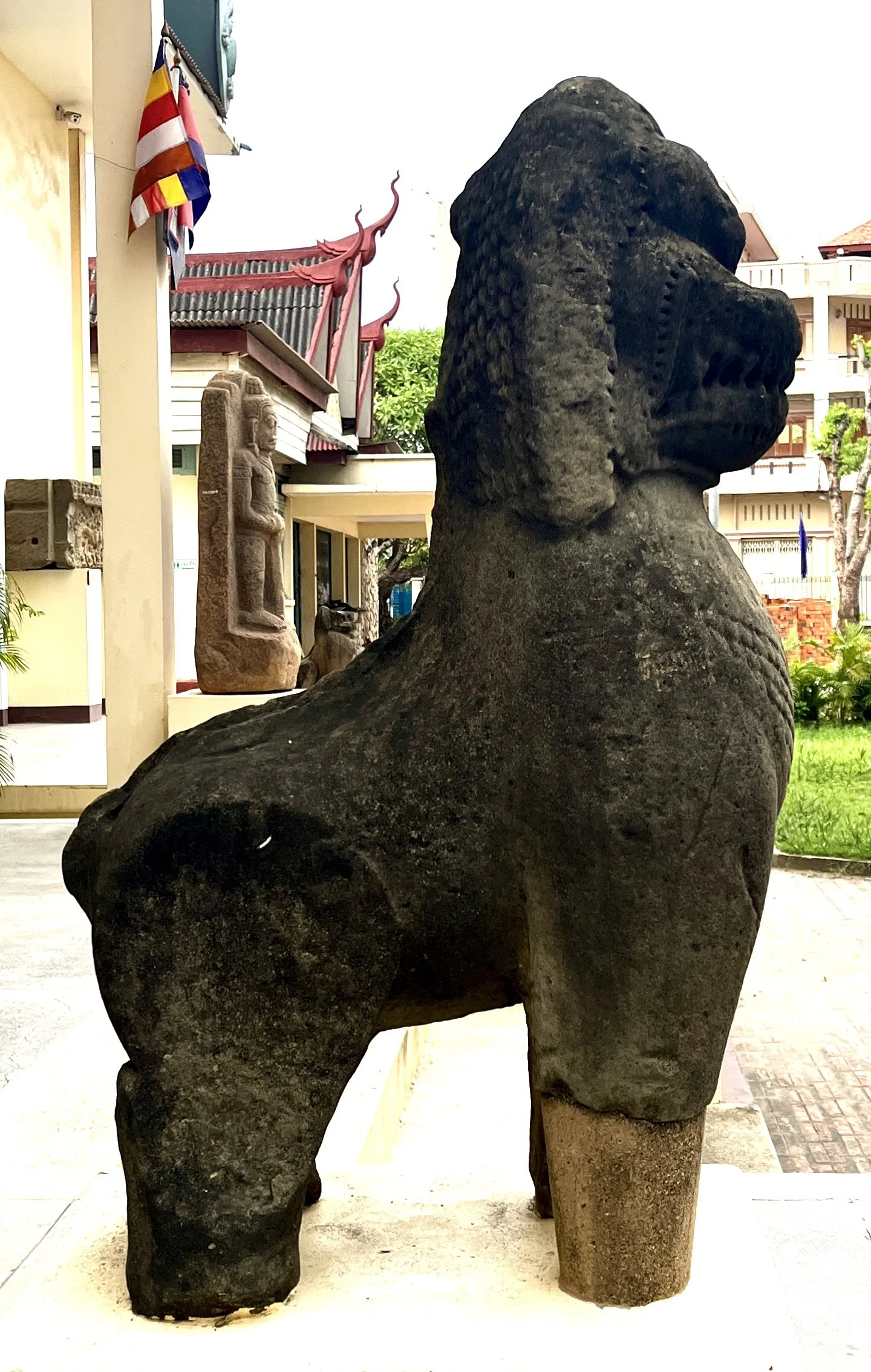
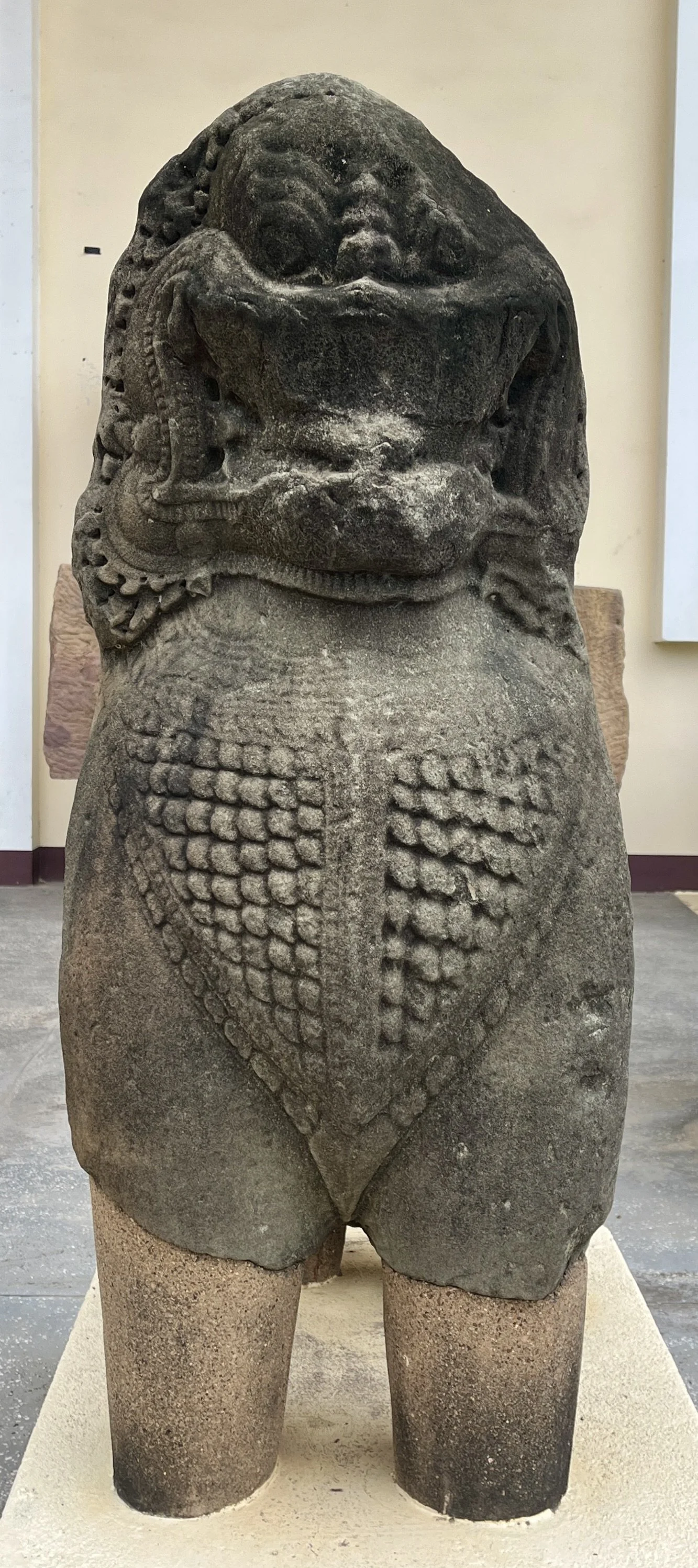
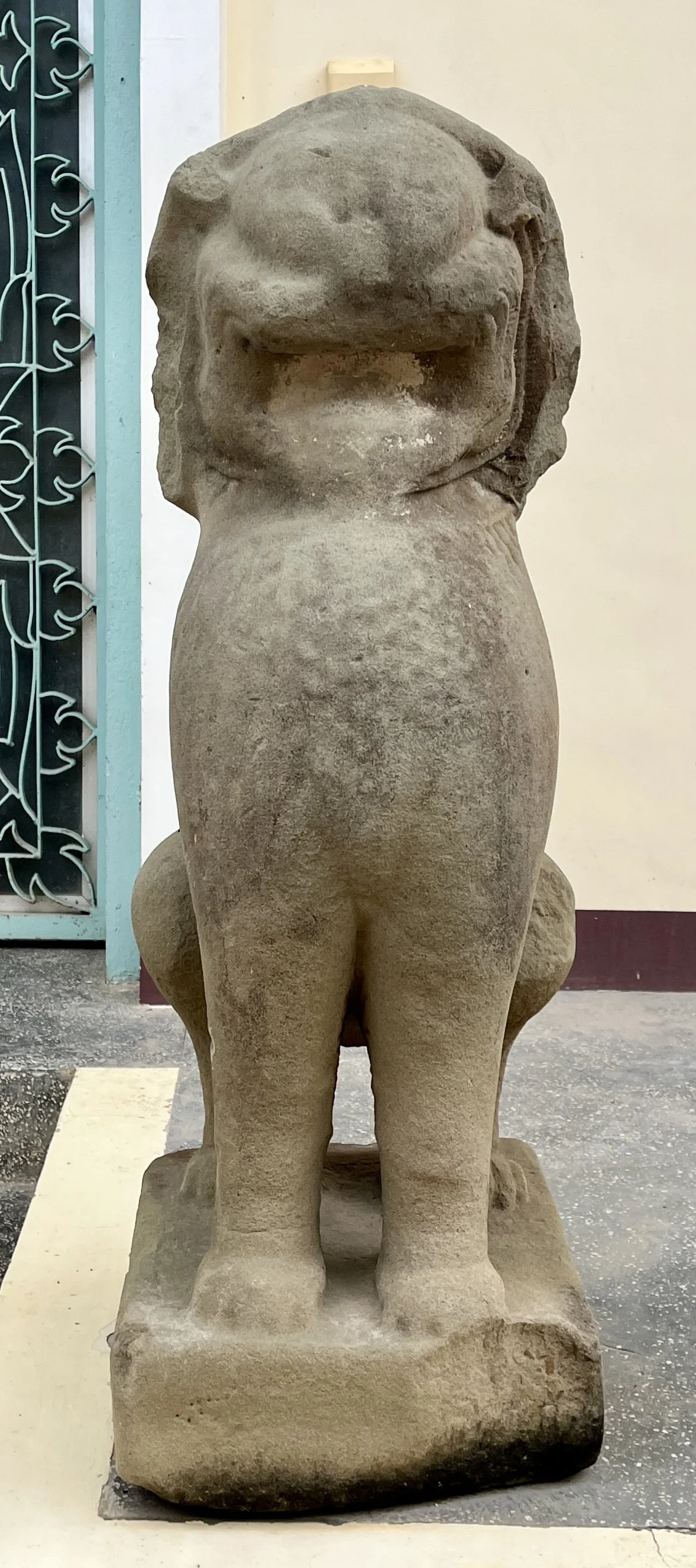
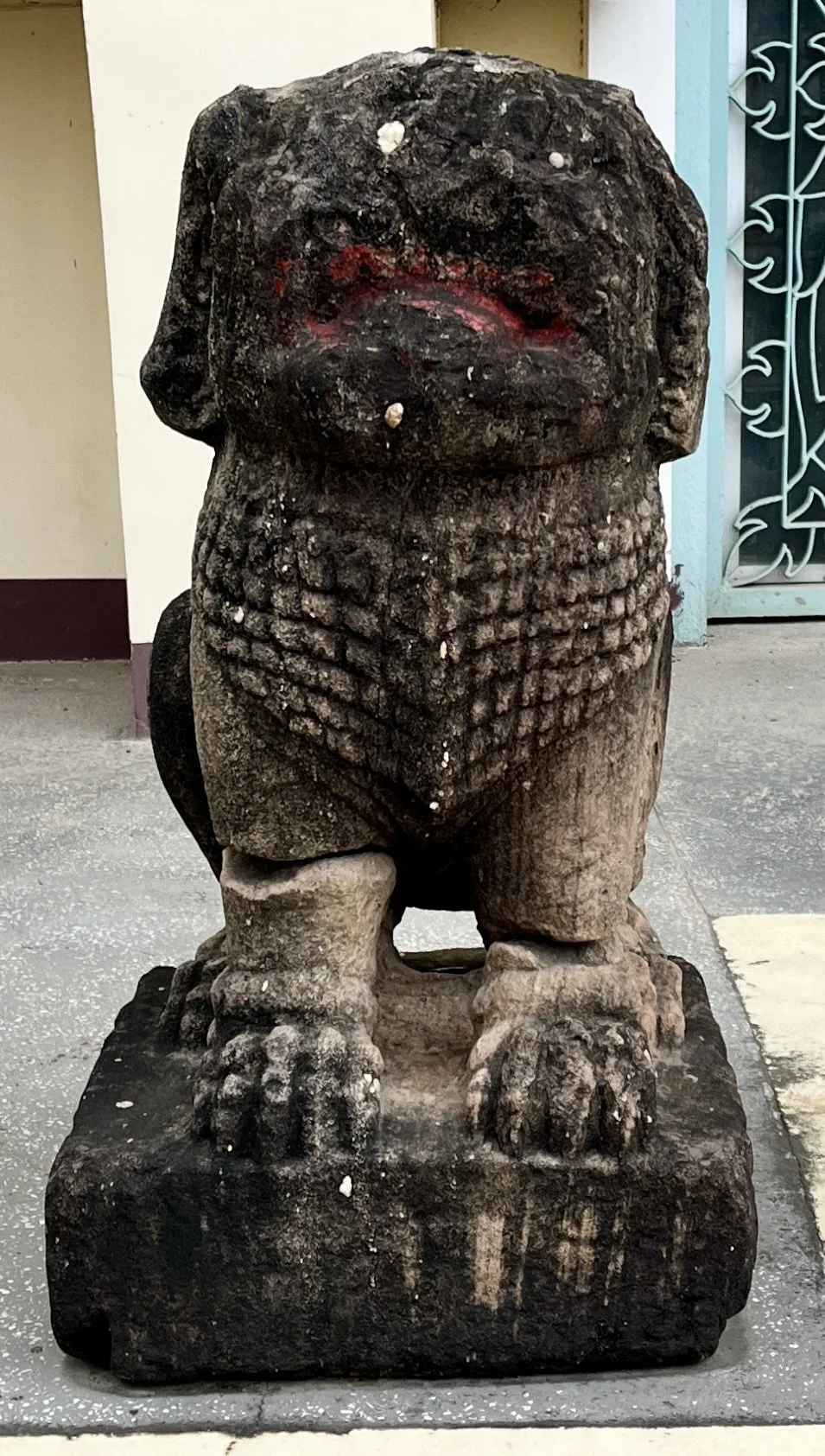
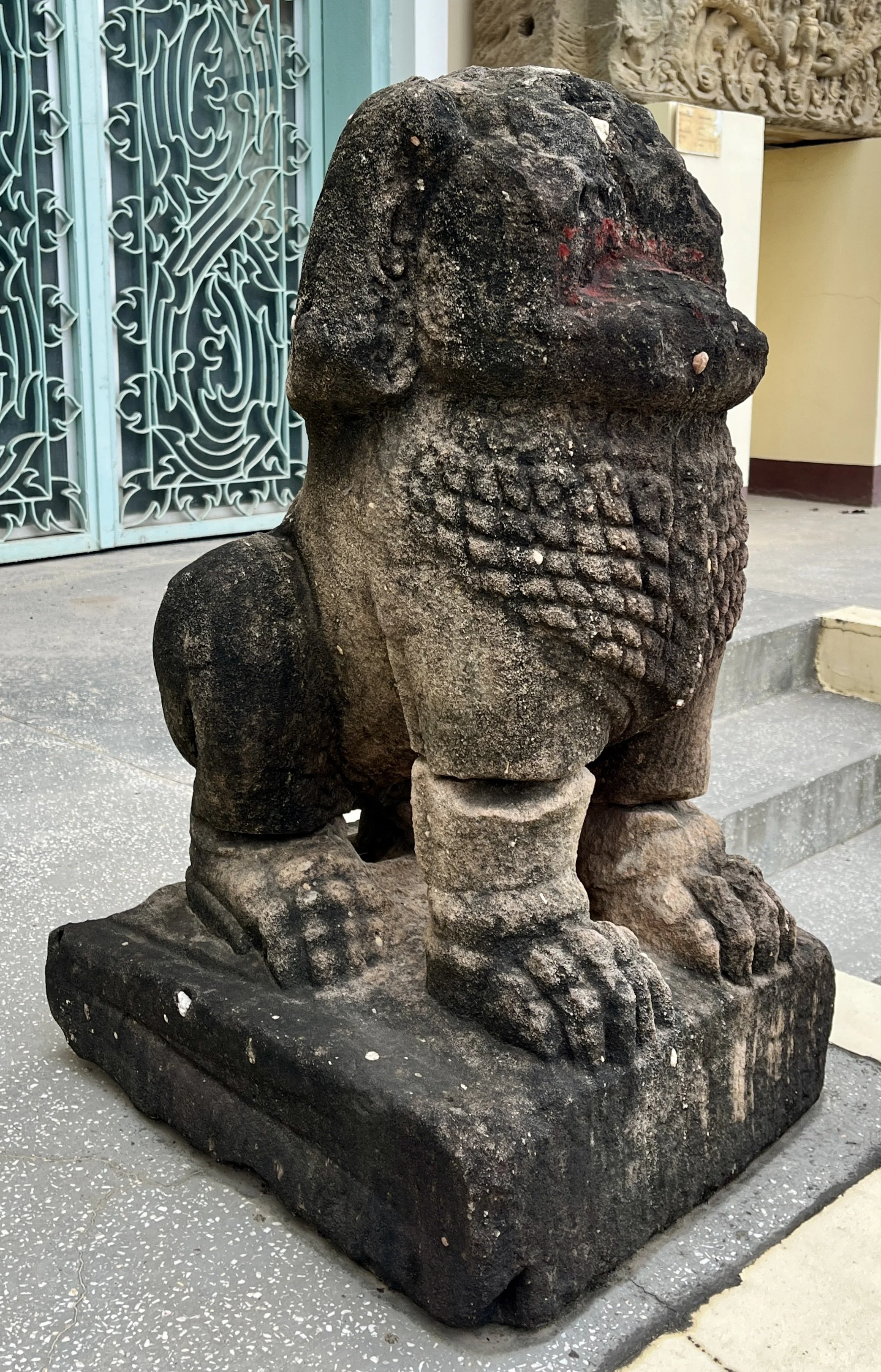
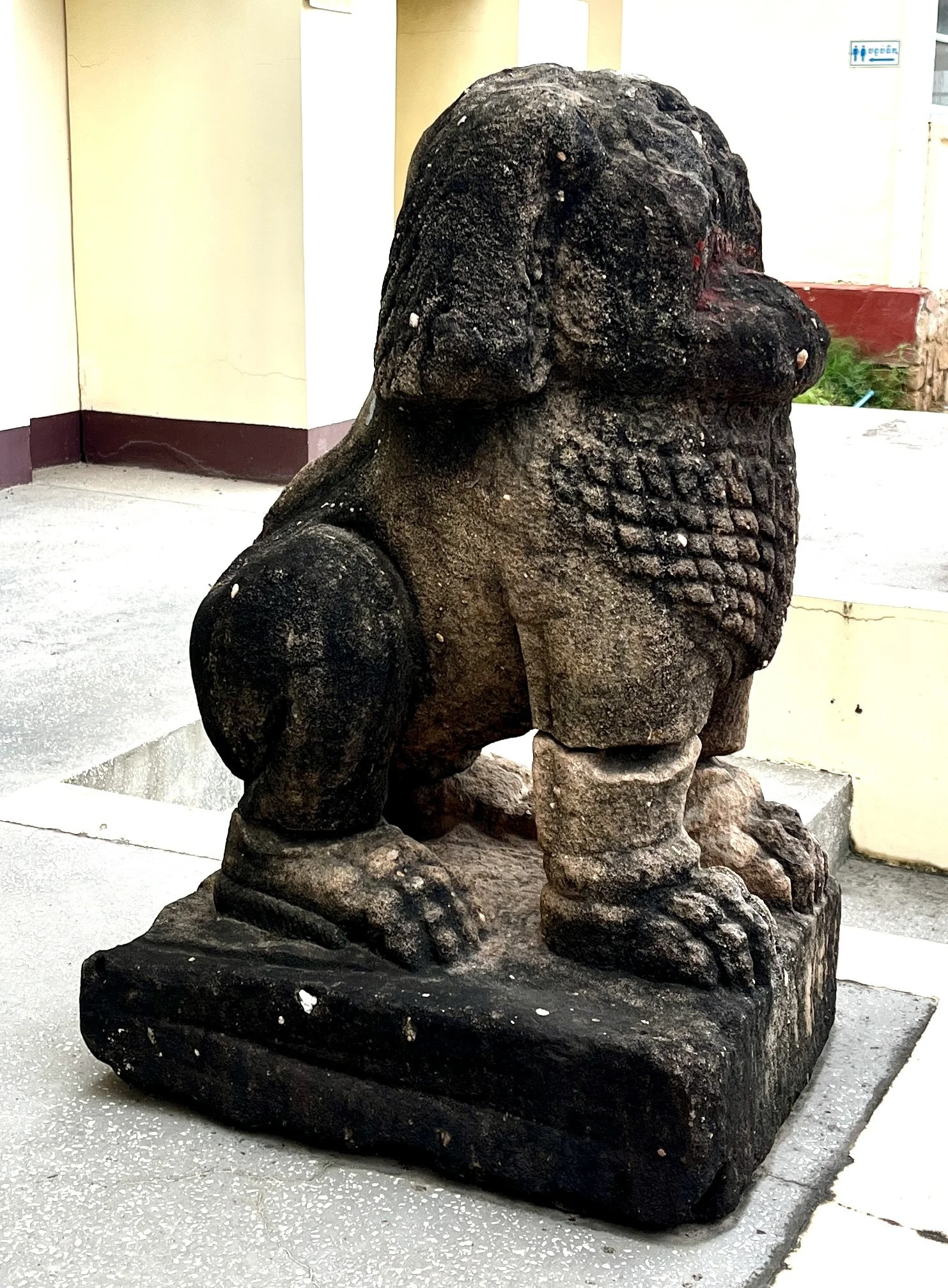
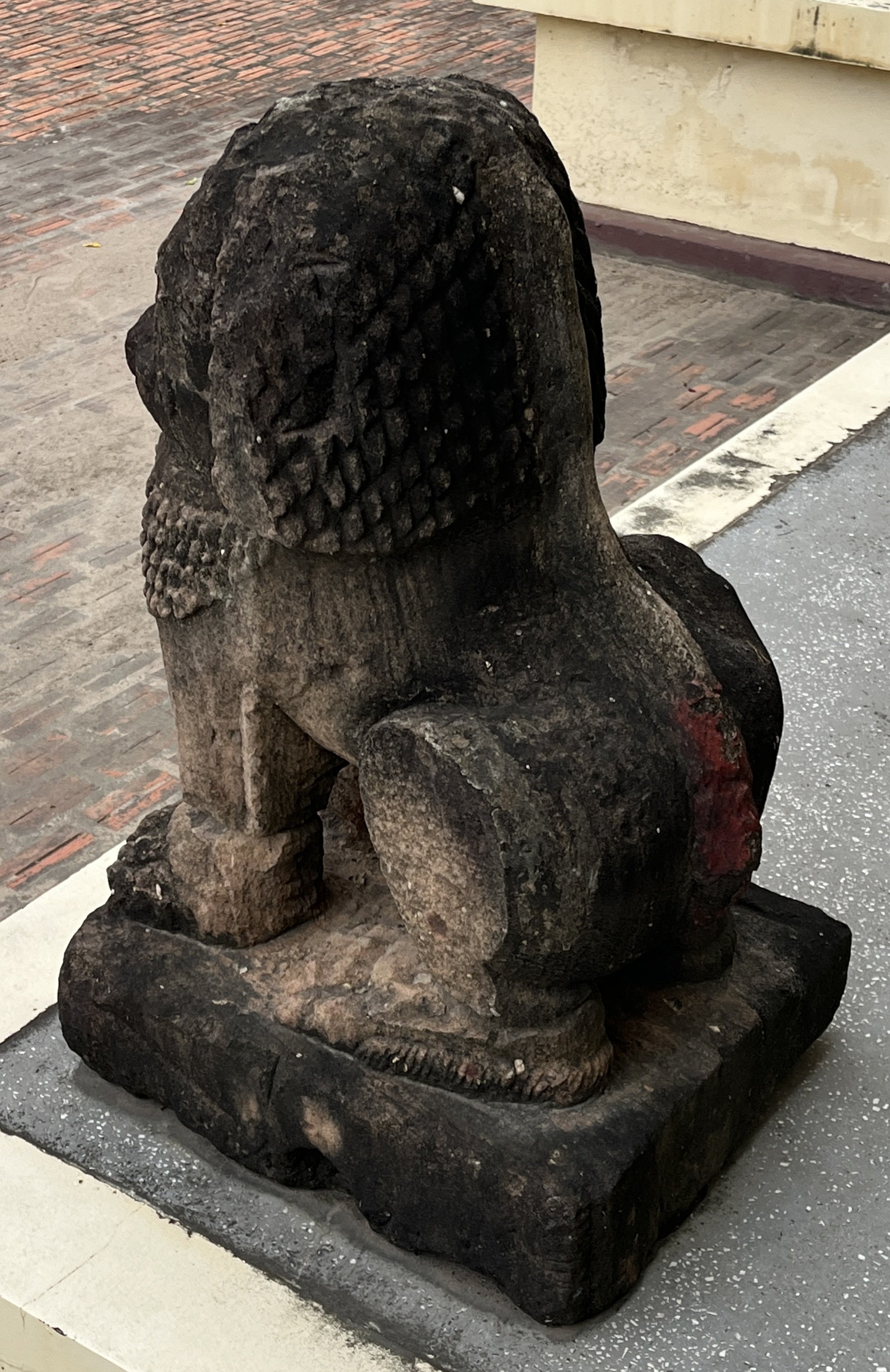
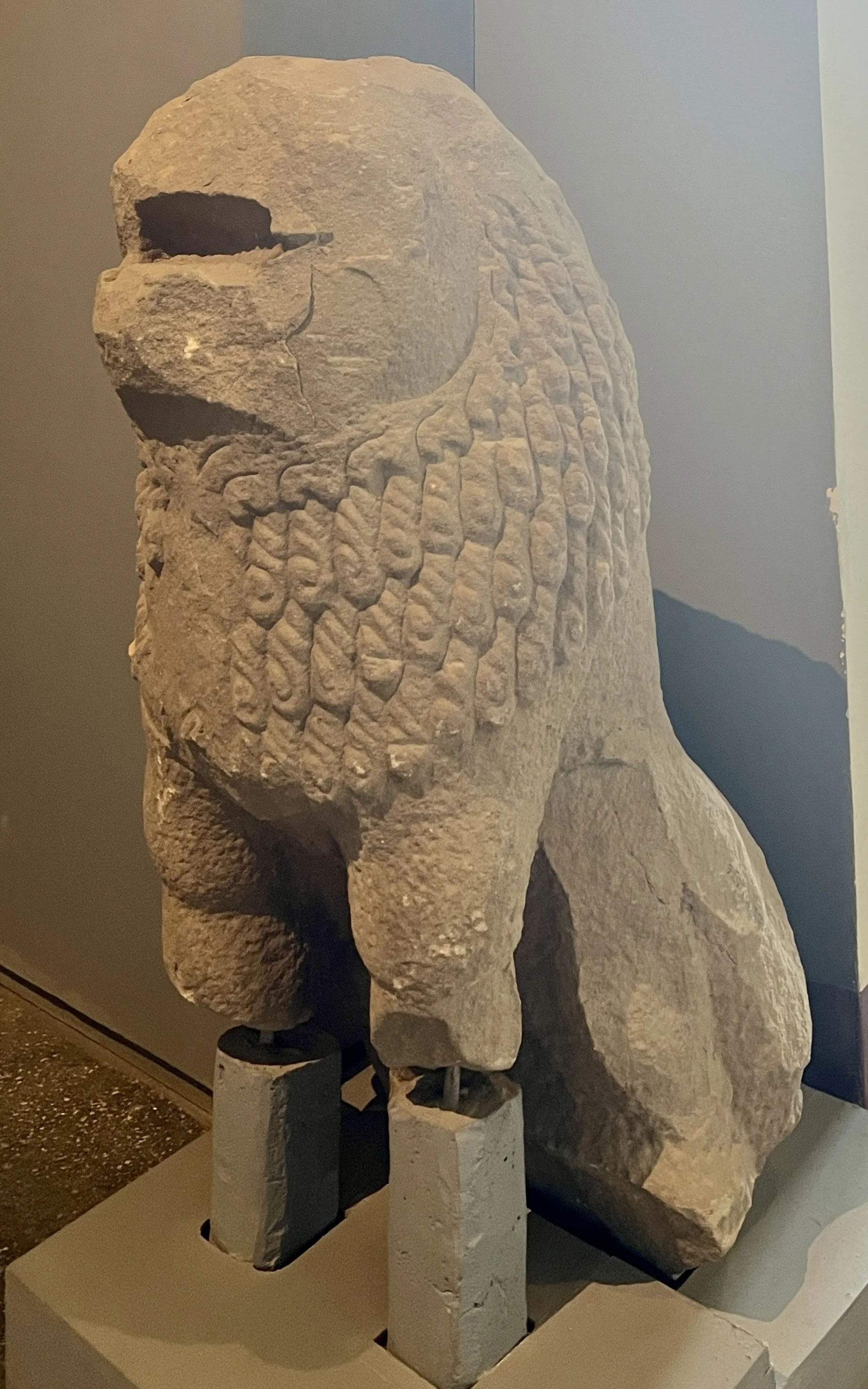
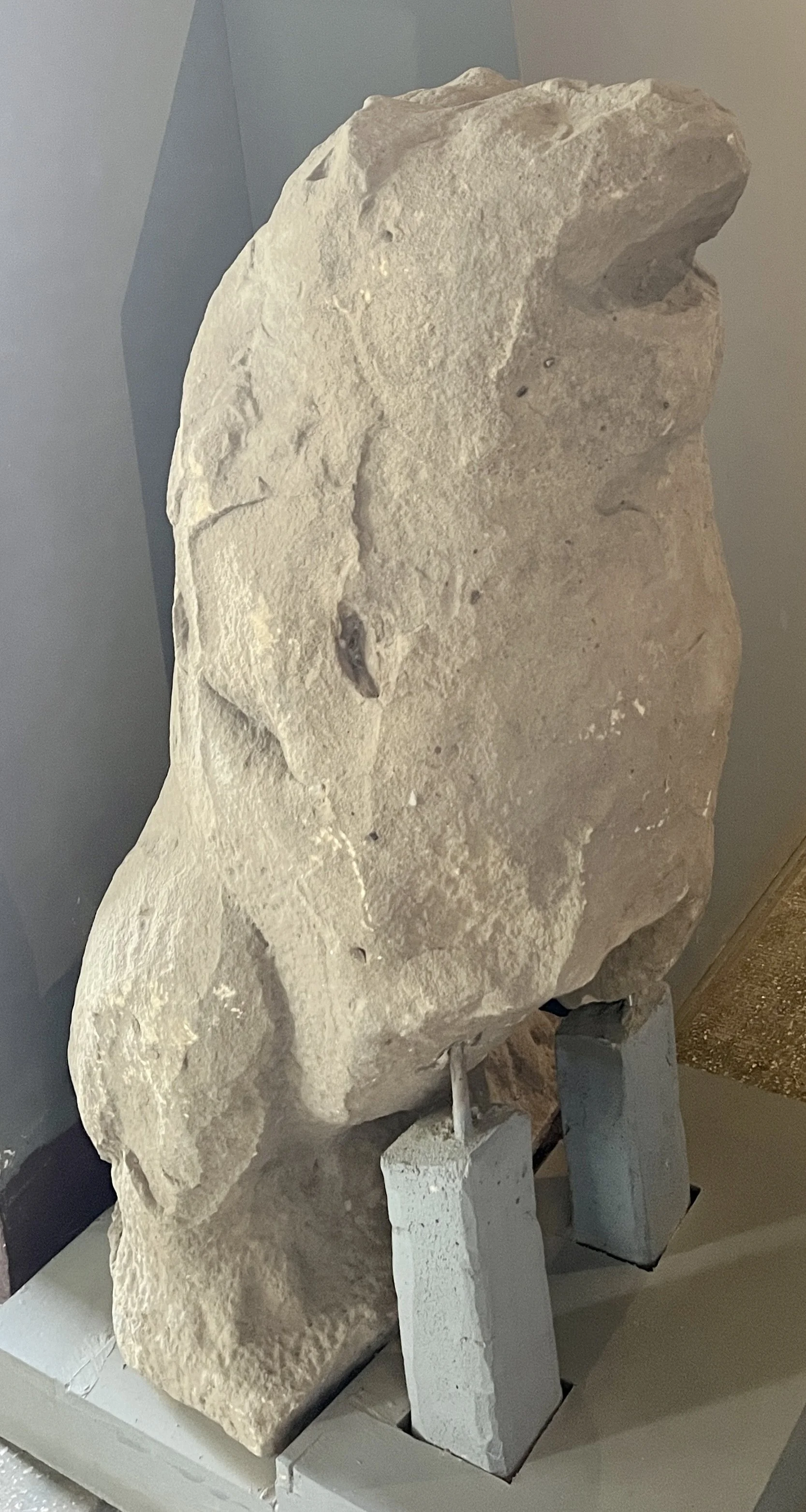
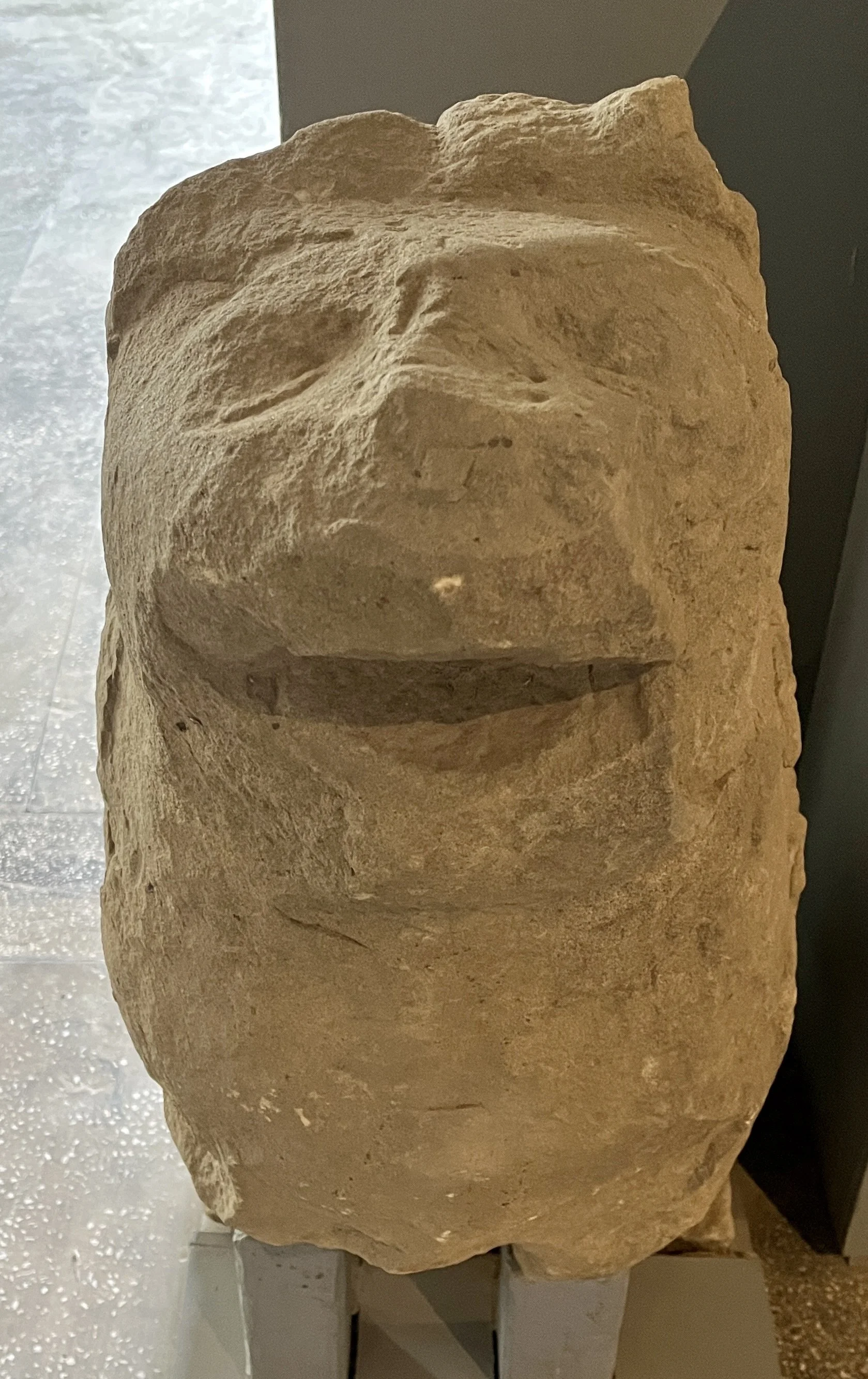
Lions

Sandstone, Pre-Angkorian, Sambo Preikuk style? 7th-8th c., Baset temple

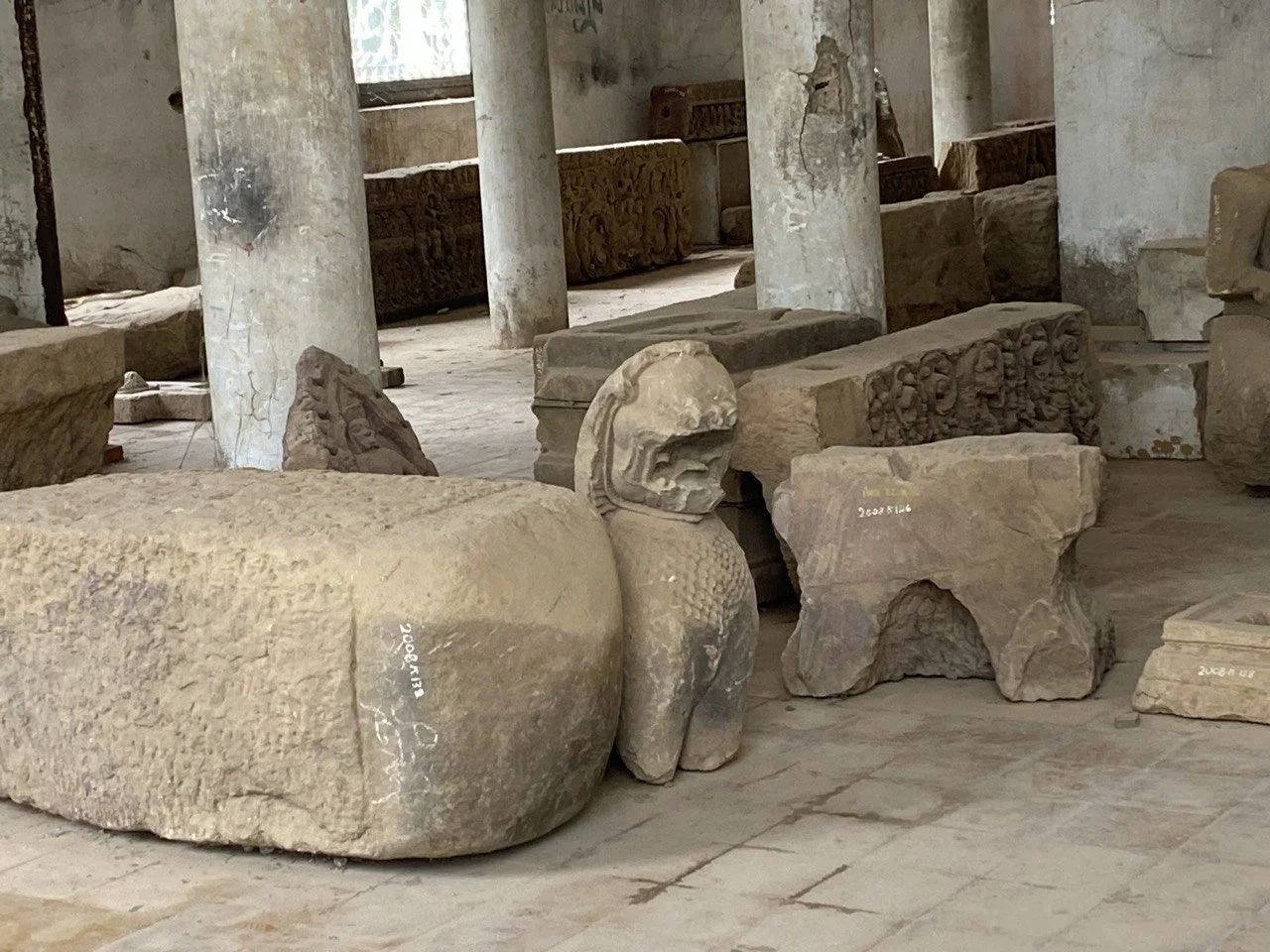
According to hair style, these two monolithic carved lions are quite similar to those of Sambo Preikuk, an ancient Khmer capital, Isanapura, located in Kampong Thom province and a few others are located at Kuk Lvea De, Kampong Cham and Wat Sasar Muyroy, Kratie. Without decoration, its natural looking mane proves its power as the king of animals. Both lions are found with their lower mouths broken and have severely worn heads, and the lower part of their front legs are broken off.

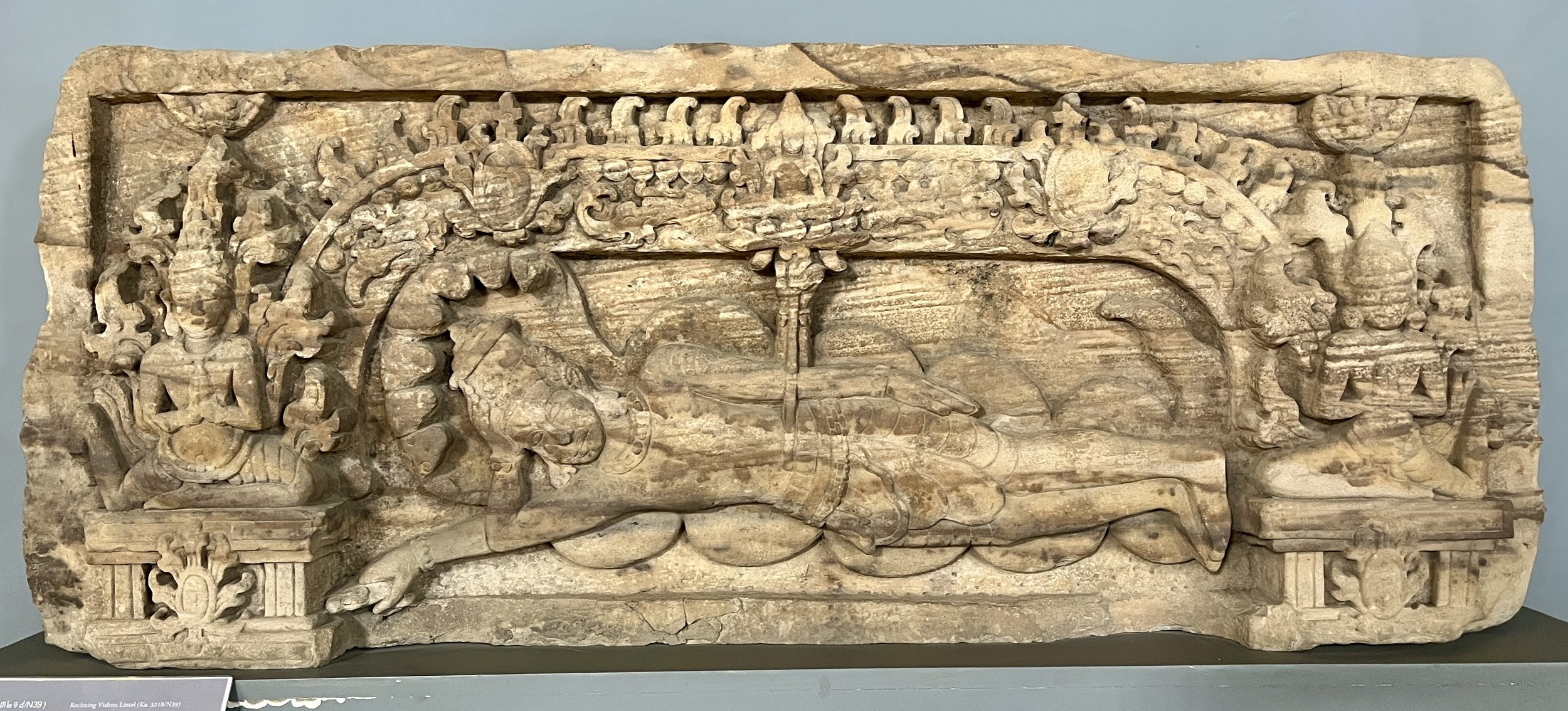
Reclining Vishnu Lintel

Sandstone, Pre-Angkorian period, Prei Khmeng style, second half of 7th c., Prasat Bavel

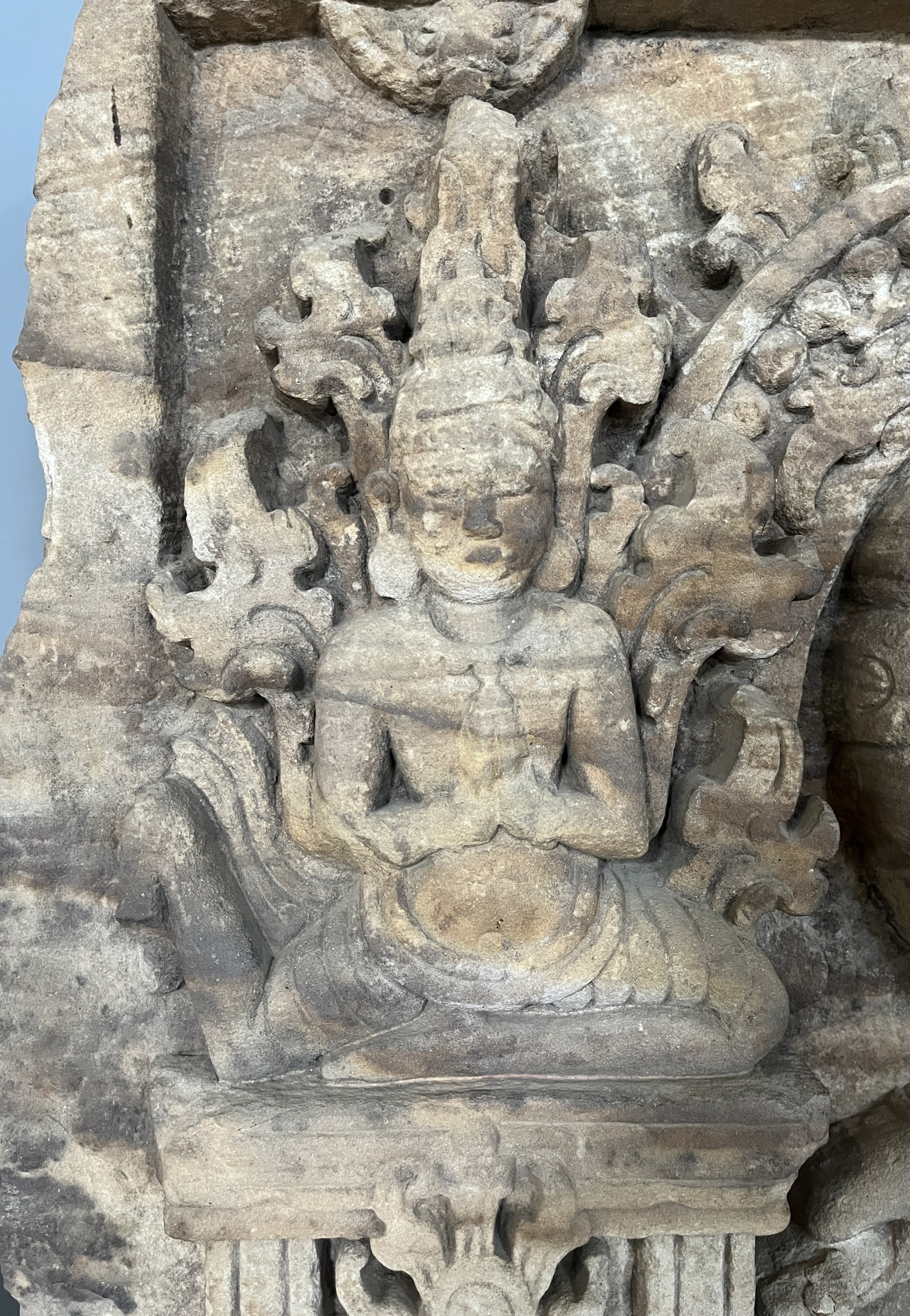
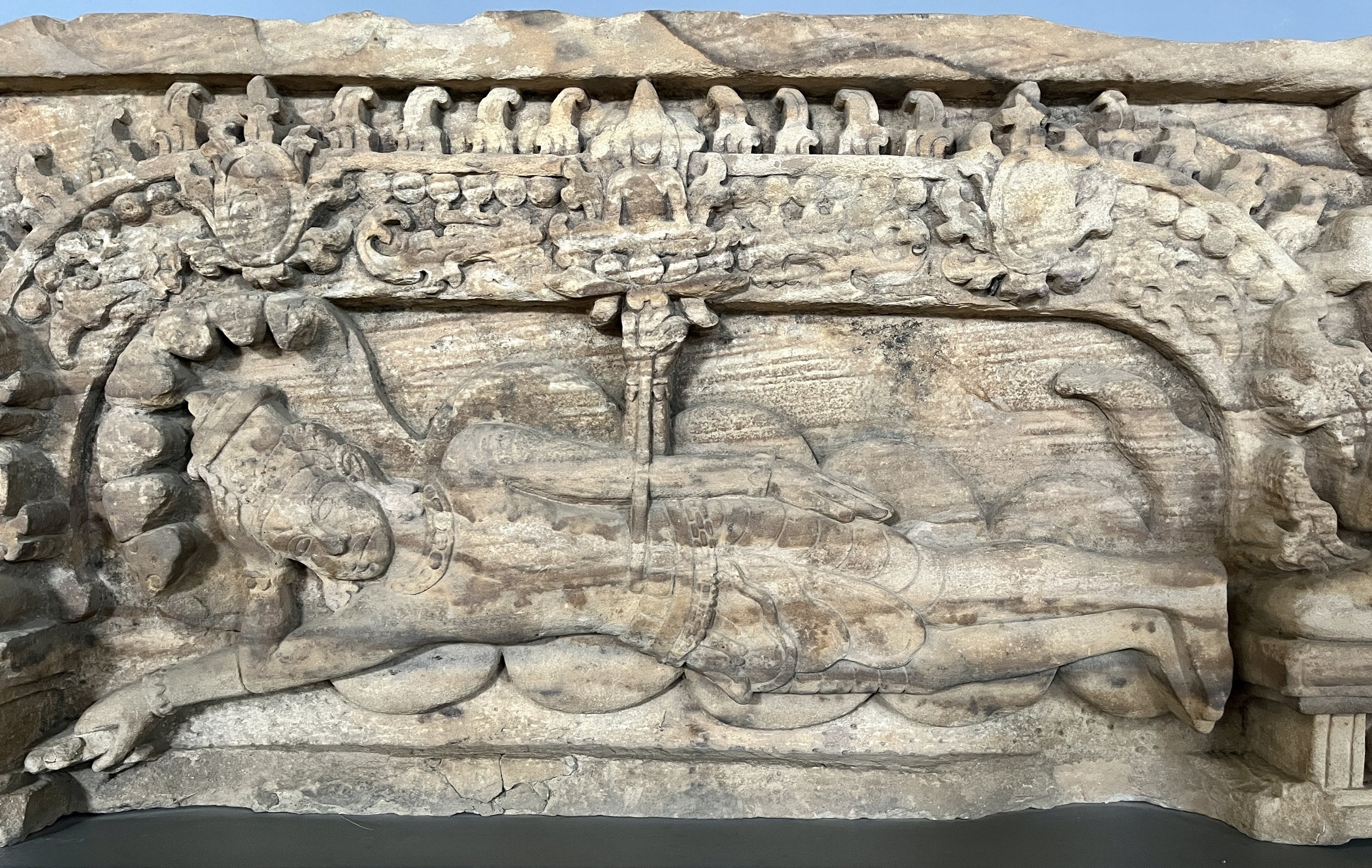
There are two types of lintel, depicting either floral shapes or carved deities in Hindu or Buddhist mythology. This lintel depicts reclining Vishnu on Ananta, a mythical snake (Anantasay-in), floating on the Ocean of Milk to create a new universe. In this depiction, he has only two arms, with the left arm lying along his body and the right one stretching out and holding something in its hand.

A lotus stem emerges from his navel; on that lotus, Brahma is born. Vishnu wears a high cylindrical chignon that is decorated with a flower motif on the front, which is believed to have some influences from Champa.

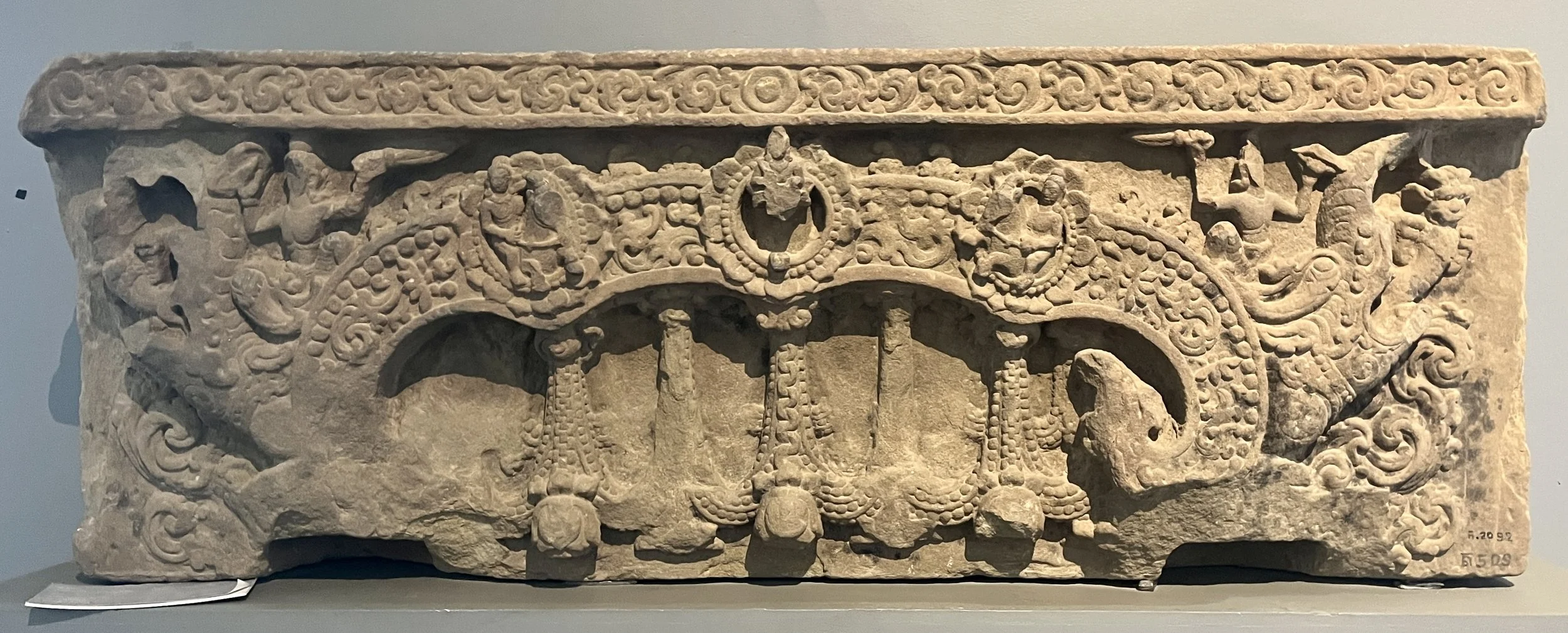
Lintel

Sandstone

Pre-Angkorian period, 7th c.,

Prey Khmeng Style

Lintel

Sandstone, Angkorian period, Bakheng style, early 10th c., Unknown

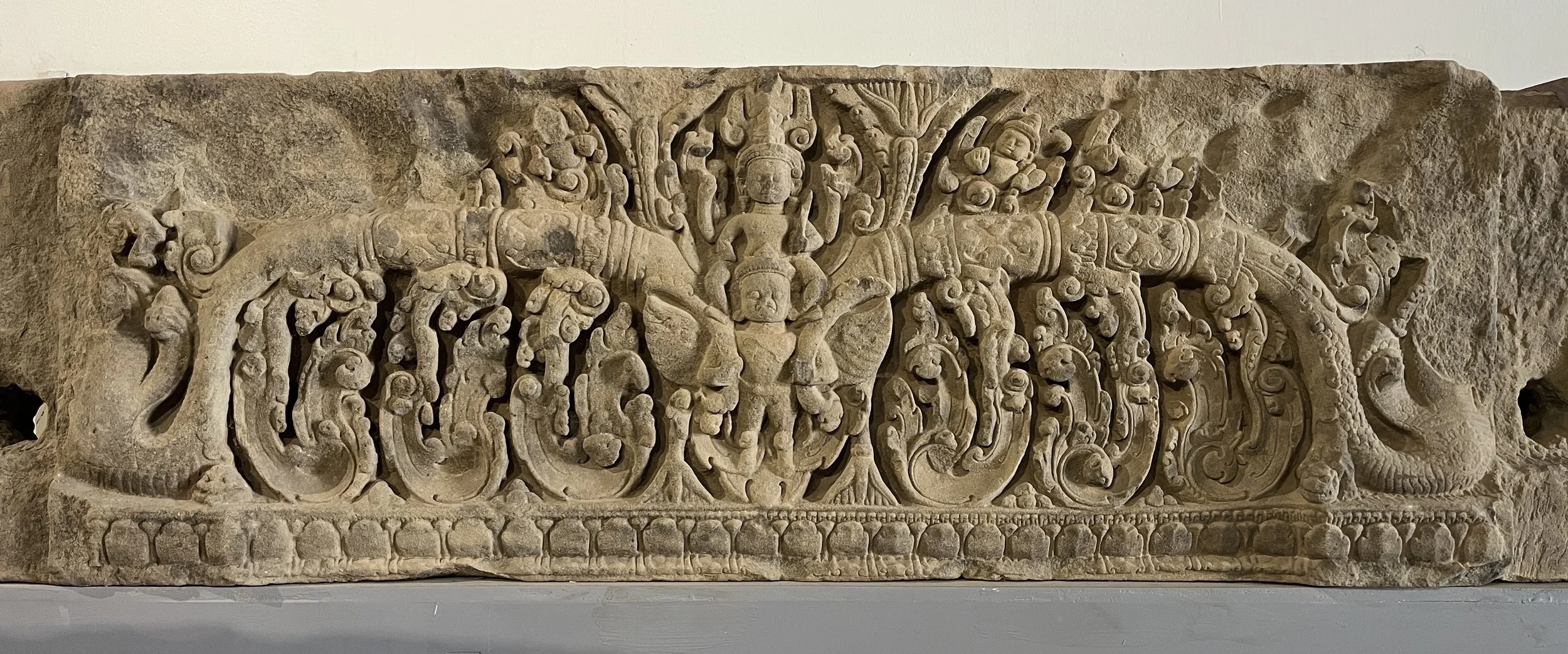
This is in Bakheang style. The depiction of a variety of floral motifs on the branches and foliage seen in this style is quite similar from one to another. This simplicity in presentation appears to be the preferred choice of this period. At the center of this piece is Vishnu riding on Garuda.

The foliage protrudes from Garuda's wings to form a bow-shaped feature, with both ends forming a Naga headed shape. The upper frieze depicts a row of eleven worshipers in decorative niches, one in each.

Shiva's head

Sandstone

Angkorian period,

Khleang style,

late 10th - early 11th c.,

Unknown

Lintel

Sandstone, Angkorian period,

Khleang style(?) Middle. 10th - 11th c.,

Unknown

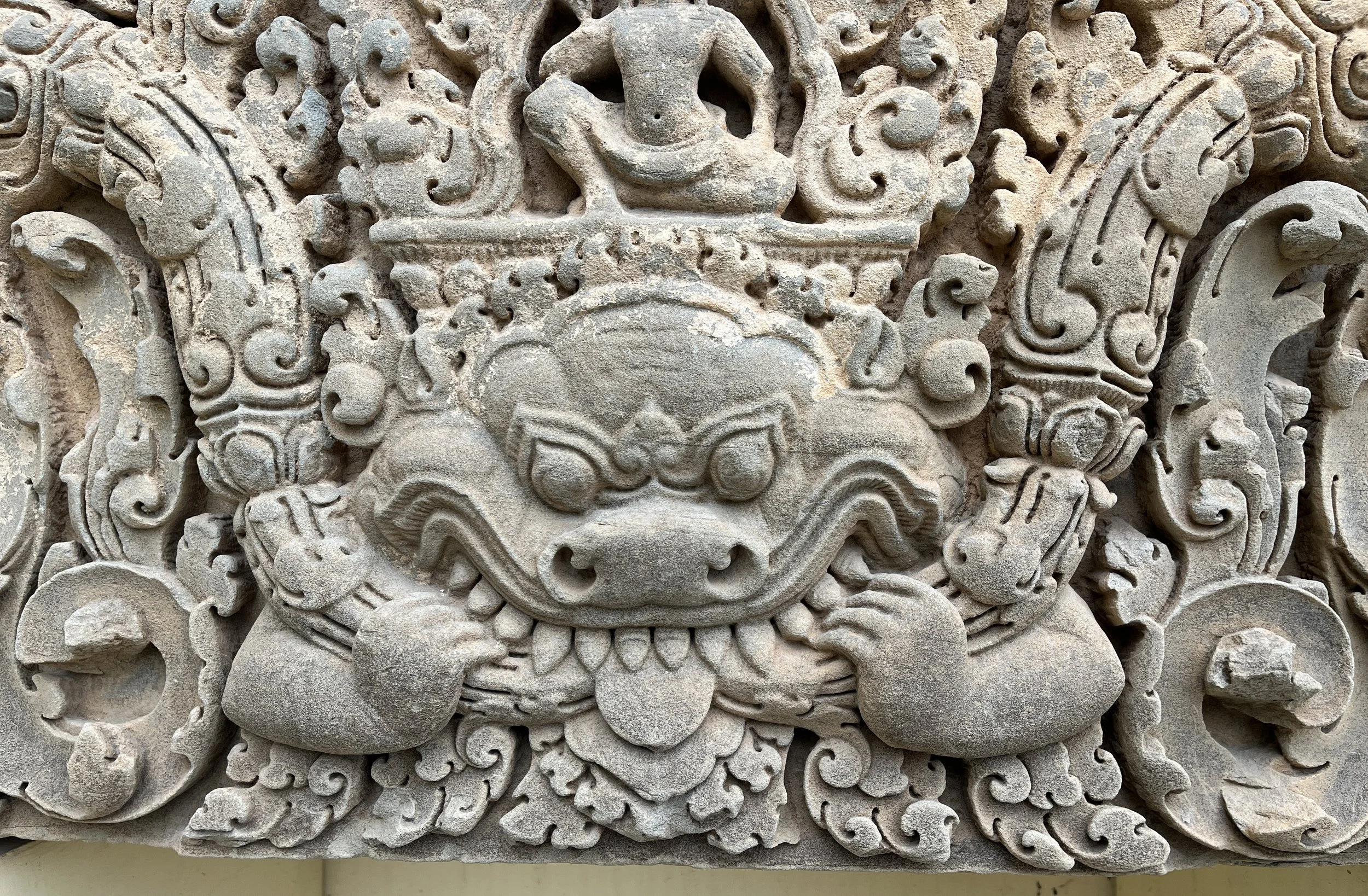
The early Khleang style was one of the most enduring in ancient Khmer history, lasting over the reigns of several kings. This style begins approximately from the end of Beanteay Srei style to late Khleang style (968-1080). Since it occupied such a long period of time, the style slightly changes from the earliest to latest examples, including its architecture like this lintel for instance. The lower part of the central section of this lintel depicts a large head of Kala, a monstrous head with a large upper jaw lined by large carnivorous teeth, with a smaller lower jaw. Both of his hands are holding an undulating garland, both swallowed and regurgitated from his mouth. This depiction of Kala's head characterizes a specific Khleang style wherein the undulating garland comes from the bottom part, from Kala's mouth, and forms a capsized U shape which is distorted at center. This distortion divides the lintel into four portions. At both ends of this undulating garland are two standing personages, one each in a decorative niche. Above the Kala head, a four armed Vishnu stands on Garuda, his mythical bird mount, in an elaborate niche which takes up the upper half of the central space of the lintel.

Lintel

Sandstone, Angkorian period, Preah Ko style (?)

9th C., Unknown

The central part of this lintel depicts a four armed Vishnu riding on his mythological birdmount, Garuda. Each of his four hands is holding different attributes such as conch, mace, disk and globe. Garuda is in flight, his wings outspread and his hands are holding a horizontal undulating garland with each end forming a three headed Naga.

The upper register of the garland is occupied by three floral motifs, each consisting of a divine being in a dancing posture. Below this garland has a large flower in pendant motif where the lowest part is decorated by a line of lotus buds.

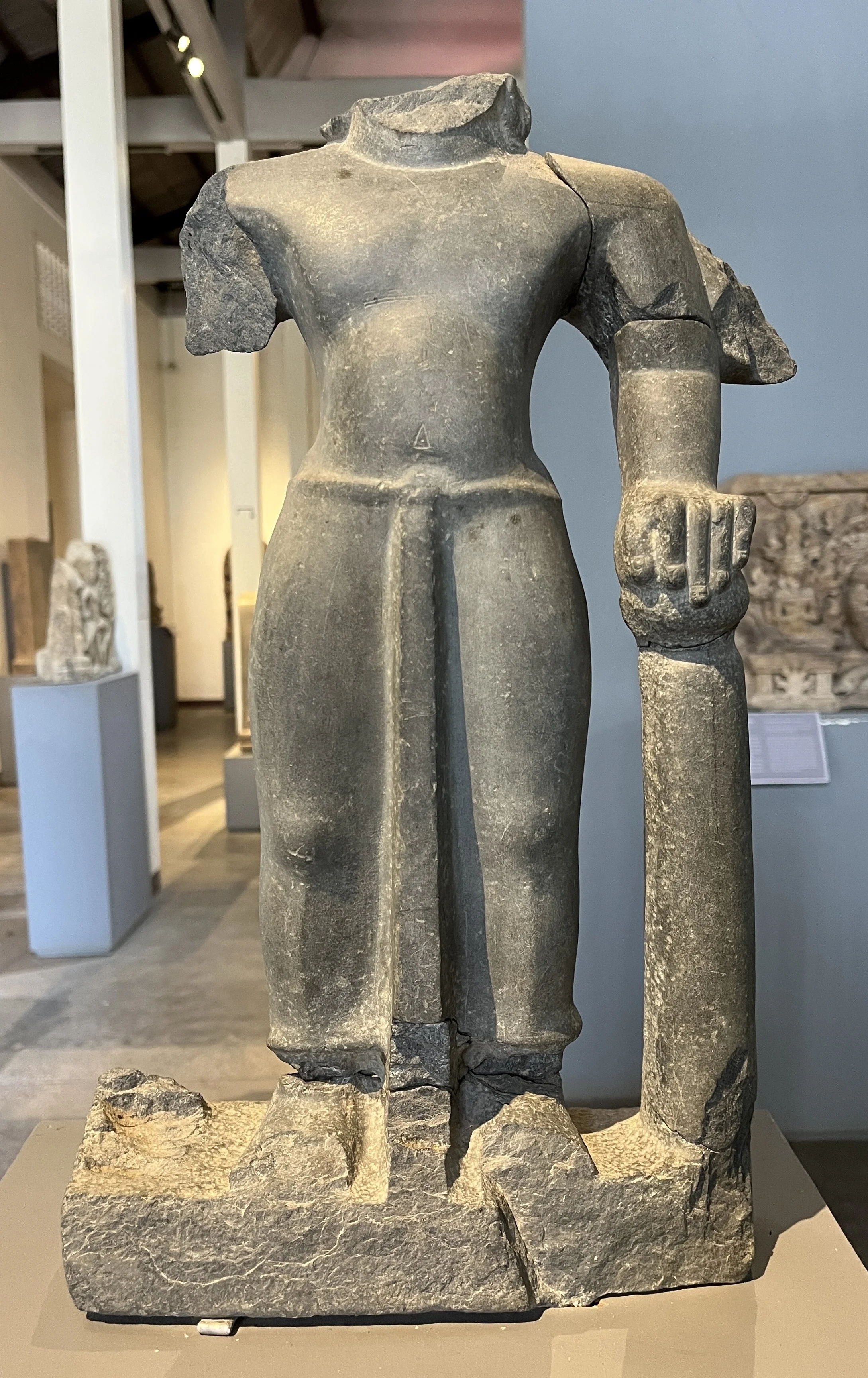
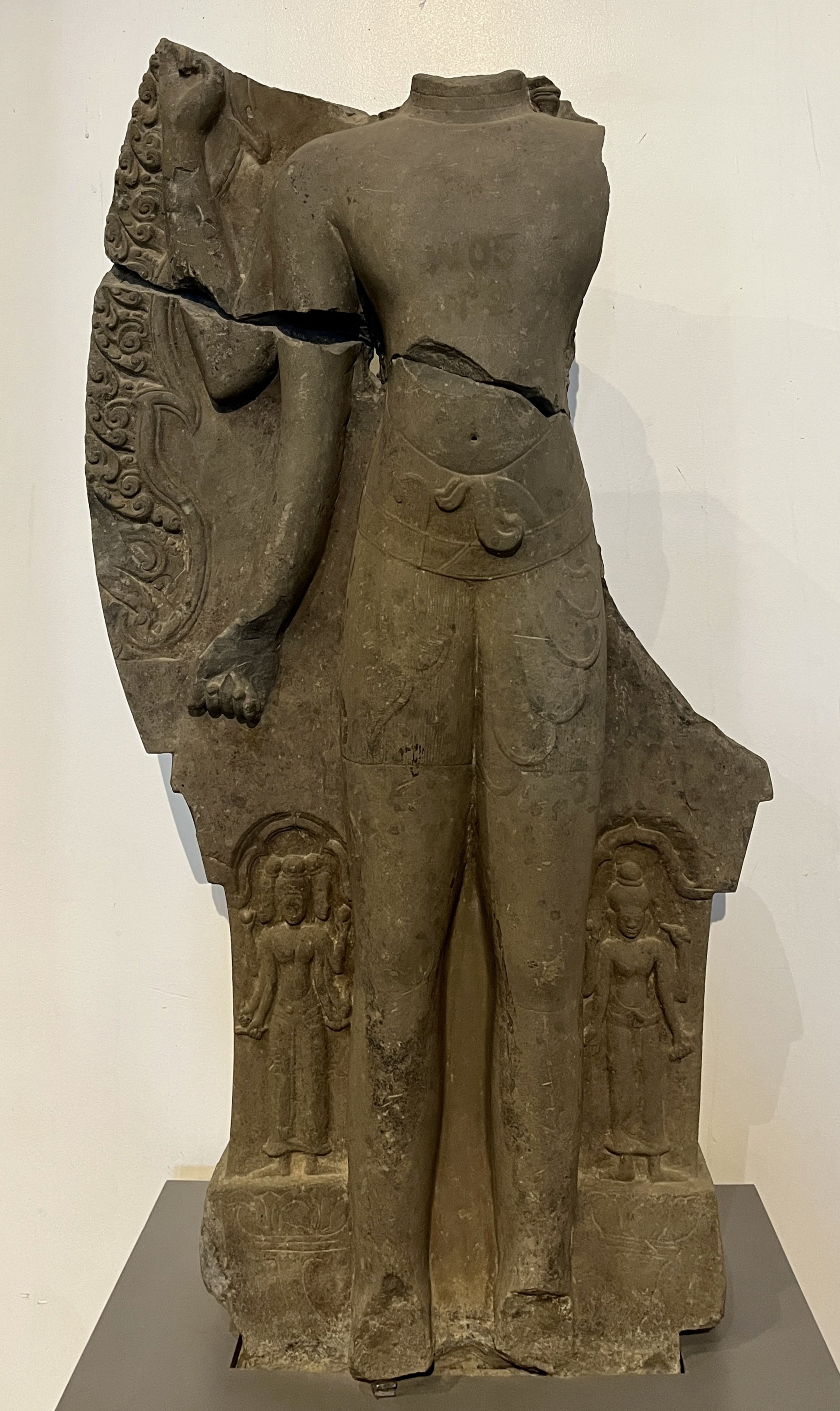
Torso of Vishnu

Sandstone, Pre-Angkorian, Prie Kmeng style, 7th - 8th C.

Baset Temple

The figure was found by a restoration team from the department of preservation and restoration of historical monuments, Ministry of Culture and Fine Arts, during the restoration of a principal tower of the Baset temple in 2017.

Torso was found together with a fragment of a face, and they correspondent to each other according to scientific analysis.

The sculpture has four arms and is probably the God Vishnu. All arms are lost at upper part, the right leg is broken at the thigh and the left leg is broken into pieces above the foot. According to the face, chignon and dress, the figure probably dates to the Prei Khmeng style, 7th-8th c.

Torso of Vishnu

Sandstone, Pre-Angkorian, Phnom Da style, 6th - 7th C.

Kouk Wat Chas, Samrong village, Ta Moeun Commune, Thmar Kol, Battambang

Phnom Da style, the oldest style of stone sculpture in Cambodia. Although this figure is broken into many pieces, the remaining left arm proves that the figure had four arms (Chaturbhuja). If all the arms exist, each one supposed to carry a globe, a disk, a conch, and a mace as distinguishing attributes. The figure has a slender shape and is wearing a thin, smooth long sampot which shows details of his legs. Triangle mark is visible on his navel.

The figure is supported by the maces of original stone block to support his upper arms, so does his body which lower edge of his skirt connects to its base.

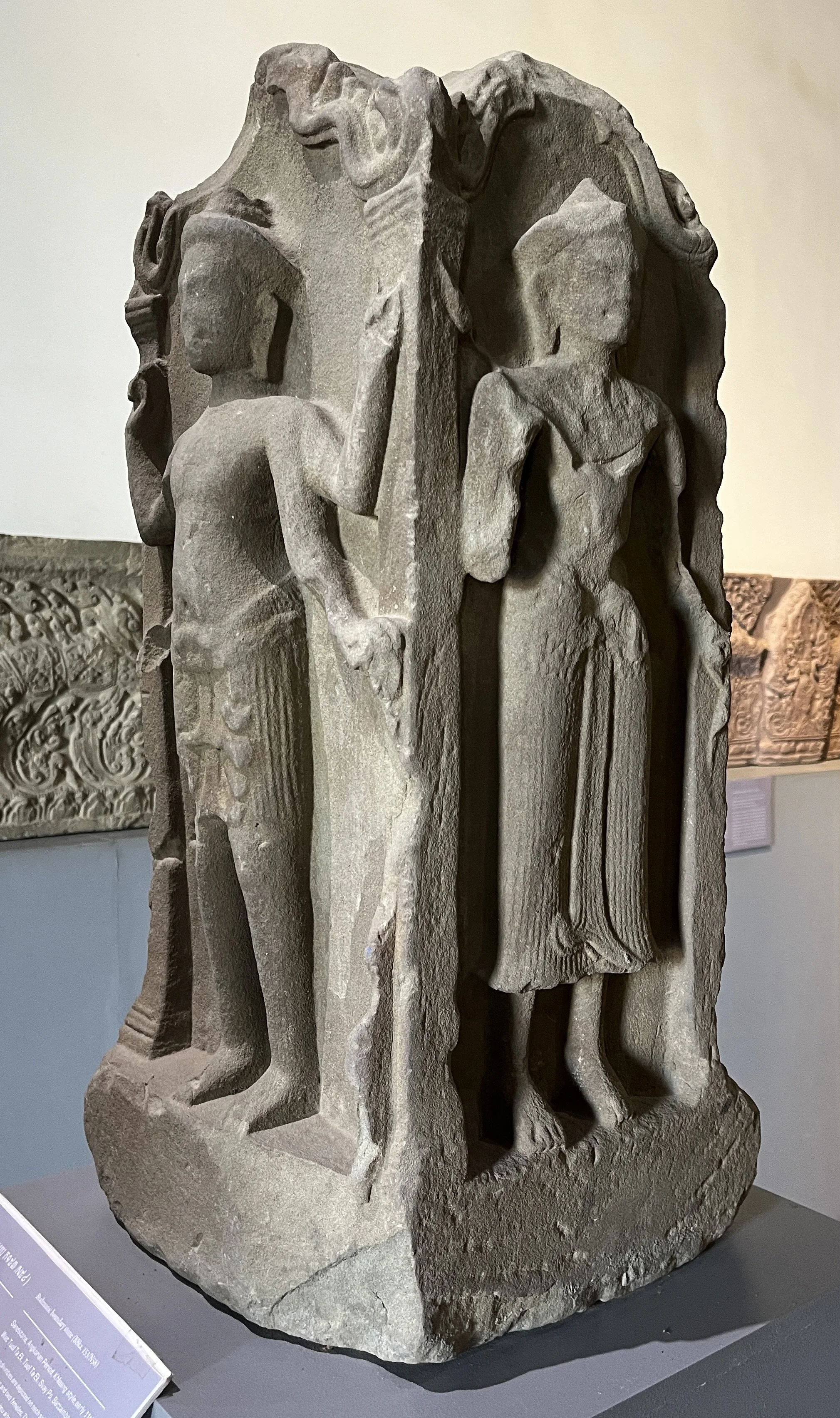
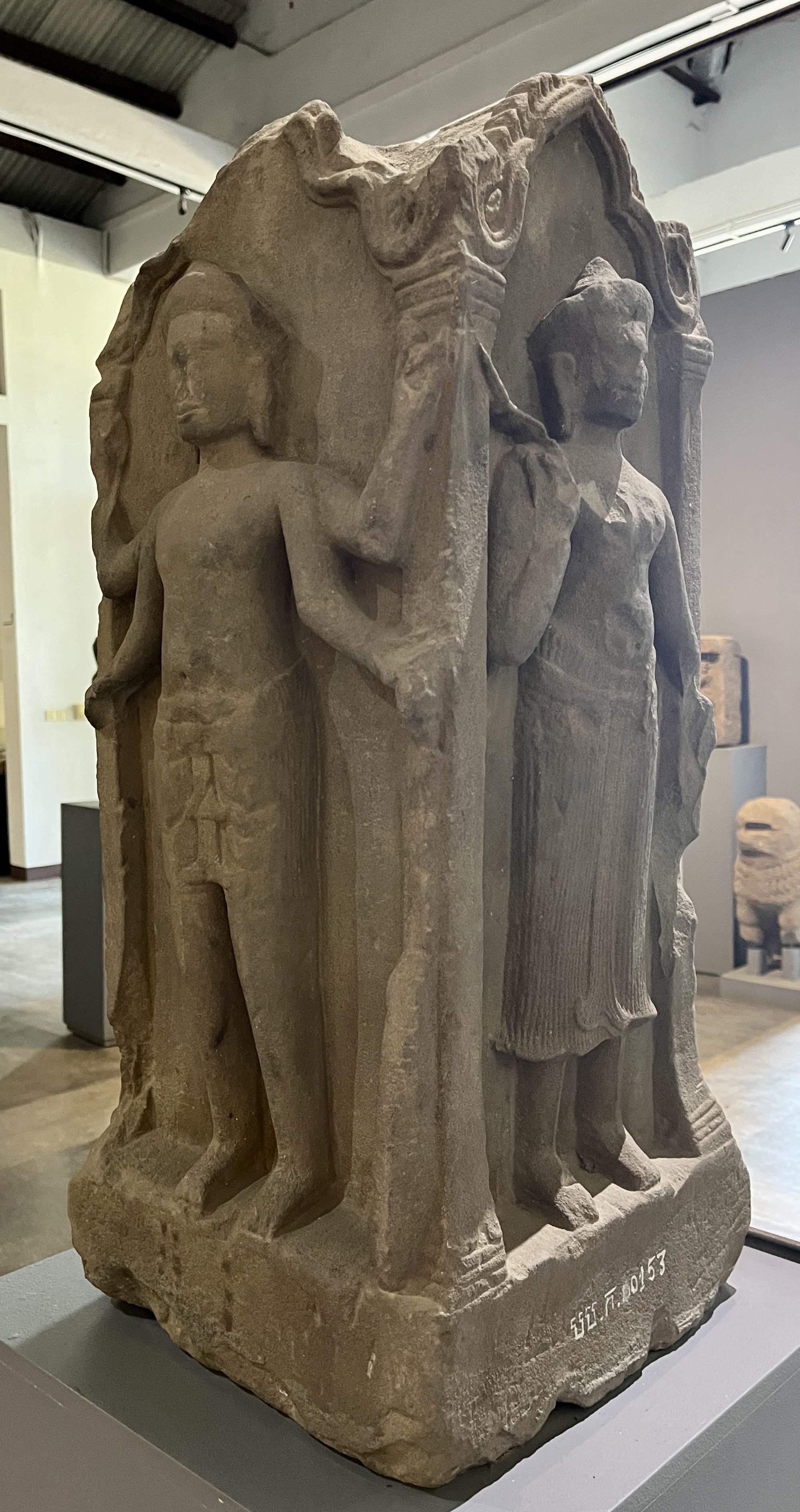
Brahmanic boundary stone

Sandstone, Angkorian Period, Khleang style, early 11th C.

Wat Tuol Ta Ek, Tuội Ta Ek, Svay Po, Battambang

Four main divinities are depicted on each side of the boundary stone, two males and two females. The first one is a four armed male deity, probably Vishnu, with upper left hand holding a conch, lower one holding a mace, right one probably holding a disk while the lower one is lost. On another side is a female figure, holding a lotus in her right hand while her left hand rests along her body but also holds a lotus. The other female figure is similar. It is believed that the female figures are Lakshmi. The last side is a male deity which is the mirror opposite of the male figure on the front, believed to be Vishnu. Based on the decoration on their bodies and dressing style, this boundary is probably dated to 11th C., in the Khleang style.

Lintel

Sandstone, Angkorian period, Preah Ko style (?). 9th c., Unknown

Similar to other lintels in this section, Vishnu and his Garuda mount occupy the central part of the lintel. Both of Garuda's hands are holding undulating garlands with each end forming a three headed Naga. Below that are floral pendant motifs followed by a row of lotus at the lowest part. In general, this lintel was carved very shallow, and this suggests the work is probably done by a local workshop.

Lintel

Sandstone, Angkorian period, Bakheng style, 10th C.

Phum Banteah Boh, Khum Tean Kam, Srok Preahneth Preah, Banteay Meanchey.

This piece belongs to the Bakheng style, depicting Vishnu seated on garuda, his vehicle, in the center, flanked by two branches and foliage in arch form finishing in Naga headed shapes. Above and below the branches are floral shape motifs. There is no frieze at the upper part; but the lower edge of the lintel depicts a row of lotus petal. The motif carved on this lintel is quite shallow, perhaps, the works is not completed yet.

Shiva

This section displays different forms of the god Shiva. He is one of the main gods in Hinduism, the god of destructor and creator of the world. Some-times, he is shown with two other gods, Vishnu and Brahma. Sometimes with his spouse; Uma, Paravati or Durga, with his sons, Ganesh or Skanda, otherwise, he is shown alone by himself.

Shiva manifests in many forms. in early Khmer arts, he was usually represented in a form of Linga, phallic symbol of fertility. In the phallus form, it is usually carved in three sections representing trimurti. The square shape at bottom alludes to Brahma the Creator, the octagonal form at central to Vishnu the preserver and the cylindrical portion at top to Siva, symbolized infinity cosmic. Sometimes, this Linga has face at this cylindrical section which is called Mukha Linga in Sanskrit.

In anthropomorphic forms, Shiva could have two or more arms and many heads too. He is identified by his special characteristics such as a moon crest on chignon, a third eye at center of forehead. Sometimes, he is known by his attributes; trident, rosary, drum, a water flask, cord or cobra. In addition, he is also recognized by his vehicle bull nandin, or by his posture, for instance, when he is dancing, when riding a bull with his spouse or when Uma sits on his leg when ravana shakes mount Kailasha.

Lintel

Sandstone, Angkorian period, Koh Ke Style

10th c., Unknown

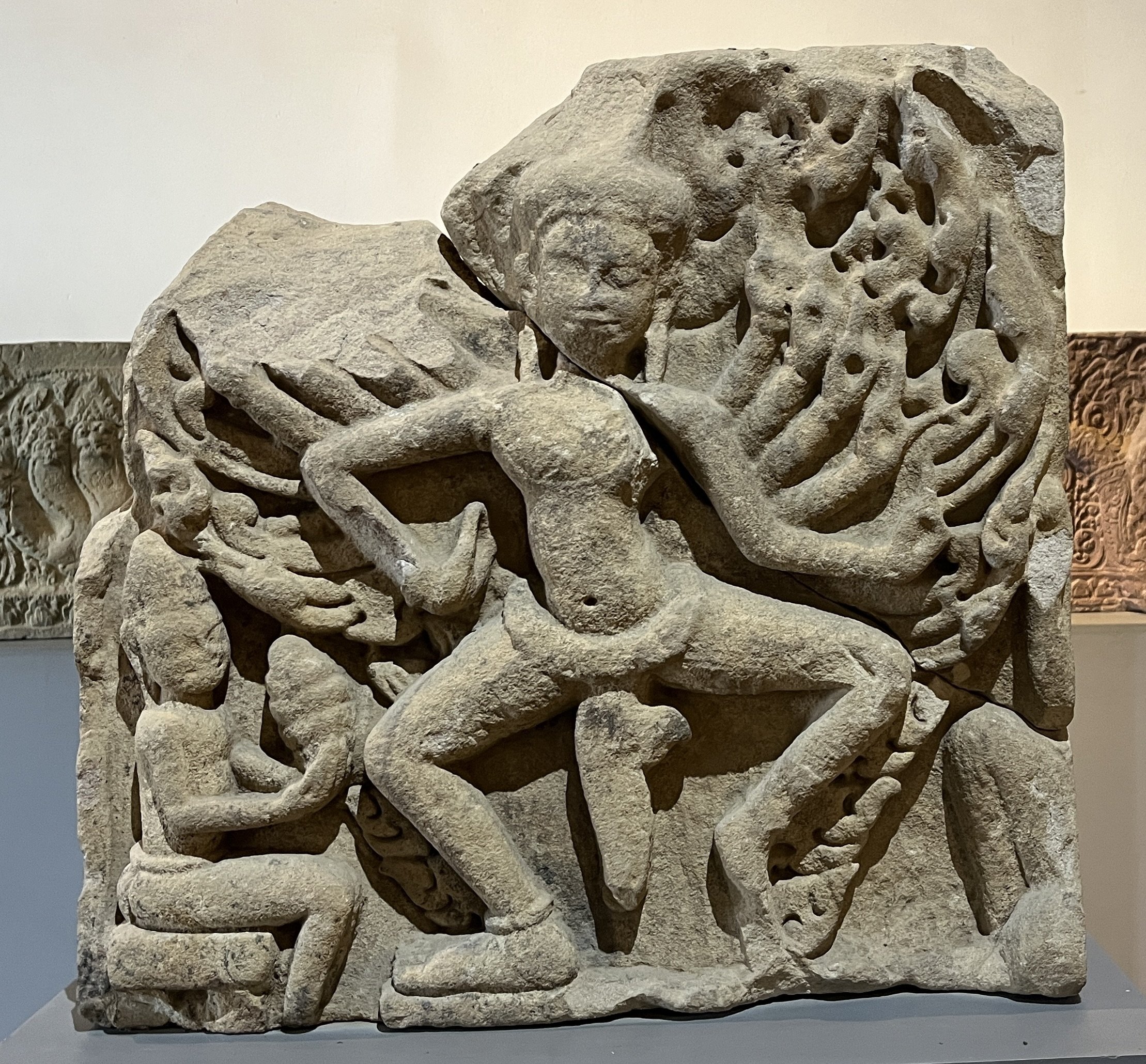
This lintel depicts a famous Indian myth, an episode of Ravana shaking Mount Kailasha, a residence where Shiva and his consort Parvati reside. According to the myth, Ravana once tried to lift Mount Kailasha, but Shiva pushed the mountain into place and trapped Ravana beneath it. When the mountain was shaking, Parvati was frightened and clutched Shiva's knee. Ravana, however, wailed for mercy. Having humbled Ravana, Shiva released him. After this experience, Ravana became a great devotee of Shiva.

Instead of the typical branch, this lintel is fully covered with interlocking vines that descend into scrolls. On the left end of the branch is a lion which its face is turned inward toward the scene. A band of lotus petals is carved at the bottom of the lintel.

Lintel with dancing Shiva

Sandstone, Angkorian Period, Khleang style,

Late 10th - first half of 11th c., Baset temple

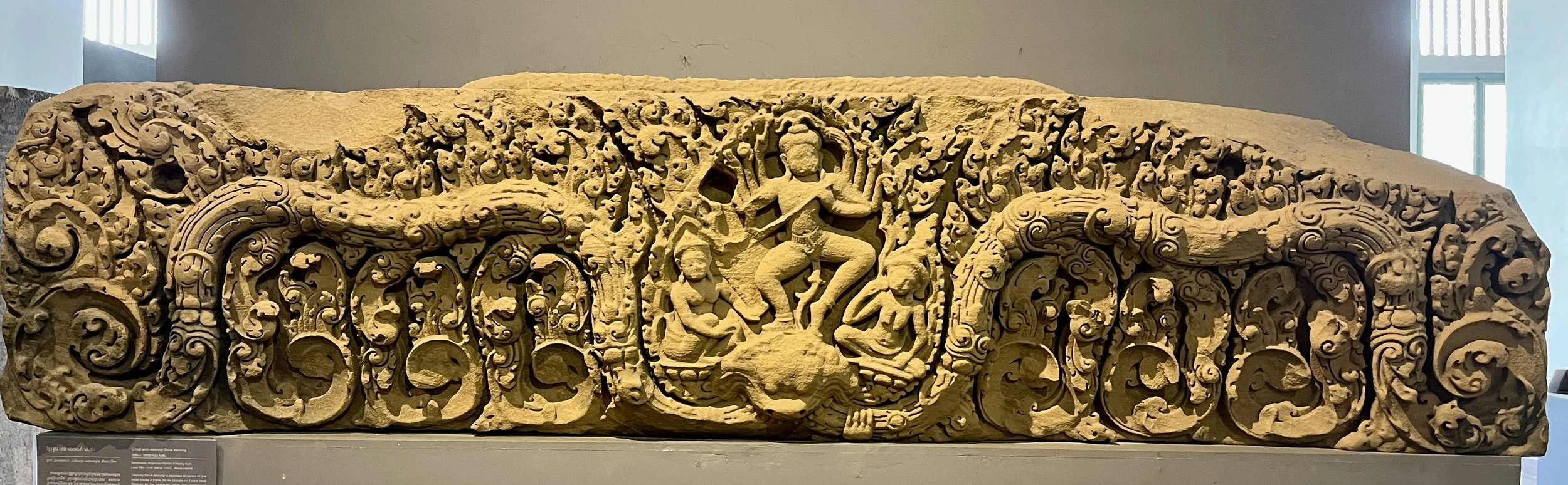
Dancing Shiva is depicted at the center of the lintel inside a niche. He dances on Kala's head flanked by his consorts, Uma, who sits in dancing posture on the right, and Karikalammayar who has swelling long breasts, sitting on the left. Kala's head below Shiva seems to swallow branches of undulating garlands in a "U" shape, finishing in large floral shapes.

The branches divide the lintel into four parts, above it are five large flowers and below are three floral motifs in hook shapes on each side. These floral motifs are carved very deeply into stone and look so vivid.

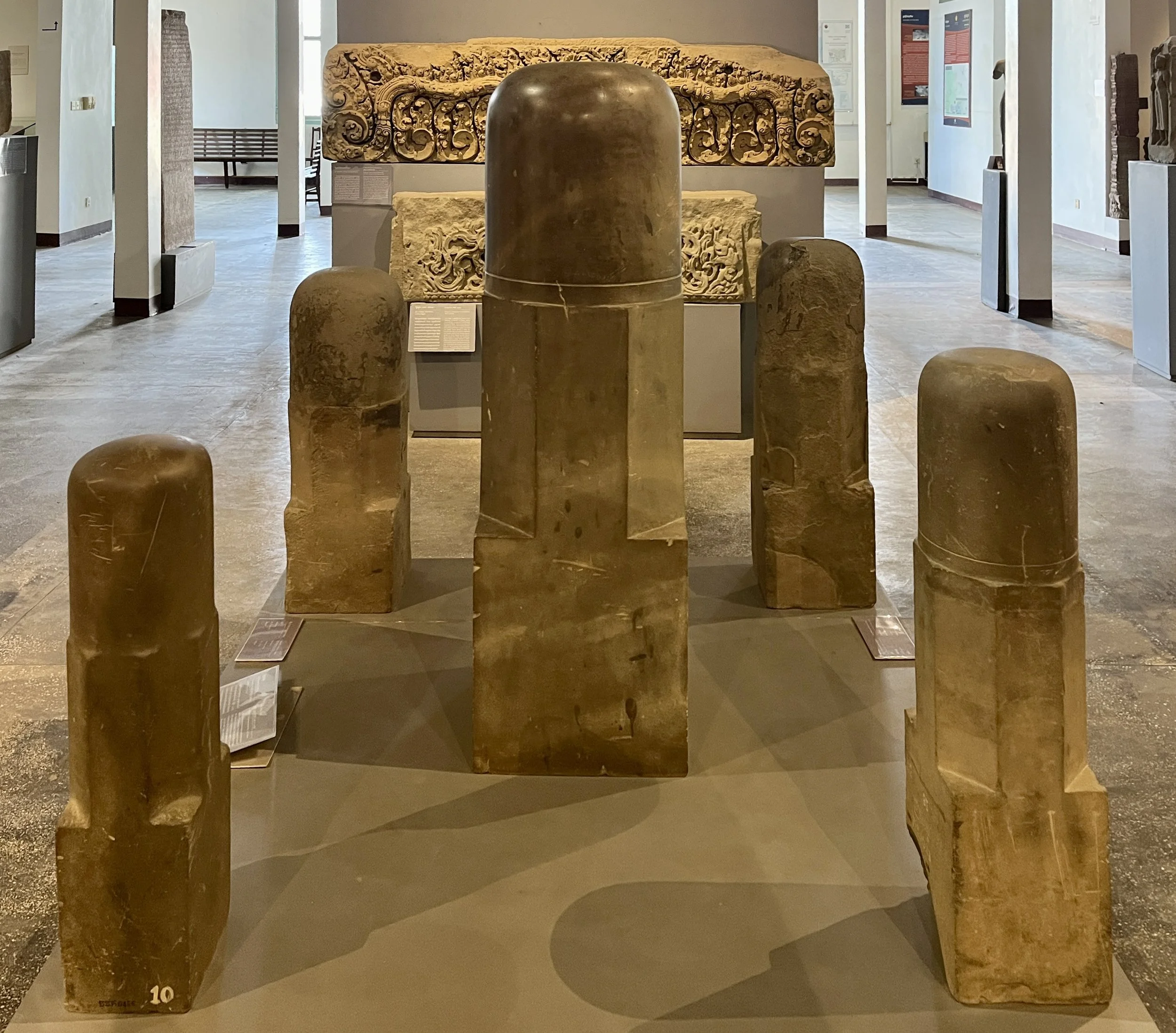
Linga

Sandstone, Pre-Angkorian period, Gth - 7th C, Basat

Linga is commonly known as an abstract repre-sentatian of Shiva, one of the thres main gods of the Hinduism. In ancient Cambodia, Shiva lingo had various shapes and was made from various materials such as metal, sandstone, and granice.

This particular linge represents not only the Shrva, but the union of the three main Hindu gods; the cubic base represents Brahma, che octagonal middle section reprosents Vishnu, and the hemisphere section at the top represents Shiva.

The largest one at center is originated from Baset cemple and four others are from different places in the province. Each one has a capsize "U sign on the face, and this place sometimes replaced by a face, mukhalinga,

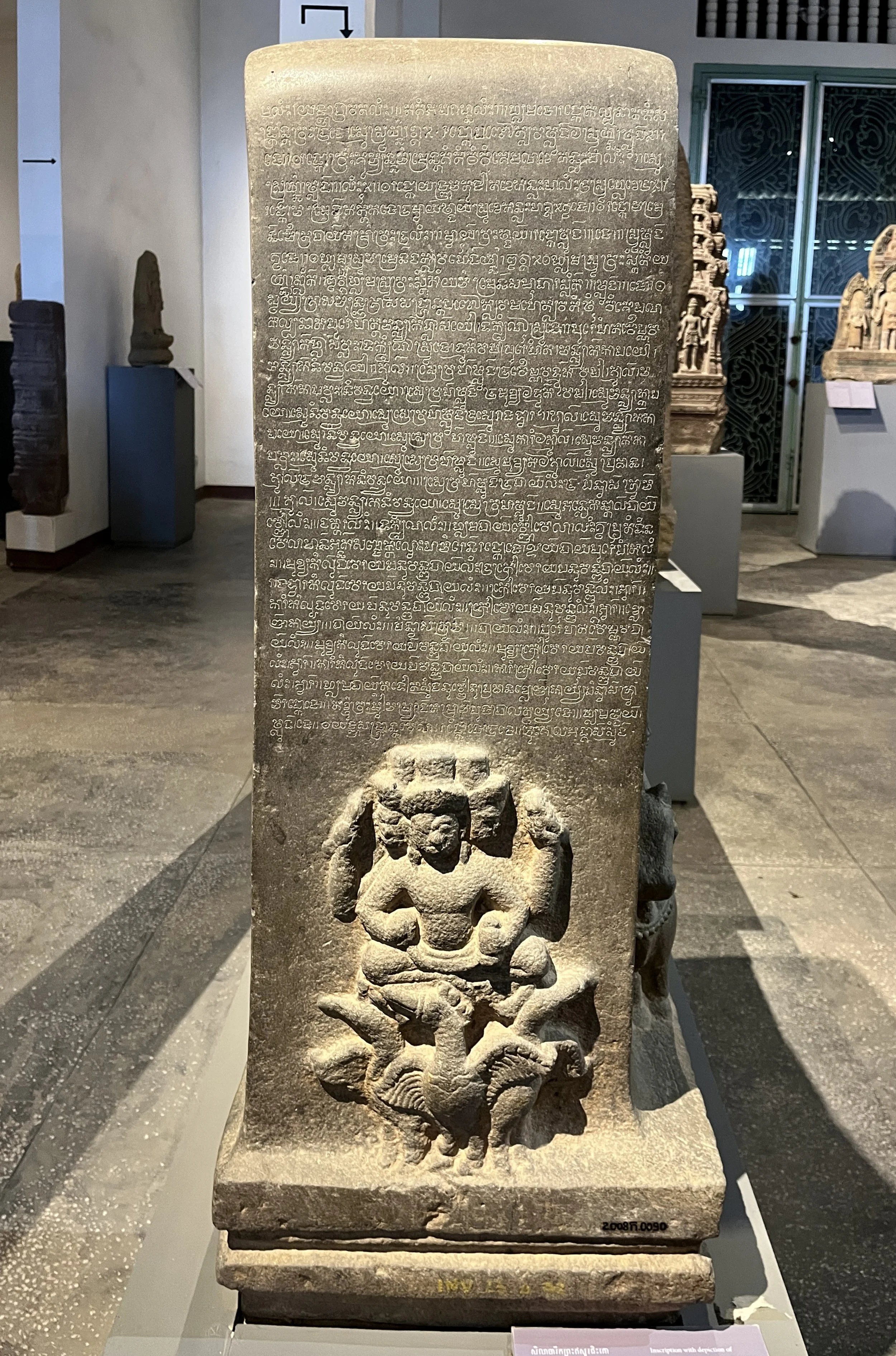
Inscription with depiction of Trimurti

Sandstone

Angkorian period, 10th c.,

Prasat Khvav, Svay Chek;

Banteay Meanchey

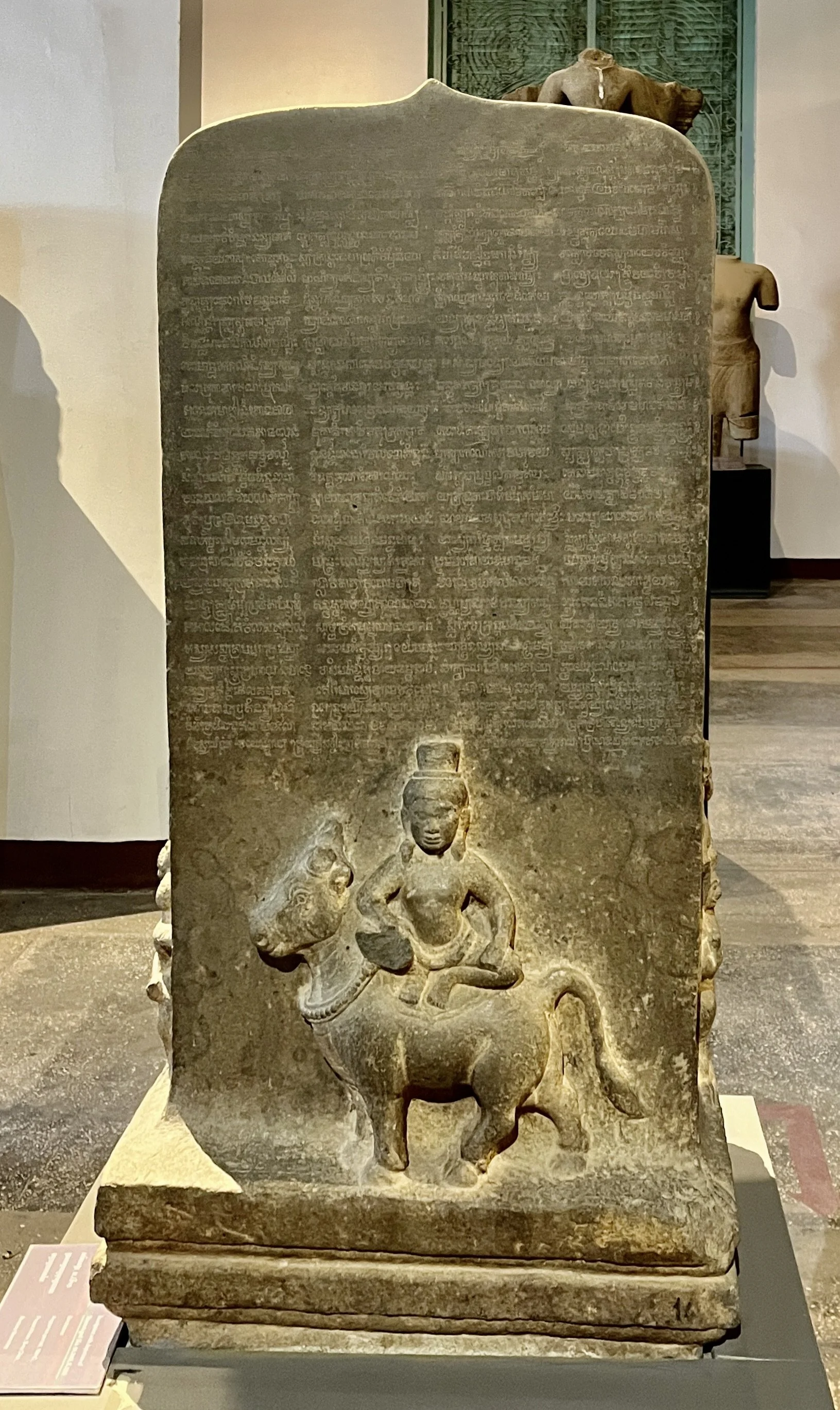
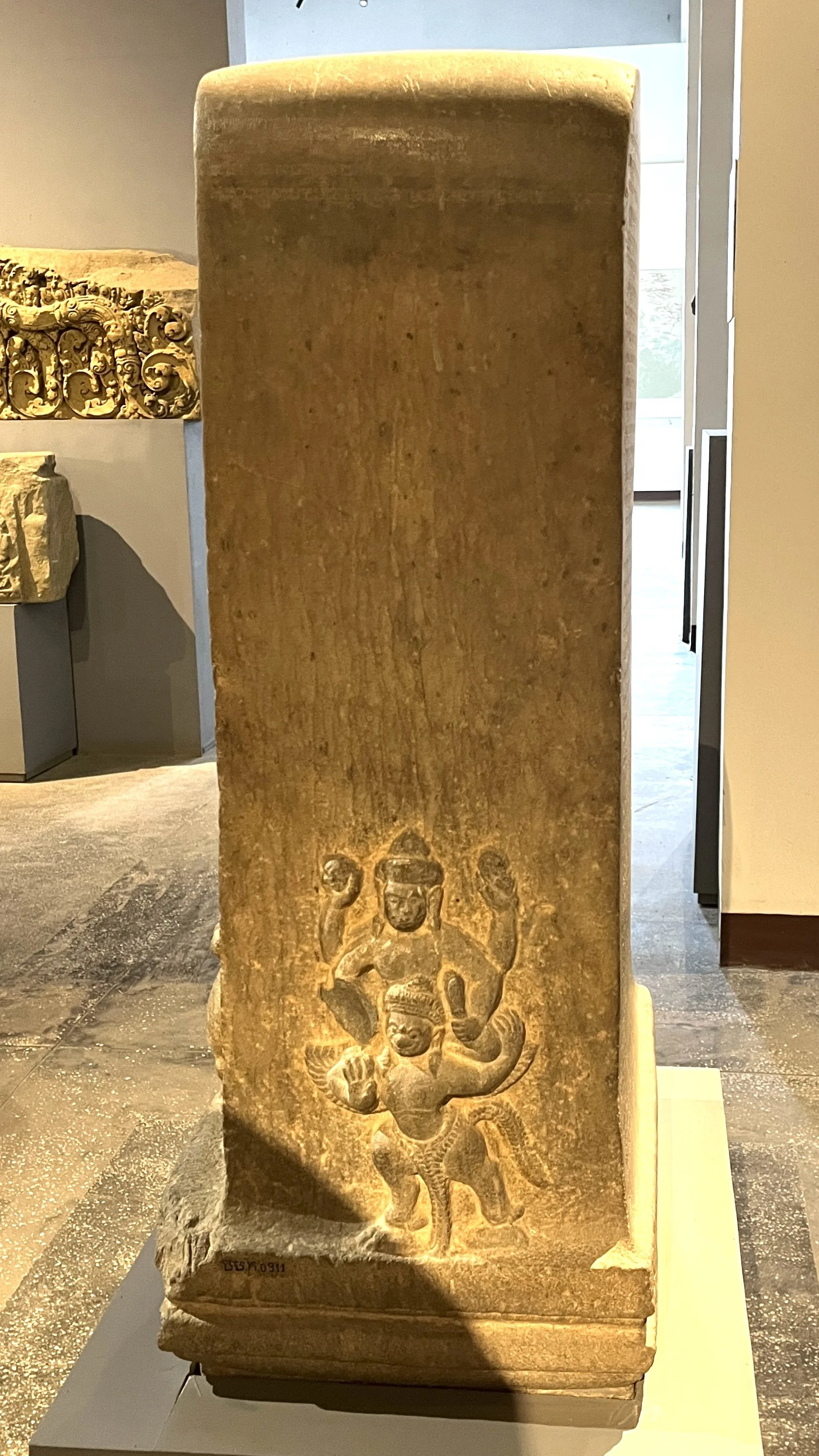
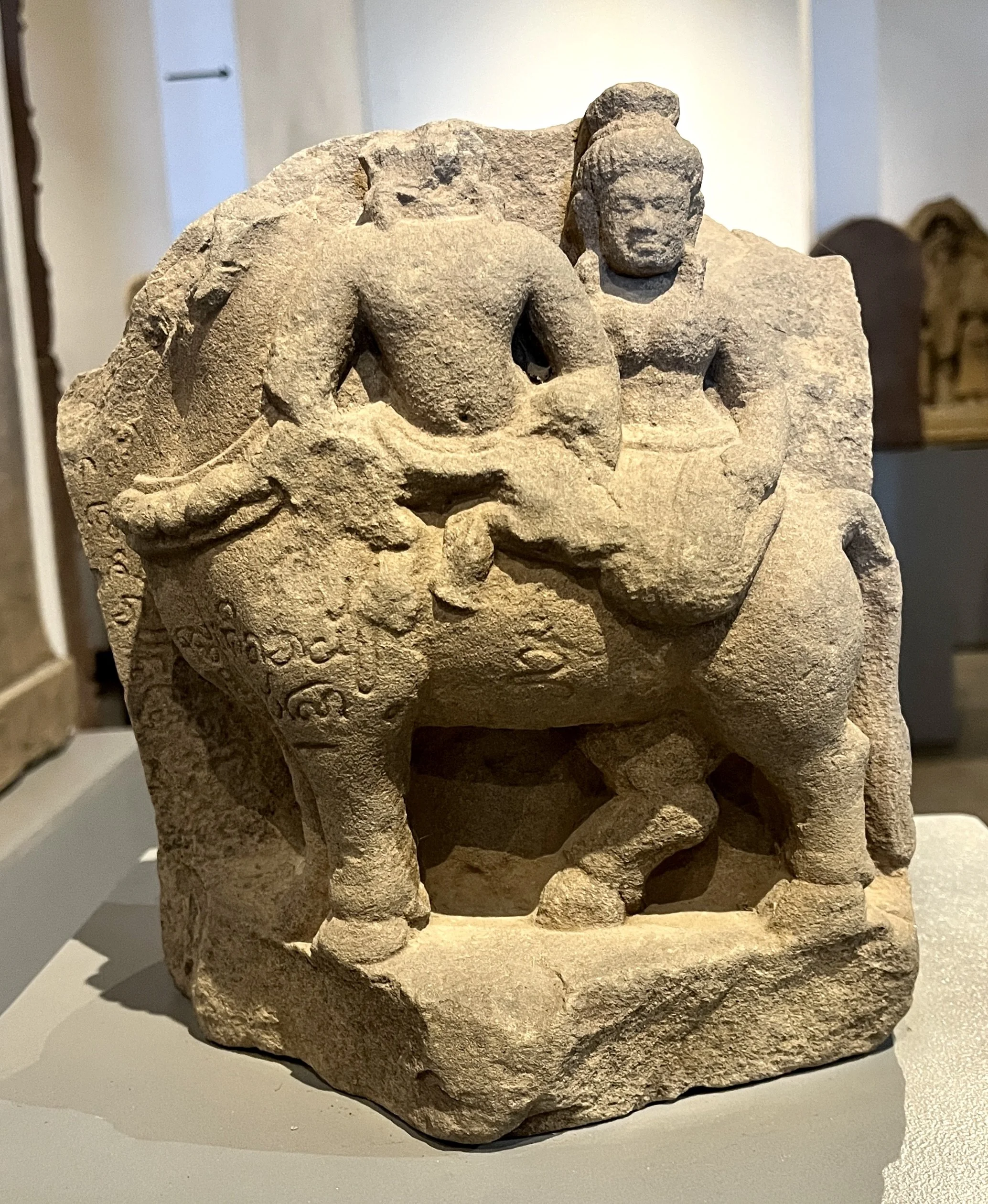
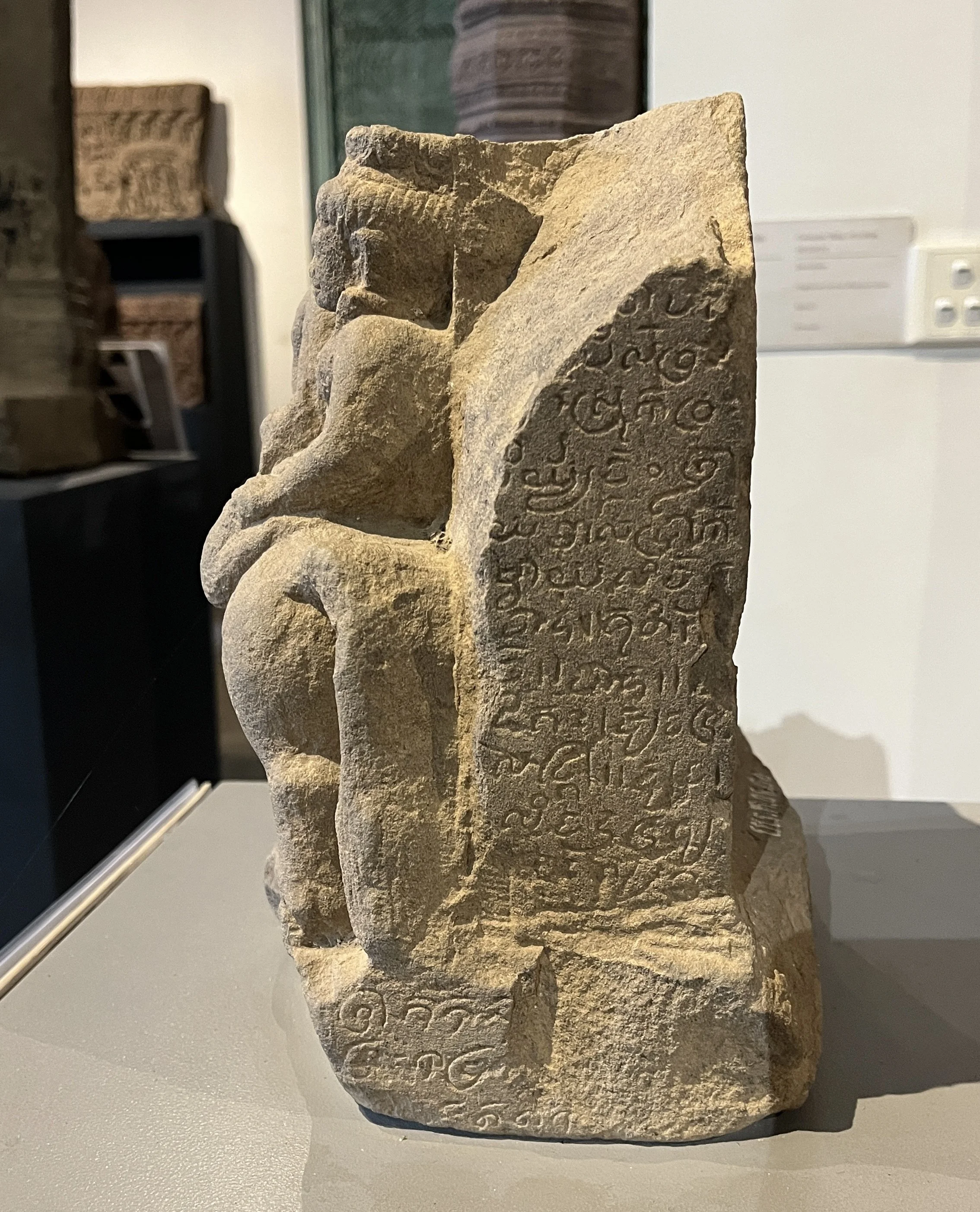
Inscription with Shiva and Uma riding bull

Sandstone, Angkorian period,

End of 10th-11th century (?)

Baset temple

An inscription is engraved on all sides of this stone featuring a depiction of Shiva and his spouse, Uma, riding a bull on one side. It is written in two languages, Sanskrit and old Khmer, an "Um" sign is visible on the bull's belly and on its neck is written a name of a priest called Shivacar who donated offerings to the god. On the left side, there is a list of daily donations given by the priest to the temple. On the right side, which is similar to the left one, is a list of daily utensils offered to the temple such as silver bowls, copper spittoons, etc. On the back side is writing in both languages, Sanskrit and old Khmer, but some is illegible. The text mentions a ceremony being conducted annually, and other offerings the priest had offered to the god at Lingapura.

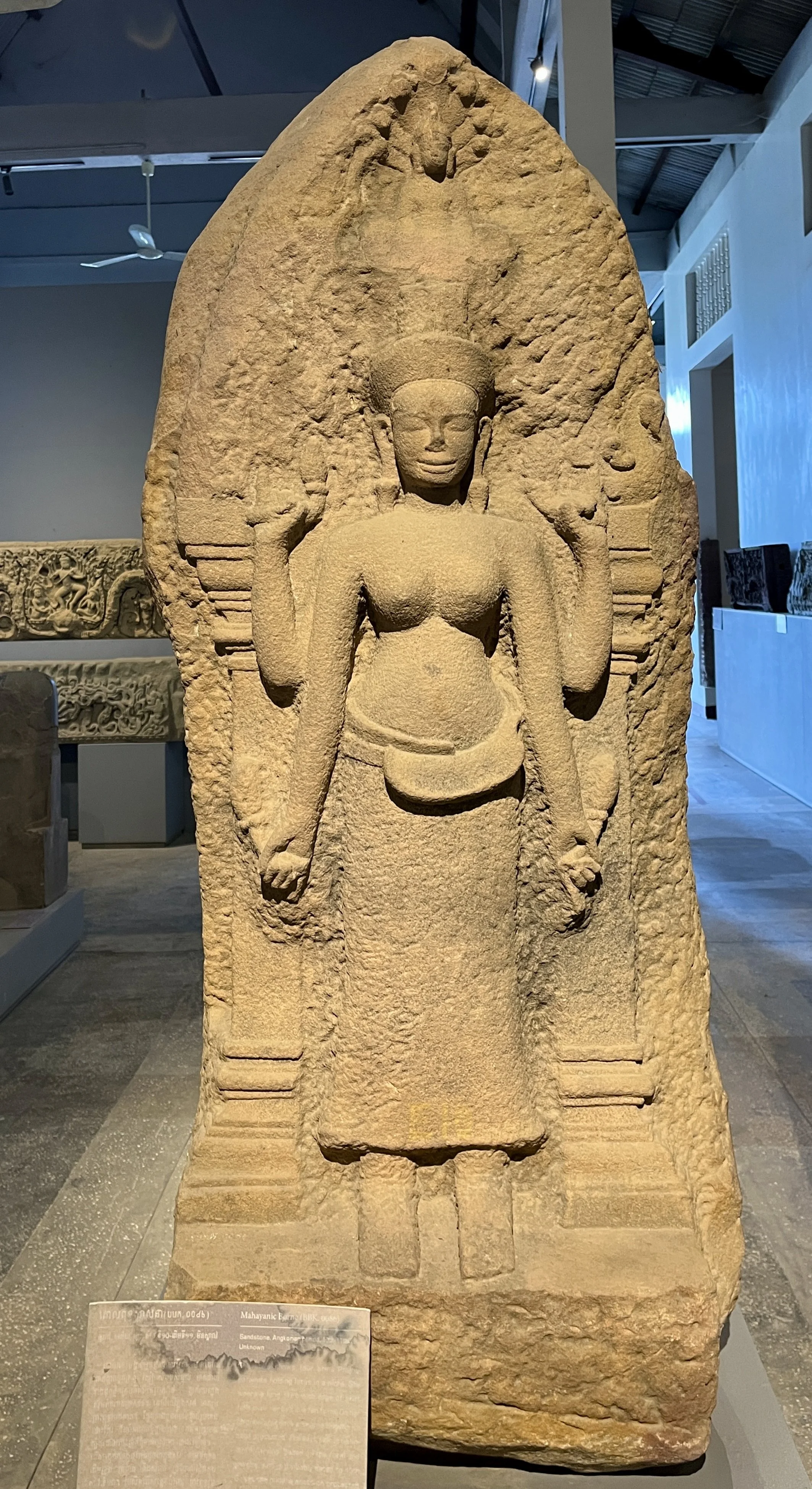
Mahayanic Borne

Sandstone, Angkorian period, 10th-11th c.

The stele shows a four armed Prainaparamita holding a lotus in a niche. She wears a lang skirt; the edge of the skirt falls over her belt in a tent form. On her chignon is a seated Buddha, protected by a naga. The backside is uninscribed carving. Based on her figure and jewelry, this probably dates to the 10th century, though perhaps later as the seated Buddha protected by Naga is typically 11th century.

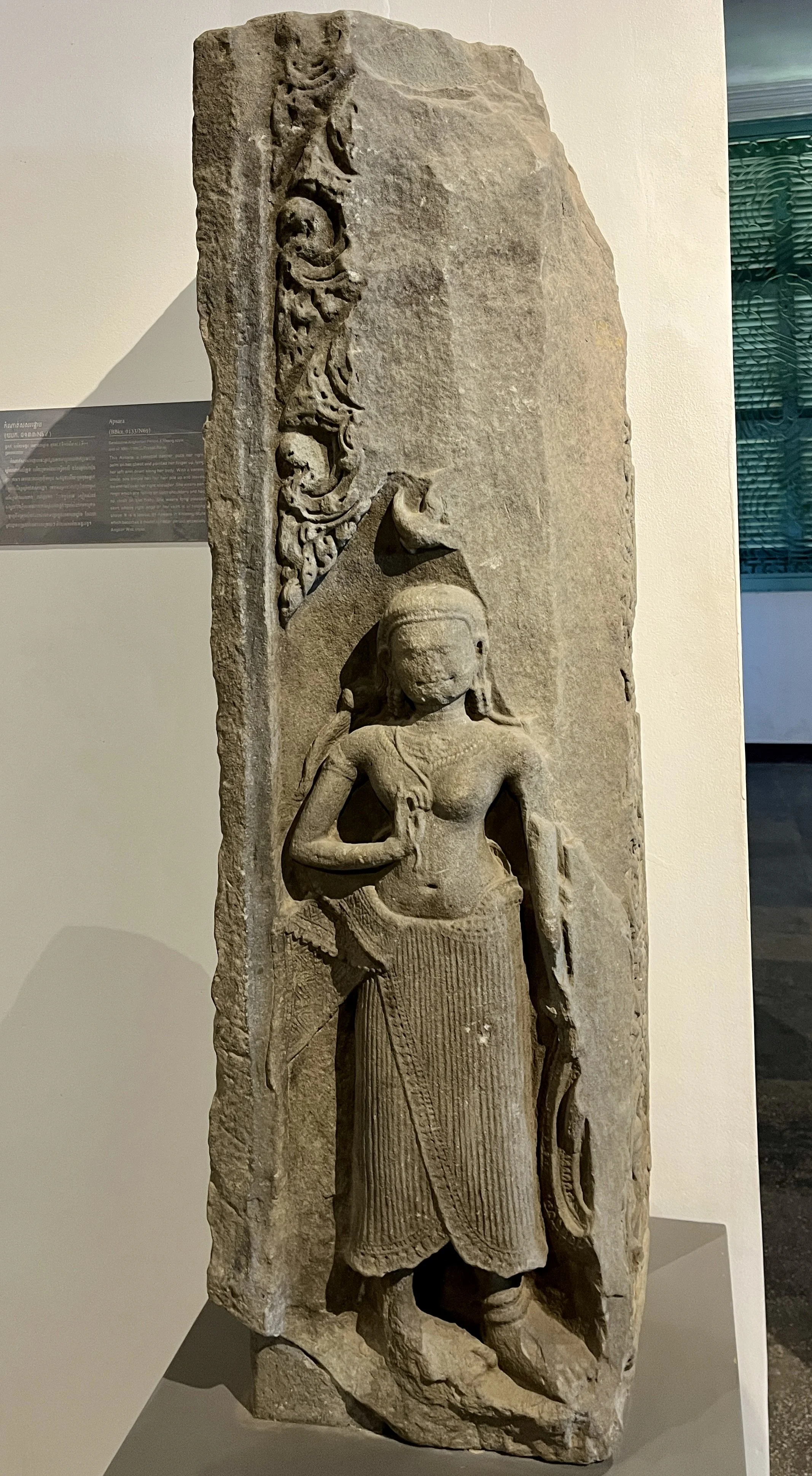
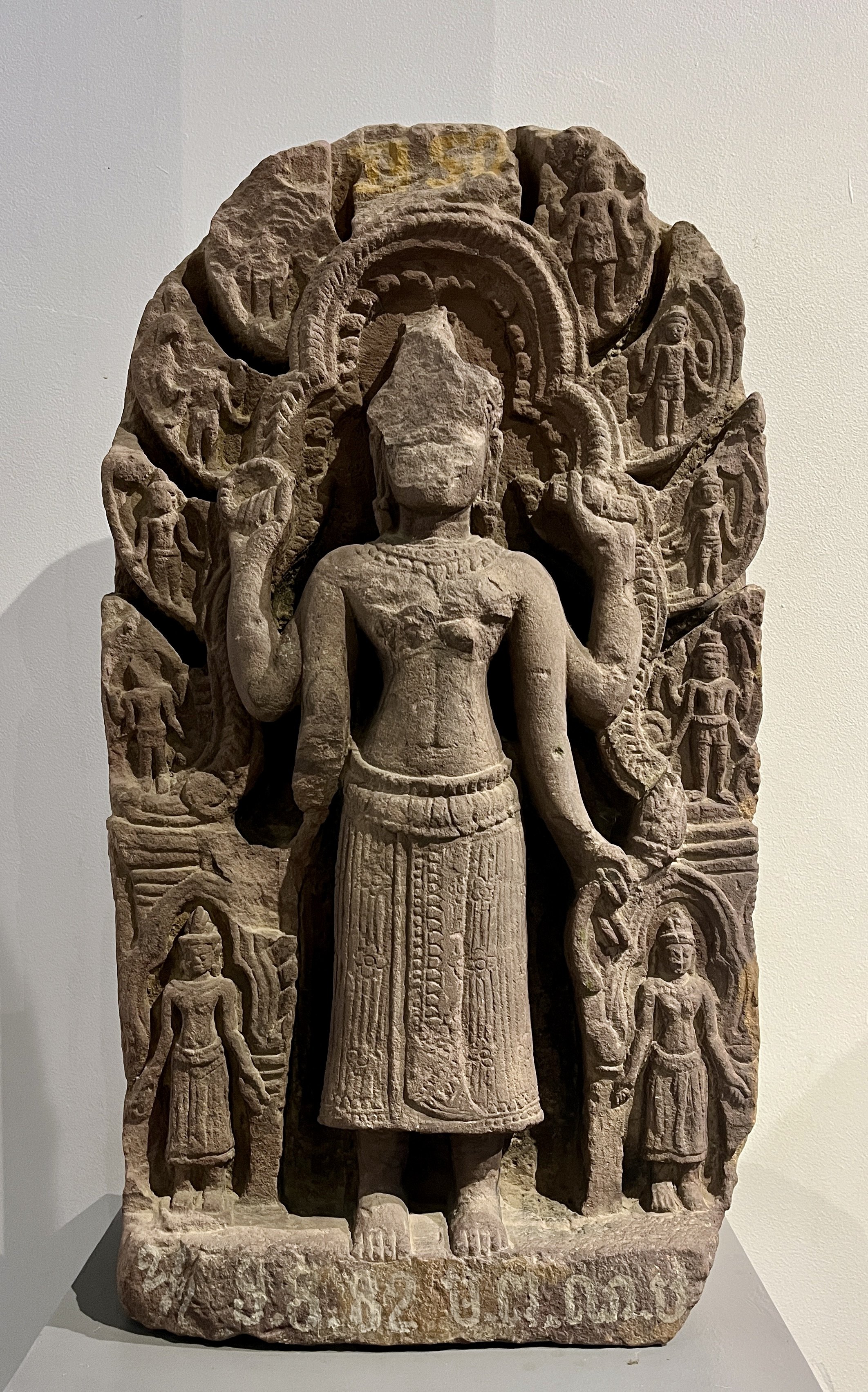
Apsara

Sandstone, Angkorian Period, Khleang style, end of 10th -11th c., Prasat Bavet.

This Apsara, a celestial dancer, puts her right palm on her chest and points her finger up, lying her left arm down along her body. With a serene smile, she simply has her hair piledd up and lets its ends fall over her right shoulder (editor’s note: what? are we even looking at the same statue? this is clearly an intricate and symmetrical hairstyle, perhaps even a wig. Whoever wrote these absolutely meaningless descriptions focusing on their own phenotypical preferences is really annoying me). She wears earrings which are falling on both shoulders and has no cloth on the upper body. She wears a long pleated skirt, folded at her right hip. It is a typical Apsara in the Khleang style, which becomes a model in later periods, especially Angkor Wat style.

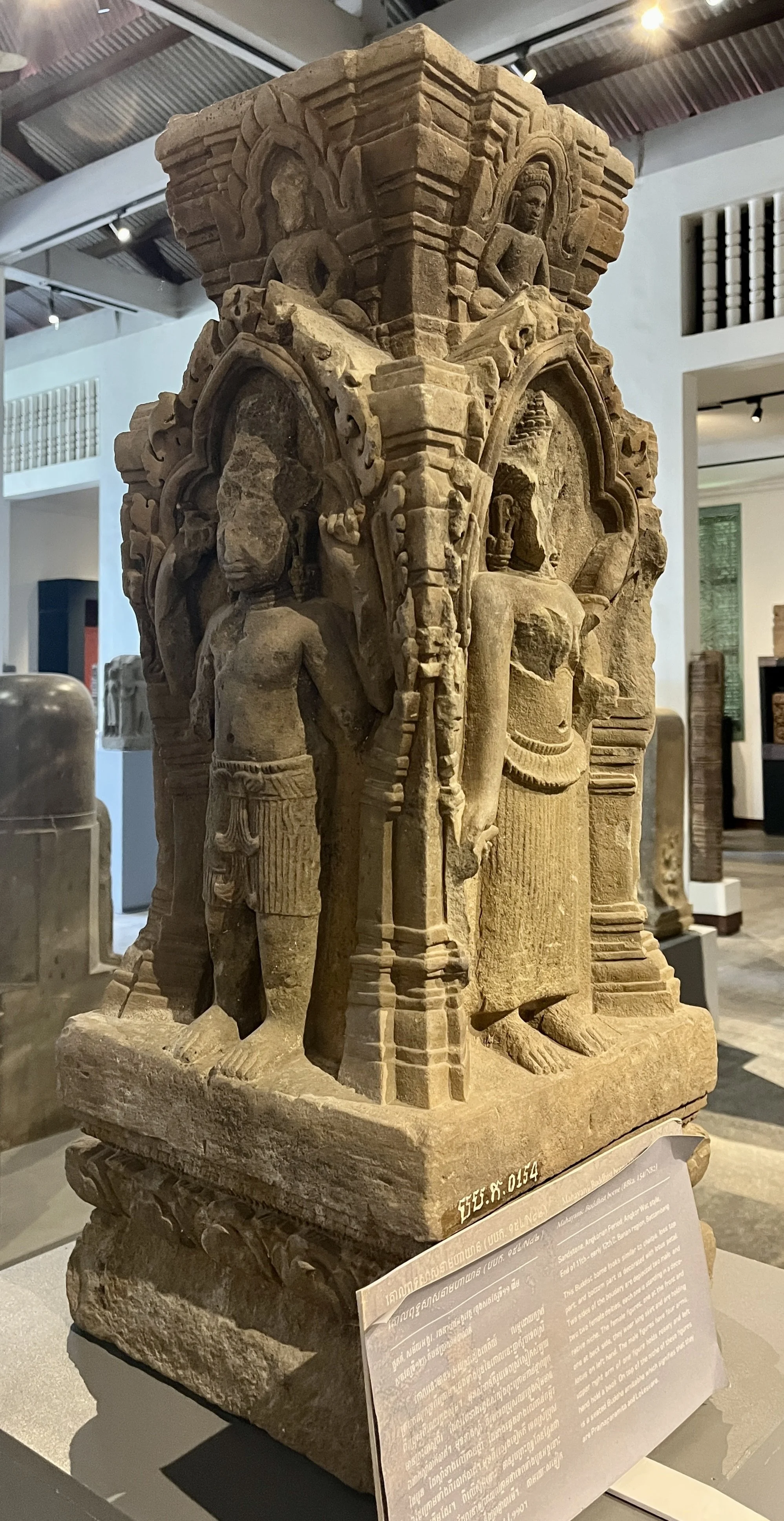
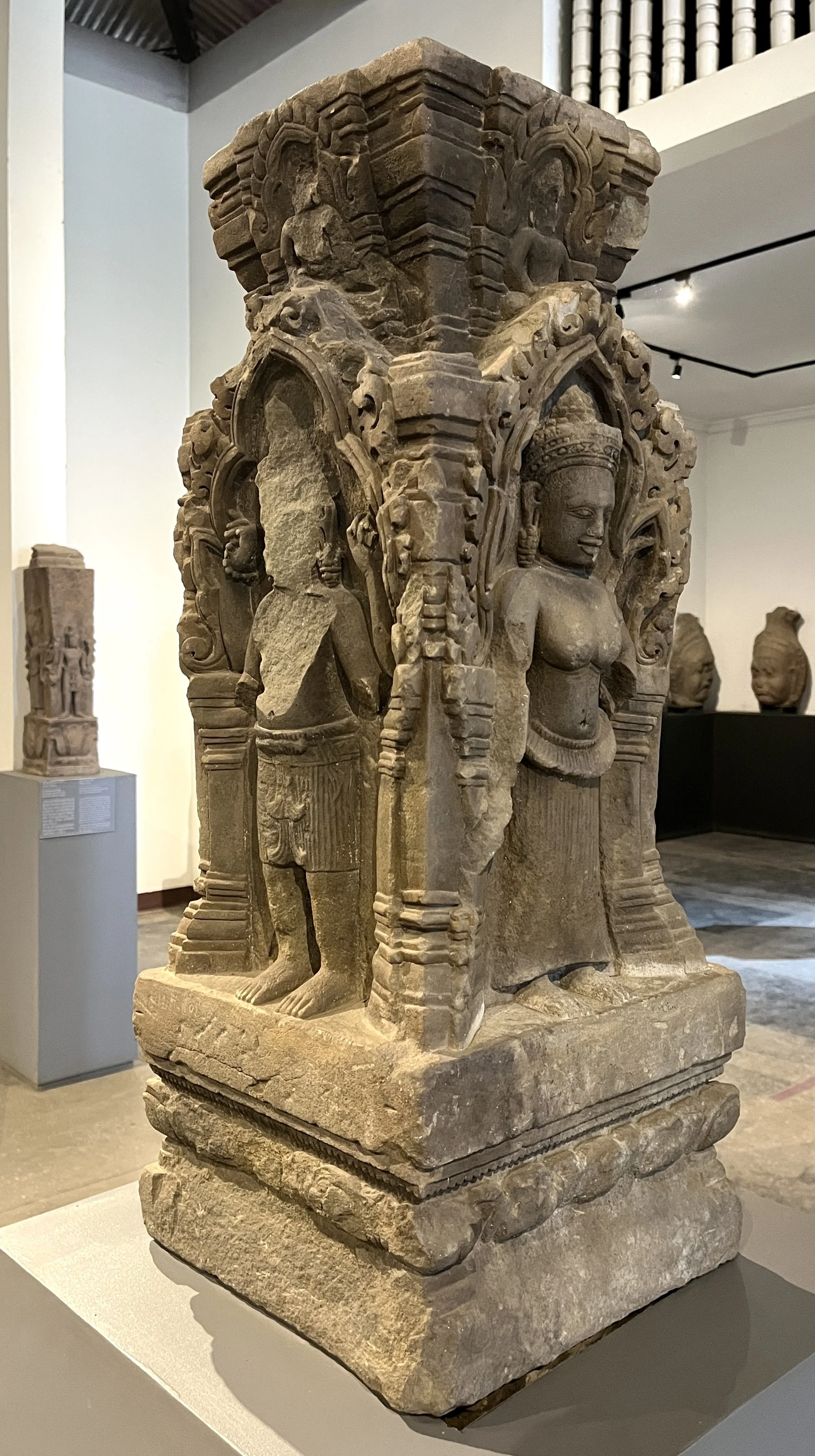
Mahayanic Buddhist borne

Sandstone, Angkorian Period, Angkor Wat style,

End of 11th - early 12th c. Banan region, Battambang

This Buddhist borne looks similar to chaitya, with losses on the faces, and the bottom part is decorated with lotus petals.

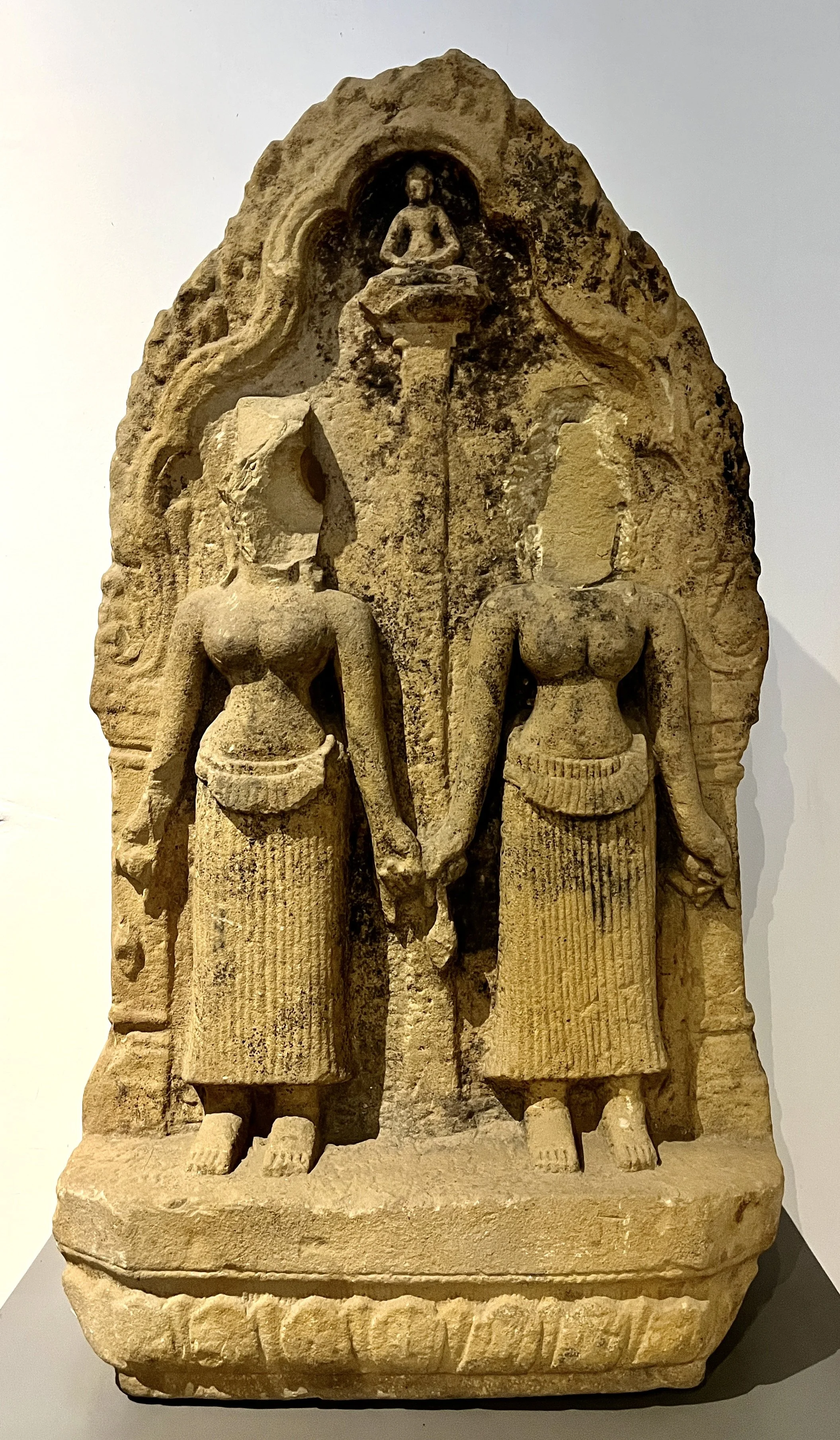
The sides of the boundary marker depict two male and two two female deities, each one standing in a decorative niche. The female figures, one at the front and one at back side, wear long skirts and are holding lotus flowers in their left hands. The male figures have four arms; the upper right arm of one figure holds a rosary and the left hand holds a book. On top of the niches is a seated Buddha Amitabha which signifies that they are Prajnaparamita and Lokesvara.

Mahayanic stele

Sandstone, Angkorian period,

Khleang style, Early 11th c.

Prasat Pongteouk, Banteay Chmar,

Thmar Puok district

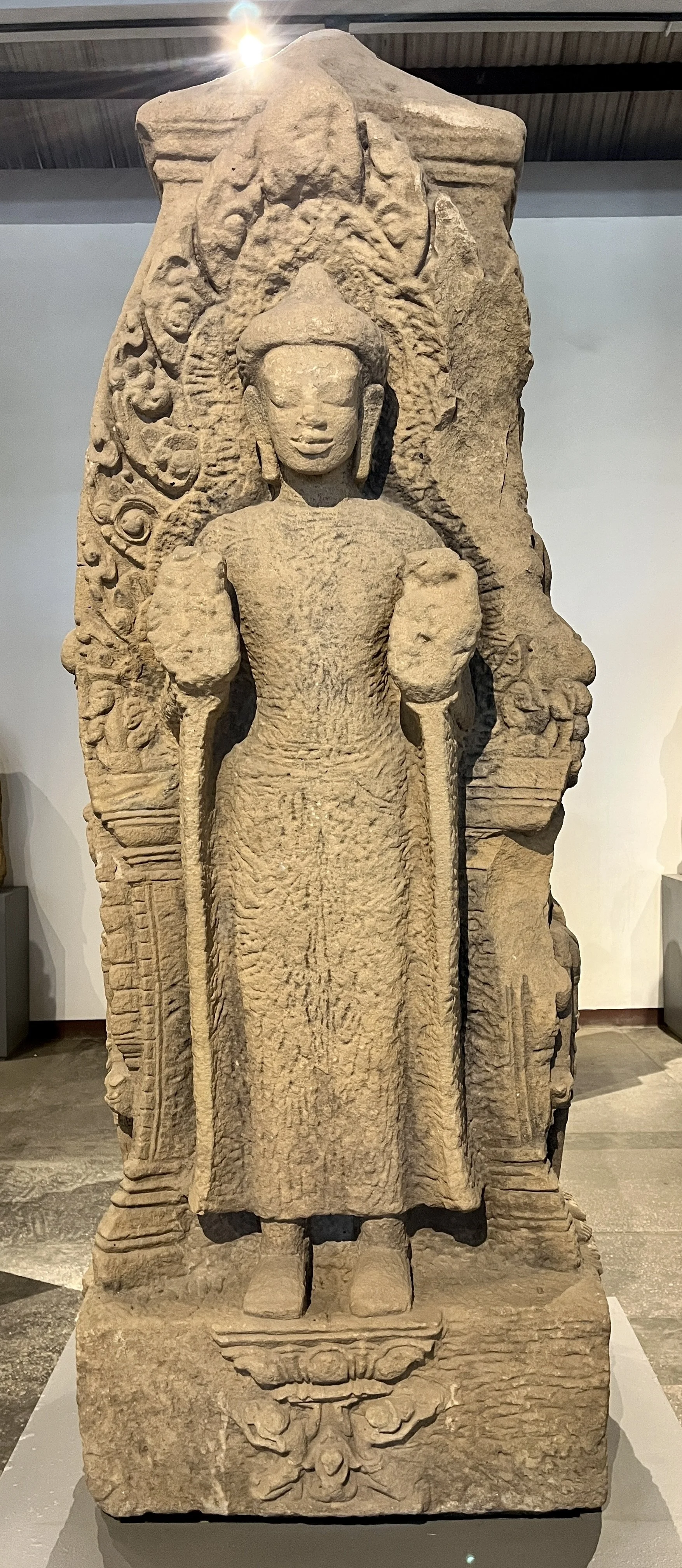
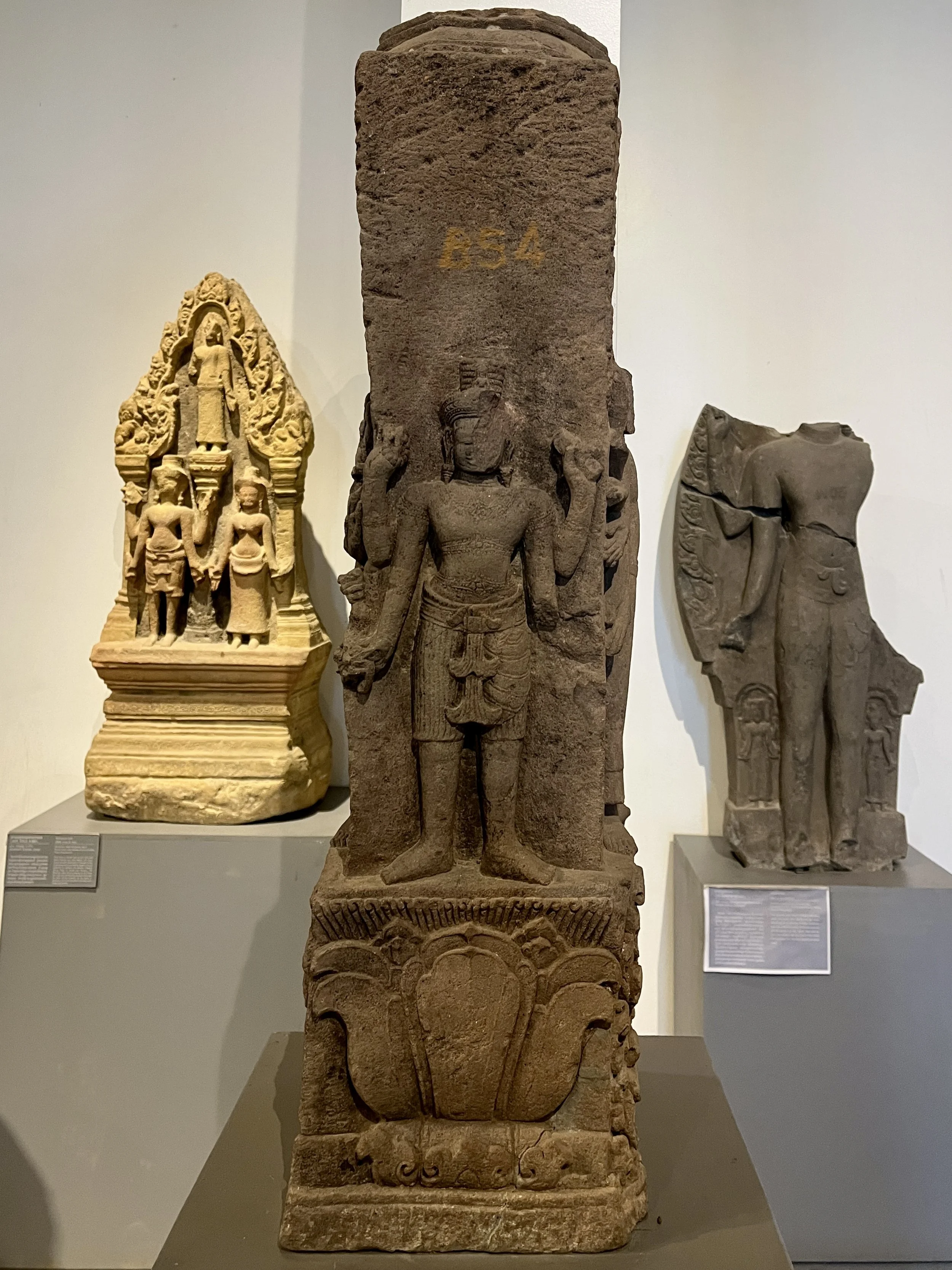
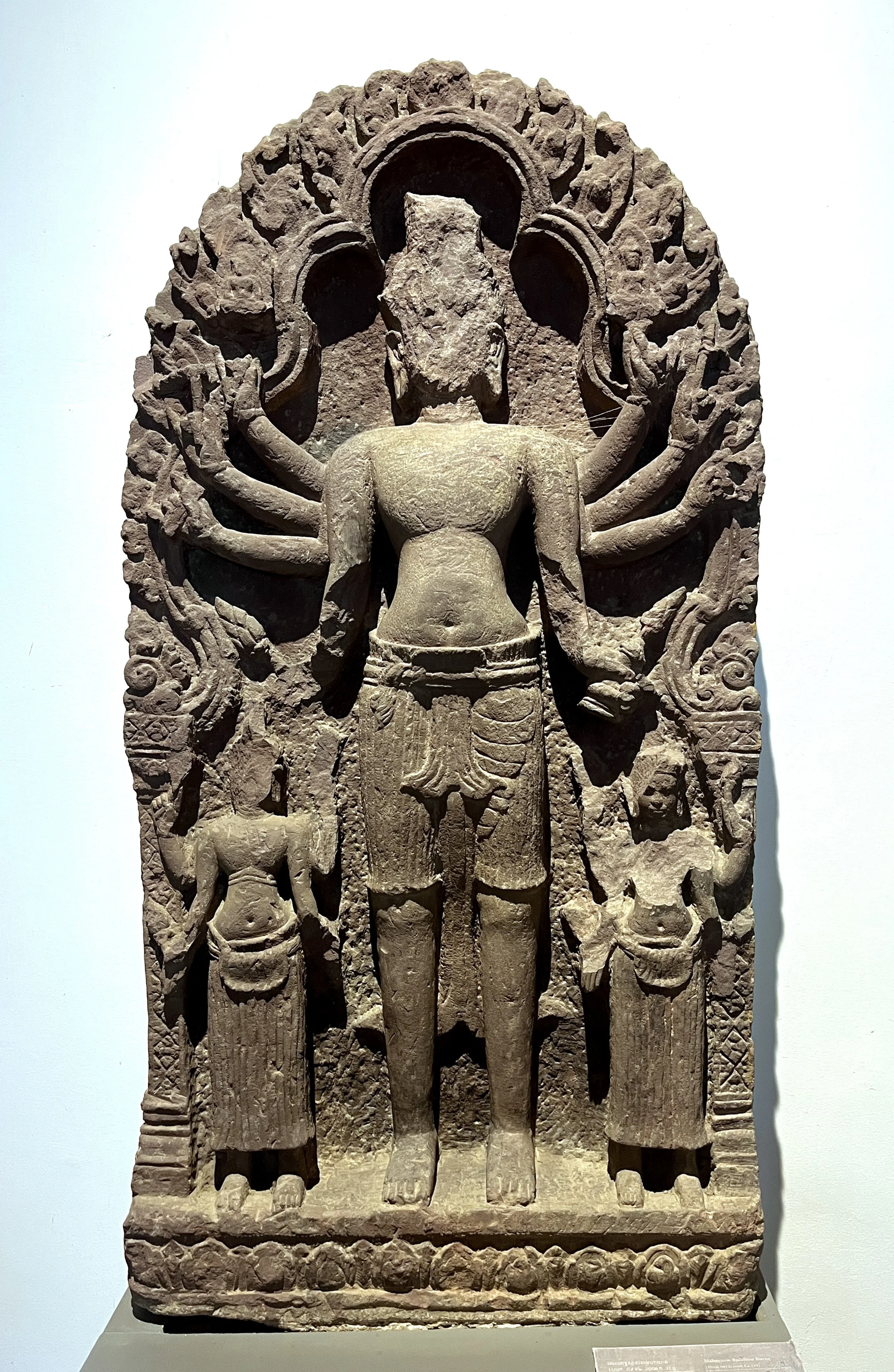
This stele was acquired by the museum on 13 April 1965. It has four faces and each side is carved with a different Buddhist deity. One is an eight armed standing female deity, probably Vajrapani, wearing a long skirt. Each of her hands is holding a different attribute; the original left hand is holding a Vajra bell.

This figure wears heavy jewelry such as necklace, armband, bracelet, torso band, waist band and lower waist band, with pendant motifs covering her thigh. The figure stands on a lotus pedestal, and in front of the pedestal are three lions flanked by two females holding hands. To the right, a four armed Lokesvara is standing in a niche on a lotus pedestal with two female dancing figures.

Above the niche of Lokesvara figure is a seated Buddha. Buddha amitabha normally appears in front of Lokesvrara's chignon. To the left of the female figure is one quite similar to the Lokesvara on the right, but at the front of the pedestal is Kala's head. The last is a Buddha figure standing on a lotus pedestal in abhayamudra inside a niche.

Mahayanic stele

Sandstone, Angkorian period, Angkor Wat style,

End of 11th c., Unknown

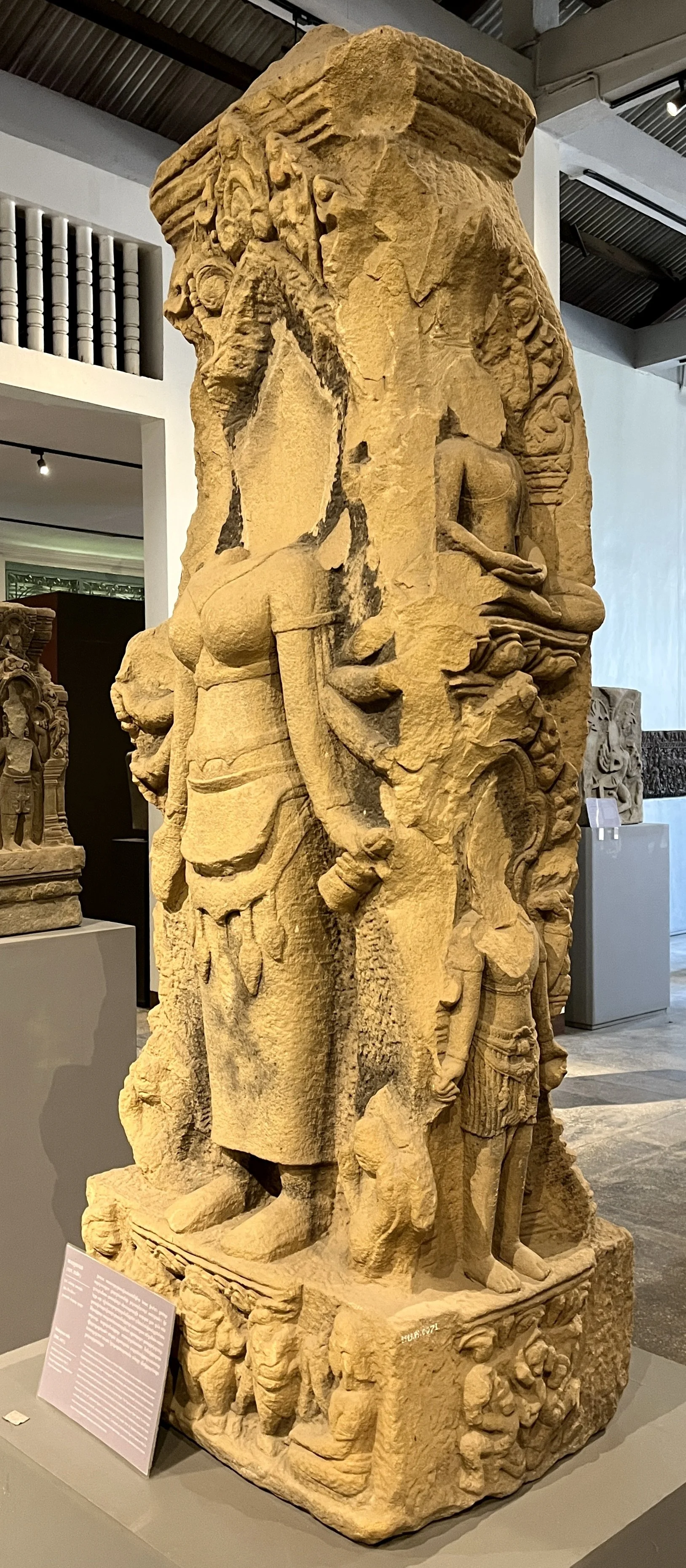
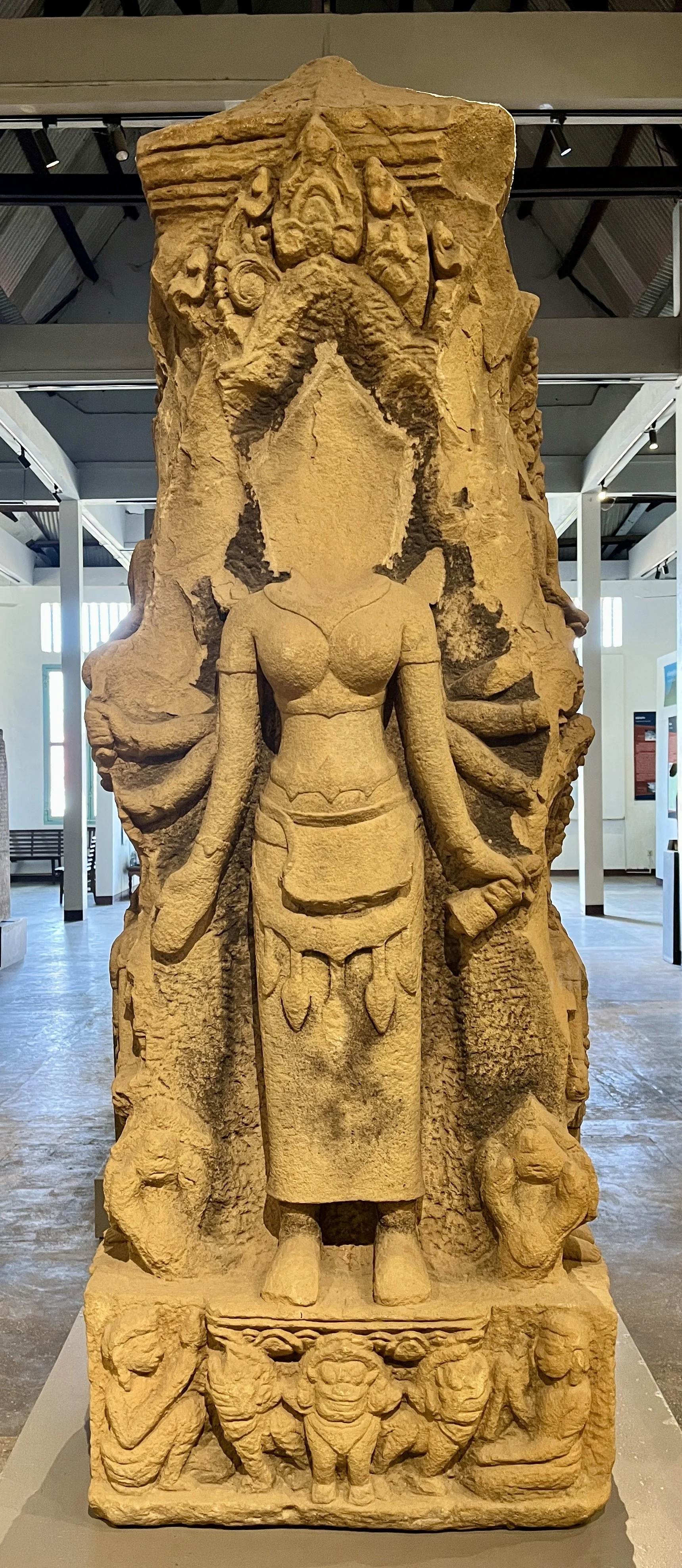
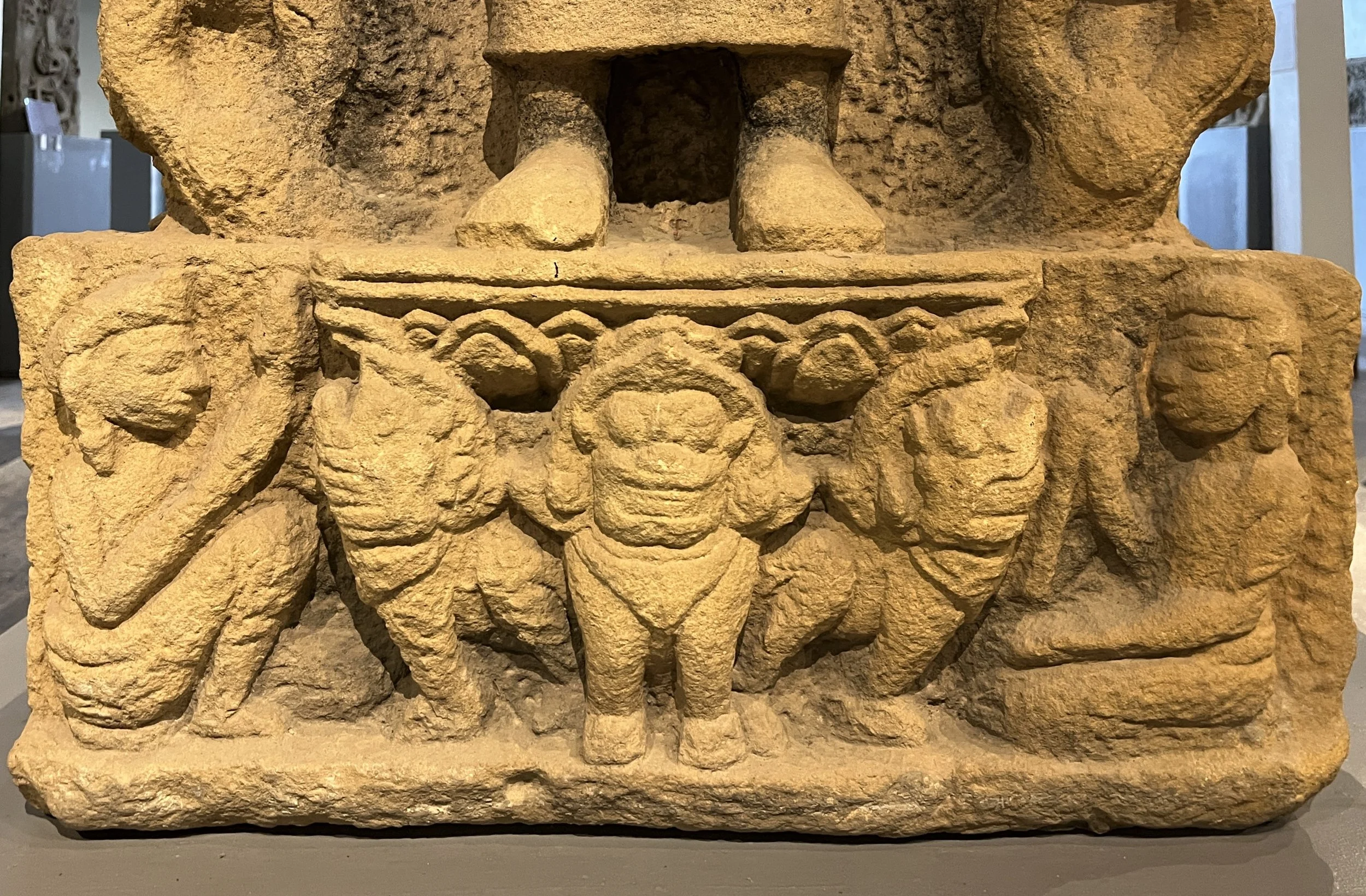
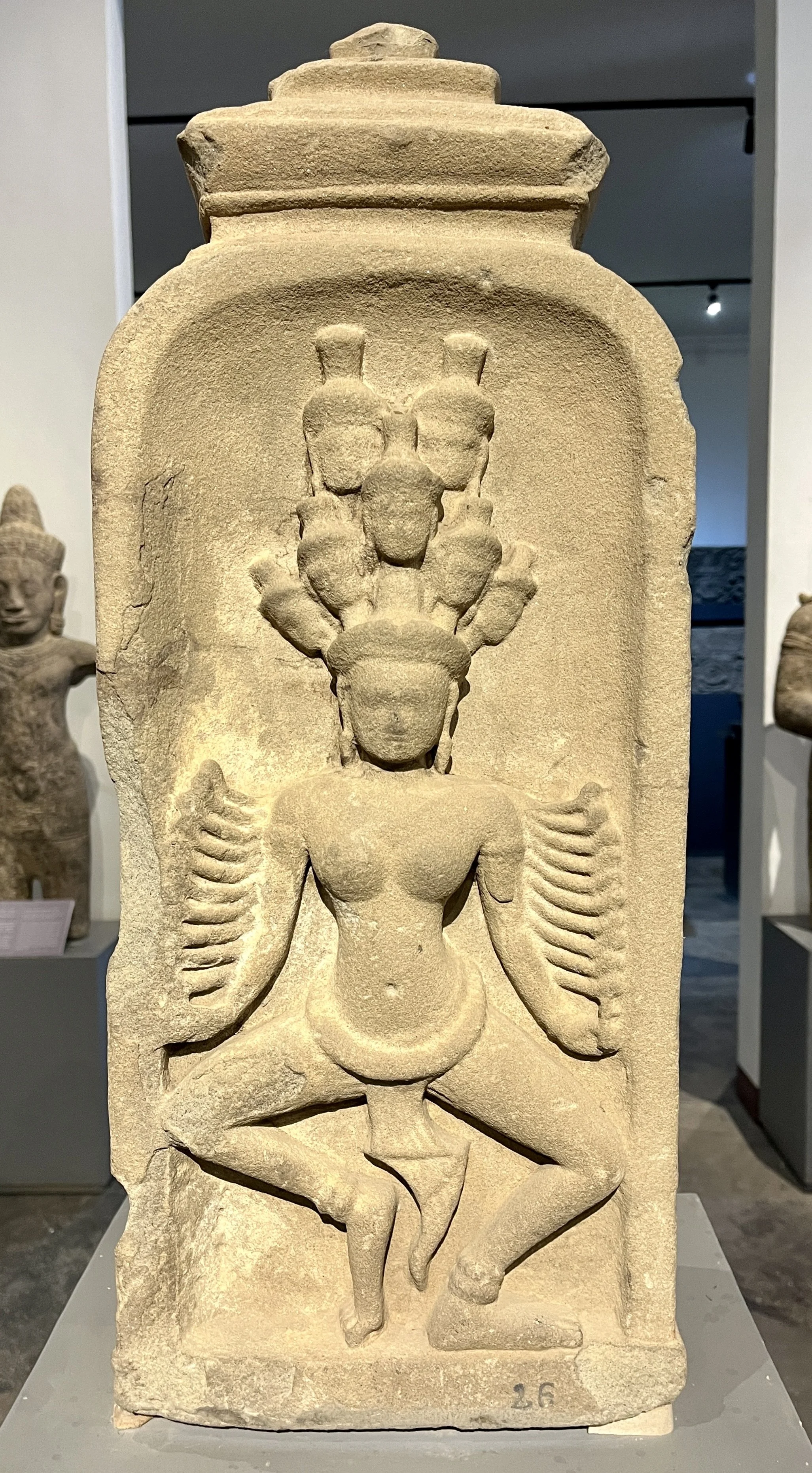
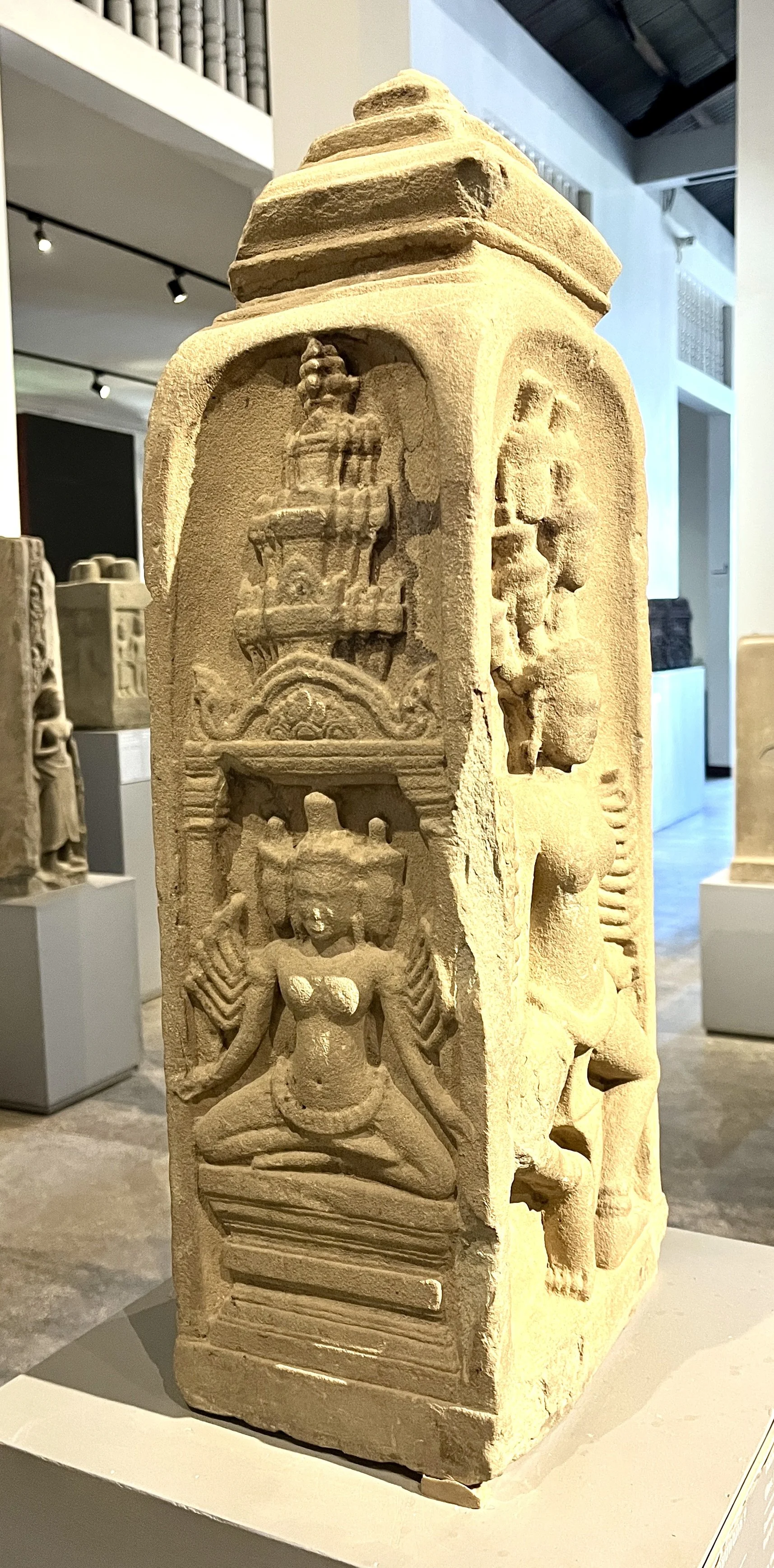
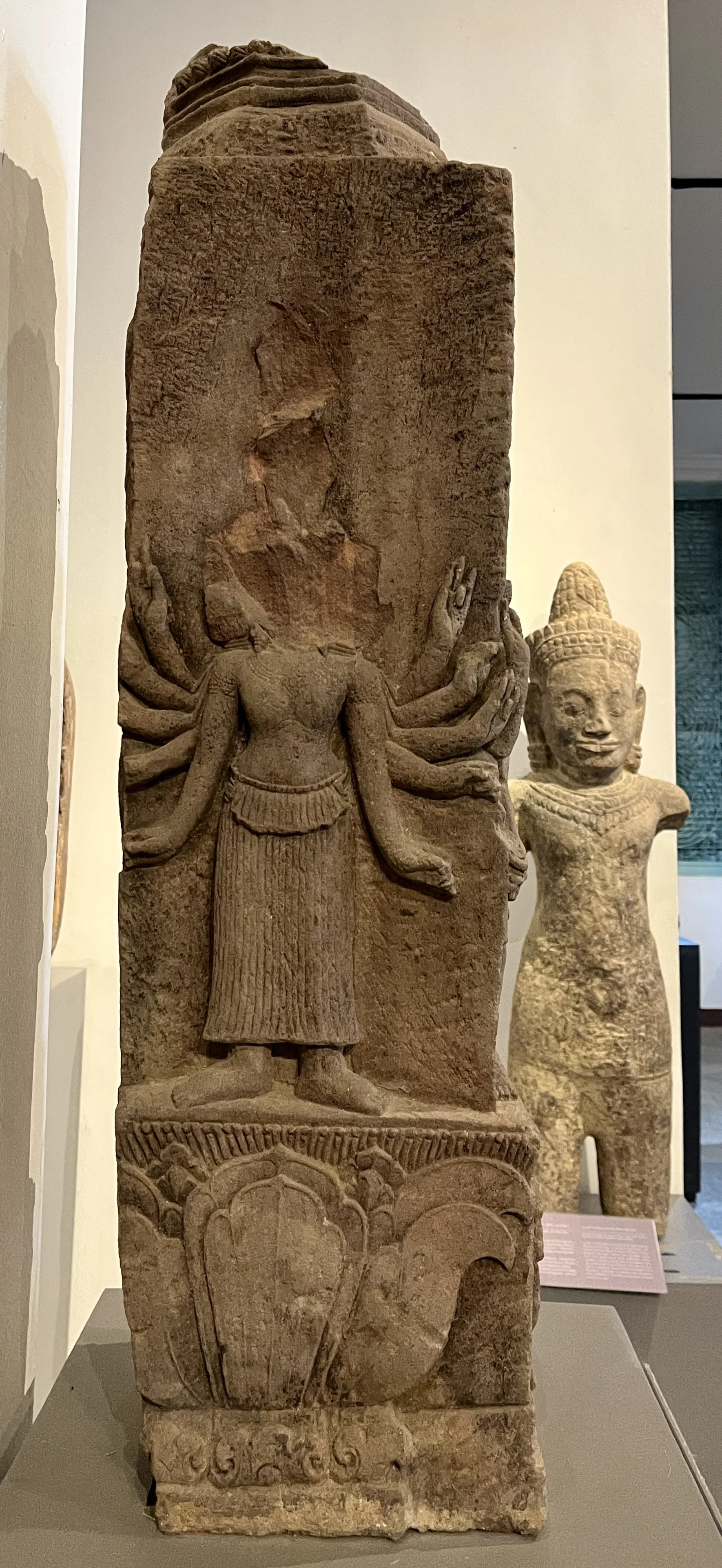
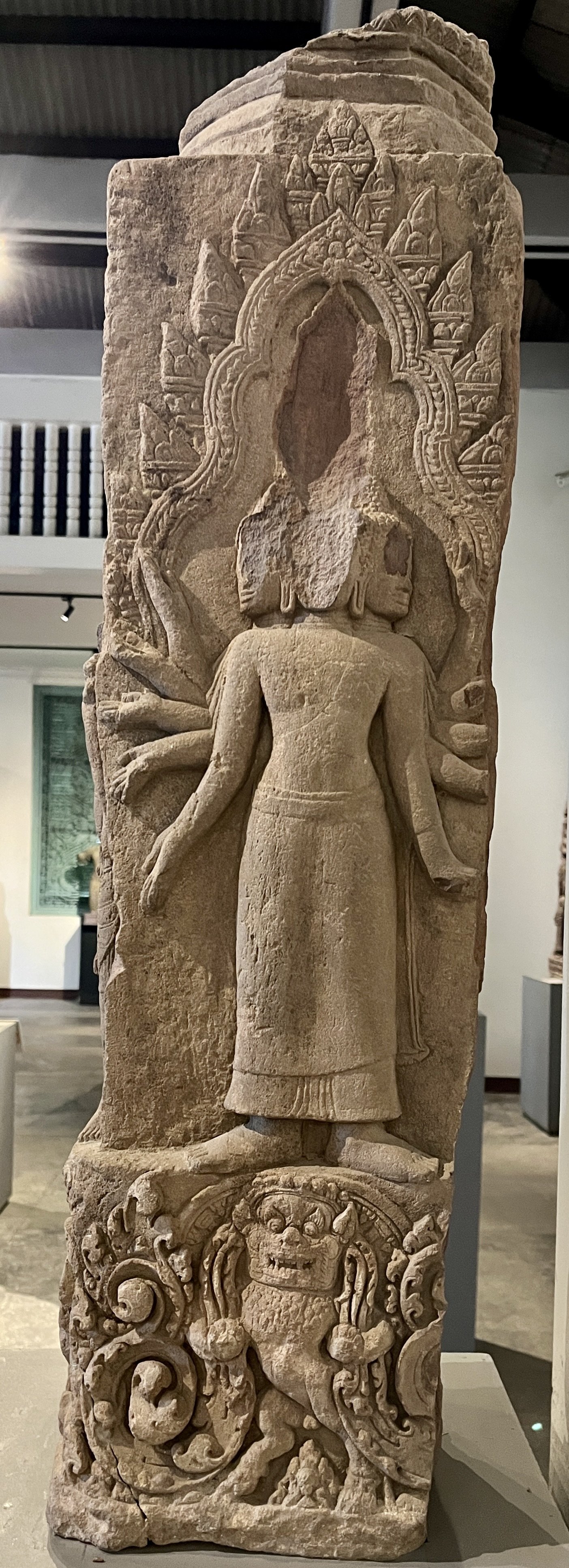
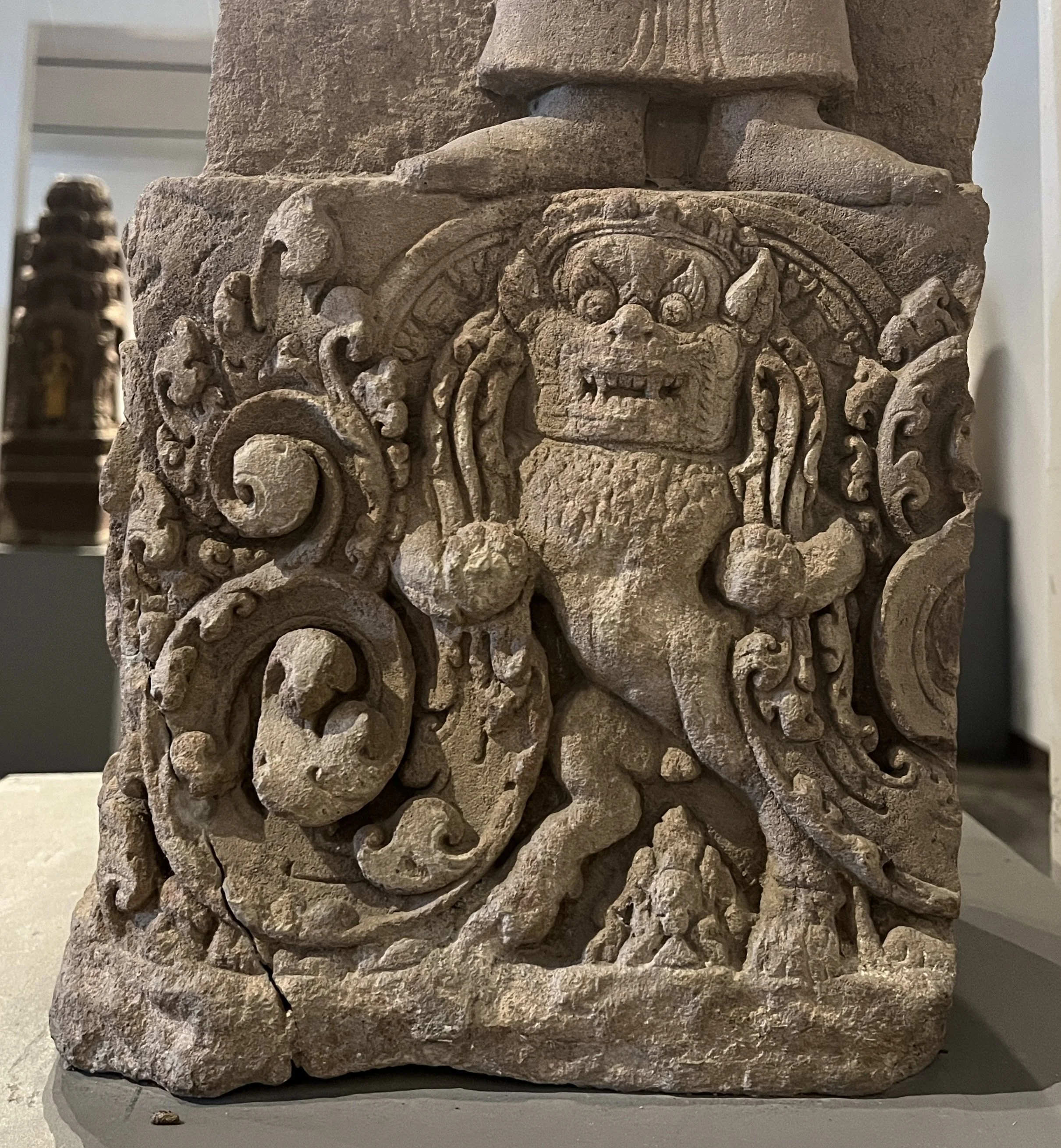
This slender Mahayanic stele has three carved faces; each face depicts different gestures of the Buddhist deity, Prajnaparamita. The first one is a depiction of a dancing female deity Prajnaparamita which has 8 heads and 20 arms. This posture is similar to dancing Shiva whose right leg is pulling up and left leg is leaning to the front.

The figure has multiple heads and arms, with Buddha Amitabha appearing on her original head.

Such Prajnaparamita depictions with multiple heads and arms are rare in the history of Khmer art. However, there is one kept at Gimet museum in Paris, MG14098. On the left hand side, there is a seated female deity inside a temple. She has four faces and seven arms. The last one, on the right, is a standing four armed Prajnaparamita.

Based on its decoration and deity cloth, one could date this stele to the Angkor style.

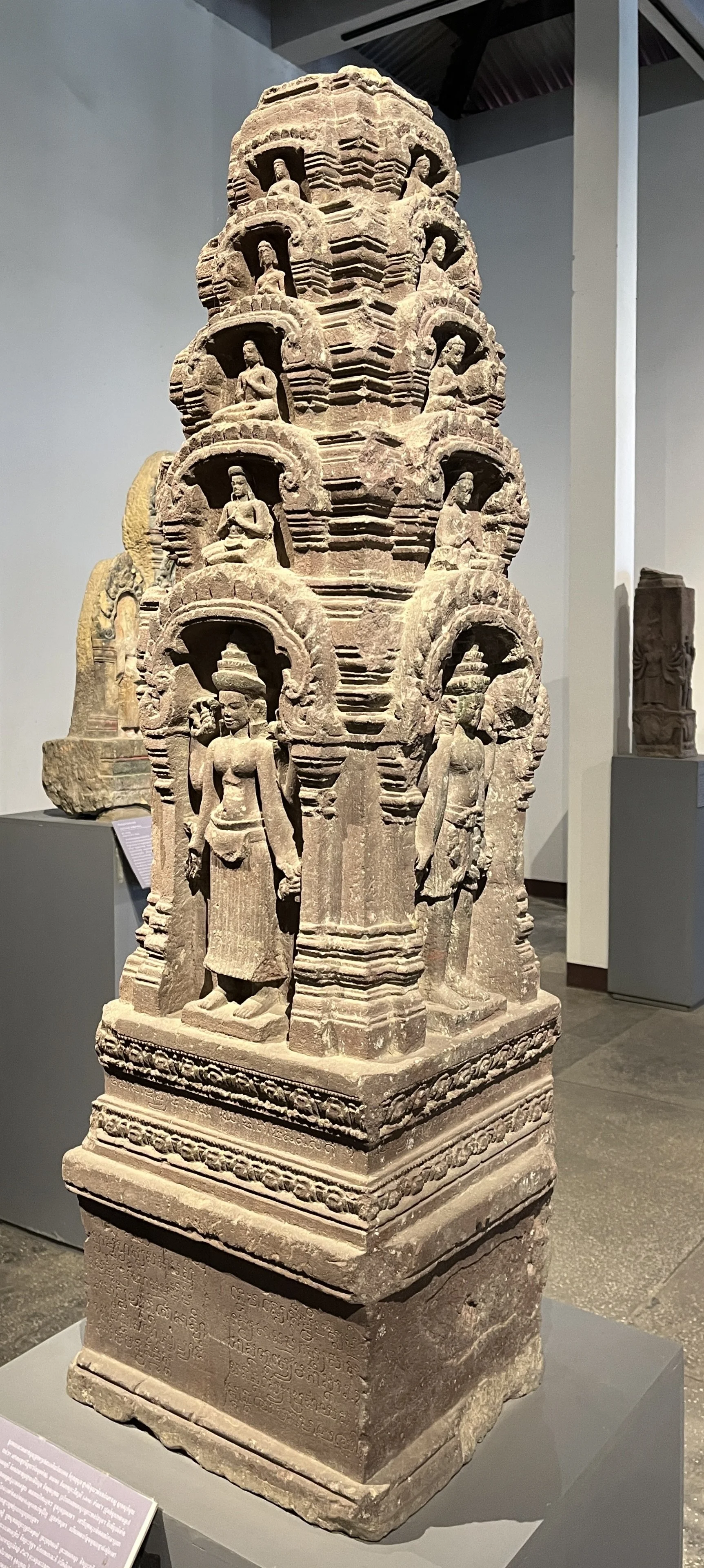
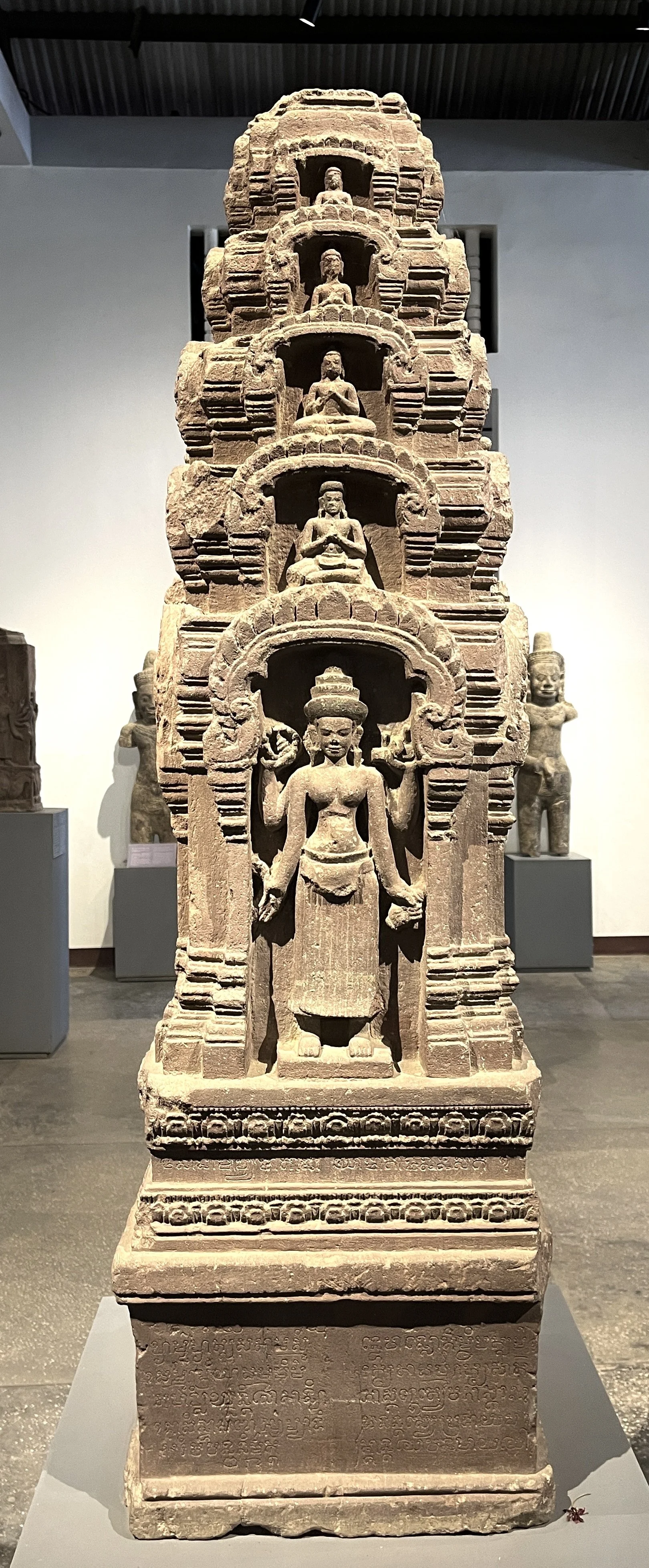
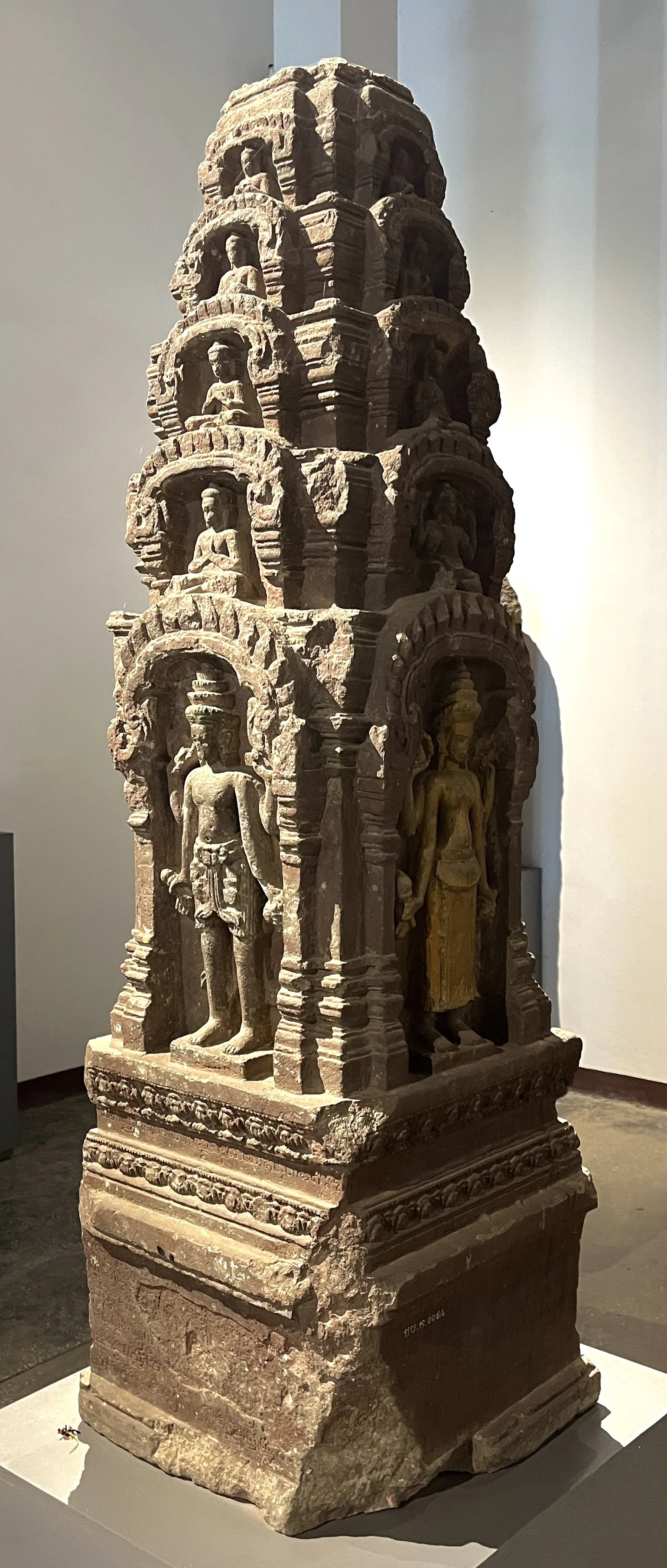
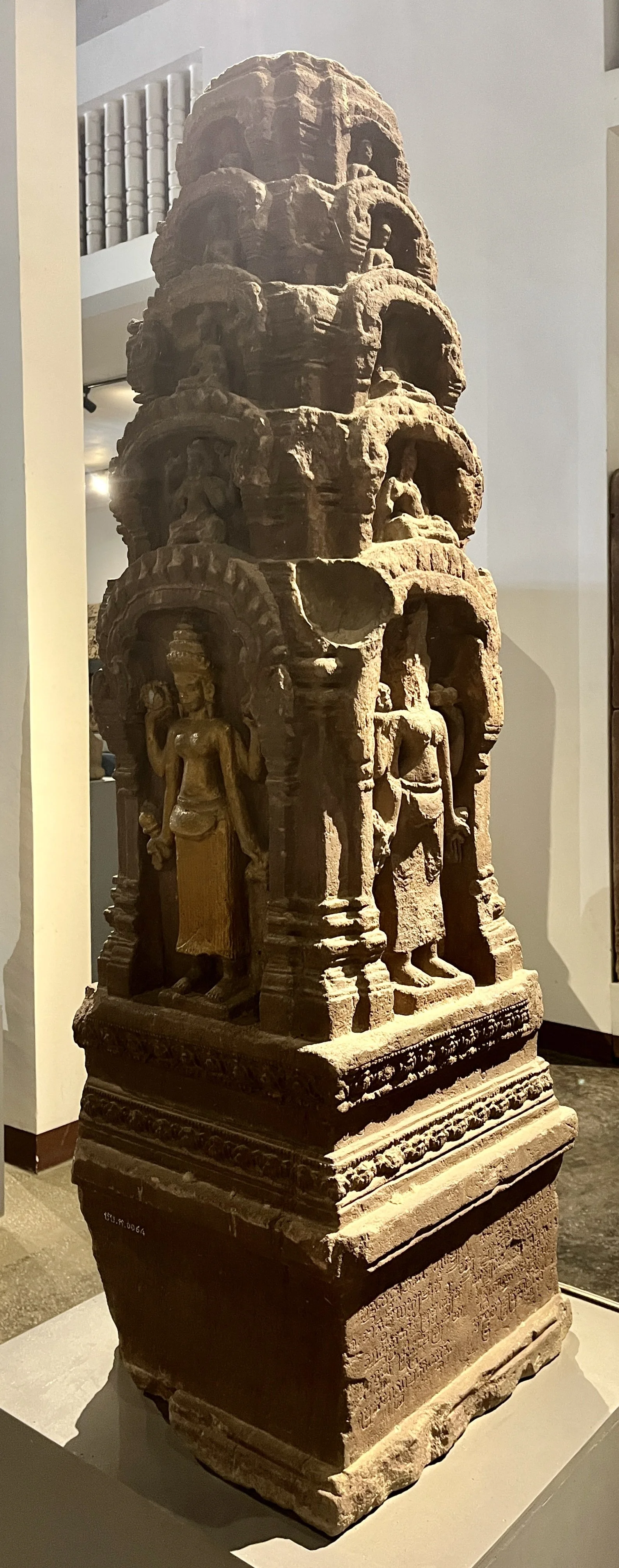
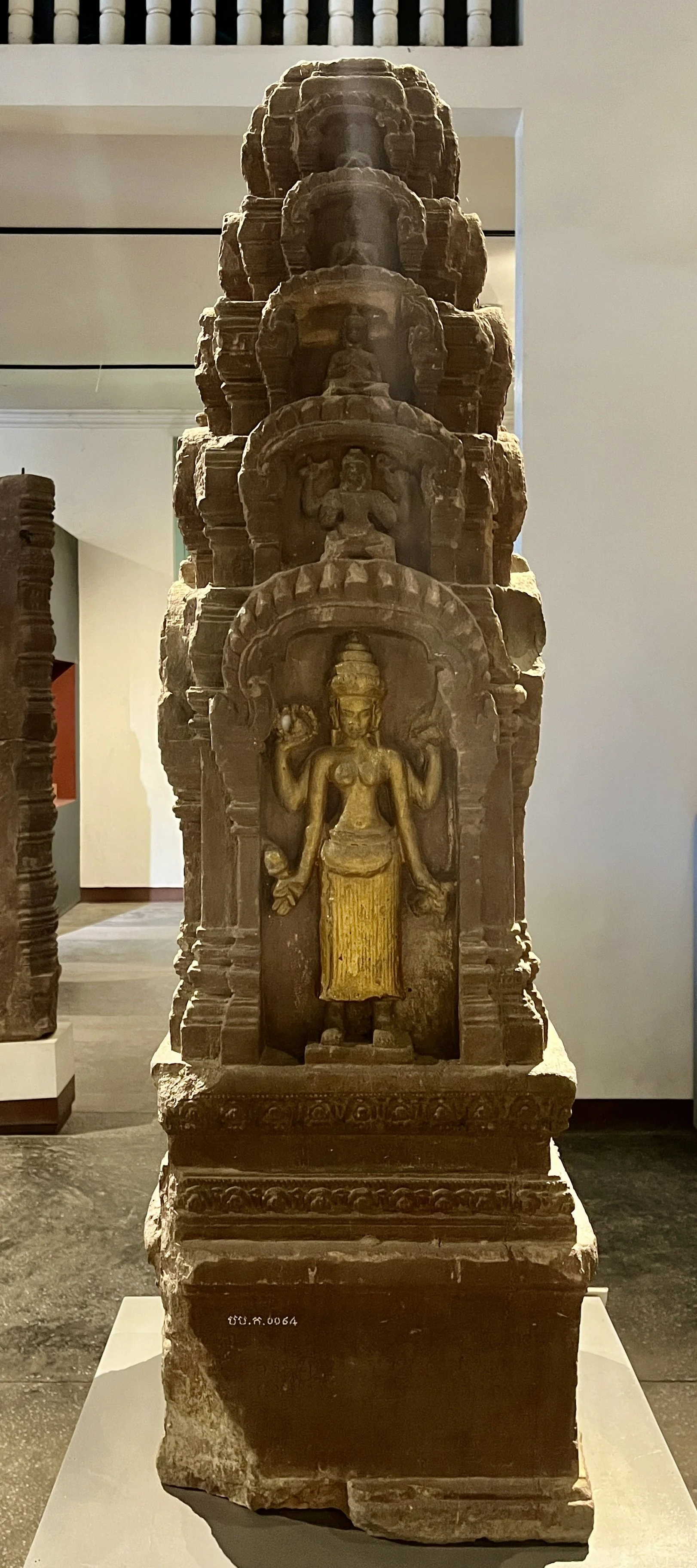
Brahmanic stele, four faced with inscription

Sandstone, Angkorian period, about 989 A.D

Vat Thmar Puok, Svay Chek commune, Thmar Puok district

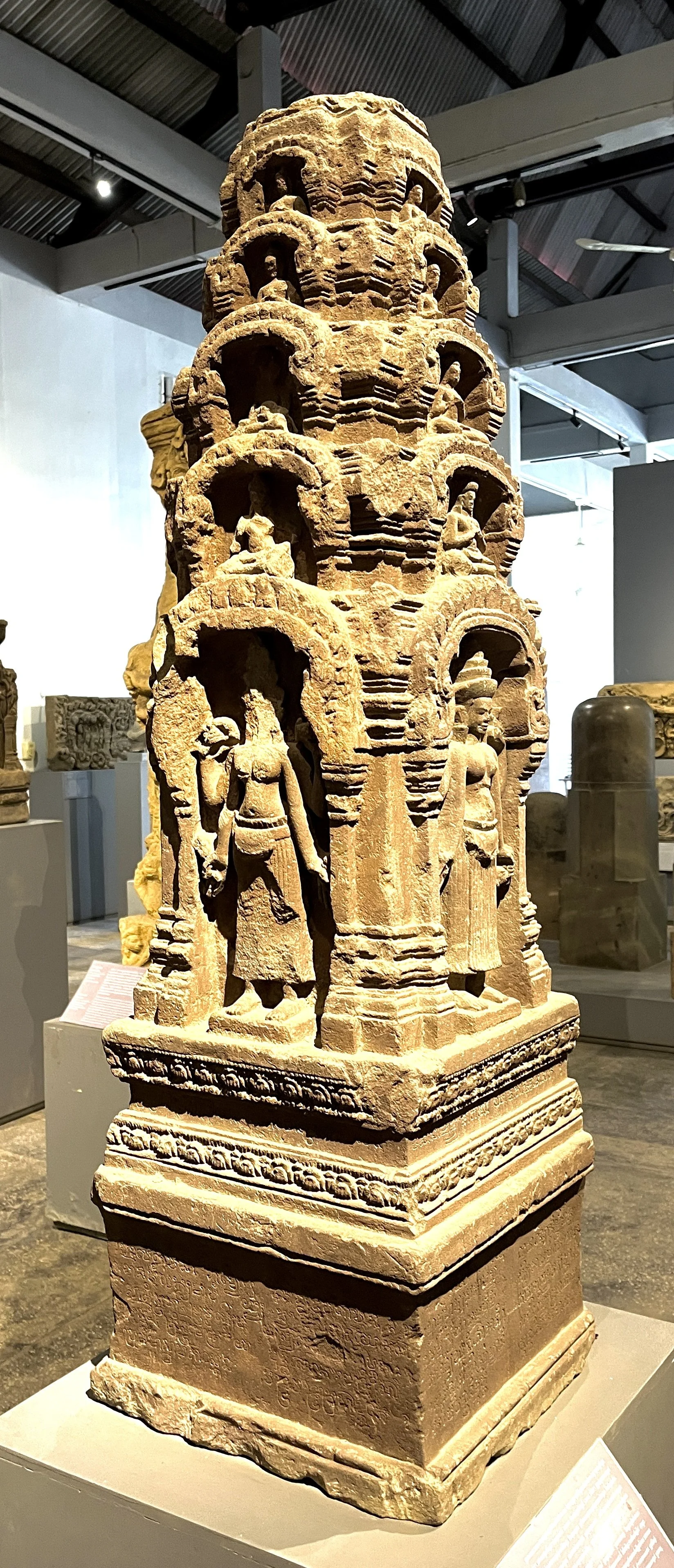
This four-faced stele has a form like a pointed-top stupa. Each tier likely represents each tier of heaven. On each tier of the four faces are figures representing the five Jina.

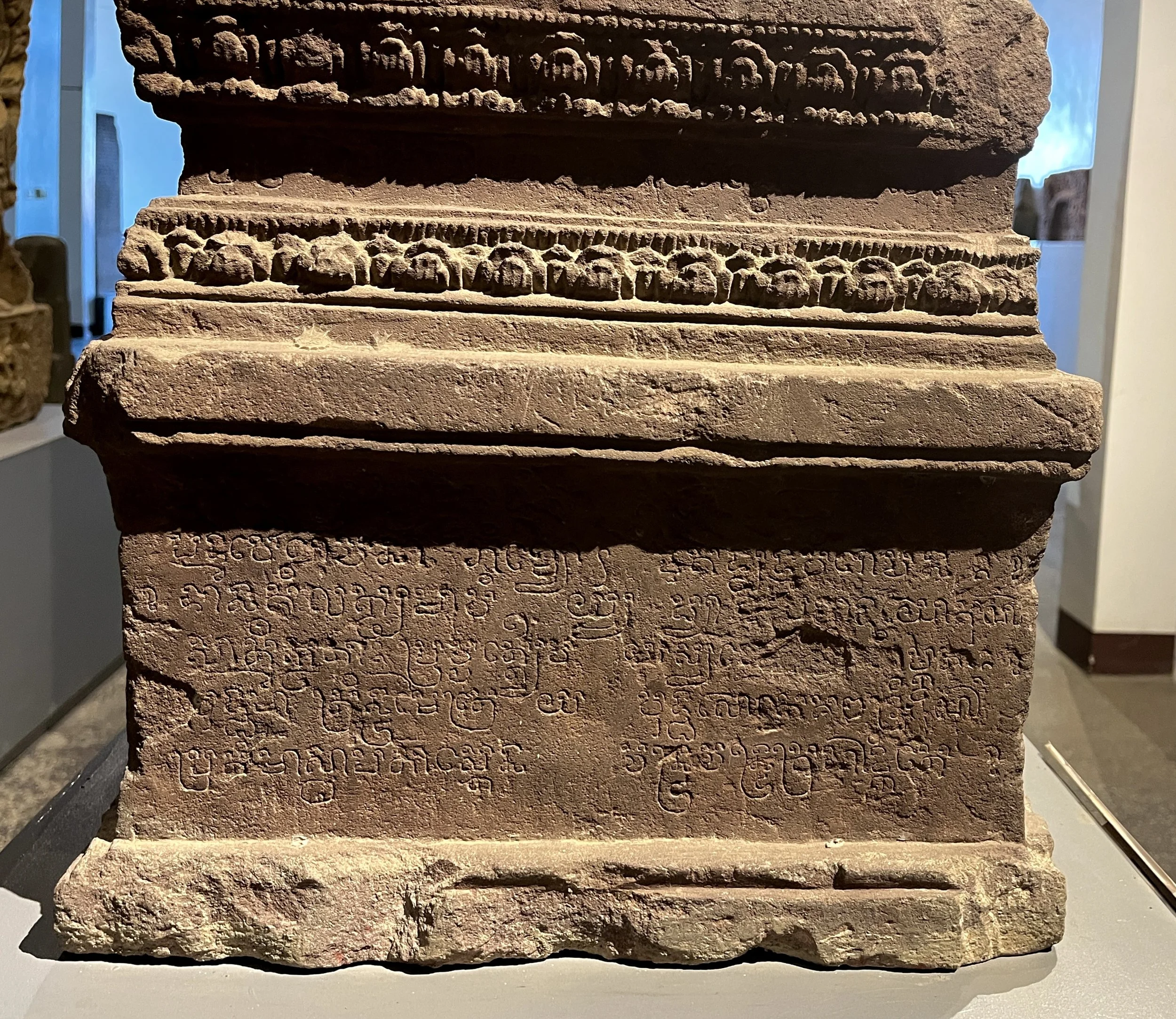
Three faces of the stele are carved with Prajnaparimata, and the last one might be the figure of Lokesvara because it has four arms. Above the four main figures are gods with different gestures sitting in niches. Below the main figures of all four faces are 14 lines of Sanskrit inscription. There is an additional line of inscription between the bud's decoration of all corners.

The inscription is a prayer to Prajnaparamita, Lokesvara and Vajrin (known as Vajra-pani), Buddha and Indra. This inscription also mentions King Jayavarman V (passed away in 890 Saka, or 968 A.D.) He is the king who believed in Mahayana Buddhism, and his posthumous name is Prahbotamavirojna. The last paragraph of the inscription gives the date 911 Saka, which is 989 A.D.; it cites a prayer to six gods in Buddhism, in a similar form to the prayer above.

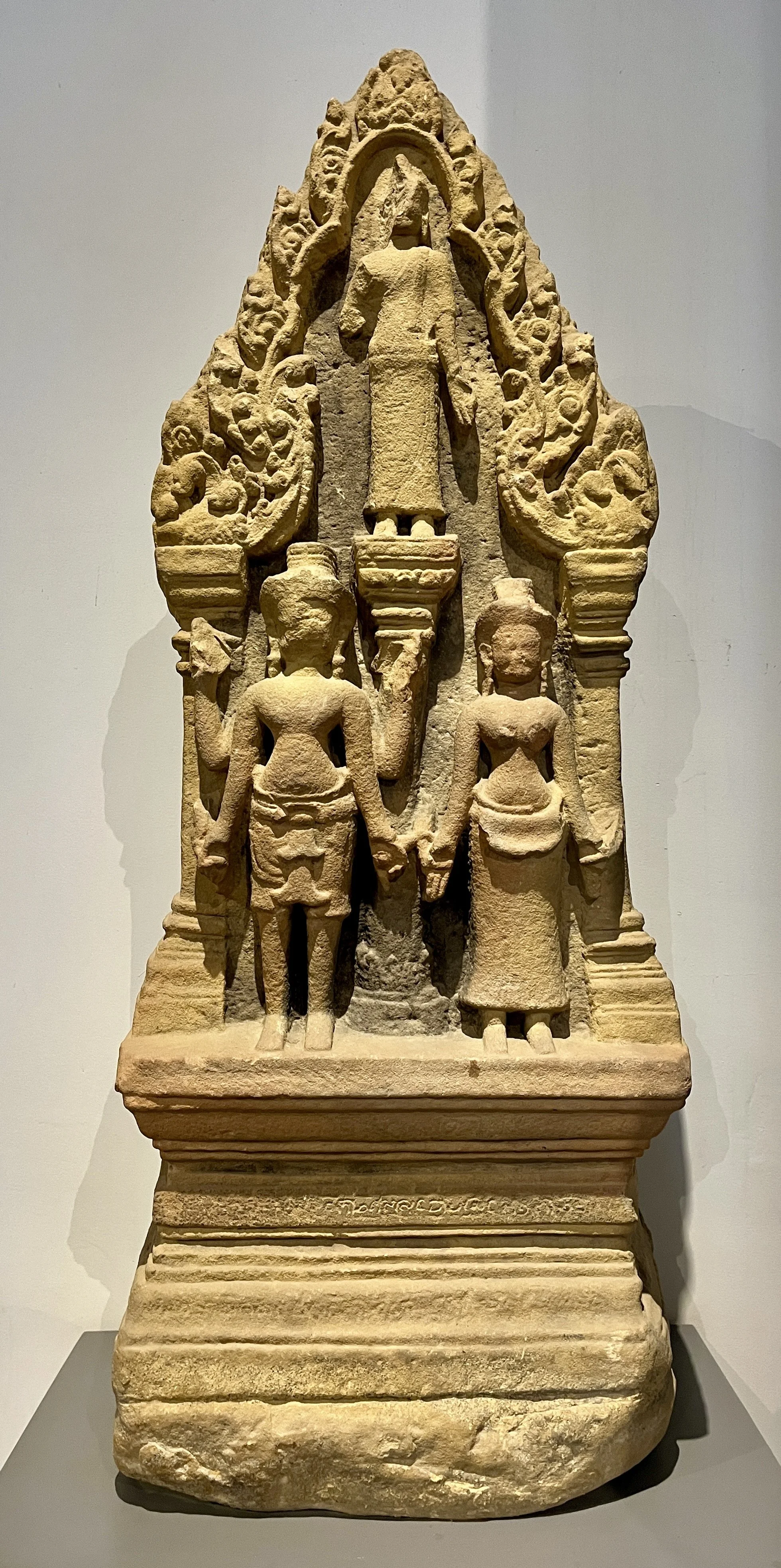
Buddhist boundary stone

Sandstone, Angkorian Period,

10th c., Unknown

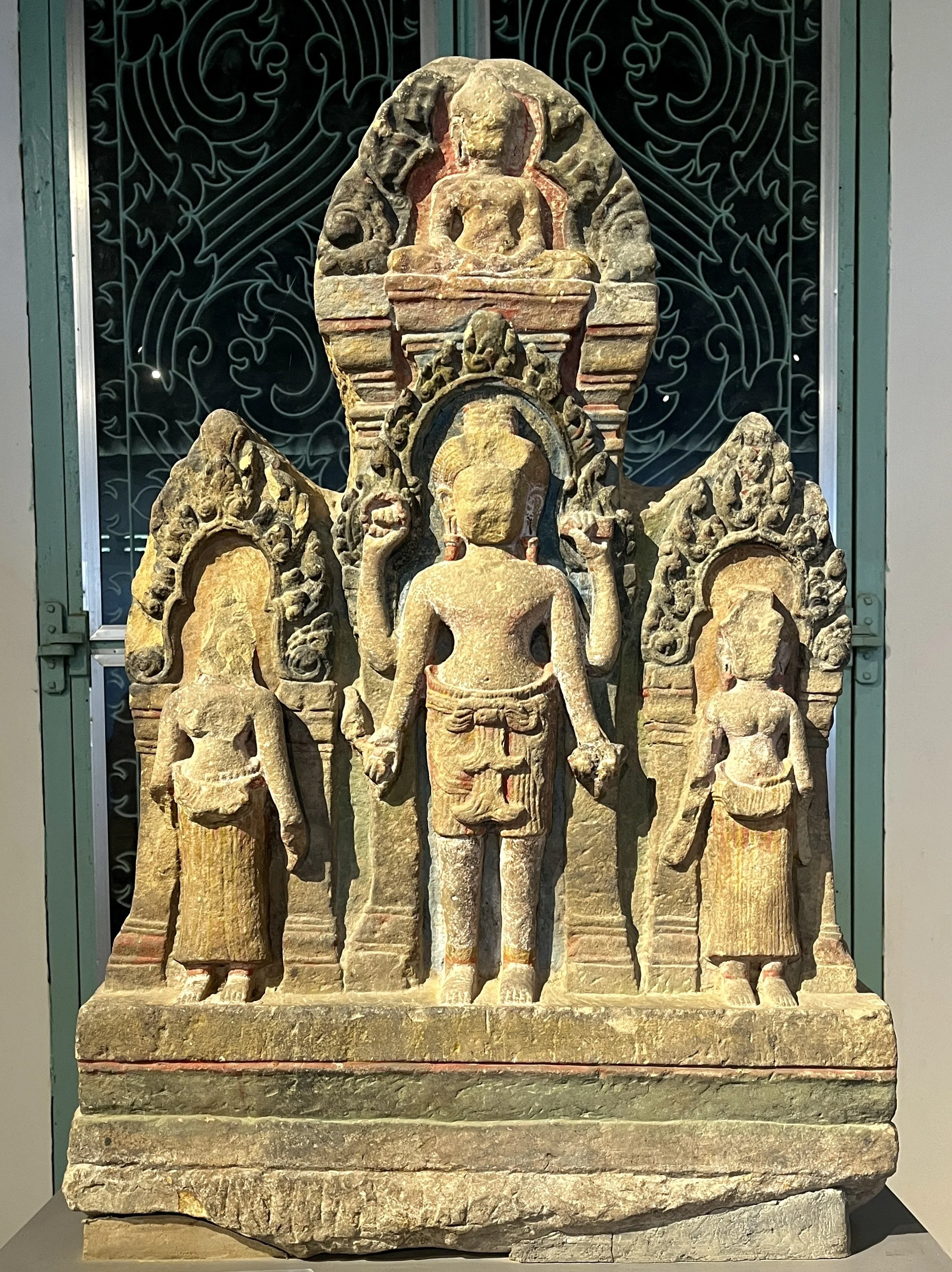
This boundary stone carved only the front side depicts three figures; Lokesvara flanked by two Prajnaparamitas standing inside decorative niches. Lokesvara has four arms; each one holds a different attribute. This figure has a strongly built body, and wears a short pleated skirt; the upper edge of the skirt falls over the belt in a fan shape, and a double central pleat in a fish tail shape is visible below. He is decorated with a large headdress and cylindrical chignon. Above his niche is a seated Buddha amitabha. The Buddha amitabha usually appears on the chignon. The Prajnaparamitas are wearing the same long pleated skirt, a large fan shape or oyster shape is visible at the upper front of their waists. According to the body shape, jewelry, and dressing style of the figures, it is believed that the boundary dates to the mid-10th century AD.

Bhramanic stele

Sandstone, Angkorian period,

late 10th -11th c. Prasat Samre, Namtaov, Phnom Srok, Banteay Meanchey

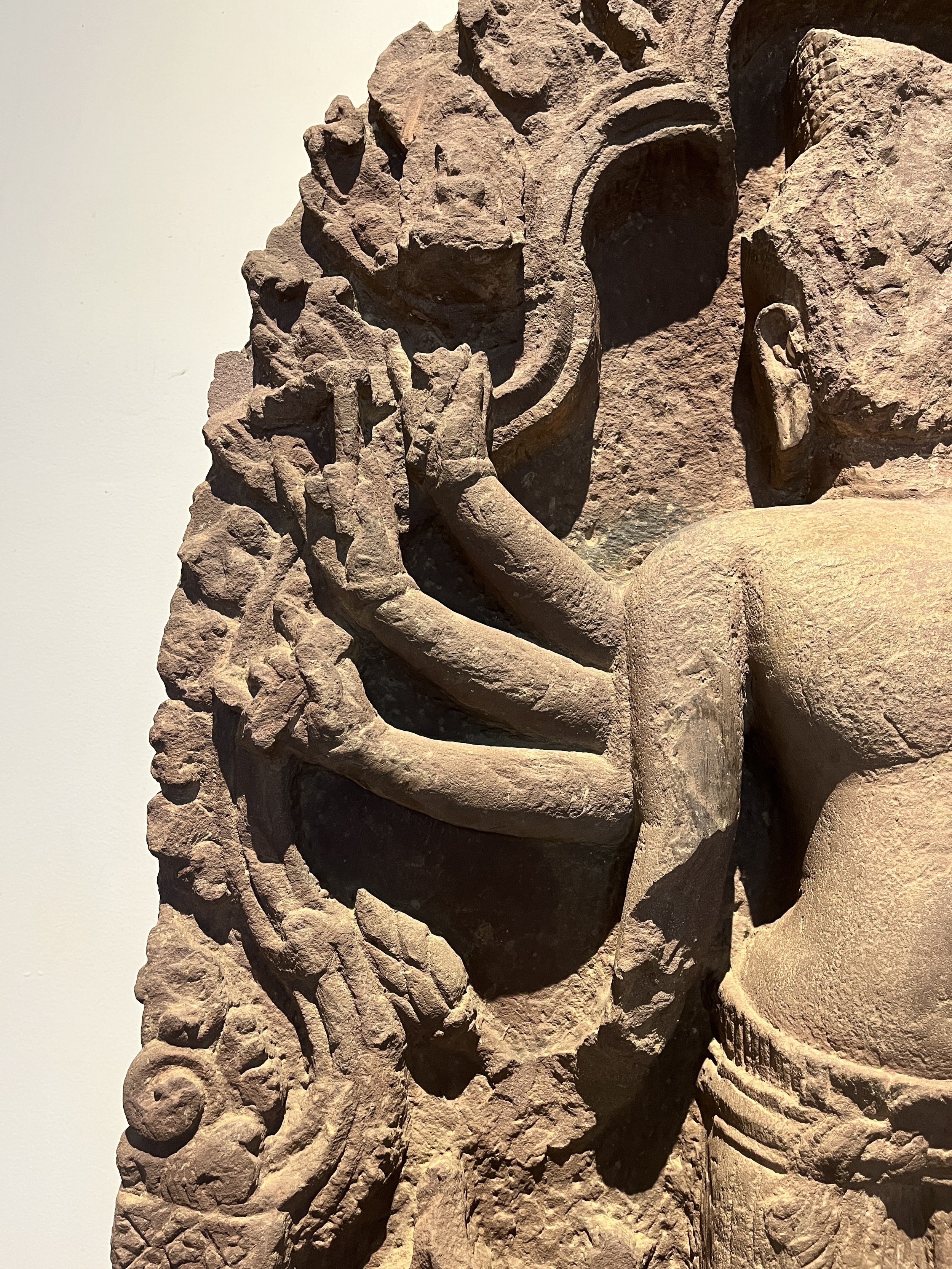
The top of the stele is broken, leaving three carved faces, each depicting a different Buddhist deity. The first shows a female figure, probably Prajnaparamita, with multiple heads and ten arms, standing on a lotus pedestal. Unfortunately, the heads are broken. The second one is a four-armed Lokesvara stands on a lotus base, and the last one is a Buddha who has multiple heads and arms. He stands on a decorative lion throne inside an elaborated niche. The presentation of such a Buddha is rare in the history of Khmer art.

Based on its form and the decoration of the cloth and jewelry they wear, one could suggest that this stele was produced at the end of 10th -11th century.

Guardians

Sandstone, Angkorian period, Bayon style, 12th - 13th c.

Prasat Tuol Preah Theat Bavil, Battambang

This pair of Dvarapala (guardians stationed at the door of a tower or gate) are similar in proportion and style, suggesting that both objects probably come from the same place. Both guardians stand straight, with lost hands that probably held a club at stomach level. This posture is a mark of vigilance. They are heavily decorated with bracelets, armbands, a necklace, ear pendants, and a headdress. Their skirts are short and tied with a scarf or belt.

Mahayanic stele

Sandstone, Angkorian period, Khleang style, frist half of 11th c., Unknown

Similar to a Sima stone, this stele is carved with a larger four-armed Prajnaparamita standing in a decorative niche and flanked by two smaller prajaparamita. Behind the niches, above the column, there are nine floral motifs; each has a four-armed Lokesvara standing inside.

Buddhist Stele

Sandstone, Angkorian period, Baphuon style, second half of 11th c., Kuk Wat Chas, Samrong, Ta Meun, Thmar Kol, Battambang

This amazing stele depicts a standing male deity inside a decorative arch flanked by two small female figures on either side of his legs. The figures wear typical Baphuon dress. The female figure on the left appears to have three heads and six arms; the other has four arms. Their hands hold attributes, but only a lotus can be recognized.

Mahayanic stele

Sandstone, Angkorian period, 10th c.

Prasat Kbal Krabei, Banteay Chmar commune,

Thmar Puok district

This stele is carved only on the front and depicts two main deities, a four-armed Lokesvara and an attending Prajanaparamita.

In between these two deities appears a lotus pedestal supporting a Buddha standing above their heads. The Buddha's right hand is placed on his shoulder, while his left lays along his body with palm facing outward. At the base of the pedestal, there are two lines of writing from the Angkorian period.

Prajnaparamita stele

Sandstone, Angkorian Period, mid 10th C.

Prasat Kou, Toeuk Chum, Thmar Puok, Banteay Meanchey

In a Sima form, this Buddhist stele depicts twin female deities standing on a lotus petal inside a niche, with hands at their sides holding lotuses.

The faces of these figures are lost; they wear long pleated skirts fastened with belts, with the outer part of their upper edges falling in an oyster shell form and the inner standing straight up and clinging to the abdomen. In between these figures appears a large lotus stem growing up above their heads with Buddha amitabha seated on it. It is believed that the two female figures are prajnaparami-ta. This presentation is similar to two other Buddhist boundary stones in this section, Bbka. 0136, Bbka. 0140, .

Mahayanic Buddhist Borne

Sandstone

Angkoran period

11th c.

Arak Bak Kor Temple

Buddhist borne

Sandstone, Angkorian Period, 10th c., Unknown

This stele depicts a four-armed female divinity holding a lotus fiower in both of her lowered hands, while the upper two hands are probably holding books.

She stands in a decorative niche. The figure has a strongly built body and a seated Buddha amitabha is visible on her chignon, signifying she is Prajnaparamita ("the Perfection of Wisdom" or "Transcendental Knowledge" in Mahāyāna Buddhism). She wears a long pleated skirt; the upper edge of her cloth falls over her belt in a fan shape at her waist.

late 10th c. unfinished stele

Dhyana Buddha

Sandstone,

Angkorian period

Baphuon style

second half of 11th C.,

Unknown

Buddha protected by Naga

Sandstone

Angkorian period, Bayon style,

late 12th to early 13th C.

Unknown

Standing Buddha

Wood

Post-Angkorian period

18th to 19th C

Wat Dountri, Mong Reusey

Not long after the end of Jayavarman VIl's reign, with the wide-spread conversion to Theravada Buddhism (CE. 15th onward), wood became the primary material used for Buddhist temple construction and to carve Buddha sculptures, though a number of stone sculptures were also made during that period.

These standing Buddha sculptures are made of different kind of wood, many of which are painted with natural resin such as black and red lacquer, gilded, or inlaid.

Although many of these statues have lost their hands, making it challenging to confirm their gestures, one can presume that they are in the Abhaya mudra, the gesture of reassurance and safety. Four postures can be identified among these sculptures.

First posture, both hands of the Buddha are held upright (Bbgha.0005). Second posture, the Buddha's left hand is palm upright facing outward instead (Bb-gha.0006, 0004, 0008). Third posture, the Buddha put his left hand on his chest (Bbgha.0720, 0002). Fourth posture, the Buddha's right hand is palm upright to show the Abhaya mudra, a gesture of fearlessness (B-bgha.0007).

The Buddha images of this period could be either covered in a plain robe, strictly following the orthodox Buddhist tradition of depicting the Buddha in his human form without worldly attachments, or adorned with ornaments and a crown, depicting Buddha as a prince, king, or superhuman (Bbgha. 0003).

Buddha Foot Print

In the early period of Buddhism, the footprint of Buddha was an iconic representation of his selfless form.

At a later period when anthropomorphic images of Buddha were introduced, the meaning of the footprint of Buddha changed. It became a reminder to his followers that the Buddha was once present on earth and left a path for them.

These are 4 modern footprints, three in cast metal and one in stone painted with black lacquer over cinnabar. They were commissioned by individual Buddhists, presumably as a gift to a monastery. The names of the donors and the date of their creation are imprinted on the objects. Similar iconography is depicted on each. In the center is the depiction of Dharmachakra, surrounded by various signs.

Manuscript

Palm leaf

Moden period,

19th-20th c.

Wat Samrong Knong,

Ek Phnom, Battambang

mid 20th c.

The collection of Wat Khdang Ngea consists of forty-five small seated Buddhas, which are made from a variety of metals, namely copper alloys, brass, silver and gold. They are depicted wearing either a normal Buddhist robe or heavily adorned. Within the collection, the Buddhas make three gestures:

Bhumisparshamudra: the most common gesture, in which the Buddha extends his five right fingers to touch the ground, calling the earth goddess to witness his enlightenment.

Dhyanamudra: a gesture which, in Cambodia, commonly shows both of the Buddha’s hands held at stomach level. This mudra symbolizes Buddha's meditation under the Bodhi tree before attaining the enlightenment.

Buddha hold alms bowl: Generally, this posture shows Buddha standing or seated; one hand holds his alms bowl either outside or inside his robe.

Idha Bhumisparsa

The depiction of Buddha in Bhumisparsamudra is very popular in modern Cambodia.

The Buddha places his right hand on his right knee and points to the ground with the five fingers of his right hand to summon the earth goddess to bear witness to his attainment of enlightenment. It is believed that mara tried to frighten him with the armies of demons claiming his throne. The Buddha, at that point, reaches his right hand to touch the earth. It is believed that Bhumi, the earth goddess, answers and appears. She uses her palm to squeeze her wet hair; the water from her hair floods the evil demons of mara. In this mudra, the Cambodian Buddha image can wear either a plain robe or be highly adorned with ornaments, and is commonly seated on a lotus throne. In a plain robe, the Buddha is usually wrapped with uttarasanga, but only the left shoulder is covered, leaving the right shoulder and arm bare.


Strangely, the final case of artifacts on display are just common wares dating from between the 17th and 20th centuries. I guess they showed up when an old abbot’s personal belongings were delivered to Wat Po Veal, and somehow they made it onto the floor at the Battambang Museum to teach us . . . something? about local production and trade.

Bottle With four ears

Earthenware

18th - 19th c.

I’ve probably bought a modern bottle of fish sauce from this factory . . .

Pedestal bowl

Earthenware

17th-18th c.

Wat Damrei sa, Svay Po, Svay Po, Battambang

The mystery staging area

Wat Sampeau, Battambang | Cambodia

Phnom Sampeou is one of a range, whose origin story is told in a Khmer folktale (fair warning, also a fuckboy glorifying fable):

The Legend of Reachkol and Neang Romsay Sok

The story of Reachkol and Neang Romsay Sok is a Khmer folktale explaining the origin of several hills near Battambang, Cambodia.

Prince Reachkol, enchanted by the beauty of a poor girl named Sovann Maksa, promised her his love. She had raised a magical crocodile named Athun from an egg. When Reachkol's parents arranged his marriage to Princess Neang Romsay Sok of Chan Borey (known for her magic hair that could control water), Sovann Maksa was heartbroken.

As Reachkol sailed with his wedding gifts on a junk, Sovann Maksa sent Athun to destroy the vessel. The giant crocodile attacked, causing panic among the crew who threw chicken and duck cages at it.

Neang Romsay Sok, sensing her future husband's peril, stroked her magic hair, causing the sea to dry up. Athun was left stranded and died, his body becoming Phnom Krapeu (Crocodile Mountain). The junk turned into Phnom Sompov (Boat Mountain), and the thrown cages became Phnom Trung Morn and Trung Tea (Chicken and Duck Cage Hills). The place where Neang Romsay Sok stood became Phnom Neang Romsay Sok.

Furious at the destruction, Reachkol blamed Sovann Maksa and ordered her execution. He then married Neang Romsay Sok, and they lived together until the end of their lives.


There are 3 main sights on Phnom Sampeau: the bat cave, the killing cave, and the temple.

Reclining Buddha, symbolizing Buddha’s final illness before entering parinirvana (the state entered after death by someone who has attained nirvana during their lifetime. It implies a release from Saṃsārakarma and rebirth as well as the dissolution of the skandhas.)

Bhumisparsha (calling earth to witness) Buddha, symbolizing the pivotal moment in the Buddha's journey to enlightenment when he was confronted by Mara, the demon of illusion and desire, who sought to distract him from attaining awakening under the Bodhi tree.

Rahula asking Buddha for his inheeritance under the Bodhi tree,

Modern Buddhist depictions have been carved into the mountain outside the bat cave quite recently, post-covid.

Between 5:30 and 6pm, the bats began to emerge.

There wasn’t a giant mass of bats, but they just kept coming! Apparently almost 2 million bats exit the cave every night. I was shocked to discover this number is a 70% reduction from the ‘90s bat population. I found a great blog post (https://therestlessbeans.com/battambang-bat-caves-cambodia/) from the restless beans that explains the situation in detail:

The species is Asian Wrinkle-Lipped Free-Tailed Bats (chaerephon plicatus).

The examples Claire gives of how the bat populations are threatened by human interference:

Shrines | the caves where the bats live are often home to Buddhist shrines. These shrines cause obvious disruptions, including cave modifications like artificial lighting, entrance adjustments and excess noise from visitors.

However, there are also more insidious consequences of these shrines. The shrines are most heavily frequented during Buddhist New Year, which occurs in April and May. This timing coincides exactly with critical milestones in a bat’s life – the reproductive stage (late pregnancy, lactation and weaning). This peak in human visitation has a direct impact on the bat populations.

Lack of Awareness | many people still do not understand the benefits provided by bats. They are caught and used as bushmeat, or sold at local markets (a news report noted that a group of individuals could catch more than 1000 a night, only using nets). Also, pesticides, used by local farmers in their fields and guano miners protecting themselves from bugs, are damaging to bats. There was even a recent video from December 2023 showing three Cambodian men flinging projectiles at the cave.

Mining | anthropogenic activities, such as mining, have a devastating effect on bats. Limestone karsts are heavily in demand and mined to produce cement, destroying bat habitats along the way.

Babies | bats have low annual reproductive rates (they only have two breeding cycles per year – March to April and October), so do not recover quickly after population decline caused by humans.

Close quarters | if a cave is disturbed in some way, this damages all of the colony, because the bats live in close confines. This causes a larger degradation of the population in a shorter timescale.

Foraging | foraging habitats have been consistently destroyed, threatening the longevity of bats in these regions. In fact, Cambodia experienced the largest forest loss in the world between 2001 and 2014, replacing trees with agricultural land, particularly rice fields.

Though several structures are more modern, most of the temple buidlings were constructed in the mid 1960s at the height of Cambodia’s golden era under Prince Sihanouk.

The whole place is lined with floored with slippery old tile– arriving on a rainy day was a bit scary, I had to go absolutely slomo to keep from falling.

Bad Buddhists suffering in Naraka (Buddhist purgator or hell; a temporary realm of suffering experienced as a result of negative karma accumulated through past actions. Unlike the eternal damnation found in some other religious traditions, Buddhist hell is not permanent; beings remain in Naraka only for a finite period until their negative karma is exhausted, after which they are reborn into another realm based on their remaining karmic imprints.) Apparently these are such a common form of statuary to serve as a warning.

The sunset was unbelievably beautiful, like a painting; this photo is has absolutely no editing/color correction.

The entrance to one of the killing caves. They’ve since been honored with Buddhist shrines.

Thousands of people were tortured and killed, and thrown down into the caves when dead or dying.


Wat Kor, Battambang | Cambodia

Like most of the other temples around Battambang, I can’t find much info on Wat Kor beyond “It dates from the early 1900s” and is in the “special Battambang architectural style blending Thai and Khmer”. I believe the proper context for understanding it is that historically, this was the neighborhood where Khmer civil servants and their various adjutants chose to live, in both Thai and French colonial eras. Their wealth afforded them a wat fitting their social status, and their exposure to Thai and French architecture and material culture diversified and refined their tastes.

I’m assuming this is about the construction, history, and/or renovation of the temple. There was nothing in English or French.

To give some context for exactly how mangled and useless translator apps are with Khmer, here’s the google translation of the text into English.

One lovely thing about the place is that, as it is not a monastery, it hasn’t been littered with the stupas of generations of abbots. The grounds, though not large, still give the relief delivered by negative space. The statuary here are more charming than tacky. Still can’t escape the mangey temple dogs though!

I was quite ill when I visited, so I took bad photos and worse videos, and am having trouble breathing in the audio. It’s a shame because this is probably the most aesthetic temple I encountered in Battambang. This video really shows what it’s like outside; even though my video is trash it does show more of the interior.

The gate guardians have brown glass eyes, making them at once more human and more grotesque.

These photos from 2018 show how nicely/recently things have been retouched

2018, from google maps

In Buddhist and Hindu traditions, these four faces represent the "four sublime states" or Brahmavihara: loving-kindness (Metta), compassion (Karuna), empathetic joy (Mudita), and equanimity (Upekkha)

I didn’t take a single photo of the building. This is the best I could find, from Hello Angkor.

The mix of simple European and Khmer columns is interesting. The facade is very plain, almost completely whitewashed with just a couple of paintings.

I really like the original tile. Not the colorway, but the intact original match, particularly at the borders.

My ugly foot for scale, ha!

Another from google maps that’s just way better than mine.

I saw it written somewhere that these pillars are very unique. They feature paint at the base and appliqués on the columns rather than carving, so it’s not just the supposedly unique motif of flaming scrolls, but an interesting way to get max impact with least labor.

I was so thankful to finally find an unlocked vat in Battambang! I love, LOVE old Buddhist temple painted walls, they’re such a palette, such a vibe.

I particularly like the faux coffered ceilings and stenciled border. The border is SO of its era. This photo also makes it easy to appreciate how slender the columns are, which is unique and, I think, elegant.

A much better photo of the ceiling from google maps.

I couldn’t find any archival photos of this temple. Finding new resources for this blog is always an unpredictable journey though; there will be nothing for years, then a university in France that’s held the archives of some colonial administrator for a century puts 6000 photos online at once.

The Buddhas are pretty obviously modern.

The wall paintings are from a range of decades. Some seem to be original; others, like those towards the right of this picture, are in the post 1950 style. I’m learning a lot about Khmer Buddhist paintings reading my first Roveda book about Preah Bot.

Though it is Buddhist tradition to touch up the temple every new year, they do pick and choose. I love seeing truly old paintings that haven’t been extensively retouched.

Buddha descends the celestial ladder.

Probably my favorite panel and section of border.

I really enjoy the rosettes (romdouls? lotus?). They seem a very late 1800s/early 1900s decorative touch.

I really enjoyed this little ‘back doorway’ behind the main altar

I actually hate Battambang: venting about tourist problems and a couple bad pictures of Wat Phi Pit | Cambodia

My almost 3 weeks in Battambang were a misery for several reasons, listed below for my catharsis:

  1. My airbnb, which looked shiny and new in the pictures, was one of the smelliest, stinkiest houses I’ve ever endured. It absolutely reeked of fruity vape smoke, cheap perfume, sweat, and sex. The stench was so bad that I ripped off the bedding, threw it in the worst smelling room, closed the door, and slept on my own pillow and body towel (which I had luckily brought along) on the bare mattress– at least the mattress was new. I also went straight to the shop, bought two cans of aircon cleaning foam, and even after using both up on the single working aircon, the stink was strong enough to hit me every time I entered the house from outside, and bother me much of the time I was inside. It was really unbelievable for a newish looking house to stink so abominably. It was not the stink of messy prior guests. It was the stink of trashy whores living like that for months or years. The upholstered furniture was also so visibly filthy I refused to sit on it, perching myself on one vinyl covered stool I thoroughly wiped down with a clorox wet wipe.

  2. Despite the property ostensibly being fenced in on all sides, one morning I woke up to hear the back door opening. I immediately got up and started shuffling towards it, which must have scared off the intruder, who ran away without even closing the door. 

  3. The neighbors were absolute trash. At least every other day they played unbelievably loud bad music for unbelievably long and late hours– one Saturday during Pchum Ben, they played very very loud (I’m estimating 85 or 90 db inside my bedroom) shitty booming bass dance music for 13-14 hours straight, no breaks, from lunchtime until 3 in the morning, coupled with a rotating rainbow strobe light that shone directly into my kitchen/living/work space. They smoked the nastiest shit imaginable at all hours, and burned their trash every few days, and of course the shitty construction standards of the airbnb meant I was wearing a mask and closing the curtains (denying   myself much needed sunshine) most of the time, to avoid breathing it in as best I could, but still had serious difficulties in the already stank house. I don’t know why I even hope for better, considering I’ve never lived anywhere in Cambodia where at least one neighbor isn’t ruining everyone else’s quality of life (and at this point I’ve had 4 apartments, 4 houses, and umpteen hotel stays). It’s amazing, really; no matter how far into the countryside of Cambodia you go, the neighbors are equally and unbearably loud, smelly and antisocial.

4. The shit neighbors were not just trash, they were trolls– almost every day, sometimes twice a day, I’d find my running water was shut off, and had to walk through the front garden, unlock the front gate, exit the property, climb up onto a little mound made of tile shards, and turn it back on. There’s no way it was an accident, or caused by an animal or someone trying to get water– It’s a large blue handle that is parallel to the pipe in the off position, perpendicular to the pipe in the on position, and there’s no faucet. This continued throughout my stay. I’m guessing the nasty neighbors are also xenophobes/racists who just don’t want foreigners around, because a) obviously they are the rude, disturbing neighbors, not me (I’m not home most of the time, and when I am, I’m quiet, and I obviously don’t burn anything, litter, or otherwise bother anyone) and b) I never complained or even cursed out loud about their absolute shit behavior, so it wasn’t personal.

5. The shit construction and 2 inch gaps around all the doors also meant endless bugs in the house. I was lucky I came prepared with my mosquito bat, because I had to make extensive use of it. Between the mosquitos and the bare mattress and the stinky aircon, I was sleeping every night fully clothed, including hood, socks, and mask, often in the heat. Was there a fan of any sort anywhere in the house? Of course fucking not. But the worst bug didn’t come in through the gaps– it crawled up through the shower drain– a fucking scorpion! I was lucky I opened my eyes while shampooing my hair, because it was heading towards my foot fast when I noticed it. I sprayed it as far away from me as possible with the shower head, grabbed the cup I put my tooth brush and paste in, and tried to spray it into a corner/against the wall with my right hand and catch it under the cup with my left. The edge of the cup came down on its middle, unintended but perhaps lucky– I ground it into the floor with the cup as best as I could, which while not enough to assure it wouldn’t crawl out, gave me time to run to my luggage, naked and wet, grab my boxcutter, and slice through it around the edge of the glass, killing it. I think in the end that was better than the original plan of just leaving it trapped under the cup until the owners of the place found it. According to a bit of later research Cambodian scorpions are not deadly, just painful like an XL hornet sting.
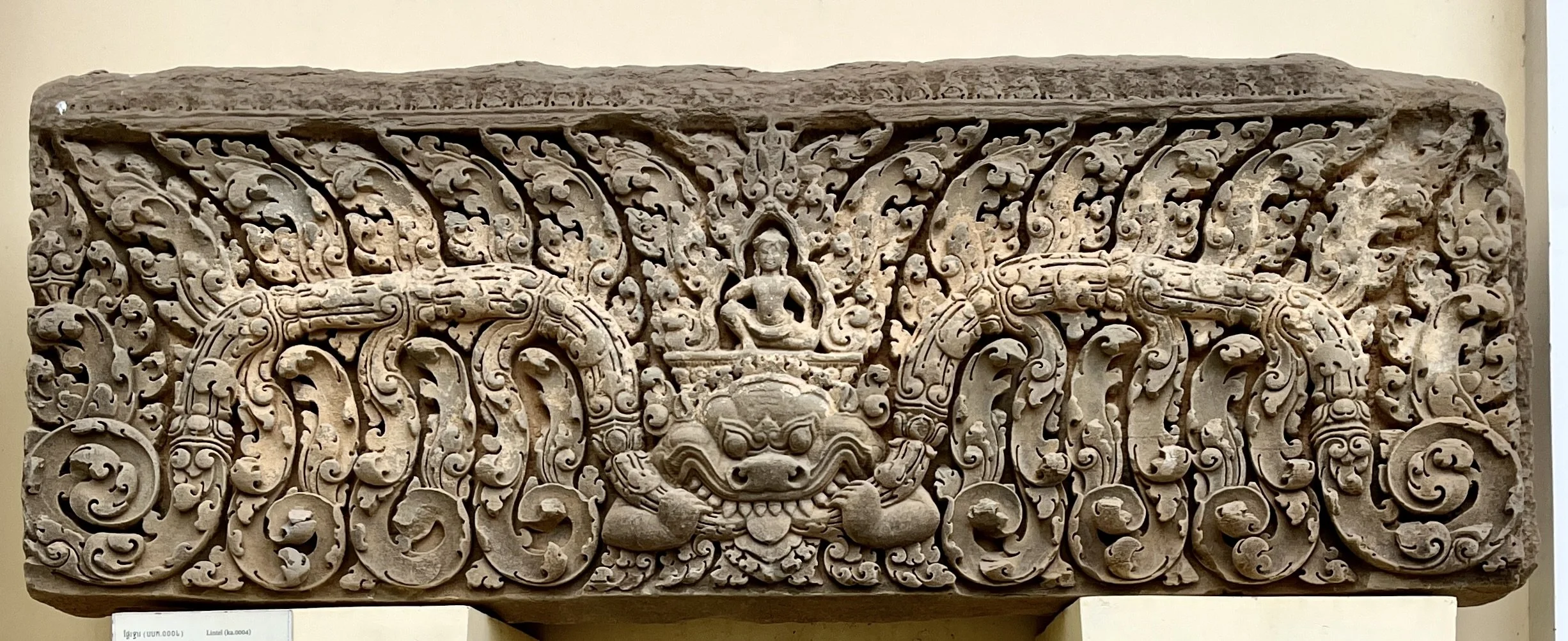
6. The commute was much longer than I expected– a 25 minute or so tuktuk ride into the city each day, made longer by needing to call for a driver and getting cancelled on at least once or twice per trip. In addition to slowing me down and costing more than double what it should, this made delivery from restaurants impossible, which became a huge problem because .  . .

7. The house didn’t have a kitchen as pictured. Not only were the pictured full size fridge and cooktop missing, so was the aircon in the living/kitchen space. There was what I think is a drinks cooler, or maybe XS fridge for beauty products– it was much smaller than even a hotel minifridge, so I couldn’t refrigerate anything beyond a single box of leftovers and 1-2 canned drinks. So, I ended up eating things I normally wouldn’t– boxes of dry carbs like crackers and cookies, and takeout meals left on the counter for hours.

In addition to just being miserable and non-nutritious, I think I learned the hard way about fried rice syndrome. I think I got VERY VERY lucky, only taking one bite of leftover rice before remembering it had been sitting out for two nights without refrigeration. I’ve had genuine food poisoning once or maybe twice, somewhat easier but still appalling “Bali belly” a few times, and this was not those– it was the worst gastro event of my life by far. Only googling around days later did I learn about fried rice syndrome for the first time, and recognize the symptoms/severity/progression. I truly believe I’m only alive because it was only one bite AND I always carry around antibiotics, just in case.

Experience has taught me to take antibiotics early into a food poisoning or Bali belly type gastro episode; if they help, great; if they don’t, oh well, at least they don’t hurt. So, within the first hour or two of misery I took a double dose of clindamycin I had on hand completely coincidentally (thanks asshole Siem Reap pharmacist who pretended to not know what a UTI was/shamed me for having one/insisted on selling me a pointless generic antibiotic that probably wouldn’t cure a UTI because I had ‘wasted’ his time explaining my ailment and thereby reminded him of his incompetence), and taking action early could (or not, I don’t know) have saved me. Apparently clindamycin is one of the antibiotics that helps with fried rice syndrome, though not a first line med.

The pain was so strong, the fever so high, and the diarrhea and vomit so unrelenting that I put my pillow on the tiled bathroom floor; there was no time to walk the perhaps 6 feet from bed to toilet, and my balance was failing. I’d experienced that before with food poisoning; the difference this time was that during my previous worst episode, 6 or 8 hours into it coming out both ends I was thinking “Force yourself to drink this water, drink, drink, drink; if this vomit/diarrhea doesn’t stop in 5 or 6 more hours, we’ll (my physical and mental selves) go to the hospital”. This time, I was in too much pain/too weak and dizzy to even crawl 5 feet to find/see my phone to call a hospital, certainly physically unable to exit the house or enter a vehicle unaided, and that’s not even accounting for the language barrier.

No one reads my blog anyway so I can be graphic; in the last few hours of the episode, I was no longer vomiting or defecating excrement, I had none left; just lots of congealed blood. I knew rationally it was probably related to internal hemorrhoids/strain but it was still terrifying, moreso because I had no one and no way to call for help; thankfully that aspect resolved within 24 hours. I spent the next 3 days bedridden, the first 2 still sick/sleeping, and it took maybe a week to fully recover.

8. Speaking of food, even at restaurants in town, it was expensive and bad, extremely ironic given Battambang has been honored by UNESCO for its culinary heritage. At the heroically priced (and Angelina Jolie patronized) Maison Wat Kor, the food is bland and inauthentic, catering to the insulting stereotype they maintain of a European palate. At the one American-owned restaurant in town, the windowless, fanless toilets face directly onto the dining room, and the staff leaves the doors wide open to air out the shits everyone hears everyone else take where we eat. In what tripadvisor rates the best restaurant in Battambang, supposedly social enterprise/french-khmer fusion/wine bar, there was a fucking longass manicured thumbnail in my food– you know the type, usually seen on taxi drivers who do drugs– clearly accidentally half chopped/half ripped off by a cook not wearing gloves, who then chose to leave it in my food. And when I complained and showed it to the waiter, they called over the manager, who not only did not apologize or comp a thing, but lied to my face in a totally absurd manner, telling me I was confused and it was just a piece of cooked garlic! The audacity!
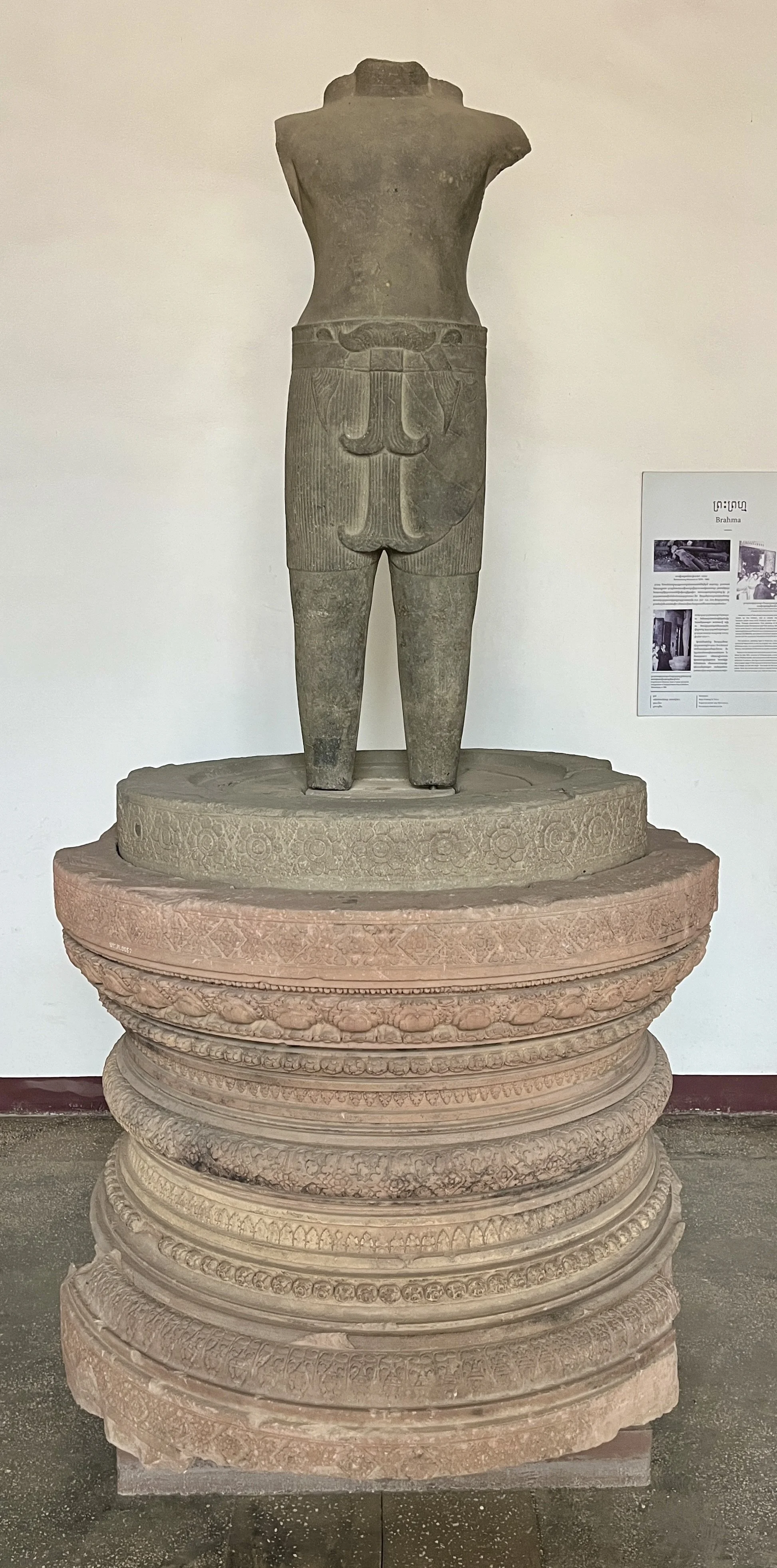
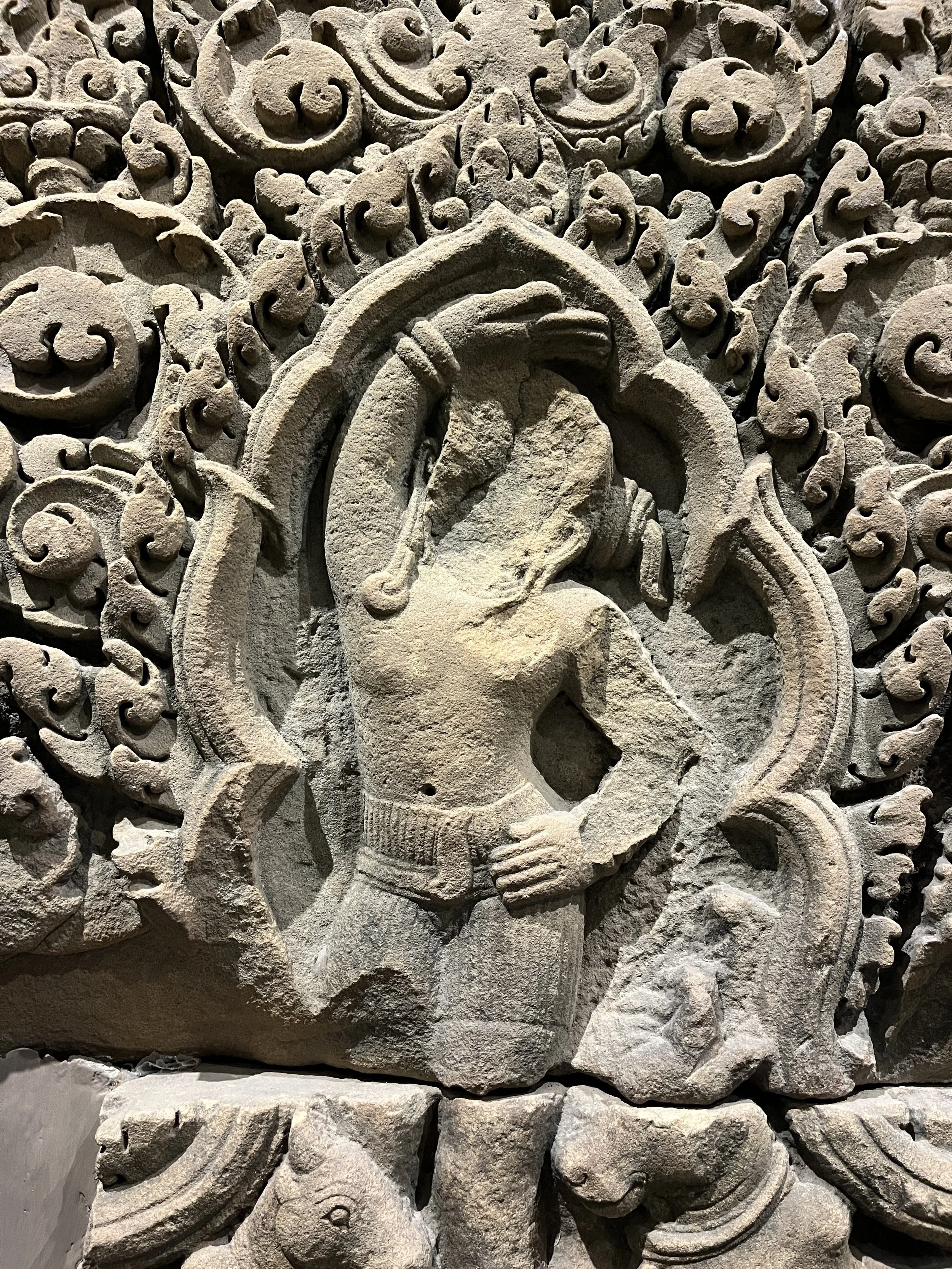

I’ve learned through countless conversations over my year plus living here that Cambodians have an unfathomable, bizarre, totally fucked, cultural predilection for casual lies and gaslighting– they think it’s unclockable, socially/morally acceptable, or both; they all do it, and they always try it if they have even the slightest chance of gaining even the smallest thing by it. But even more maddeningly, they often do it when they have nothing to gain except the chance to smile smugly at their sabotage and feel for a moment they’ve gotten the best of someone; in fact, they seem to consider maintaining irrational fantasies of their own superiority and control the most valuable benefit.

Out of hundreds, thousands? of these micro-aggressions, in every transaction and most stakeless interactions, this fingernail debacle is just the most succinctly illustrative example I’ve experienced to date. How shameless must one be to suggest to my face that I, an over 40 woman, have never before seen or bitten either a piece of cooked garlic or a fingernail, can’t easily identify them independently or in comparison, and have somehow mixed them up? Even if he got the word wrong and meant ginger, or galangal, or some other root or spice stiffer than cooked garlic, the notion would be absurd.

How insolent must one be to assume I, an over 40 woman, better than him by any standard that matters– wealth, class, intelligence, education, age, experience, morality, manners, self-awareness, fairness, generosity, pride in a job well done, overall success, positive impact on the lives of children, charity work, political activism, number and variety of languages spoken and cultures witnessed– hell, even knowledge of his own country’s geography, history, and heritage . . . and based on his behavior, though perhaps counterintuitively given this sentence, modesty, not that I require it, I bet I even fuck better than this loser– would or should back down when confronted, especially so directly, with bullshit that insults my intelligence? In New York only small children or personality disordered imbeciles attempt these sorts of lies; I understand the logic of ‘can’t knock ‘em for trying’, but can’t help but feel repulsed.


I often wonder how this became an acceptable norm. What proportion of Cambodians tell each other that foreigners are stupid, or women are stupid, or middle-aged people are stupid, or rich people are stupid, or it’s a combo, or it’s just something about my face, or just do a little test and see for sure if I’m stupid, or if they insult each other’s intelligence this way too. It seems like they are constantly taking my foreignness for foolishness, my kindness for weakness, my generosity for profligacy, my curiosity for naïveté, and my good manners and standard American friendliness as a psychological need for their approval/validation/friendship.

I realize my contempt makes me sound racist, and to be frank, dealing with this so often from so many different Cambodians has made me reconsider nature/nurture. On one hand, I’m very aware and admiring of the Khmer who once wrote better Sanskrit than the Brahmins; on the other, I’ve so regularly experienced exactly the combination of bitter jealousy/resentment, low to middling intelligence, and moral turpitude that could have been predicted 40 years ago when they genocided a full third of their population– literally everyone with a heart, brain, or franc, and their whole families with them– as insurance against future generations with any of those things.


Anyway, to end this rant still talking about Battambang food . . . even at chains/franchises that are supposed to be relatively safe (like Domino’s pizza and Gloria Jean’s coffee) the food smelled strongly of mold– like they saw it, decided they cared more about making money than their customers’ health, brushed it off literally and figuratively, and sold it anyway. Just so fucking nasty in every way. I think in the whole town there was a single coffee shop I liked.

9. The weather sucked and the temples were all locked. Despite feeling quite ill and exhausted, I was getting up early and dragging myself around, as expensive as that got, trying to see the important temples. It rained for several hours every fucking day for three weeks, and not a single temple was open. The only temple interior I saw the entire time was that of Wat Kor, which I stumbled into just because I happened to be walking down the street, on my way to that hotel restaurant that wasn’t worth eating at anyway. It was obviously only left unlocked because, unlike the others, they don’t usually get tourists.

Cambodia as a whole and each city/province individually wants you to visit and spend your dollars, and they do so by extensively appealing to Western press, always about their artistic and cultural attractions. Consider this 2023 quote from a BBC article about Battambang titled The Transformation of a Creative Capital:

"Take Wat Ek Nom, which is near our house," said Koeurm of the monastery complex, first built in 1757. "Even if you have no money for entrance fees, this is like a free art gallery; this is where you can appreciate the power of visual storytelling in every pagoda panel and see how something as extraordinary as Buddha's enlightenment can be captured with just a paintbrush. This is a place to encourage people to go and seek inspiration."

Was Wat Ek open even one of the three times I visited (and I tried morning and afternoon, weekend and weekday, rain and shine)? Of course fucking not. Was a keyholder anywhere to be found? Of course fucking not. They don’t care if you have a good time or see anything you wanted to see once you’re here; they know you’ll buy food and pay for a tour whether they unlock the temple or not, so they don’t. It’s all just so ironic and again, xenophobic and insulting: foreigners aren’t the homeless and useless people shitting in the garden, sleeping on the verandas, and littering; locals are. Foreigners didn’t loot the temples of Cambodia, Cambodians did. It’s 2026; every single theft for the past century has been by locals making a living selling out their own material culture and artistic heritage. Begging tourists to come and see the temples– then locking up every temple to prevent them actually visiting– is nasty and ridiculous.

10. My macbook air screen cracked in Battambang, and I was charged $300 for a supposedly authentic apple replacement screen, and forced to extend my stay in this place I really didn’t like while the repair was made. This ended up just being the first in a series of costly tech failures: the doubtless counterfeit replacement screen failed within a month, costing me another $300 to replace back in Siem Reap; that second doubtless counterfeit replacement screen just failed again this week, and of course the repair shop owner came up with some bullshit reason his warrantied repair wasn’t actually warrantied, costing me another $150. (Author’s note: rereading this blog post 6 months later, that 3rd!!!! replacement screen just failed AGAIN!!!!); for the cherry on top, my iphone screen also failed within 48 hours of my returning from Battambang, a known bug in iphone 13s. Between apple’s planned obsolescence and the Cambodian norm of fakes and scams, I’ll have spent between $2000 and $3000 by the end of the first quarter of 2026 to replace broken tech with ever lower quality, even less reliable tech.

11. The only nanoplated thin silver lining of all this is that now, as I edit pictures like these of Wat Phi Pit– bad uninteresting photos I went to great lengths and expense to take– my unhappiness at their poor quality has forced me into improving my editing skills a bit and investing (albeit money I don’t have) in a) backup tech, so I’m not out 2 weeks’ income next time a computer component fails and b) a better camera phone, when I can afford it– I can’t right now, and that’s why these blog posts are coming out in relatively quick (for me, anyway) succession– nothing to do for the next few months except hang around and edit photos of travels past.

12. On the bus rides there and back from Siem Reap, I was tortured by stinky smokers. On the bus ride back, the smoker was also very obviously ill, constantly coughing, sneezing, and hacking (with mask worn under his chin rather than over his nose and mouth, of course); and of course he was not refused service, and of course I came down with whatever respiratory illness he had within 48 hours of arriving back in Siem Reap. 

If I had not been traveling with a fucking camper kit of supplies (antibiotics, exacto knife, mosquito bat, pillow, towel, masks, hoodie, socks, more than a few hundred bucks in the bank) I cannot even imagine how exponentially worse my misery would have been, everything already sucked so much. I still prefer a lifestyle of constant travel to any other lifestyle, but cities/weeks like this try my patience and make me sad and bitter.

As for Wat Phi Pit, otherwise known as Piphetthearam Pagoda, I can’t find any info about it except that it dates to the 19th century and was built by the Siamese, which is visually evident. 

I did at least learn something new when looking up old pictures of it– many of the photos from EFEO labeled April or May 1964 are in fact reprints from old plates, and that’s why they have what I thought to be anachronistic– but is in fact original– hand lettering. These photos of Wat Phi Pit, for example, are actually from March 1924.

I suppose I also know that at some point their original Buddha was looted or destroyed, because while the current one (shown here in a google maps photo being regilded) is a close copy, the draping fabric details are not present in the original.

La Villa Hotel, Battambang | Cambodia

According to the hotel, La Villa was constructed in 1933 as the private residence of local ‘tradesman’ Eap Heo, and lived in by his descendants until the Khmer Rouge takeover in 1975. When the Vietnamese defeated the Khmer Rouge and occupied Battambang in 1979, they made this their local headquarters. When the Vietnamese left in 1989, the building was alternately leased or squatted in until it was sold to the present owners, “a young expat couple”, in 2004, and following renovation opened as a hotel in 2005.

We all know young expat couples can’t actually purchase property in Cambodia, so who knows what the truth actually is– I’m guessing at least one member of said couple is the K visa kid of refugees in France, or maybe the Cambodian kid of a corrupt government bigwig who studied and married abroad. Over the decades since Pol Pot died, these types have scooped up anything nice, setting up as landlords and hoteliers, many continuing to live in Europe while collecting rents here.

I really like that the renovation was more like a restoration, with period-perfect details and decor. It really feels like stepping back into the late 1930s; everything but the pool is accurate enough to be a movie set. Well, I guess there’s one minor caveat– all the antiques etc. are Vietnamese, not Khmer. However, as I’ve written before, after the Khmer Rouge, there are few if any surviving Khmer antiques (not looted artifacts). Zero pretense has been made towards inauthentic generic “luxury” in the style of Raffles, and I really like that. On the other hand, housekeeping is really not up to snuff; the rooms were very visibly dusty, smelled vaguely of either stale cigarettes or mold, and the linens etc. have clearly never been refreshed. It reminded me a lot of Loire valley 2 or 3 stars I stayed in as a teenager in the ‘90s.

In terms of service . . . not good enough. There were assholes smoking in front of my bathroom window and the concierge refused to ask them to stop or move– he did the standard SEA act of pretending to ask them not to smoke, then coming back to me and denying they had. When I told him I saw it with my own eyes, smelled it with my own nose, and wanted them and the furniture they were sitting on moved away so it didn’t happen again, he again, according to what seems to be a standardized SEA playbook of bullshit for hoteliers, refused to confront them, instead offering to move me into another room, as if I was the problem. I had paid for their most expensive suite– and therefore shouldn’t be inconvenienced, and certainly not downgraded– but was forced to choose another lesser room because the head staffer refused to confront the offending guests.

Same thing with the restaurant– instead of seating smokers far away from other guests outside, they let them sit right next to the glass doors, and left the doors propped all the way open, not caring if people purposefully sat inside in order to not be disturbed by smokers. It’s not an issue of not getting it, it’s an issue of not caring. Any complaints are answered with feigned ignorance, lies, and malicious compliance, it’s so, SO gross. I’ve been in SEA long enough to expect this nastiness rather than be surprised by it, but it still disappoints and disgusts me every time.

The restaurant is overpriced but reliable. The cocktails are fine. My favorite thing about this place, other than its architectural integrity, is how few other guests were there most of the time. It’s the kind of place I’d like to buy and turn back into a private residence.

The Old Khmer Houses of Wat Kor, Battambang | Cambodia

Models of various traditional Khmer house types at Mrs. Bun Roeung’s House

Wat Kor village, 2km south of Battambang proper, was the neighborhood historically chosen by wealthy Khmers a century ago. Today, it is best known for its 20ish heritage houses showcasing local traditional architecture; 20 years ago, it was best known as the hometown of Brother Number 2, who was born in one such house in 1926 to wealthy Chinese immigrants.

The house is still there, but no one will tell you which one it is; there’s no photo identifying it online; in person and search results the laughable party line is “the house no longer belongs to Nuon Chea’s family; it was purchased by a local resident in the late 1980s from someone else.” Who else? In the 80s, when everyone was squatting and no one had any kind of ownership documents, or money to speak of? Battambang was held by the Khmer Rouge by turns until 1996.

The Khmer Rouge leadership in 1986: Khieu Sampan, Nuon Chea, Pol Pot

No matter, I was there for the architecture. And that architecture may have been at least partially preserved because Batttambang– and Wat Kor village specifically– were occupied BY KR top brass.

In photos of well-to-do villages dating from the 3rd quarter of the 19th century, the houses tend to have walls of woven grass and thatched roofs, but the bones of the regional architecture are the same: stilt houses with square layouts and gabled roofs.

The wealthier houses featured front or wraparound porches covered by a second lower roof, and a connected outhouse for cooking. These photos were taken by Émile Gsell between 1877 and 1879. This photo likely depicts the novices at a monastery.

In photos taken 30 to 40 years later, so around the same time the heritage houses of Wat Kor village were constructed, anyone who could afford to was building out of wood rather than woven grass– having even a small wood house became preferable to a large grass one.

But the layout remained the same, squarish with gabled roofs. You’ll also notice that at first, thatched roofs on wooden houses was the norm. These photos were taken by Léon Busy between 1926 and 1931.

A classic simple wooden house in Wat Kor village.

By the first quarter of the 20th century, anyone who could afford to was building with or renovating to tiled roofs. This is a great example of a house that was built with a wooden roof initially intended for thatch, but had tile laid over top.

As the local Thai colonial architecture became more formal and sophisticated, the gables shrunk, while the perimeter roofs, originally meant to cover just the porch, were made to cover more of the central house, for a more tiered Siamese look.

By the turn of the century, new houses were constructed to showcase beautiful tiered Siam style tiled roofs with cement finials. Decorative aprons became popular in the 1910s.

Another option when putting on a new tiled roof was a French style mansard roof. Enclosing the stilted area below the house also became the norm in the French colonial era.

Later houses feature a flattened rectangular layout better suited to showcase the tiers of the Siamese style tile roofs, and emphasize the central finial–usually a flame, but occasionally something else– I’ve seen some with the year inscribed.

The final iteration: extensively renovated with each decades’ favored modern “upgrades”– most noticeably the picture window and metal sunroof– this house is actually rather old. Yet, it is the template for most ‘Khmer style’ houses constructed today; the only dead giveaway here is the rather steep outdoor wooden staircase coupled with the enclosed ground floor– most modern houses would have one or the other, but not both.

Khor Sang House is one of the two in the village that operates as a museum. It was built in 1907 by the present owner’s grandfather, then a young secretary to a colonial Thai official. I wonder if, like the governor’s mansion, construction was begun here before the surprise handover to the French, or if it was built with the proceeds of a severance package. The proportions of the house are inconspicuous, but the owner standing in this photo gives enough of a sense of scale to appreciate how large the place really is.

Compared to pictures on google maps from 2018ish, there’s less furniture in the house than there used to be, so it looks a bit empty. The layout is the traditionally Khmer open square with some walled off bedrooms.

The high ceilings and oversized windows really give a feel of rustic grandeur.

The walls are wattle and daub– in Cambodia, that means layers of latticed bamboo and plaster.

The owner doesn’t speak English– only mile a minute strongly accented French. My French is poor, so it was hard for me to keep up! In his father and grandfather’s generations, most colonial administrators, lawyers, successful merchants, etc. were polyglots, speaking the Chinese dialect of their ancestors (usually Cantonese), Khmer, Thai, and French.

This made me laugh– must have been the money room!

Inside one of the bedrooms.

There’s a collection of bills from all over the world, cash donations tourists have made.

Around the house are some old household tools.

I found it interesting that a good half of the old furniture was locally made, rough hewn versions of European styles.

The walls aren’t decorated but for calendars, portraits and graduation photos. It is cheering to see a family who have valued education so highly over multiple generations.

I have no idea what this cabinet of curiosities is about, but it did make me smile.

The owner’s diploma from 1966. I always want to ask how someone like him survived the Khmer Rouge, but fear the answer, and don’t want to re-traumatize or offend either.

The original builders of the house, I believe.

The second heritage home open to tourists is Mrs. Bun Roeung’s house. She is also a third generation inhabitant of the house.

She speaks English, so I was able to pick up a lot more about the house’s construction and history. It was built by her great-grandparents in1920; her great-grandfather was an Okhna and retired general, working as a lawyer when the house was built.

One thing that was emphasized to me, and is also visible in Yi Sarit’s house, is the mix of valuable hardwoods used in construction. The 36 structural pillars and roof frame are Phcheuk, the indoor floorboards are Beng and the outdoor floorboards are Korkoh. The design of the house is called “Pet”– with a wraparound verandah.

Right next door, visible through the window, is the smaller modern house the family currently resides in.

The walls are wattle and daub.

All the furniture is old. Some of it is not original to the house, but similar to what was once there and replaced by the owner. She said the original pieces are the biggest and heaviest; the Khmer Rouge stole everything that wasn’t too heavy to carry.

The original owners of the house.

According to the Battambang government website:

“The said ancient house is divided into three parts:
1st part: this part consists of the front and side verandahs.
2st part: this part is the middle part of the house, which consists of a huge living room. At the rear left side of the living room, there is a door leading to two bedrooms.
3rd part: in front of the two bedrooms, there is another door leading to a side verandah and the wooden staircase. At the left side about 5 meters from the door, there is a kitchen.”

She explained that in a typical eat-the-rich move, the Khmer Rouge turned this house, arguably the fanciest in the neighborhood, into the communal kitchen/place for storing heavy equipment and threshing rice. She says having big vats of water and porridge leaking onto this part of the verandah for years was what damaged the wood, and any lesser wood would have rotted completely.

The running water for the garden as it is today.

I’d love a pet turtle but alas, can’t have any pets at present.

Downstairs are some old tools for threshing rice, weaving fabric etc.

The cement stairwell is original; at the time, it was considered modern and stylish.

Colonial Architecture in Battambang | Cambodia

Honestly . . . underwhelming. Yes, there are many colonial buildings– over 800 according to conservation area records– but they’re 1. of the simplest sort 2. ill maintained and often extensively renovated in all the wrong ways. I visited thinking perhaps I’d find a cute house to rent . . . definitely not. It’s everything I don’t like about Siem Reap– dusty streets and falling apart buildings; constant traffic noise and fumes; trashy peasant neighbors chainsmoking, playing awful music until the wee hours, and burning their rubbish, in both the city proper and the surrounding villages; litter absolutely everywhere– but a fifth the size, with extremely limited dining and shopping.

The neighborhoods at the time of the handover from Siam to France in 1907. Though the bridge locations are indicated on this map, there actually weren’t any permanent bridges at this time; the first was built in 1916. I’ll cover the neighborhoods from left to right.

The Khmer district. I’ll be covering the antique Khmer houses around Battambang more thoroughly in a separate blog post (click here); I’ve just chosen this photo as an aesthetic/representative example. This photo of the family of a local administrator outside their house/office was taken by Léon Busy between 1914 and 1921, likely closer to 1921.

Khmer houses from the first quarter of the 20th century are still around, a couple with the descendants of colonial administrators still living in them.

The Khmer neighborhood market in 1931, attributed to Léon Busy (but probably taken by a staff photographer).

The Governor’s Residence in August 1948, less than a year before Cambodia was granted limited autonomy as a member state of the French Union amidst multiple independence movements.

The grounds of the Governor’s Residence dominate the 1907 map, and while it is in what people perceive as French colonial style, it is of course Thai, commissioned from an Italian favored by Thai King Chulalongkorn for his ‘European’ buildings. So are several other administrative buildings in this neighborhood; it’s a mix of Thai-European-style and actually French. For a post solely about this house, click here.

The carved wooden window grilles on this building are quite delicately done.

c. 1910s postcard showing High Commissioner’s office.

I believe this is the building above, freshly butchered, with typical weird changes like an extra floor, a totally incongruous utility room or apartment on the roof, terrible windows . . .

Most of the big old colonial mansions/onetime offices are in disuse/disrepair, apparently owned by local grandees who think they’ll sell them to an international corporation one fine day for millions.

Many have been partially renovated, then abandoned, and are now in ruins.

A never or rarely used official residence is somewhere beyond this gate.

The royal seal of Cambodia.

Not sure what this is– I think the office of an NGO– but this is my dream house in Cambodia. Rip up the concrete, put in a pool and gardens, perfect.

I think? this is a modern building built in the old style to blend in. This is common in Cambodia.

The definitely actually old building next door.

On the grounds of the Governor’s Residence; the backsides show clearly the colonial building vs. the colonial style building.

The post office in August 1948

The post office, 2025

I found this little map showing Battambang’s historical buildings on urbandatabse.khmerstudies.org. It only covers the old Chinese quarter, which was almost completely removed by the French and replaced with simple shophouses, which were then reinhabited by the same people. I’d say it’s bordered at one end by the museum, and on the other by the neighborhood just beyond the 1931 ‘new’ market. I wish the map covered more of the old city.

it would look so fab if it was just clean– not even renovated, just clean.

Thai era building. I always wonder how much it costs to get these things really nice again.

My understanding is this was a bank at some point. Private villa? Government? Still a bank? A couple years ago it was in the news that it was going to be an economics museum. Unclear, but the renovation was literally just finishing as I photographed it in October 2025. Clearly a Thai buidling.

French era shophouses

Thai era shophouses

The new indoor market,1931

The new outdoor market, 1931

The indoor and outdoor market in 2025

One of the oldest hotels in town, the very simple Art Deco 30s/40s Seng Hout.

Cantonese school/guild in August 1948.

As it stands today, converted into shophouses.

Some shophouses have been combined into larger residences.

I do enjoy a Frankenbuilding! This one just beyond the market is really extra– it looks like a classic Vietnamese style block through shophouse with a front and back house, built before the street pictured here was paved– it looks like a house on the corner was knocked down for this street to be paved, and new retail storefronts were built to face the new street– but at different times, the short green building to the left probably 1920s, and the taller building to the right likely 40s or even later. The very modern yellow balcony out the back with Indian/Malay vibes completes the charm.

I felt my stay here was worth its own post (click here) but I’m placing this here to show what I suppose is an exception to the rule? Located in the ‘Sino-Khmer’ neighborhood and built by a wealthy local businessman, the La Villa hotel is entirely ‘European style’.

Just as there’s nothing particularly ‘Sino-Khmer’, there’s little to nothing visibly ‘Siamese’ left in the then-Siamese district. Instead, there are Thai era European styled colonial buildings sprinkled throughout. This one’s a good example: probably Thai, possibly French.

It’s very possible, particularly based on Émile Gsell’s photographs, that the vast majority of the houses, be they Sino-Khmer, Siamese, or European, were wooden and therefore didn’t survive and/or were disassembled, moved, or reused.

Likewise, there are very few European buildings left in the once European district; they may have been destroyed, rotted, or just renovated beyond all recognition.

Built in 1929, the local Roman Catholic Cathedral was blown up by the Khmer Rouge in 1975.

The French colonial outbuildings remain, and it’s still fully functional as a church, school, community center, etc.

A few doors down from the church was this old French colonial house, now split into two. The owner told me she’d been here since 1981? 1985? something like that. After the rural dislocation and genocide, Cambodia was littered with empty houses, and people squatted on a first come first served basis. There are still two classes of property deed, soft and hard titles: hard titles are official; soft titles are been-there-forever squatters’ rights, or 10-50 year leases. The soft title holder here told me that once in the ‘90s a Frenchman visited and told her he grew up in this house, but didn’t ask for anything but to see inside again. Pre-Khmer Rouge property rights have never been restored or respected for Cambodian survivors or foreign returnees.

The typical sloppy division of a once fine house into 2 or 3 “connected houses”, each for 1-2 multigenerational families, none of whom have any qualms about disrespecting the architecture with absurd, cheap, ugly, damaging, or irreversible changes.

The Muslim neighborhood is still Muslim today, and apparently handmade fishing nets have been one of their dedicated handicrafts all this time.

The Governor's Mansion that Never Was . . . Battambang | Cambodia

Occasionally I visit a place that’s simply not worth the entrance fee, and this is one.

Lord Chhum Aphaiwongse

Commissioned by Lord Chhum Aphaiwongse in 1905 from Mario Tamagno (best known for the Ananta Samakhom Throne Hall at Dusit Palace), this is as close to a simple template of a French colonial style mansion as could be conceived, the SEA base model McMansion of a hundred years ago. It’s an almost eery feeling; I’ve walked through this exact house, all over SEA, smaller or larger, with only slight differences.

circa 1910, photograph by Henri Marchal

circa 1910, photograph by Henri Marchal

Lord Chhum must not have seen the Franco-Siamese Treaty of 1907 coming. In 1904, Siam gave France Trat in exchange for Chantaburi. In 1905, Lord Chhum commissioned the house. In 1907, just as it was completed, Siam got Trat back by trading in the Buphaphon, the area including Siem Reap and Battambang that the Aphaiwongses had hereditarily governed since 1795.

The Aphaiwongses, originally local warlords in far southern Treang, rose to nobility and wealth with Siamese backing in the latter half of the 18th century. When local Cambodian chiefs went to war for Cambodian puppet kings supported by either Siam or Annam, the Aphaiwongses supported, and were supported by, Siam. When the Nguyens became distracted by the Tay Son rebellion, Siam got the upper hand in Cambodia, culminating in the first Aphaiwongse Okhna, Chau Baen, serving as regent over the Cambodian child puppet King Ang Eng.

1773 map by Thomas Kitchin

Over time the court in Oudong divided into those who wished to continue with the current line of puppet kings, and those who preferred to just give Chau Baen Aphaiwongse the throne in his own name. To prevent civil war in Cambodia, and/or the rise of a formidable rival, Siamese King Rama I recalled Chau Baen from Oudong, but raised him to the nobility and awarded him the hereditary governorship of Battambang, Siem Reap, and Sisophon, to defend and administer as annexed Siamese territories.

Thai King Rama I

After the 1907 treaty, the French offered Lord Chhum, the sixth generation ruler of Bupaphon, to stay on as their governor in Battambang. However, like his ancestors, Lord Chhum again chose loyalty to Siam, moving his family to the Bangkok court of Rama V (Chulalongkorn) after the handover. Briefly installed as the governor of Prachin Buri, he had the Tamagno house built for him again there, hoping to entertain Chulalongkorn in style. Other than the window shapes and plaster appliqués, everything was exactly the same. Unfortunately Rama V died before the house was finished.

The Prachin Buri twin house

When Lord Chhum’s granddaughter eventually married Rama VI, becoming the Princess Consort of Thailand, Lord Chhum gave them the Prachin Buri house as a wedding gift. Unfortunately Rama VI died before Princess Suvadhana could have a son, so the throne passed to his younger brother . . . and the Prachin Buri house remained unoccupied. At the outbreak of WW2, Suvadhana and her daughter fled to England, remaining there until 1957.

Princess Suvadhana

Because Thailand allied with Japan in WW2, Suvadhana’s father Lueam officially became the last Abhayavongsa governor of Buphaphon during the period Japan occupied Cambodia, from 1941 through 1945– though he still never lived in the Battambang house, which was used as Japanese army offices.

Khuang Aphaiwongse in the 1930s

Meanwhile, her older brother Khuang served as Prime Minister of Thailand three times between 1944 and 1948. After the war, he remained the leader of Thailand’s Democratic party until his death in 1968. Suvadhana had a royal funeral in 1985, and the family is still considered noble/royal in Thailand.

The most impressive thing about the place is the grounds. Large grassy lawns with manicured trees are rare things in Cambodia, it’s typically either city living or a waterlogged mess.

Another colonial era building on the grounds.

There are several government office buildings in one corner of the grounds.

I like the chevron brickwork.

Inside is both inauthentically renovated (lol at that layered drop ceiling) and as dull as possible.

The ground floor is occupied by what they think passes as a museum. It’s the most pointless, random assortment of mostly vintage objects.

A jumble of bad, mostly recent furniture.

Horrid door that has clearly had things ripped off at some point.

Are they trolling?

Built in features have mostly been ripped out, but there were 2 bookcases like this.

I wonder if it was never quite finished because the family knew they’d never move in, or if things were ripped out at some point.

Hard to tell if these are original tiles or not. I think mostly, but there is a huge jumble in this building. The pretentious polyester curtains really bring out the depression of it all.

I don’t even know why I took this picture. Despair? Wanting to remember the dimensions should I ever install shutters?

The performative shrine of course.

I guess some people will pay to rent traditional clothes and do a little photo shoot here?

I took lots of pictures of the tile border combos for inspiration

Weird assortment of farm equipment and housewares.

Hard to say because nothing was translated, but I think these were the personal hobby instruments of famous people?

Likewise, hobby shooting items?

There are a bunch of old photos.

This view is not much different today.

Are these cowbells? Are these cowbells in a display cabinet or am I losing my mind?

Not particularly fond of this style but it’s growing on me.

Why are these things in a museum?!

It’s always struck me as strange how local museums in Asia have “antiques” so much worse than literally anything in my grandparents’ very middle class homes in New York.

It’s a custom for court women in Thailand and Cambodia to wear a specific color every day of the week.

Wat Damrey Sar, Battambang | Cambodia

Wat Damrey Sar, or the White Elephant Temple, was officially founded as a monastery in 1793, by a rich noblewoman who promised the Black Buddha at Wat Kandal to build it if she recovered from an illness. In 1895 this small old pagoda was renovated, but it was decided something new and grand was required; construction of the present-day Wat began in 1904 and finished in 1907. The old pagoda has been expanded and altered almost beyond recognition as such, into an office building with a seemingly too small roof.

The old pagoda in the background of this 1907 photo of famille Marchal

The old pagoda as of 2013, via google maps. It looked the same as of October 2025.

The new (1907) pagoda.

The new and old pagodas were constructed contemporaneously with the beginning and end of Battambang’s most recent 300 years as part of Siam (present day Thailand). The 1907 pagoda is a unique blend of Thai and Khmer architectural styles achieved during a golden age of temple construction.

It’s quite jarring how a once beautiful large garden, and I think, a pond with bridge? has been completely filled in, paved over, and cluttered with graves and additional buildings.

I have yet to find a temple in SEA that hasn’t been cheapened and uglified by its custodians. Why have a large meditative garden when you can have a parking lot?

Sappho Marchal posing for her parents in 1907

Why let children like Sappho sit on the banister with the chimeras and lions when you can fence the magical protective animals in with an ugly iron rail ineffective for any purpose except scaring playful children? Speaking of the banister, how many times do you think it’s been washed since 1907? I hope they don’t intend to paint even more of the place blood red to continue avoiding cleaning.

I also find these oversized statues of various Buddhist stories completely inelegant, although I suppose they would help engage young children who are taught here.

The namesake white elephant.

Originally these animals were painted somewhat intricately, but they’ve long since been given up on.

One of the most ornate stupas onsite.

The quatrefoil columns are really elegant and unique. I also like the simple black and white checkerboard tile.

The wire mesh over the paintings is ridiculous . . . people are not defacing the paintings, and the mesh wouldn’t stop them from doing so. The paintings are disintegrating from neglect.

Amidst the decadence, this snoozing kid made me chuckle at least! I love how he got really comfortable, took off his pants, put his feet up and everything.

All of the details have been lost over decades of overpainting.

1964, possibly a reprint from 1924.

Above the doorway, the royal coat of arms of the Kingdom of Siam used between 1873 and 1910, the independent rule of Chulalongkorn (King Rama V). Propping it up with European style cherubs was a fun choice that was perhaps symbolic as well as aesthetic; Chulalongkorn was the first king to send royal princes to Europe for their education, and the king responsible for concluding wars with the English and French, conceding territory (including Battambang) in order to keep Siam uncolonized.

Explanation from wikipedia: Shield depicting the three-headed elephant (Erawan) of Siam, the White Elephant (Lan Xang) of Laos and the Krises of Malaya. Crowned by the Great Crown of Victory (rays of light from behind), Behind the shield are the crossed Sword of Victory (left), Royal Staff (right), Royal Fan (right) and Flywisk (left). The shield is surrounded on two sides by two seven-tiered Royal Umbrellas. On the compartments are two Royal Slippers. All, composing the six Royal Regalia of Siam. the Mantle is the cloak (with pink ribbons) of the Order of the Chula Chom Klao, the order around the shield is the Order of the Nine Gems with Chula Chomklao chain and pendant (with a portrait of King Rama V on it). Motto on green and red ribbon reads: "สพฺเพสํ สงฺฆภูตานํ สามคฺคี วุฑฺฒิ สาธิกา" (Pali written in Thai alphabet) ("Sabbesam Sanghabhutānam Sāmaggī Vuḍḍhi Sādhiga") or "Unity brings happiness". Supported by a Kojasiha; a lion with elephant trunk (dexter), and a Rajasiha; a lion (sinister), representing Kalahom and Mahathai, respectively

The ruling monarchs of 1908, including a young Chulalongkorn.

A glimpse inside, showing what appears to be a rather recent Buddha.

All of the current interior images I have were taken from google maps reviews! The pagoda was yet another that was locked when I showed up. Perhaps because the interior is typically not visible, much misinformation is on the internet about “European painted ceilings”. Obviously, these are not!

Further, this image (probably from spring 1924, reprinted by EFEO in May 1964) shows unpainted ceilings and walls. While I suppose it’s possible that original painting were whitewashed away, I highly doubt it. Also notice the original window grilles and crystal chandeliers.

The highly carved plinth appears to be the same as the original.

The tiles and carved wooden columns are also original.

“You can’t buy wood like that anymore” is a common refrain in Cambodia. These old growth ironwood columns are certainly proof of that!

It’s hard to see in these photos what condition the inside of the wooden shutters are currently in relative to a century ago.

In my usual matching game, I was looking for this piece (this image is dated by EFEO as April 1964, not sure if it’s an original or reprint, but guessing it’s original as the reprints mostly show Buddhas in situ) in current photos of the interior, and didn’t see it.

A reverse google image search brought me to this post from Andy Brouwer, who is apparently quite active in posting about the restitution of Khmer art, though I don’t know his exact involvement. The post is almost 4 years old and I know the Musée Guimet has made some amends since then, so I wonder if this piece is one thing that has either been returned or kept on a loan basis with official ownership switching back to the National Museum of Cambodia.

It was included in the April - September 2025 exhibition of Khmer royal bronzes at the Guimet. Supposedly the Guimet collections are available on Joconde via pop, but I can’t manage to find them there, or elsewhere. I also saw some news that the Guimet had returned several pieces connected to Douglas Latchford . . . was this one of them? Or do they think the donors, famille Vérité, are totally clean? I’ll definitely explore this further in my post on looted Khmer antiquities, and I’ll update this post if I hear back regarding this piece or figure it out.

I really liked the applied and painted column bases, not particularly the content but the concept and structure.

In my previous post about Kbal Spean, I covered the Kraithong folktale, brought to the region by Thai immigrants.

According to the internet, this Buddha backs onto Angkorian era remains. Is that true or just an AI hiccup? I didn’t see any when I was there.

In 1907, Marchal took this picture of “modern pilasters”. They seem to be closeups of this gate.