I really fell in love with the Battambang Provincial Museum. It’s a small museum, with one open continuous space holding fewer than 250 objects. The entrance fee is forgettable, the ticket seller is absolutely lovely, there are no tours or crowds.
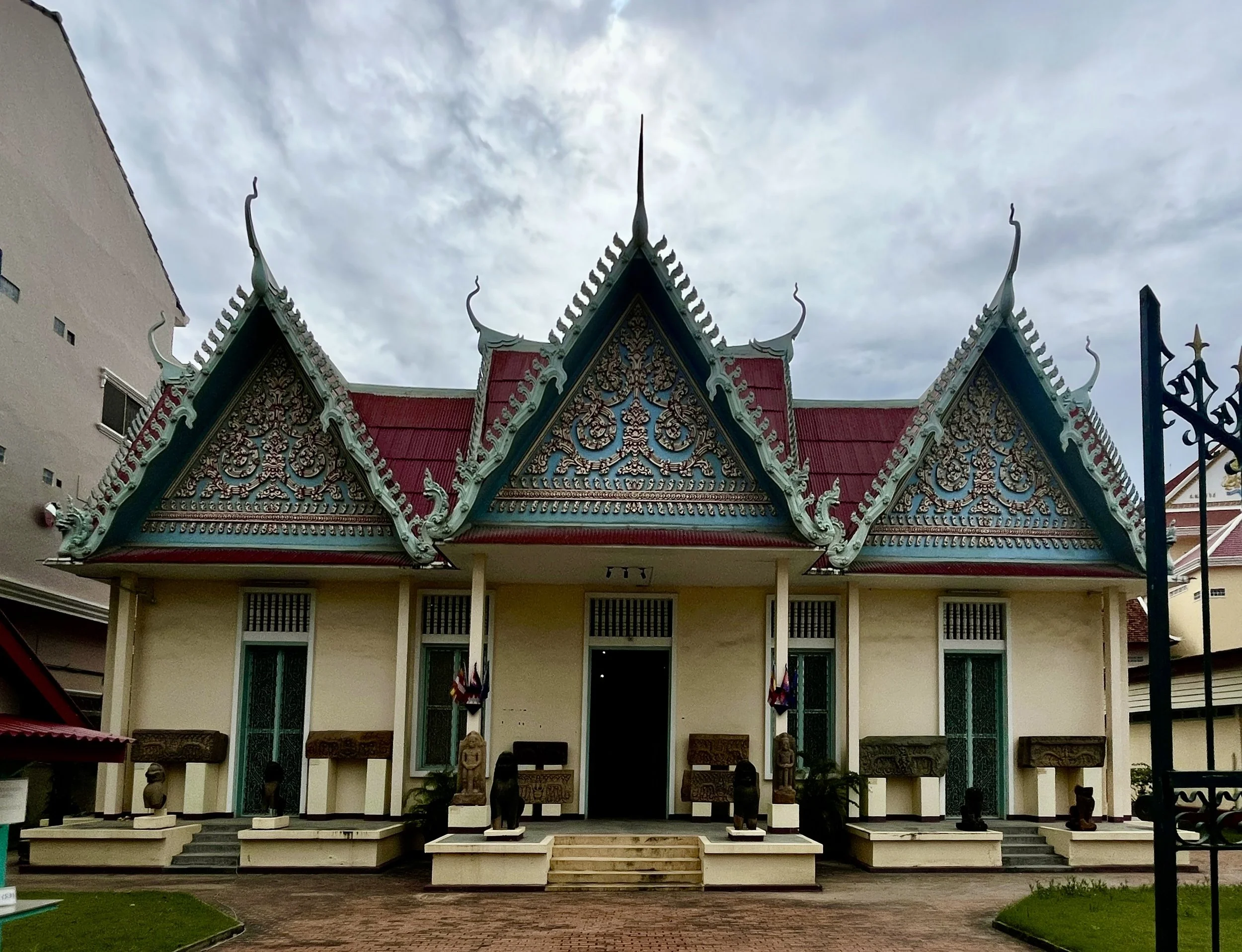
The front of the museum
One interesting aspect of the museum is its cagey autobiography!
This is the information provided about the museum, its history and displays, as written on the placard within the museum itself (grammar and spelling very lightly corrected):
Originally built in a T shape, Battambang Provincial Museum was inaugurated and opened its door to the public under the auspices of Preah Borom Ratanak Kaudh (Late King Norodom Sihanouk) in 1968. During the Pol Pot regime, from 1975 to 1979, the museum was closed, and was used as a prison leaving most of the collections piled up on the floor. Many important works of art were transferred to the National Museum in Phnom Penh for safety reasons, most of which were bronze objects.
Since then until 1997, with financial support from Seila-Carere Programme, the Ministry of Culture and Fine Art restored some parts of the museum building and built a new storage area which is located right behind the museum. In 1999-2000, as the collections grew, the Royal Government of Cambodia decided to expand the museum space by extending display halls on both sides of the front gallery. Due to the condition of the museum building as well as the display arrangement, in 2015, the Ministry of Culture and Fine Arts with financial contribution from the Friends of Khmer Culture Inc., a non-profit cultural organization based in New York, began to renovate the building and re-organize the display as we see today.
The exhibition is organized with a new display concept which focuses on collections originating from Battambang province. The purpose of the exhibition aims to provide general evidence of the civilization in this region such as Laang Spean, one of the oldest prehistoric inhabitant sites in the country, and other archaeological remains dated from Angkorian period to the mid-20th century.
Through this exhibition, one could help to preserve, conserve and promote this invaluable cultural heritage. In addition, this exhibition also aims to restitute objects from this museum and the Wat Poveal museum (another museum on the eastern bank of the Sangker River, in front of Central market) that went missing during the war in 1970s.
There are 233 objects on display, most of which are sandstone. They are arranged in chronological order from the pre-historical period to the mid-20th century. Some sections of the museum display different themes according to mythology episodes of Brahmanism and Buddhism, the two main religions originating from India. And yet, there are a variety of stories carved on Buddhist steles. The display is organized in 5 different sections as following:
1. Outside of the museum
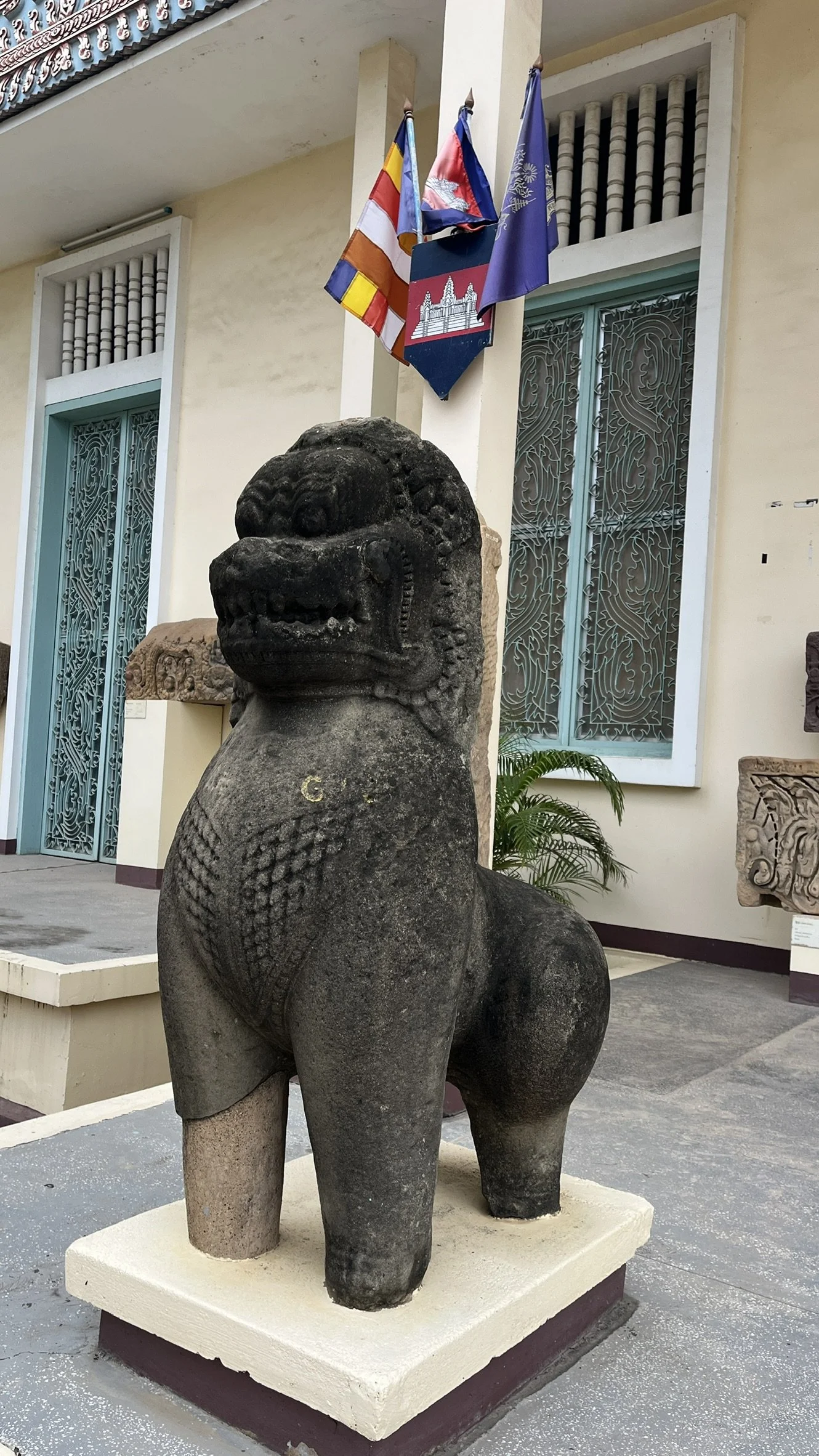
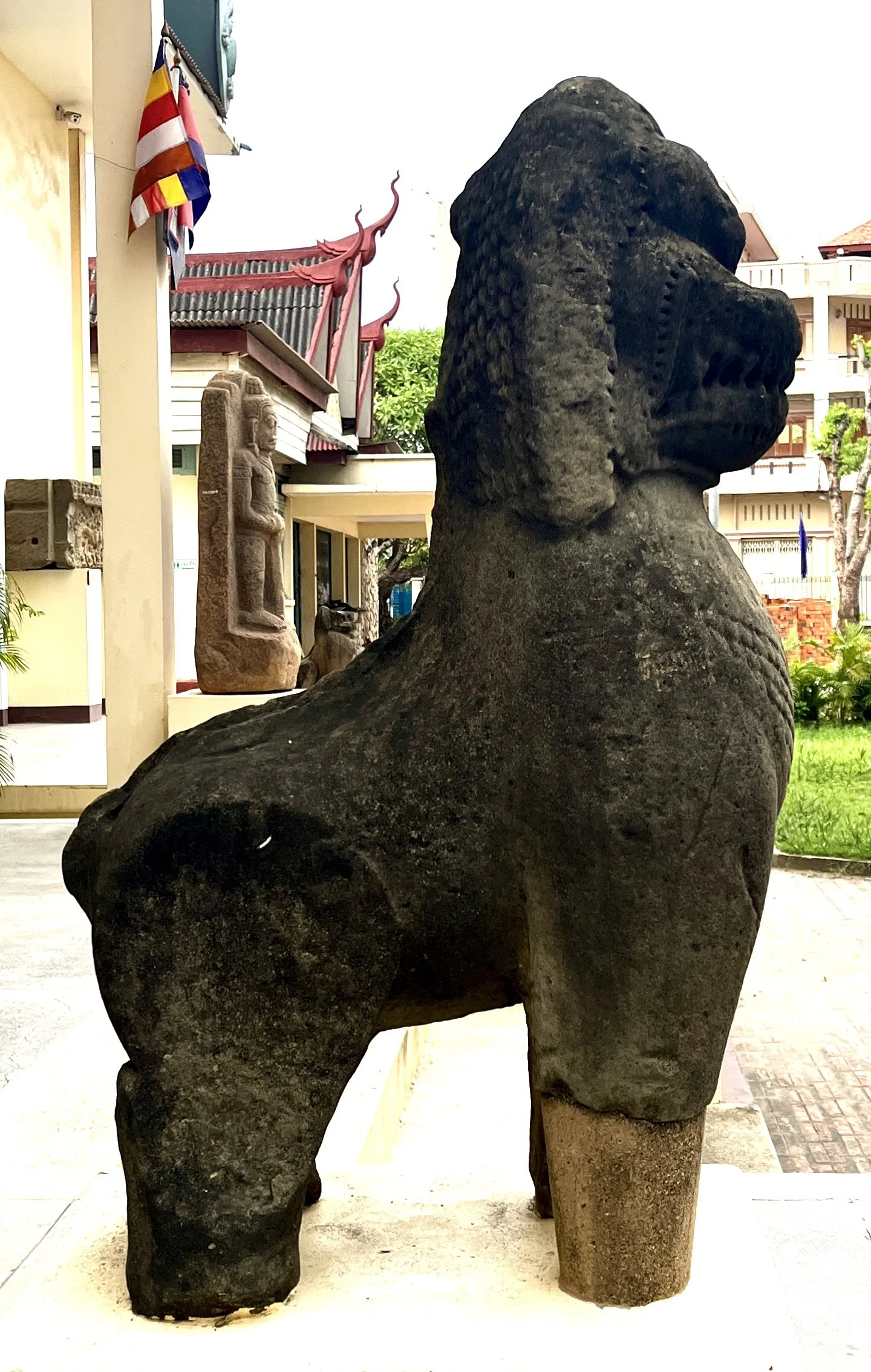
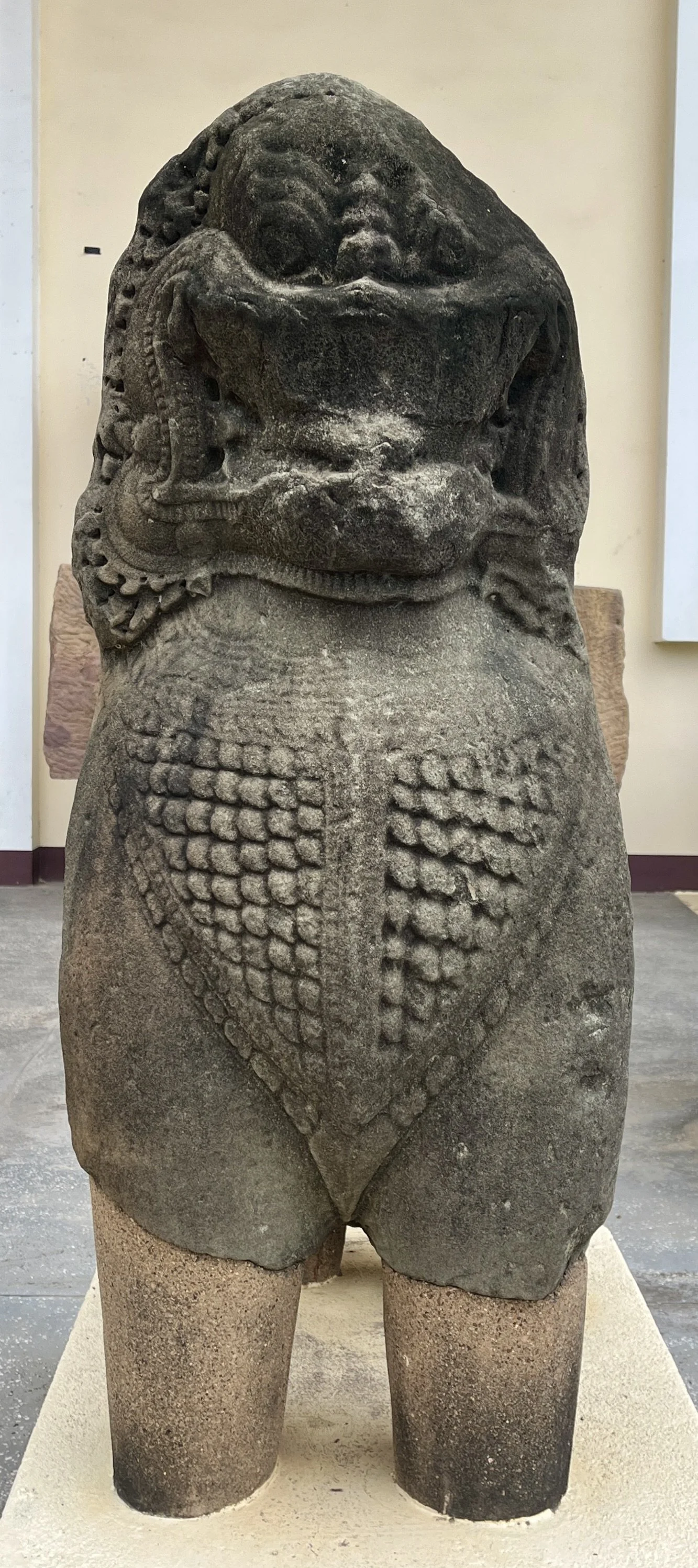
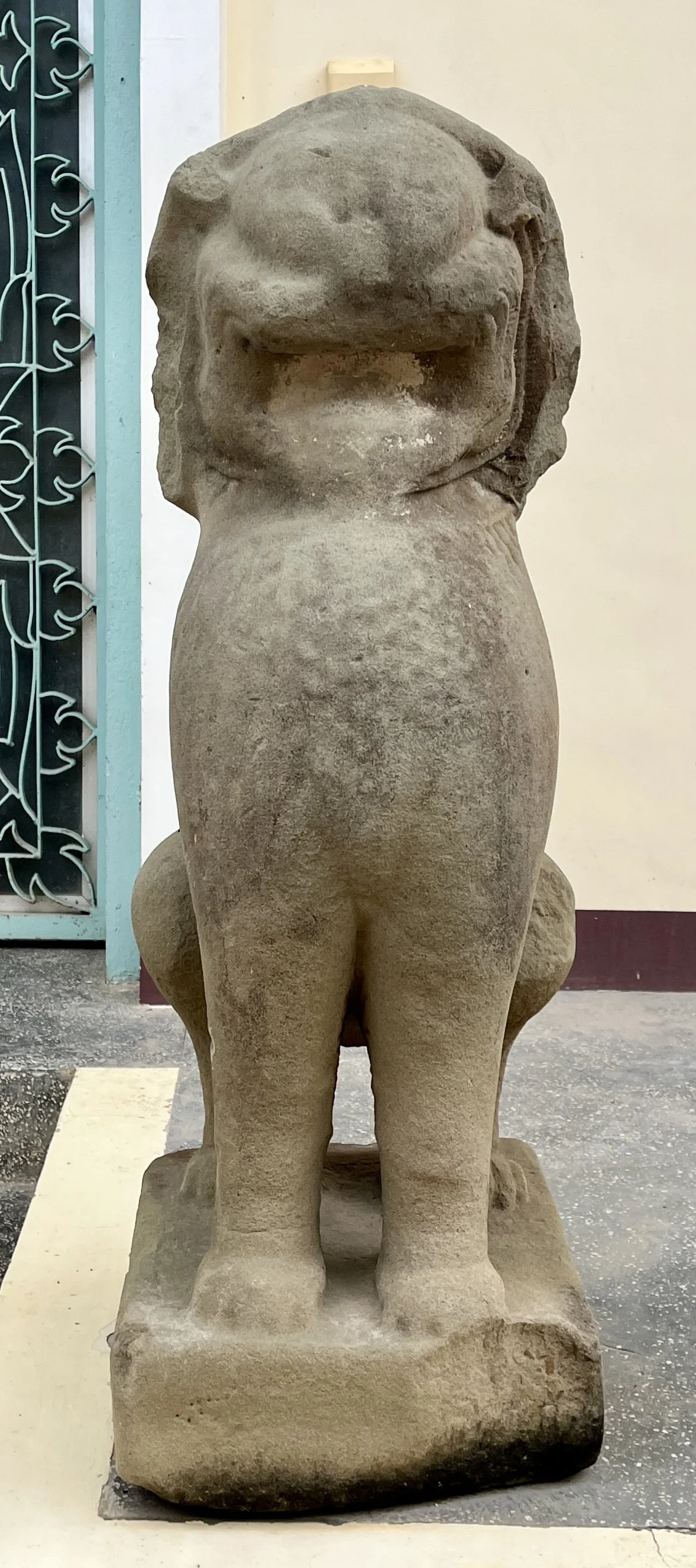
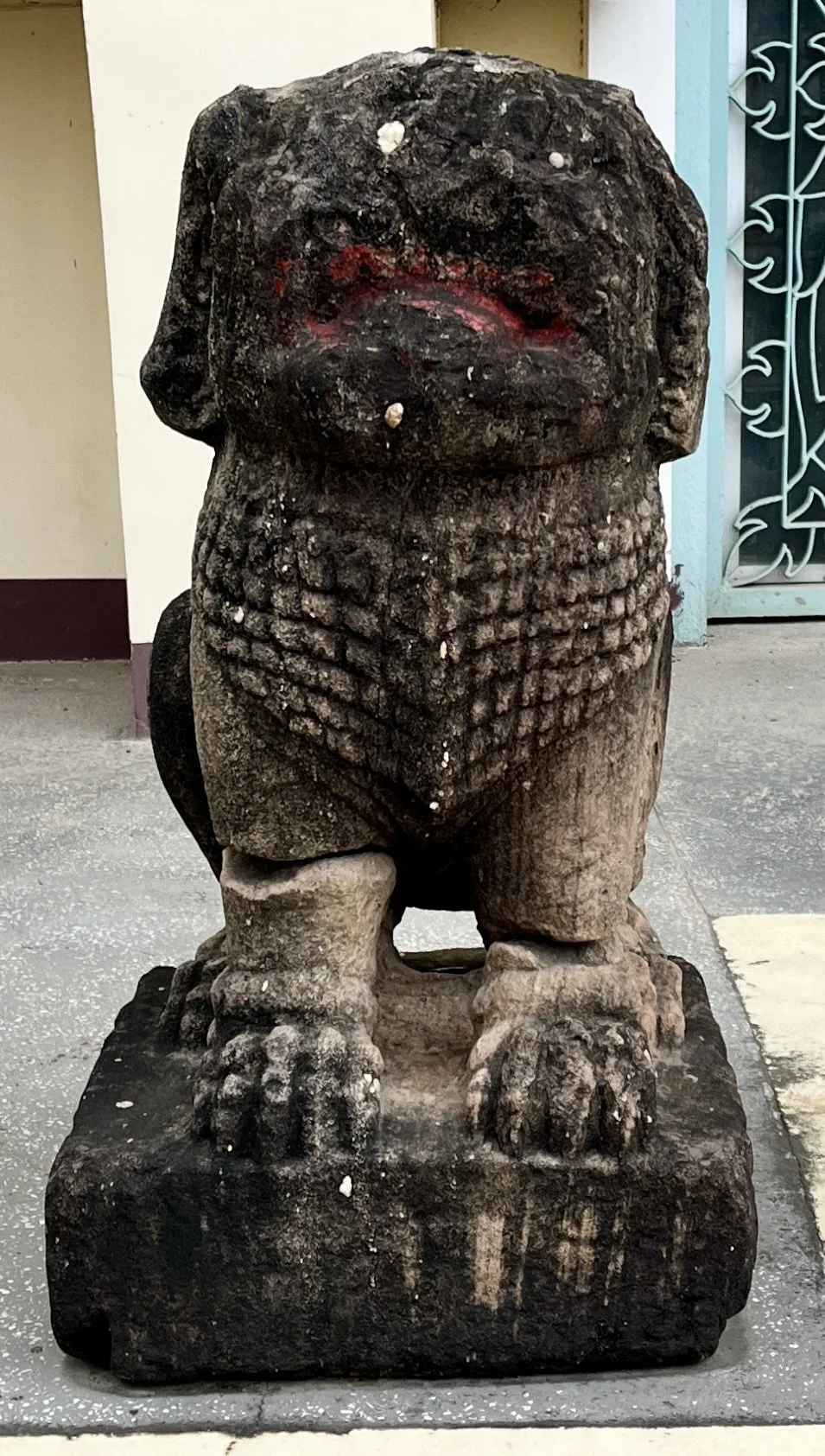
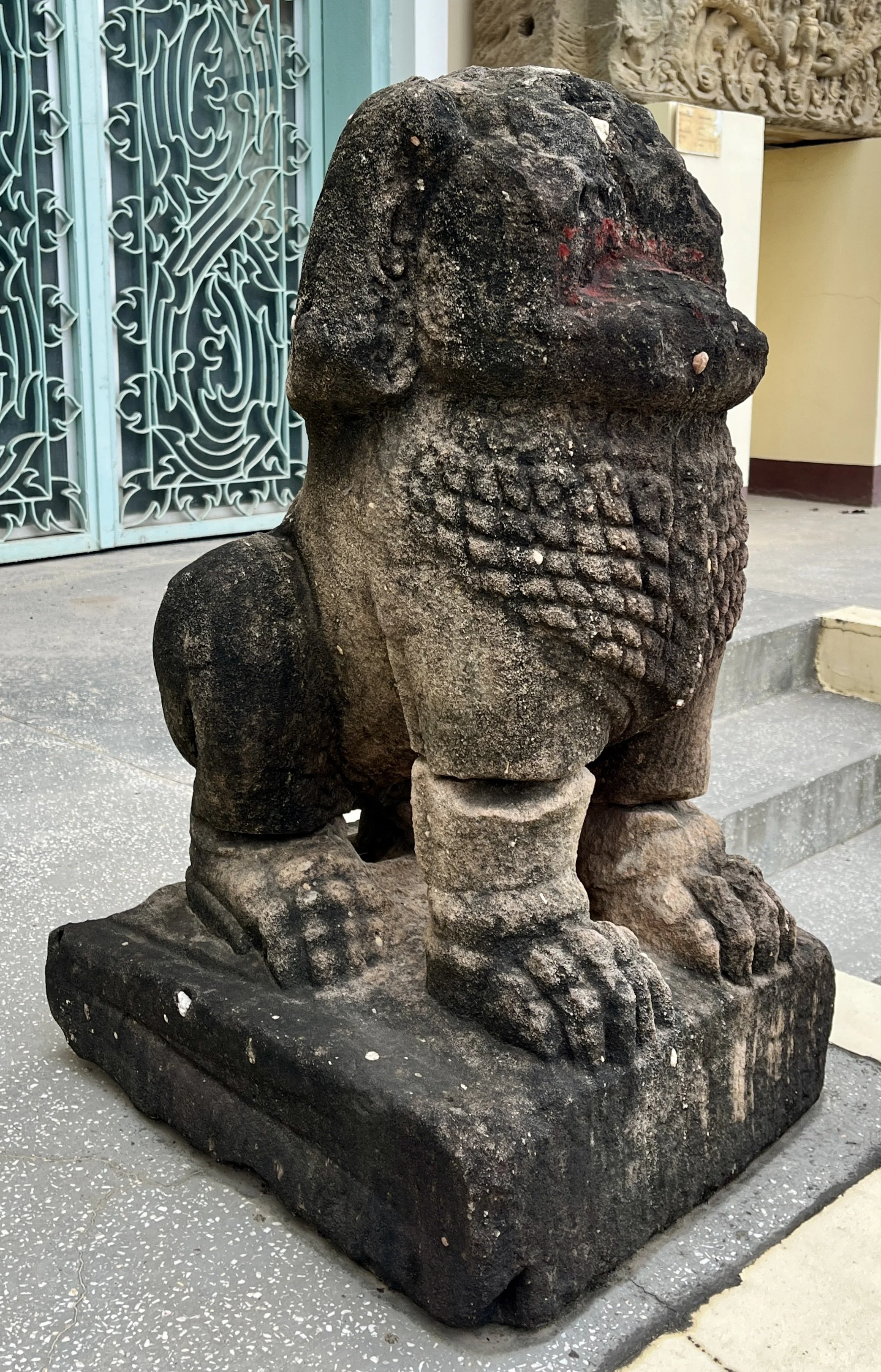
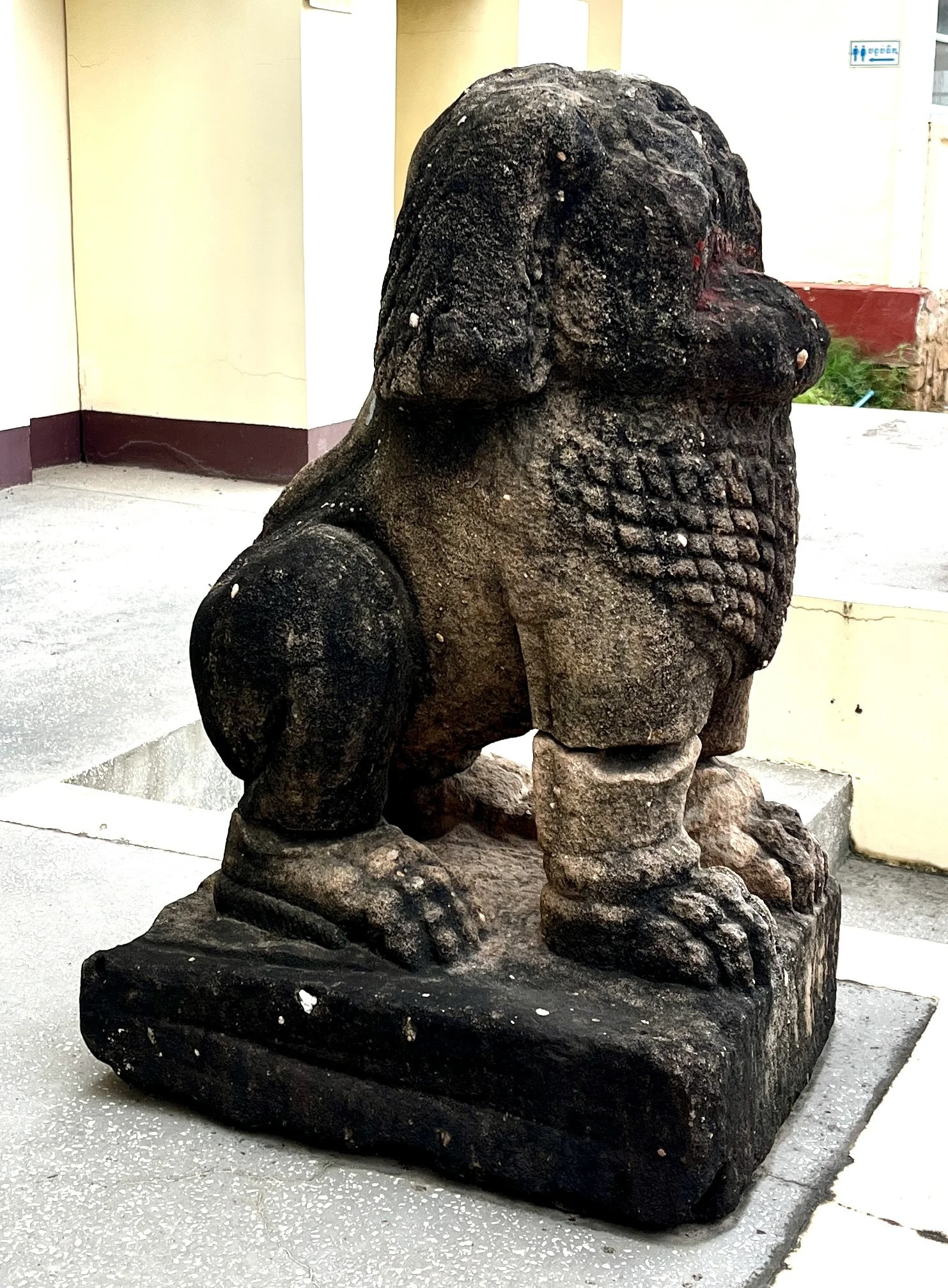
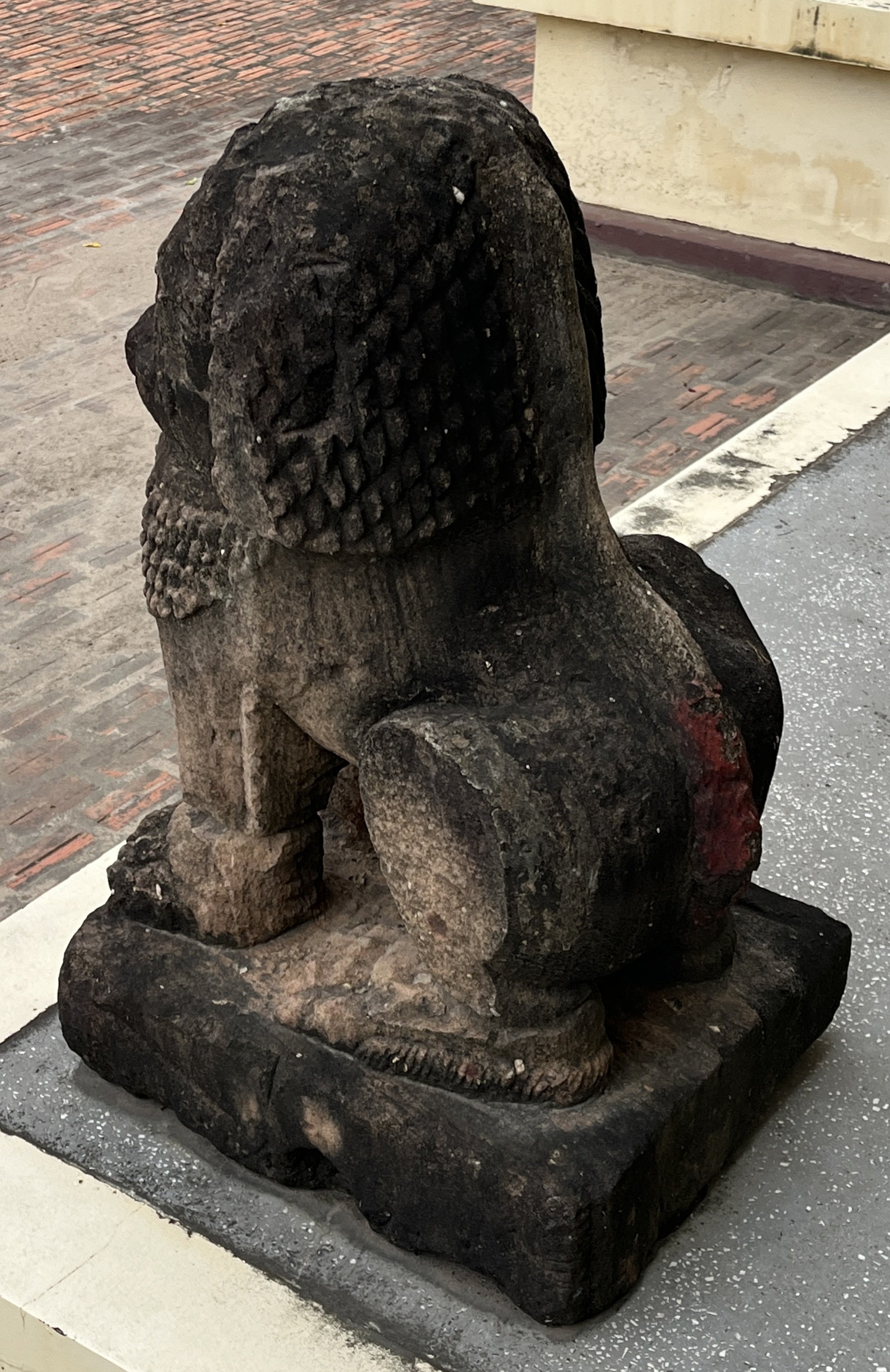
Right in front of the museum displays architectural elements such as lintels, guardians, and lions from the Angkorian period
2. The 1st room
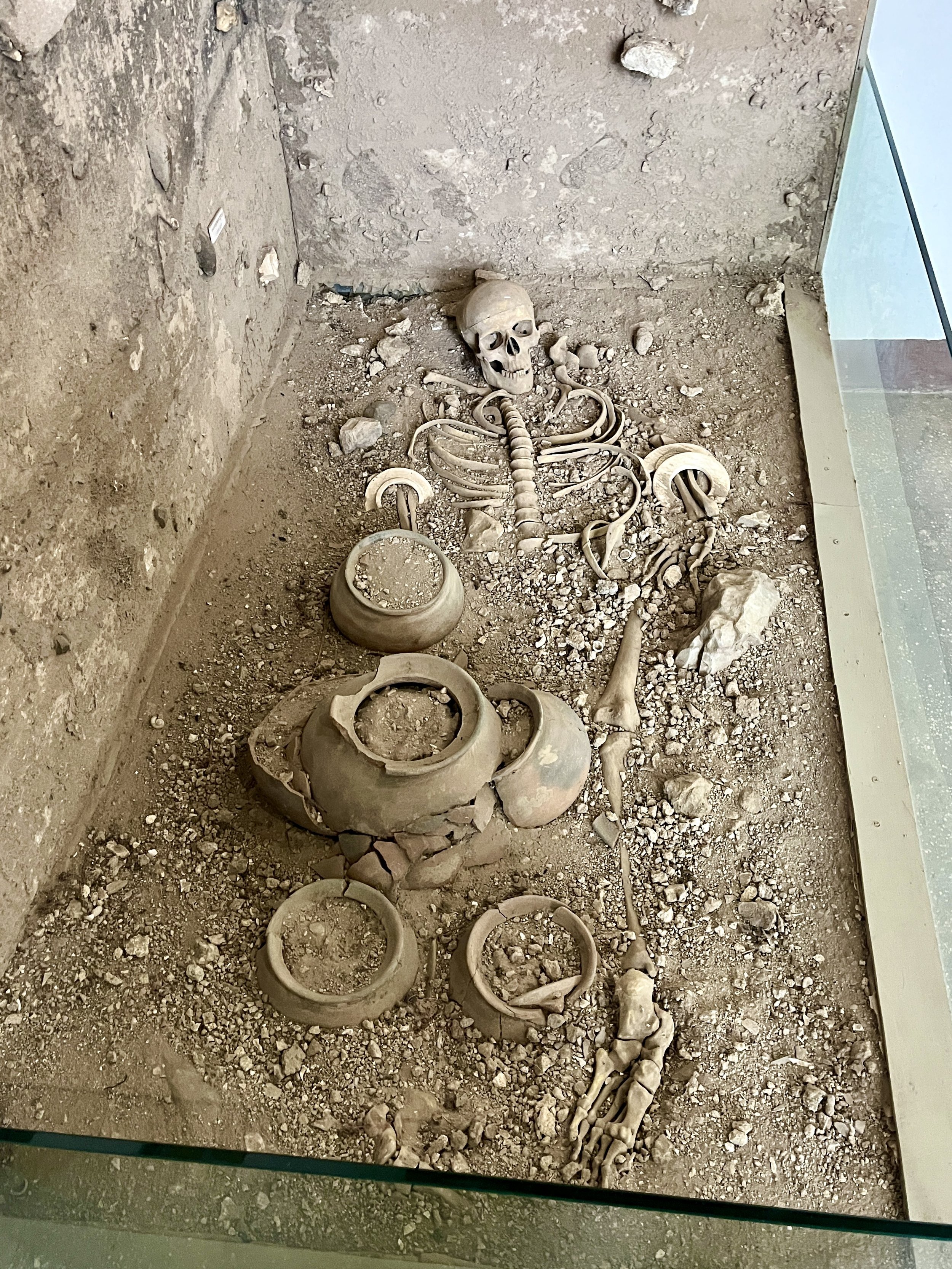
On the left-hand side displays a reconstruction of part of the cave and archaeological findings from the Laang Spean pre-historical site, and on the right-side displays pottery from pre-history, through the Angkorian period to the nineteenth century.
3. The 2nd room, on the left side
Displays different objects such as inscriptions, sculptures in Brahmanism including Yama, Ganesha, Krishna, Indra, Varuna etc., as well as some architectural elements. These artifacts can tell us about ancient society, politics and religions during the 10th to 12th century.
4. The 3rd room
The central part displays different types of objects from the two main religions, Brahmanism and Buddhism, and they are dated from the pre-Angkorian and Angkorian periods. The front part displays the three main gods of Brahmanism: Brahma at the front door as a welcome sculpture, Vishnu figures depicted in form of bas-relief on lintels and as sculpture, and Siva appearing in phallus and anthropomorphic forms. Back side of this gallery displays a group of Buddhist triad steles, consisting of three main deities: Prajna Paramita, Buddha and Lokesvara.
5. The 4th room on the right side
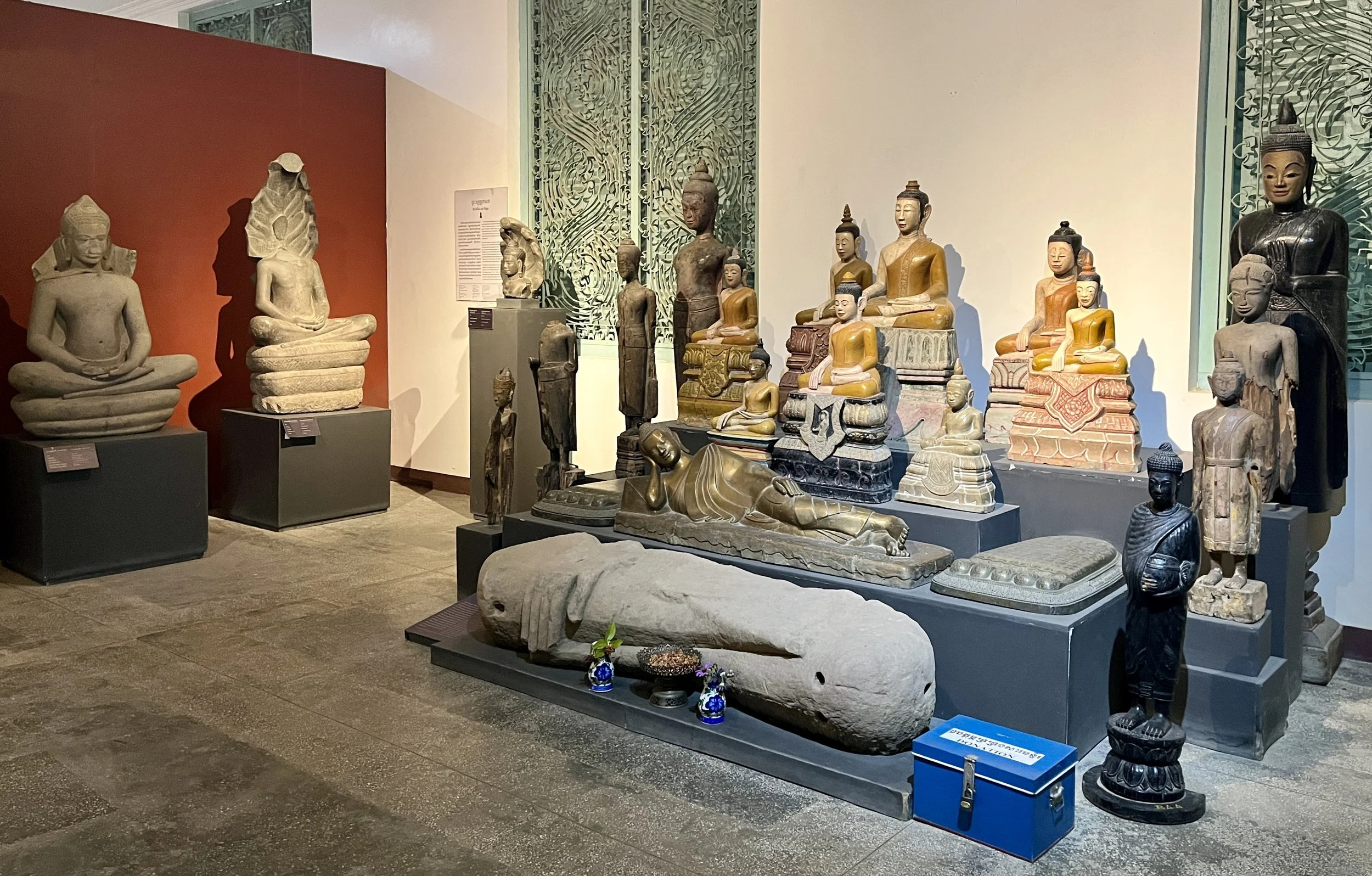
Continues from the back side of central room, this gallery displays deities from Mahayana Buddhism in the 13th century during the reign of King Jayavarman VII, along with God and Demons' heads representing the scene of the churning ocean of milk. The last part of this section displays a mixture of Buddha statues which are made of different materials such as stone, metal and wood from different periods, and Buddhist scriptures. This section represents a Buddhist monastery where Buddhist followers come to visit and pray.
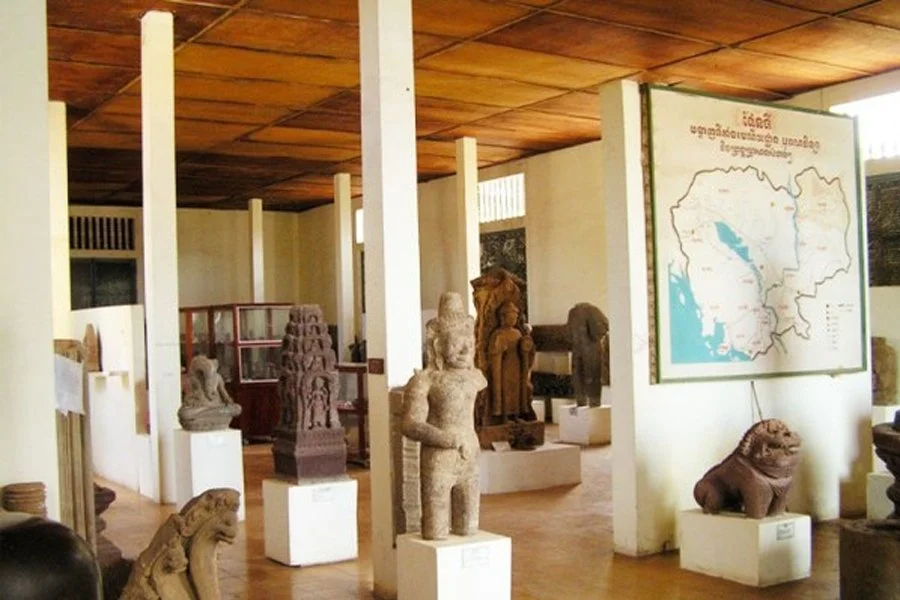
early 2010s, before the 2015 renovation
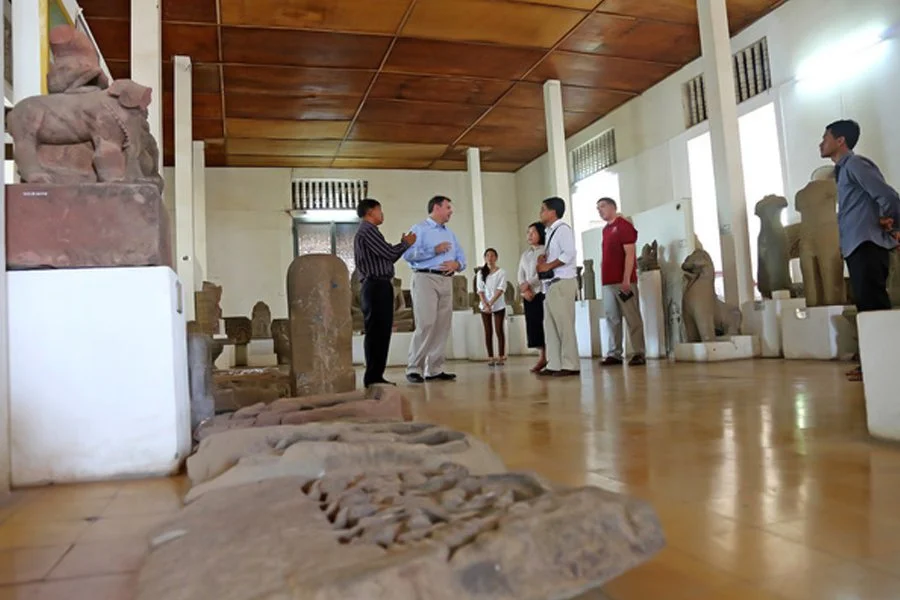
early 2010s, before the 2015 renovation
So what’s missing?
First, they’ve totally erased the role of the French– in particular the eminent French scholar Madeleine Giteau– from the museum’s history.
EFEO video about Madeleine Giteau’s work and legacy
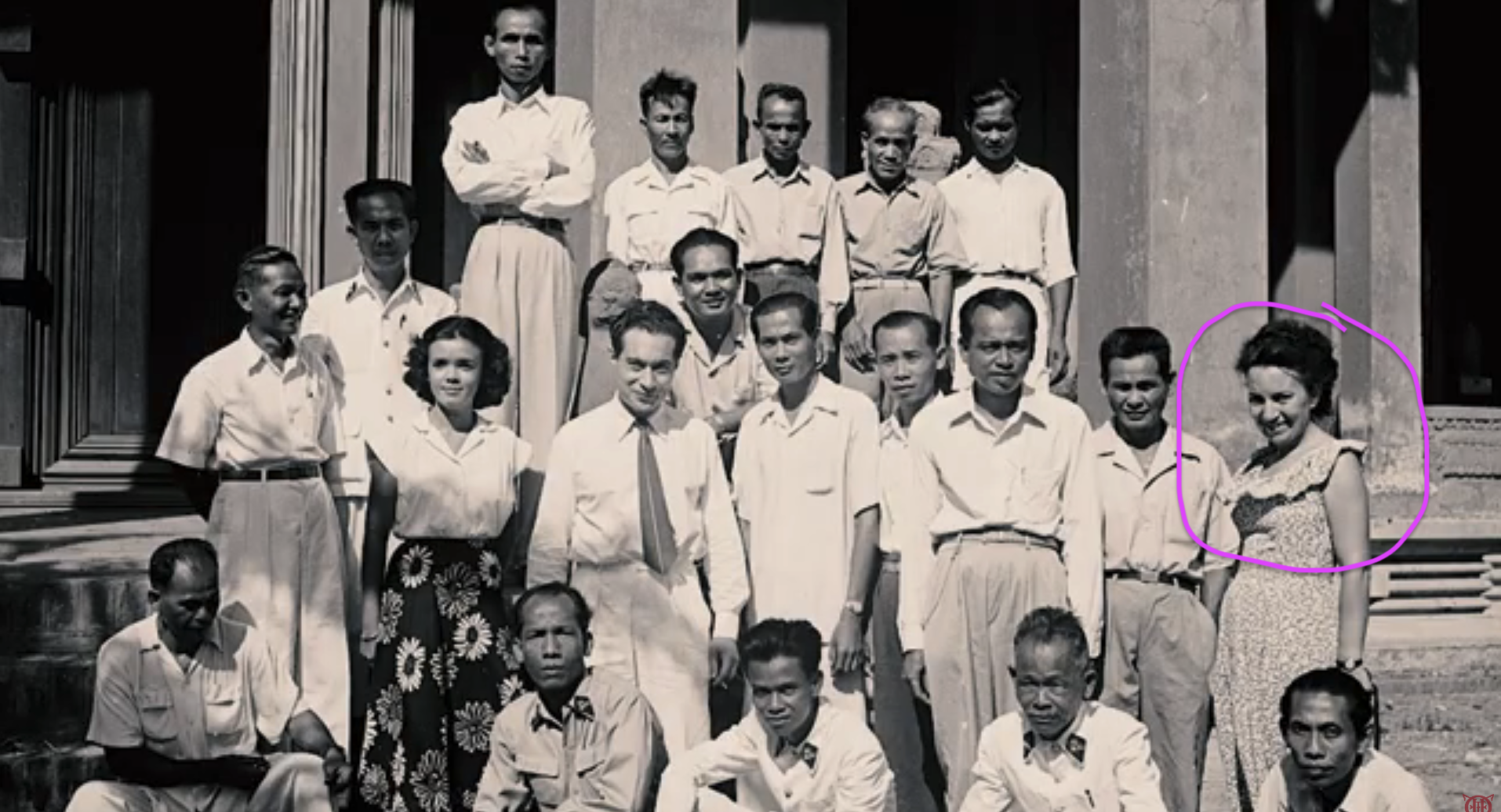
Madeleine Giteau with the team at the National Museum in Phnom Penh
Giteau deserves a blog post of her own (and I hope I eventually get around to it), but to summarize:
She was an EFEO historian, and the last French curator of the National Museum in Phnom Penh, from 1956 to1966.
She wrote seminal works on history and art history in the region: her 1956 History of Cambodia, for example, is still used as a textbook today, as is her 1965 Khmer Sculpture, 1974 History of Angkor, 1975 Iconography of Post-Angkorian Cambodia, etc. Further, she was engaged with the subject for over 50 years; her first paper with the EFEO was published in 1950, and her final book, (which she published at 82 years old) is the equally important 2001 Art and Archaeology of Laos.
She spent over 20 years in Cambodia, prior to and following the Khmer Rouge Era. She was undeniably responsible for the establishment of the Battambang Museum, and arguably the most impactful individual in its history. She did everything including: collaborating on the architecture and supervising construction (which began in1963); assembling the collection and meticulously archiving photographs and notes on each piece; training local Cambodian curators and handing it over to their management in 1966; returning during and after the Khmer Rouge era (throughout the 80s and 90s), to record what had been moved or gone missing; and supervising the 2000 reopening.
Born in 1918 and passing away in 2005, she was the generational link between the original French colonial specialists/explorers and the present system, having begun her career working with Henri Parmentier; continued during the unlivable KR years as a lecturer in SEA art and history at the Sorbonne; and ended as an esteemed collaborator of the Royal Archaeological Faculty of Cambodia.
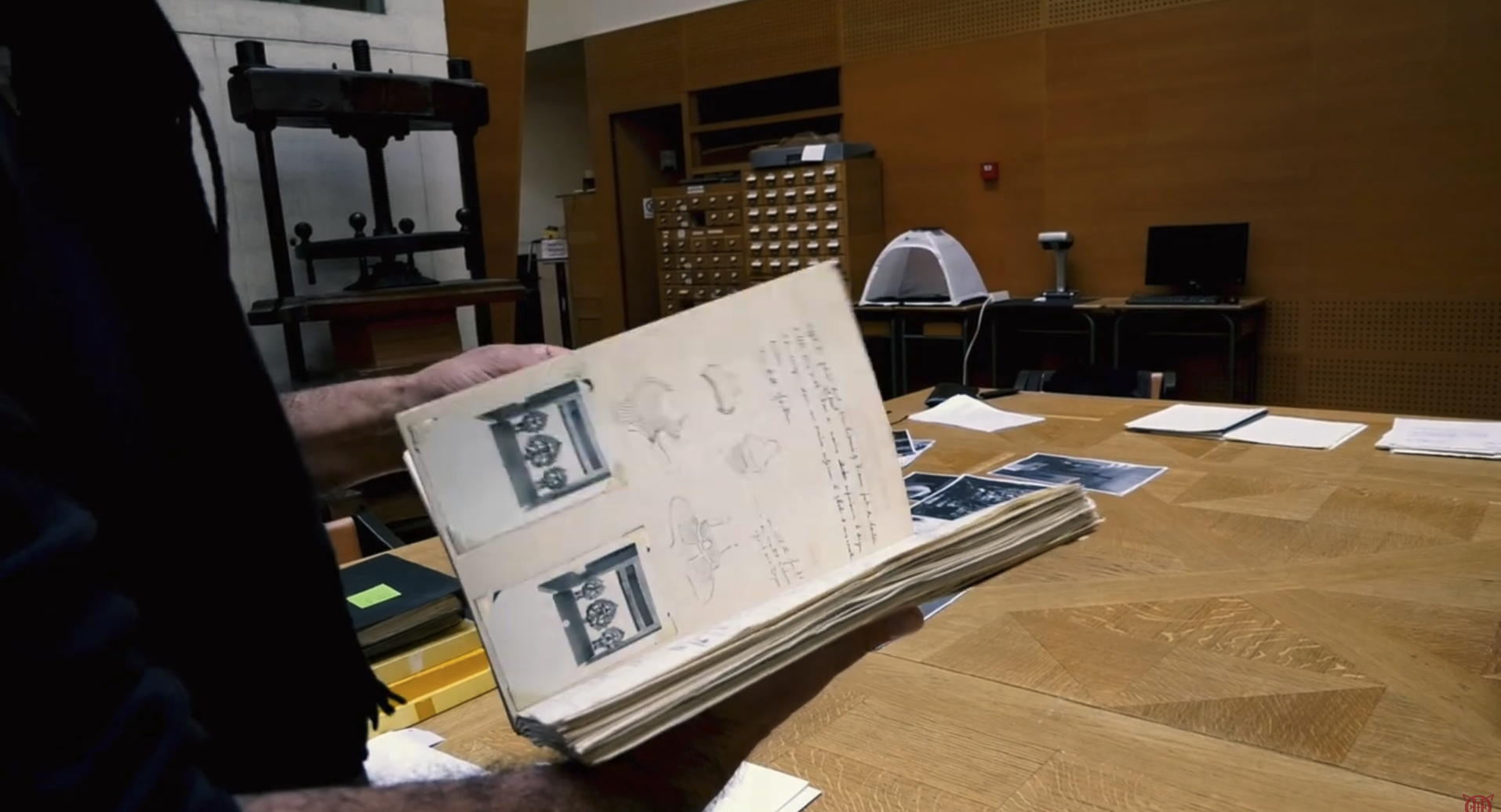
One of Giteau’s notebooks detailing the collections in Phnom Penh and Battambang, held at EFEO
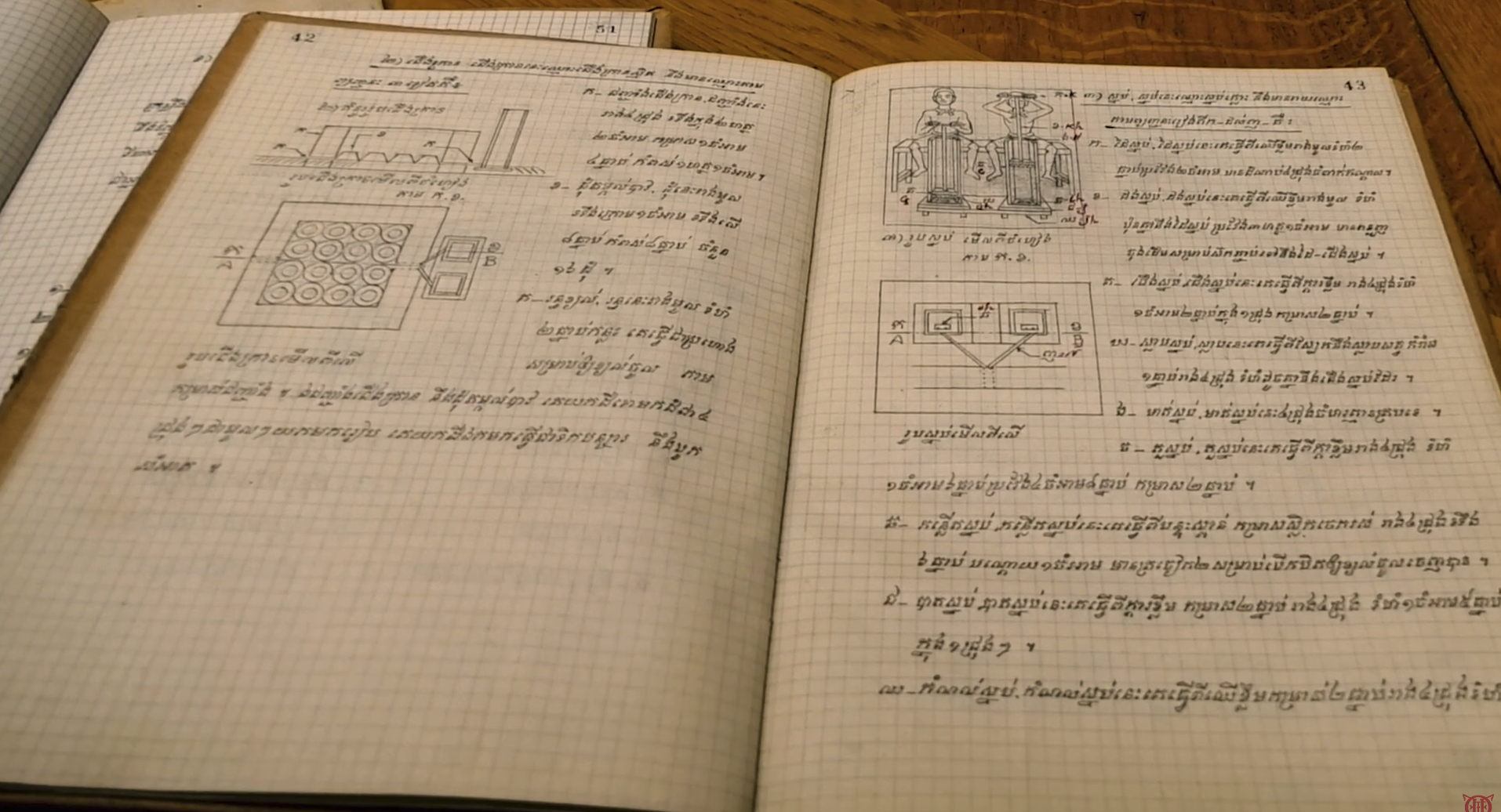
In the Giteau era, the original siting of artifacts was carefully and scientifically recorded wherever possible. This obviously disappeared later on.
Second, they’ve omitted the thievery the collection suffered, likely at the hands of Douglas Latchford.
The aforementioned Friends of Khmer Culture Inc. (founded by Helen Ibbitson Jessup to publish scholarly works, fund conservation efforts, and create educational resources) ostensibly ran a program to prevent looting by cataloguing the holdings of Cambodian Provincial Museums, including the Battambang Museum. In reality, Latchford served as the organization's primary art advisor and acquisition agent, in charge of using their money wisely to repatriate Khmer art. He sold stolen Khmer artifacts to Friends of Khmer Culture Inc., who would then donate them to Cambodian institutions, primarily the National Museum of Cambodia.
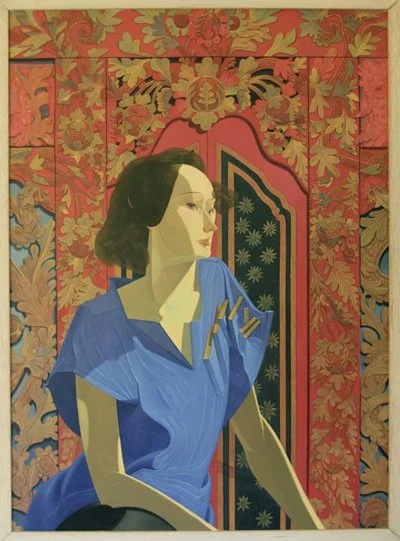
Portrait of Helen Jessup by Lawrence Preece
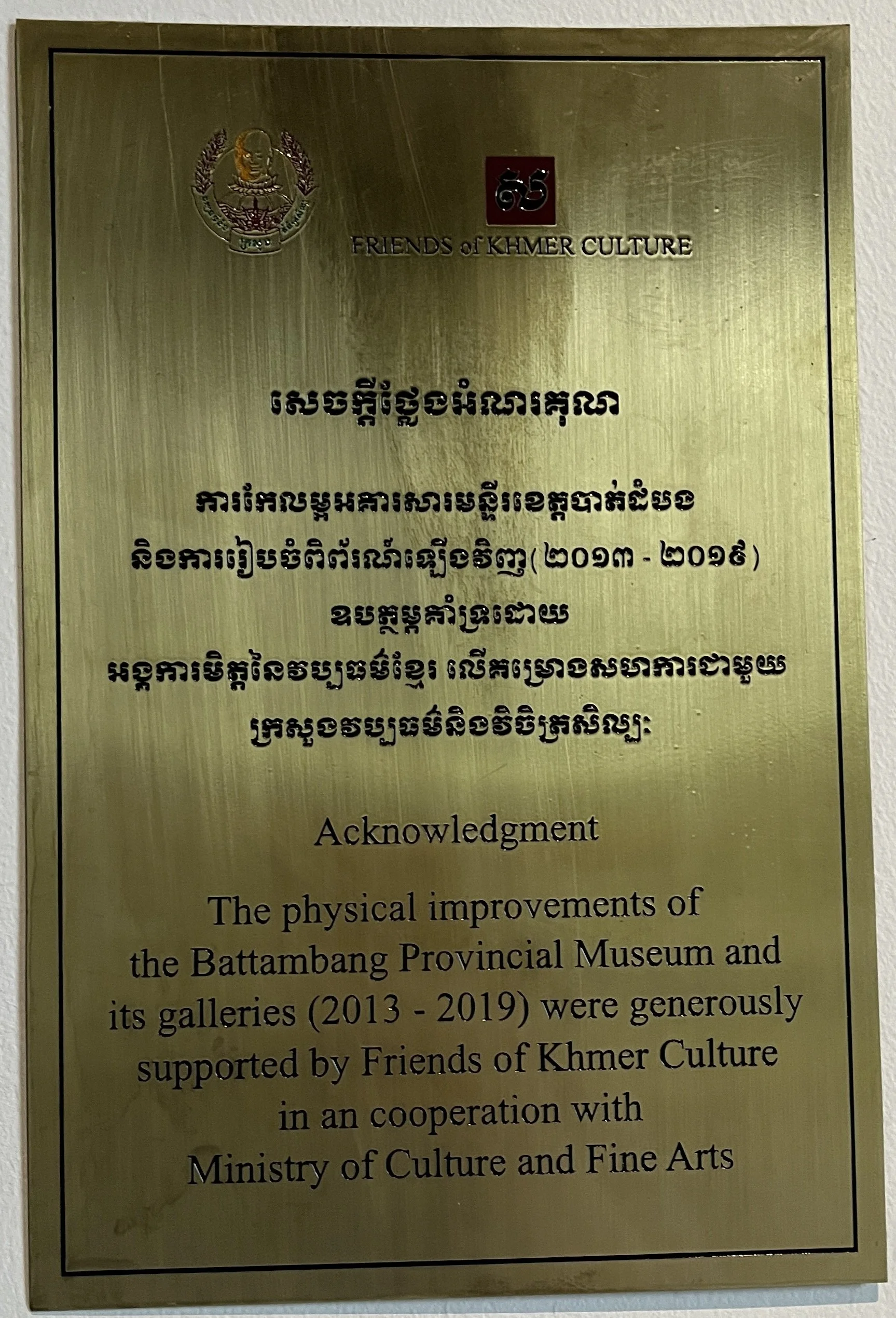
Plaque commemorating the now disbanded FOKCI
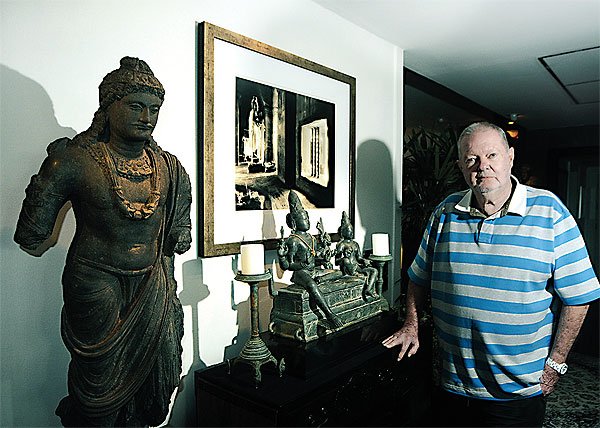
Douglas Latchford in his London apartment
So, Latchford triple dipped: first he profited from looting Cambodian artifacts and selling them abroad; then he profited from participating in various ways in the repeated trades, sales, auctions, and donations of these objects abroad; and finally he profited from selling them back into Cambodia. Emma Bunker’s academic credentials provided scholarly legitimacy to his collection and activities on the way out, and Helen Jessup’s did the same on the way back in. The expansion of the Battambang Museum’s collection in the ‘90s and 2000s was, ironically, funding continued looting and illicit trading in Khmer artifacts.
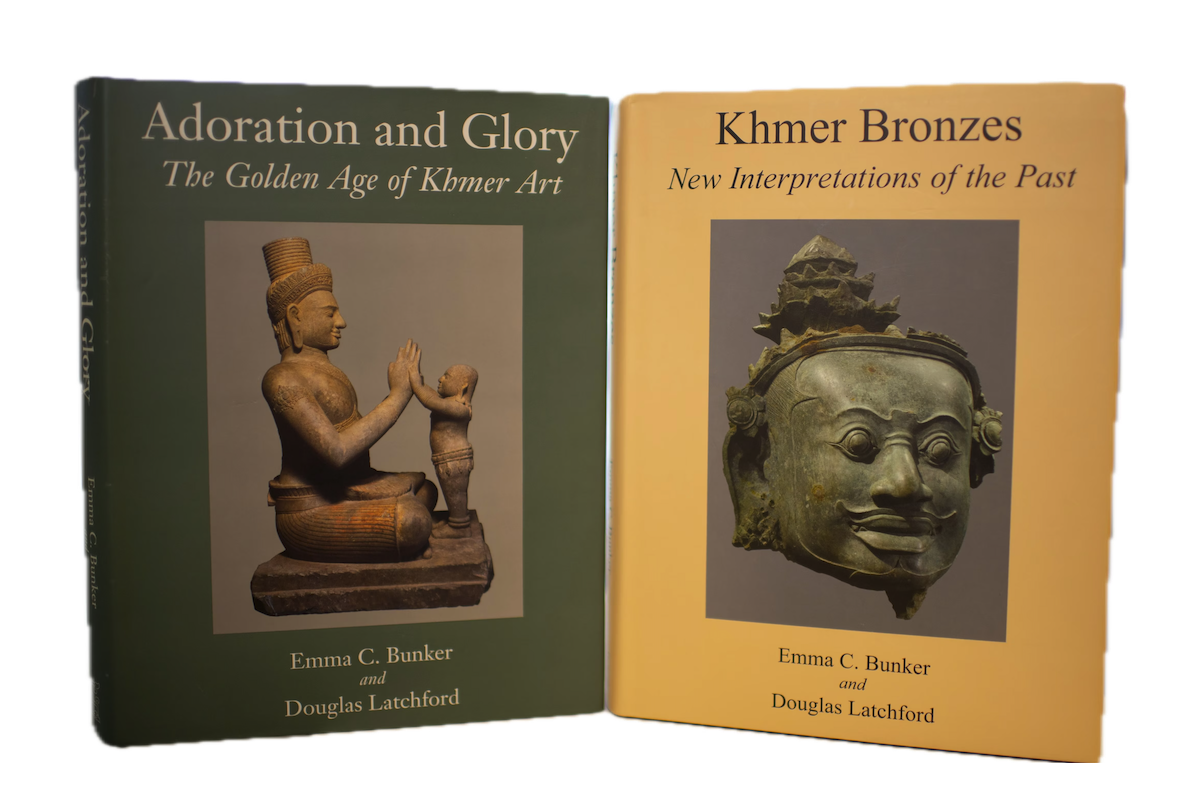
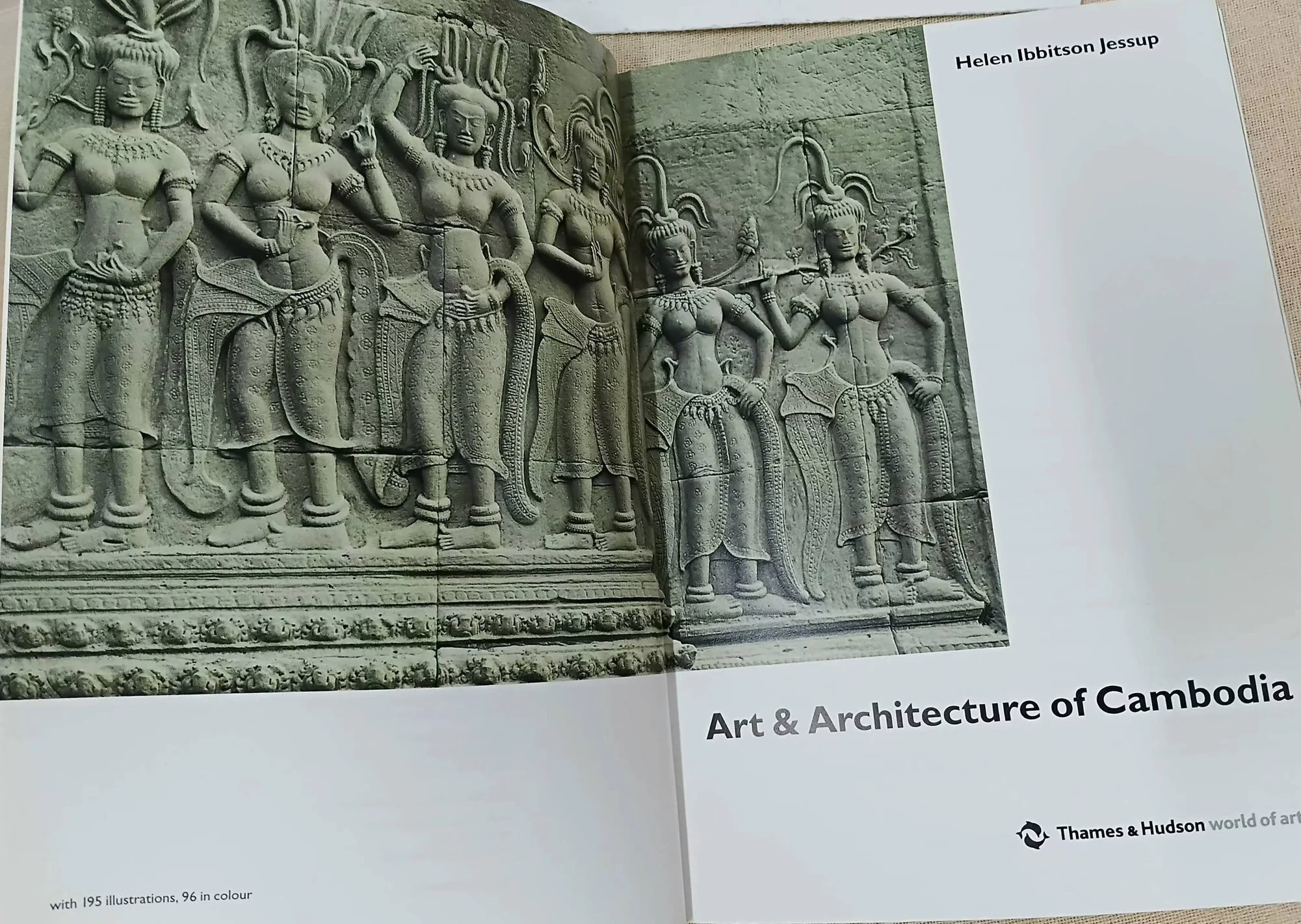
In addition to inventorying the collection, Friends of Khmer Culture Inc.’s 2015 makeover of the Battambang Museum fixed roof leaks, installed a new lighting system, reorganized displays, and installed the current (unforgivably flawed) Khmer/English signage . . . but 29 objects detailed in Giteau’s original inventory were recorded as missing, and as of May 2026 remain so. As of my 2026 visit, I’m also a bit confused; there are supposedly 1000+ objects in the collection, so why are fewer than 250 on display? It’s very clear that the same objects have been on display for over a decade, probably longer. Where are the rest?
Was Jessup a victim, a conspirator, an intentional or unintentional money launderer? She’s still a respected academic, supposedly working on a book titled Angkor and Beyond since 2010. Friends of Khmer Culture Inc., however, quietly ceased operations and publishing in the lead-up to Latchford’s 2019 indictment, and as of 2026 the company’s website has disappeared.
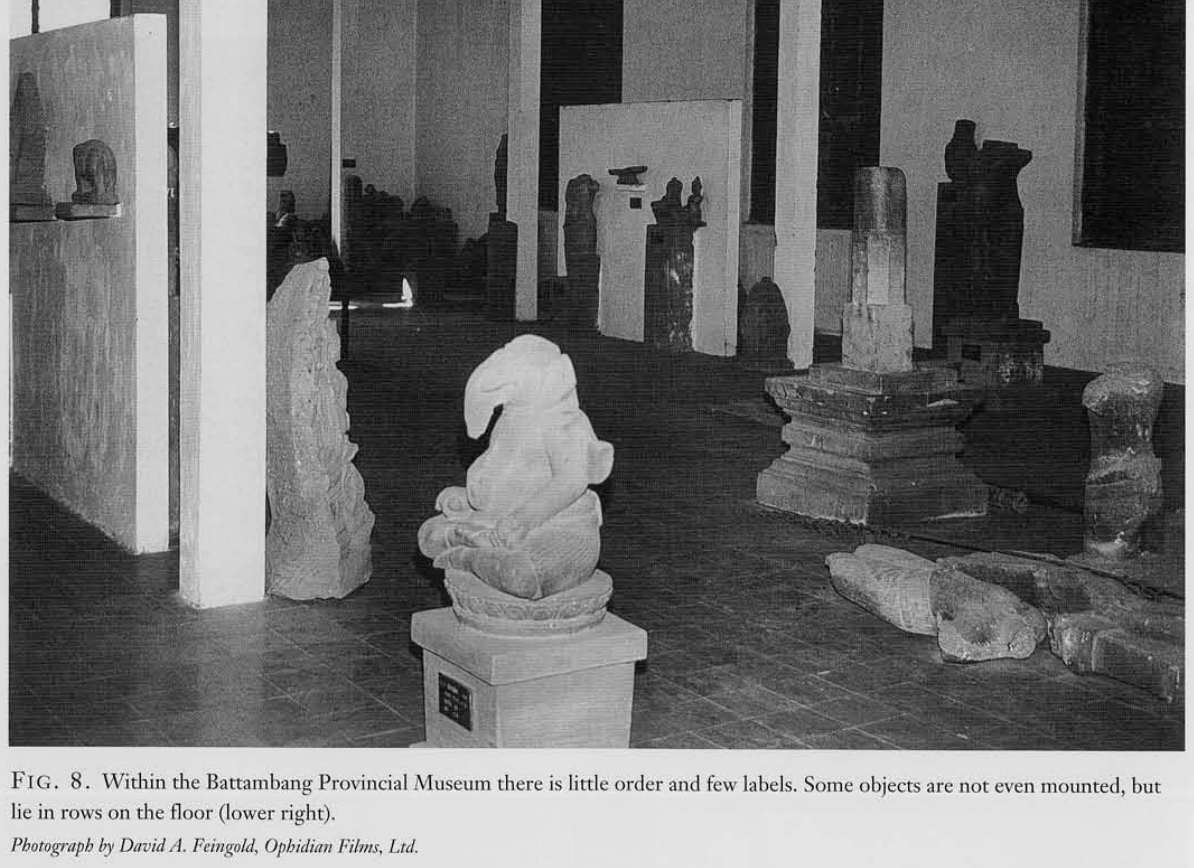
November 1993
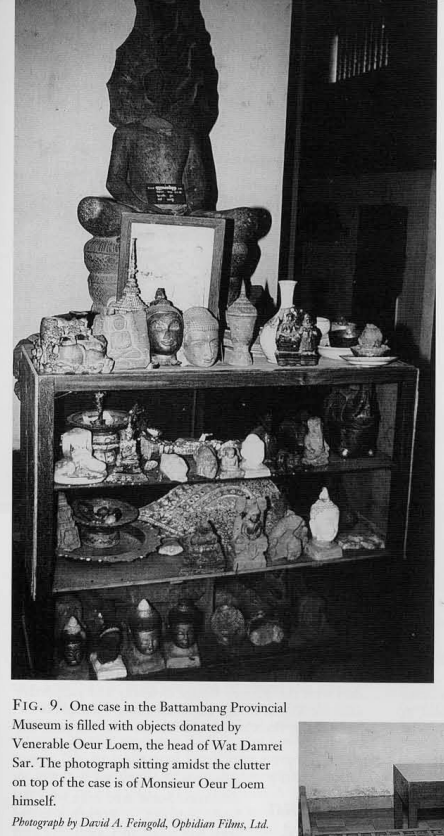
November 1993
Lastly, the historic relationship the museum has had with the Wat Po Veal museum is unmentioned, which I think does tourists a disservice. When locals in the province come across an artifact accidentally (usually digging a plumbing system, plowing a field, draining a pond etc.) and don’t attempt to sell it, they always bring it first to Wat Po Veal, and only to the Battambang Museum if rejected by Wat Po Veal . . . if they go to the Battambang Museum at all.
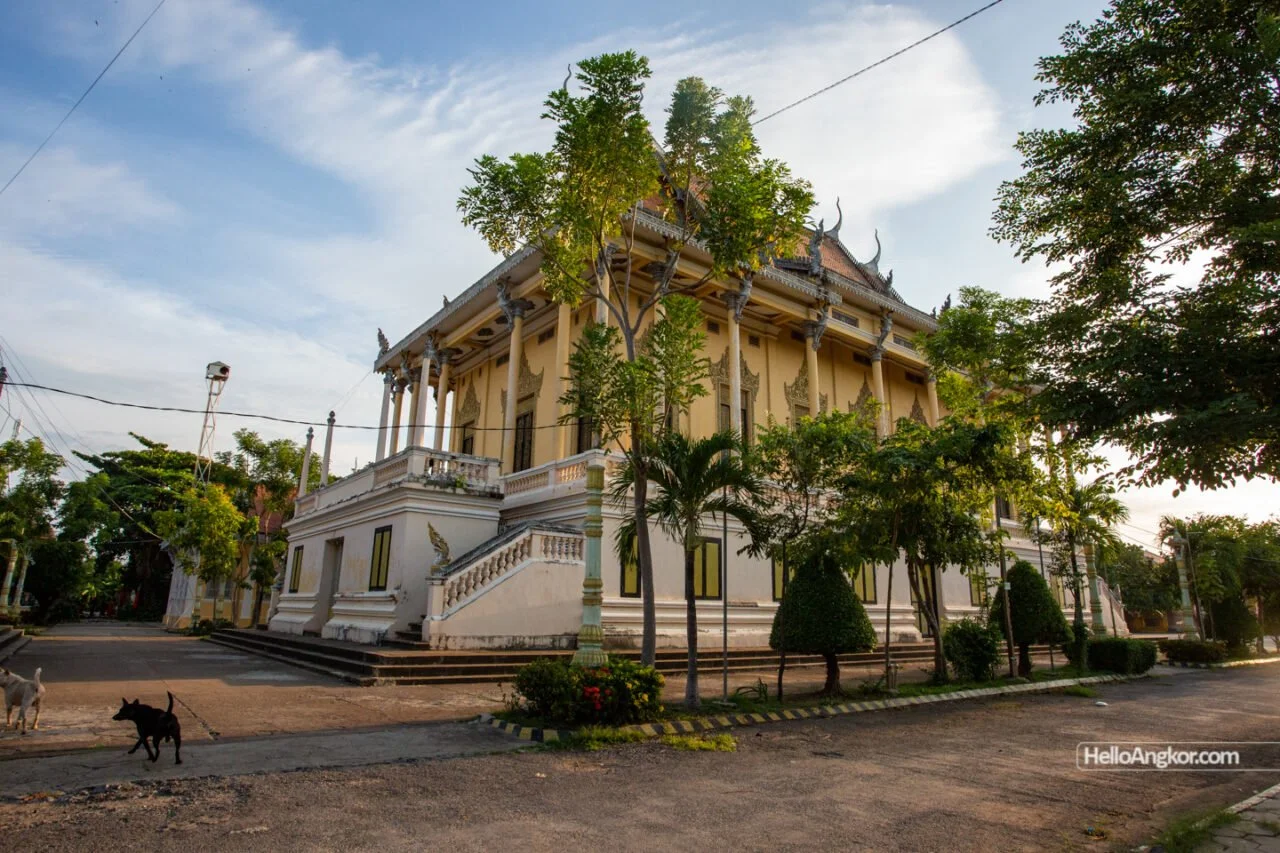
Wat Po Veal
In the 1920s, Samdech Vannarath Iv Tuot put out the word among locals that Wat Po Veal was the place to bring any artifacts, to make merit and keep them safe. By the 50s, under Tuot’s leadership, the displays at Wat Po Veal had become arguably the best museum in Cambodia, with a collection rivaling if not surpassing the National Museum in Phnom Penh; in 1957 a new, two-story Vihear was constructed solely for its display. Valuable artifacts Tuot deemed redundant or of relatively lower quality were turned away with some frequency.
Then and now, if the villagers finding artifacts can’t make merit, many would at least like to make money; the local police and village chiefs have been equally as likely to connect them with looters for a cut as to connect them with academics in Phnom Penh. In the eyes of the newly independent (as of 1953) Cambodian government and the French administrators of museums and archaeological sites invited to stay on (until 1966) for a smooth transition, the number and quality of objects rejected by Wat Po Veal necessitated the founding of the Battambang Provincial Museum, whose collection was initially comprised entirely of unwanted Wat Po Veal donations.
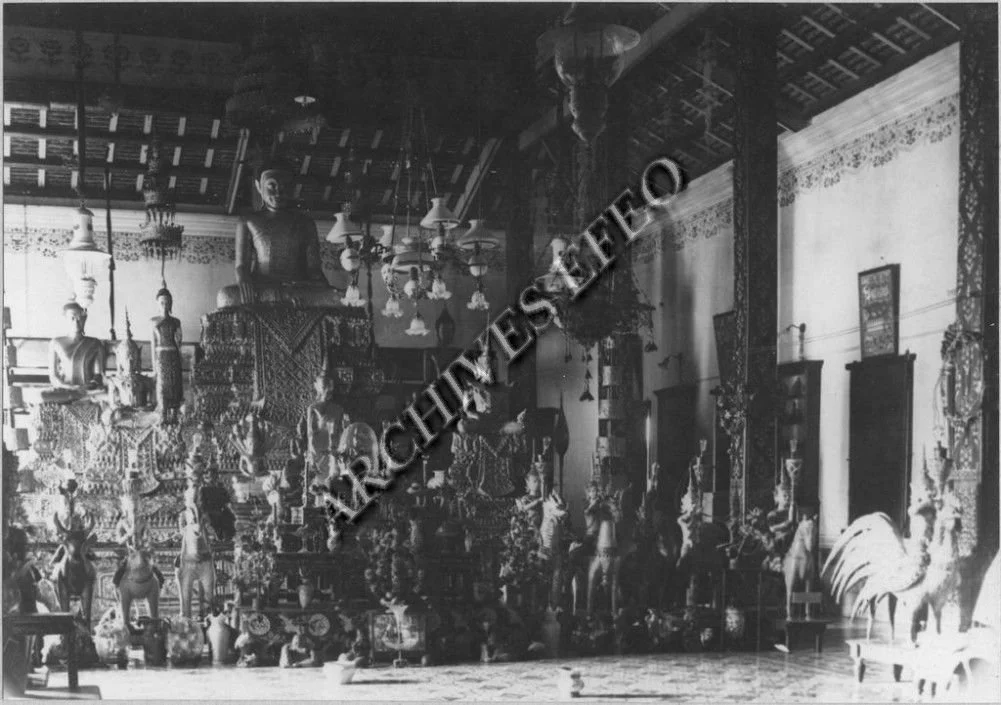
Wat Po Veal in 1934
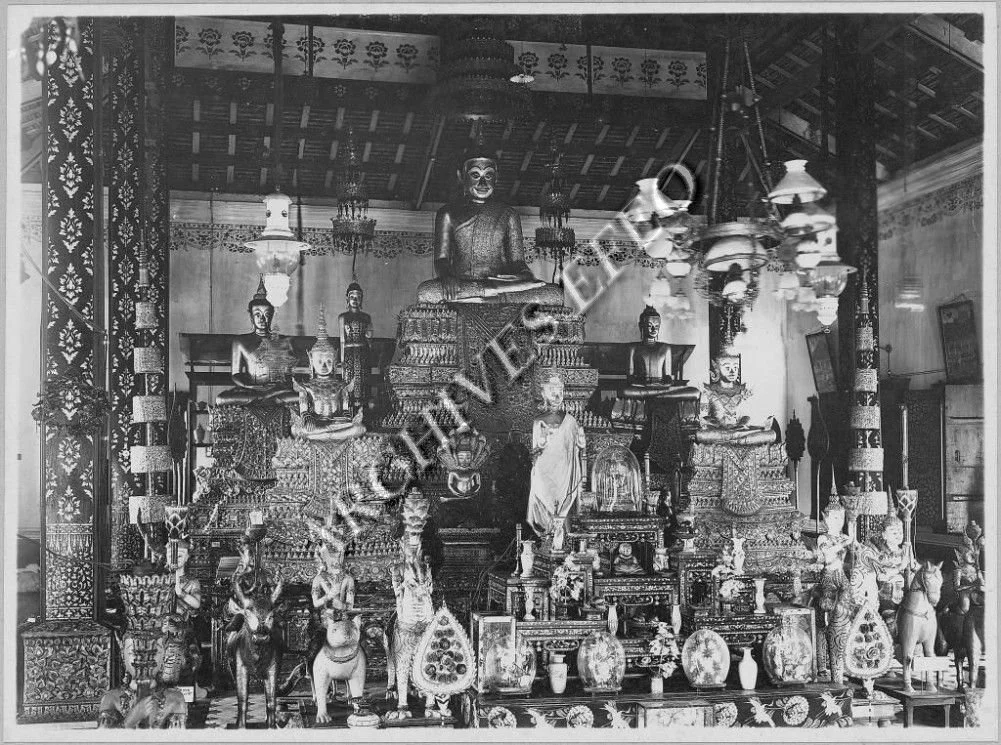
Wa Po Veal in 1937
In his later years, having seen the progress and investment in the provincial museum, Tuot petitioned to have Wat Po Veal also officially recognized as a state museum. Madeleine Giteau, already in Battambang, was dispatched to organize and catalogue Wat Po Veal’s collection and get the displays ready for the public, which she did in 1965. The Wat Po Veal Museum officially opened in 1967, and the Battambang Provincial Museum in 1968.
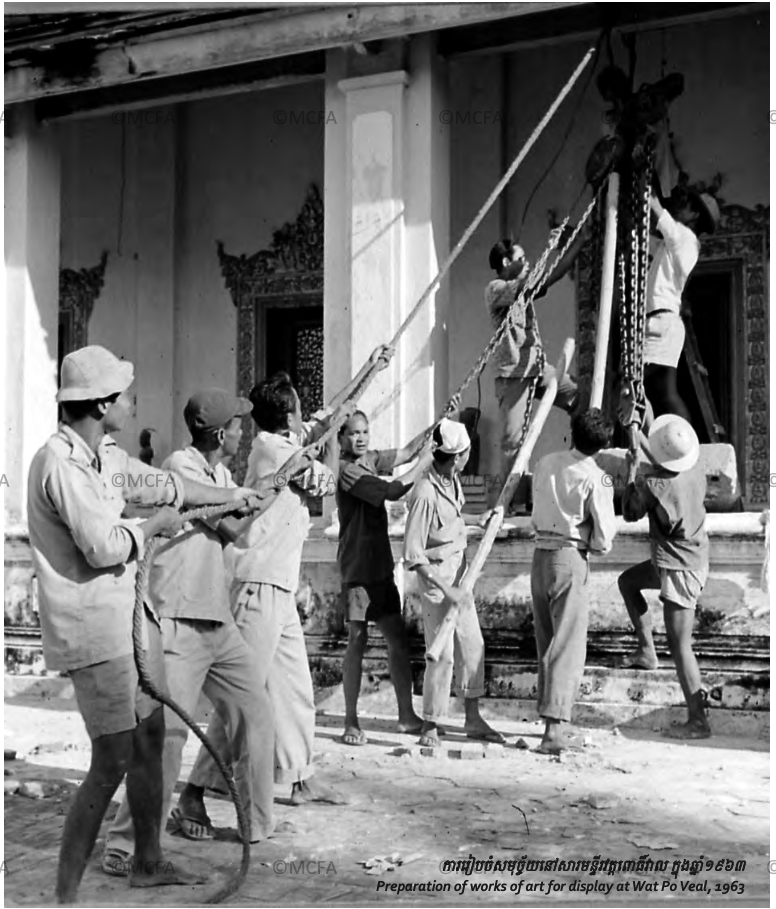
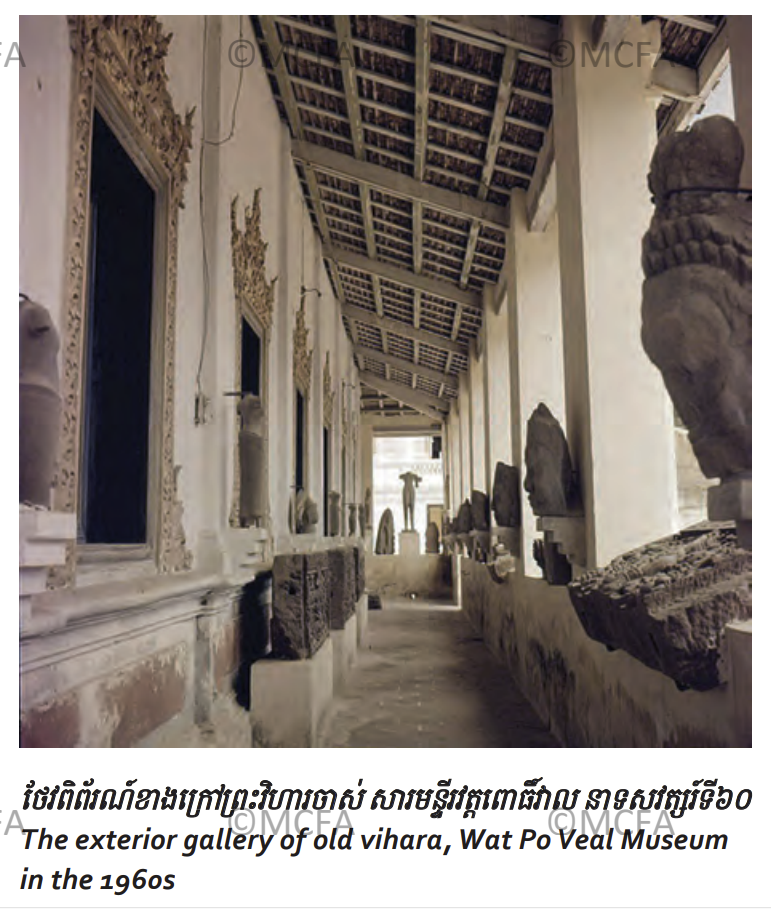
Unfortunately, Wat Po Veal’s once vast collection has been inaccessible to the public since the beginning of the Cambodian Civil War in 1967, and was totally decimated by the 1980s. Artifacts suffered various fates: many were transported to the National Museum at various points; others looted; still more were buried for safekeeping, then lost when whoever buried them was murdered by the Khmer Rouge.
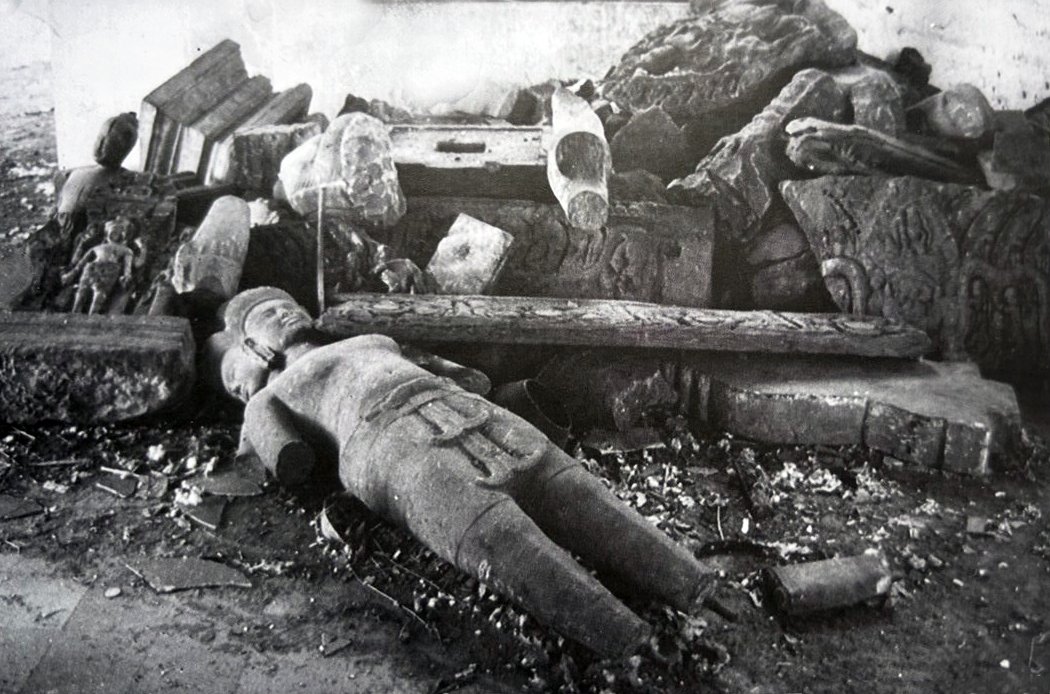
Wat Po Veal in the 1980s
In 2015, a reporter from the Phnom Penh Post who gained access to the Vihear said it had just become a messy pile of artifacts and antiques, many broken, most not even propped up but piled haphazardly on the floor. He estimated there were around 300 objects there, but wasn’t able to access the upstairs where most of the collection was once held. He wrote that the door hadn’t been opened in so long the lock was stiff and had to be forced.
Most disturbingly, when asked what she said to people looking for the museum, the caretaker, Huon Nin, said no one ever asked. When pushed as to what she would say to anyone who did ask, she replied: “I don’t care about it so I haven’t tried to find out. It’s the history of people who lived here a long time ago.” That’s wilful neglect at best, the lady doth protest too much at worst, unacceptable either way, and nothing has changed over a decade later.
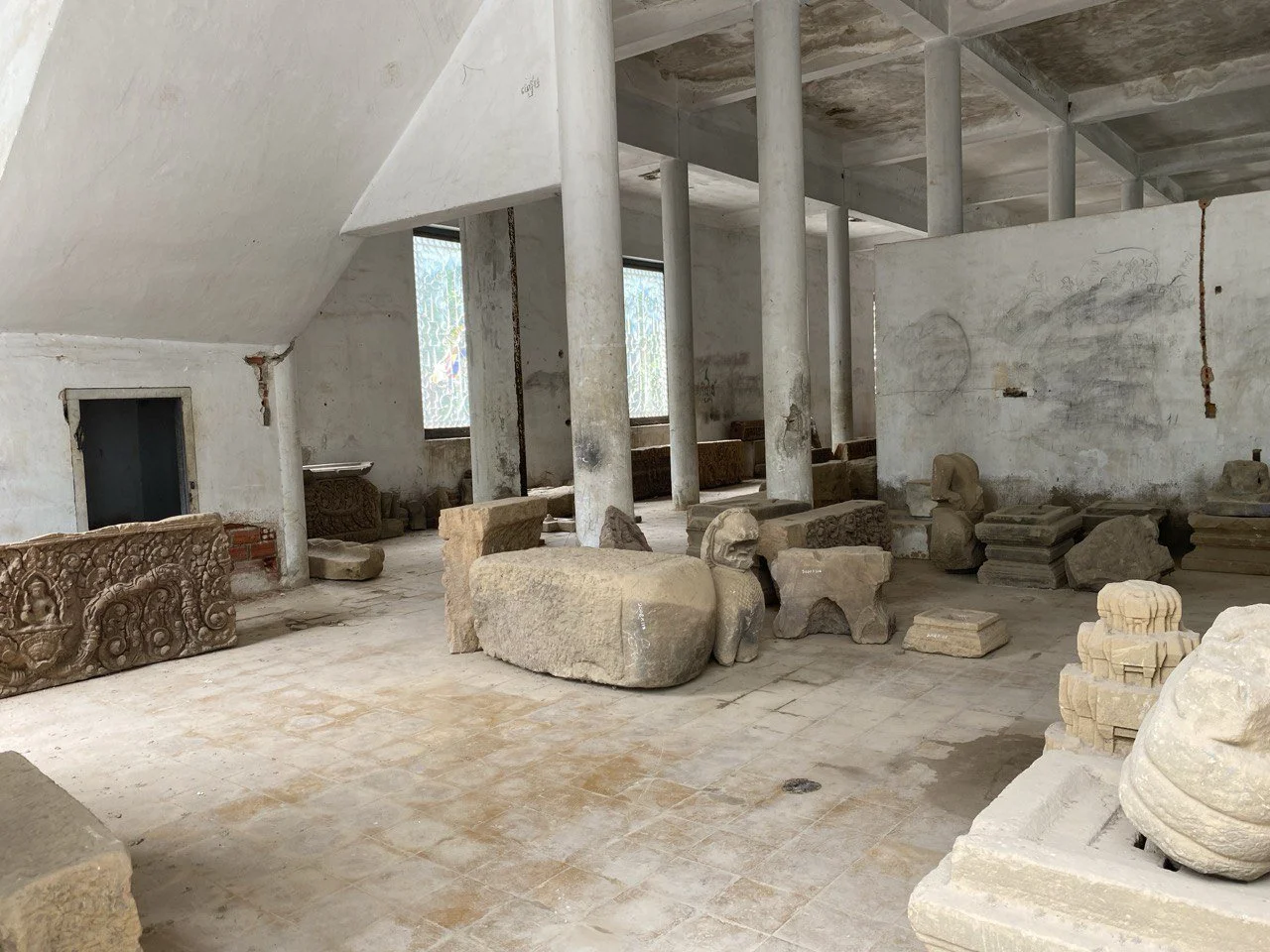
photos by Andy Brouwer September 2025
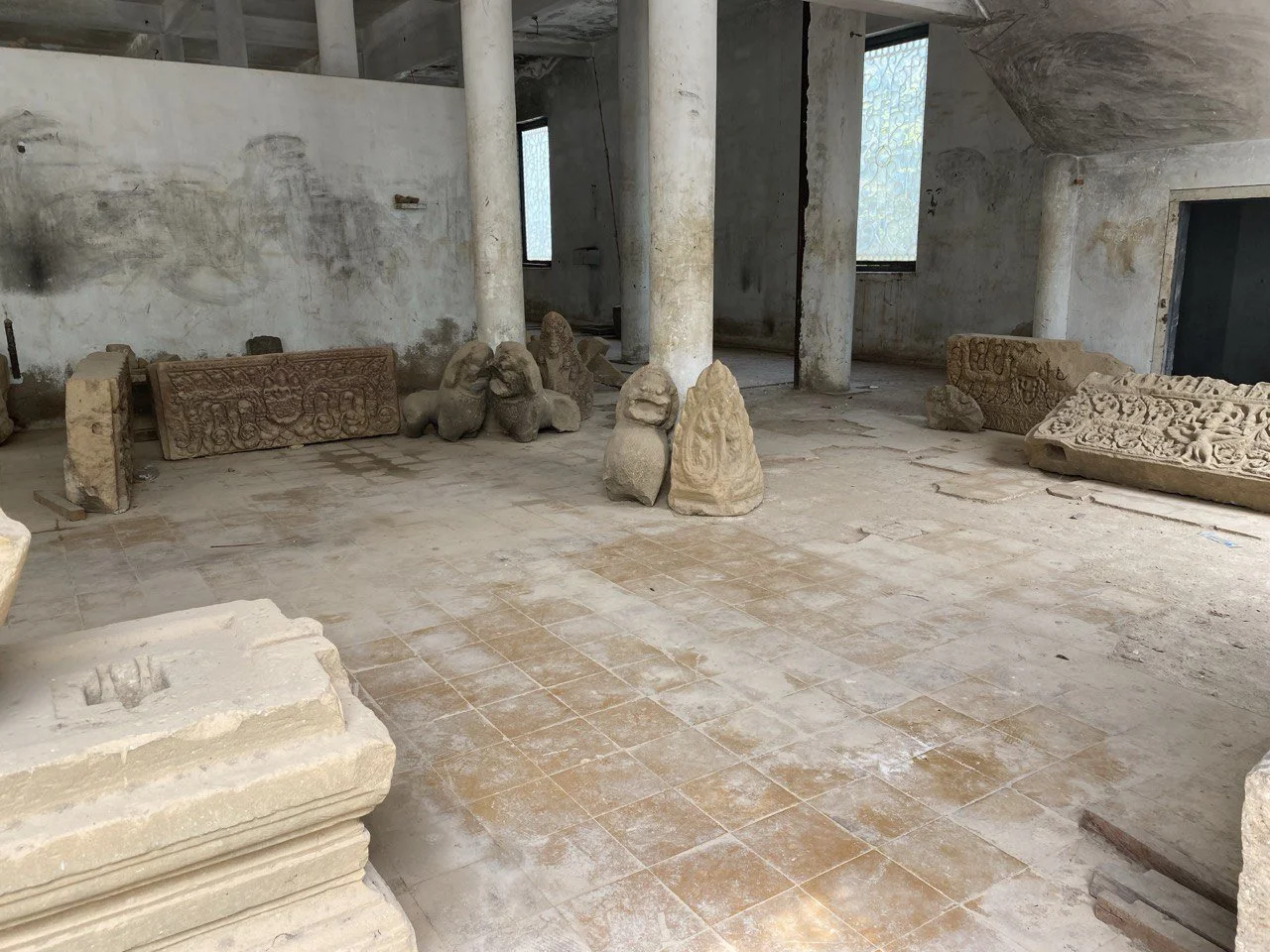
photo by Andy Brouwer September 2025
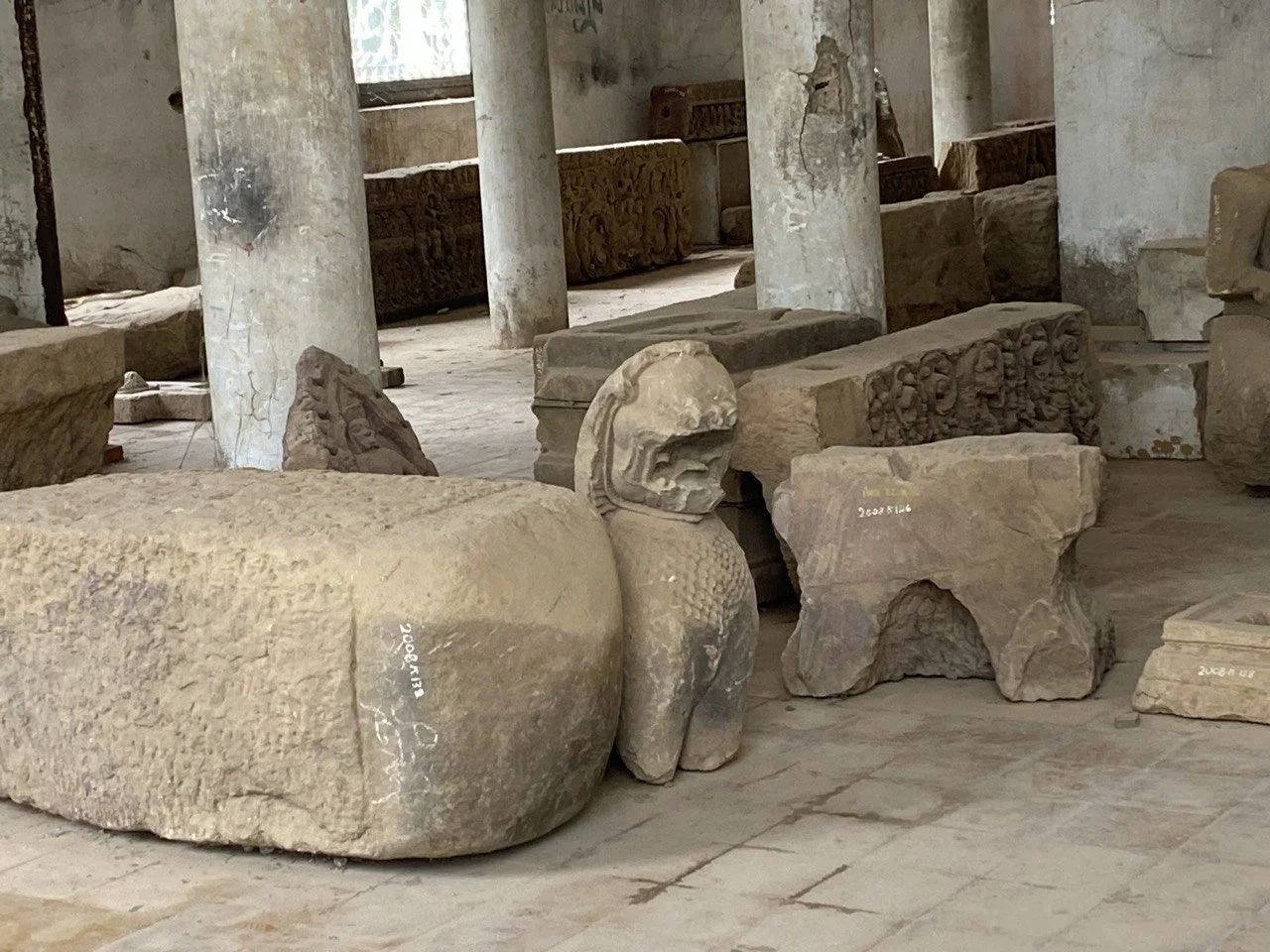
photo by Andy Brouwer September 2025
38 objects from Giteau’s initial inventory of Wat Po Veal remained unaccounted for as of the 2015 publishing of Missing Objects from the Wat Po Veal and Battambang Provincial Museums (a collaborative effort between the National Museum in Phnom Penh and UNESCO, click here for pdf). I believe a couple objects or parts of them have since been dug up locally, but who’s to say others haven’t gone missing?
I think acknowledgment and spreading awareness at Battambang Provincial Museum (the museum the public can access) would promote repatriation of objects to both Wat Po Veal and the Battambang Provincial Museum, encourage moral handling of any future discoveries by locals, and maybe even encourage charities or sponsoring businesses to get involved in fixing up and reopening the Wat Po Veal museum, or at least relocating its collection to safety. Although visitors can’t access the Wat Po Veal museum at the moment, they can take clear photos of its treasures through broken glass windows, like the ones taken by Andy Brouwer above. Hardly a secure situation.
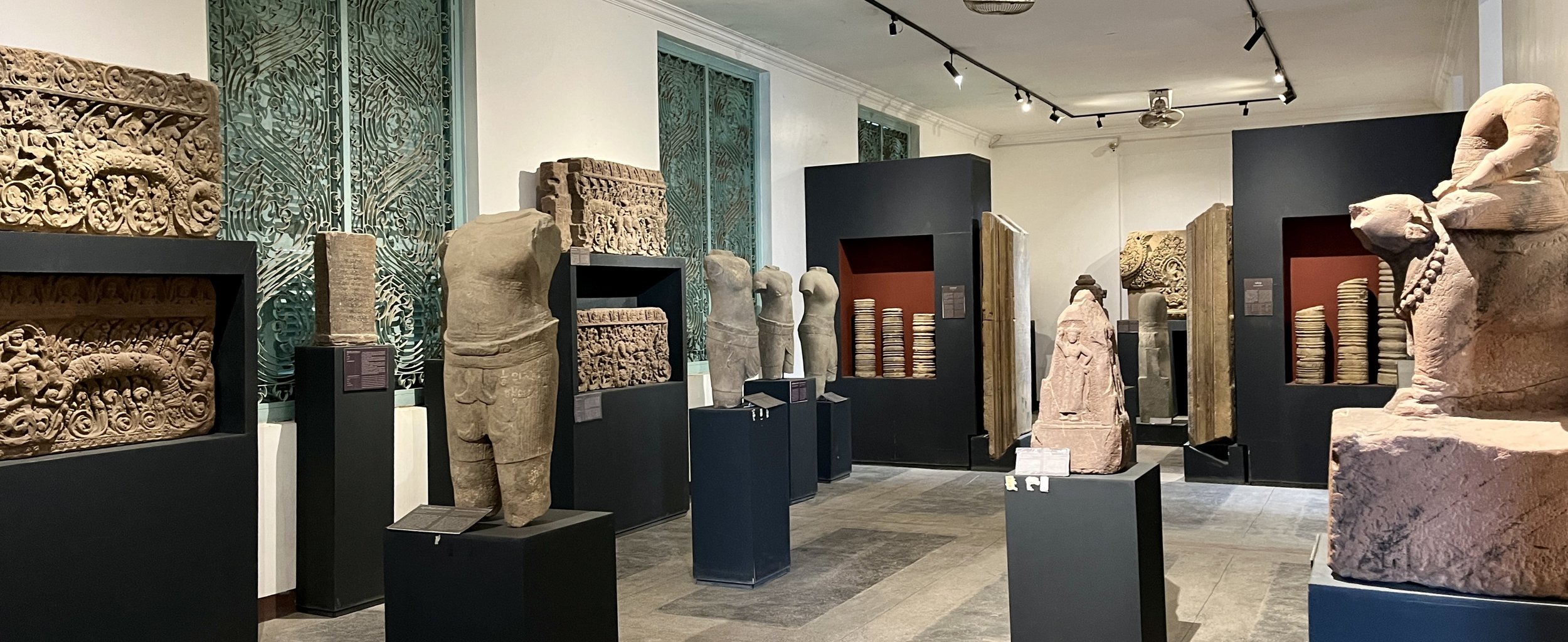
Anyway, on to the collection. I took WAY TOO MANY photos here. It was really an hour or two of zen in an otherwise mostly joyless 3 weeks in Battambang.
The museum is one big building, one floor. Next door on the same property is another building that’s closed; I’m unclear on whether this was once the storage building, still is, or has a different use. There are people in and out. Outside are lions and lintels.
Please note, these captions are as they appear on the museum placards, with just enough editing to make them comprehensible, or at least as comprehensible as possible. There may very well be a couple substantive mistakes/mixups/omissions; I did my best.
The grammar is shit and spelling and formatting are inconsistent because correcting this is time consuming and boring, so I just left much of it as-is. I honestly can’t fathom how they failed to get a native English speaking archaeologist to write these, especially considering the money and involvement of Seila-Carere, Jessup, Latchford, et. al., but they did!
Here is an example of one of the most HUH? placards, to give you an idea:
Linga
Sandezone PreAngmlie, Ta» Ba Cal
Pon Sargine Samambaro
This Linge was lound during at Bases tamale resto ration on 2017 lie the lower fart of the pediment in this rasm. In ancient Cambadia. Shiva ling had variaus shapes and was made from vandus materato such an metal sangazane, and grante Tha partcuto: linga represents not only the Sawa, but the unan of the
Ehres main Pndu gofs. the cuoc case rortaEnas
Brahma, the octagoral madie section represenss Vame end the hemisphere sectan at la Los
(etc.)
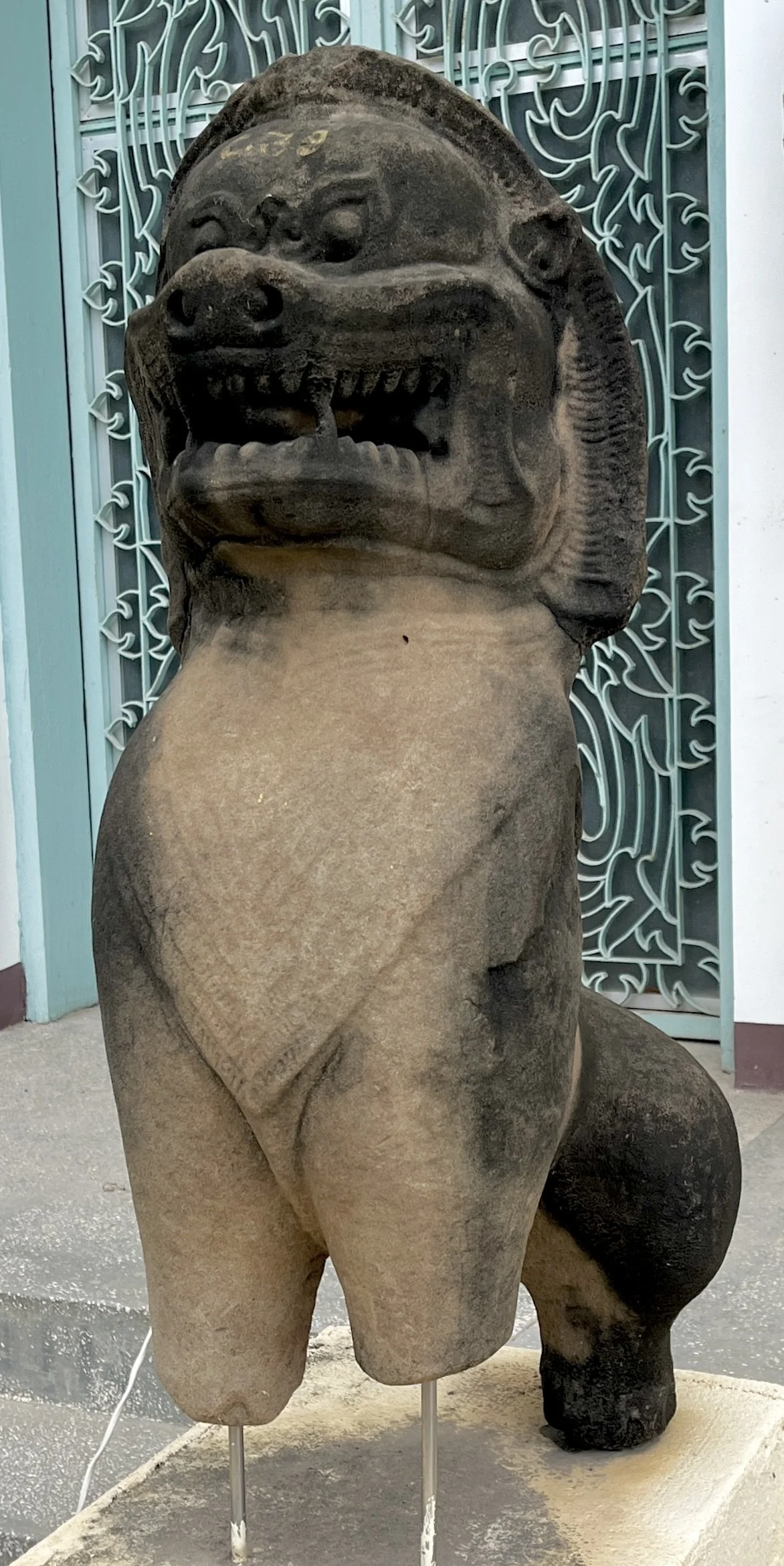
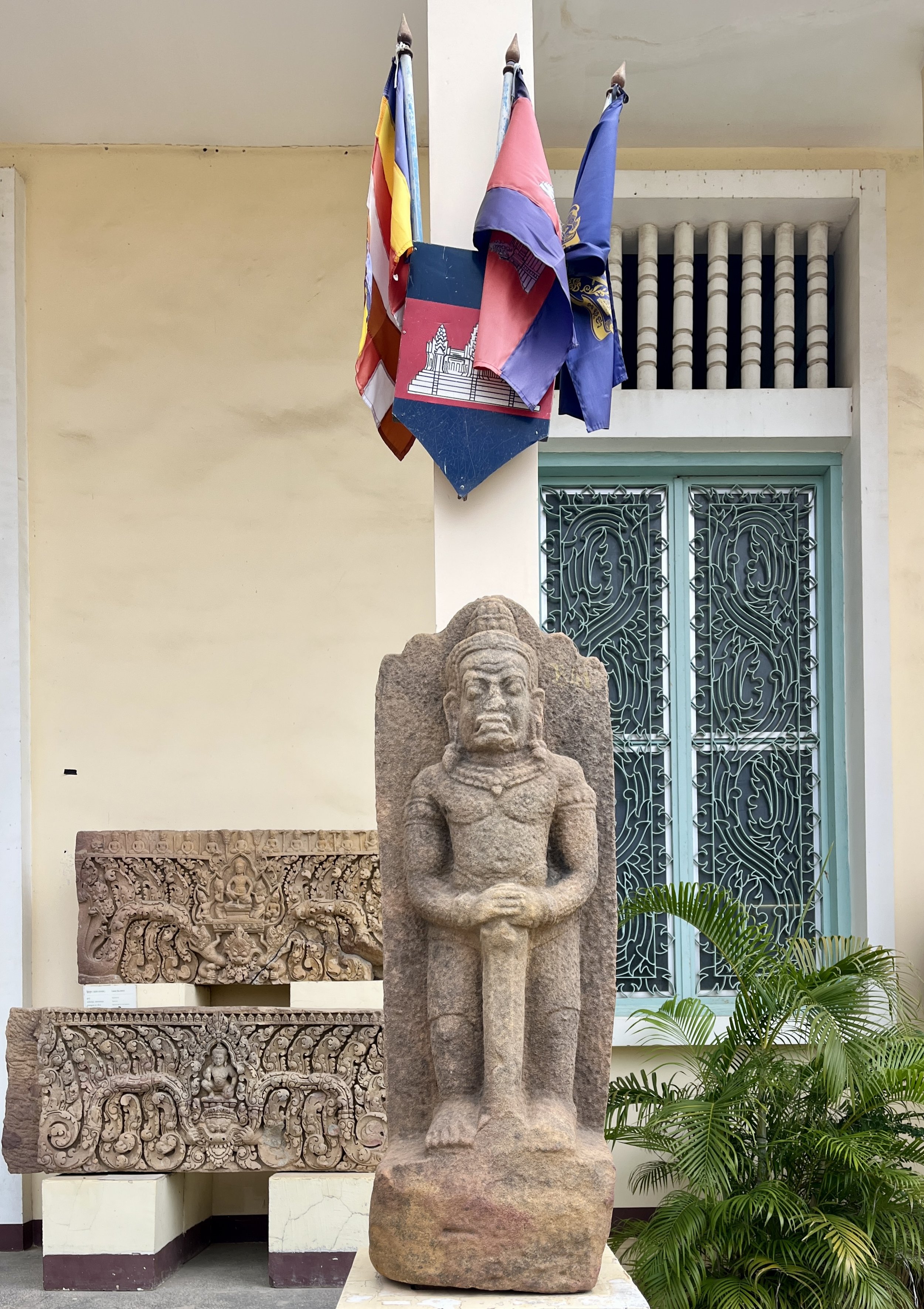
Dvarapala
Sandstone
Angkor period Bayon style
late 12th to early 13th c.
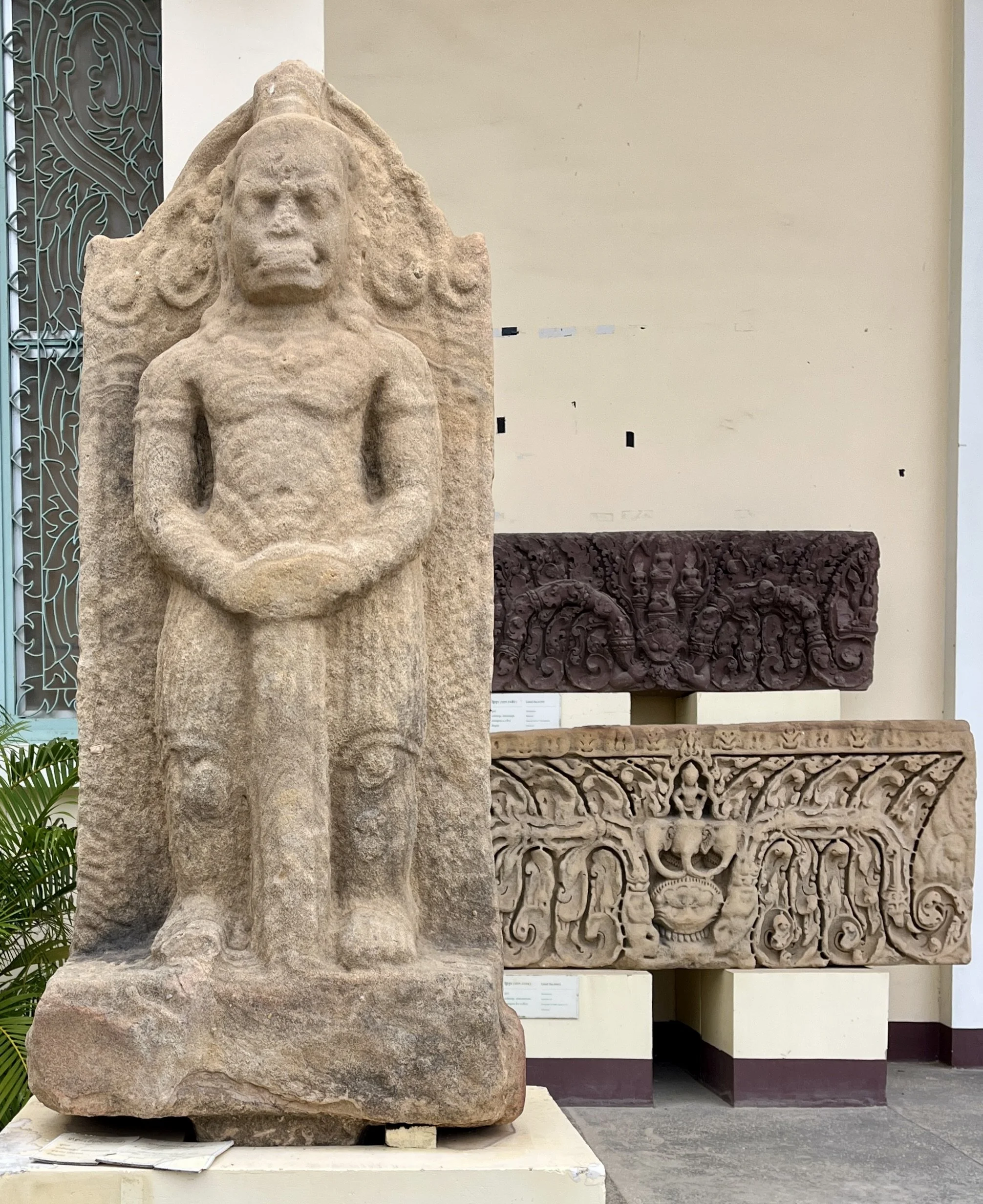
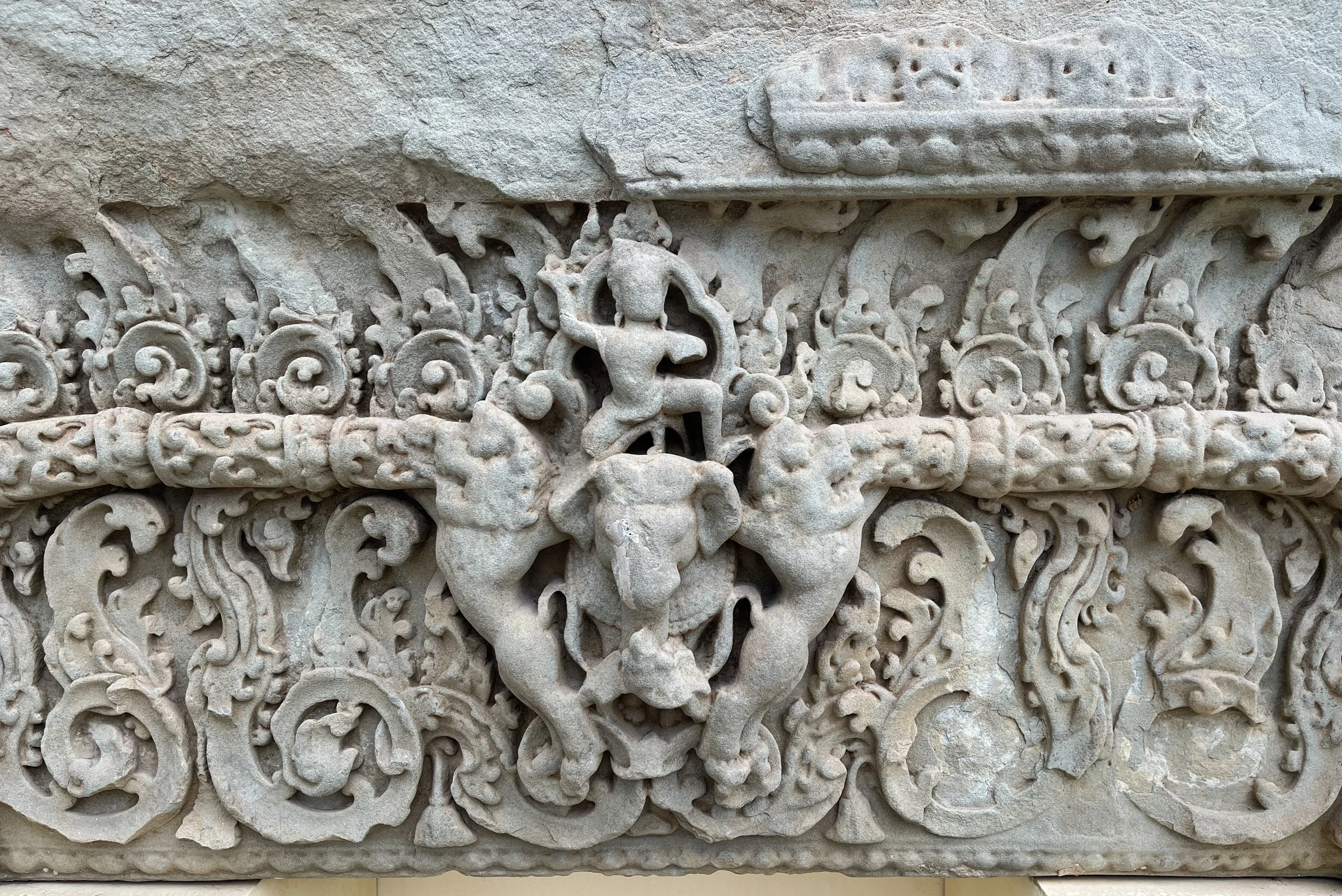
Lintel
Sandstone
Pre Rup
Second and third quarters of the 10th century
Sheng Khang Koet
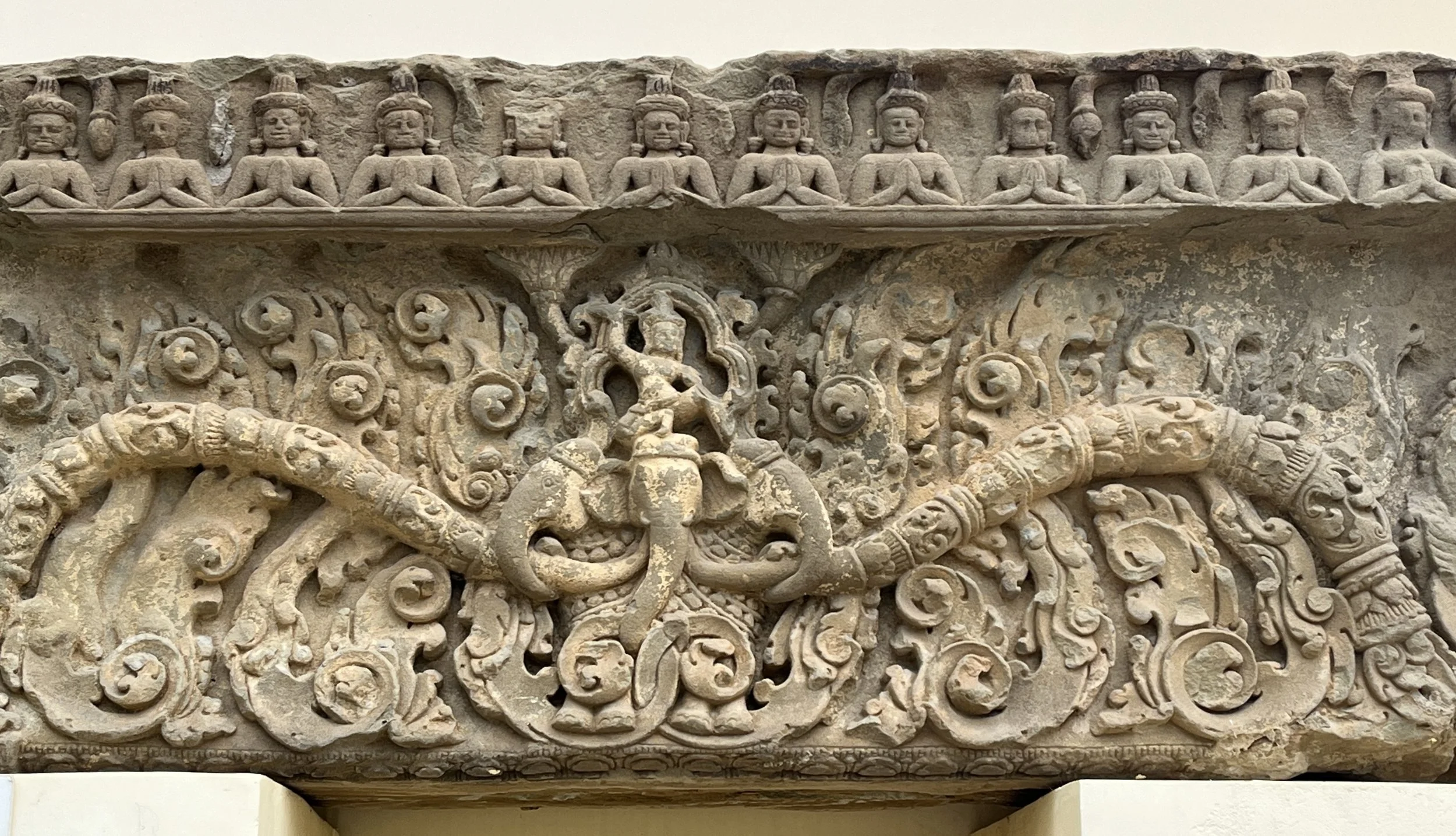
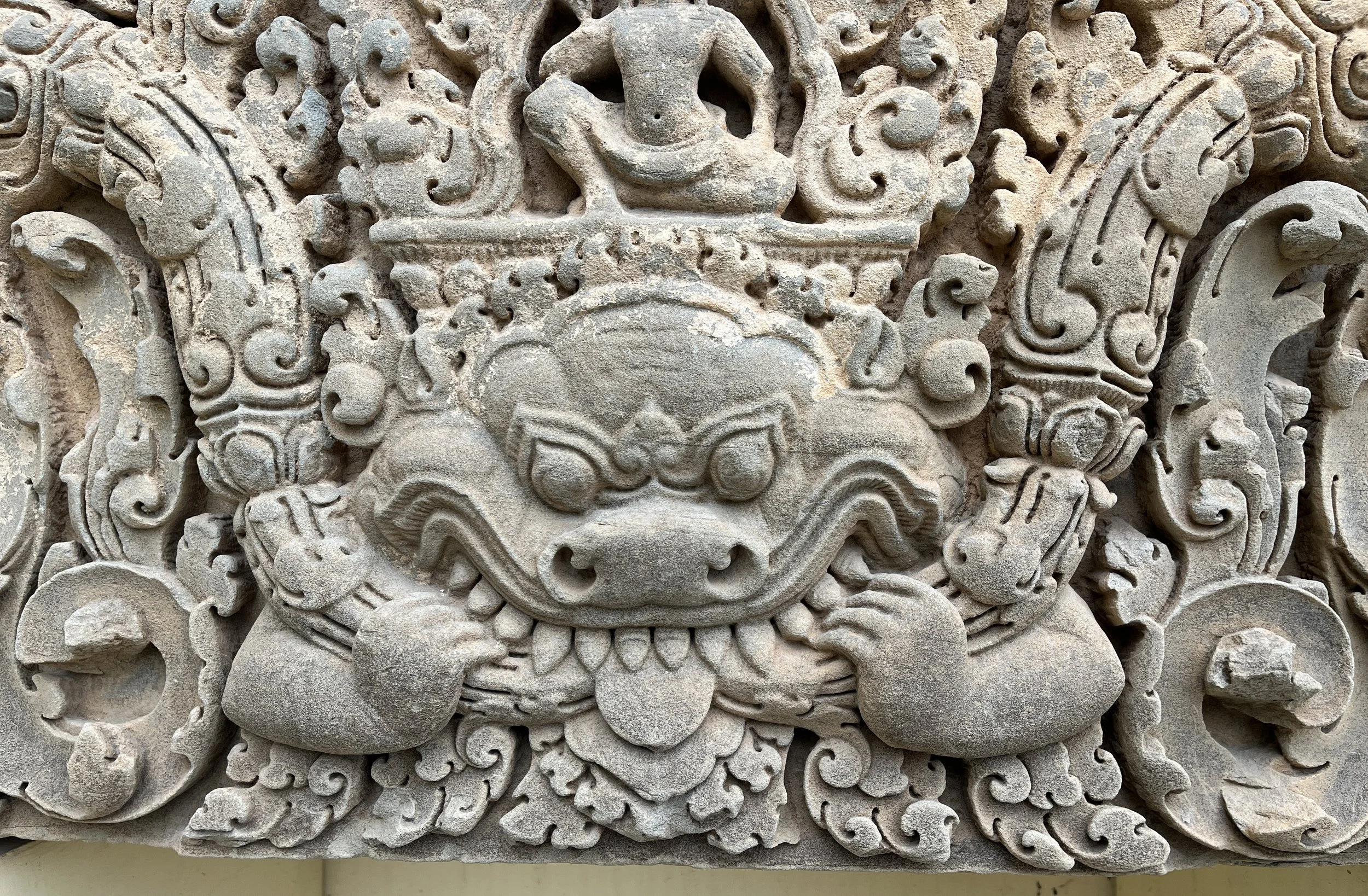
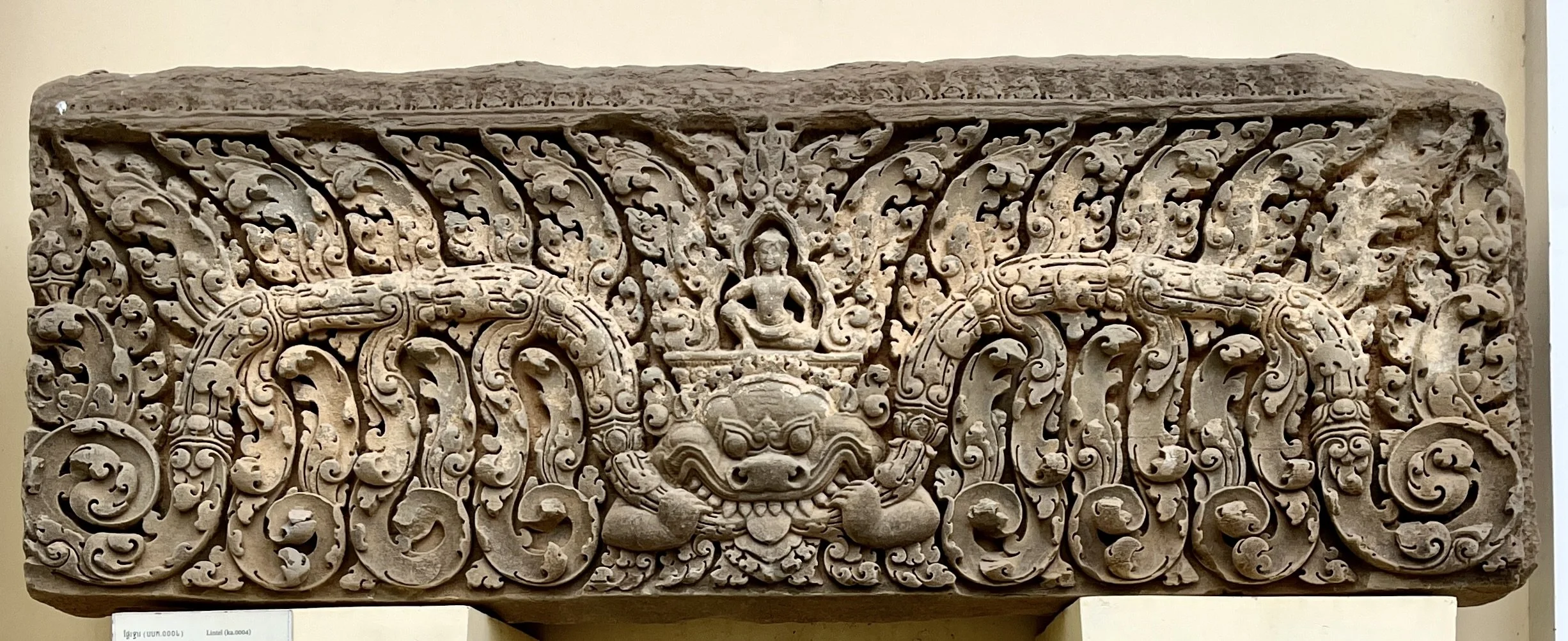
Lintel
Sandstone
Khleang
Late 10th to early 11th centuries
Toul Prasat Kampong Sema
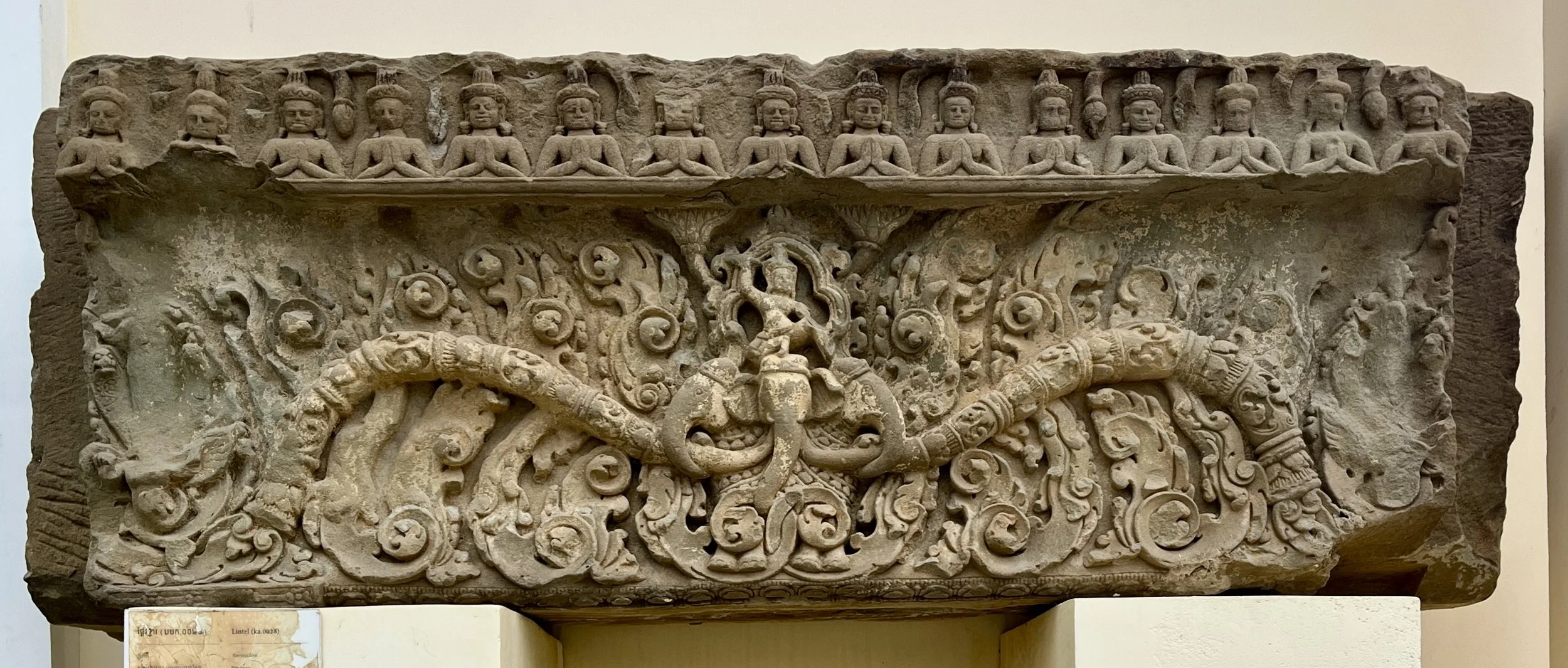
Lintel
Sandstone
Bakheng
Late 9th to early 10th centuries
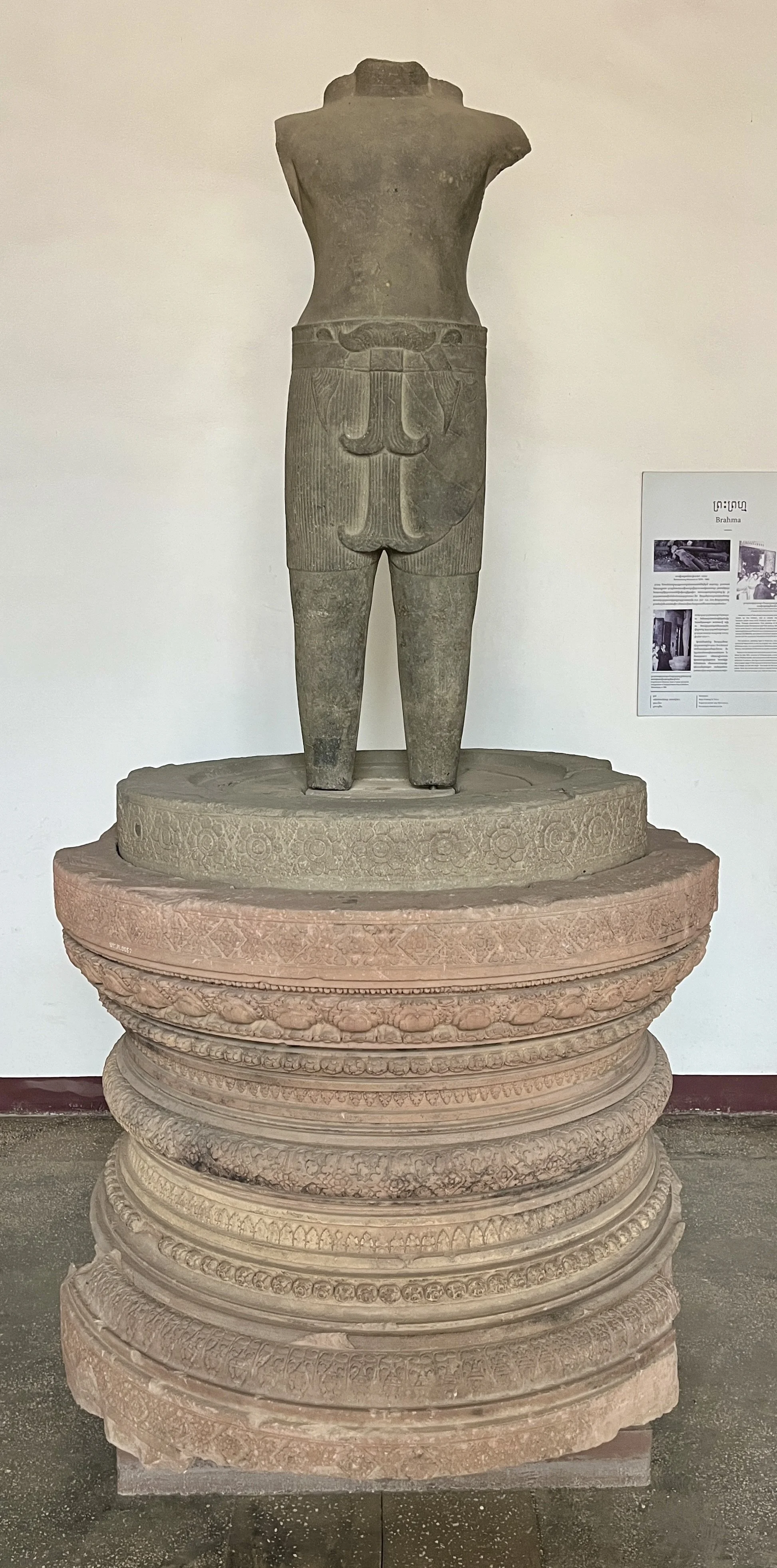
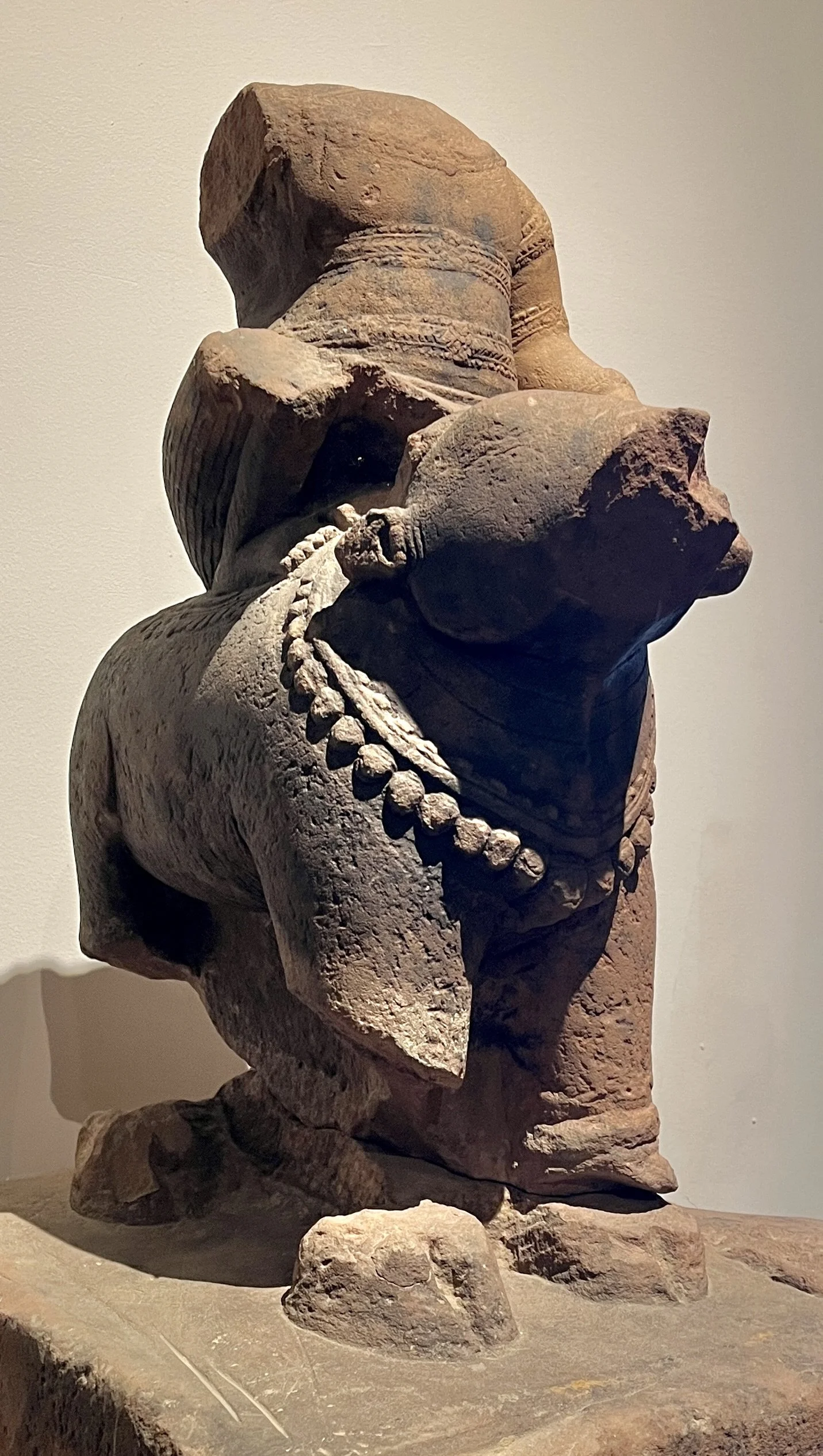
Inside, the centerpiece is the now headless Brahma from Wat Po Veal.
I did the museum roughly clockwise. The first exhibit is all about the prehistoric Laang Spean site.
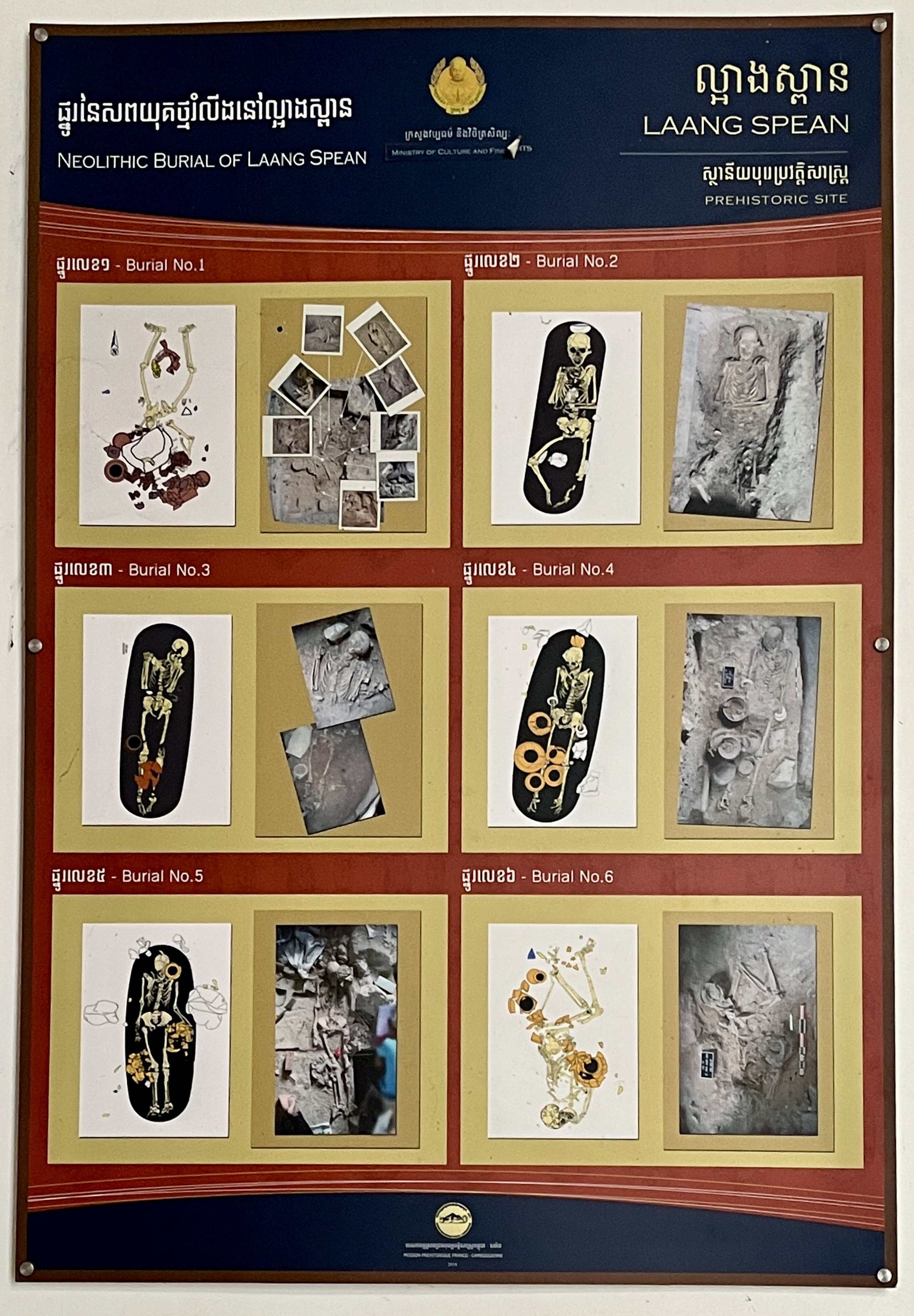
MINISTRY OF CULTURE AND FINE ARTS
LAANG SPEAN
PREHISTORIC SITE
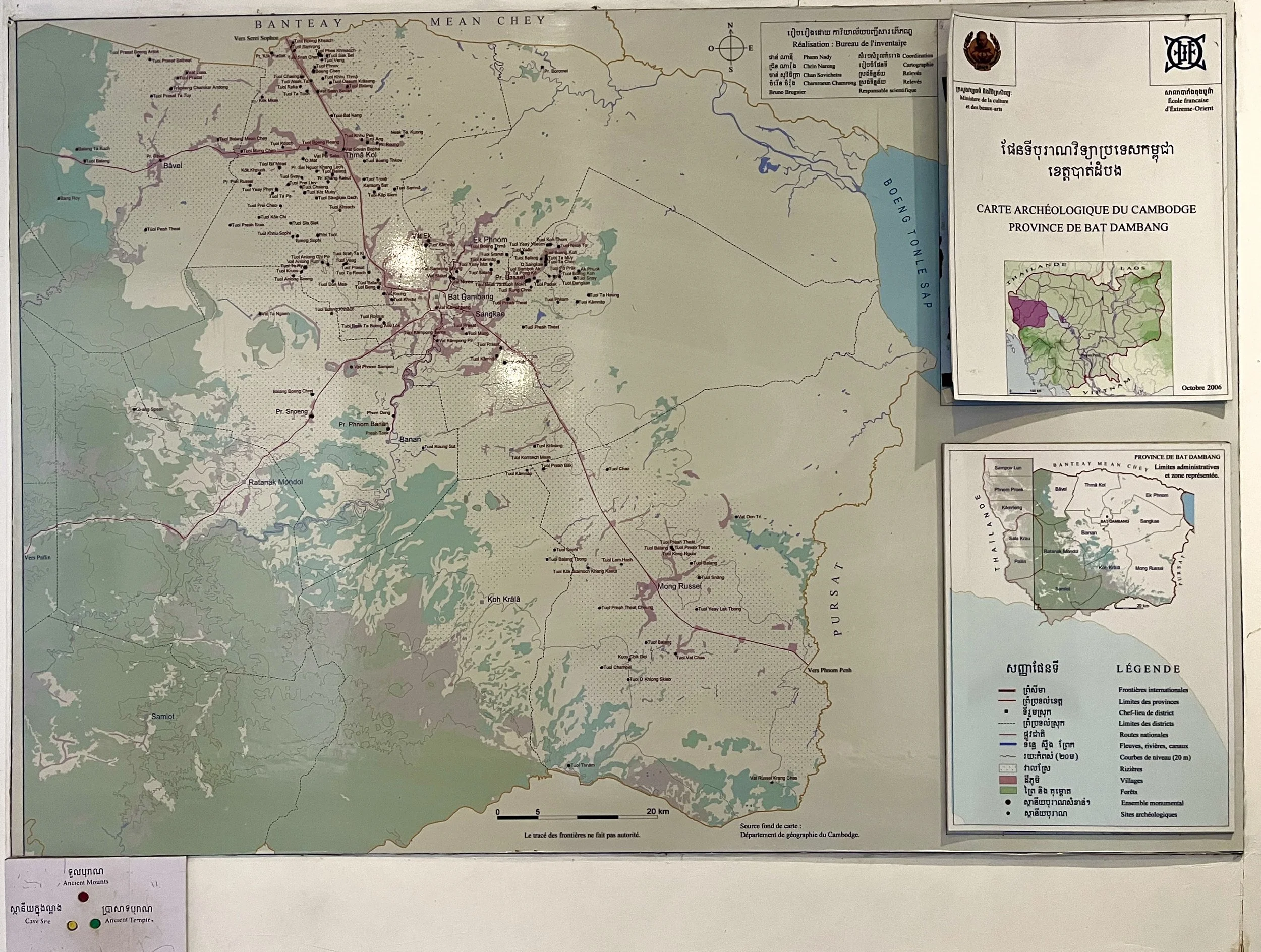
Laang Spean is the biggest known prehistoric cave site in Cambodia and is situated on top of the limestone mountain known as Phnom Teak Treang in the Treng Commune, Ratanakmundul district, southwest of Battambang province, northwest Cambodia. It is approximately 330 km from Phnom Penh, on the right-hand side of National road No. 57, half way between Battambang and Pailin. It is around 40 km southwest of the provincial capital of Battambang and around 7 km from the public gathering place of Sdao village. The name Laang Spean refers to the limestone found on the upper part of the back of the cave forming arches which looks like a stone bridge. It formed naturally after a big block in the middle of the cave's ceiling collapsed. The mountain lies on the west side of the Sangke River, one of the tributaries feeding the great Lake of Tonle Sap.
The site can be reached by different routes with vehicles. The easiest way is by the laterite road connected to the National road No. 57 at the Meas Pitou primary school to the west about 3 km from the main road.
Lang Spean Cave was formerly recognized as an important archaeological site as early as 1965 by two French archaeologists, Cécile and Roland Mourer, during their survey of northwest Cambodia.
They arrived precisely at the site on July 28th 1965 and began the first excavation at the same year. The last excavation campaign was at the end of 1970 and early 1971.
The excavations were carried out at three different locations and followed the configuration of the cave sections. The first location was at the right side of the cave entrance ( section 1 or room 1). The second location was in the central part of the cave ( section 2 or room 2), near the west wall. The third location was located at the upper level of the cave (section 3 or room 3), under a limestone bridge, close to the eastern cave wall.
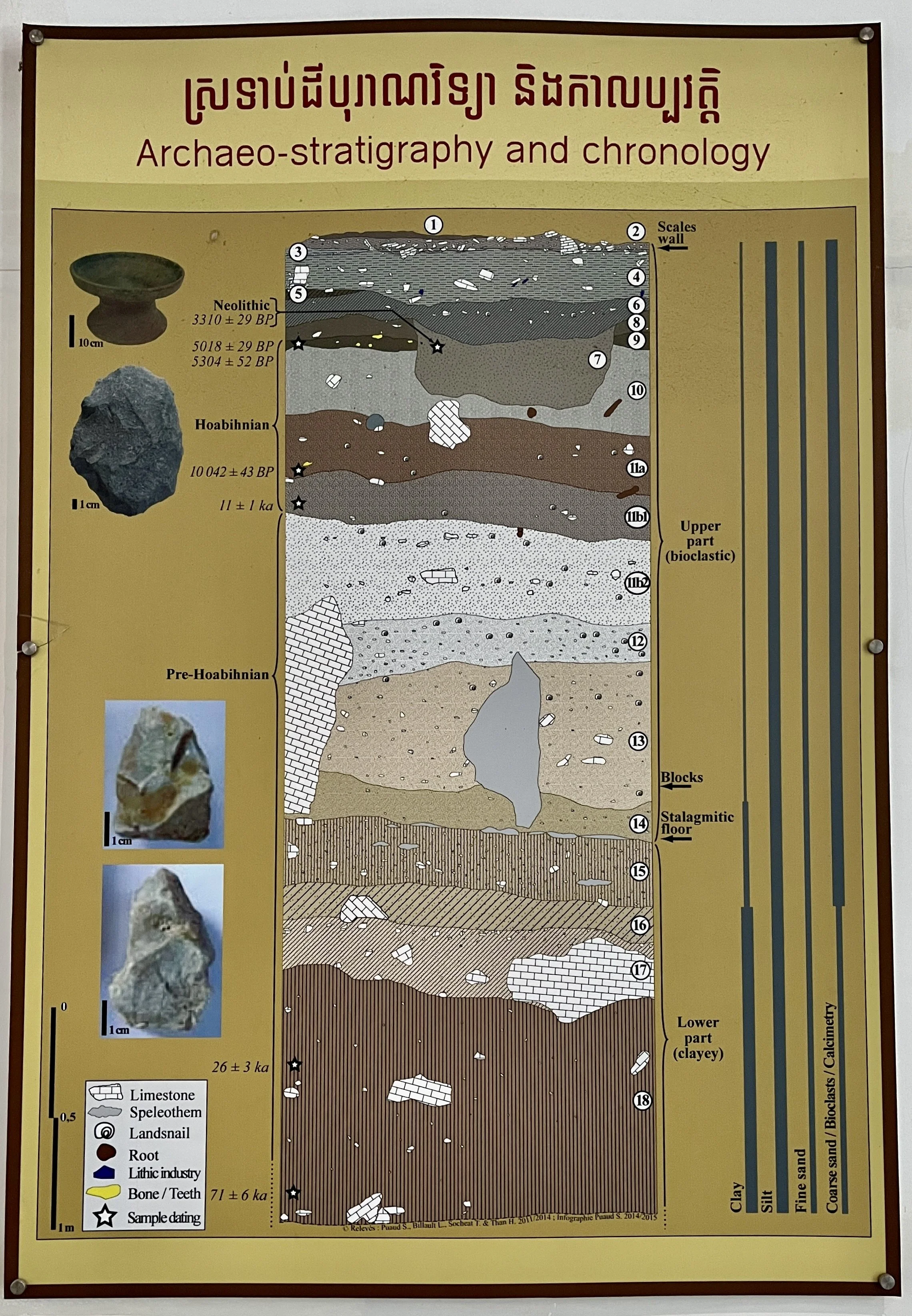
Following these pioneering years of archaeological field research, Laang Spean became a famous cave site throughout Cambodia as well as in Southeast Asia due in particular to the discovery of the Hoabinhian industry and also a rich cord-marked pottery from a Neolithic level. Beside stone artefacts and fauna, shells were also present in large quantities in the archaeological layers of the last hunter-gatherers who lived in the cave.
After about 50 years, research was stopped for security reasons, but the research and the archaeological collaboration was started again by the French-Cambodia Prehistoric Mission from 2009 with Pr. Hubert Forestier (MNHN) and Dr. Heng Sophady (MCFA) as the principle researchers.
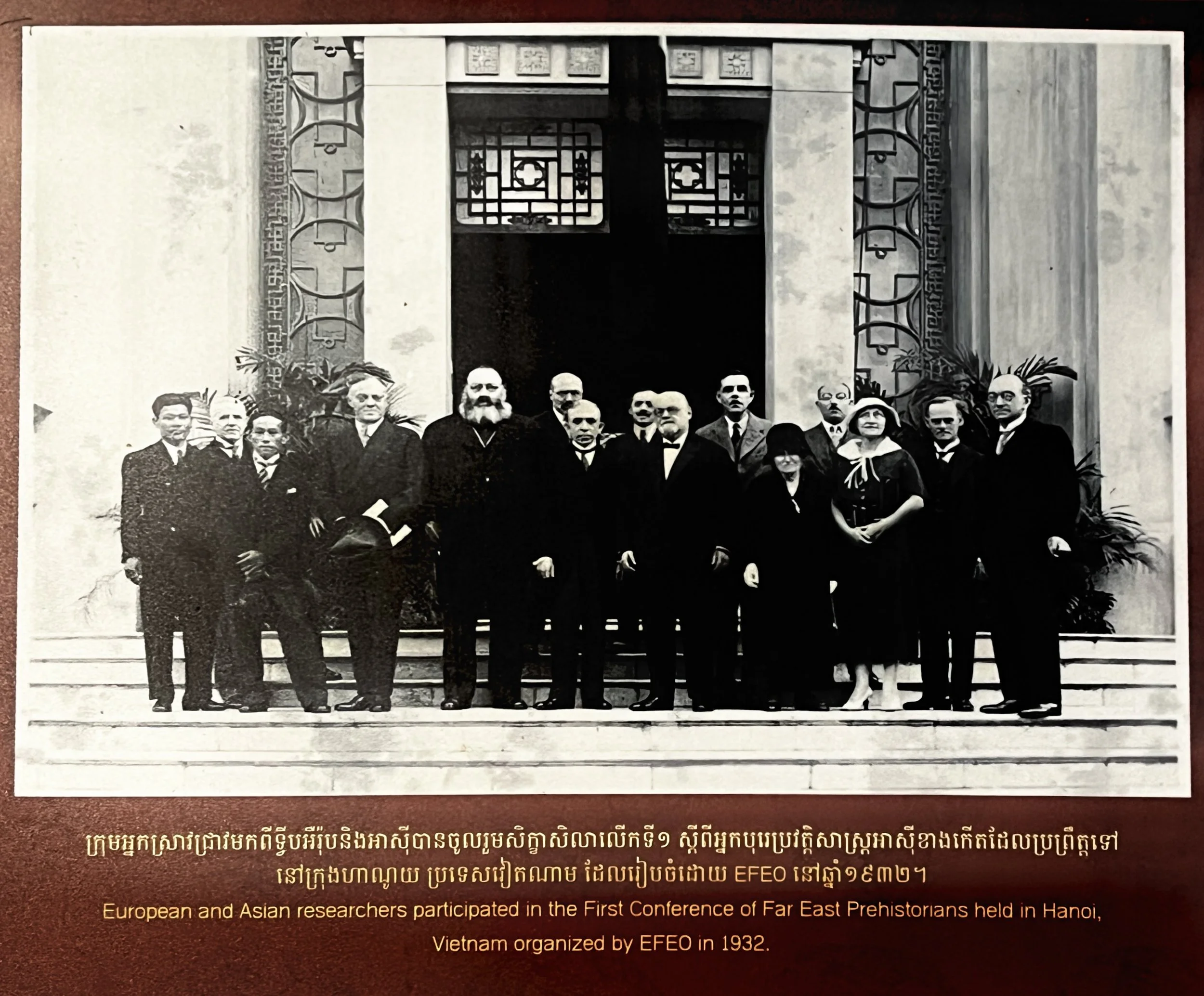
Early in 1932, the First Congress of Pre-historians of the Far East was held in Hanoi, and the term 'Hoa Binh Culture' proposed by M. Colani was agreed to define a specific culture that inhabited the region.
The location of Hoabinhian sites in Southeast Asia
The term Hoabinhian comes from 'Hoa Binh' Culture named after Hoa Binh province in Northern Vietnam. French archaeologist Madeleine Colani from EFEO, excavated many Hoa Binh culture sites in Vietnam during the period 1926-1932. Early in 1932, the First Congress of Pre-historians of the Far East was held in Hanoi, and the term 'Hoa Binh Culture' proposed by M. Colani was agreed to define a specific culture that inhabited the region.
In Southeast Asia it has easily become a common term to describe stone artefact accumulations with a limited time period from Late Upper Pleistocene to Middle Holocene with a distinctive settlement pattern, subsistence economy, and technology. Additionally, in Western Indonesia was also noted Hoabinhian artifacts with unifacial pebble tools call "Sumatralith" which correspond to efficient cultural markers.
Different types of pebble tools (Hoabinhian techno-complex or Sumatraliths) have been found in many archaeological sites in Southeast Asia, both on the mainland such as Cambodia, Myanmar, Laos, Malaysia, Thailand, Vietnam, and few on islands such as Sumatra, Indonesia sharing similar cultural complexity on pebble/cobble utilization.
In Cambodia only one prehistoric site, Laang Spean cave in Battambang province, was excavating since 2009 by the Franco-Cambodian Prehistoric Mission ( FCPM). The Hoabinhian level was well dated and stratified with numerous archaeological remains including typical stone tools made from river cobble in hornfels, sandstone and limestone raw materials. The tools were always associated with abundant animal remains of different species as well as fresh water shells that were the main diet for prehistoric people between 11,000 and 5,000 years B.P.
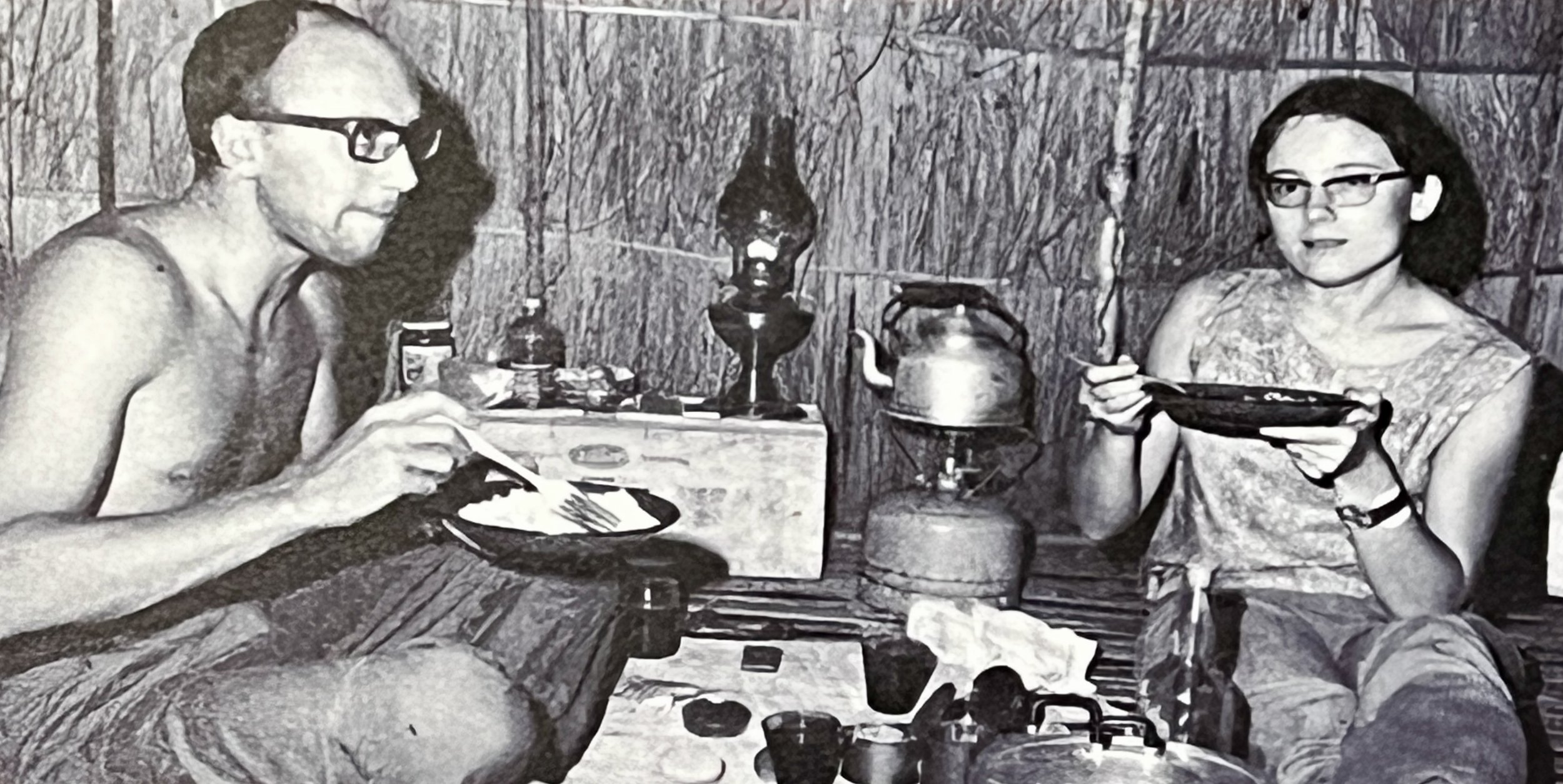
Roland Mourer and Cécile Mourer-Chauviré. The museum caption is “The enjoyment of dinner of Mr. Roland Mourer and his wite at Laang Spean in January 1967”. and his wife. As if she wasn’t a degreed, experienced, published paleontologist, a professor of geology at the Royal University of Phnom Penh prior to and during this dig, with her own name, equally deserving of an honorific, working on the site for a decade! Though of little interest to me personally, her work since has been even more esteemed; she is a founder of the Society of Avian Paleontology and Evolution (SAPE) and has 8 avian fossil species or genera named for her (by her colleagues; she has named 18 herself but never after herself!) The misogyny of most Cambodians remains appalling, and I experience it daily.
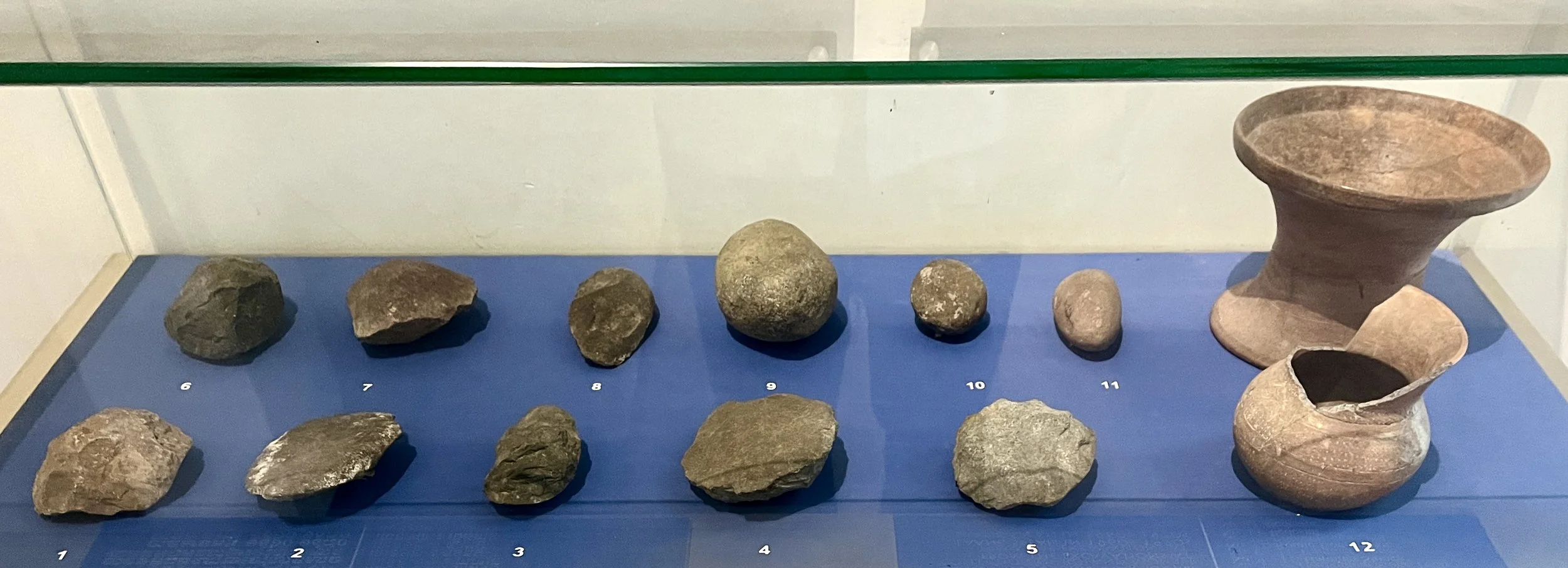
COLLECTION OF ROLAND MOURER
FROM THE EXCAVATIONS AT LAANG SPEAN IN 1965-1975
No. 1 - 8: Hoabinhian Stone Tools
No. 9 - 11: Hammer Stones
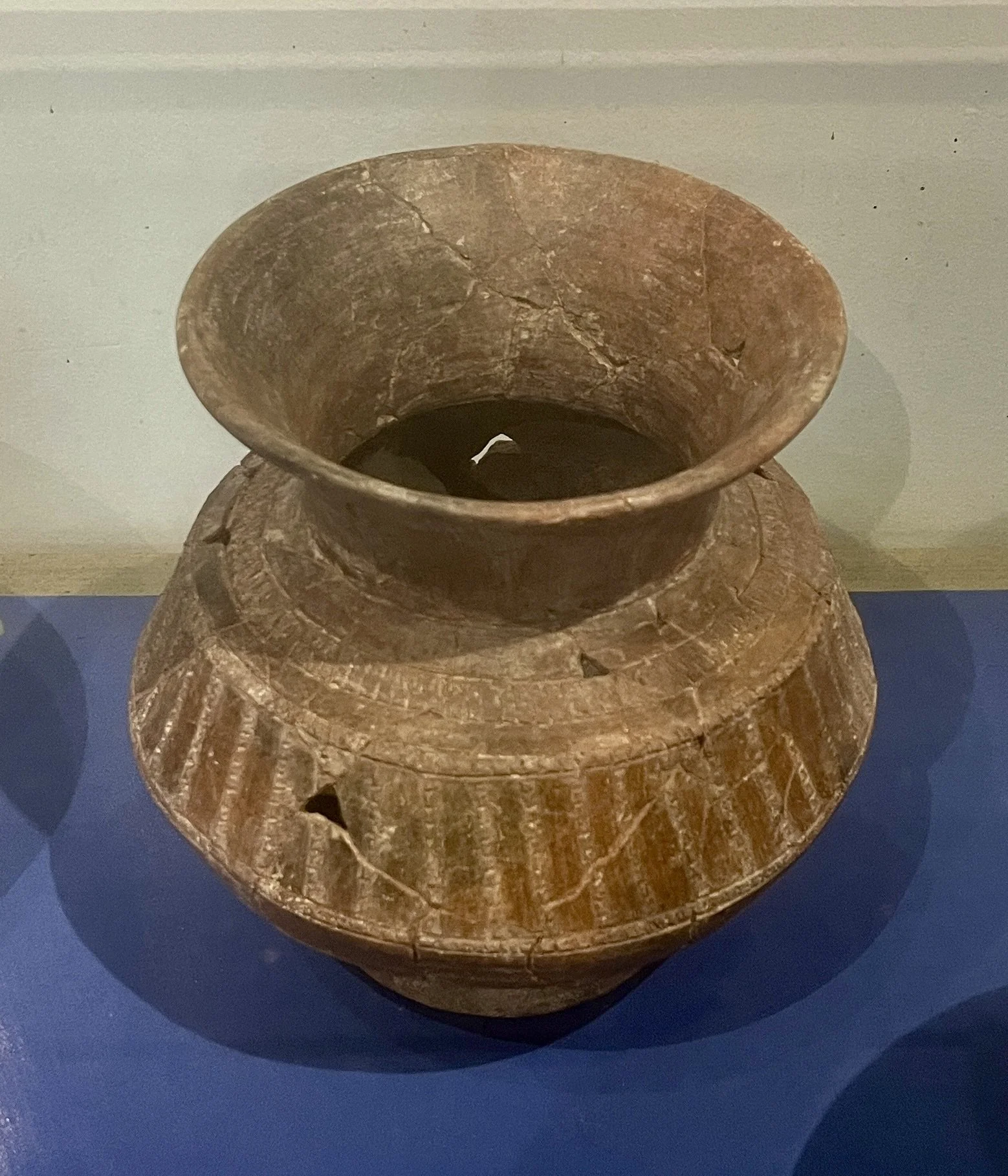
No. 12: Round Bottom Pot
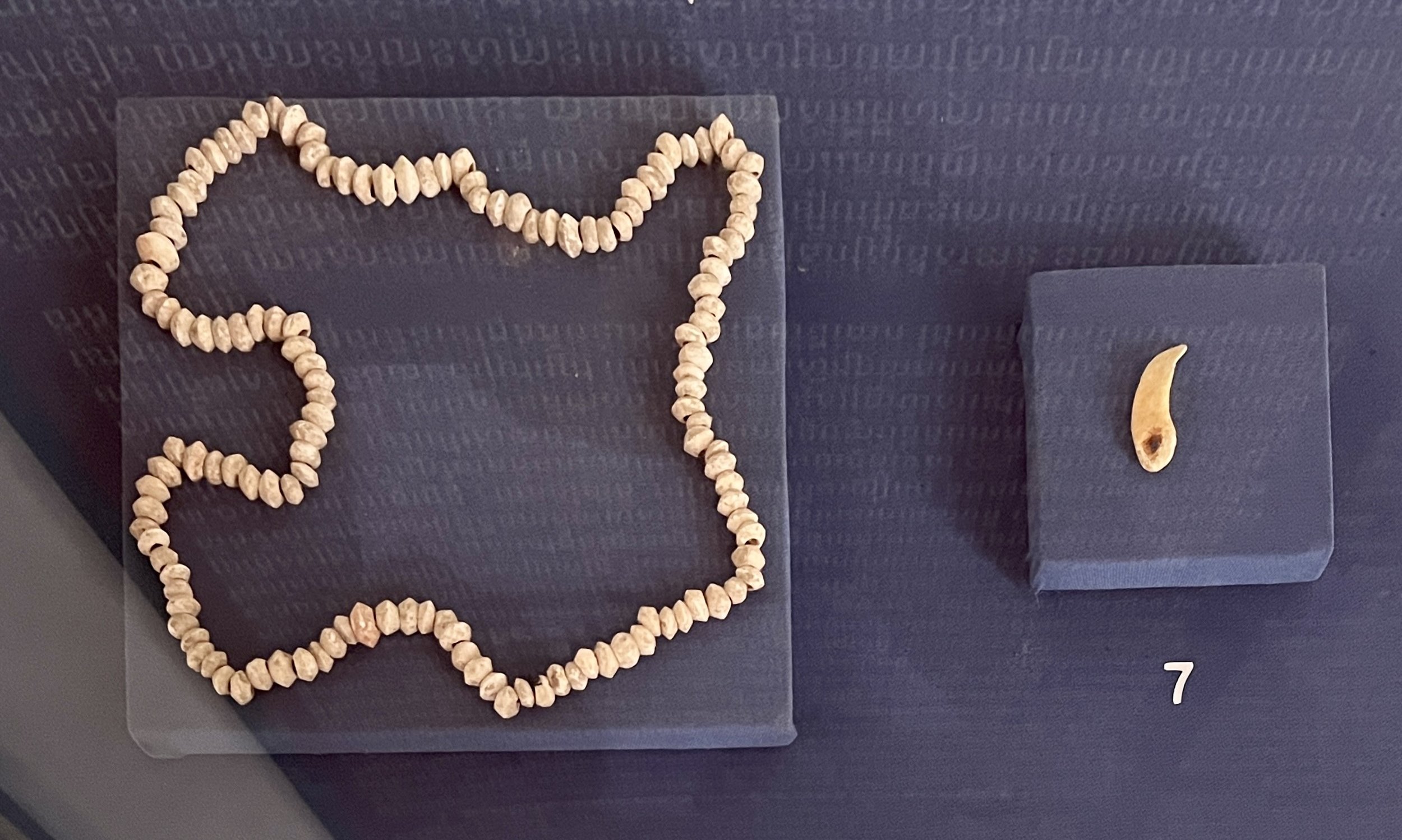
Limestone beads; pendant made from canine of wild boar
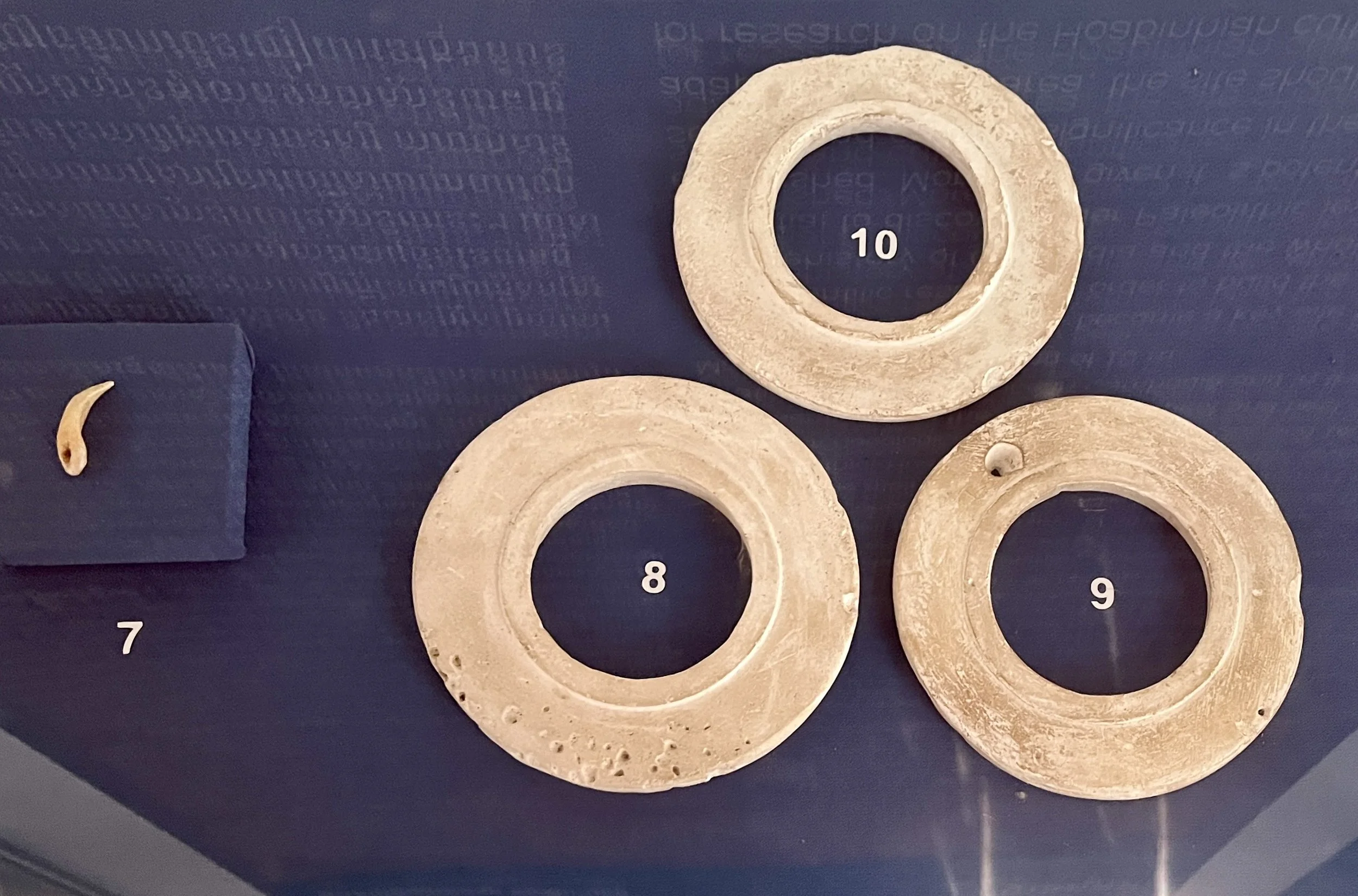
Limestone bangles
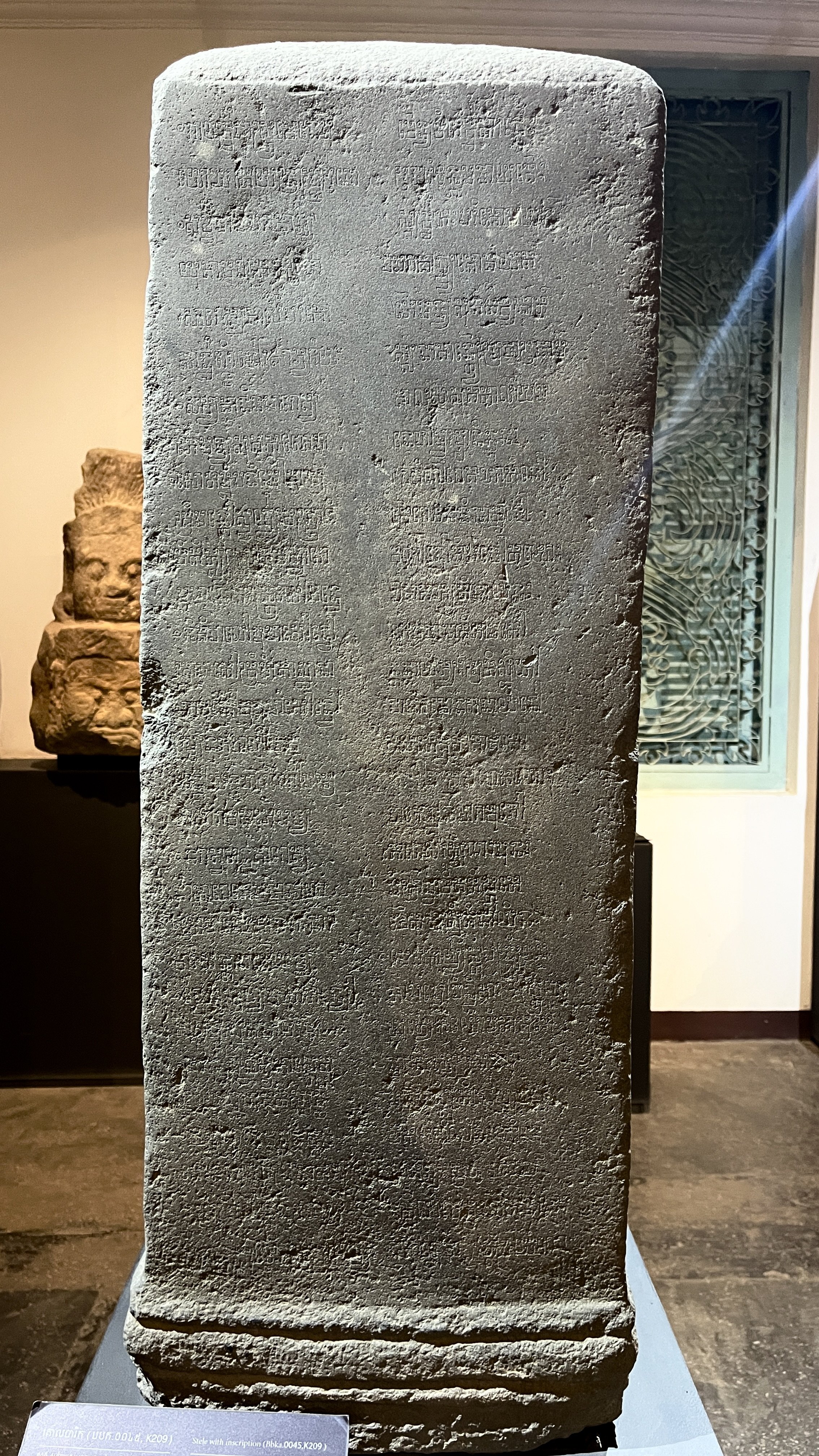
Stele with inscription
Sandstone: Angkorian period, Bayon style. 13th c.
This stele belongs to a hospital of the Jayavarman VII era, is written in sanskrit on its fours sides
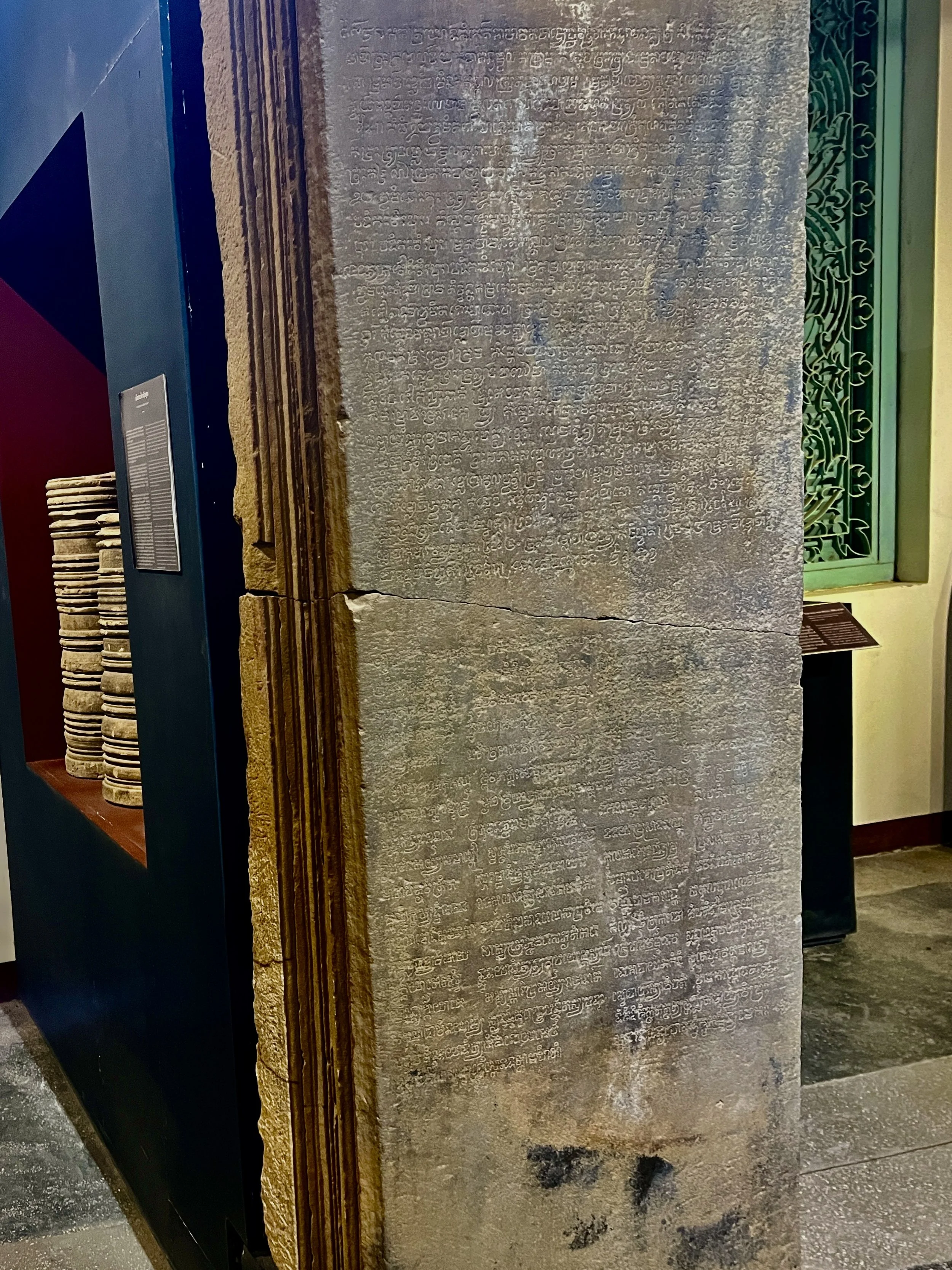
These two door frames with inscriptions are from the southern gate of Baset tower, engraved 6 years apart from one another during the reign of King Surya Varman I. They described a family of dignitaries who bought land and offered it to the gods at Cri Jaya Khsetr (the field of victory).
They are written into two languages, one has 25 lines in old Khmer and 18 lines of 16 verses in Sanskrit which is dated to 1036 A.D., the other has 45 lines engraved in old Khmer in 1042 A.D.
The old Khmer text mentions a dignitary named Frigunapativarman who purchased some of the land from five regional chiefs by exchanging it for a metal jar, metal spittoon, silver bowl, textiles, etc., offered to the god at Jayakse-tra (the field of victory). After that, he gave the land to his three children. The text also names those who perform duties in the temple and those in the court who witnessed the purchase and the boundary drawing of the land.
The Sanskrit text is a verse invoking Trimurti and describing a royal palace workshop chief named Vrah Visvakarma and his family who served King Suryavar-man I, King Udayadityavarman Il and King Harshavarman III.
Among his achievements were constructing the Western reservoir, Baphuon temple, and other palace buildings, so King Udayadityavarman II gifted his family land in the south, some gold and the title of “royal artist.”
The text of the second doorframe talks about a dignitary named Mratan, a relative of the above-mentioned Frigunapativarman, who bought some of the land from three people and their nephew with rings, gold, a large silver bowl, lots of metal, spittoons, clothes, textiles, a cart, an elephant, and a horse. The blundaries of the land are clearly described and witnesses named. After purchasing the land, he then give it to his son, titled Kamsten Asor, originally named Lon Hiraya.
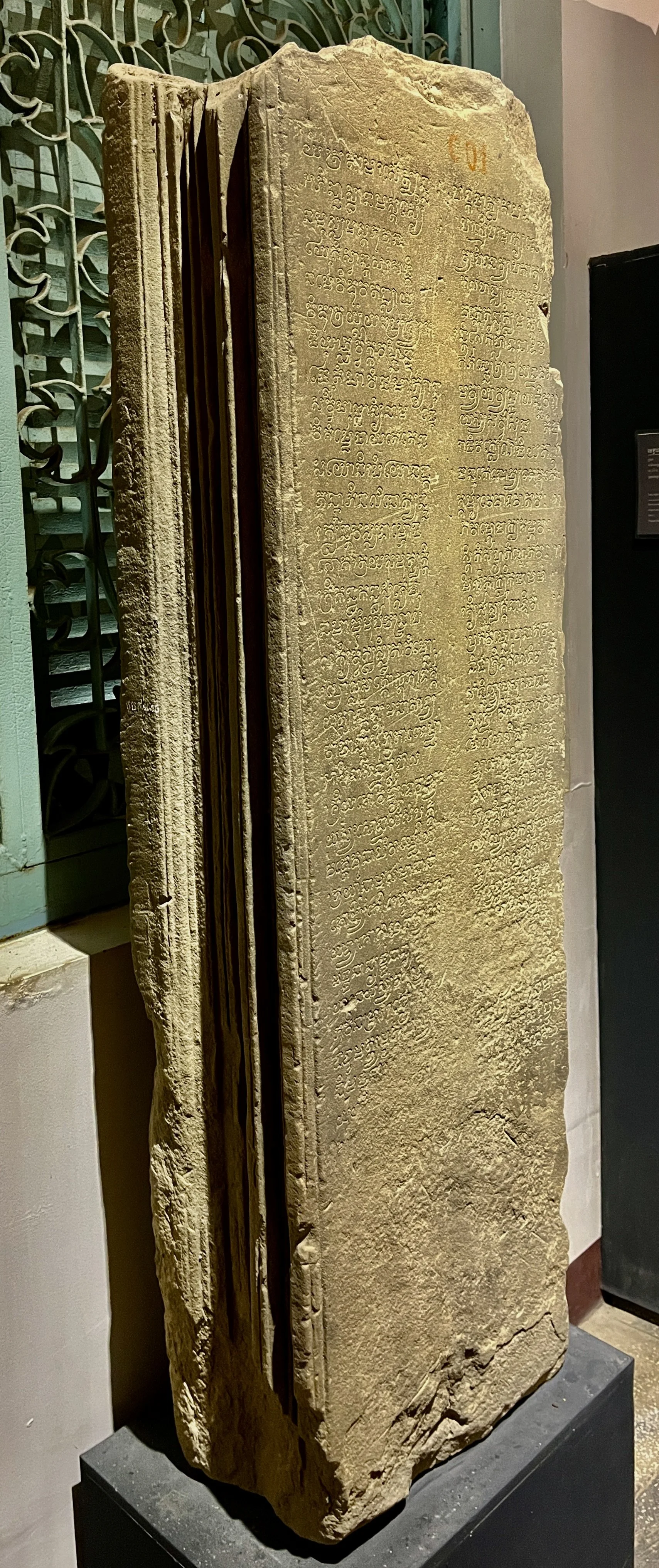
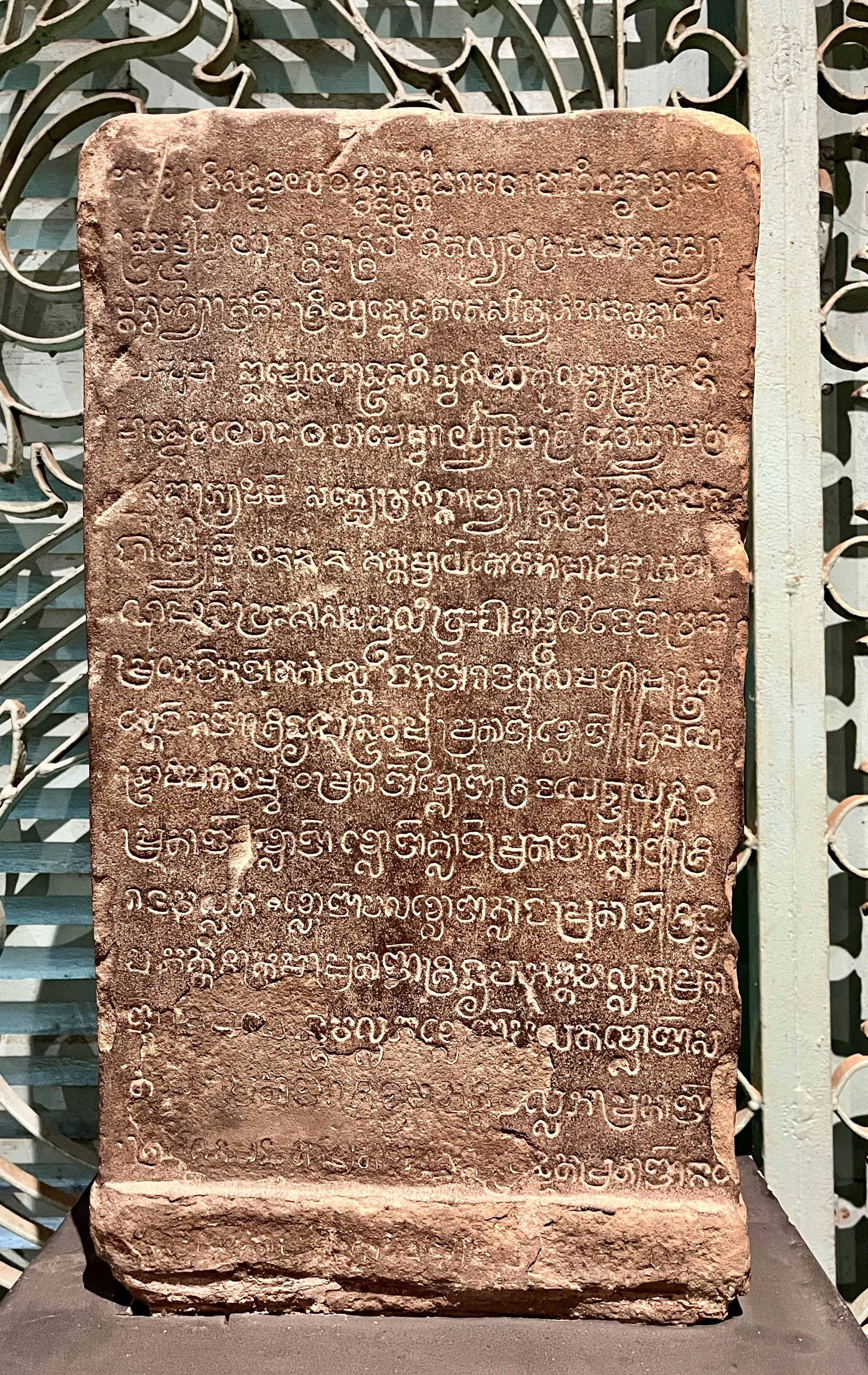
Inscription on door frame
Sandstone,
966A.D.
Dontri temple, Battambang
This stele comes from a ruined temple reported by Étienne Aymonier in 1901, which has since disappeared. It was then found back in a Buddhist monastery near the site.
Three faces are engraved; the first has six lines written in Sanskrit followed by 11 lines in old Khmer of the Angkorian period. The text in old Khmer begins on the left side (20 lines) and ends on the right side (19 lines). The introduction in Sanskrit mentions an Upendra, a nephew of King Rajendravarman's servants, Yud-dhoddhatakesari, who gave land and slaves to two gods, Paramesvara and Aryamaitri.
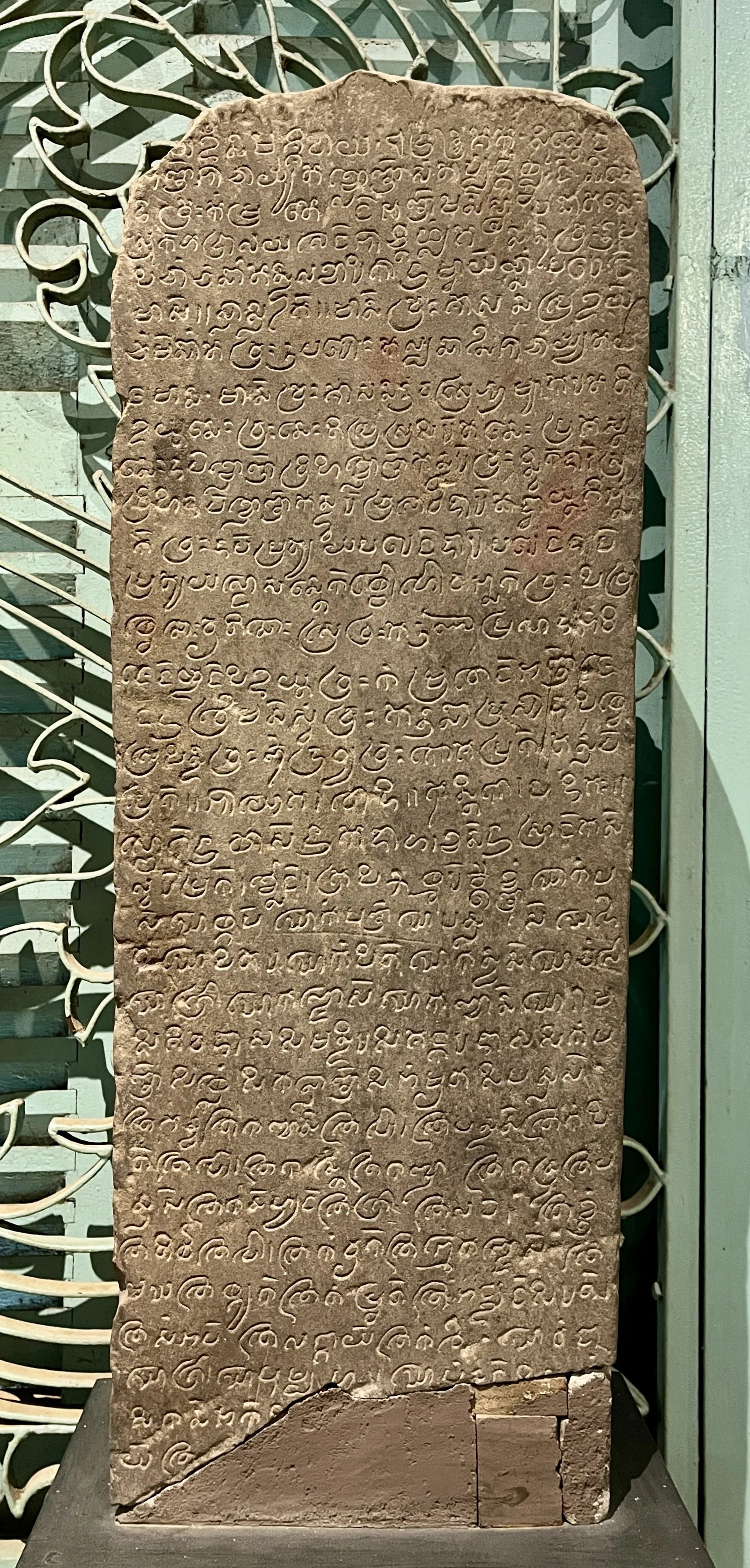
Inscription on door frame
Sandstone,
Angkorian period / 843 saka or 901 A.D.
Prei Khpos Village, Bovel District,
Battambang Province
Apart from a brief Sanskrit invocation to the God Siva, the text is entirely in Old Khmer. It informs us that in year 901 of our era, an "Acarya" (master) asked for the king's agreement to found community and a temple called Bhadralaya, the foundation accompanied by a supply of rice, oil and areca nut for offerings dedicated to the divinity of the sanctuary.
From line 9, this foundation is confirmed by a royal order which exempts the property of this foundation and certifies its ownership. It is also ordered to install this inscription to publicize this royal decision. From line 14 to the end, the text indicates that the king has handed over rice paddies located along the river and forest plots intended for rice cultivation for the foundation. There are still more mentioned gifts, of clothing, objects of worship (a large water vase, a teapot, a pitcher, a tray, a bowl), cattle, and slaves– men and women whose names are specified.
It should be noted that the gift of a kosa, a term that often refers to sheaths intended to cover the linga, confirms that the shrine was dedicated to Siva.
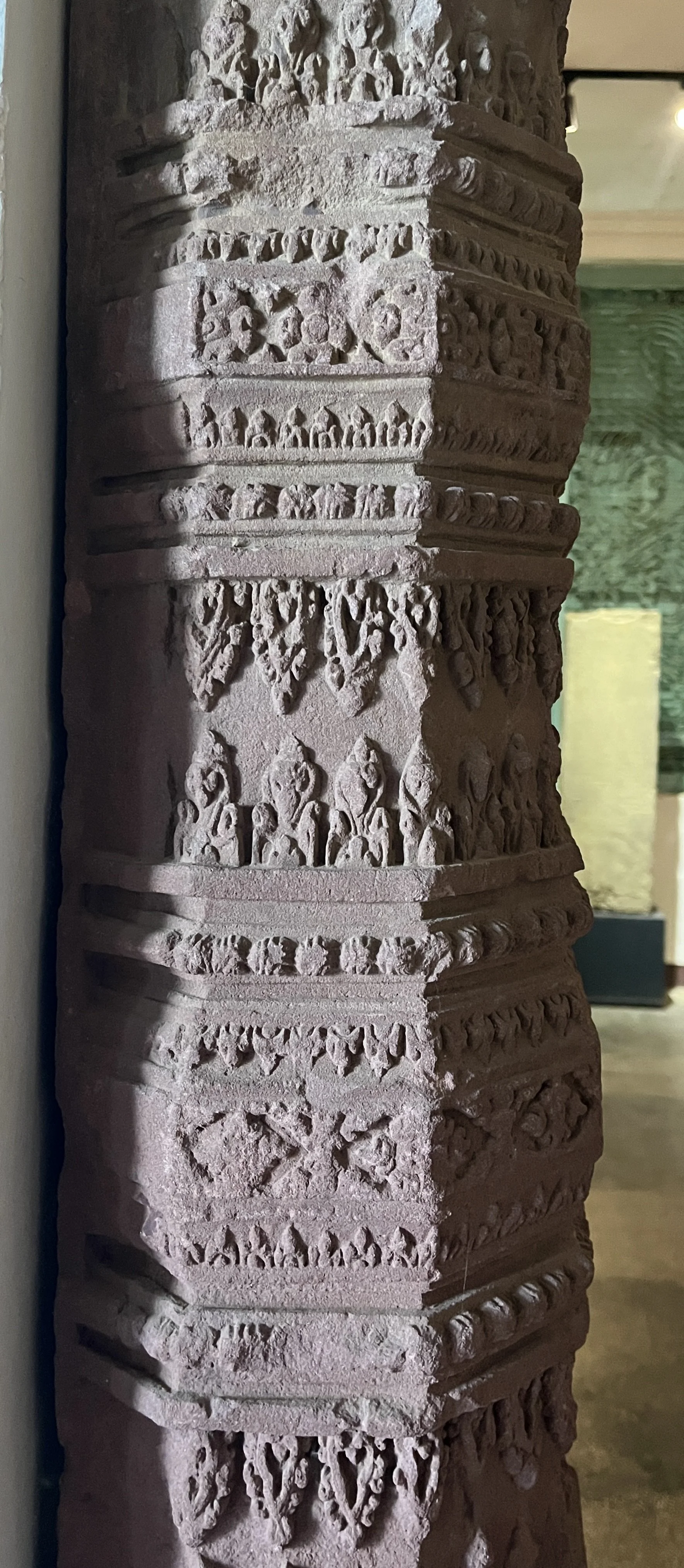
Fragment of Column
The colonette is an essential element in temple architecture to support lintels. A colonette is divided into three sections; the capital, shaft and base. In the pre-Angkorian period, the column has a round shape, while in the Angkorian period it is either heptagonal or octagonal in shape, usually with a square-shaped capital and base carved with different motifs, or in an animal shape, or depicting an episode of a myth.
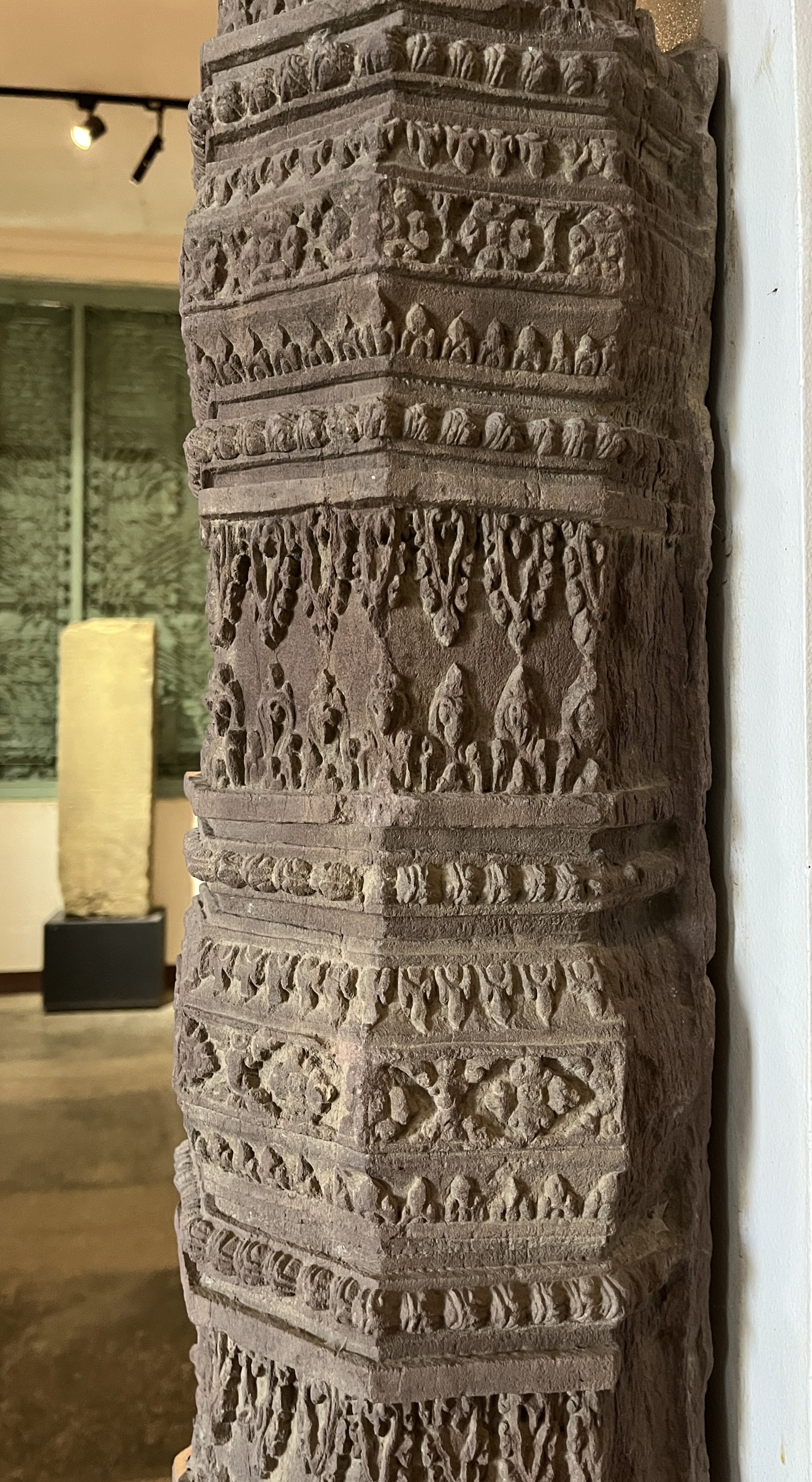
Colonette
Sandstone
Angkorian period, Koh Ker style,
10th C.?
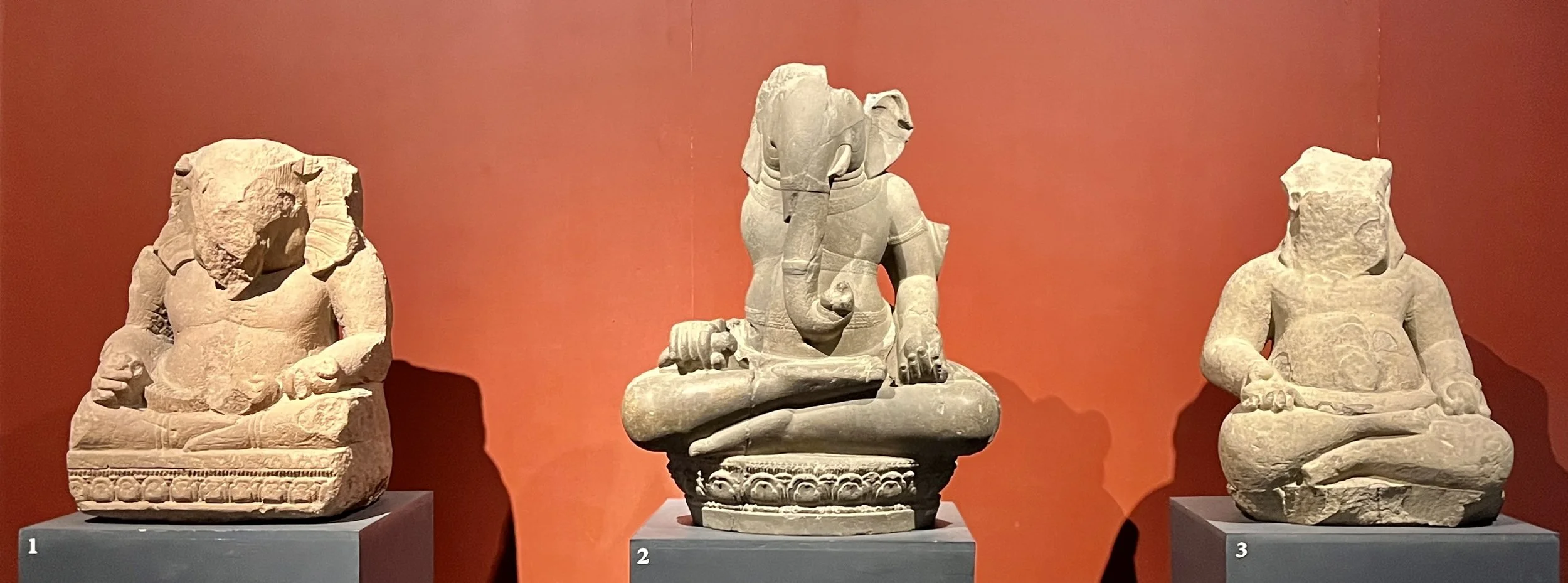
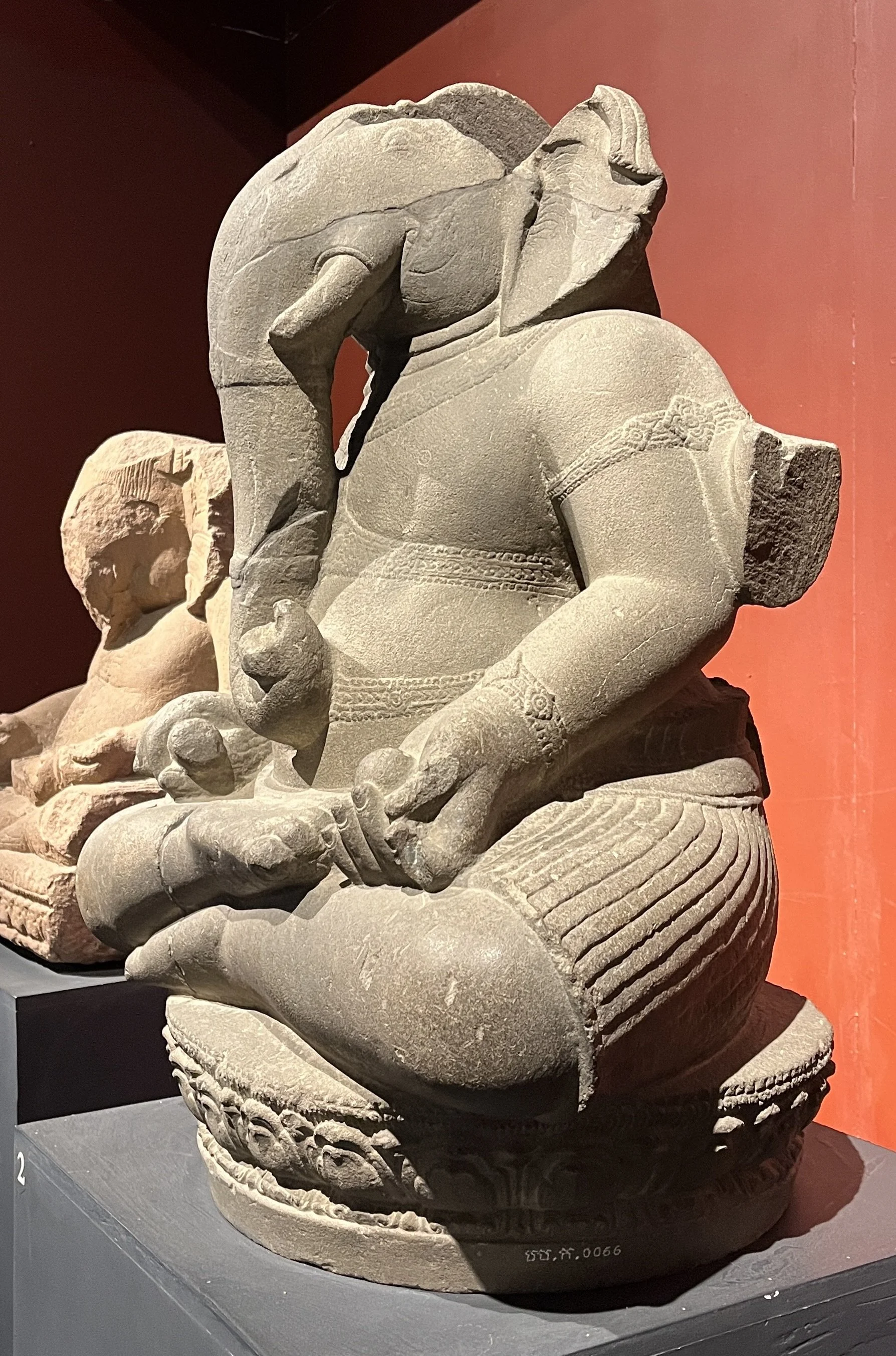
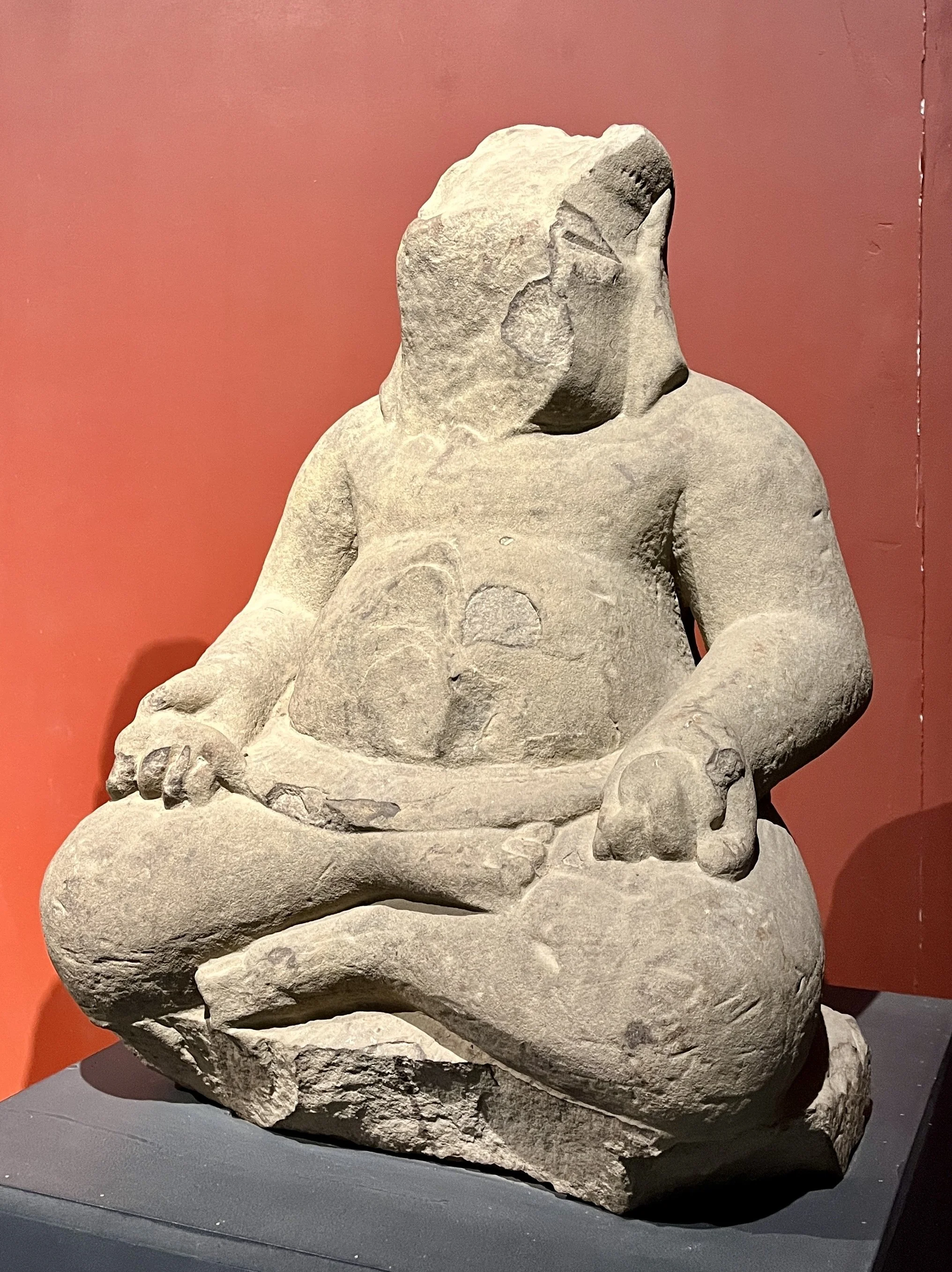
Ganesha
The Ganesha is a deity with the body of a human and the head of an elephant. He is generally known as the remover and creator of obstacles, the lord master of intellect, wisdom, science, and art. He is the most prestigious and the most honored God in various ritual ceremonies. The depiction of Ganesha in stone began in India in the first century BC. Ever since, his role and importance in society have continuously grown in India and Southeast Asia.
Images of Ganesha have appeared in sculpture in the round and in reliefs on walls and other architectural elements of ancient Khmer temples since the Pre-Angkor period, 6thC., onward. He was usually presented in either seated or standing posture with two, four or eight arms.
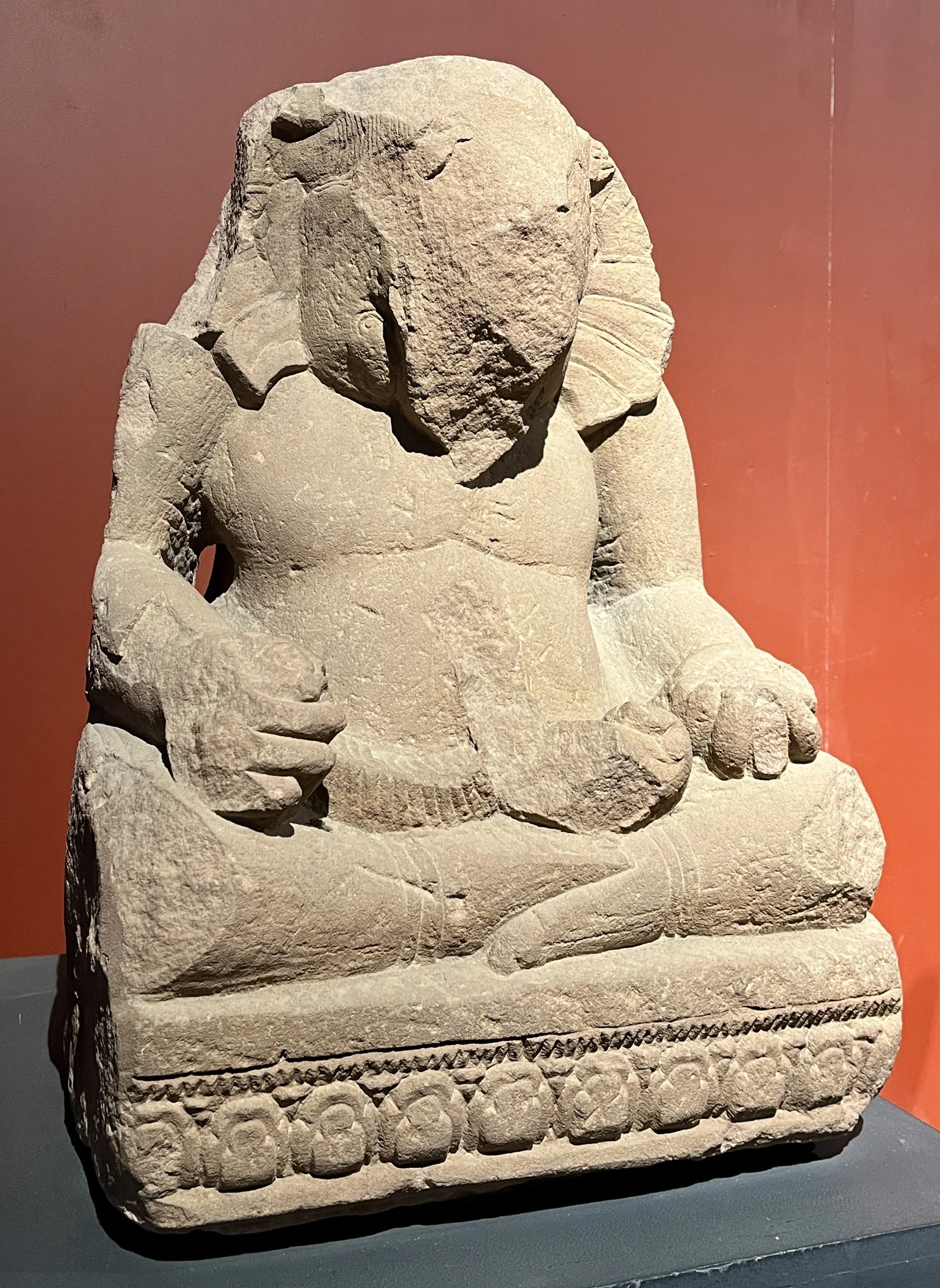
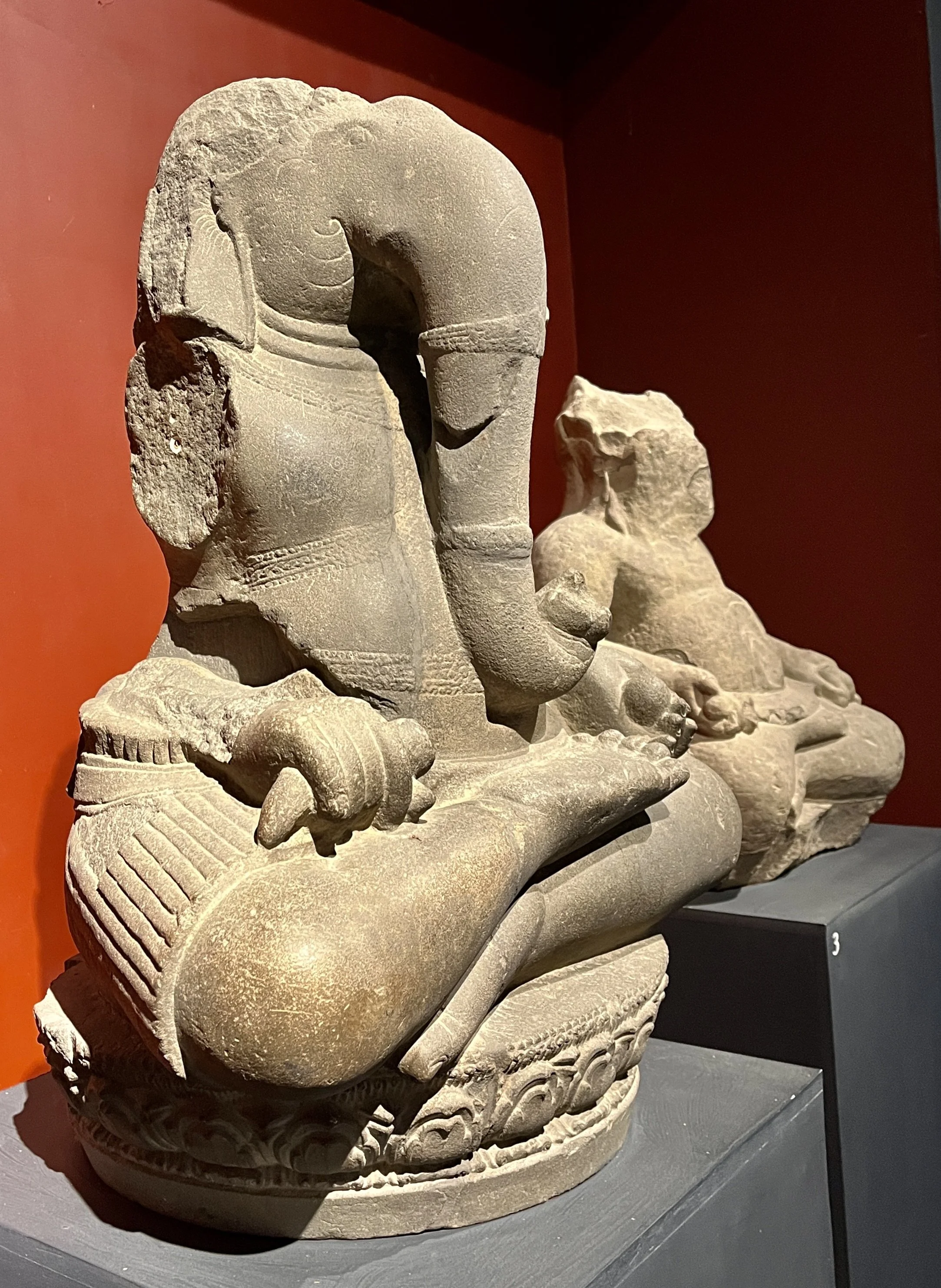
These three Ganesha probably date to the 10th c. A.D. Only the Ganesha in the middle is Koh Ker style, identifiable by its ornaments such as the necklace, torso belt, abdomen belt, armbands, bracelets and his cloth. The damage and lack of noticeable features such as garments and ornaments prevent the style analysis of the other two Ganesha.
Ganesha Left
Sandstone, Style: (?),
10ch to 11th centuries (?)
Ganesha Middle
Sandstone, Koh Ker first half of 10th century
Ganesha Right
Sandstone, Angkorian period
10th C. (?)
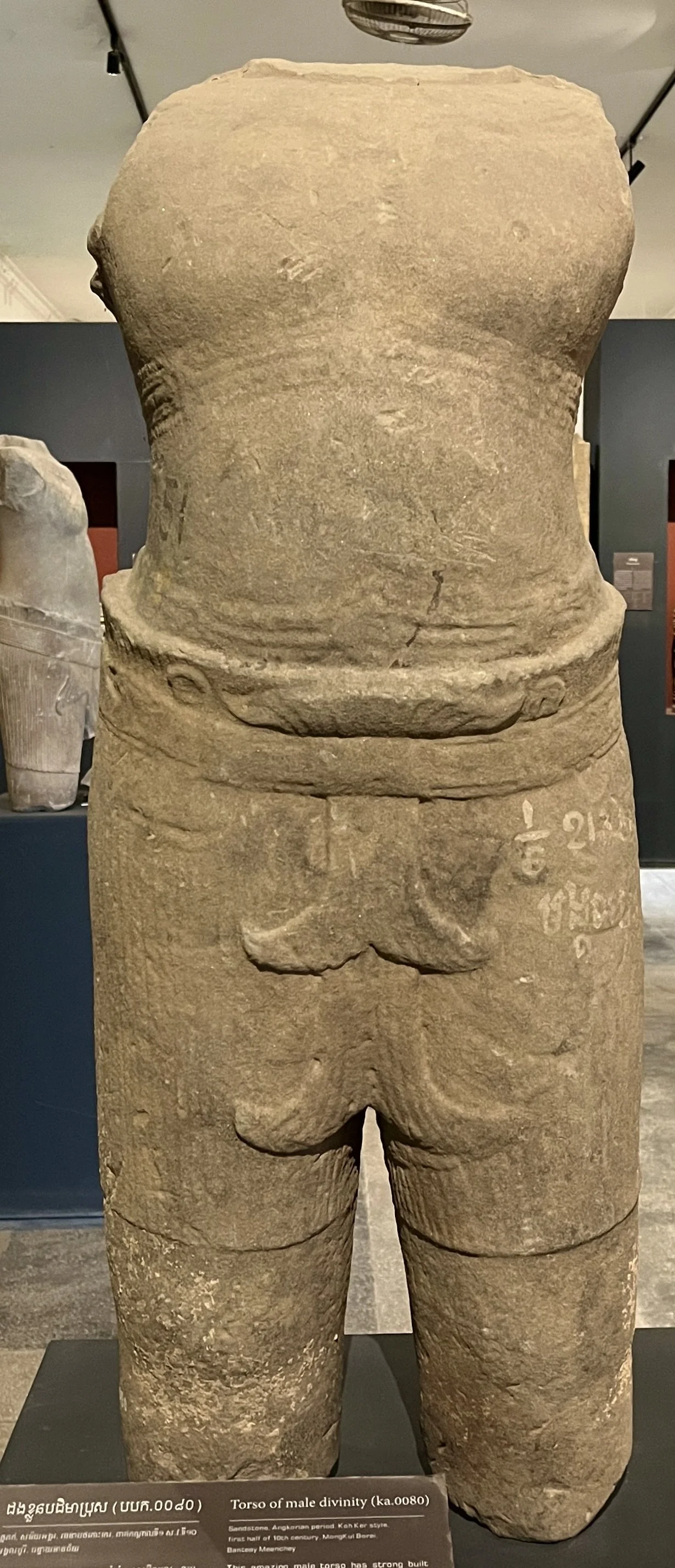
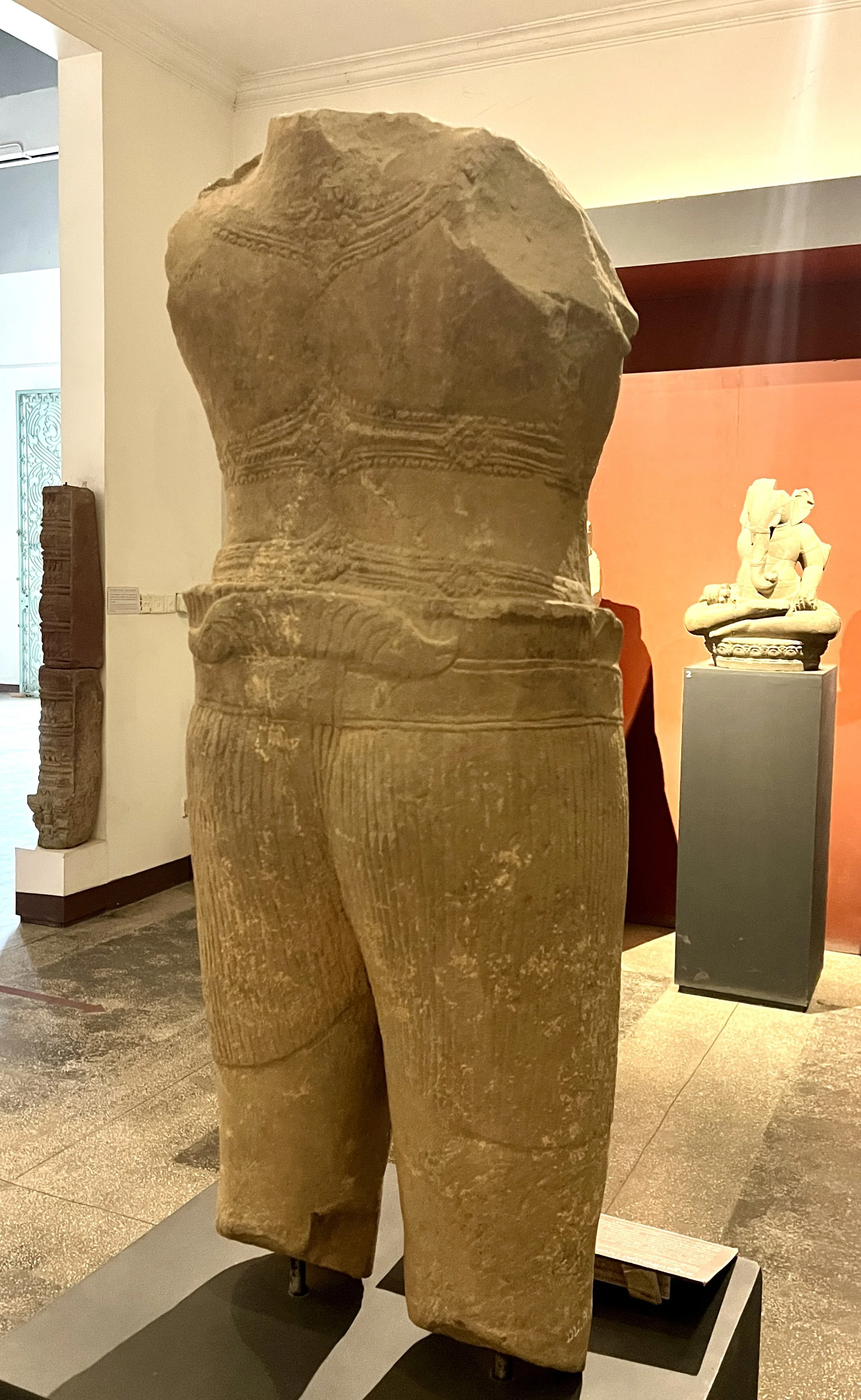
Torso of male divinity
Sandstone, Angkorian period, Koh Ker style, first half of 10th century, MongKul Borei, Banteay Meanchey
This amazing male torso has a strongly built body with broad shoulders. (editors note: AMaaayaYSSZinng/s. these descriptions are so repetitive, superficial, and even sexist, it’s annoying.) He is decorated with beautiful jewelry such as necklace, chest and waist band. He wears a short pleated skirt, Sampot Can Kbin, fastened with a plain belt of which both ends are folded ins such a way that the edges fall to form a fish tail shape on the upper part of both thighs. Below the belt, on the left thigh, a large piece creates a pleated eggplant like shape (again, editor’s note: they keep using ‘fishtail’, ‘eggplant’ and ‘oyster’ to describe common depictions of folds and knots; I have no idea if that’s standard but have never read such things elsewhere). At center, a separate folded cloth forms a double fish tail, with the shorter one overlaying the longer one.
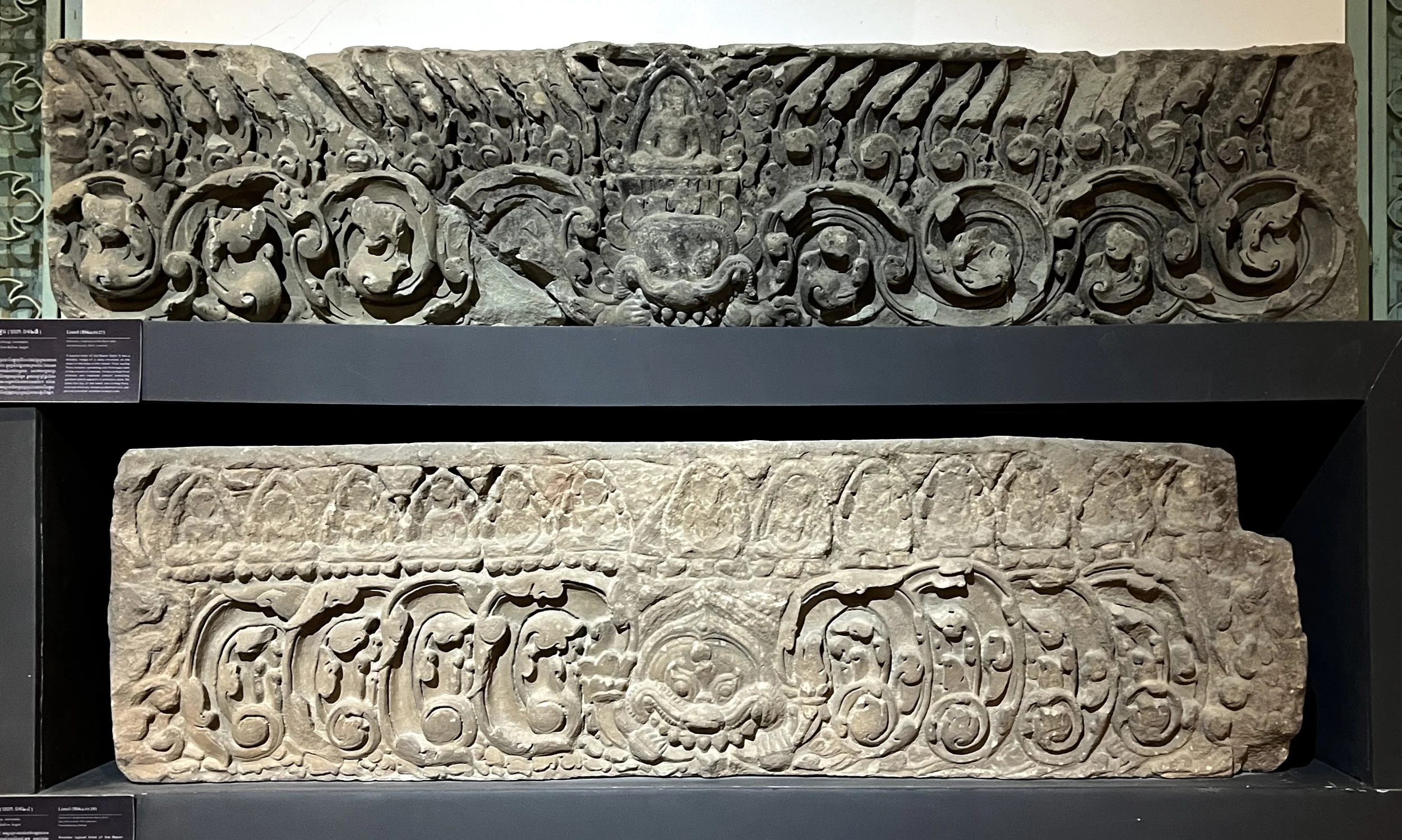
bottom lintel:
Sandstone, Angkorian period, Bayon style late 12th to early 13th centuries
Prasat Bantnay Chhmar
Another typical lintel of the Bayon Style, It has a heraldic image of a large Kala head in the center. Four curling flora protrude from the Kala on each side. The frieze has a row of ascetics, each seated on a lotus throne.
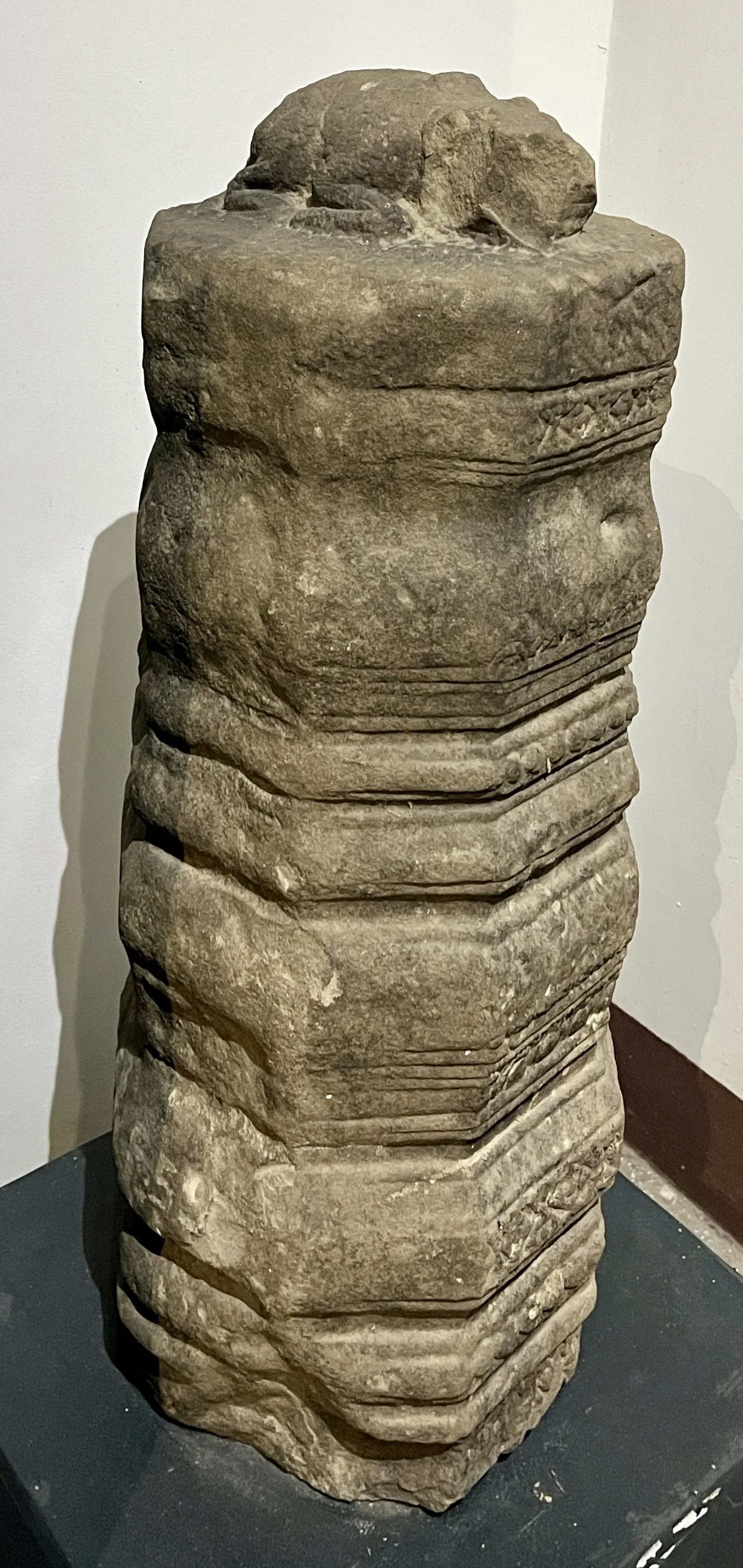
Fragment of Column
These two octagonal shape fragments of a colonette (BBK.0647 probably part of a shaft, and BBK. 0748 is a base) are dated to 10th C., probably in Koh Ker style, with tops later modified into elephant or bull like shapes
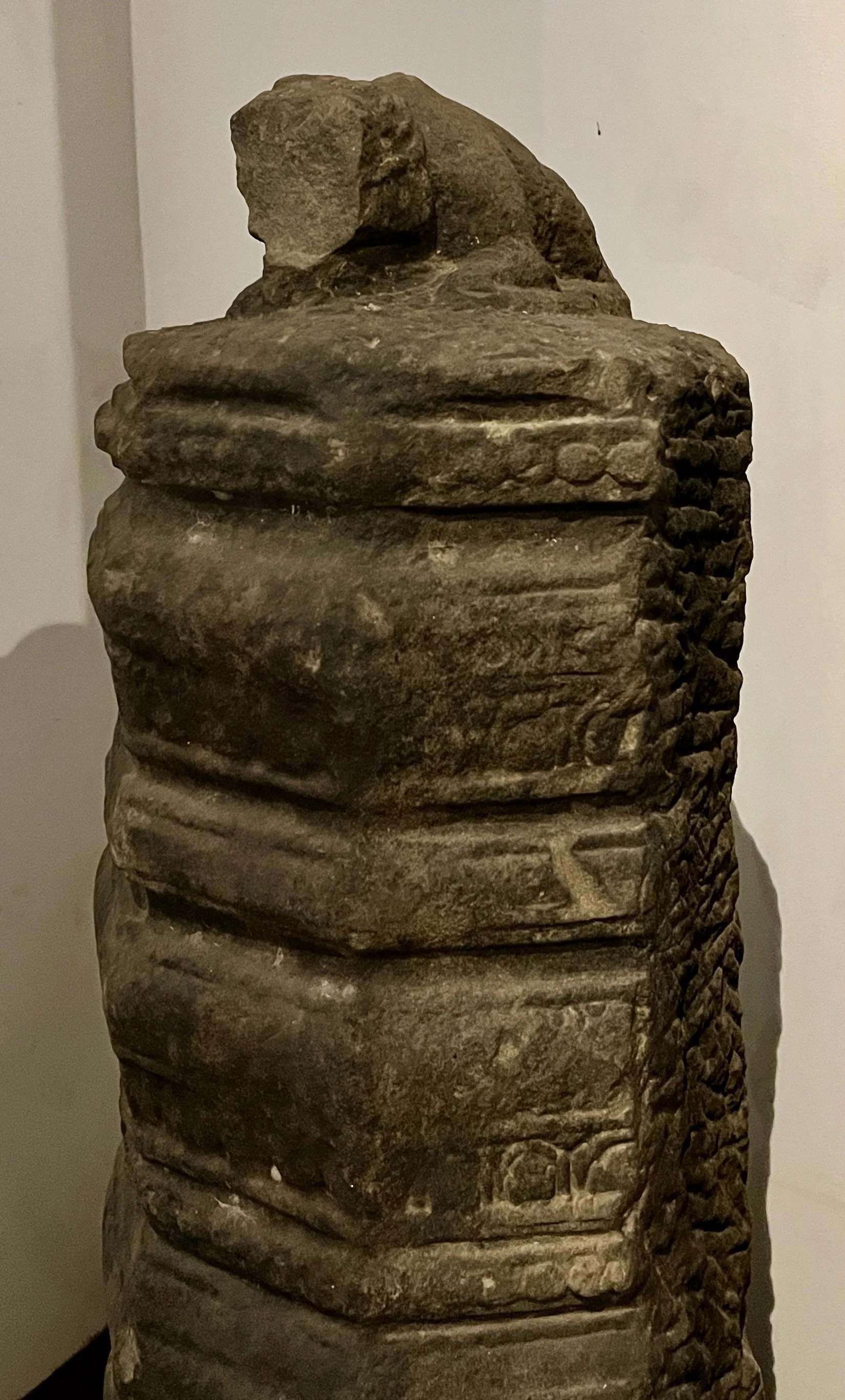
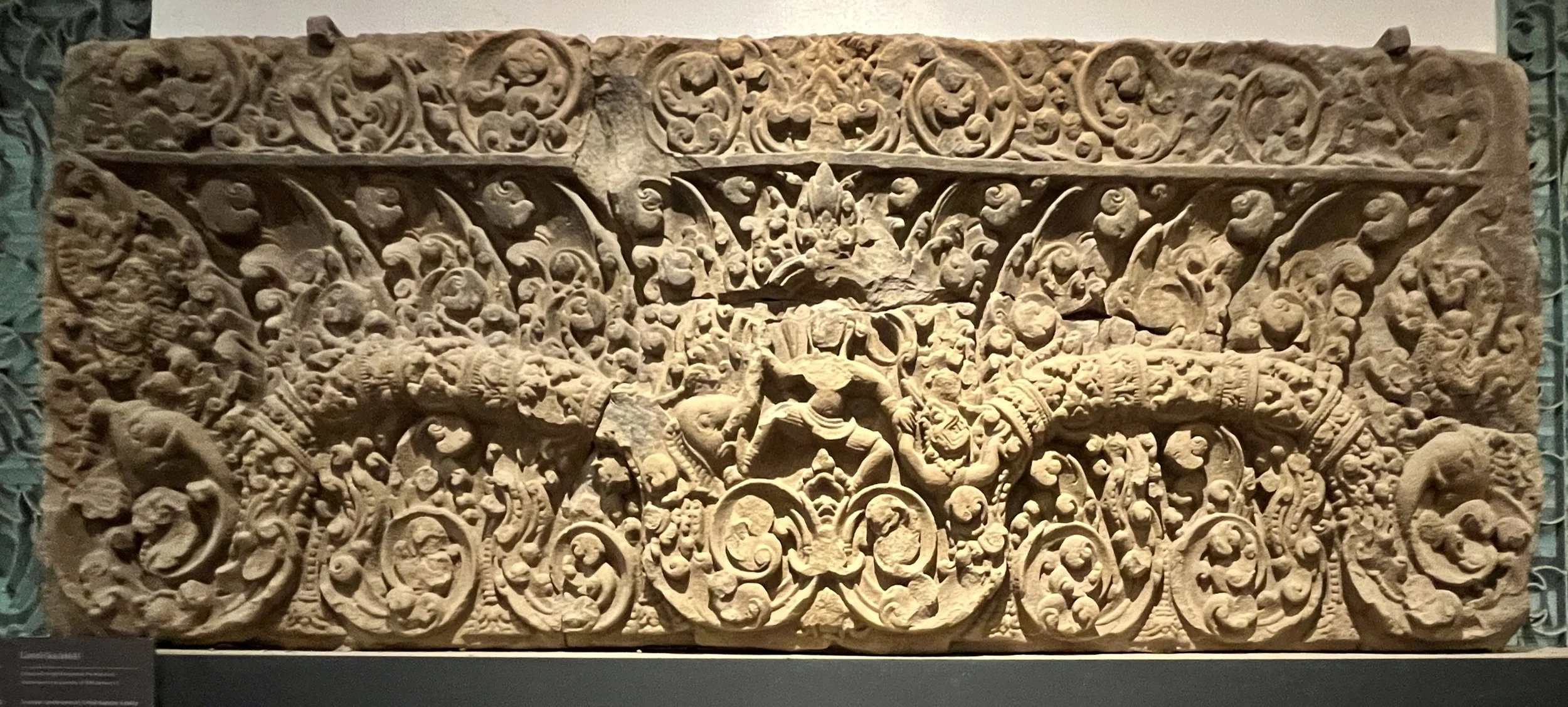
Lintel
Sandstone, Angkorian period, Pre Rup style,
Second and third quarters of 10ch century (?)
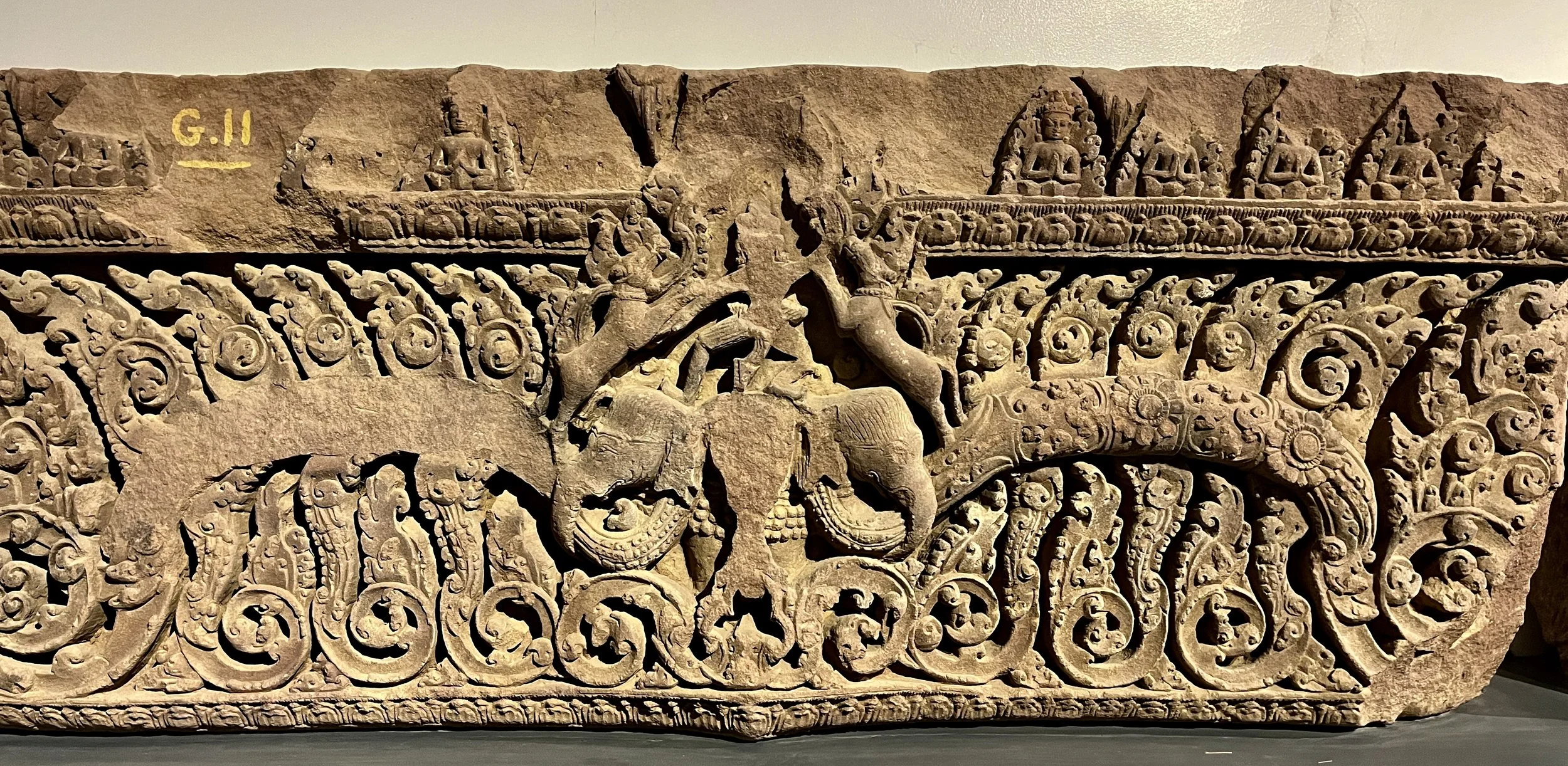
Another tenth-century lintel depicts a deity fighting an elephant and a lion at the center.
The deity is usually identified as Krishna.
Two foliate branches are connected to each other underneath the deity to form a bow shape; either end forms a lion mounted on an elephant. The leaves motif of the joint between the two branches belongs to the styles of the tenth and early eleventh centuries. The frieze has a row of floral motifs; an intricate lotus petal motif is at the center flanked on each side by four foliage motifs.
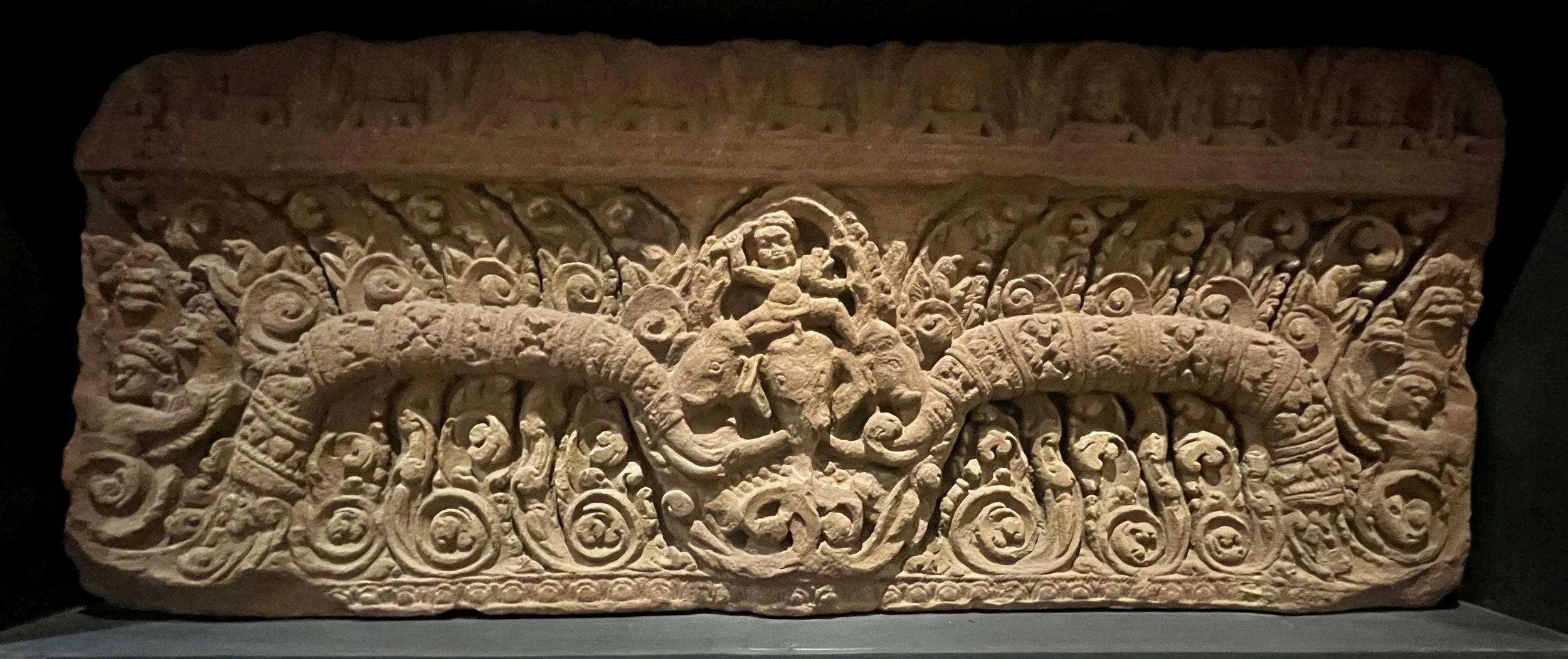
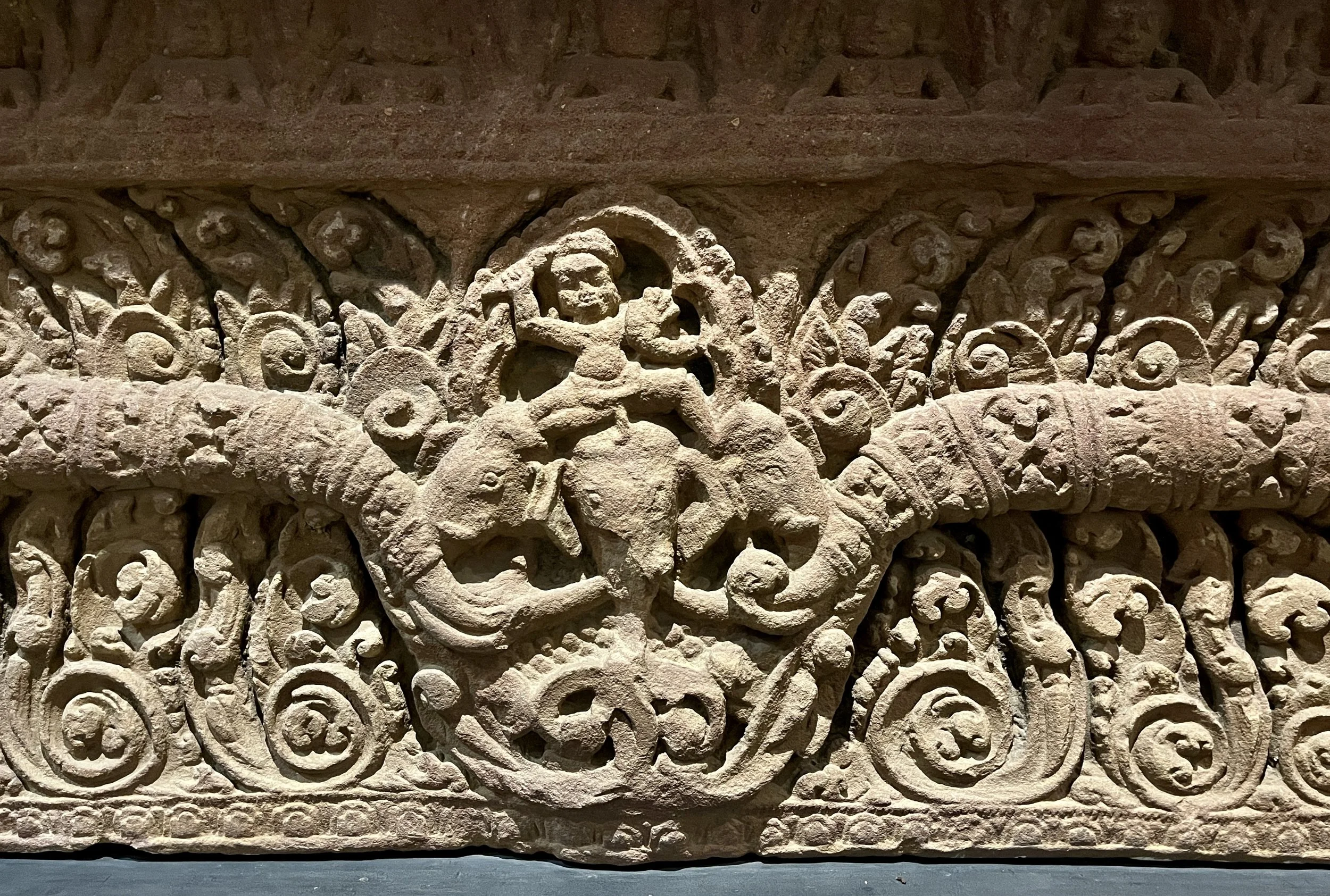
Lintel
Sandstone. Angkorian period, Koh Ker style
Second half of 10th C. Toul Roka, Phum Roka, Sangkae
This Koh Ker lintel depicts the God Indra mounted on Airavata, the three-headed elephant. A bow shape feature is formed by two foliate branches, connected below the elephant. Both ends of the bow form a Garuda hooded by five-headed Naga. The frieze has a row of eleven seated figures joining their hands as a mark of worshipping
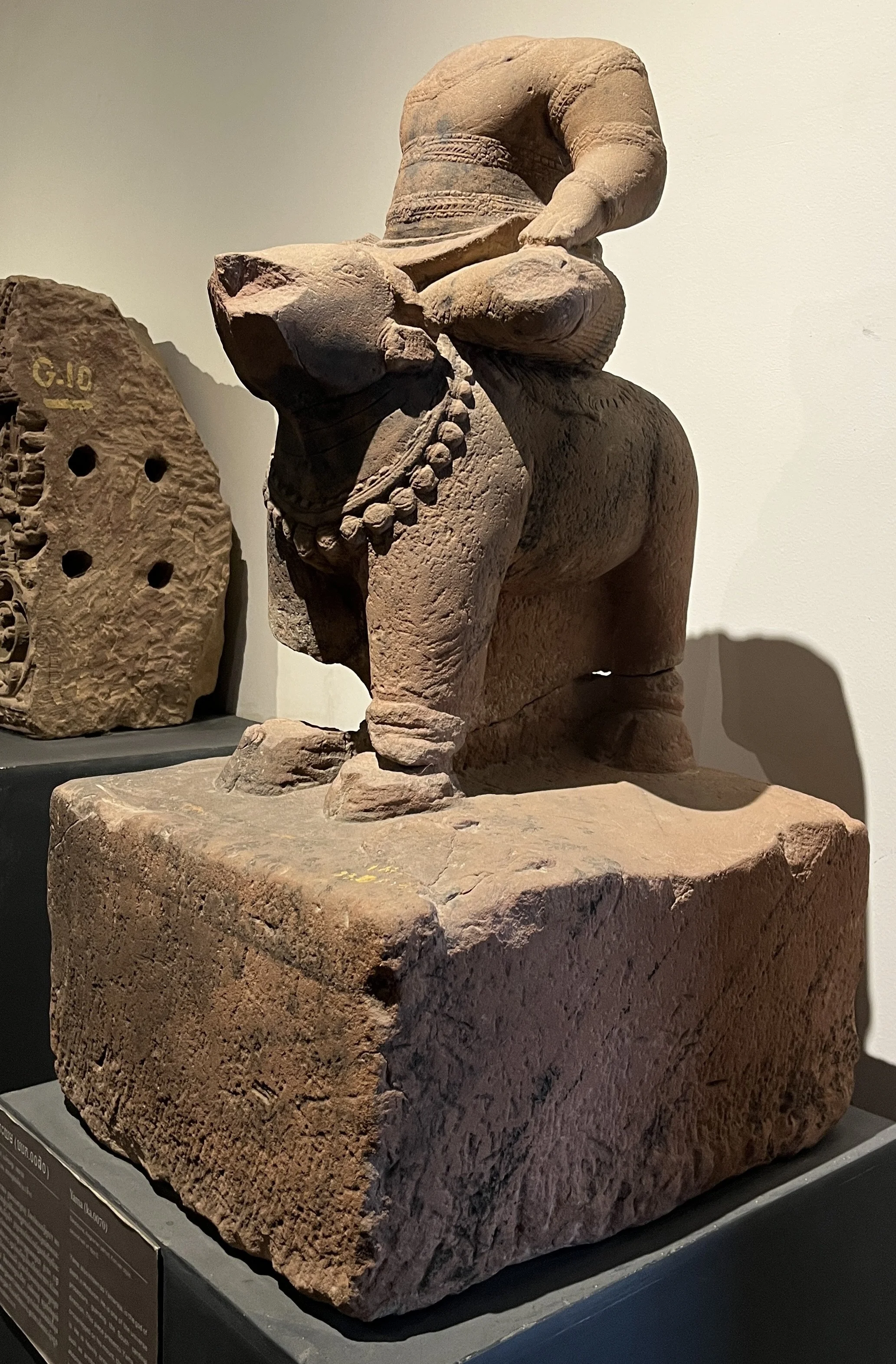
Yama
Sandstone, Angkorian period, Koh ker style, second half of 10th C.
Yama, also known as Yamaraja, is the god of death in Hinduism. He is one of the universe protectors, guarding the South. This piece presents Yama sitting cross-legged on his mount, the water Buffalo. He is heavily ornamented with jewelry such as armbands, bracelets, torso belt, abdomen belt, and necklace, like other statues of the Koh Ker style.
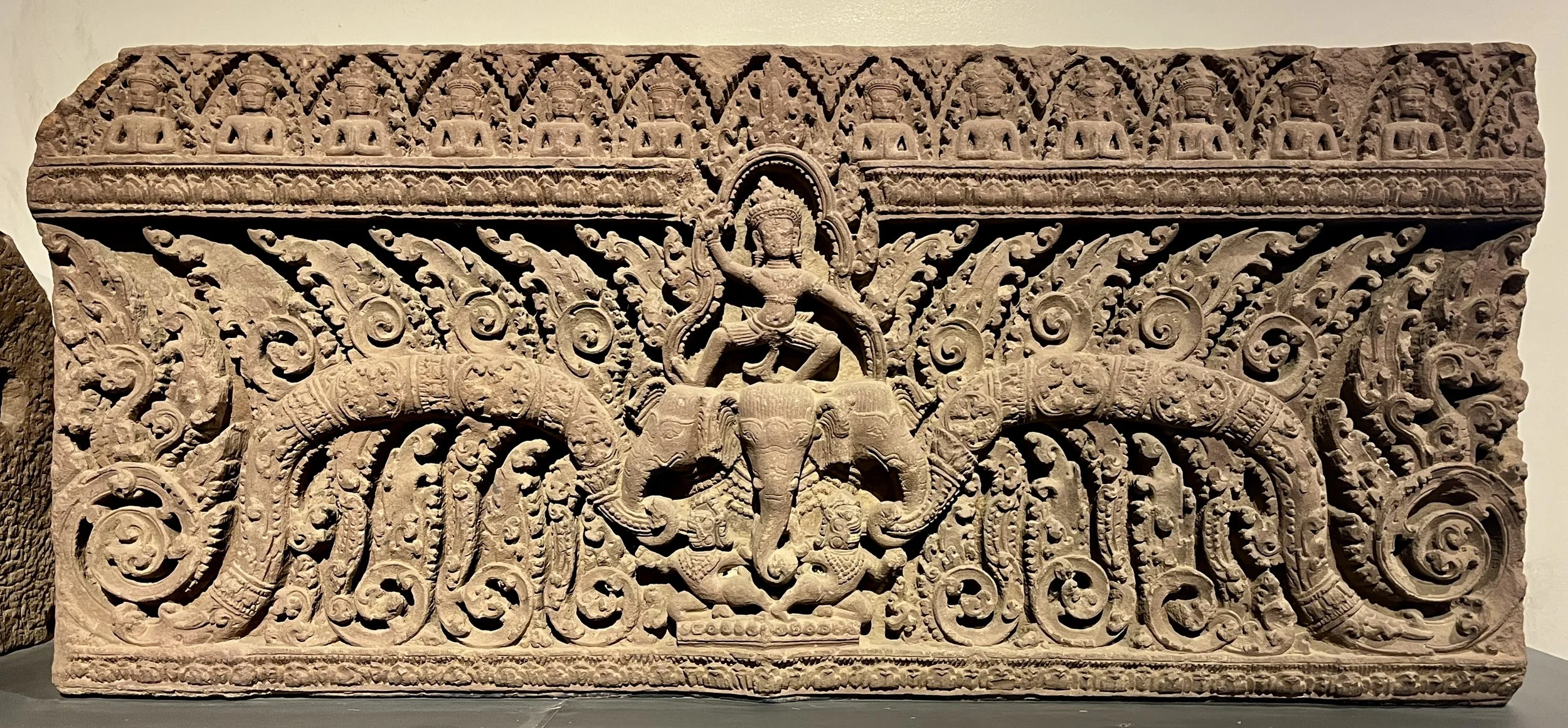
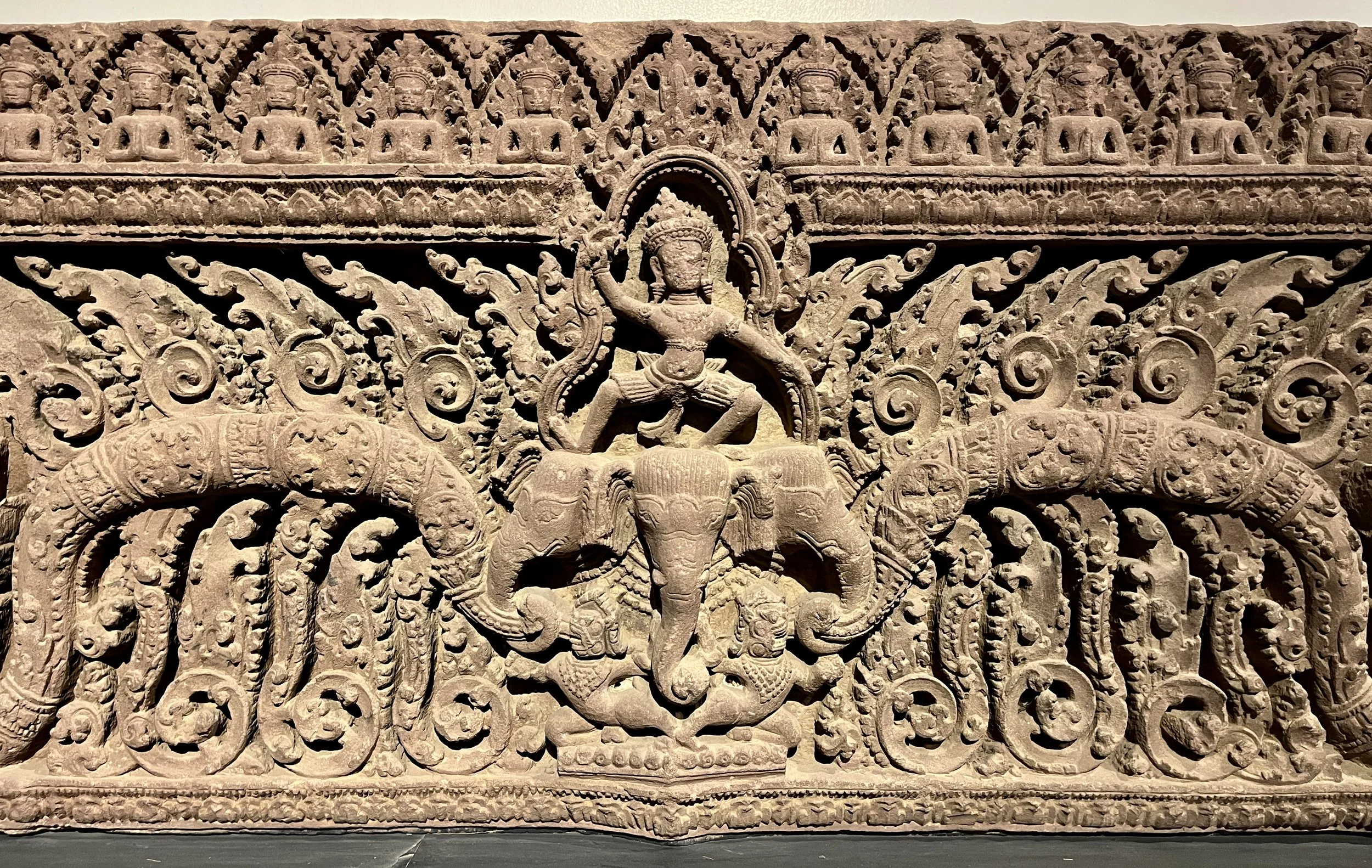
This lintel belongs to the Pre Rup Style. At its center is the God Krishna (?) mounted on Airavata, the three-headed elephant holding two horses with both hands. The depiction is of Krishna slaying the Keshin demon who transformed himself into horses. From the elephant's mouth, two foliate branches protrude out to form a bow shape, which forms at both ends a curling foliate in the shape of Naga. In this style, the curling foliage under the branch is usually more elegant and thinner than other styles. The frieze has a row of twelve seated figures joining their hands as a mark of worshipping.
Lintel
Sandstone, Angkorian period, Pre Rup, Second and third quarters of 10th century
This lintel is another typical piece in the Pre Rup Style. At its center is the God Indra mounted on Airavata, the three-headed elephant. The foliate branches protrude from two lions at the base of the center. The curling foliage under the branch is elegant and thin. The frieze has a row of twelve seated figures joining their hands as a mark of worshipping.
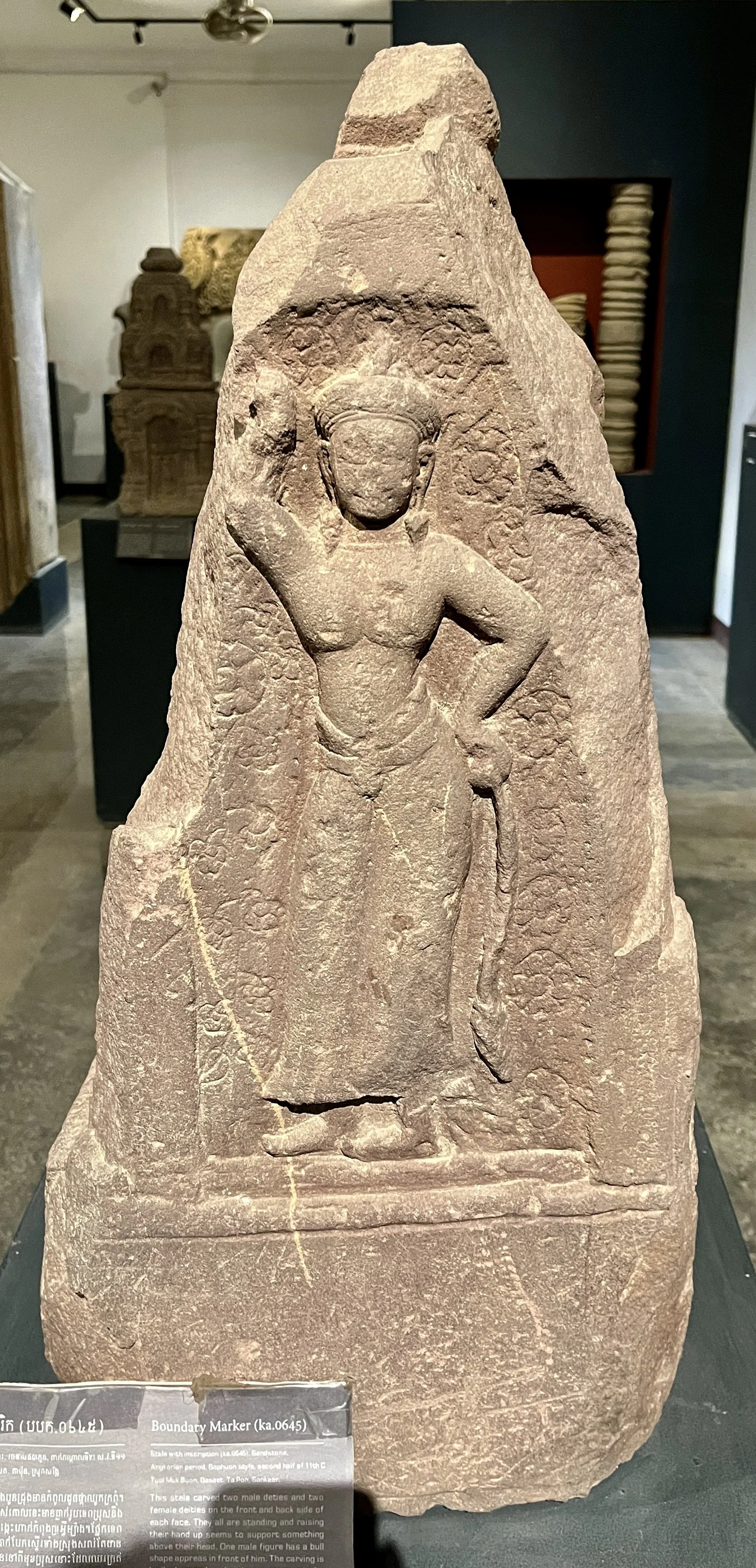
Boundary Marker
Stele with inscription, Sandstone
Angkorian period, Baphuon style, second half of 11th c. Tuol Muk Buon, Basaet, Ta Pon, Sankaer.
This stele is carved with two male deties and two female deities, one per face. They are standing and raising their hands up, seemingly to support something above their head. One male figure has a bull shape in front of him. The carving is badly damaged, and a clearer engraving of a bull is visible below. The female figure with similar posture on the opposite side has three engraved lines of inscription below her.
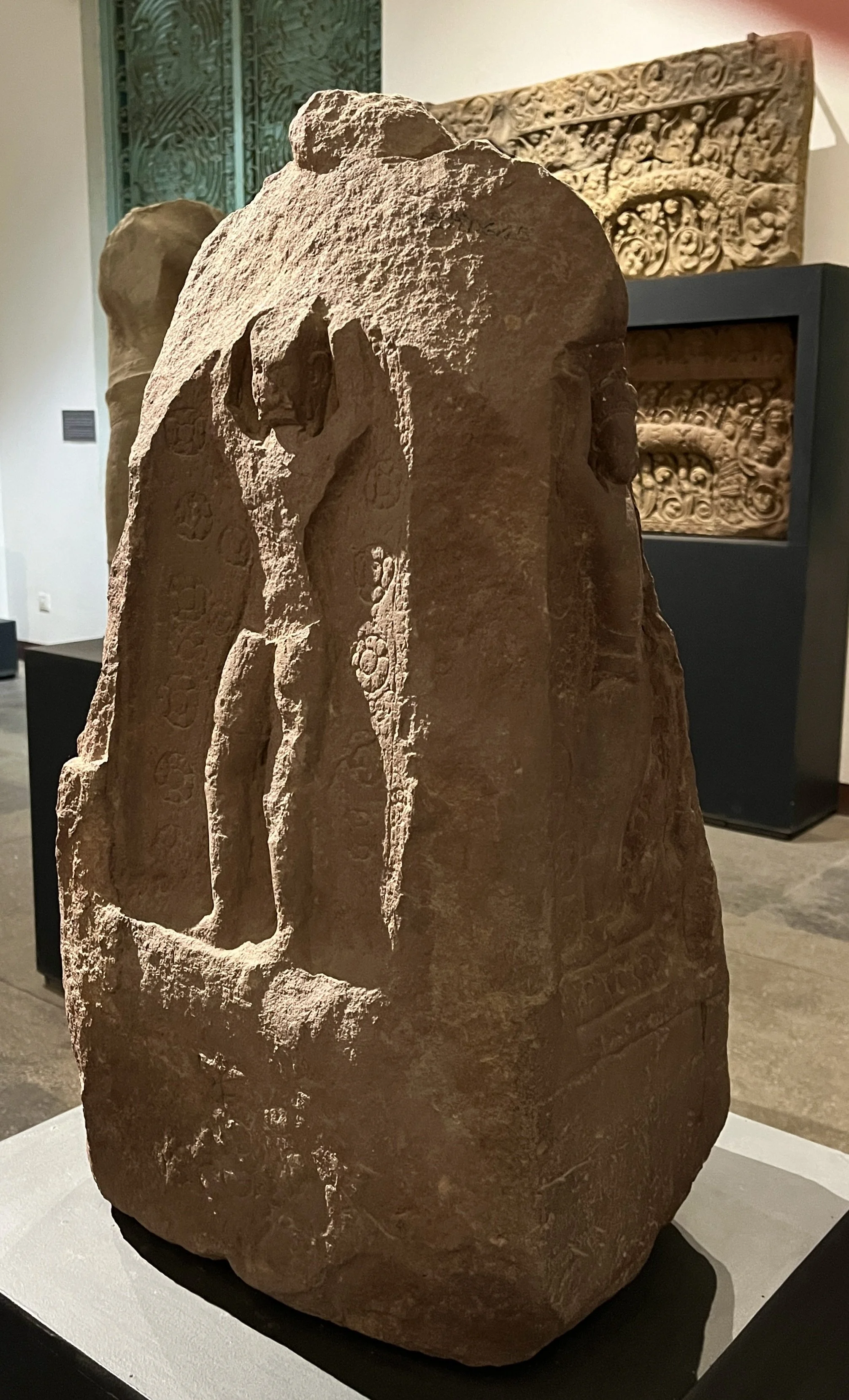
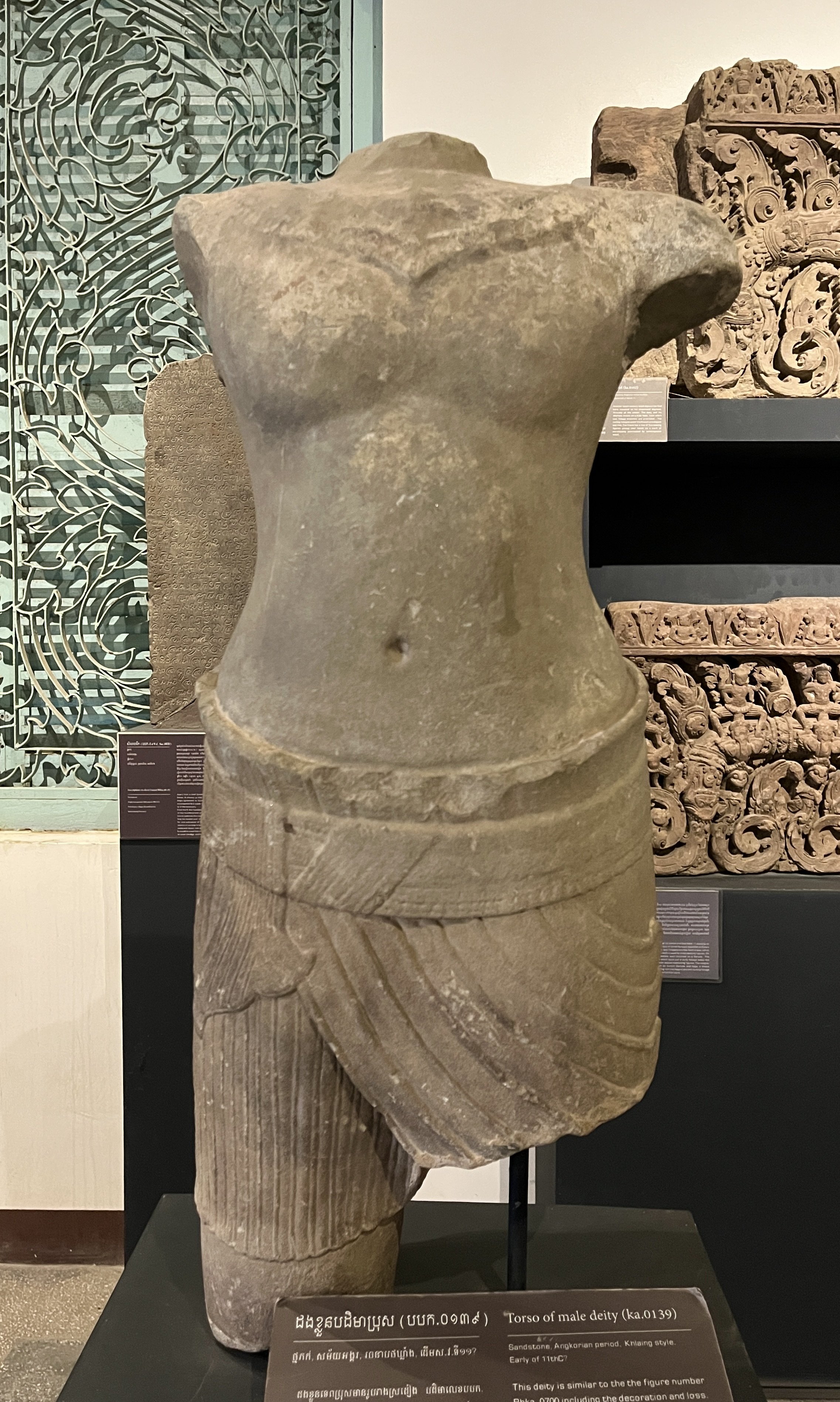
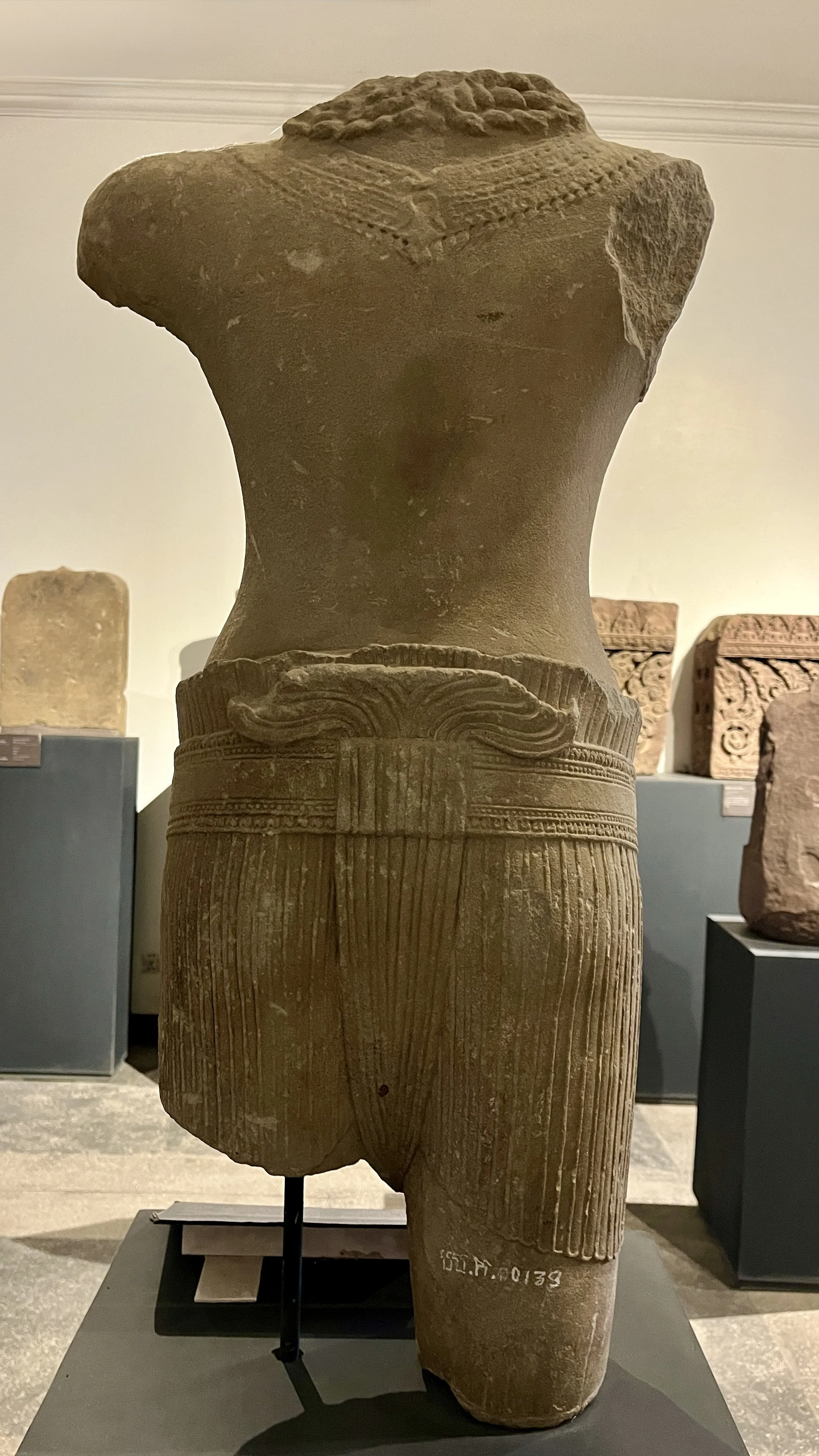
Torso of male deity
Sandstone, Angkorian period, Khlaing style,
Early 11thC?
He is ornamented with armbands and necklace. He is wearing a typical skirt of the Khlaing style. The tail of the skirt falls from the middle of upper front edge onto the left thigh. The skirt is fastened by a belt below hip level. The tail of the belt is inserted underneath the belt and falls on the right thigh.
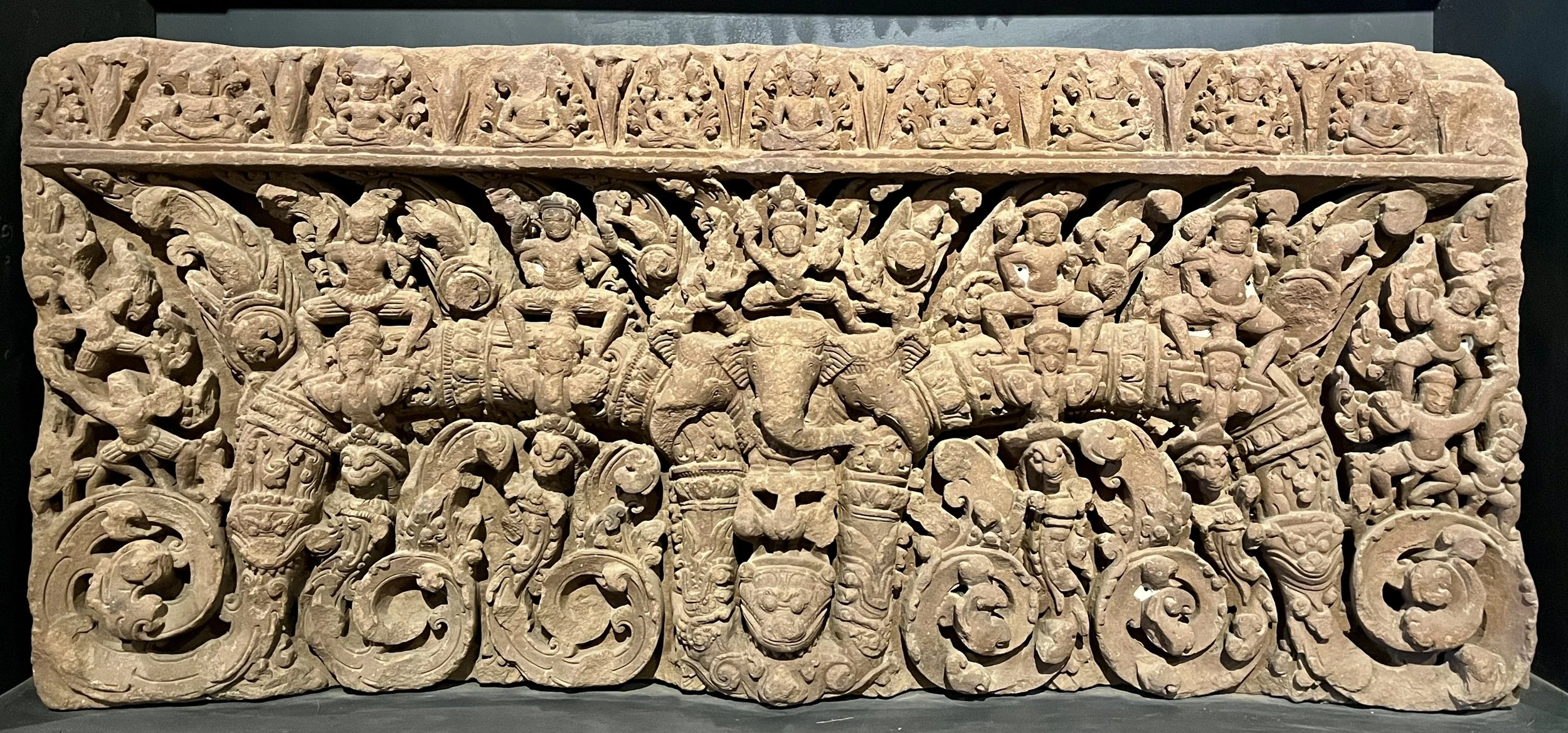
Another tenth-century lintel depicts at its center the God Indra (?) dancing on his three-head elephant, Airavata, on top of three Hamsas mounted on Kala's head. Coming out from Kala's mouth, two foliate branches form a bow, which at either end forms curly vegetations, each topped by three dancing figures. On each branch are two four-armed deities, each mounted on a Garuda. The Garuda carries in its beak a Naga which spits out a curly foliate below the branch. The frieze has a row of eleven seated meditating figures. The integration of several small figures such as human, Garuda, and Naga is a theme belonging to the Preah Ko style; coupled with the elegant and thin curling foliage, this suggests that this piece belongs to the Koh Ker style.
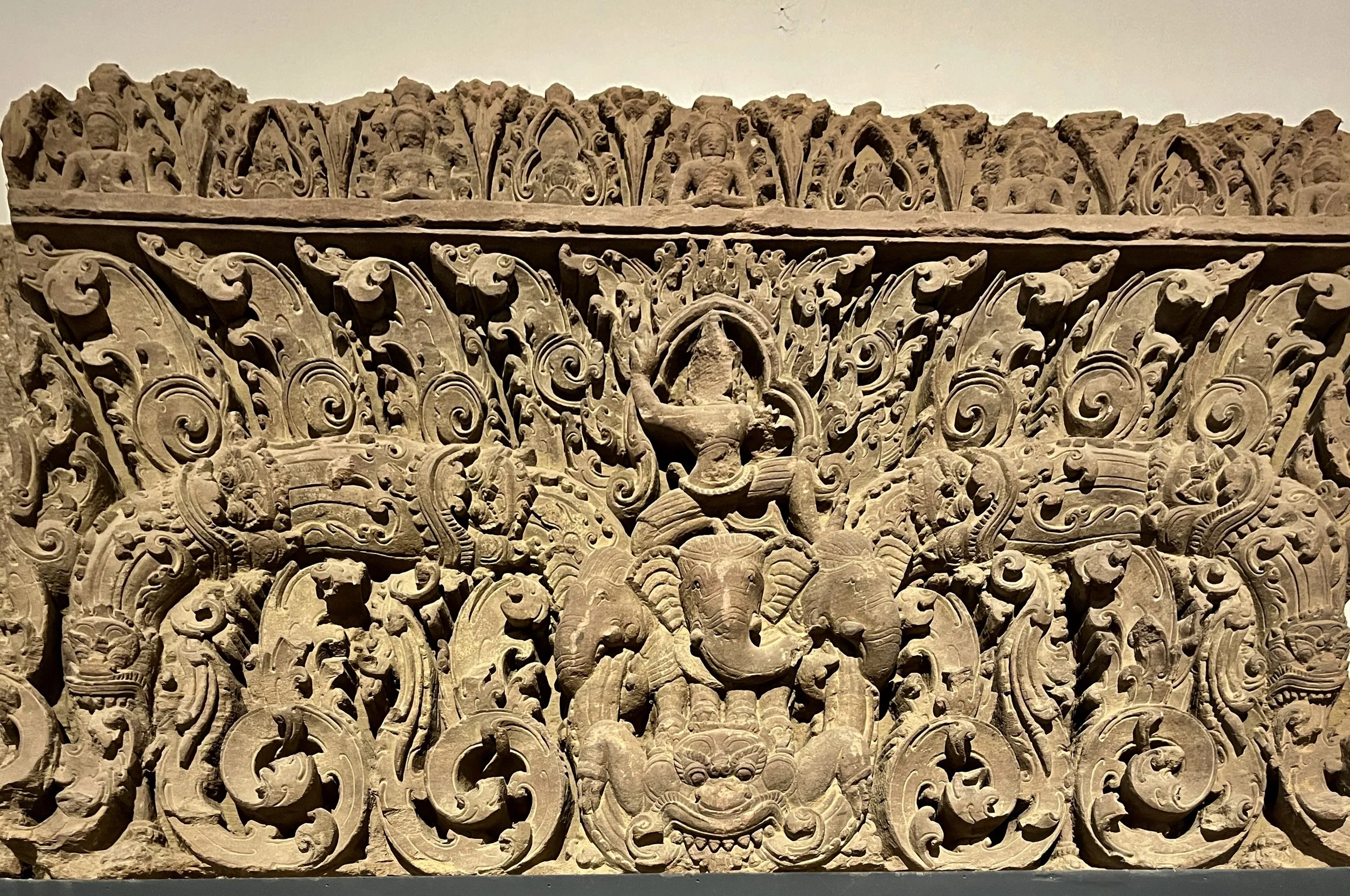
Lintel
Sandstone, Angkorian period, Koh Ker second half of 10th C. (?)
Another tenth-century lintel depicts the God Indra mounted on his three head elephant Airavata at the center. The deity and his elephant mount a Kala head from which two foliate branches protrude. The curling foliage under the branch is elegant and thin. The frieze has a row of five seated figures joining their hands as a mark of worshipping punctuated by an unrecognized motif.
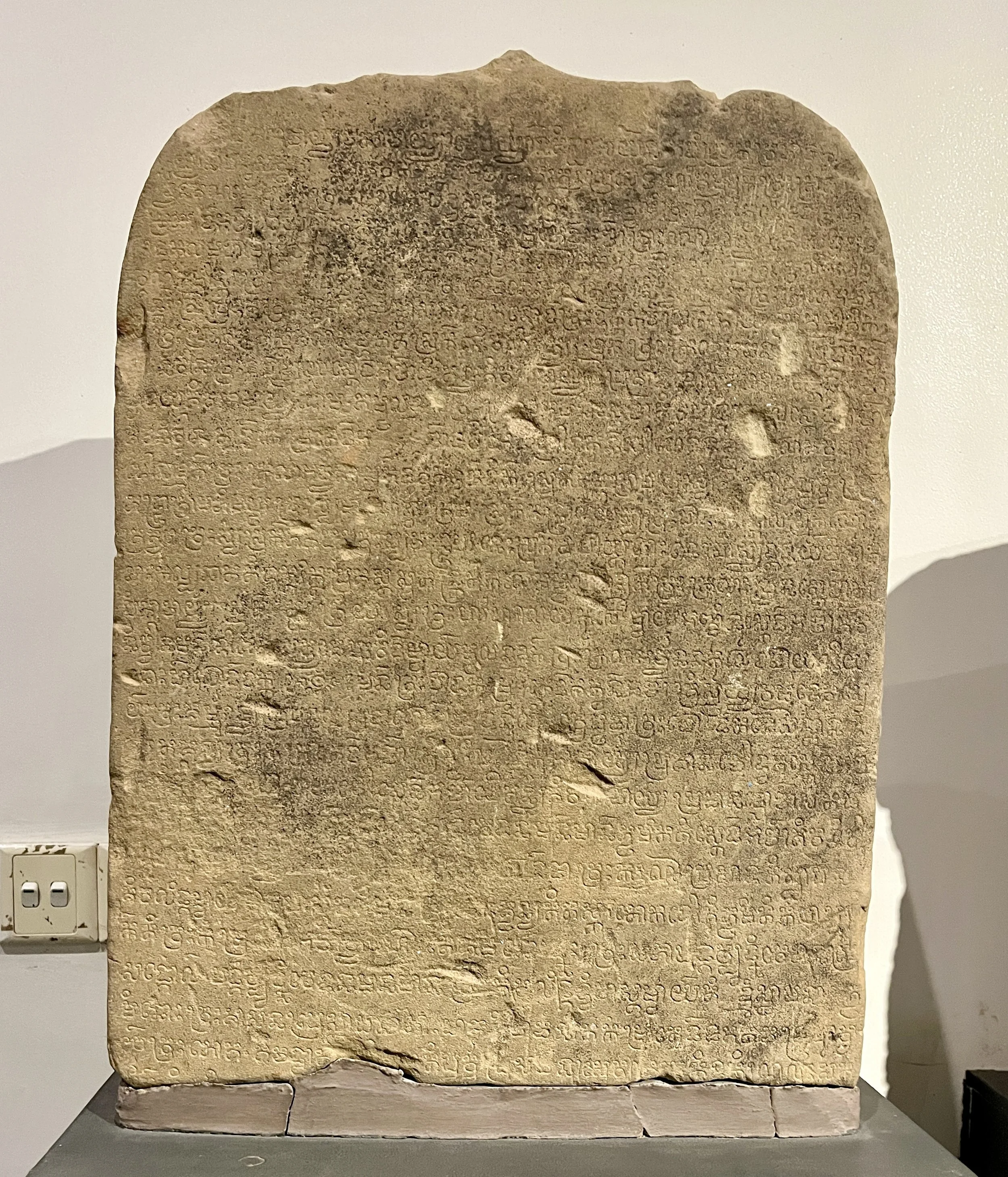
Inscription on door frame
Sandstone,
Angkorian
966A.D.
Prei Khpos Village, Bovel District,
Battambang Province
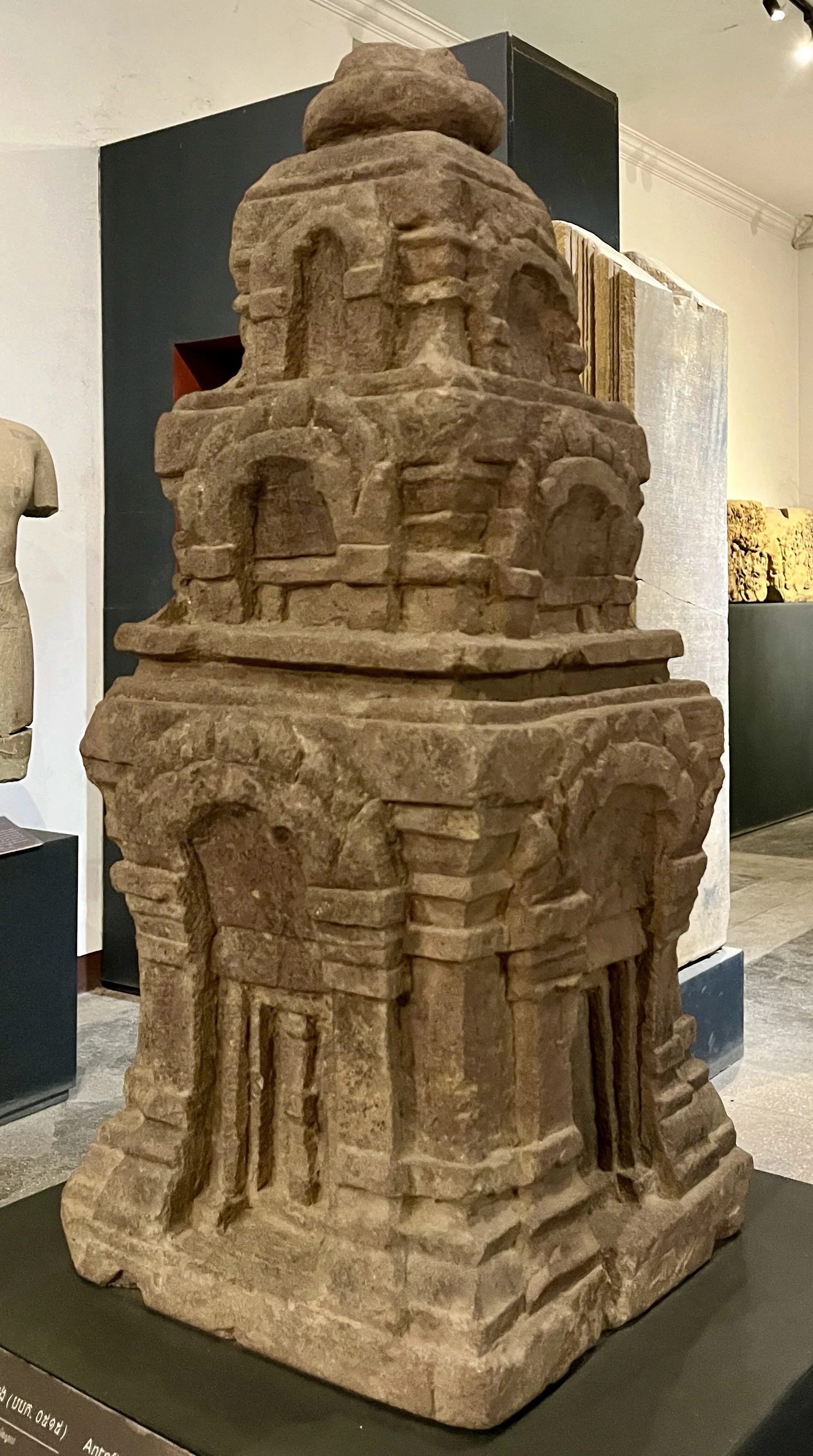
Antefix
Sandstone, Angkorian period, 10th c. (?). Unknown
Antefixes like this one in the form of a miniature temple are frequently placed at the corner of each level of a large temple tower.
This miniature has three levels indicating a larger temple. In Khmer art history, this presentation appeared in the 10th c. at Banteay Srei temple, and later in other temples built in the 11th c.
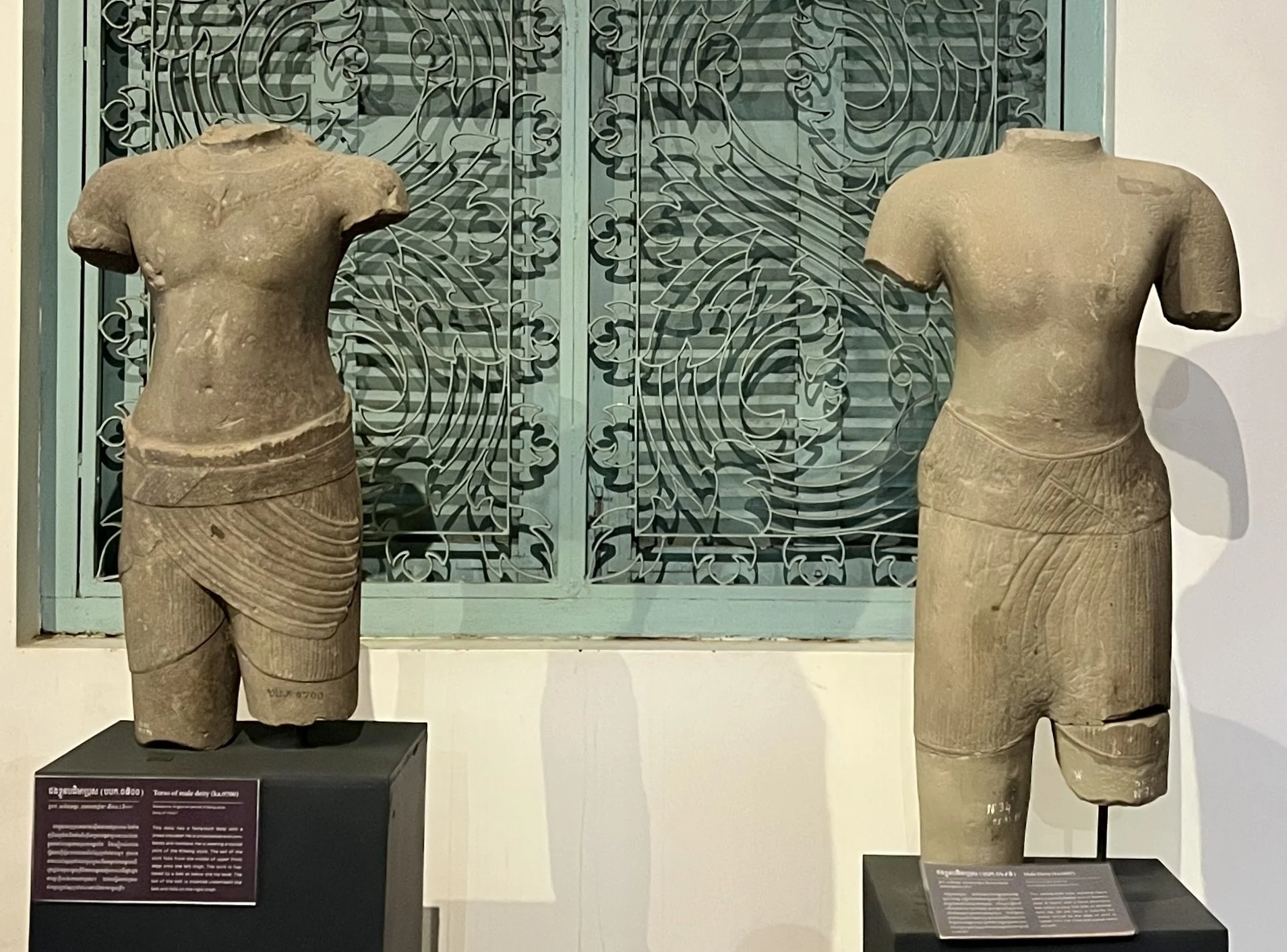
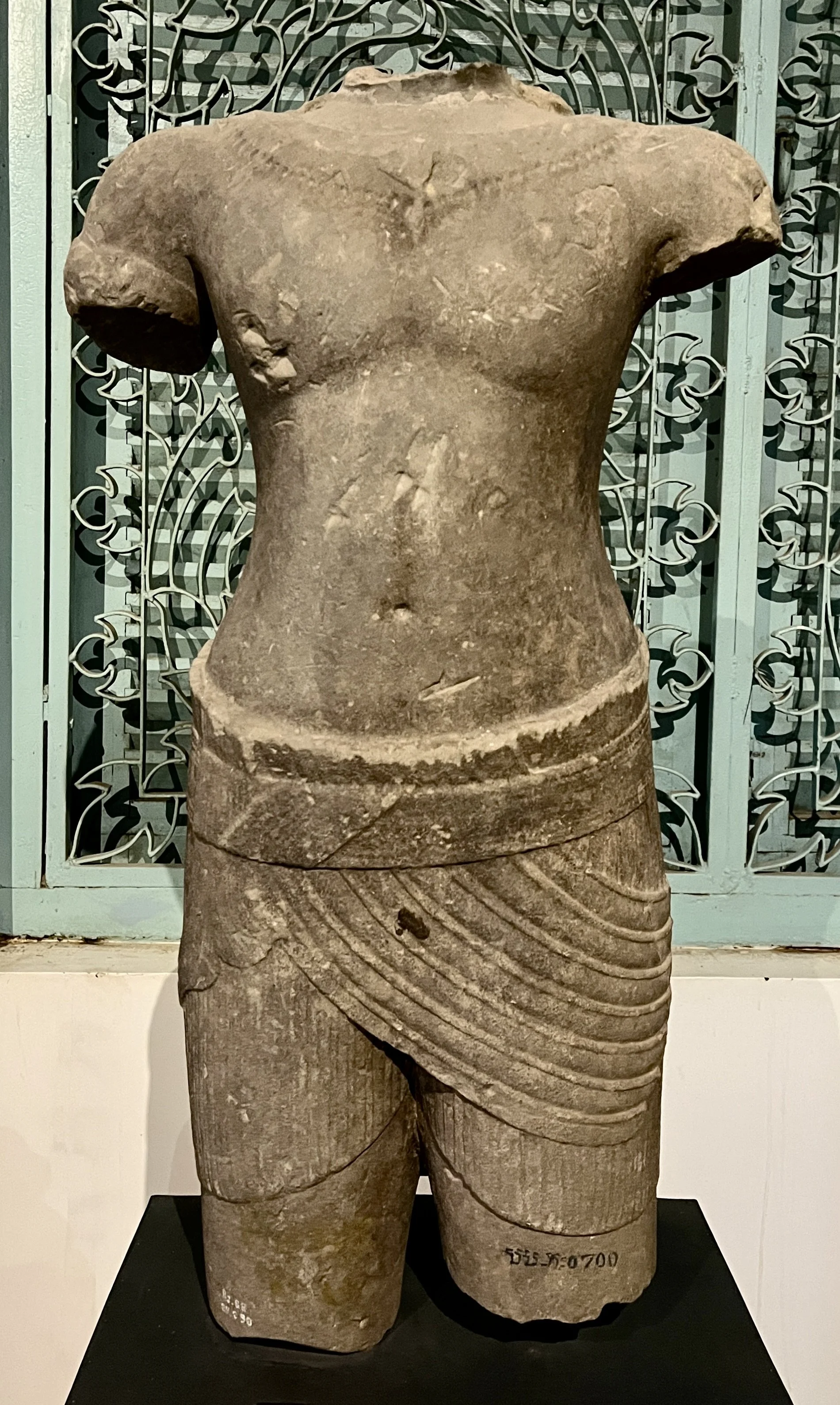
Torso of male deity
Sandstone, Angkorian period, Khlaing style,
Early 11thC?
This deity has a fairly-built body with broad shoulders. He is ornamented with arm-bands and necklace. He is wearing a typical skirt of the Khlaing style. The tail of the skirt falls from the middle of the upper front edge onto the left thigh. The skirt is fastened by a belt at below the hip level. The tail of the belt is inserted underneath the belt and falls on the right thigh.
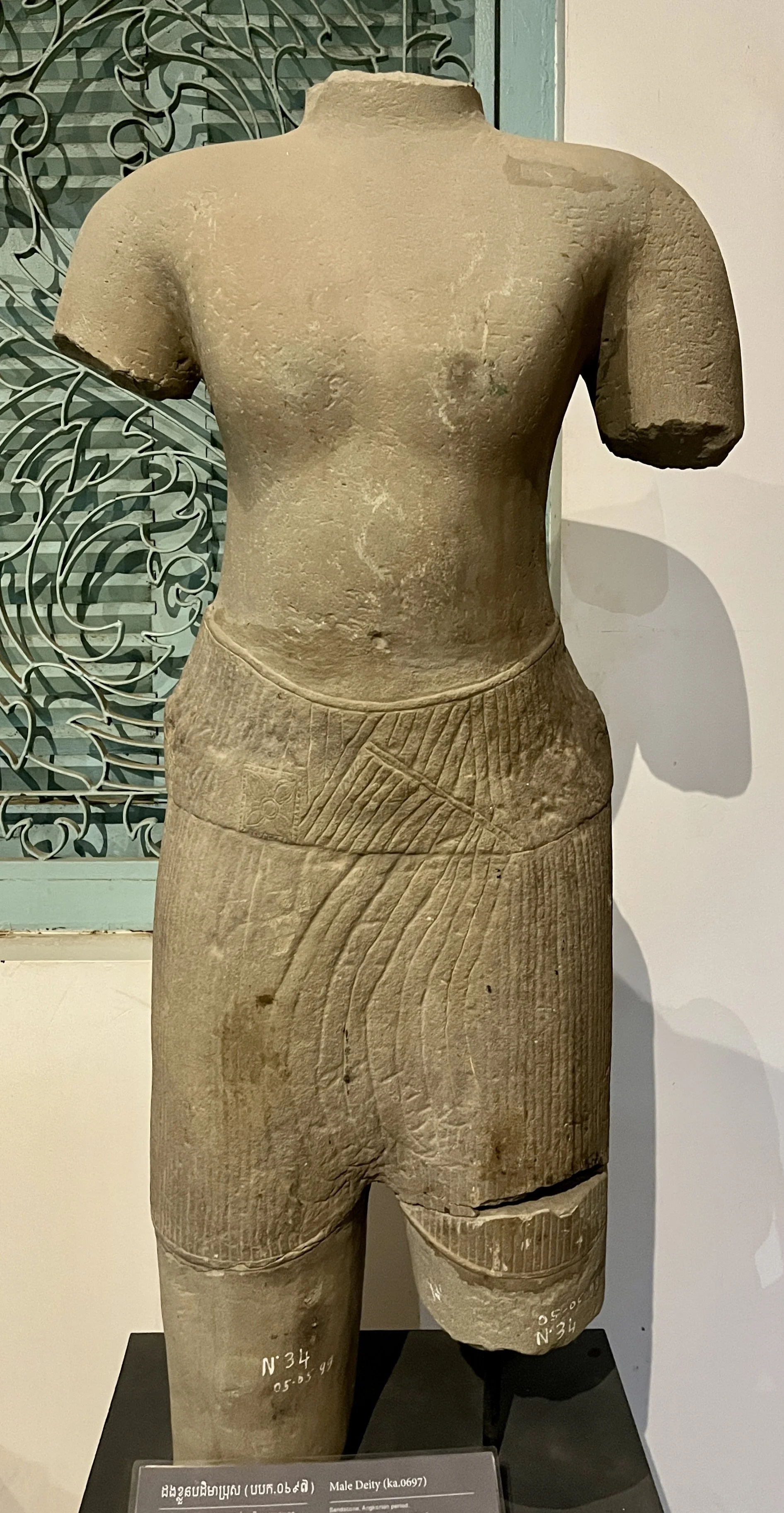
Male Deity
Sandstone: Angkorian period, late Khleang to Early Baphuon 11th C.
This strongly built standing figure wears a typical pleated skirt in the Baphuon style. It is fastened with a floral decorative belt; a wavy fold falls between both legs. On the back, a butterfly like shape is formed by the edge of the skirt folded from the front and tucked below the belt.
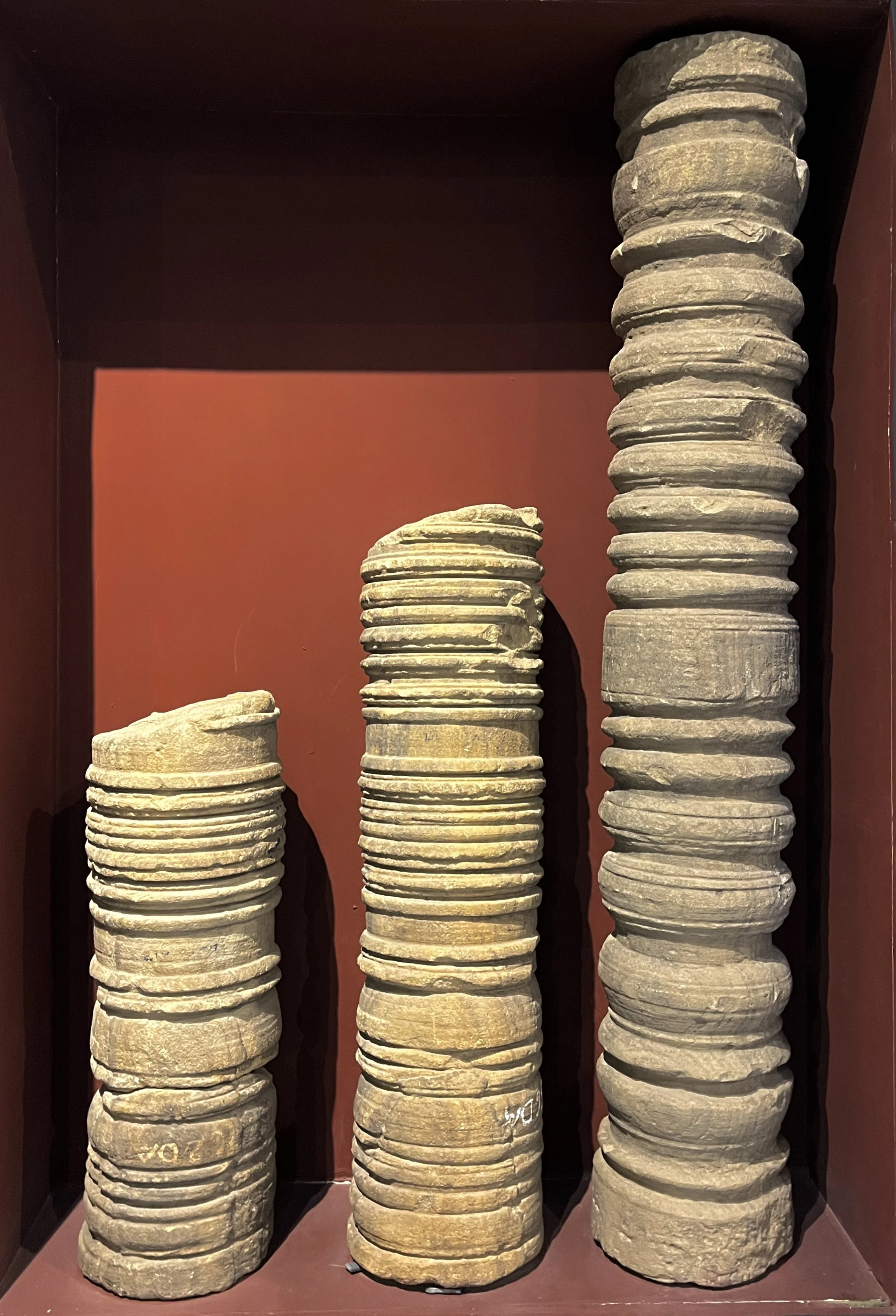
This is a reconstruction of the window baluster of ancient temples. The stone baluster of the window is composed of a base, a capital, and a shaft. The shaft is usually punctuated by rings in various shape and sizes. In a sense, the baluster is similar to the stone column with the exception that the style classification is impossible. Though, both ends of the baluster frequently have a tenon or/and a mortise to fit in the window frame.
Window Baluster (0747)
Sandstone
9th - 13thC
Unknown
Window Baluster (0780)
Material: Sandstone
Style: (?)
9th - 13th C.
Unknown
Window Baluster (0048)
Sandstone
Style: (?)
9th - 13ch C
Unknown
Window Baluster (0746)
Sandstone
Style: (?)
9th - 13th C.
Unknown
Window Baluster (0666)
Sandstone
Style: (?)
9th - 13th C
Unknown
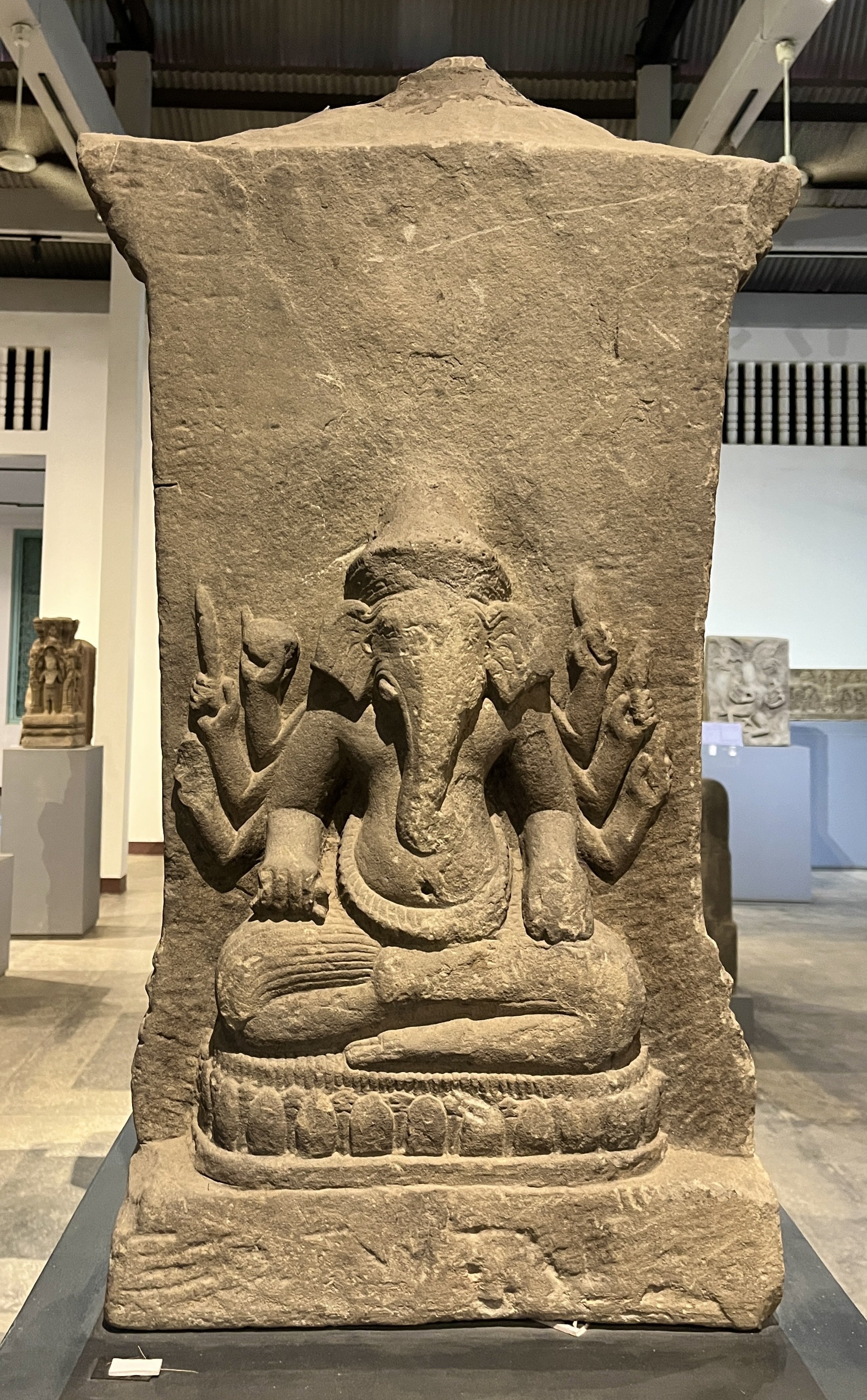
Brahmanic borne
Sandstone, Angkorian Period, Baphuon style, second half of 11th C., Unknown
This boundary marker is carved with a standing male deity on one side and a seated eight armed Ganesha on the other. The male deity wears a typical Baphuon skirt, sampot Can Kkhbin. By his left leg are three small standing figures, probably Ganesha flanked by Shiva to the left and Uma to the right. The Ganesha on the other side is seated on a lotus petal base, each hand probably holds different attributes. The one resting on his left knee probably held his broken tusk.
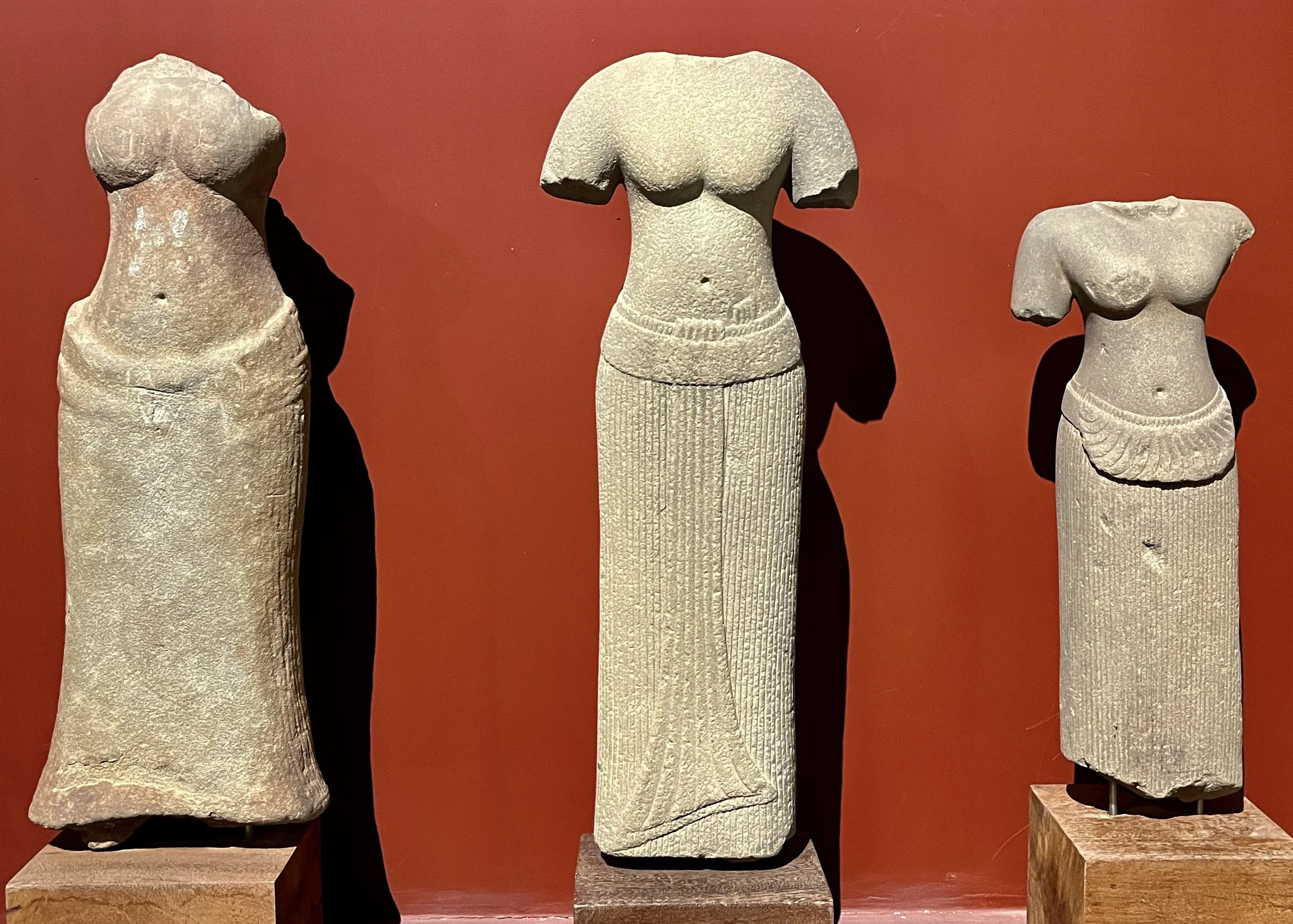
Female Deities
Female Deity (left)
Sandstone
Angkorian period. Baphuon style, Second half of 11th century Tuol Muk Buon, Basaet, Ta Pon, Sankaer.
This statue has a slender body with tight and round breasts. Despite being worn out, the features and shape of the skirt, long, pleated and fastened by a belt, suggest that the piece belongs to the Baphuon style. The dating of this piece is based on the curvy features of the body, which is commonly associated with the Baphuon style.
Female Deity (middle)
Sandstone, Angkorian period,
Khlaing style, early 11th C.
Unknown
This torso of female deity belongs to the Angkor Wat style. She wears a typical garment of the Khleang style. The pleat of the skirt is long and extends from the waist to the lower end.
The upper edge of the skirt is pulled up straight and tight against her abdomen, while another piece is pulled up straight and higher on the left but still below her navel. The style is fasterned by a scarf over the fold falling in between her legs forming a fish tail shape one over another. Such folds in fish tail shape are very popular in the Khleang style.
Female Deity (right)
Sandstone, Angkorian period.
Koh Ker style,
second half of 10th century
Unknown
The statue of this female deity cannot be identified due to severe damage. The statue wears a long pleated sampot. The fold of the skirt is half round and falls to the front in a fan form. The belt is hardly seen from the front. However, the draping of the garment suggests that this piece belongs to the Pre Rup or Koh Ker style.
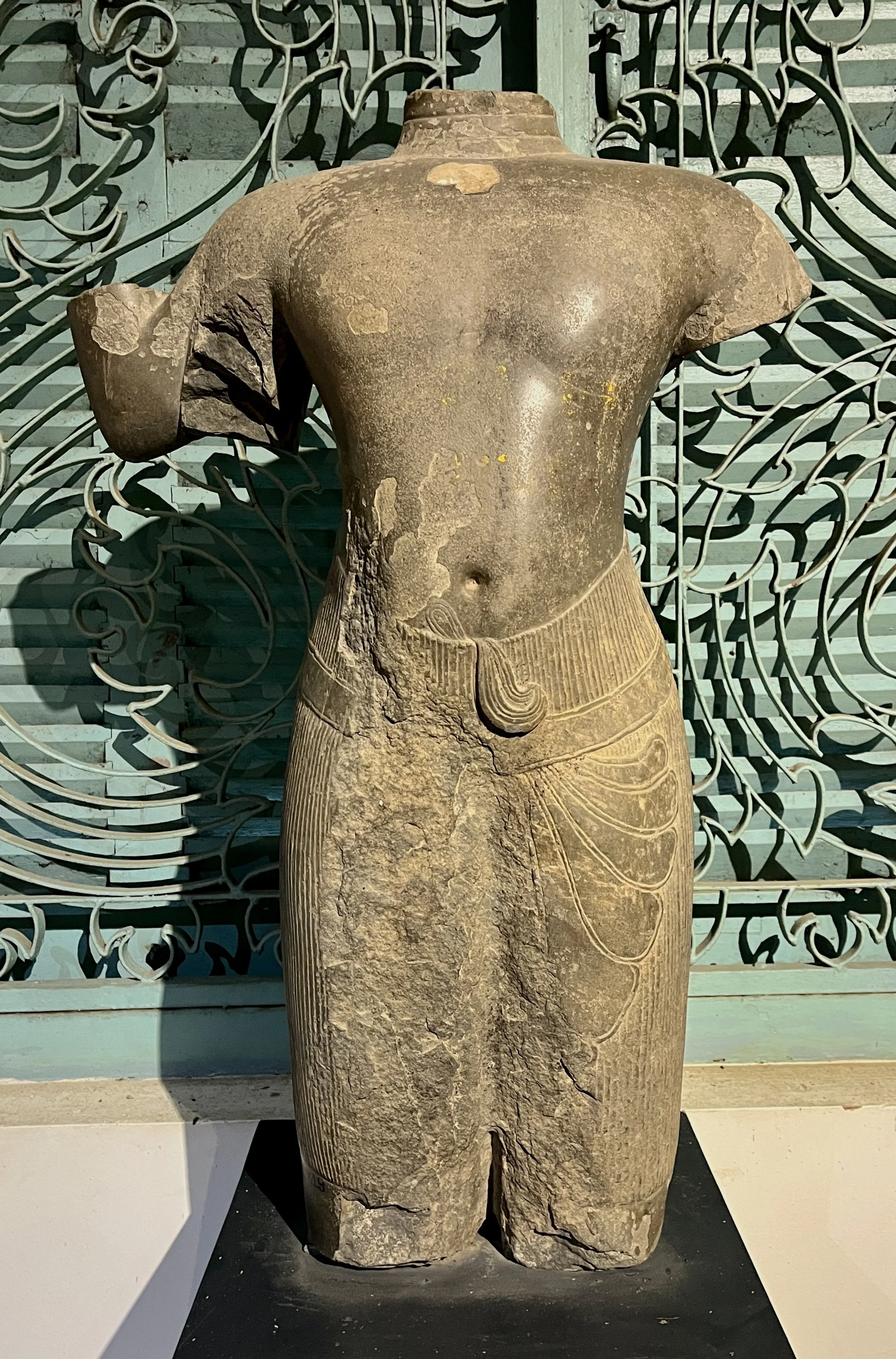
Four armed male divinity
Sandstone, Angkorian period, Baphuon style, second half of 11th c.
This four-armed deity has an elegant body, rounded shoulders, and a rounded stomach.
He is wearing a pleated skirt Sampot Chang Kbin' which is characteristic of the Baphuon style. The skirt is tied by a string in a knot in oyster shell form below his navel.
The skirt is also tied by a belt. The feature on the right thigh cannot be seen due to damage, on the left thigh is the skirt's fold.
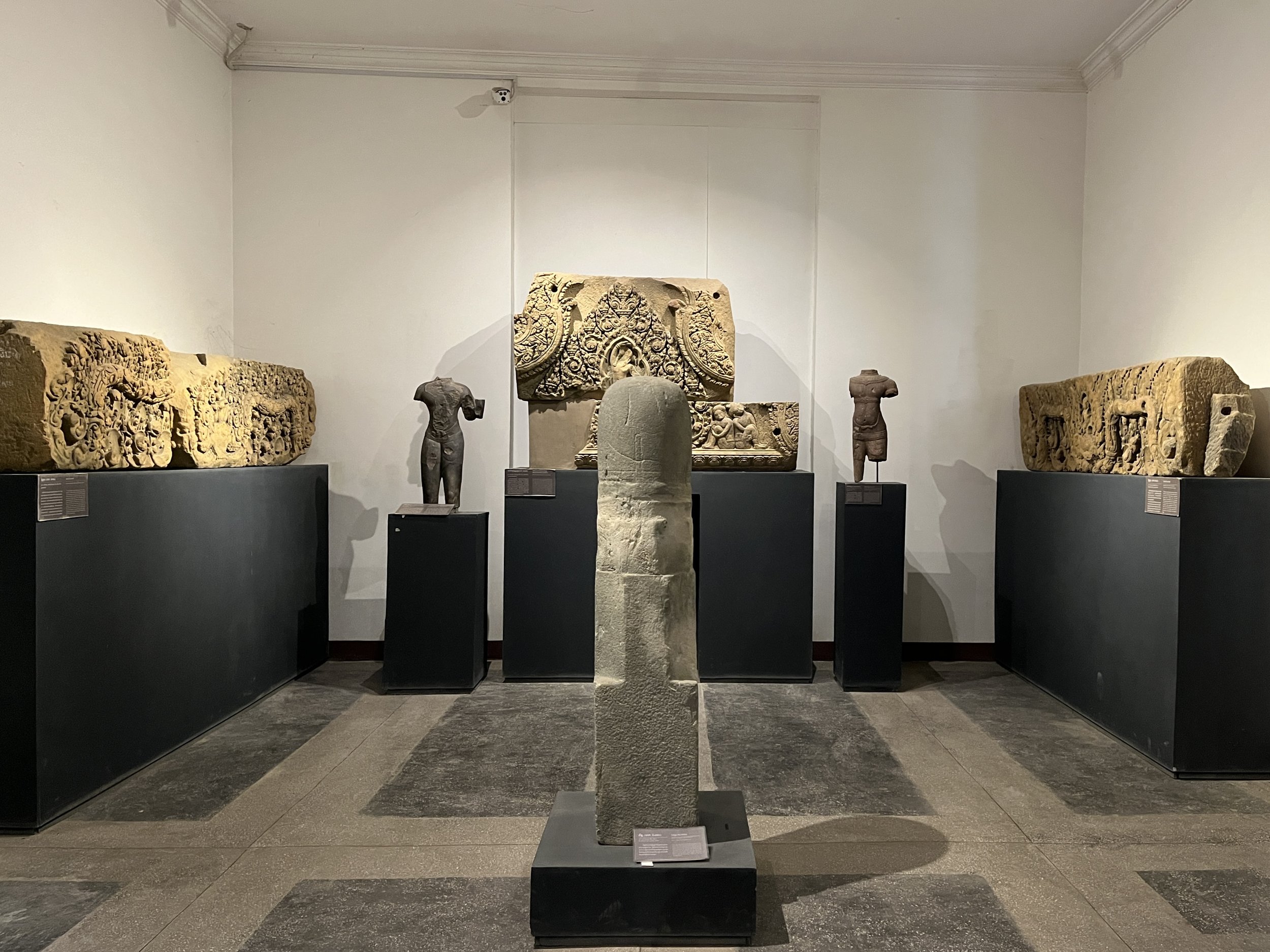
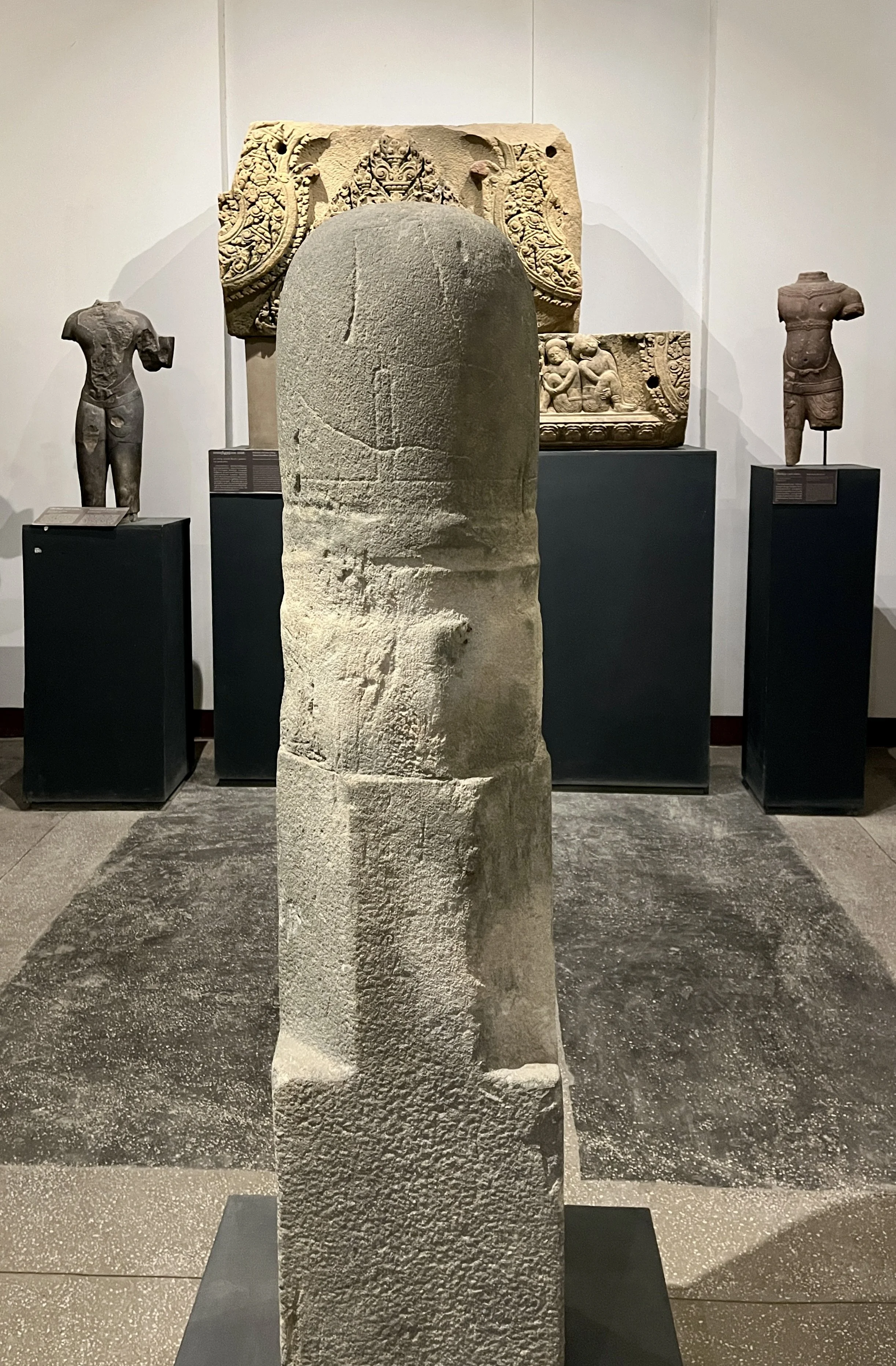
Linga
Sandstone
This Linga was found during the Baset temple restoration in 2017, lying in the lower part of the pediment. In ancient Cambodia, Shiva linga had various shapes and was made from various materials such as metal, sandstone, and granite. This particular linga represents not only Shiva, but the union of the main Hindu gods.
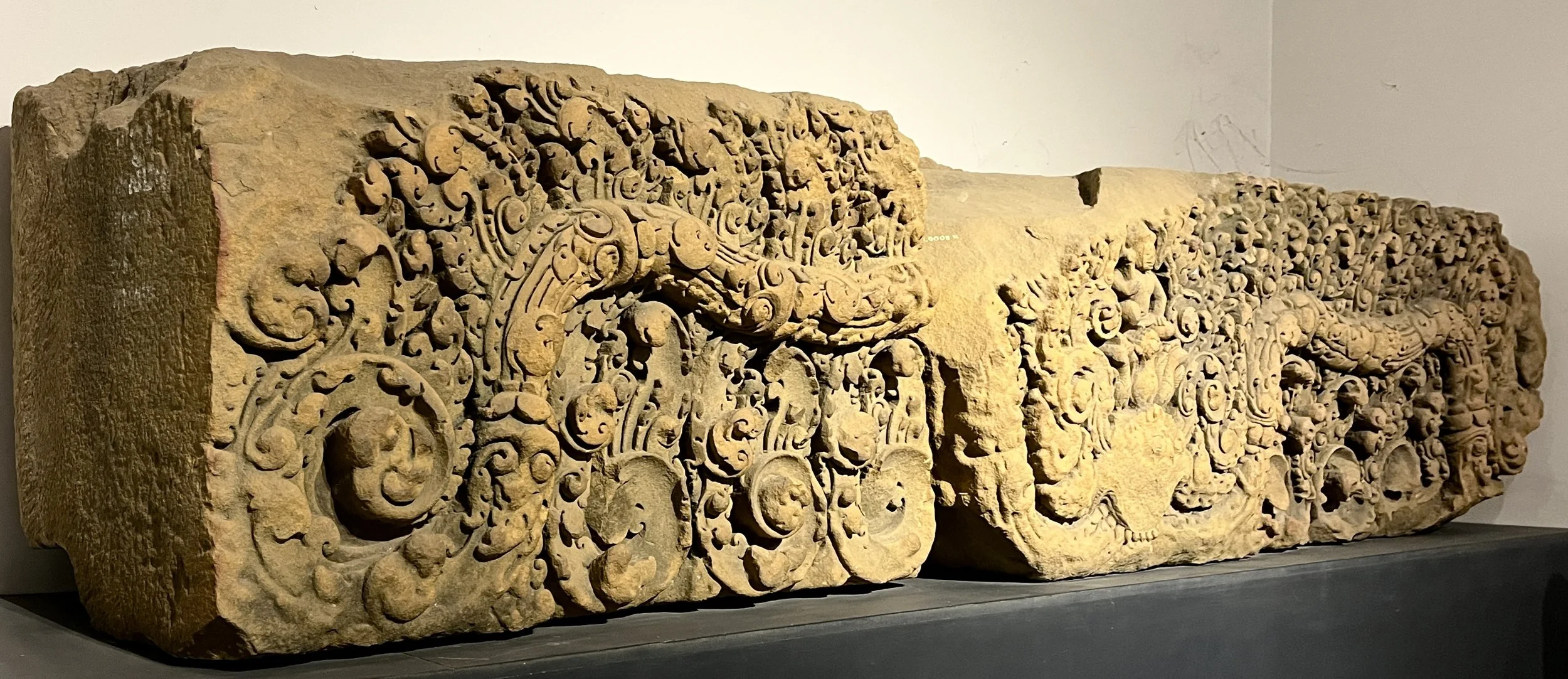
Lintel Sandstone. Khleang, Late 10th to early 11th centuries, Baset
The lintel belongs to the Khleang style. At the center, either Skanda or Varuna, a Hindu god, is depicted sitting on three swans or peacocks set on top of Kala's head. He is probably Varuna as the lintel originates from the western door of the central tower of Baset temple. The deity is a guardian of the west, and is particularly associated with oceans and water. If he is Skanda, he is a son of Shiva and Parvati, carries a club and is mounted on peacocks or roosters. From Kala's mouth, two foliate branches protrude to form a bow shape, which at both ends forms curling foliage in the shape of Naga. The monotonous presentation of heavy vegetation appears to continue from the previous style, Khleang.
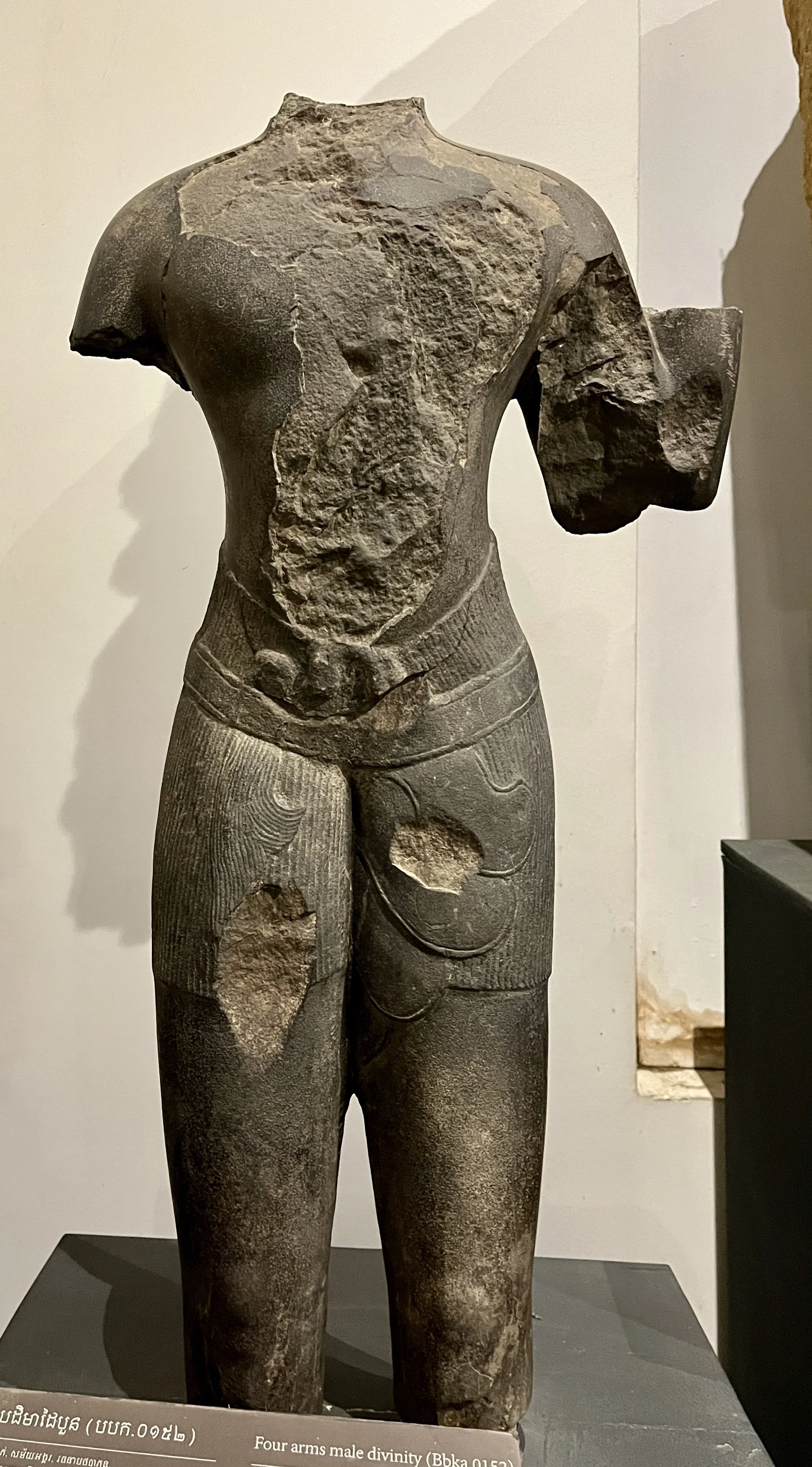
Four armed male divinity
Sandstone, Angkorian period, Baphuon style, second half of 11th c.
This four armed male statue with a slender round body wears a typical Baphuon pleated skirt, Sampot Can Khbin, with the backside of the skirt rising up almost to his back, while the front is below his navel. Two edges of a knot of the skirt form a curved green pepper form on the front. It is fastened with a stylish knot where both ends are folded and form a fish-tail shape on the right thigh and a curved eggplant shape on the left.
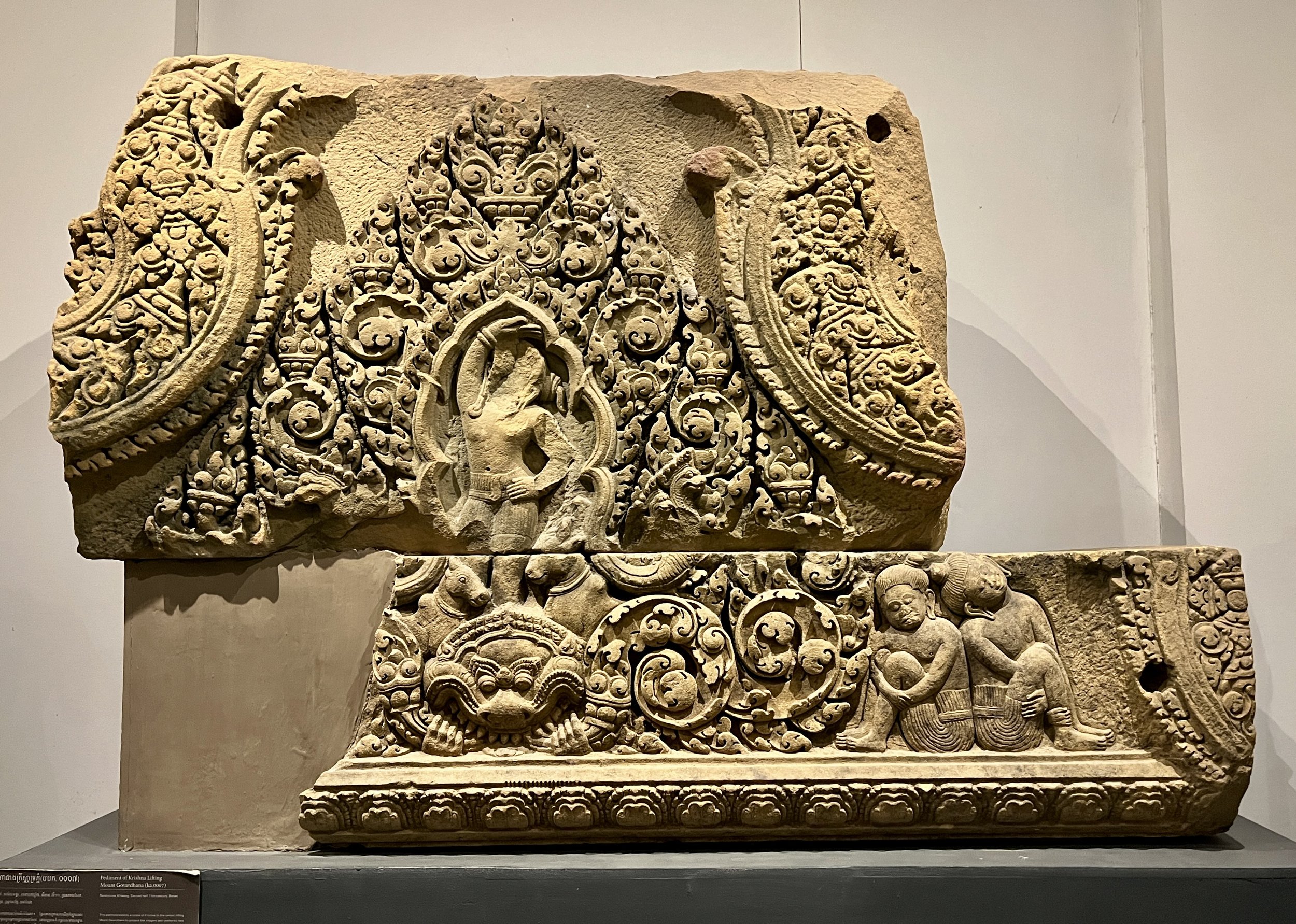
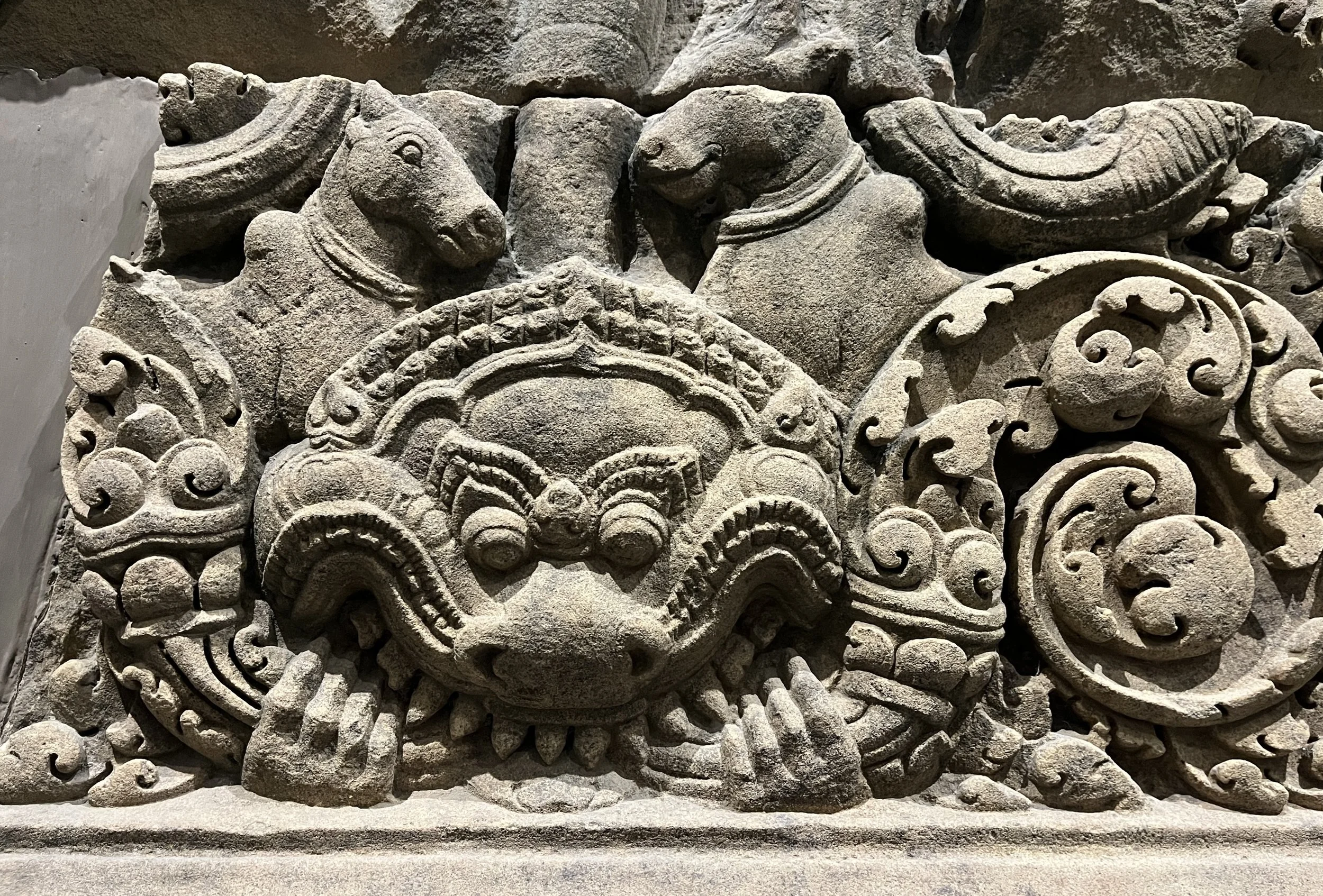
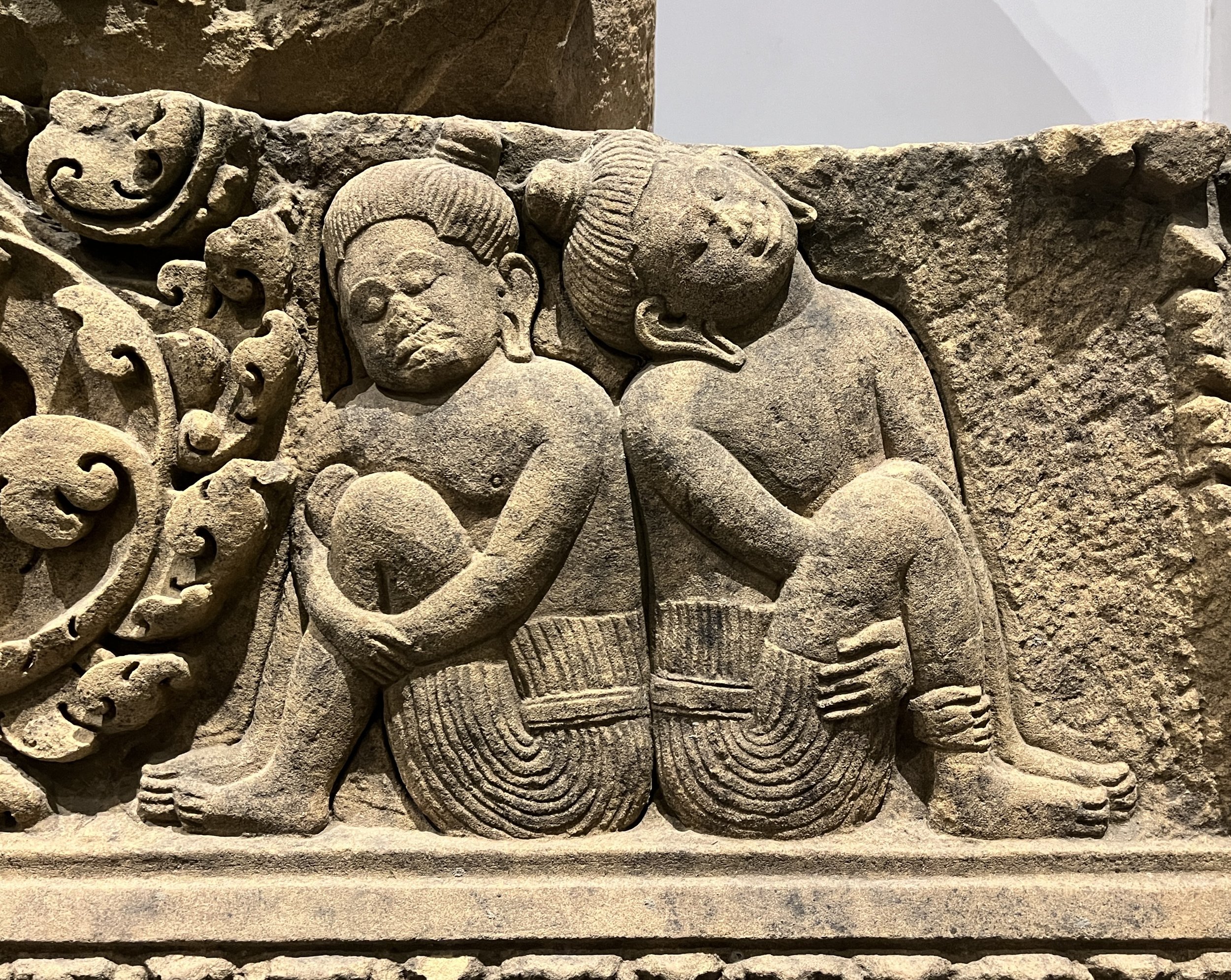
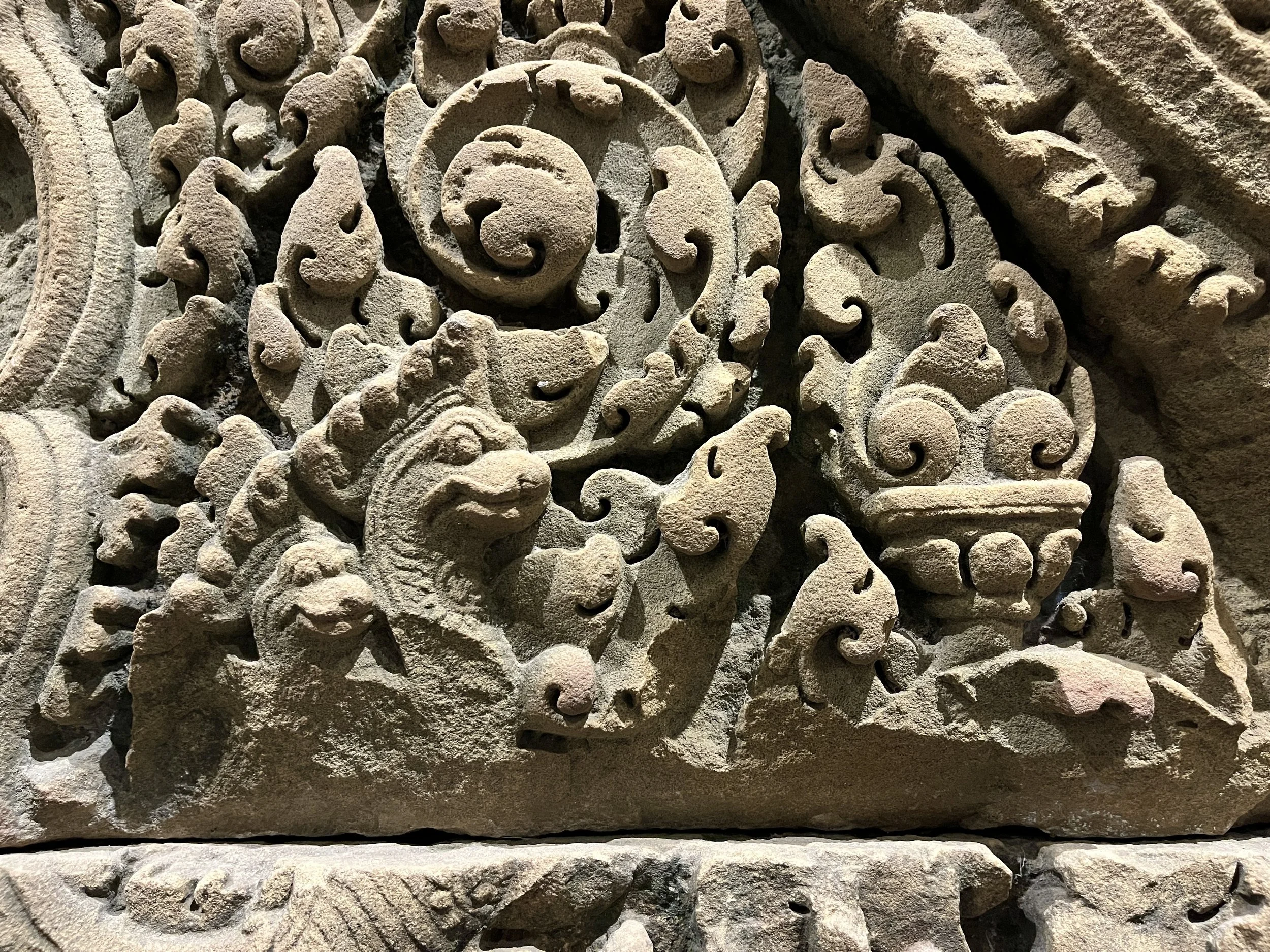
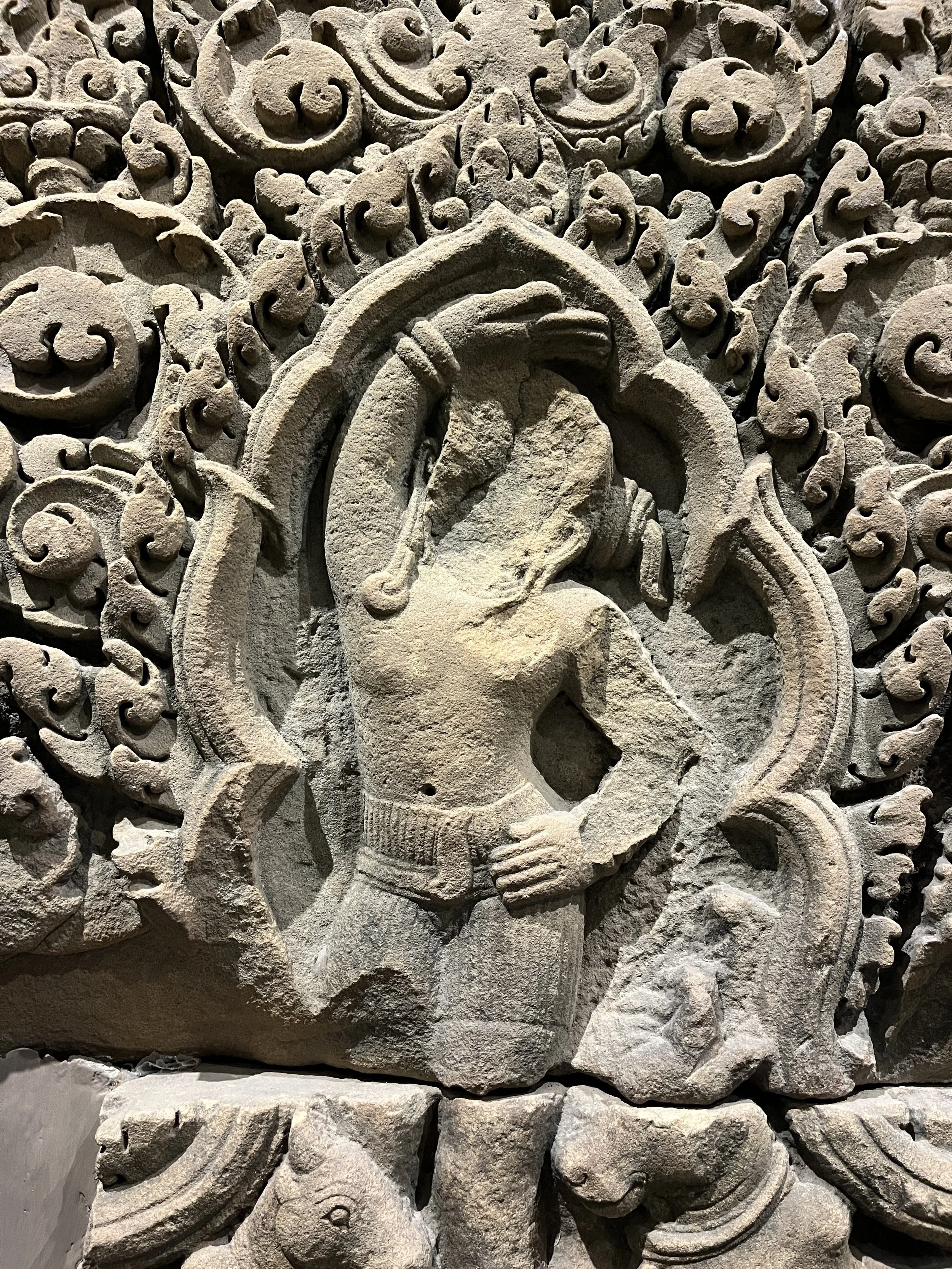
Pediment of Krishna Lifting Mount Govardhana
Sandstone, Khleang, Second half 11th century, Baset
This pediment depicts a scene of Krishna (in the center) lifting Mount Govardhana to protect the villagers and cowherds (two on the right) and animals (in the center) from Indra's wrath.
The villagers were supposed to make a sacrifice to Indra every year.
Krishna disliked the act of sacrifice and convinced them to give up the practice. Indra was irate and released torrential rain on the village. To save them, Krishna lifted Mount Govardhana with his right hand to shield the village like an umbrella from the rain. In this piece, the Kala head at the bottom center appears to serve as decoration. Krishna is depicted standing in a relaxed manner with his right hand lifted up and his left hand put on the hip. His skirt, which is tied by a string with a knot in oyster shell form below the navel, suggests that the piece belongs to the khleang style.
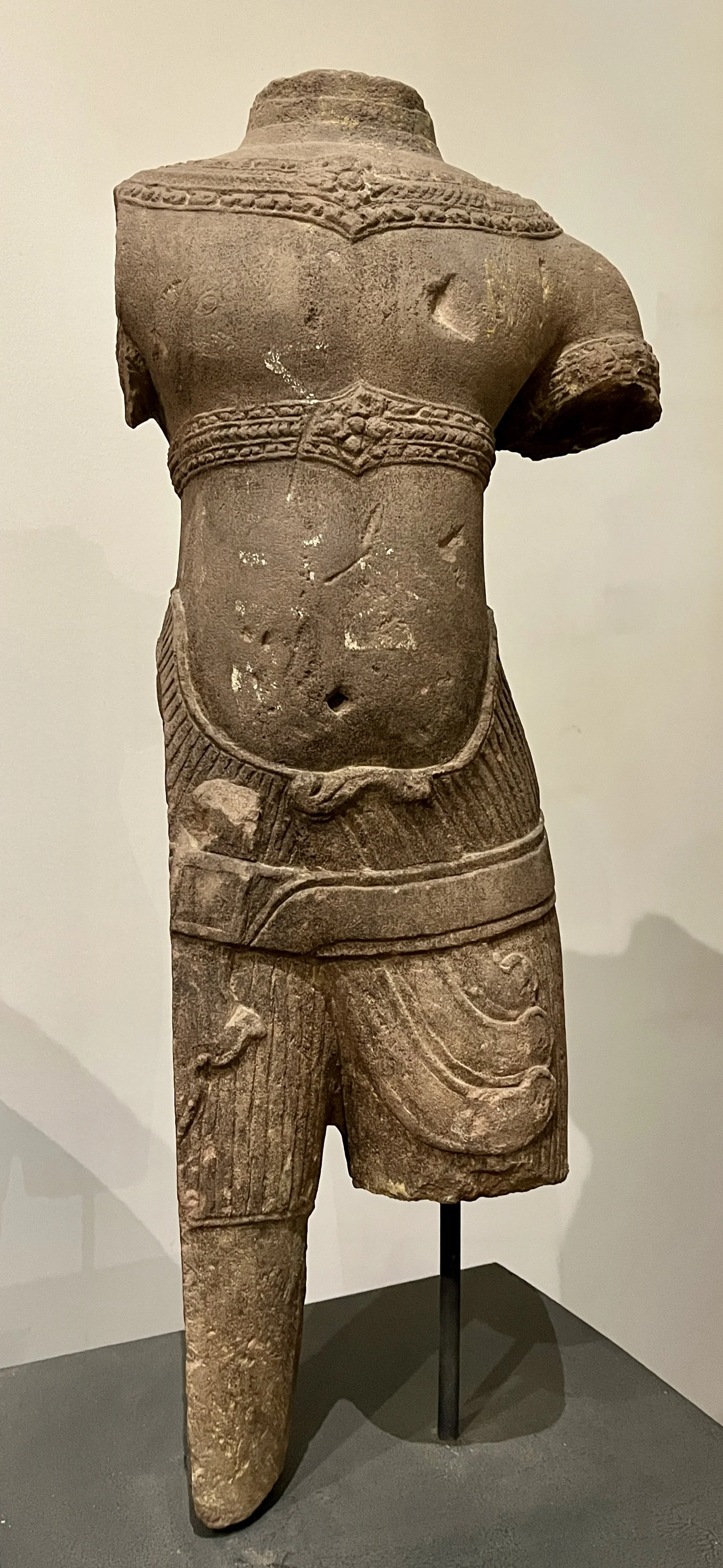
Male Deity
Sandstone, Angkorian period. Baphuon style.
Second half of 11th century
This four-armed deity has an elegant body, rounded shoulders, and a rounded stomach. The body is ornamented with a necklace, armbands, and torso belt. The rear upper edge of the skirt is straight horizontally and rises up to the middle of the back while the upper front edge is curved down from both sides and sits under the navel level. The string knot below the navel, commonly seen on statues in the Baphuon style, is absent.
The skirt is fastened by a belt at hip level. The skirt's edge is inserted underneath the belt and falls on the left thigh.
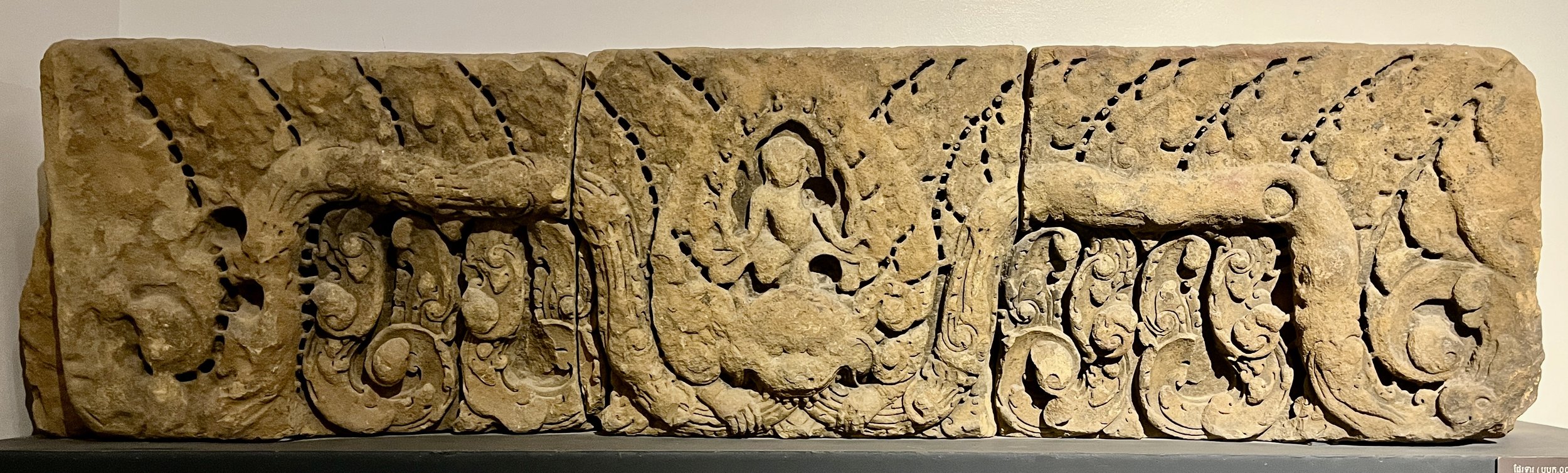
Lintel
Sandstone, Angkorian period, Khlaing style early 11th C. Prasat Baset, Tapon, Sruk Sangkae
The lintel depicts a deity mounted on Kala in the center; it is probably Krishna with both hands holding a Naga, a poisonous snake living in the Yamuna river. The lintel belongs to the Khleang style. As typical in the Khleang style, the depiction of Kala's head is at the bottom center, surrounded by heavy vegetation. From Kala's mouth, two foliate branches protrude to form a bow shape, at both ends curling into foliage in the shape of Naga.
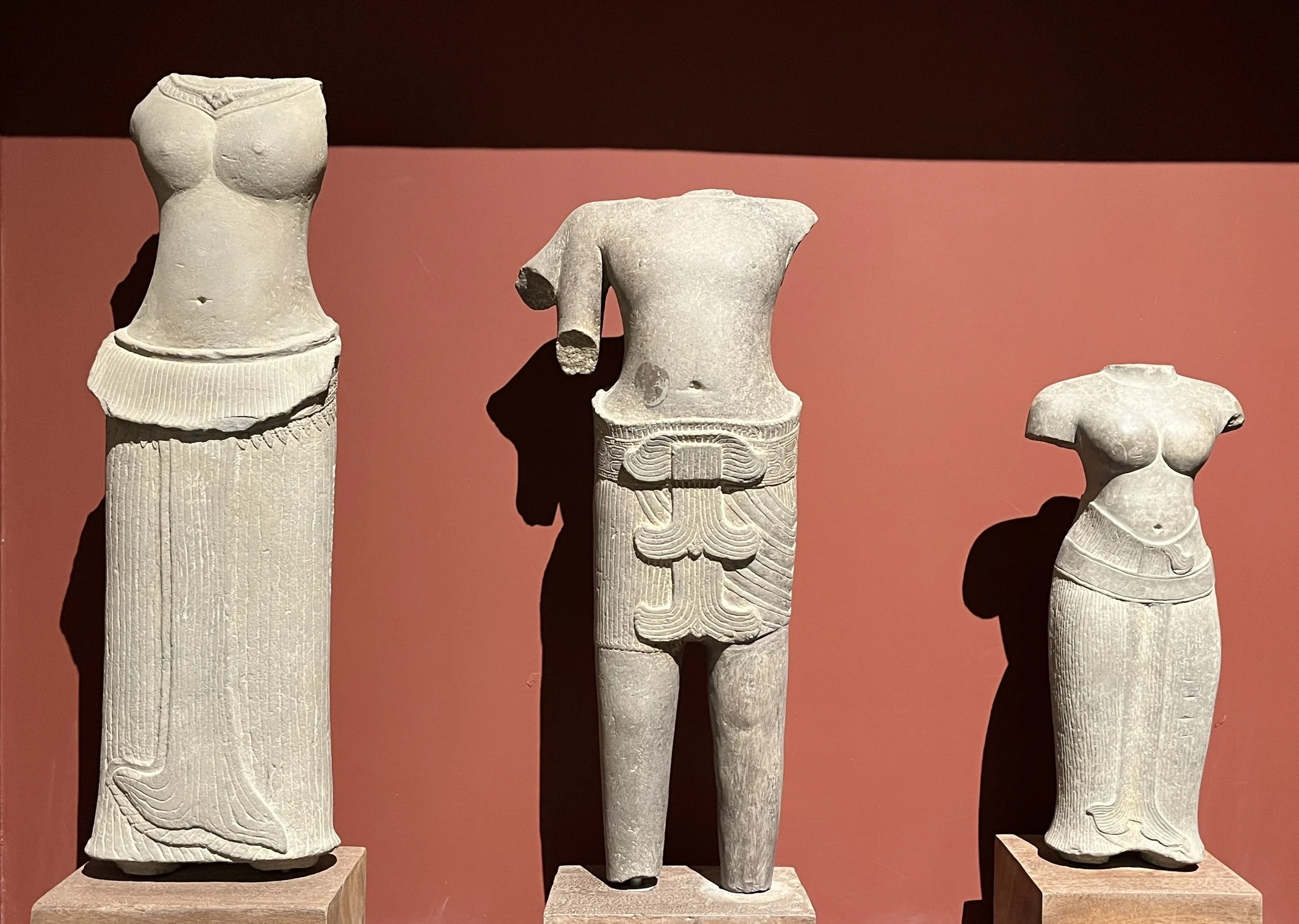
1. Female Deity
Sandstone, Angkorian period,
Baphuon style,
Second half of 11th C.
Unknown
2. Male Deity
Sandstone, Angkorian period
Angkor Wat style, late 11th to late 12thC.
Unknown
3. Female Deity
Sandstone
Angkorian period, Angkor Wat style late 11th to late 12thC.
Wat Dorei Sor
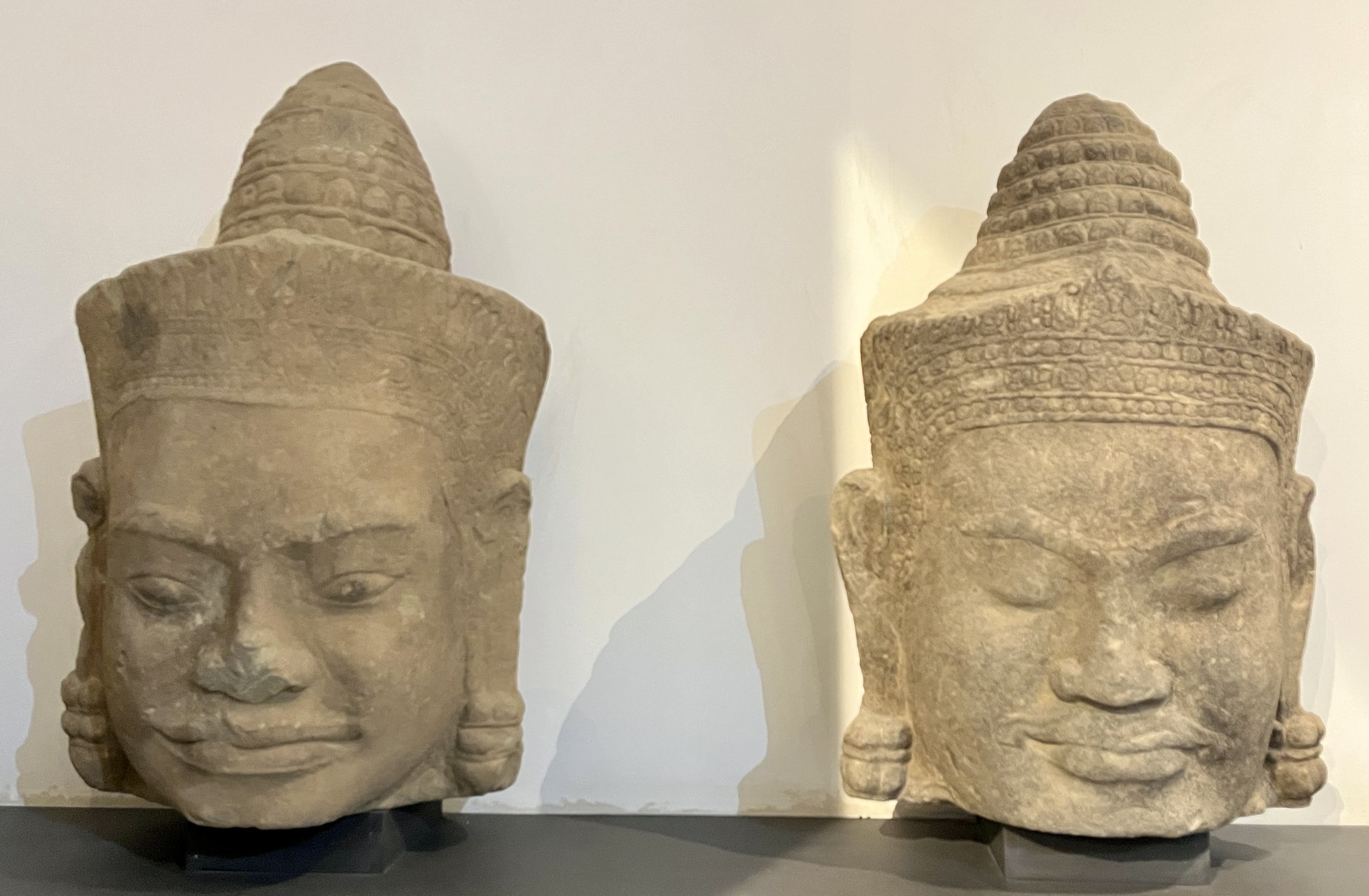
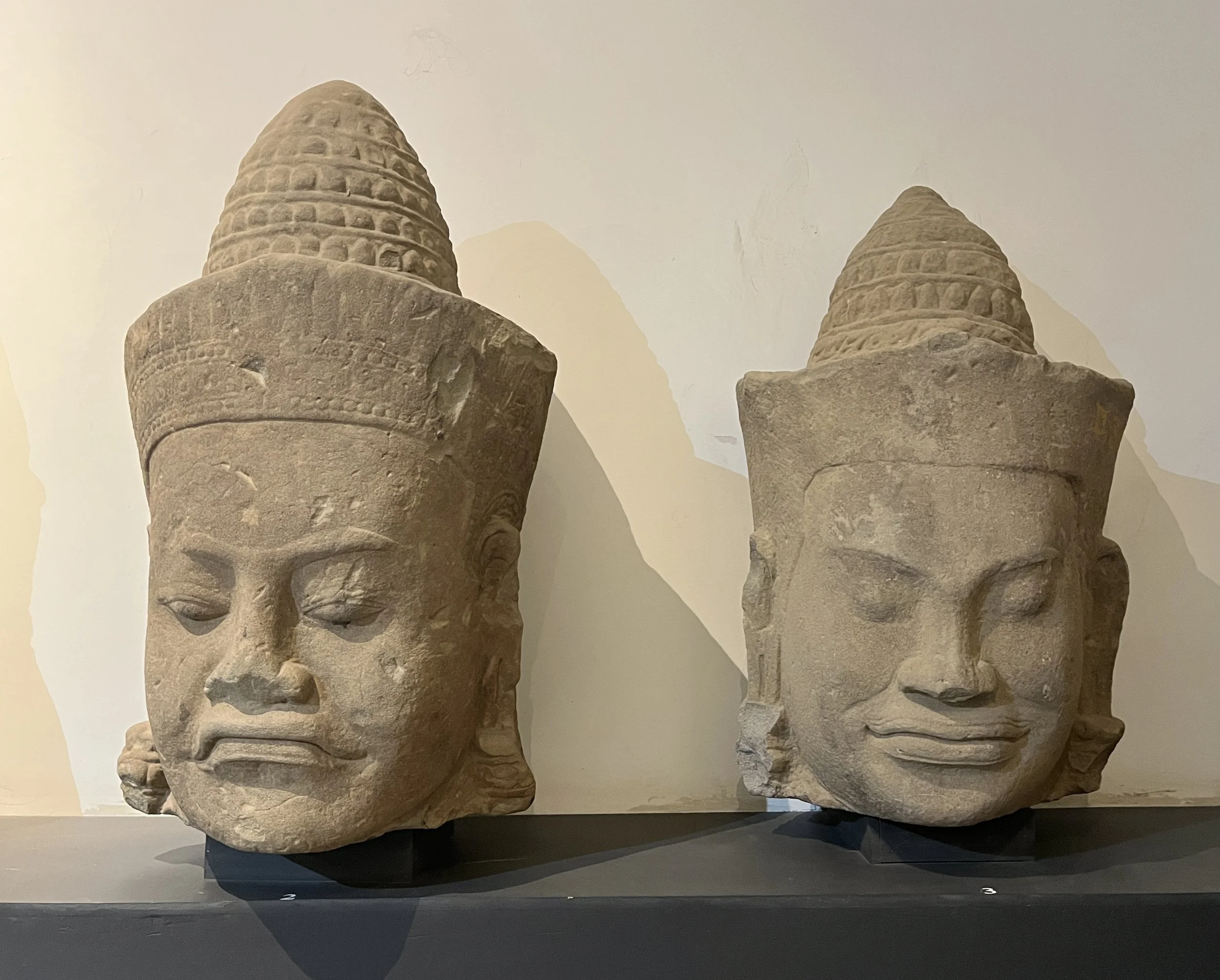
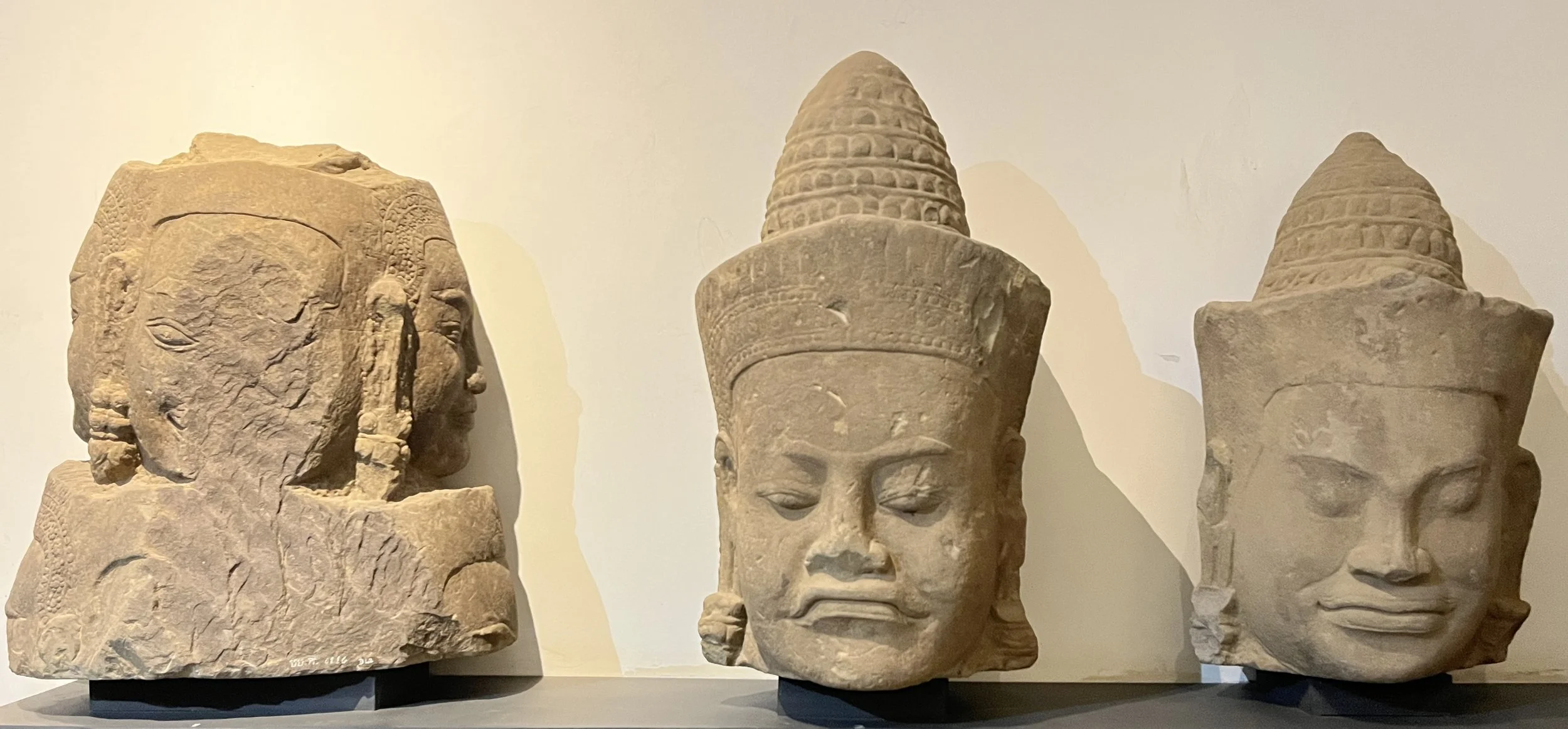
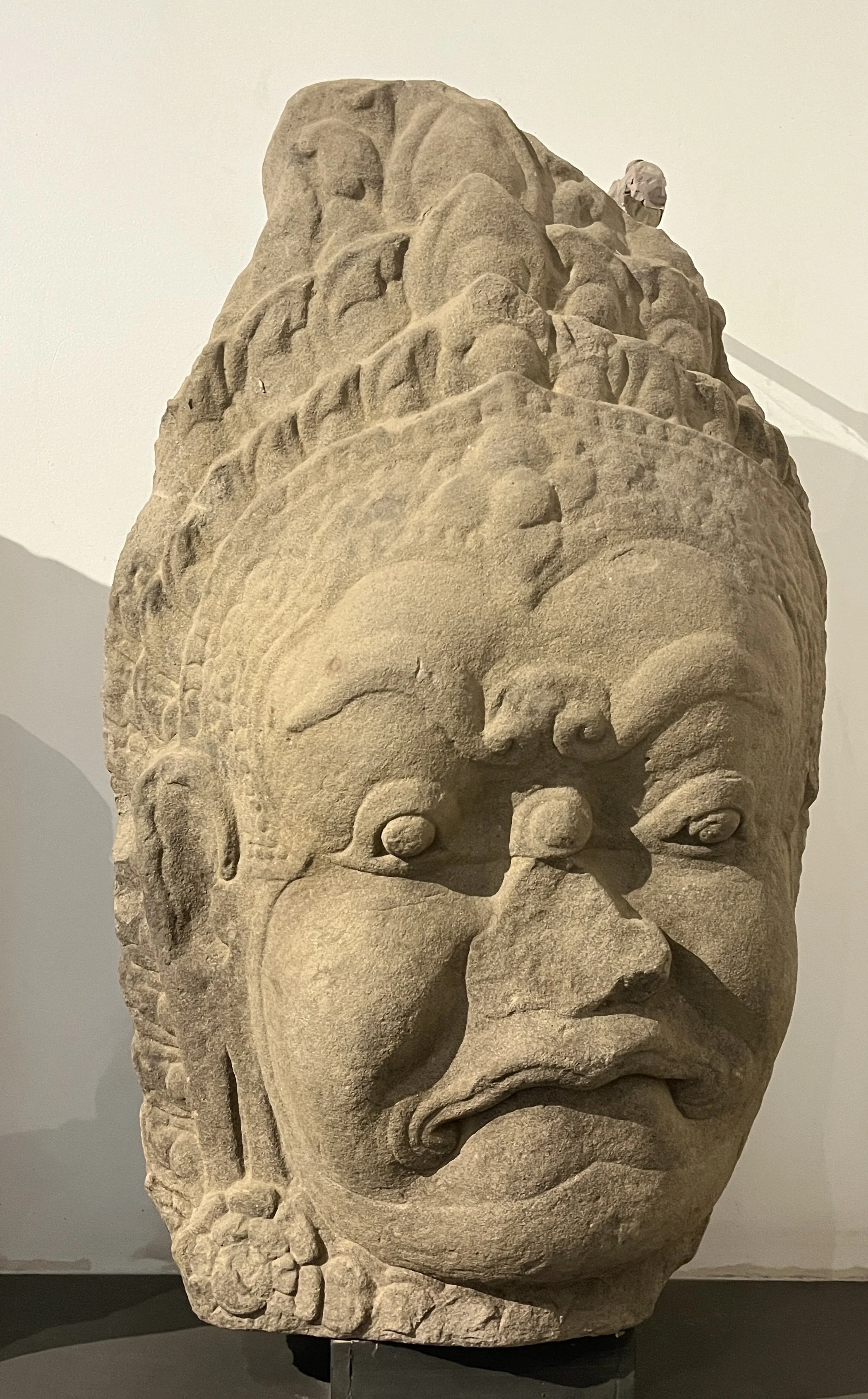
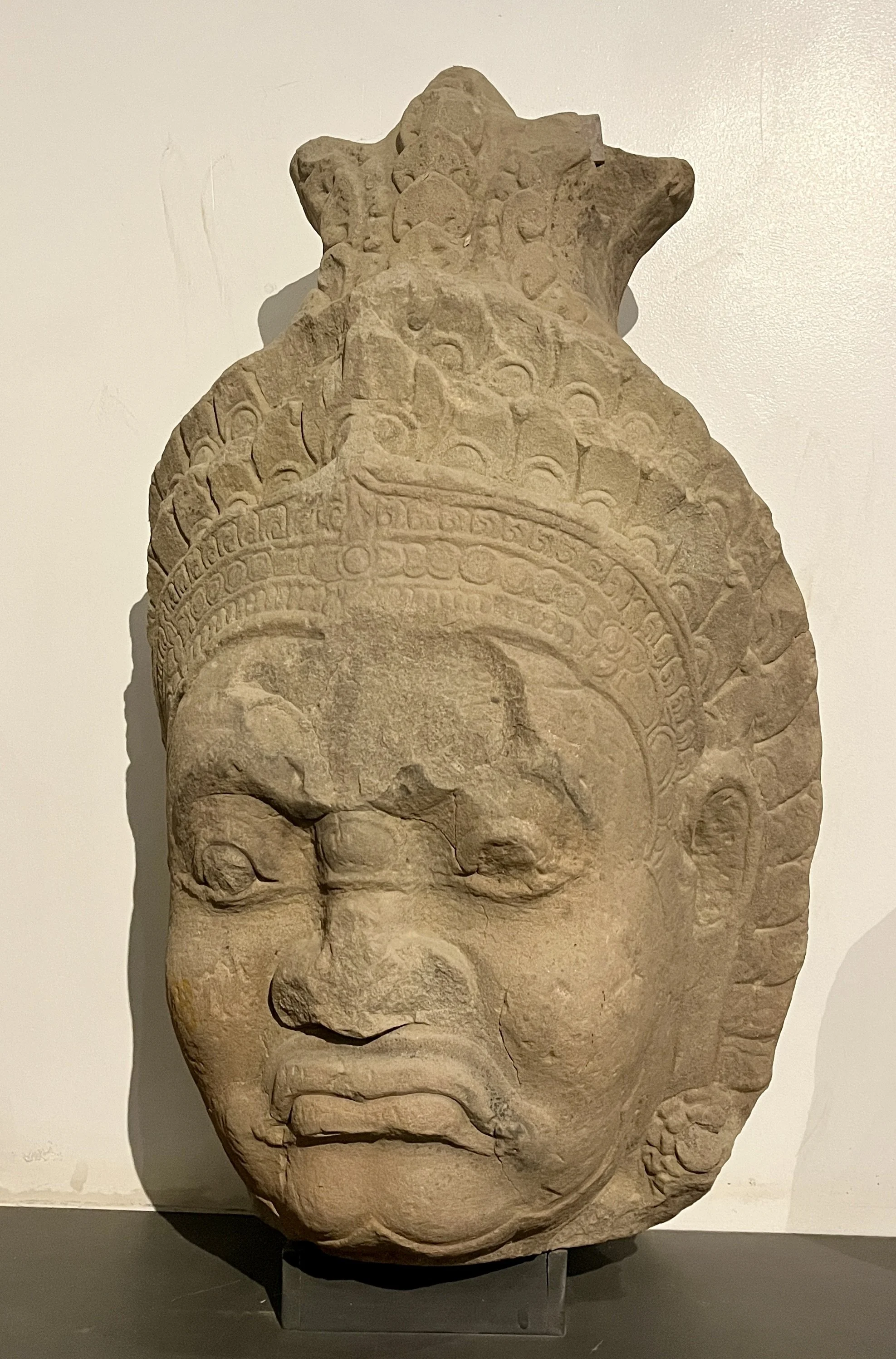
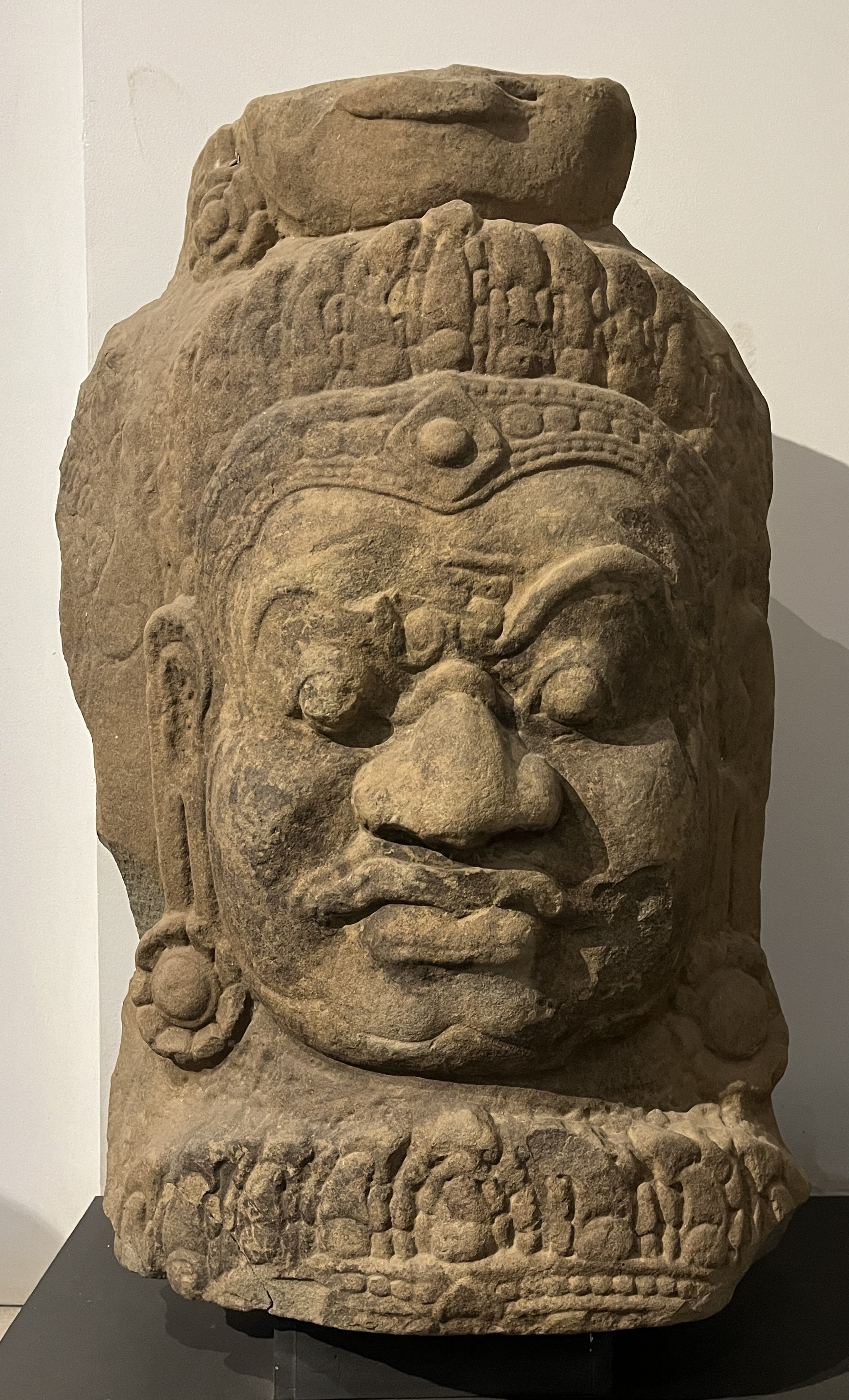
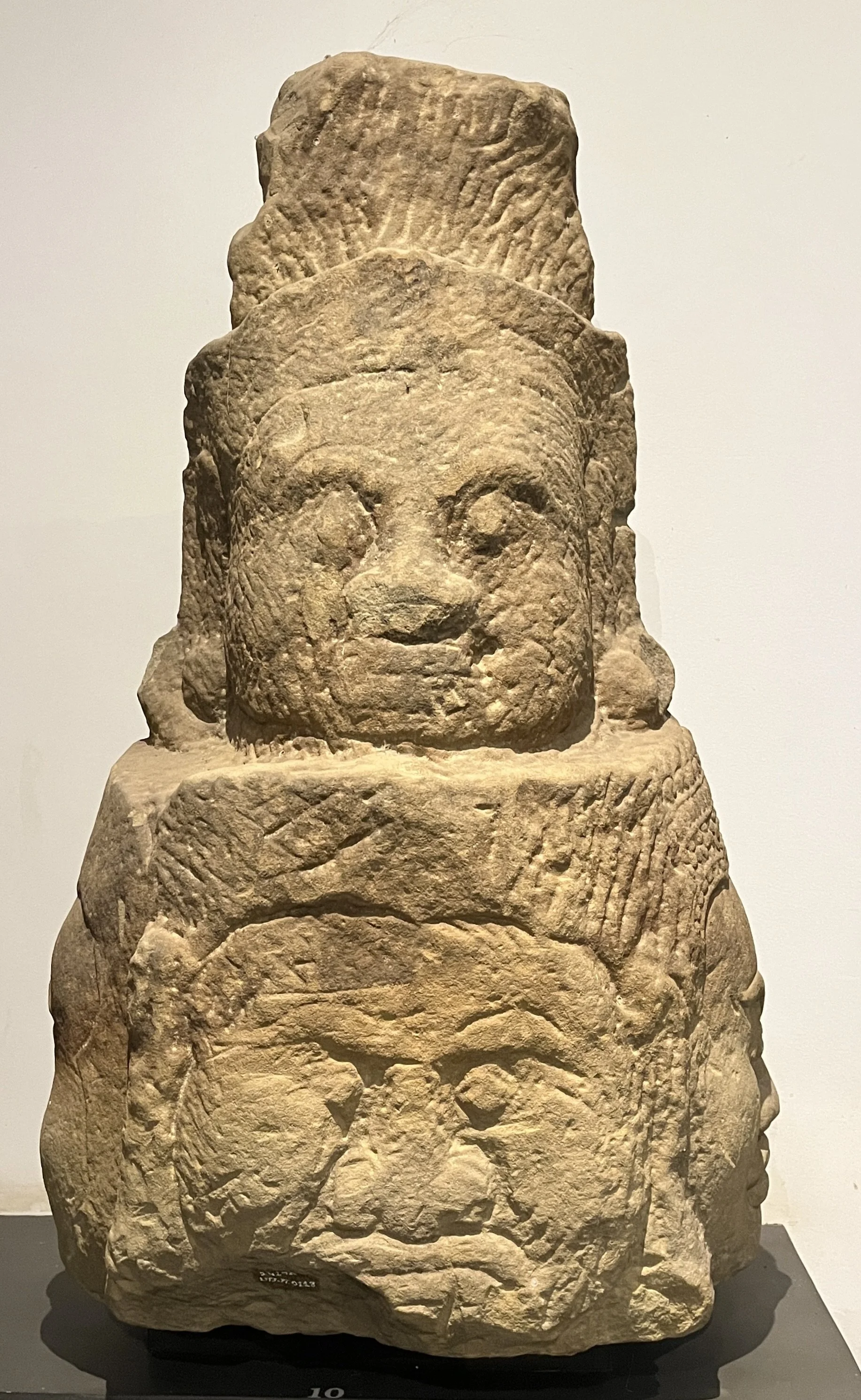
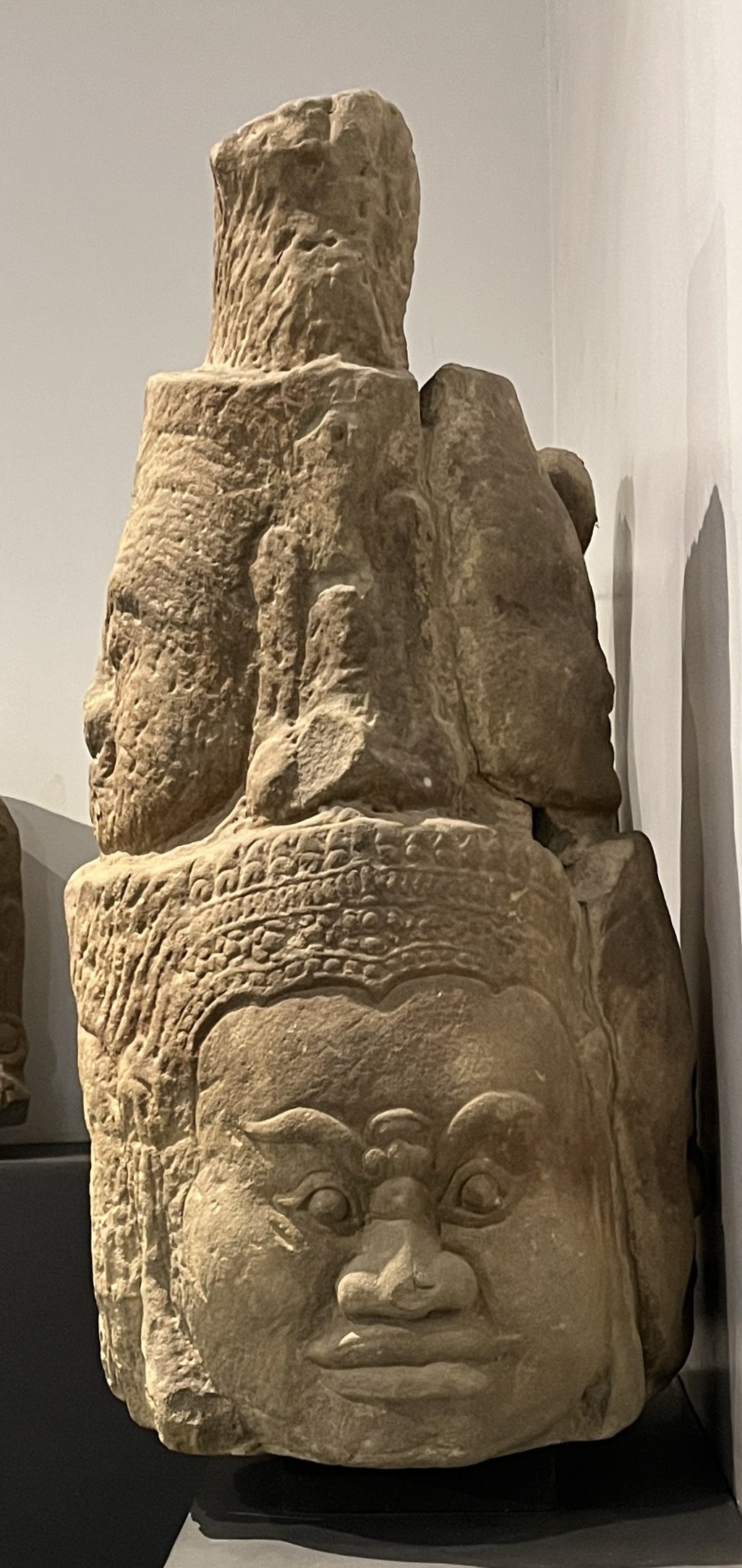
These colossal heads belong to the Deva and Yaksha at the causeway of the Banteay Chhmar temple. The causeway is situated in front of each tower gate. Along the causeway, there are two rows of mythical beings, the Devas on the left and the Yaksas on the right. Each side holds a Naga with a stance that represents a tug of war. This presentation can allude to the famous Hindu mythology, the Churning of the Sea of Milk. Depictions of the myth begin to appear on lintels in the 11th century. A final depiction dates from the late 12th -13th century reign of King Jayavarman VII; he crafted the scene of the Churning of the Sea of Milk by placing Deva and Yaksha holding the snake Vasuki on either side of the four main gates of Angkor Thom city. The work aims to make Angkor Thom an immortal city.
Two kinds of heads are exhibited here, the one-face head and multi-face head. The one-face heads belong to the common Deva (No.7, 8, 10, and 11) and Yaksa (No. 1, 3, 4, and 5). The multi-face, presumably twelve, Deva (No. 9) and Yaksa (No.2) are of higher status and have the role of holding the head and the tail of the Naga.
Heads of Devas and Yaksas
Prasat Banteay Chhmar
Late 12th to early 13th centuries
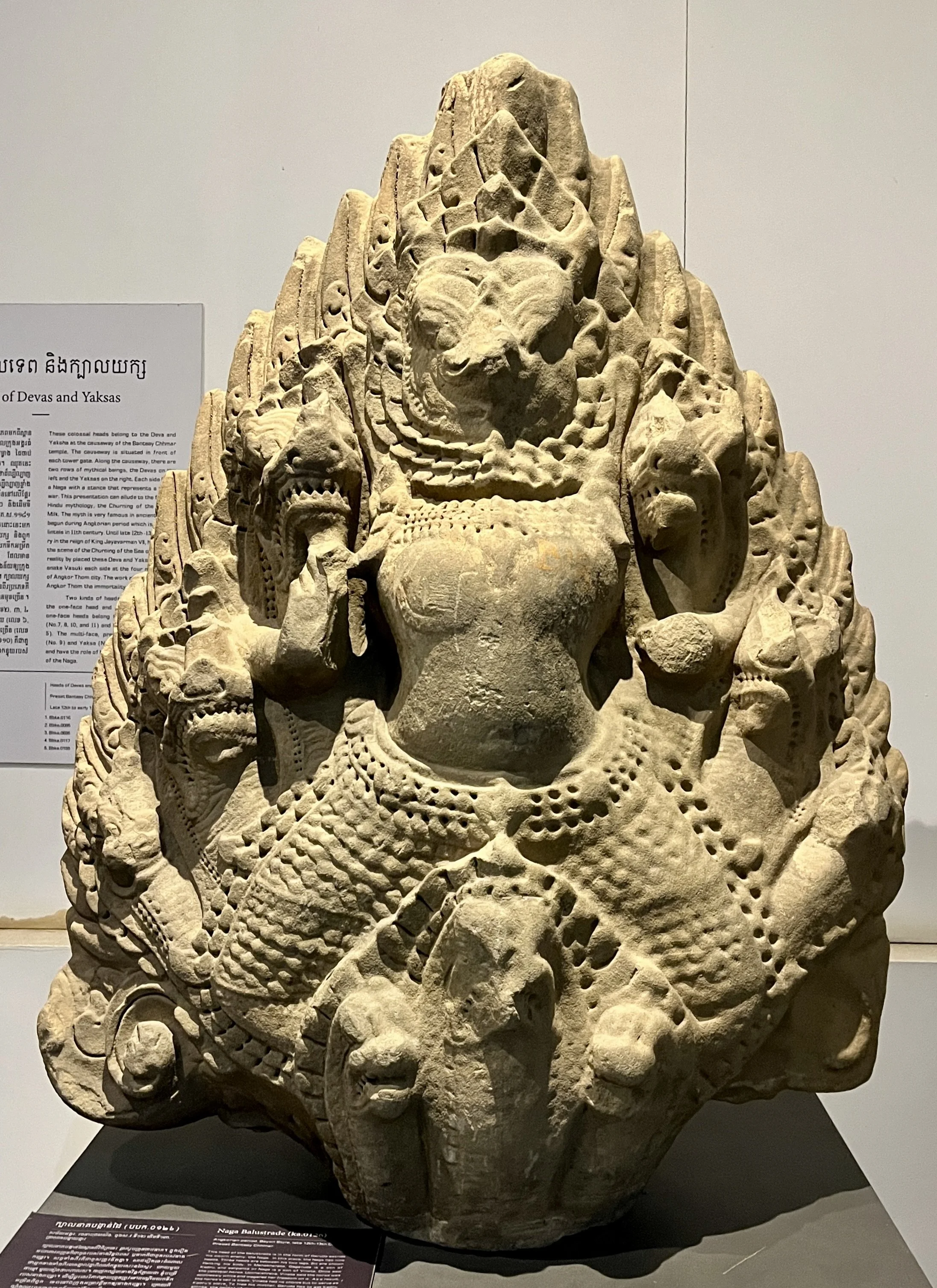
Naga Balustrade
Angkorian period, Bayon Style, late 12th-13th C..
Prasat Banteay Chhmar
This head of the balustrade is in the form of Garuda astride his sworn enemy, the Naga. In this piece, the Naga has nine heads. Three heads are between his two legs. Six are shown flanking his body. In Mahabharata, Gagaruda is a son of Kadru, and the serpent or Naga is a son of Vinata. Once he saw the celestial horse, Ucchaishrava, Vinata said the horse was spotlessly white and wagered his mother’s freedom on it. In the end, the horse's tail was black, so Vinata had no choice but for her to serve as Kadru's slave. To free his mother, Garuda has to get Kadru amrita, the nectar of immortality which is possessed by the devas at Amravati. He fought the devas and won, and took the amrita. He requested that the nagas drink the amrita only after taking a bath. While they, Kadru and his son were away he let Indra reclaim the nectar and take it back to his celestial city. Impressed by Garuda's strength valor and guile, Vishnu asks Garuda to be his mount, And agreed that Garuda became both his mount and his insignia.
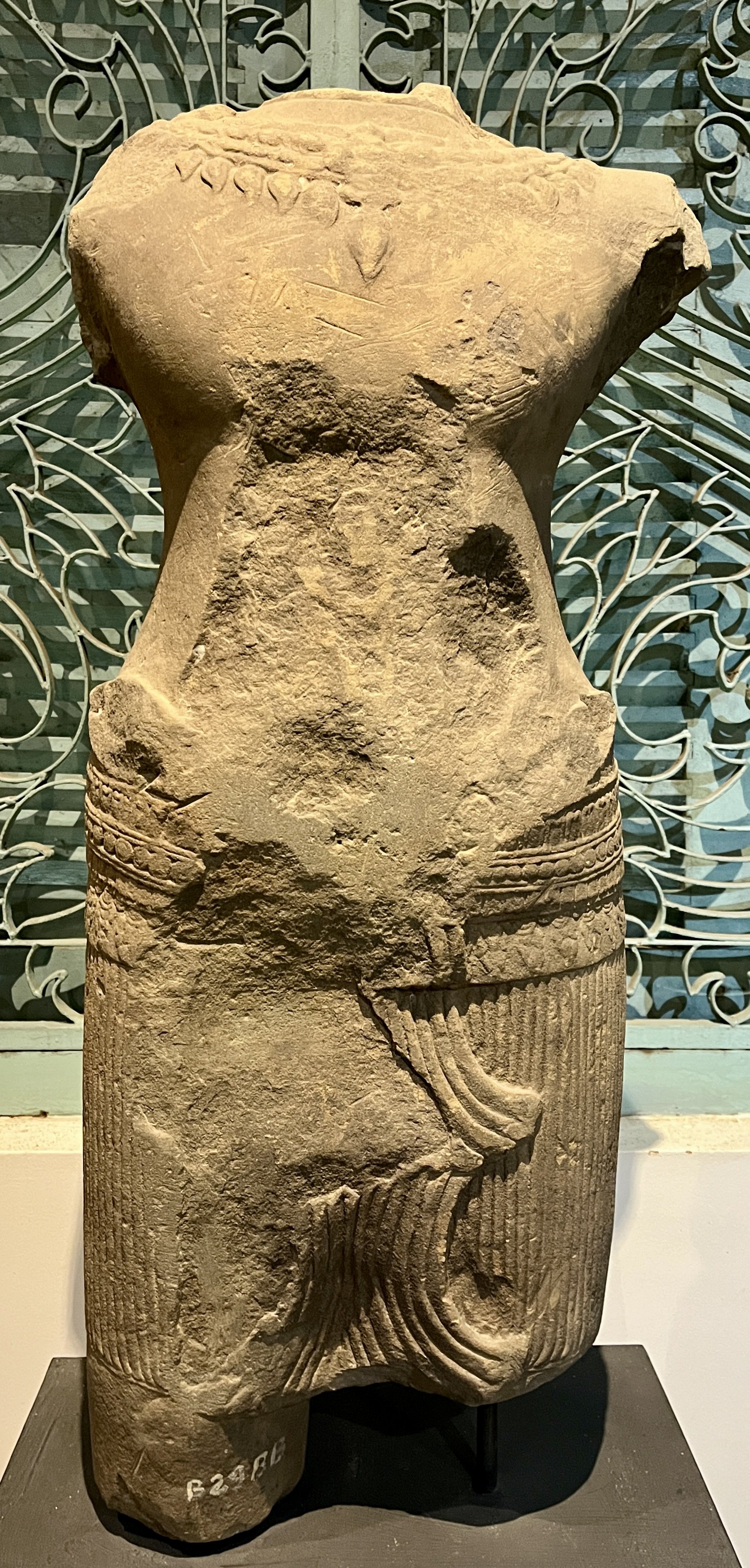
Male Deity
Sandstone, Angkorian period, late Angkorwat style. late 12th to early 13th C., Unknown
This is a typical torso of a male deity in the Bayon Style. His short skirt has two scarf tails, in fishtail shape, at the front, one atop the other. The scarf is tied with a belt decorated with a row of pearls motif.
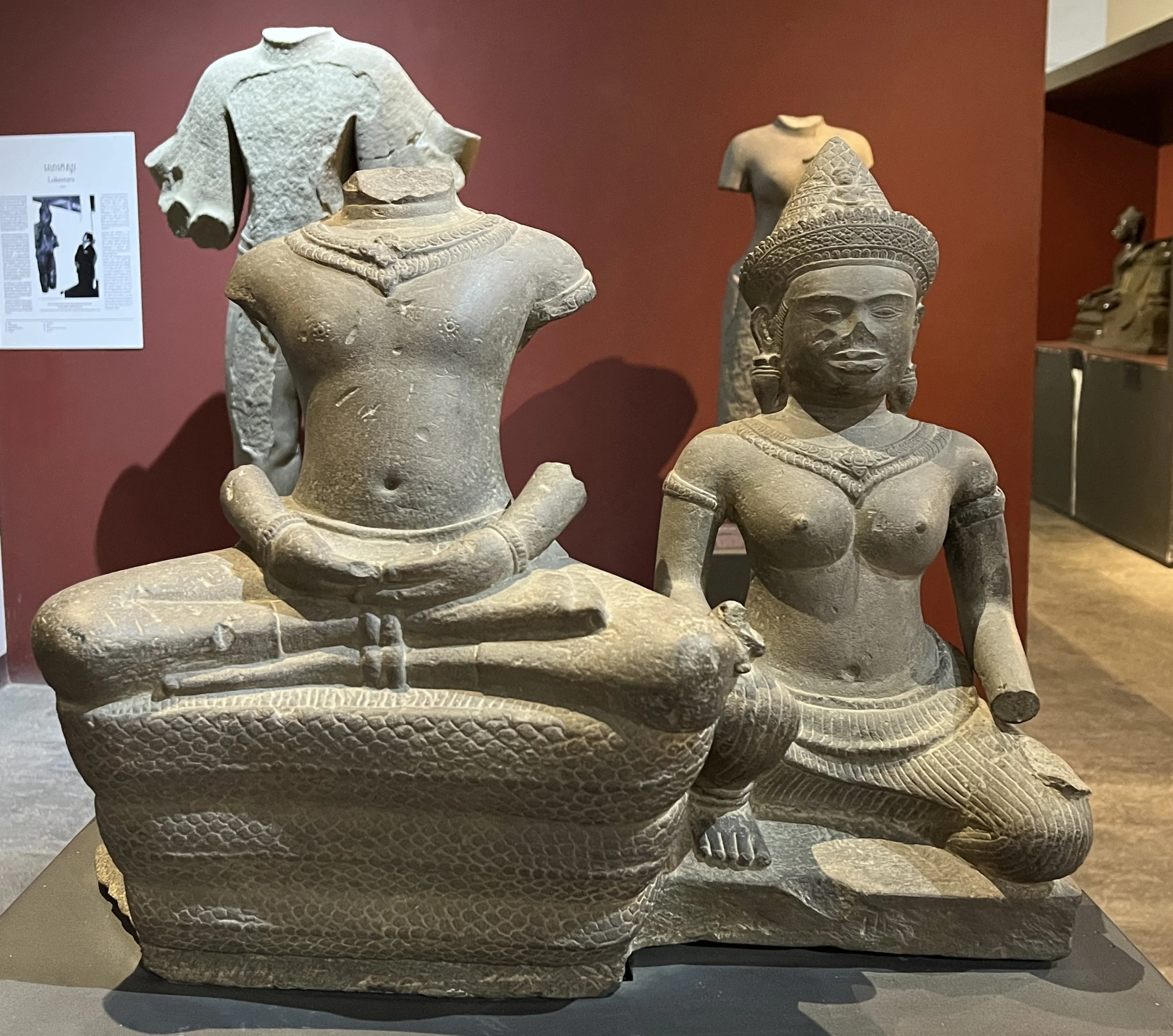
Buddhist Trimurti
Sandstone. Angkorian period, Angkor Wat style, late 12th to early 13th C.. Wat Damey Sar
This piece belongs to the Tantric Buddhist tradition. It presents three Buddhist divinities as a trinity. At the center is the Buddha protected by seven-headed Naga, Mucalinda. He is flanked by Prajnaparamita on his left side and Lokesvara (missing) on his right side. Adornments such as bracelets, armbands, anklets, necklace, diadem, and ear pendants remain on the deities Buddha and Prajnaparamita, allowing us to date this piece to the Angkor Wat style.
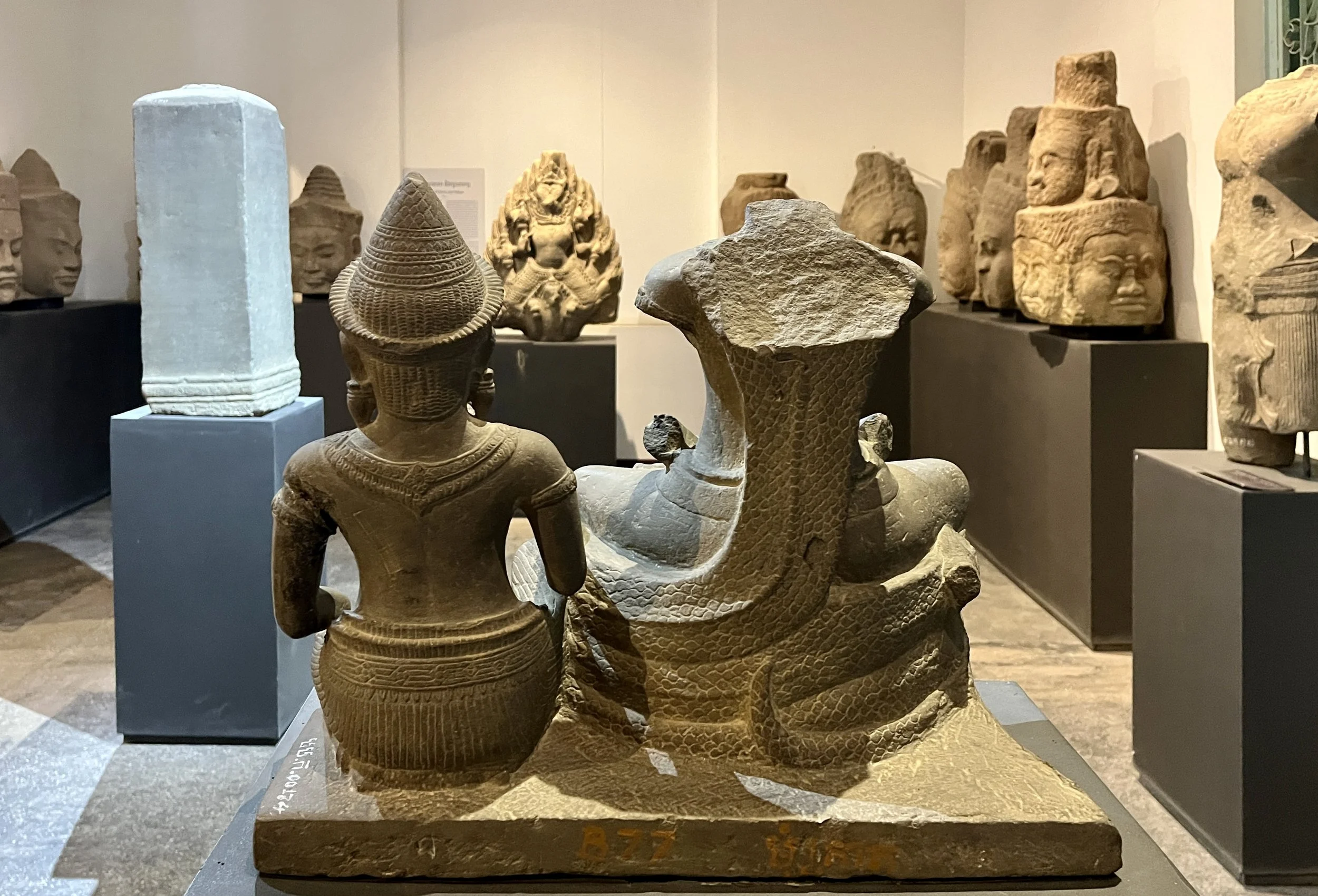
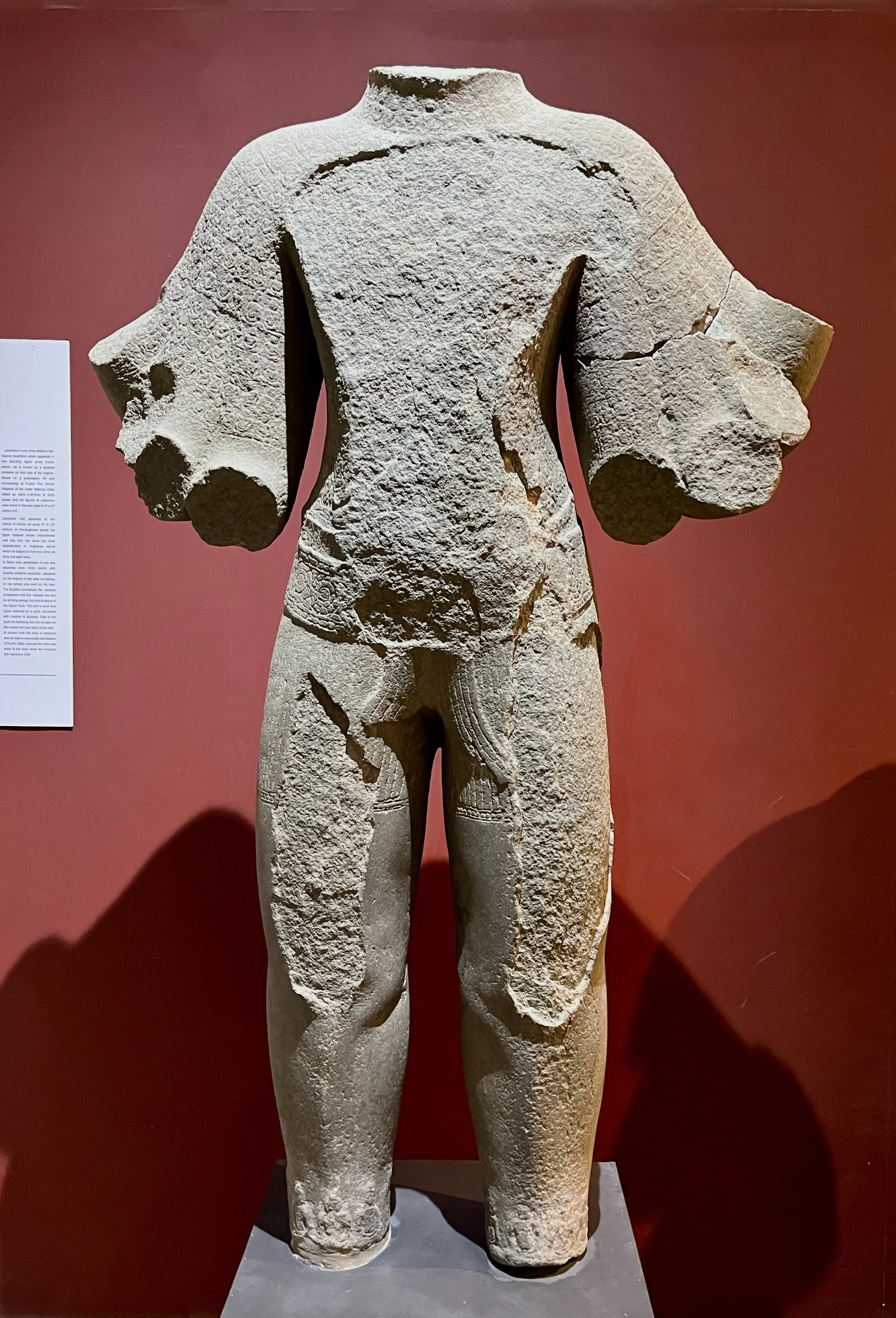
Lokesvara is one of the deities in Mahayana Buddhism who has been depicted as a free-standing figure since the Funan (Kingdom of the Lower Mekong Valley) period (5th or 6th century AD). He can be identified by the Buddha Amitabha on the front of his chignon.
Lokesvara continued to appear in Khmer art through the 13th century. In the Pre-Angkorian period, the figure displays simple characteristic and has only two arms. In the Angkorian period, more sophisticated depictions feature four arms, six arms and eight arms.
In the Bayon style, the presentation of Lokesvara becomes even more stylish, with the Buddha Amitabha previously appearing on his chignon appearing on his body, ankles, and even on his toes.
The Buddha symbolizes the extreme compassion that the blessed one has for all living beings. His skirt is typical of the Bayon Style. The skirt is short and tightly fastened by a scarf, decorated with rosettes in squares. The tails of the scarf are flattened and can be seen at the central front and back of the skirt.
At present only the body remains; the head presumably lost sometime in the 70s or 80s. The head was intact when the museum first opened in 1968.
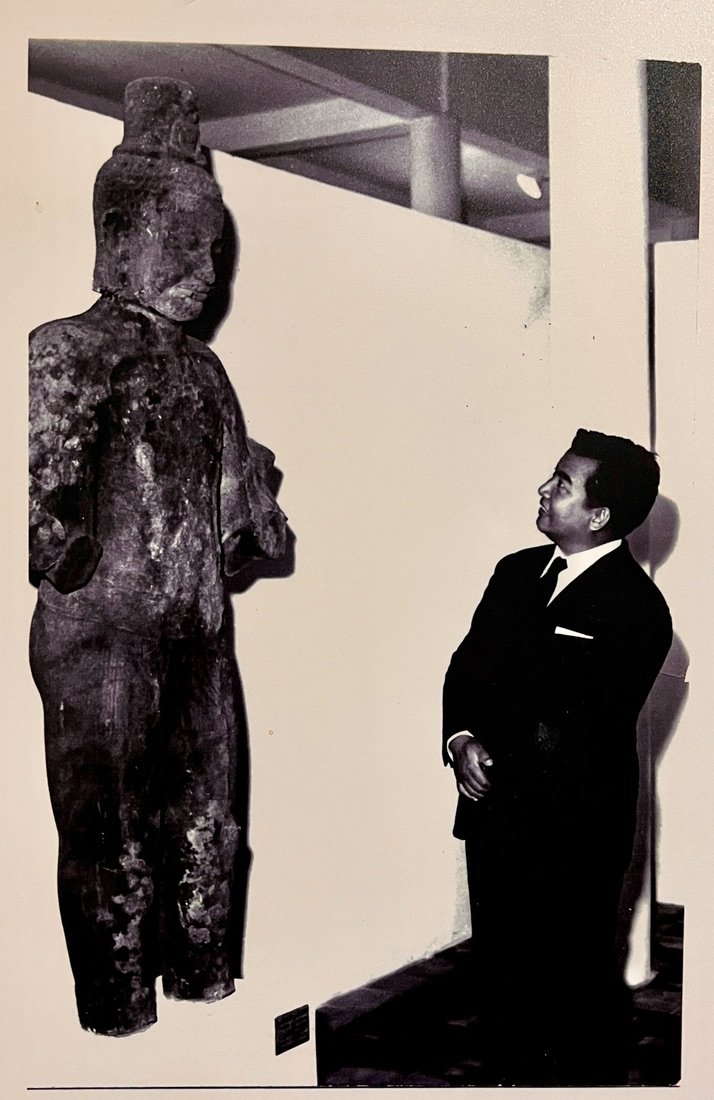
Prince Sihanouk at the museum opening in 1968, with the intact Lokesvara.
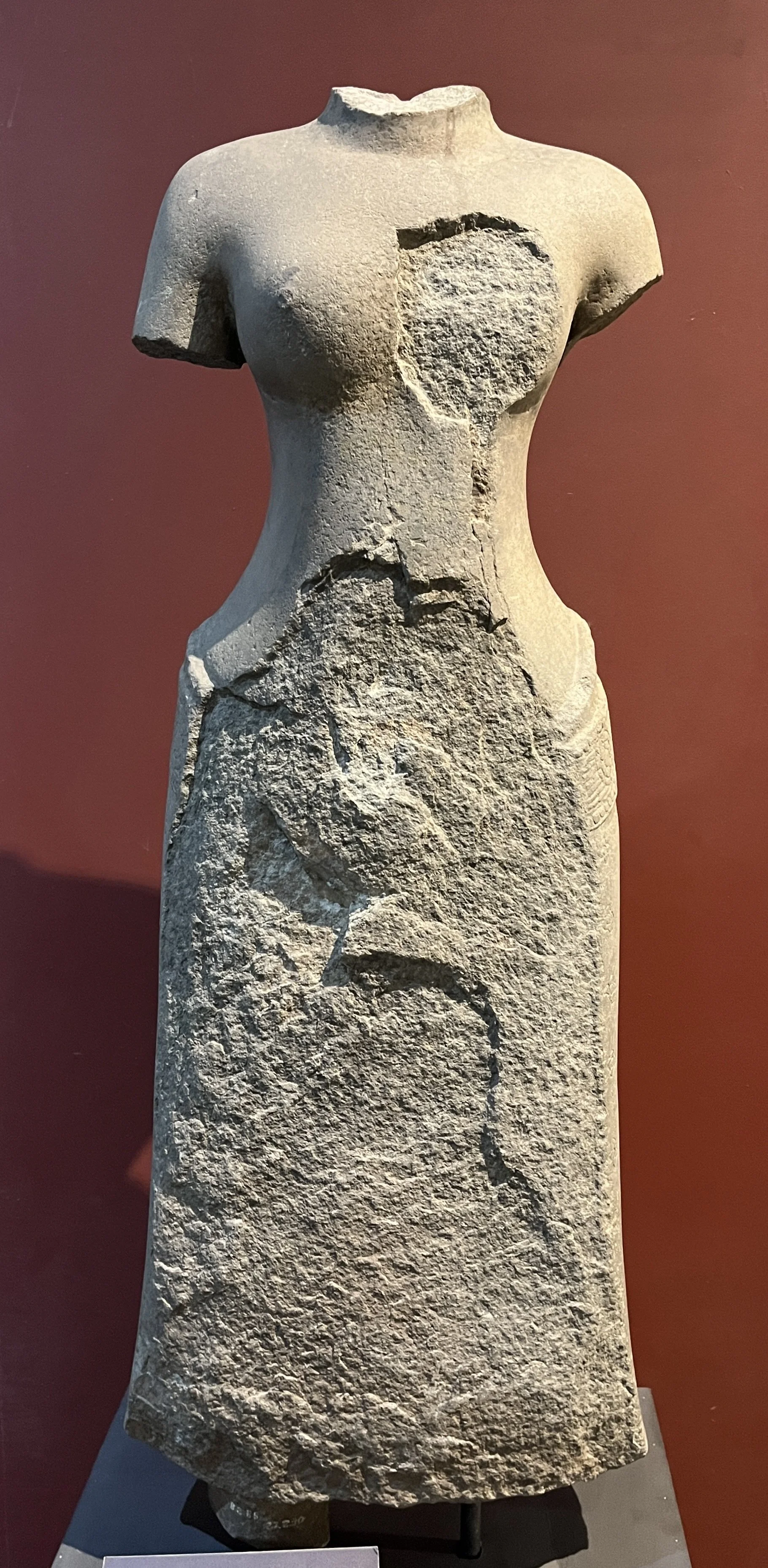
Female Deity
Sandstone. Angkorian period Bayon style, late 12th to early 13ch c. Unkrown
Despite the severe damage, the beauty of this torso can still be seen through the slender waist, elegant body, and round breast.
As a female figure, one could think that she is probably Prajnaparamita as this deity was so popular in the Bayon period. The skirt is fastened at the waist by a scarf decorated with a flower motif. The body shape and the skirt allow the dating of this piece to the Bayon style.
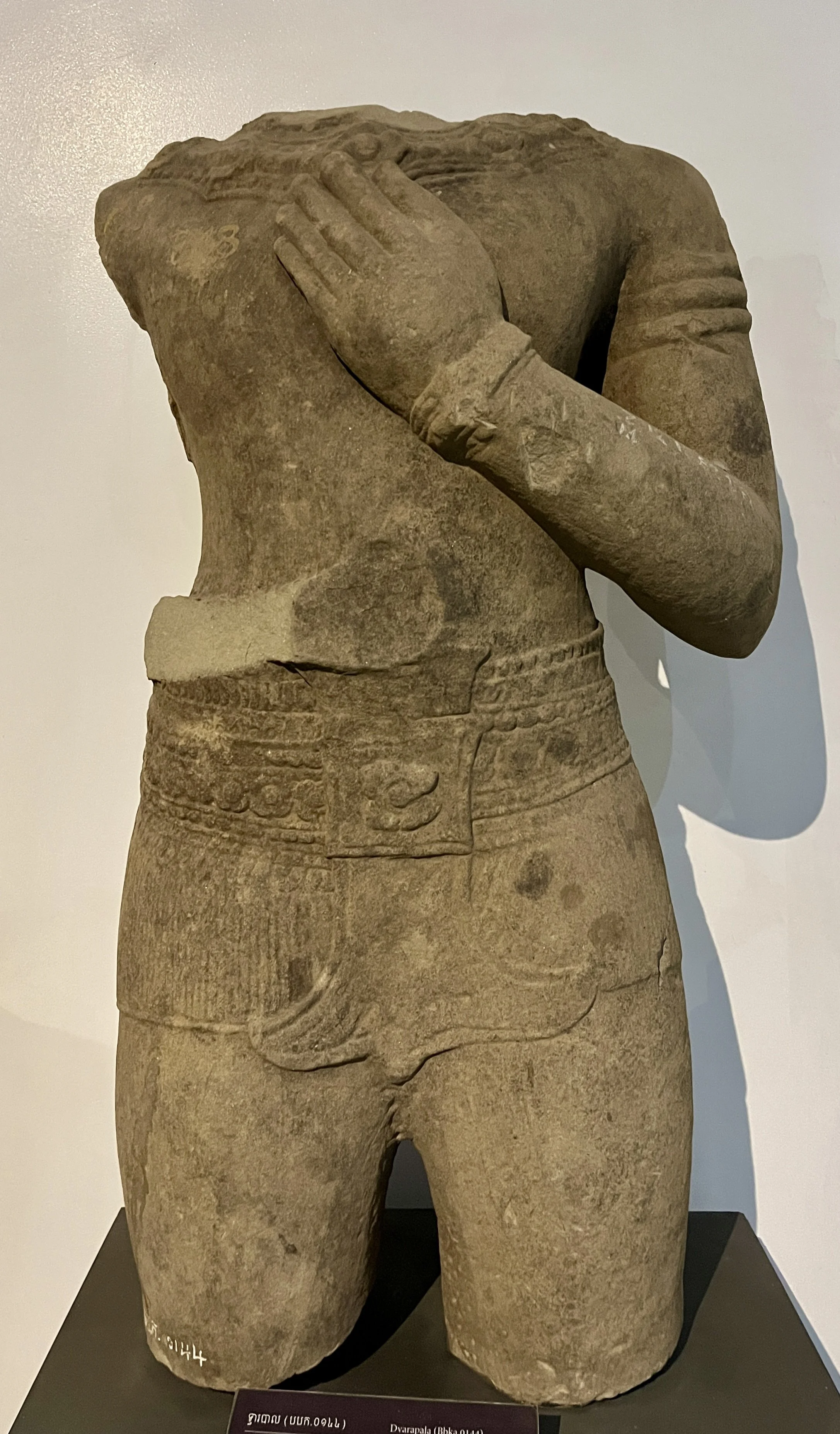
Dvarapala
Sandstone, Angkorian period, Bayon style
This is a typical Dvaropala, a door or gate guardian, of the Bayon style. His left arm is placed on his chest while his missing right arm is presumably placed on the belly with a pole.
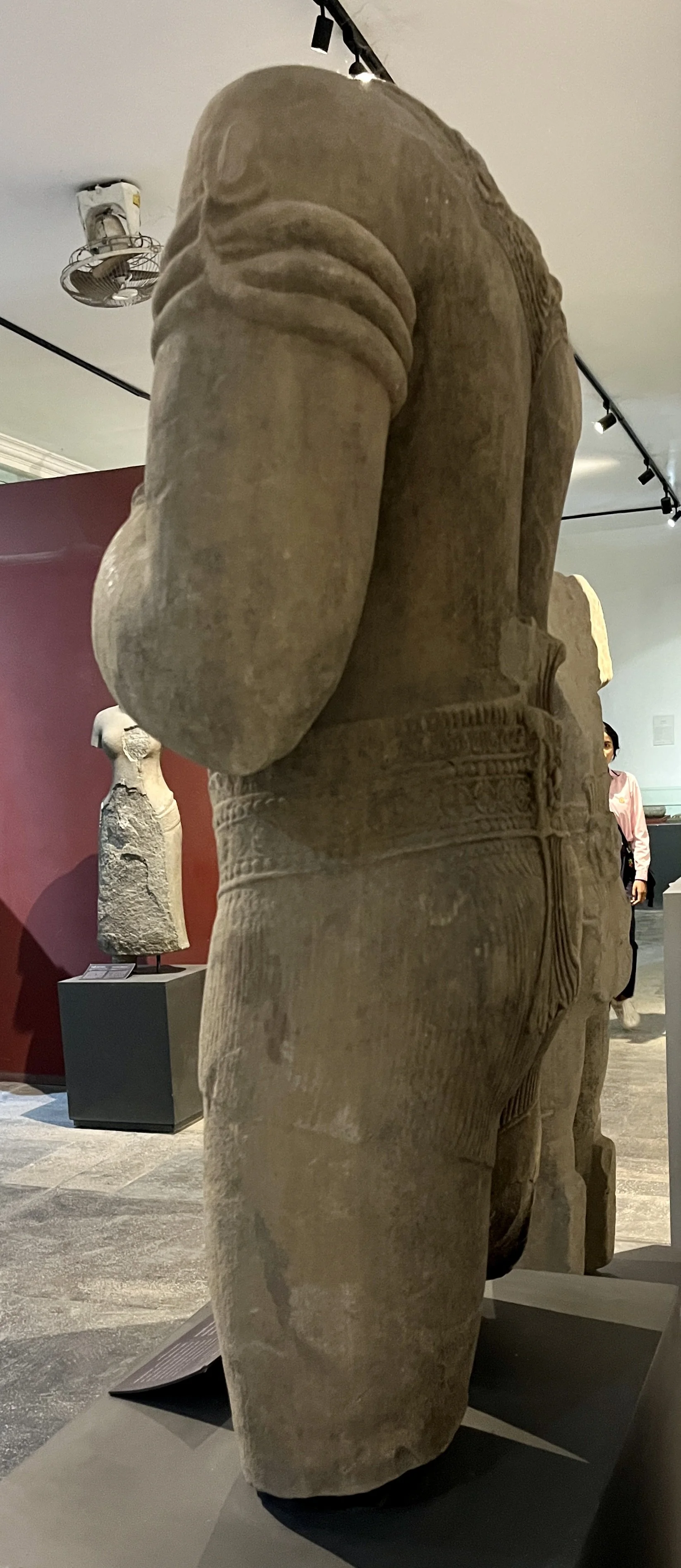
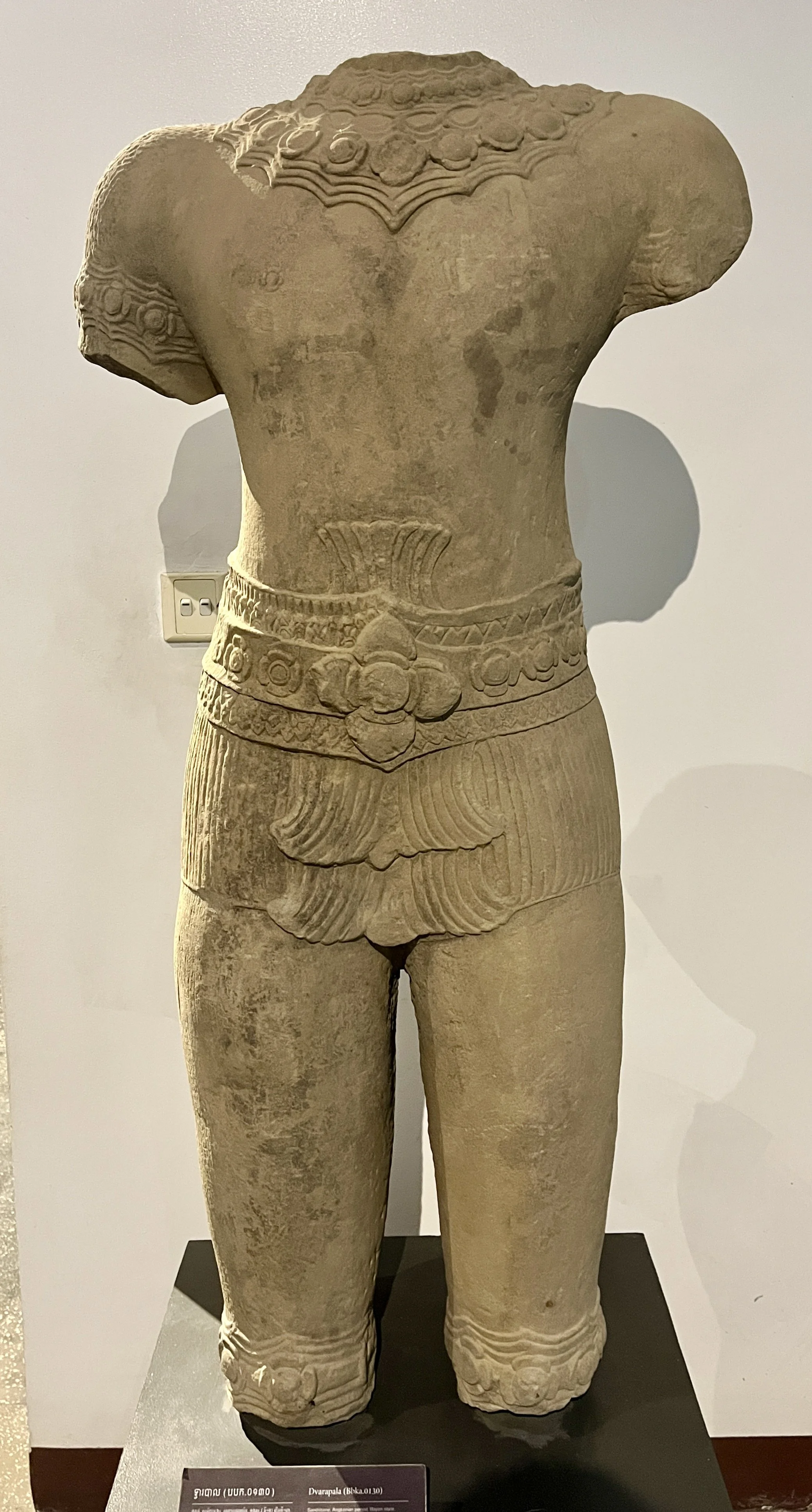
Dvarapala
Sandstone. Angkorian period. Bayon style
late 12th to early 13th c., Unknown
This piece is another typical Dvarapala, a door or gate guardian, of the Bayon style. Both missing hands are presumably placed to the front holding a long club. This posture is a mark of vigilance, His short skirt, has two scarf tails, in fishtail shape, at the front on each other. The scarf is tied by a belt decorated with rosettes.
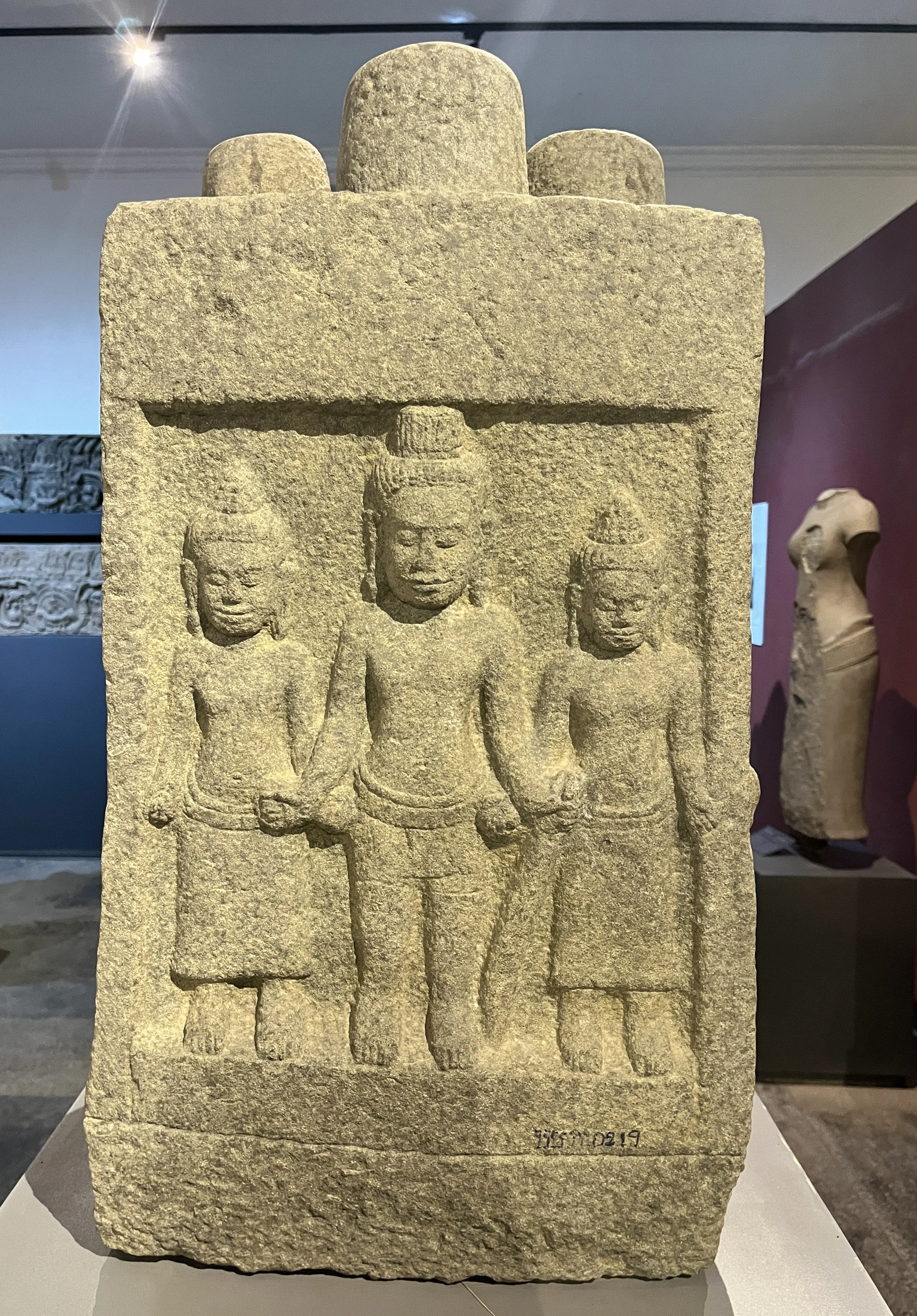
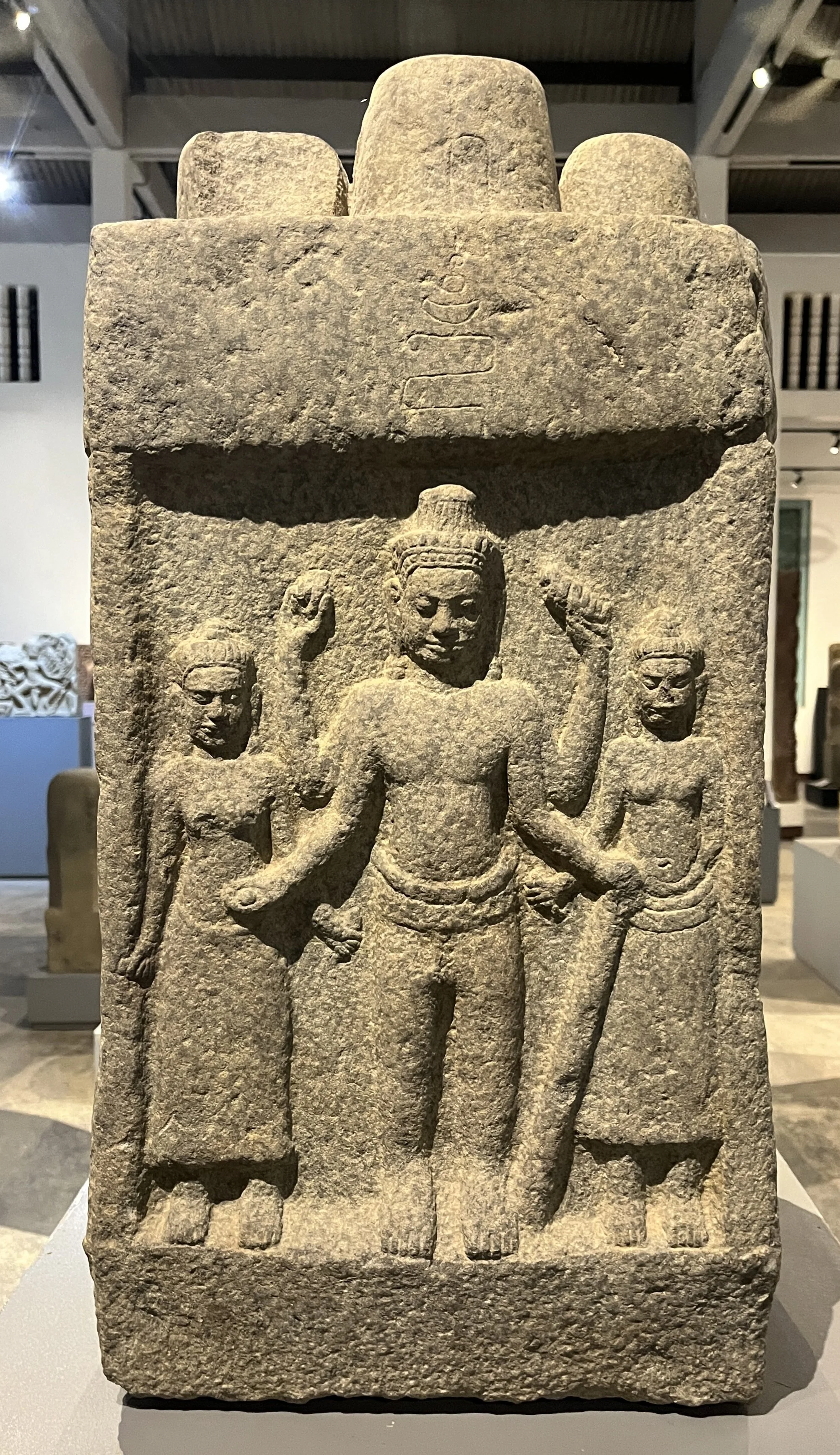
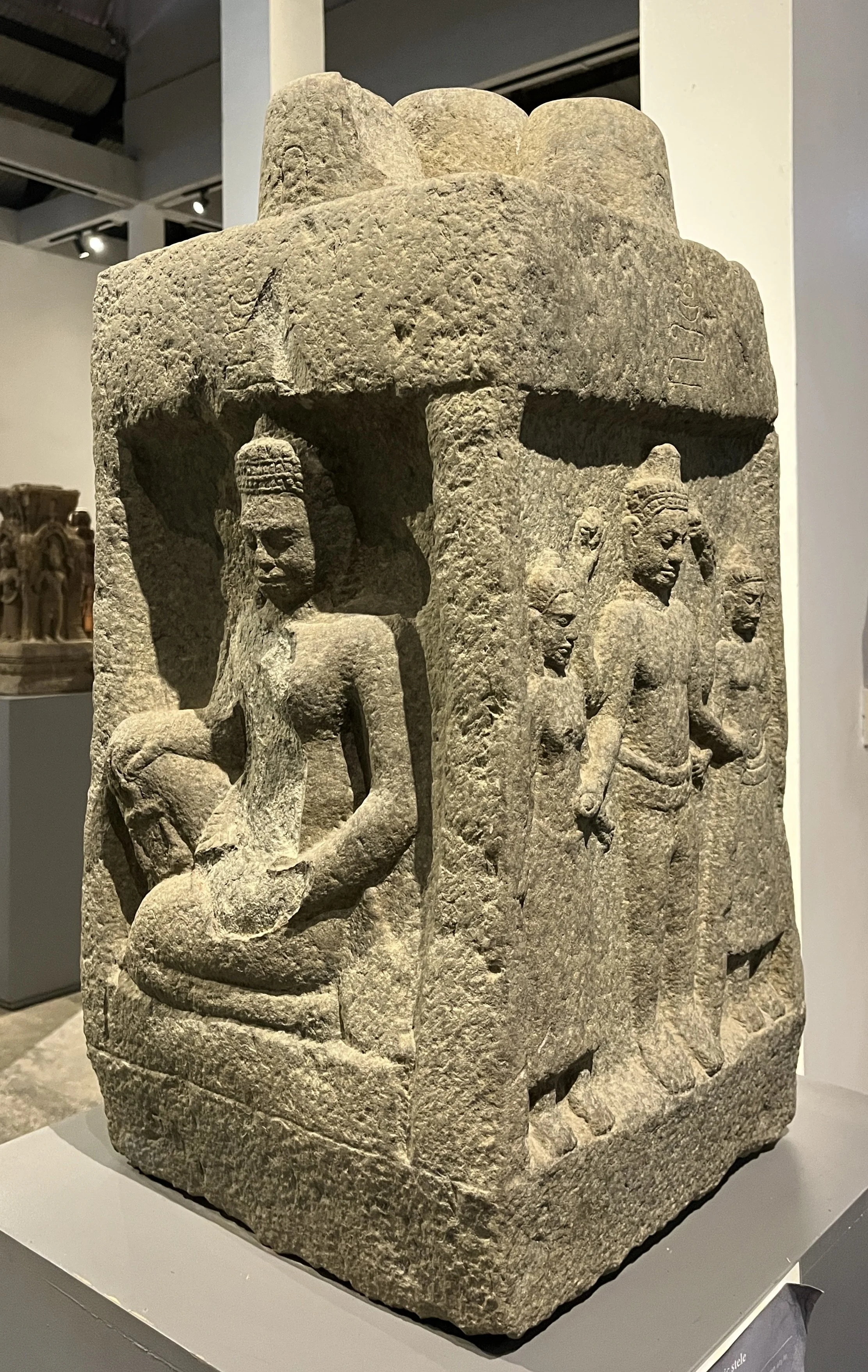
Brahmanic stele
Sandstone, Angkorian period, Bayon style, late 12th-13th c. Tuol Prasat, Kouk village, Bavel commune, Bavel District, Battambang
The stele is a rectangular prism carved on five sides. On top are five small carvings in the form of lingas. Each one has an Um sign which signifies Shiva. Each side features different divinities. The first one consists of a standing male figure holding a club flanked by two female figures, probably Shiva and his consorts because a Brahma figure is on another side, and on the opposite side are Vishnu and his spouses, Laksmi and Ganga. The last one is a seated male deity whose right arm rests on his right knee and is presumably holding a balance.
The figure is probably a judge representing Yama, the god of the dead, though he is normally presented seated on a buffalo mount holding his mace.
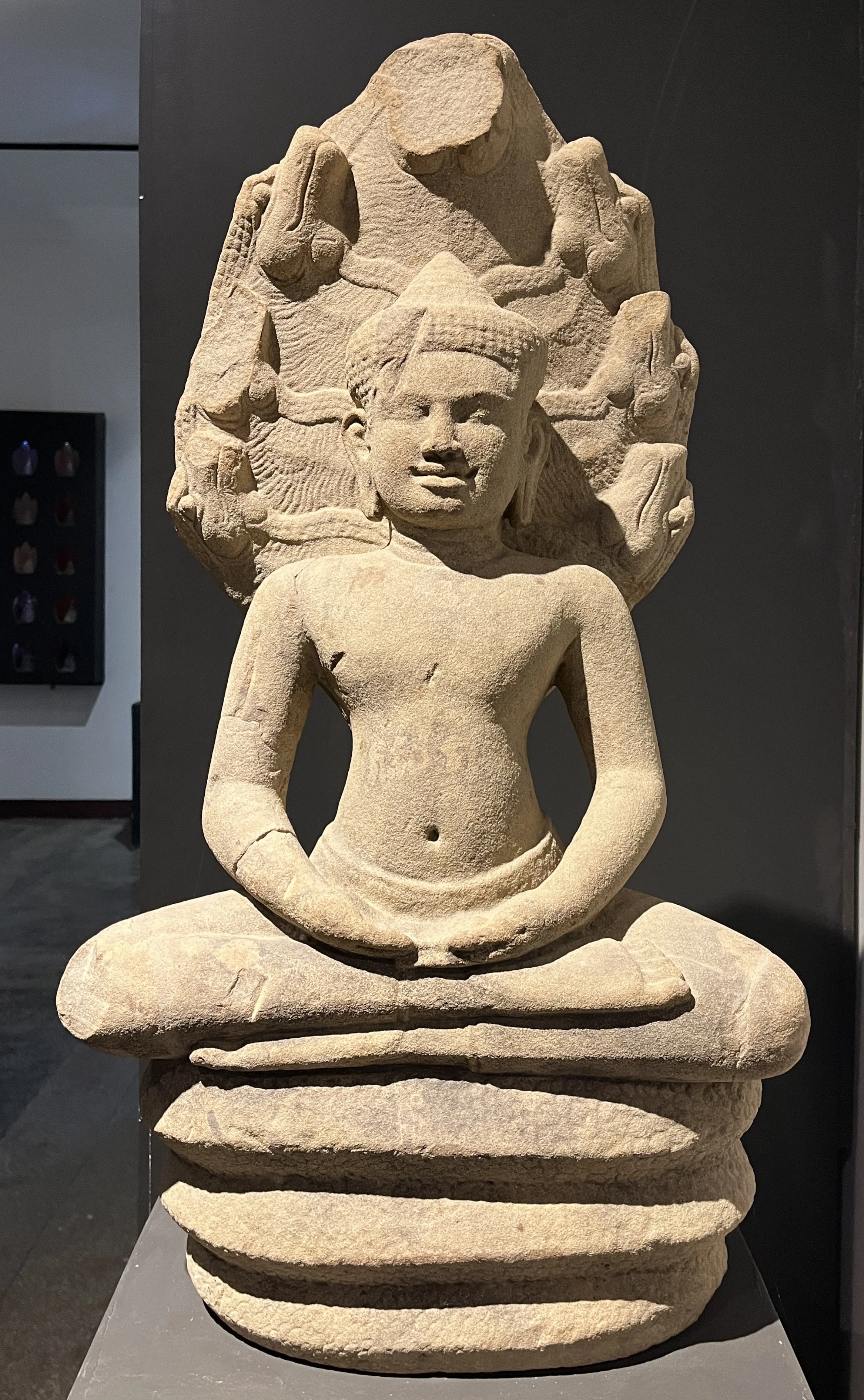
Dhyana Buddha
Sandstone,
Angkorian period
Baphuon style
second half of 11th c.,
Samnanh, Phnom Sampau, Battambang
The depiction of Buddha protected by Mucalinda, a seven-headed Naga, was popular during the Angkorian period.
It refers to the event in which the Buddha began meditation (dhyana) under the Bodhi tree. Immediately after, the sky became dark and heavy rain descended on earth for seven days. The Naga king, Mucalinda, left his palace to protect the Buddha with his hood.
This Dhyana Buddha protected by Mucalinda in the Baphuon style is a testimony to the expertise of Khmer artists, who respected the rules of symmetry, with the axis passing through the nose of the Naga to the joint of the Buddha's thumbs at his stomach level.
Buddha's smile expresses his supreme knowledge and calm concentration to understand the law of the universe. The hooded Naga, on the other hand, conveys the impression of domination.
Depicting the Buddha in a plain robe, representing the absence of earthly attachments, appears to be the preferred choice of artists in the Baphuon period. This robe allows for the differentiation of the Dhyana Buddha of this style from the later Angkor Wat and Bayon styles
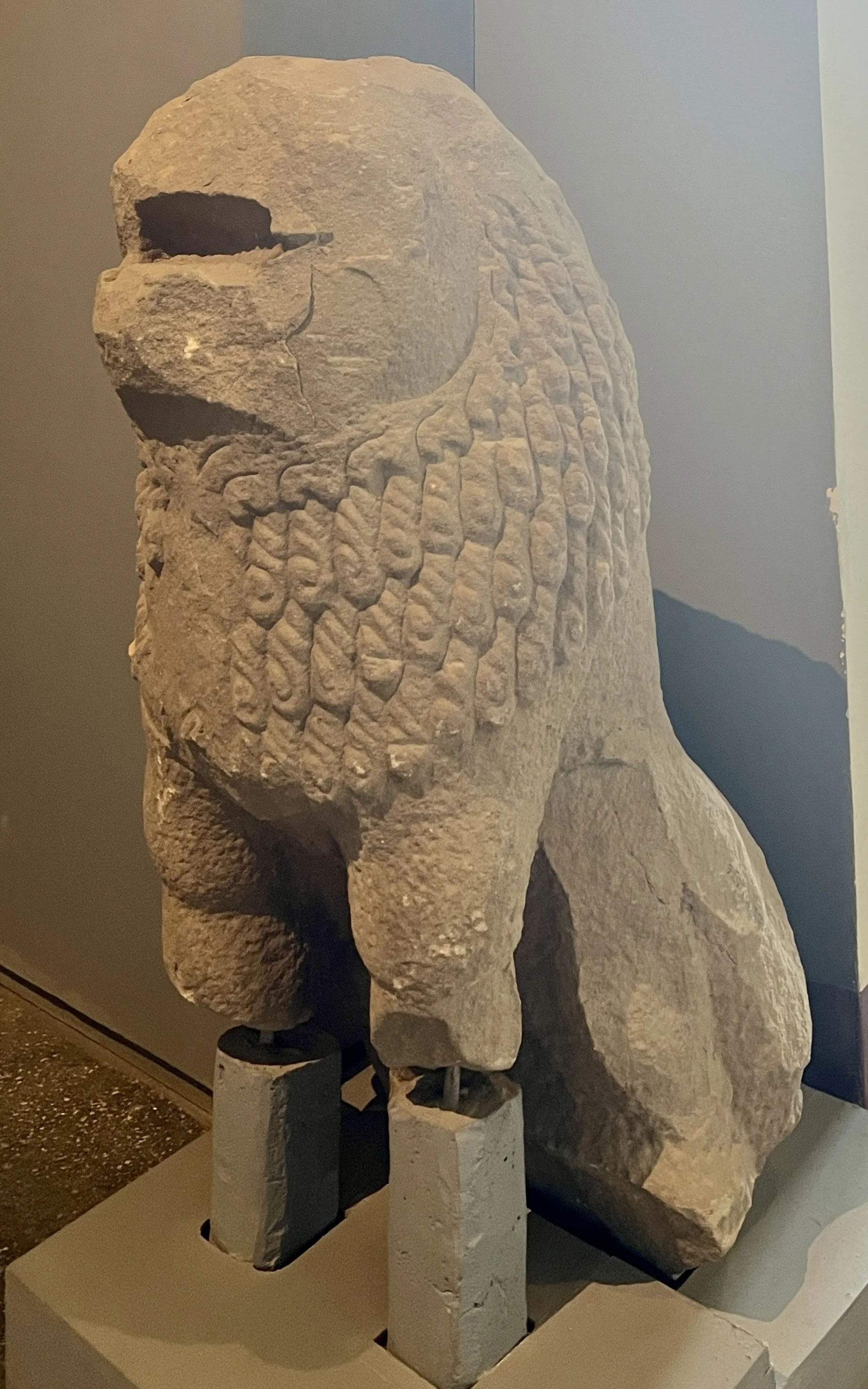
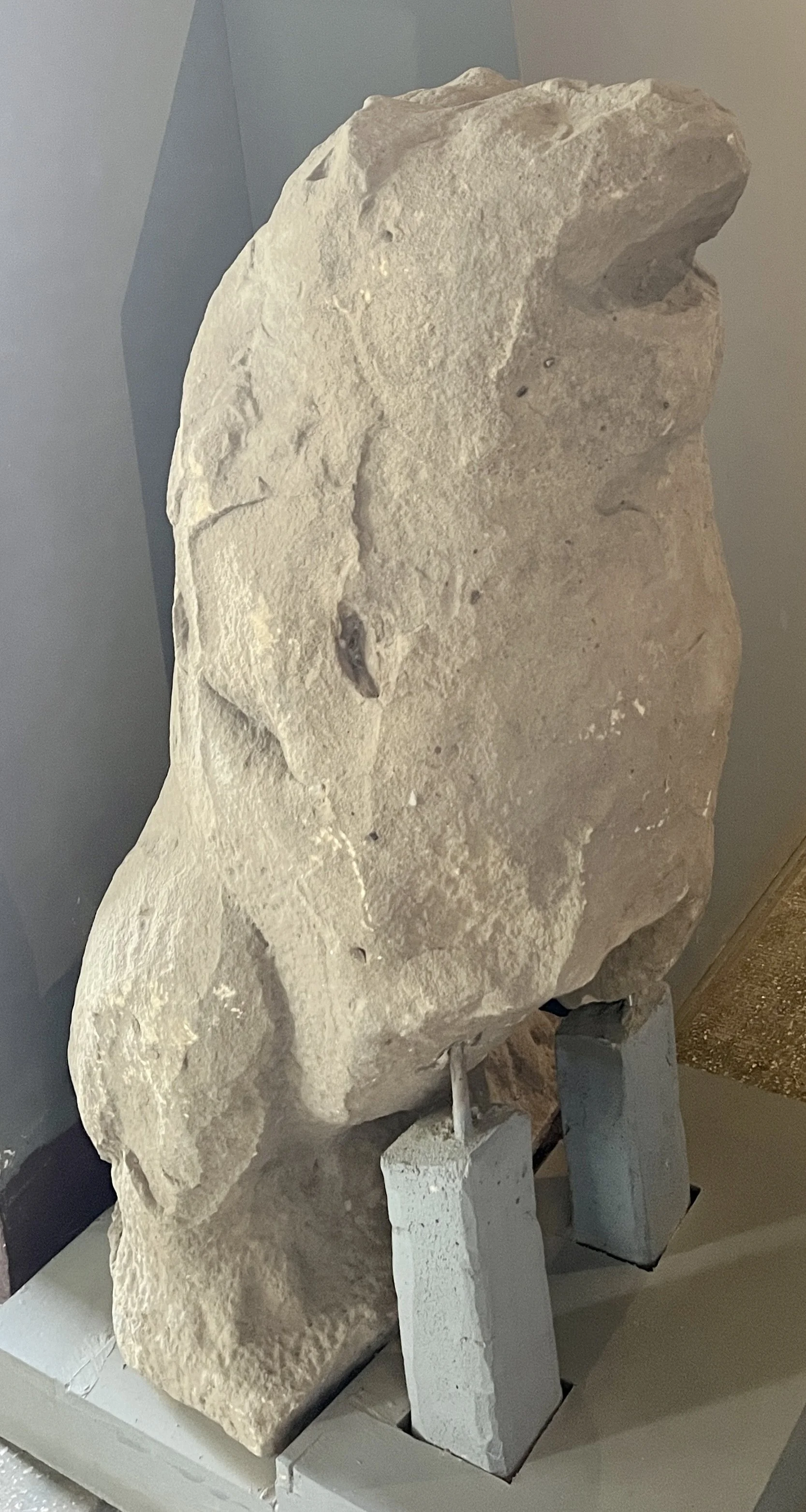
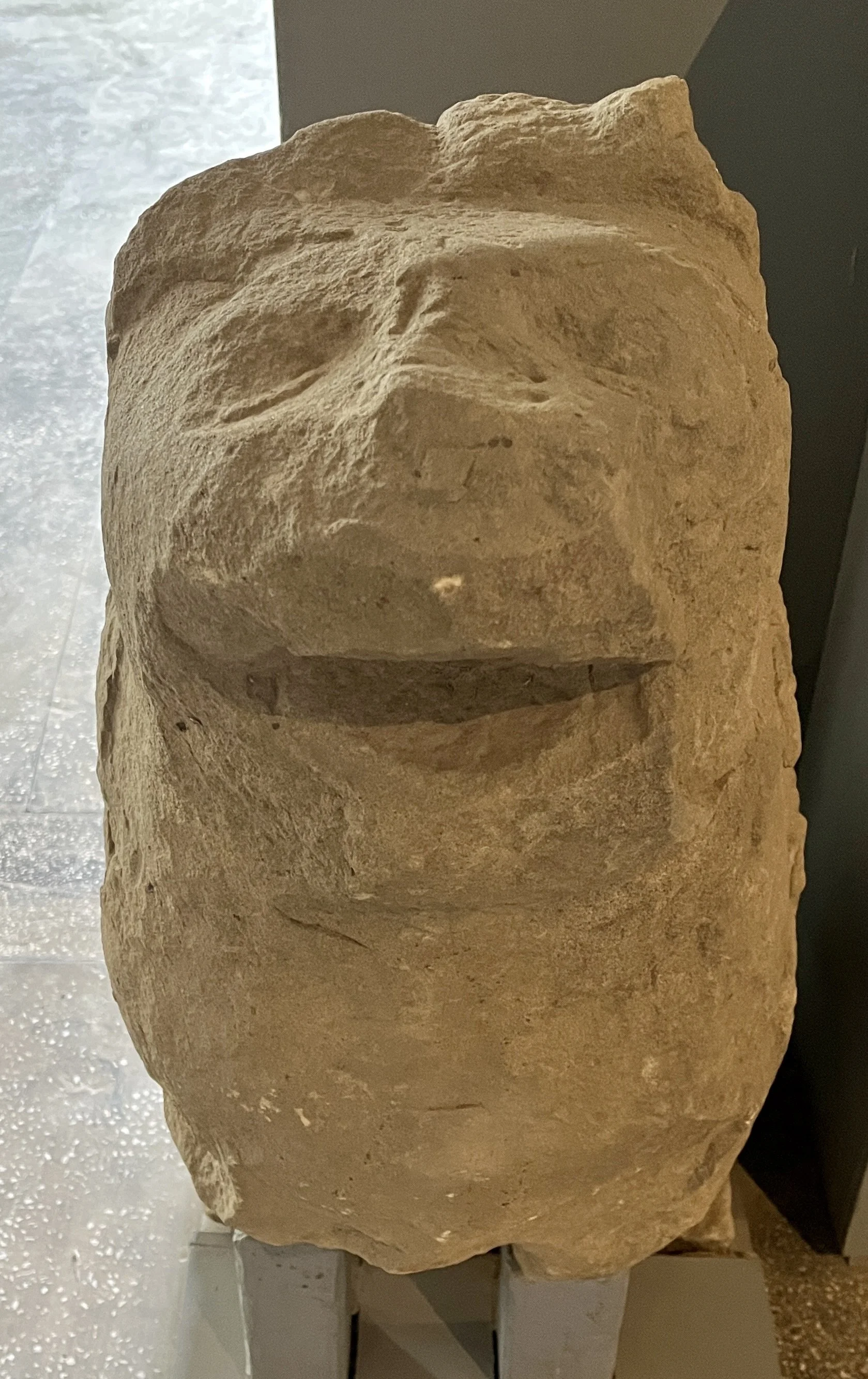
Lions
Sandstone, Pre-Angkorian, Sambo Preikuk style? 7th-8th c., Baset temple
According to hair style, these two monolithic carved lions are quite similar to those of Sambo Preikuk, an ancient Khmer capital, Isanapura, located in Kampong Thom province and a few others are located at Kuk Lvea De, Kampong Cham and Wat Sasar Muyroy, Kratie. Without decoration, its natural looking mane proves its power as the king of animals. Both lions are found with their lower mouths broken and have severely worn heads, and the lower part of their front legs are broken off.
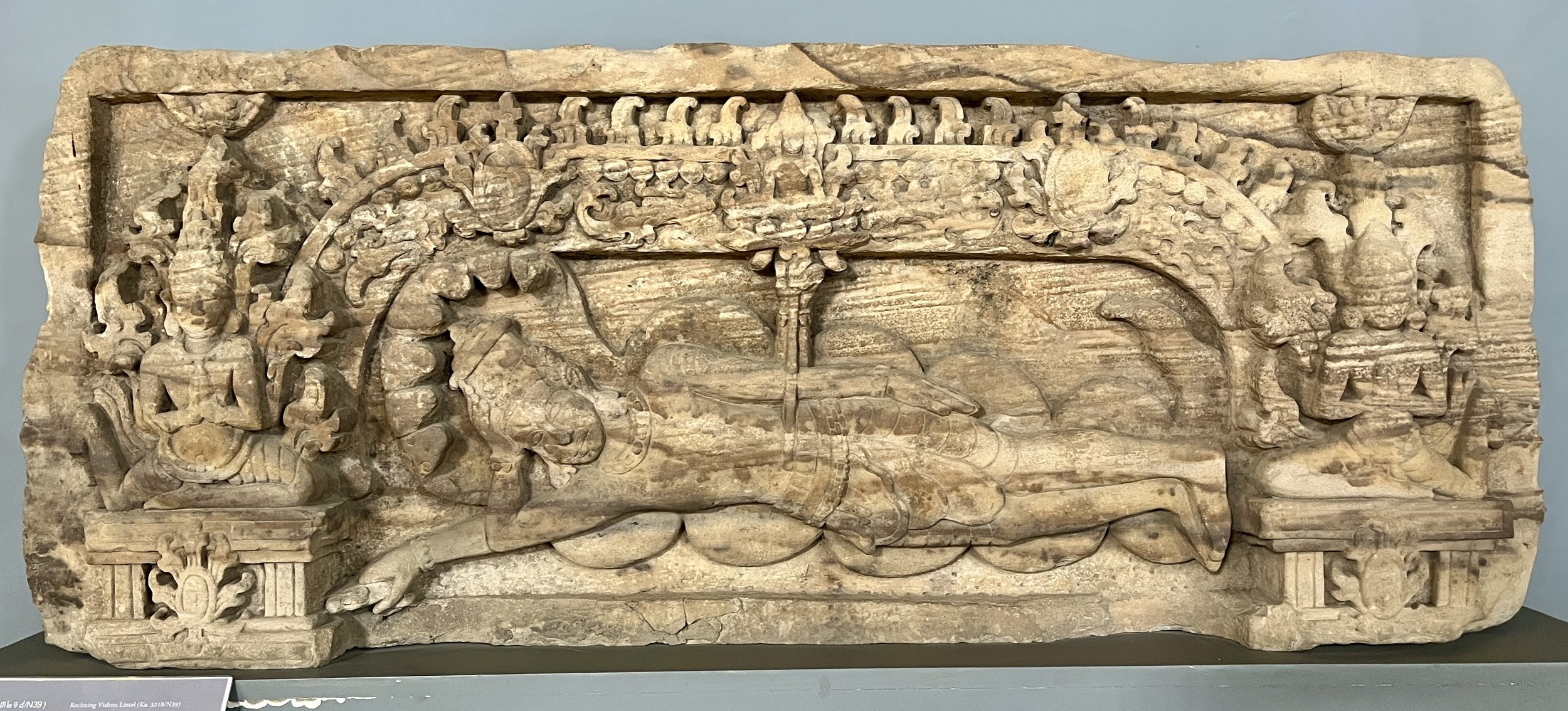
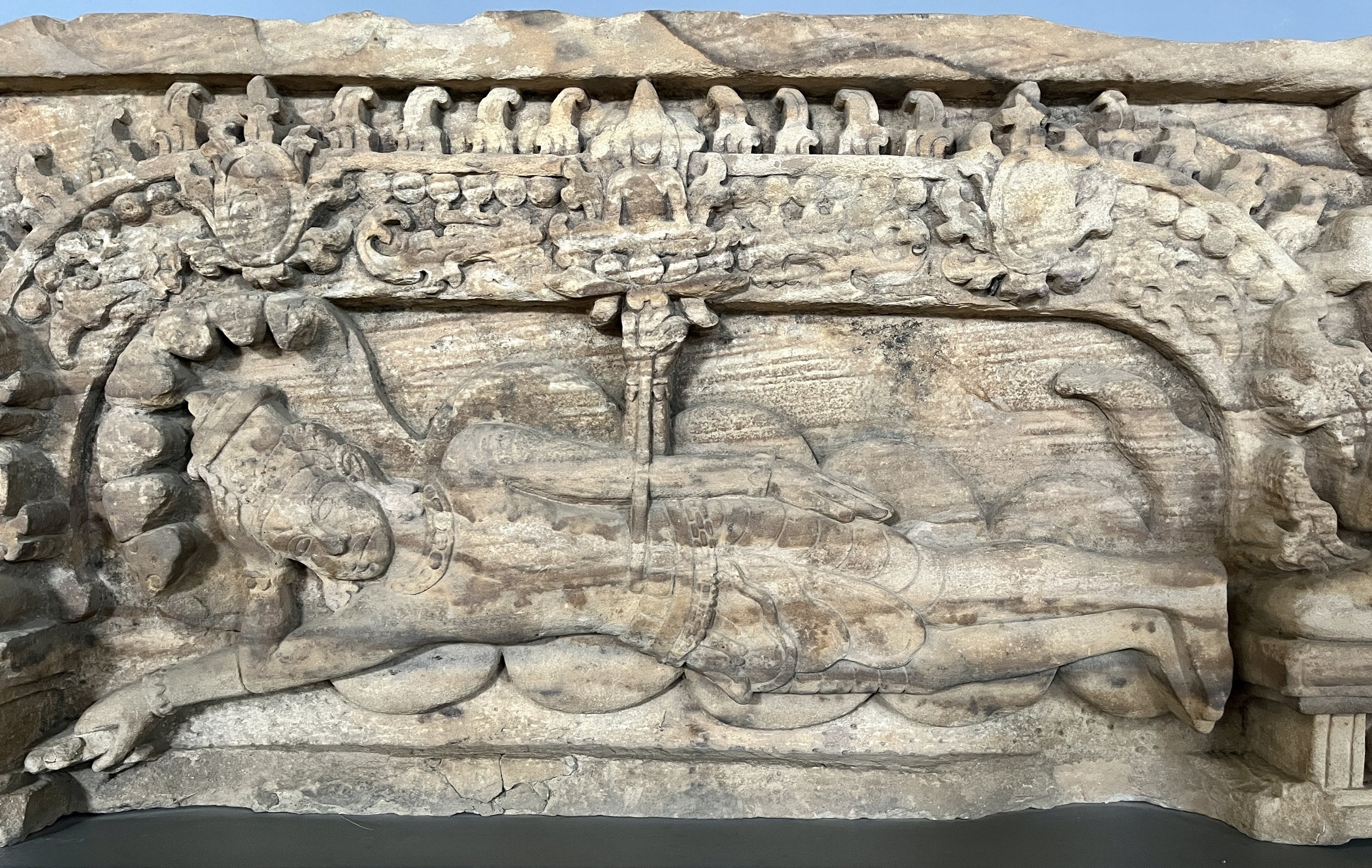
Reclining Vishnu Lintel
Sandstone, Pre-Angkorian period, Prei Khmeng style, second half of 7th c., Prasat Bavel
There are two types of lintel, depicting either floral shapes or carved deities in Hindu or Buddhist mythology. This lintel depicts reclining Vishnu on Ananta, a mythical snake (Anantasay-in), floating on the Ocean of Milk to create a new universe. In this depiction, he has only two arms, with the left arm lying along his body and the right one stretching out and holding something in its hand.
A lotus stem emerges from his navel; on that lotus, Brahma is born. Vishnu wears a high cylindrical chignon that is decorated with a flower motif on the front, which is believed to have some influences from Champa.
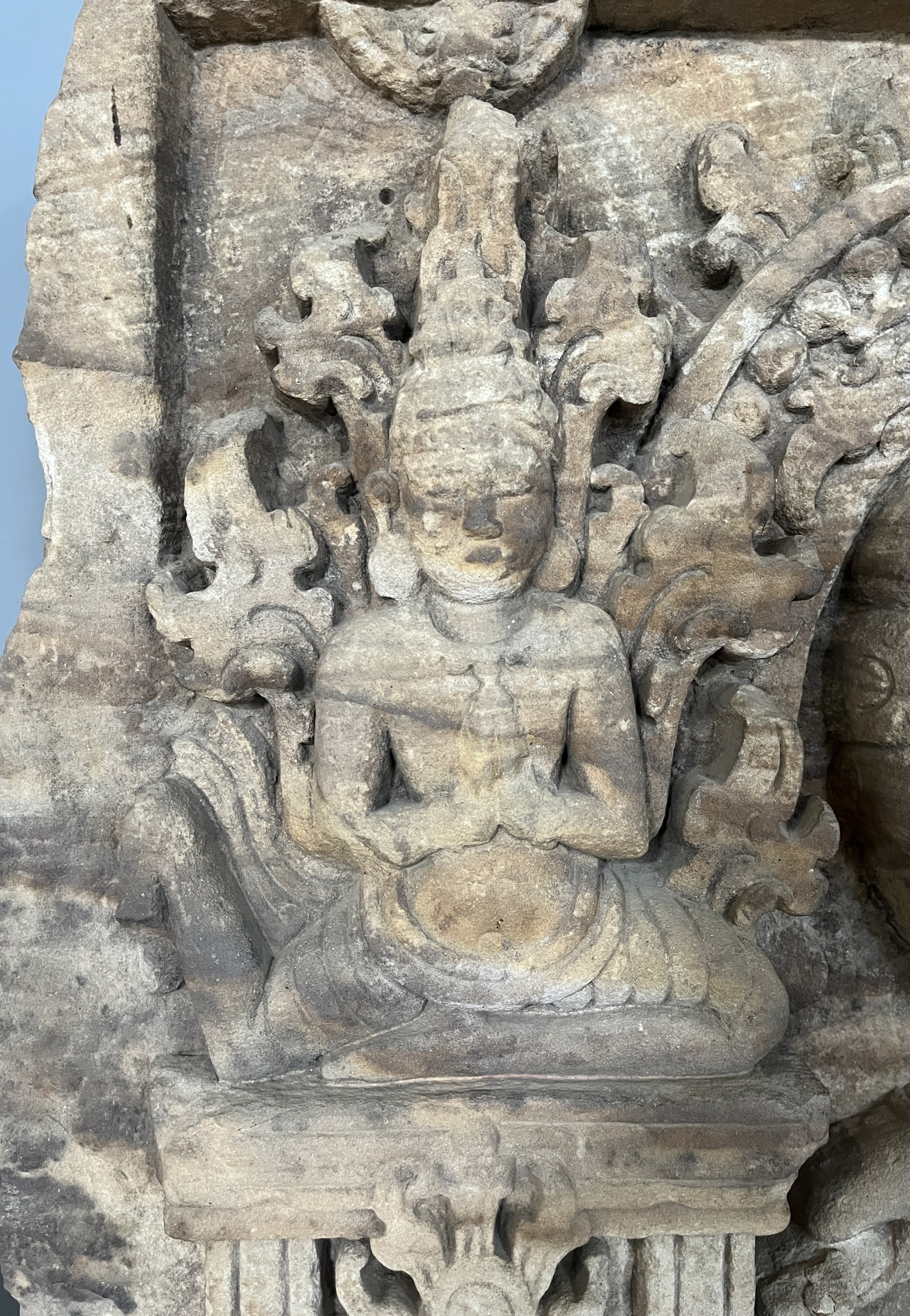
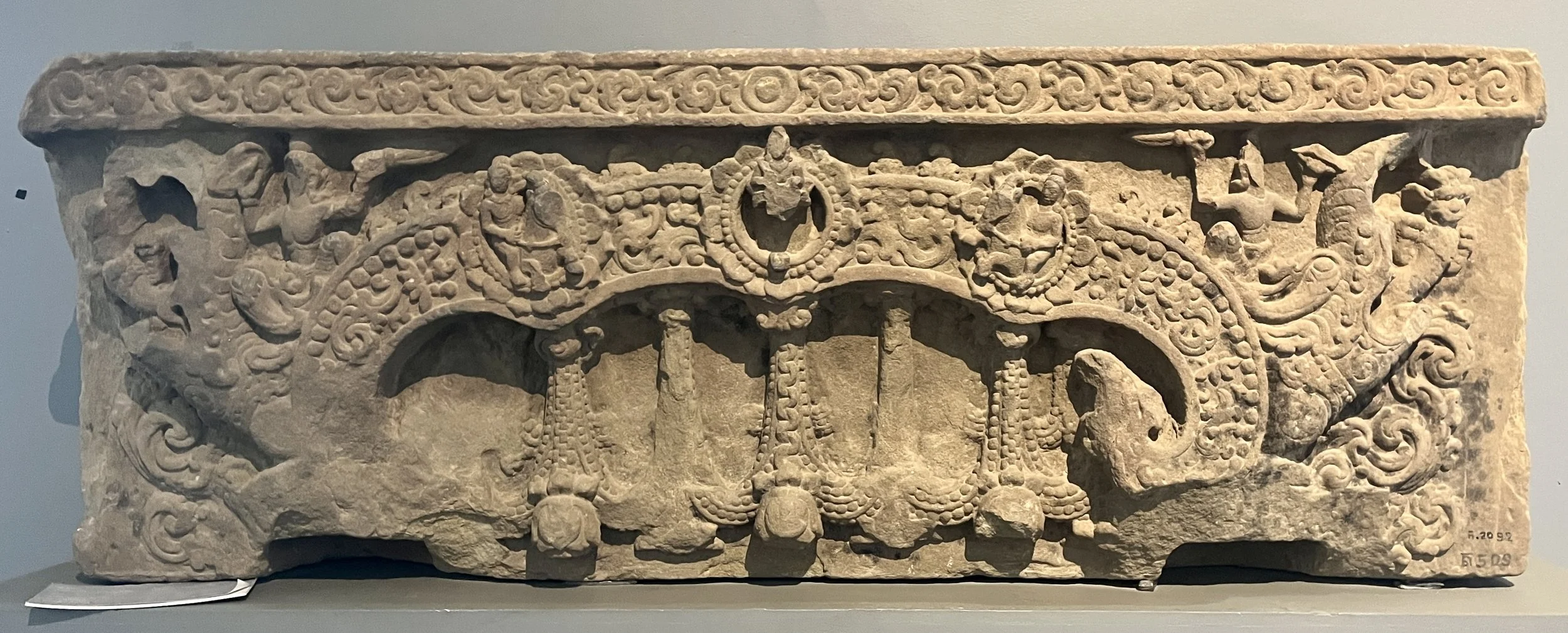
Lintel
Sandstone
Pre-Angkorian period, 7th c.,
Prey Khmeng Style
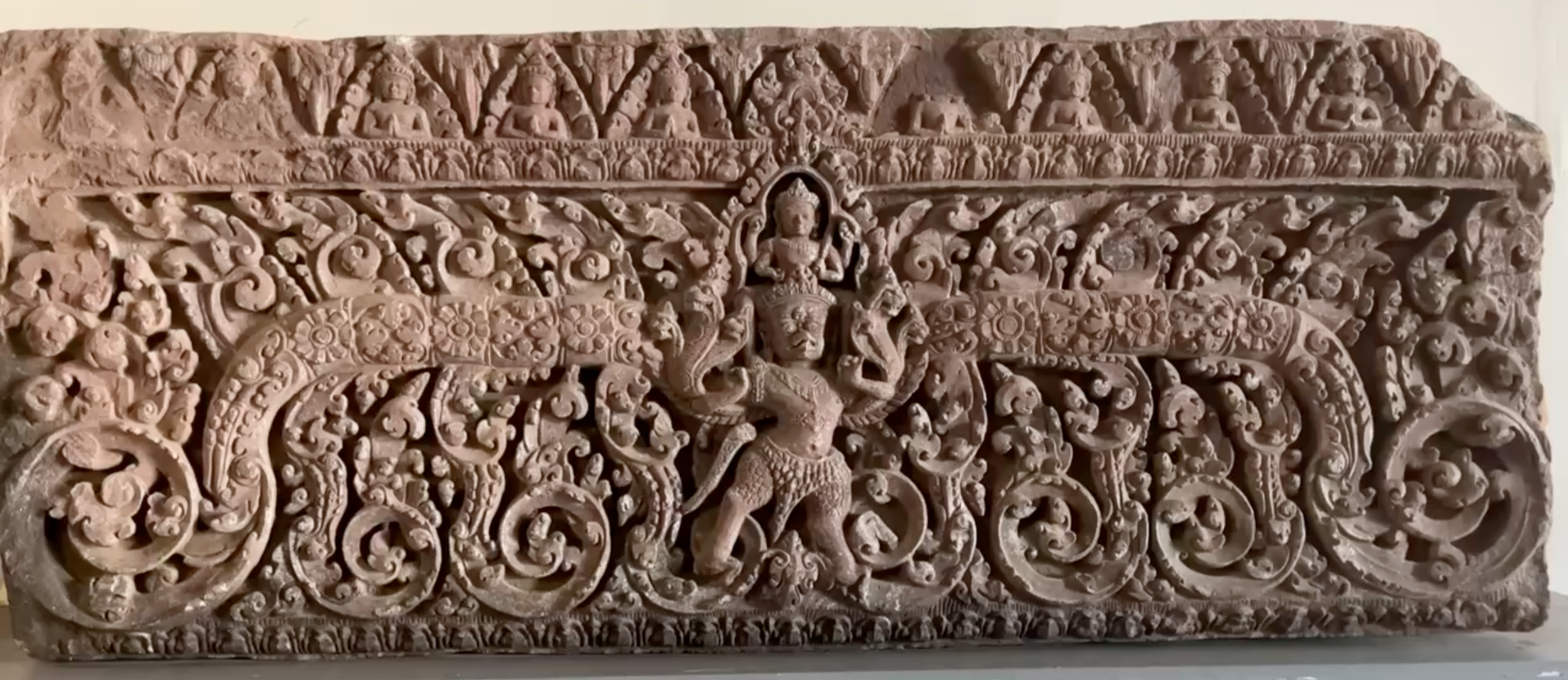
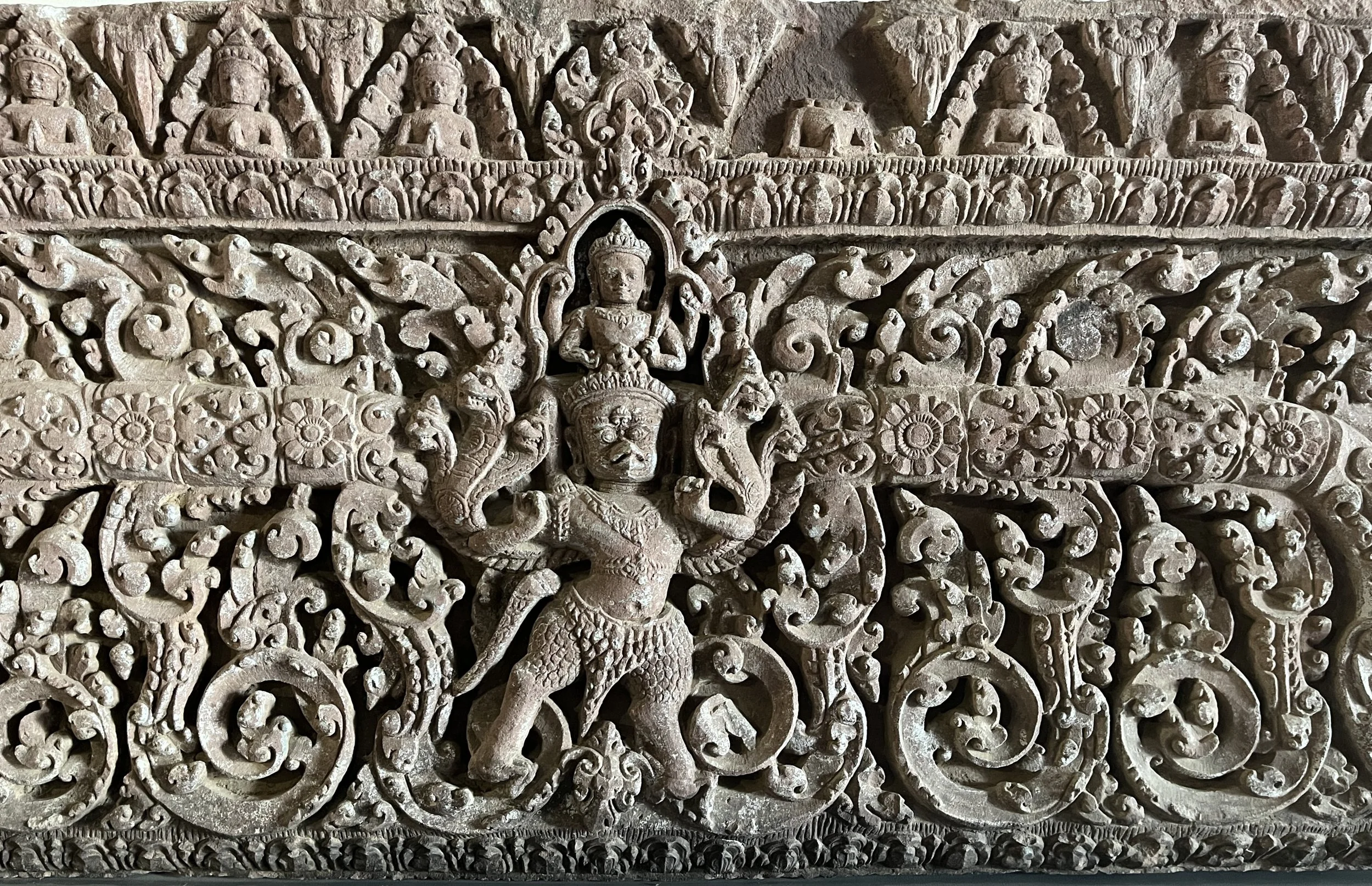
Lintel
Sandstone, Angkorian period, Bakheng style, early 10th c., Unknown
This is in Bakheang style. The depiction of a variety of floral motifs on the branches and foliage seen in this style is quite similar from one to another. This simplicity in presentation appears to be the preferred choice of this period. At the center of this piece is Vishnu riding on Garuda.
The foliage protrudes from Garuda's wings to form a bow-shaped feature, with both ends forming a Naga headed shape. The upper frieze depicts a row of eleven worshipers in decorative niches, one in each.
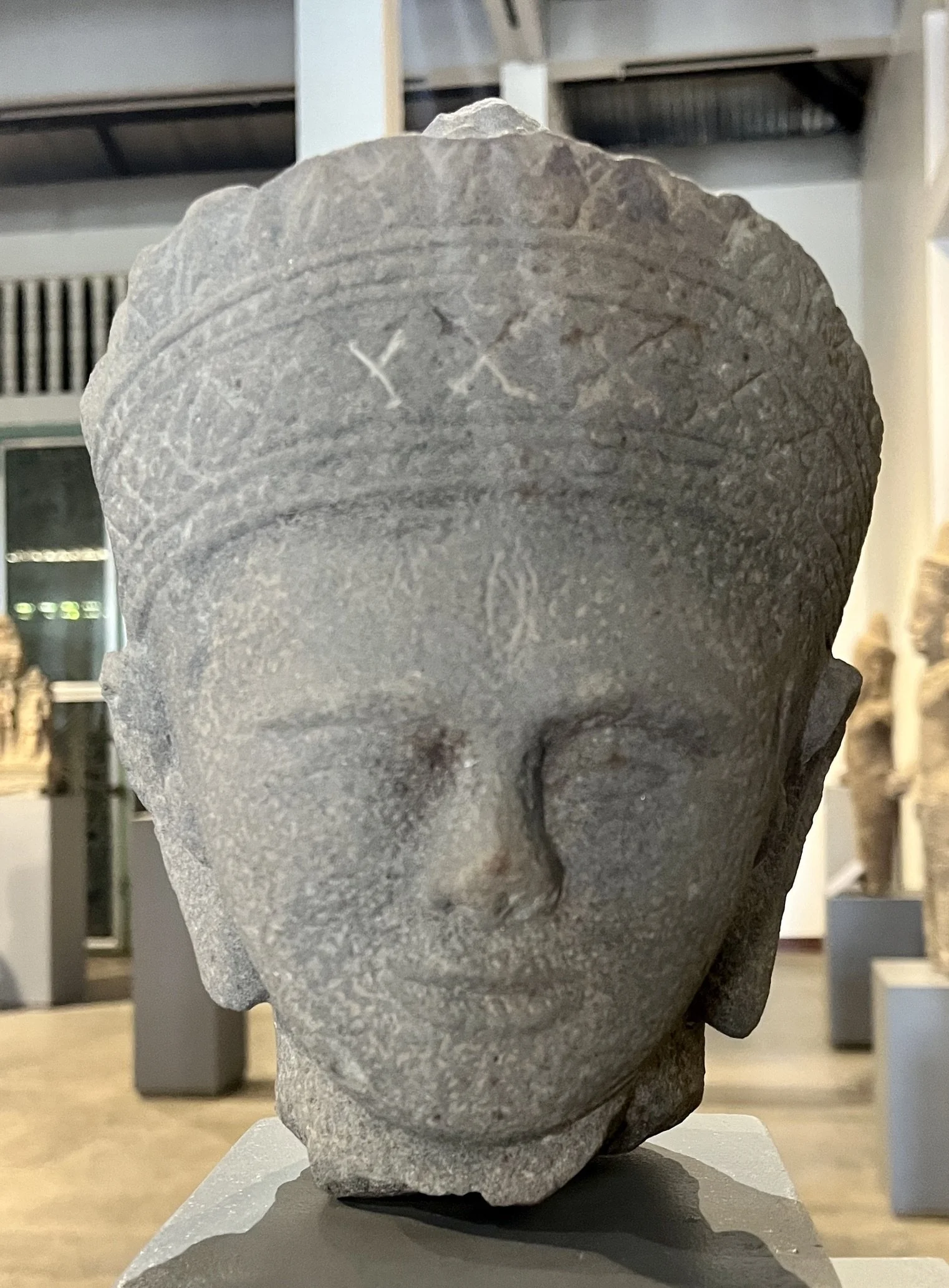
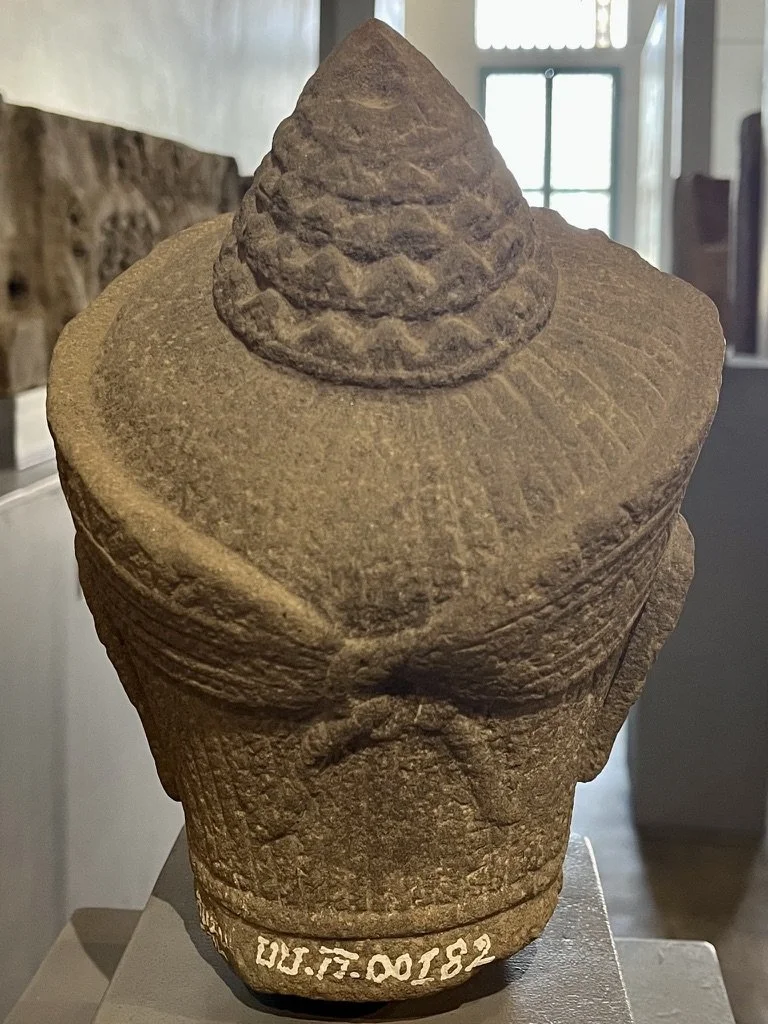
Shiva's head
Sandstone
Angkorian period,
Khleang style,
late 10th - early 11th c.,
Unknown
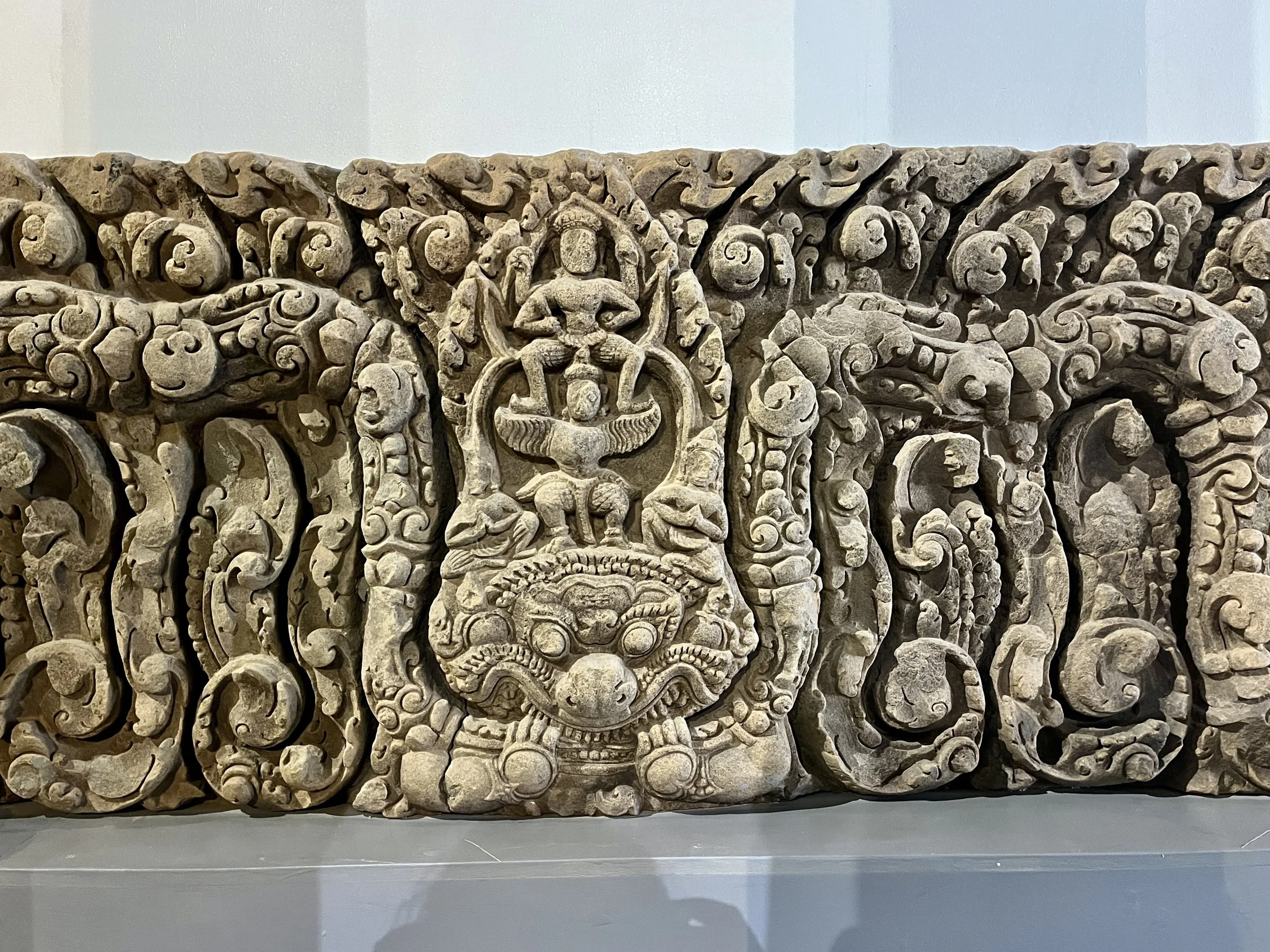
Lintel
Sandstone, Angkorian period,
Khleang style(?) Middle. 10th - 11th c.,
Unknown
The early Khleang style was one of the most enduring in ancient Khmer history, lasting over the reigns of several kings. This style begins approximately from the end of Beanteay Srei style to late Khleang style (968-1080). Since it occupied such a long period of time, the style slightly changes from the earliest to latest examples, including its architecture like this lintel for instance. The lower part of the central section of this lintel depicts a large head of Kala, a monstrous head with a large upper jaw lined by large carnivorous teeth, with a smaller lower jaw. Both of his hands are holding an undulating garland, both swallowed and regurgitated from his mouth. This depiction of Kala's head characterizes a specific Khleang style wherein the undulating garland comes from the bottom part, from Kala's mouth, and forms a capsized U shape which is distorted at center. This distortion divides the lintel into four portions. At both ends of this undulating garland are two standing personages, one each in a decorative niche. Above the Kala head, a four armed Vishnu stands on Garuda, his mythical bird mount, in an elaborate niche which takes up the upper half of the central space of the lintel.
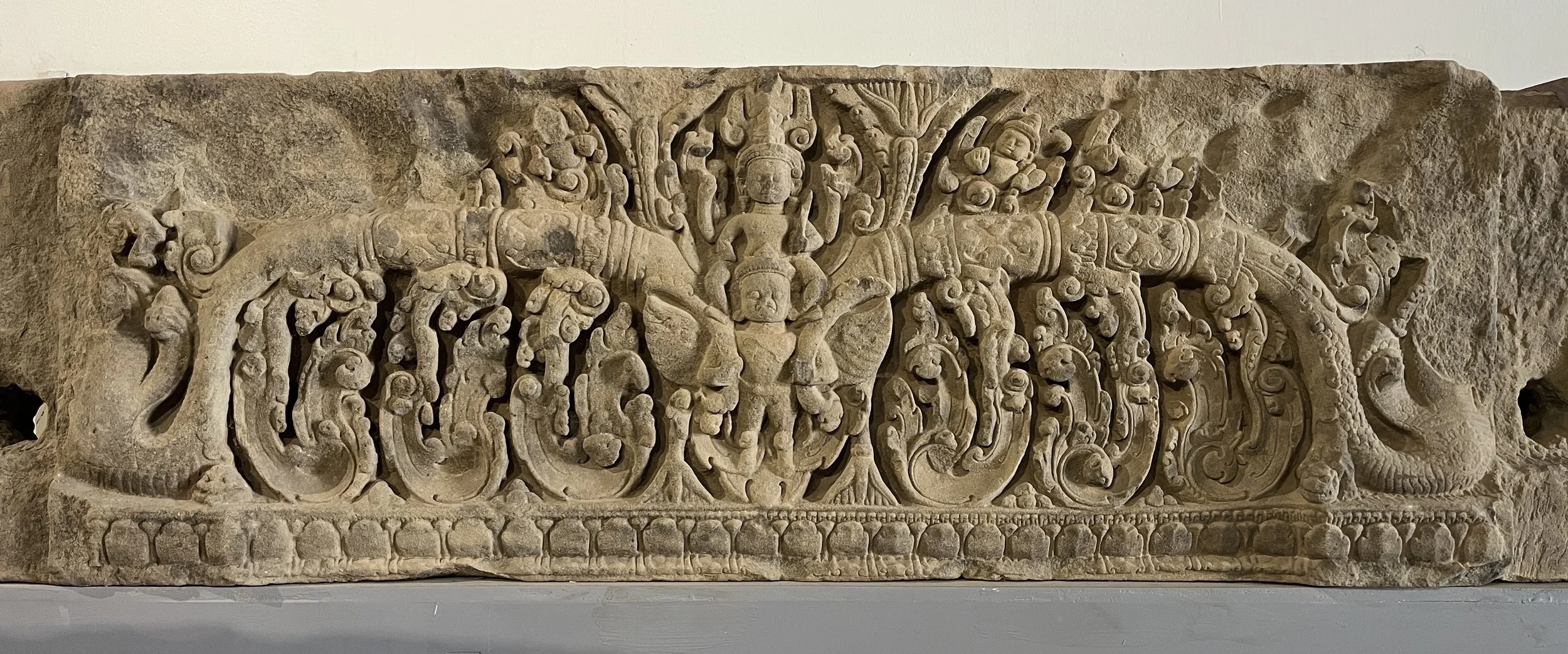
Lintel
Sandstone, Angkorian period, Preah Ko style (?)
9th C., Unknown
The central part of this lintel depicts a four armed Vishnu riding on his mythological birdmount, Garuda. Each of his four hands is holding different attributes such as conch, mace, disk and globe. Garuda is in flight, his wings outspread and his hands are holding a horizontal undulating garland with each end forming a three headed Naga.
The upper register of the garland is occupied by three floral motifs, each consisting of a divine being in a dancing posture. Below this garland has a large flower in pendant motif where the lowest part is decorated by a line of lotus buds.
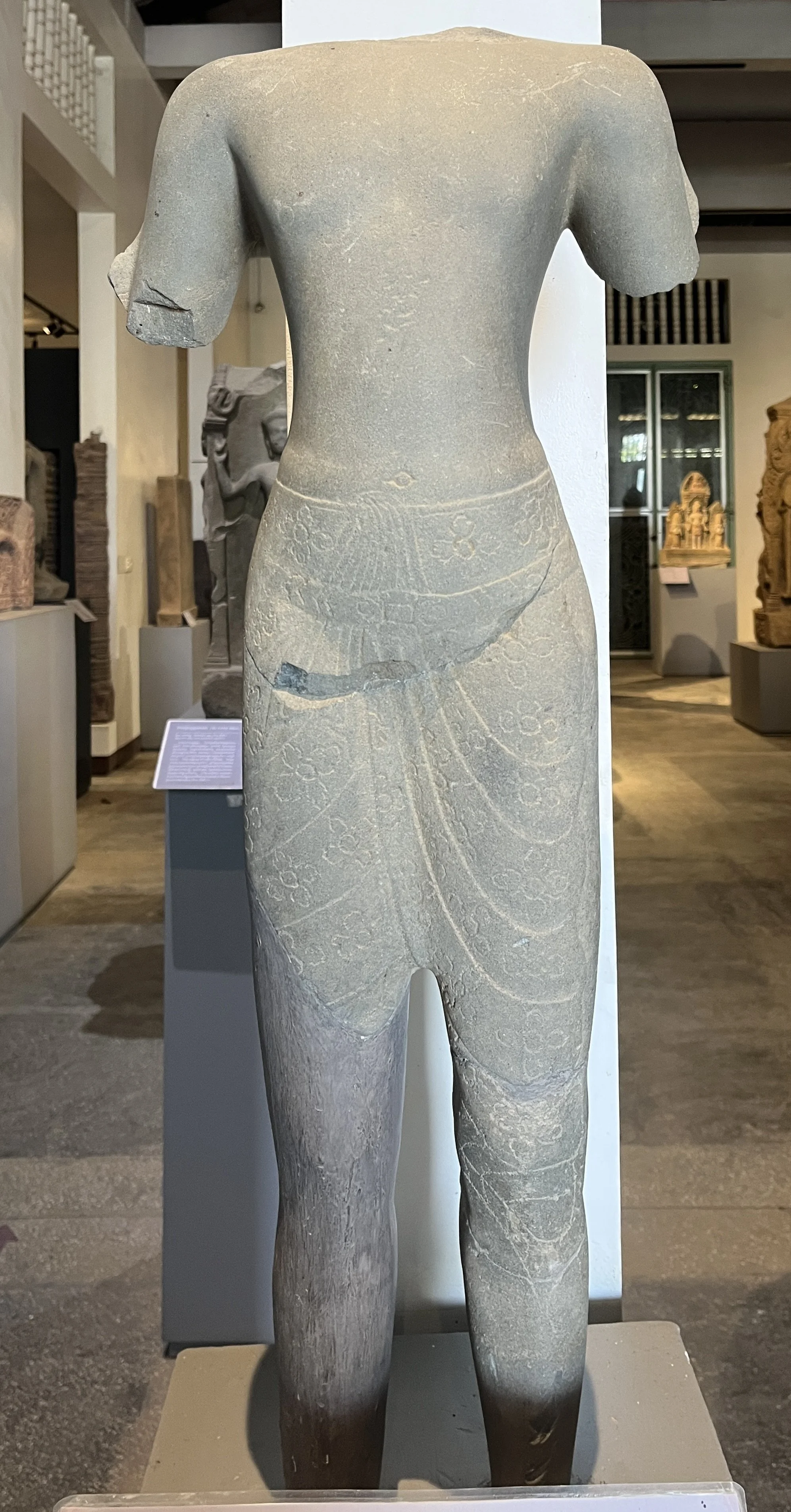
Torso of Vishnu
Sandstone, Pre-Angkorian, Prie Kmeng style, 7th - 8th C.
Baset Temple
The figure was found by a restoration team from the department of preservation and restoration of historical monuments, Ministry of Culture and Fine Arts, during the restoration of a principal tower of the Baset temple in 2017.
Torso was found together with a fragment of a face, and they correspondent to each other according to scientific analysis.
The sculpture has four arms and is probably the God Vishnu. All arms are lost at upper part, the right leg is broken at the thigh and the left leg is broken into pieces above the foot. According to the face, chignon and dress, the figure probably dates to the Prei Khmeng style, 7th-8th c.
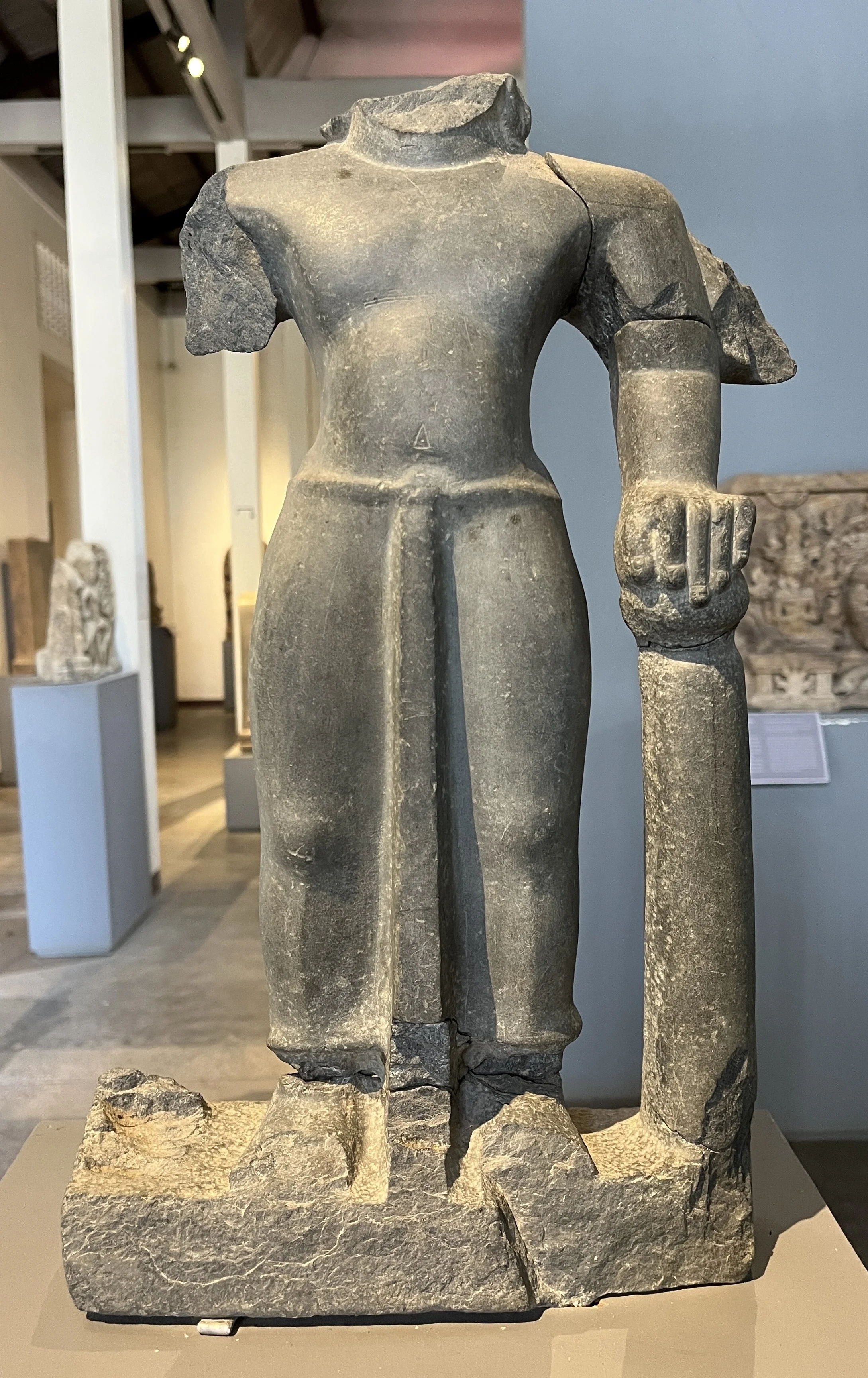
Torso of Vishnu
Sandstone, Pre-Angkorian, Phnom Da style, 6th - 7th C.
Kouk Wat Chas, Samrong village, Ta Moeun Commune, Thmar Kol, Battambang
Phnom Da style, the oldest style of stone sculpture in Cambodia. Although this figure is broken into many pieces, the remaining left arm proves that the figure had four arms (Chaturbhuja). If all the arms exist, each one supposed to carry a globe, a disk, a conch, and a mace as distinguishing attributes. The figure has a slender shape and is wearing a thin, smooth long sampot which shows details of his legs. Triangle mark is visible on his navel.
The figure is supported by the maces of original stone block to support his upper arms, so does his body which lower edge of his skirt connects to its base.
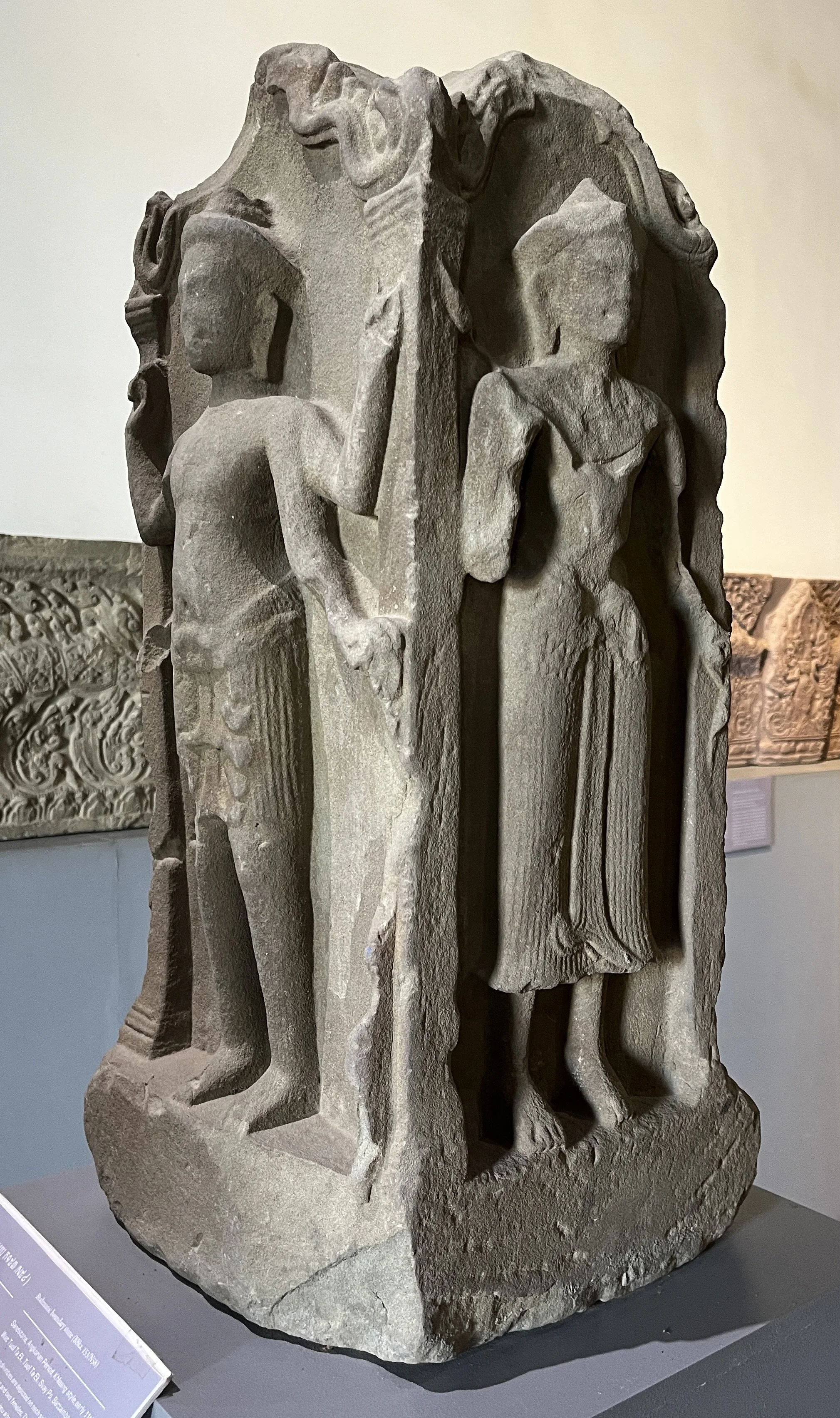
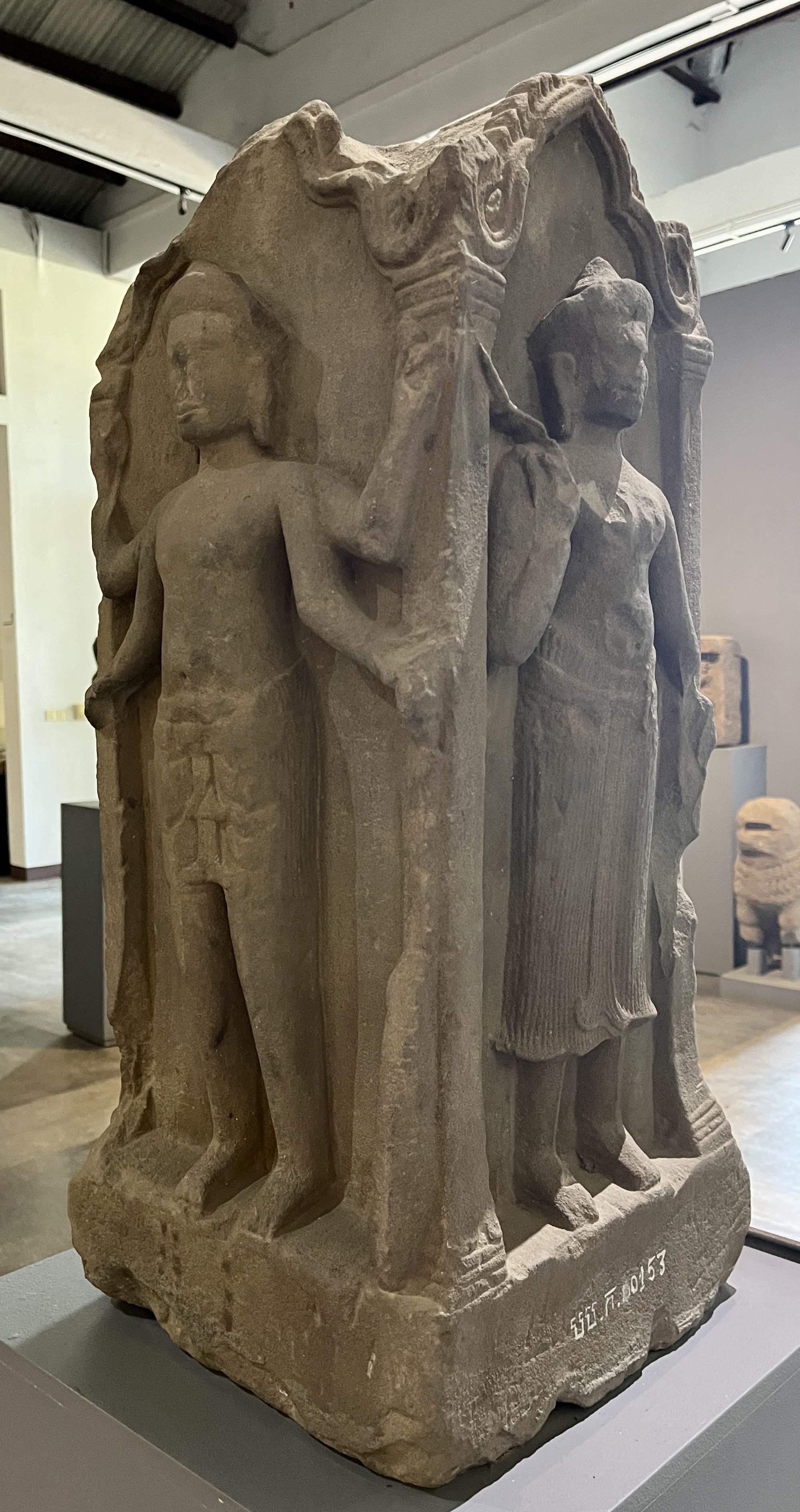
Brahmanic boundary stone
Sandstone, Angkorian Period, Khleang style, early 11th C.
Wat Tuol Ta Ek, Tuội Ta Ek, Svay Po, Battambang
Four main divinities are depicted on each side of the boundary stone, two males and two females. The first one is a four armed male deity, probably Vishnu, with upper left hand holding a conch, lower one holding a mace, right one probably holding a disk while the lower one is lost. On another side is a female figure, holding a lotus in her right hand while her left hand rests along her body but also holds a lotus. The other female figure is similar. It is believed that the female figures are Lakshmi. The last side is a male deity which is the mirror opposite of the male figure on the front, believed to be Vishnu. Based on the decoration on their bodies and dressing style, this boundary is probably dated to 11th C., in the Khleang style.
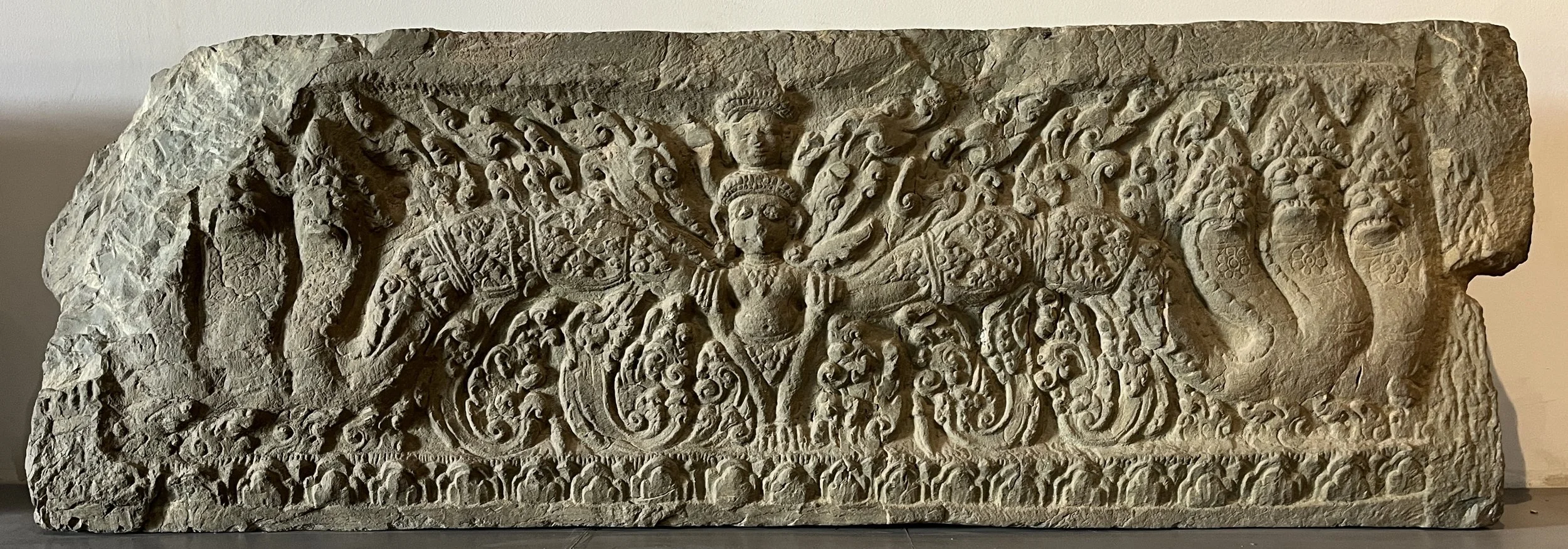
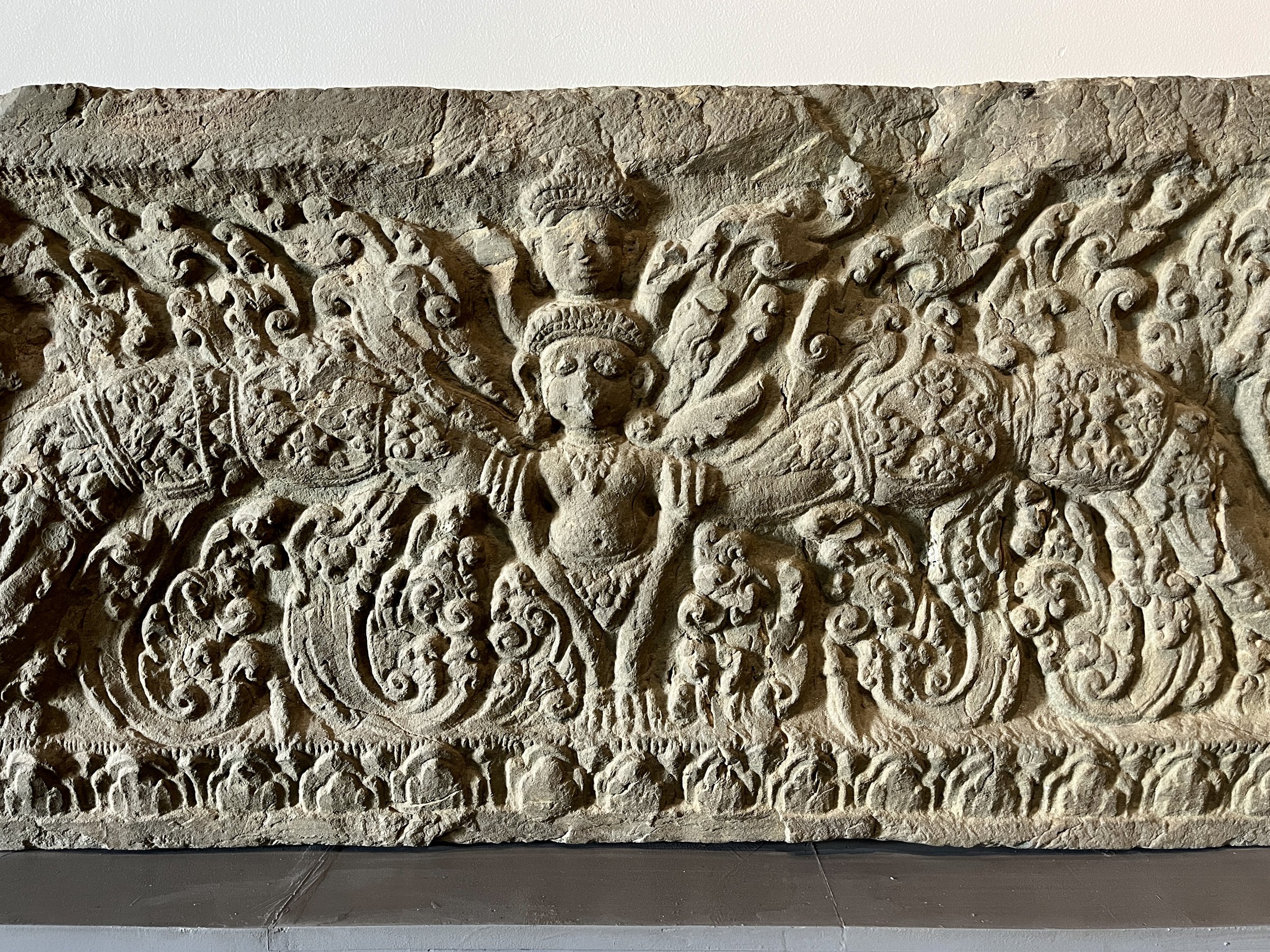
Lintel
Sandstone, Angkorian period, Preah Ko style (?). 9th c., Unknown
Similar to other lintels in this section, Vishnu and his Garuda mount occupy the central part of the lintel. Both of Garuda's hands are holding undulating garlands with each end forming a three headed Naga. Below that are floral pendant motifs followed by a row of lotus at the lowest part. In general, this lintel was carved very shallow, and this suggests the work is probably done by a local workshop.
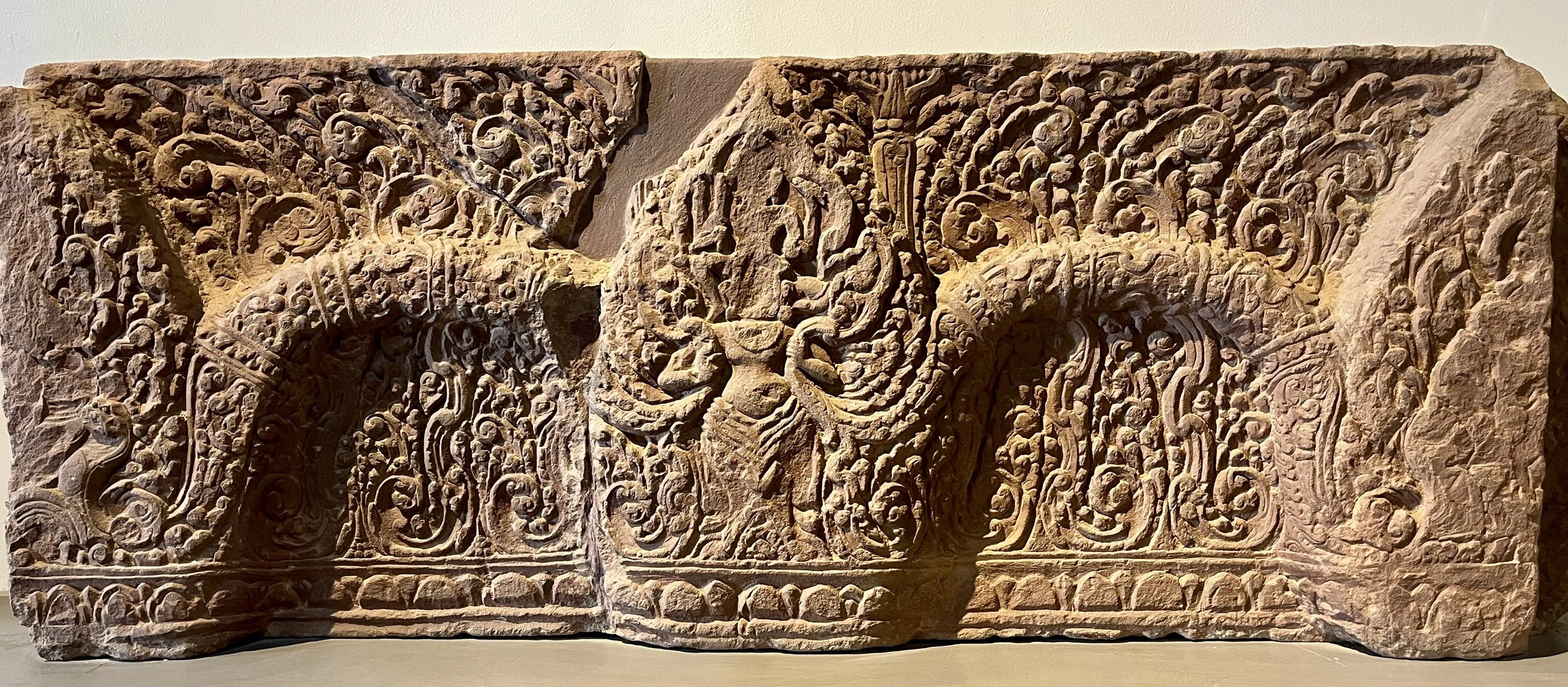
Lintel
Sandstone, Angkorian period, Bakheng style, 10th C.
Phum Banteah Boh, Khum Tean Kam, Srok Preahneth Preah, Banteay Meanchey.
This piece belongs to the Bakheng style, depicting Vishnu seated on garuda, his vehicle, in the center, flanked by two branches and foliage in arch form finishing in Naga headed shapes. Above and below the branches are floral shape motifs. There is no frieze at the upper part; but the lower edge of the lintel depicts a row of lotus petal. The motif carved on this lintel is quite shallow, perhaps, the works is not completed yet.
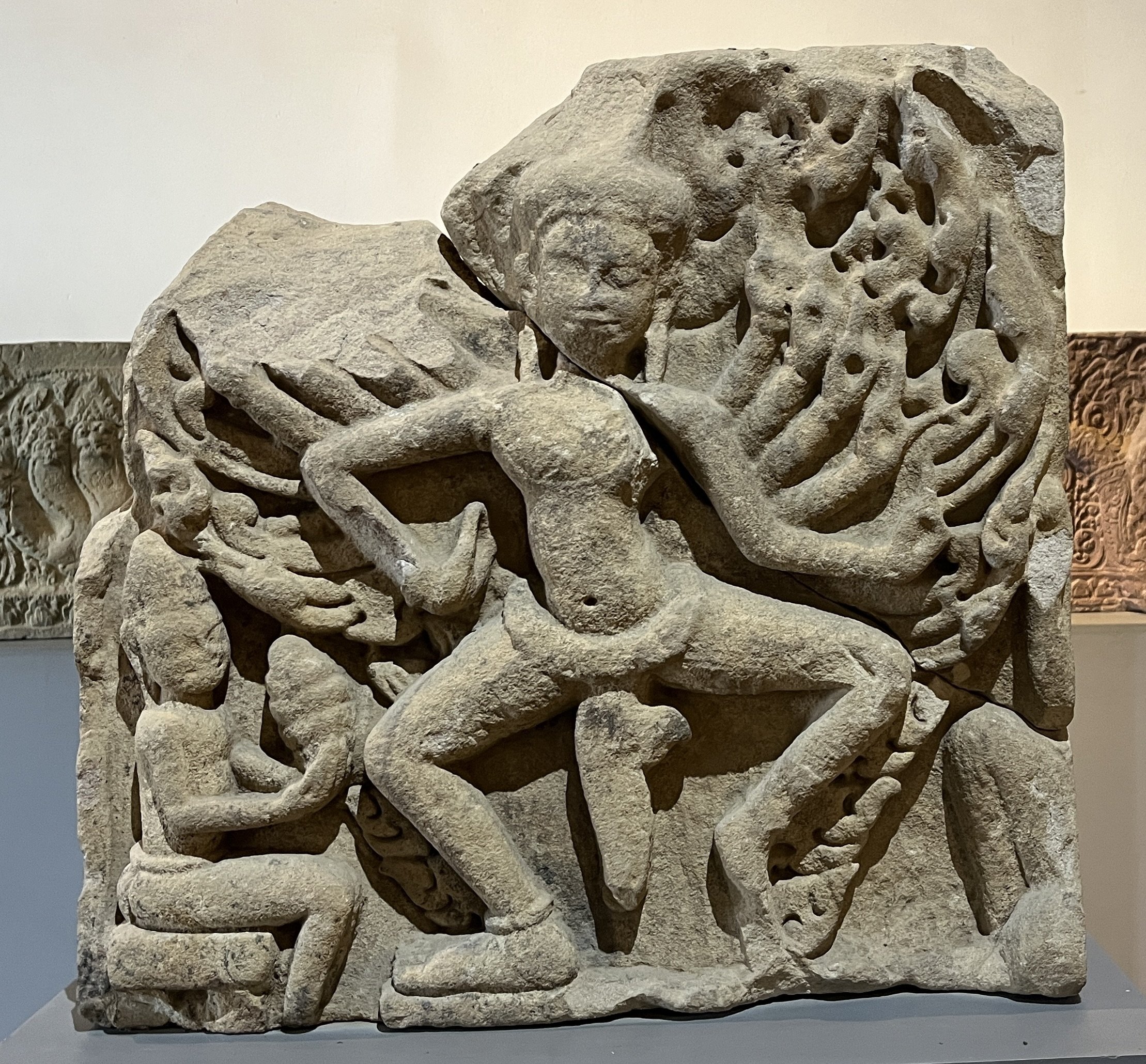
Shiva
This section displays different forms of the god Shiva. He is one of the main gods in Hinduism, the god of destructor and creator of the world. Some-times, he is shown with two other gods, Vishnu and Brahma. Sometimes with his spouse; Uma, Paravati or Durga, with his sons, Ganesh or Skanda, otherwise, he is shown alone by himself.
Shiva manifests in many forms. in early Khmer arts, he was usually represented in a form of Linga, phallic symbol of fertility. In the phallus form, it is usually carved in three sections representing trimurti. The square shape at bottom alludes to Brahma the Creator, the octagonal form at central to Vishnu the preserver and the cylindrical portion at top to Siva, symbolized infinity cosmic. Sometimes, this Linga has face at this cylindrical section which is called Mukha Linga in Sanskrit.
In anthropomorphic forms, Shiva could have two or more arms and many heads too. He is identified by his special characteristics such as a moon crest on chignon, a third eye at center of forehead. Sometimes, he is known by his attributes; trident, rosary, drum, a water flask, cord or cobra. In addition, he is also recognized by his vehicle bull nandin, or by his posture, for instance, when he is dancing, when riding a bull with his spouse or when Uma sits on his leg when ravana shakes mount Kailasha.
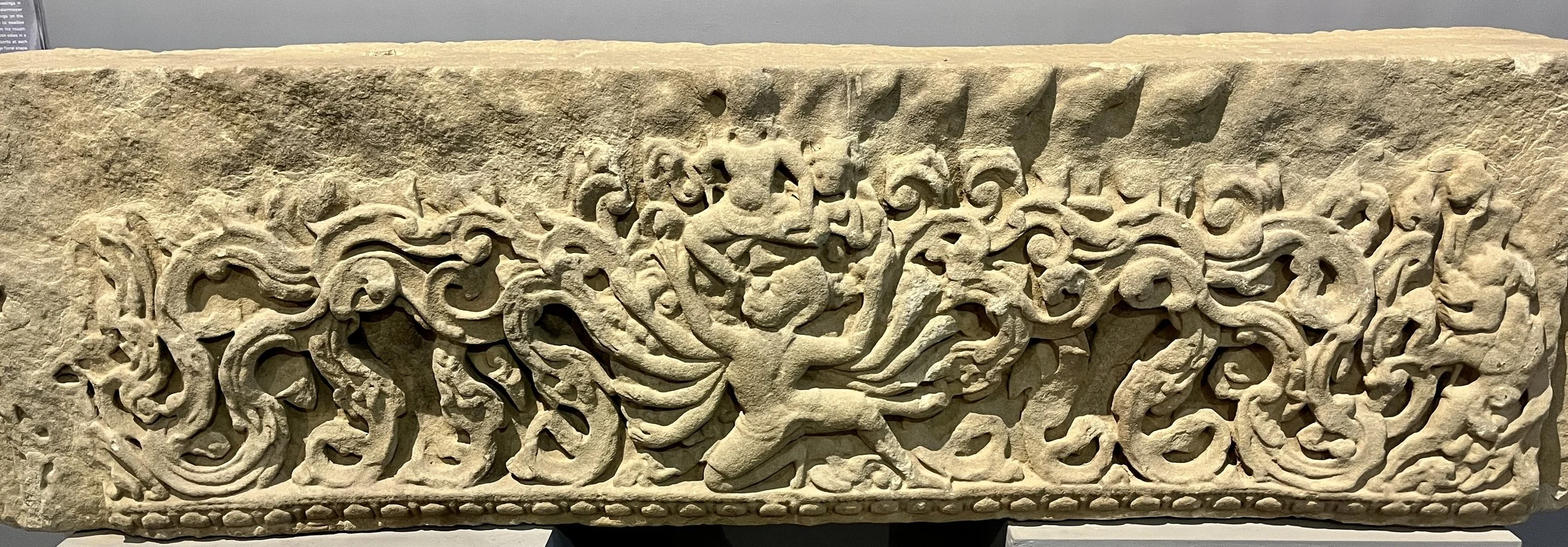
Lintel
Sandstone, Angkorian period, Koh Ke Style
10th c., Unknown
This lintel depicts a famous Indian myth, an episode of Ravana shaking Mount Kailasha, a residence where Shiva and his consort Parvati reside. According to the myth, Ravana once tried to lift Mount Kailasha, but Shiva pushed the mountain into place and trapped Ravana beneath it. When the mountain was shaking, Parvati was frightened and clutched Shiva's knee. Ravana, however, wailed for mercy. Having humbled Ravana, Shiva released him. After this experience, Ravana became a great devotee of Shiva.
Instead of the typical branch, this lintel is fully covered with interlocking vines that descend into scrolls. On the left end of the branch is a lion which its face is turned inward toward the scene. A band of lotus petals is carved at the bottom of the lintel.
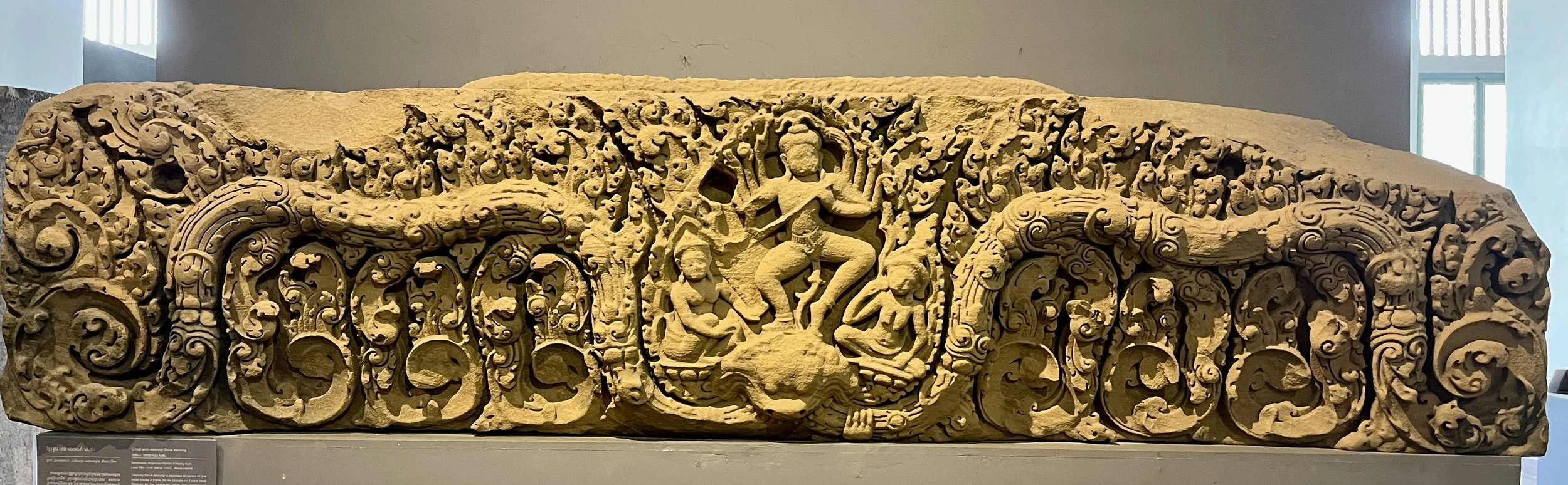
Lintel with dancing Shiva
Sandstone, Angkorian Period, Khleang style,
Late 10th - first half of 11th c., Baset temple
Dancing Shiva is depicted at the center of the lintel inside a niche. He dances on Kala's head flanked by his consorts, Uma, who sits in dancing posture on the right, and Karikalammayar who has swelling long breasts, sitting on the left. Kala's head below Shiva seems to swallow branches of undulating garlands in a "U" shape, finishing in large floral shapes.
The branches divide the lintel into four parts, above it are five large flowers and below are three floral motifs in hook shapes on each side. These floral motifs are carved very deeply into stone and look so vivid.
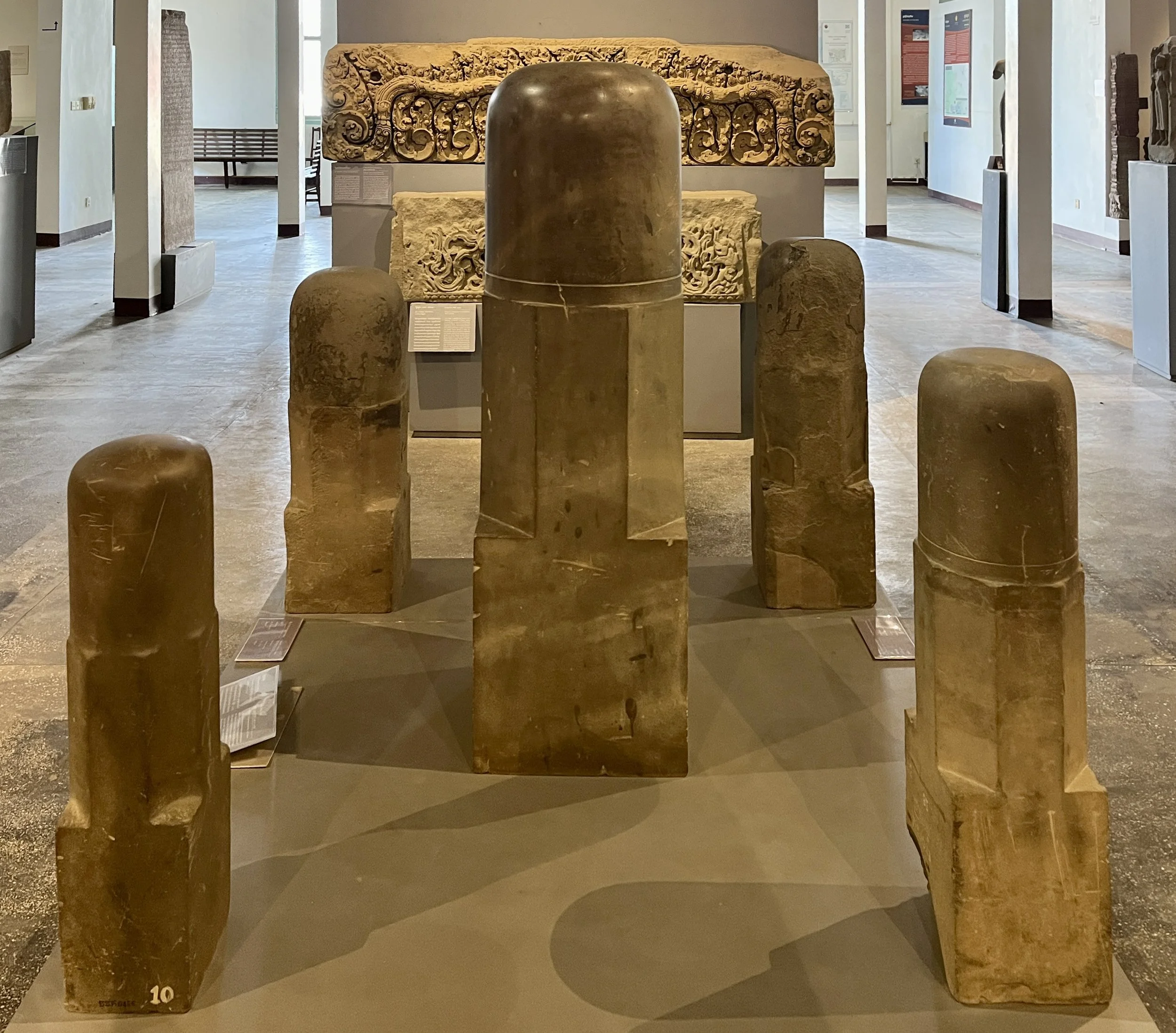
Linga
Sandstone, Pre-Angkorian period, Gth - 7th C, Basat
Linga is commonly known as an abstract repre-sentatian of Shiva, one of the thres main gods of the Hinduism. In ancient Cambodia, Shiva lingo had various shapes and was made from various materials such as metal, sandstone, and granice.
This particular linge represents not only the Shrva, but the union of the three main Hindu gods; the cubic base represents Brahma, che octagonal middle section reprosents Vishnu, and the hemisphere section at the top represents Shiva.
The largest one at center is originated from Baset cemple and four others are from different places in the province. Each one has a capsize "U sign on the face, and this place sometimes replaced by a face, mukhalinga,
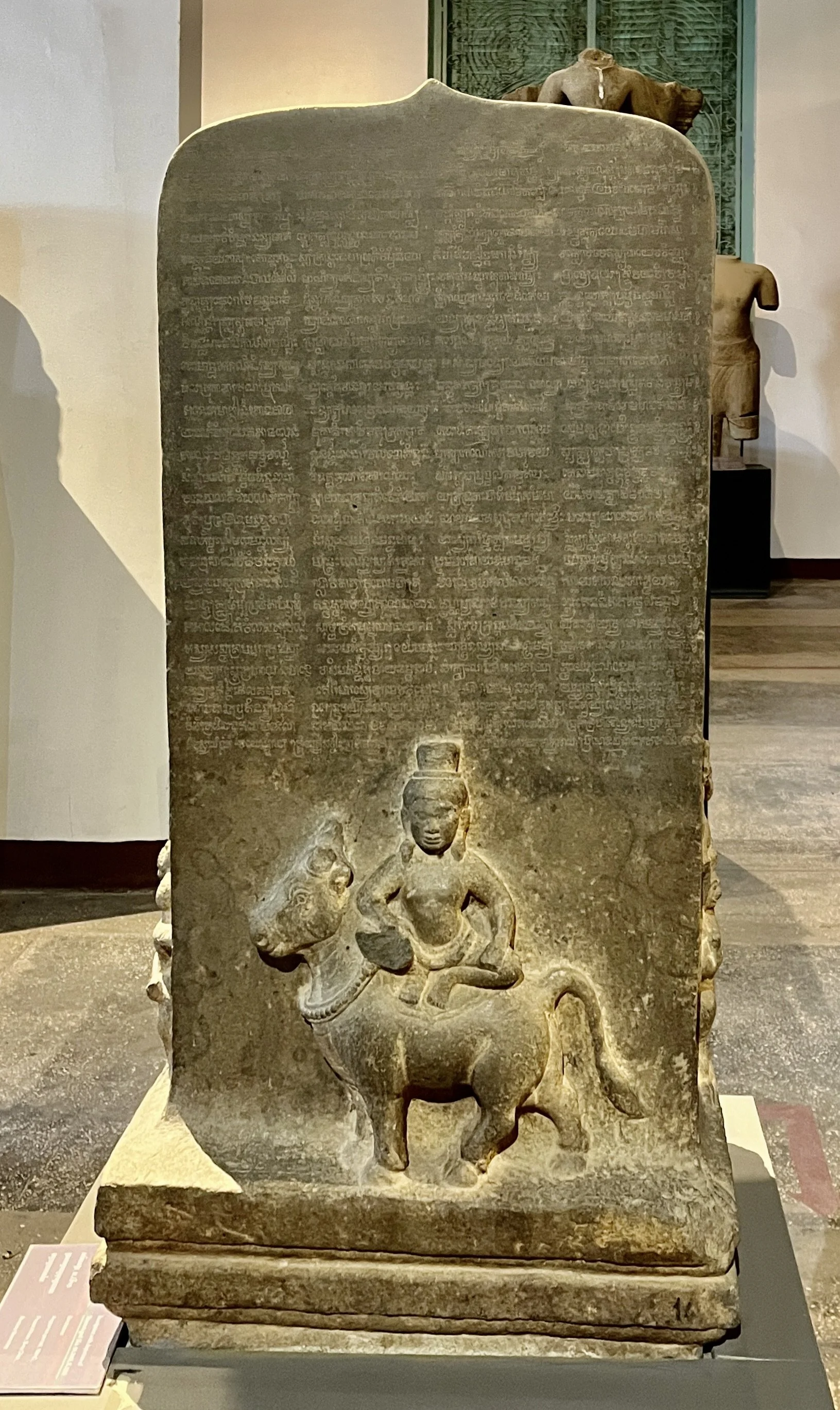
Inscription with depiction of Trimurti
Sandstone
Angkorian period, 10th c.,
Prasat Khvav, Svay Chek;
Banteay Meanchey
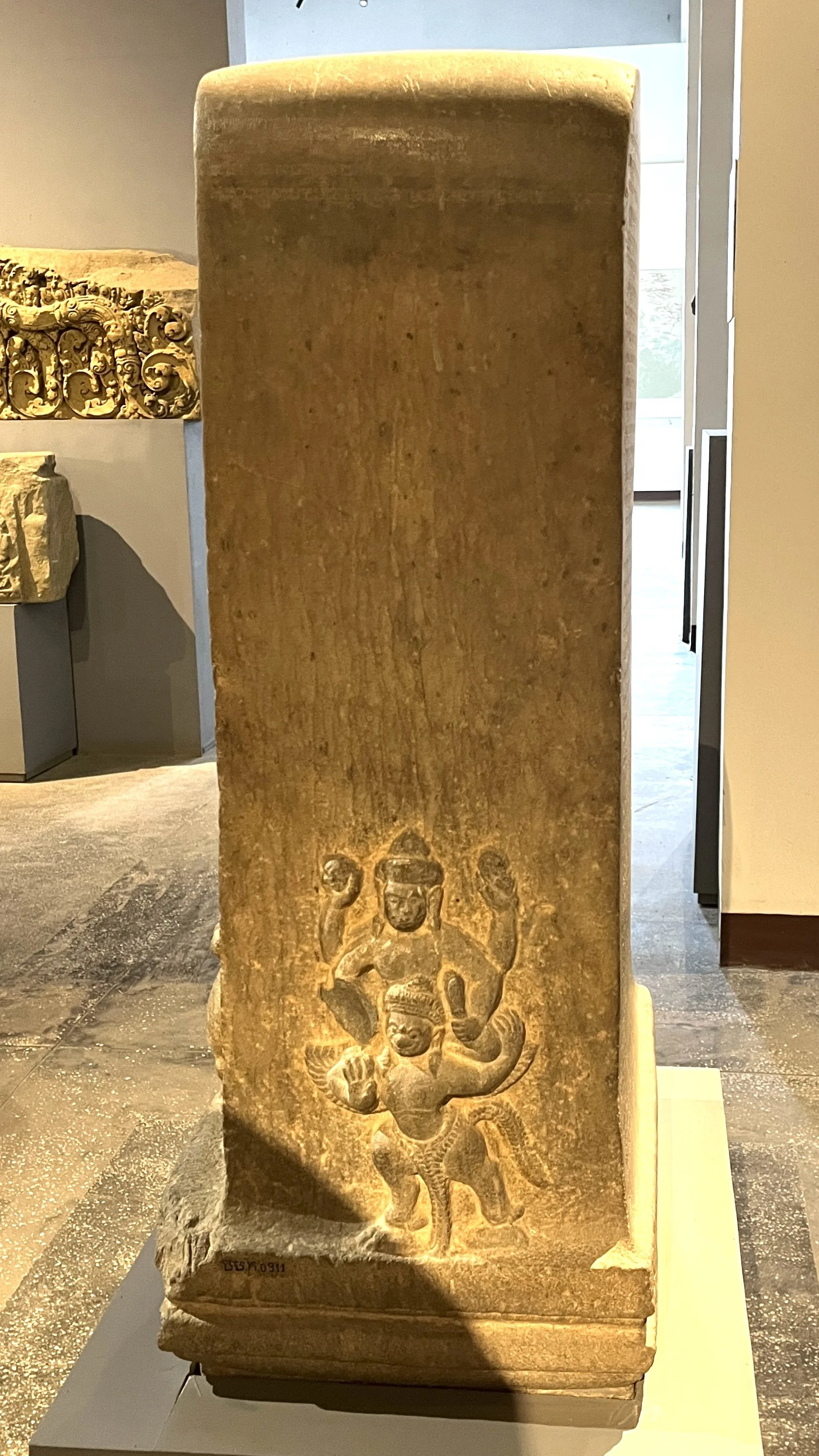
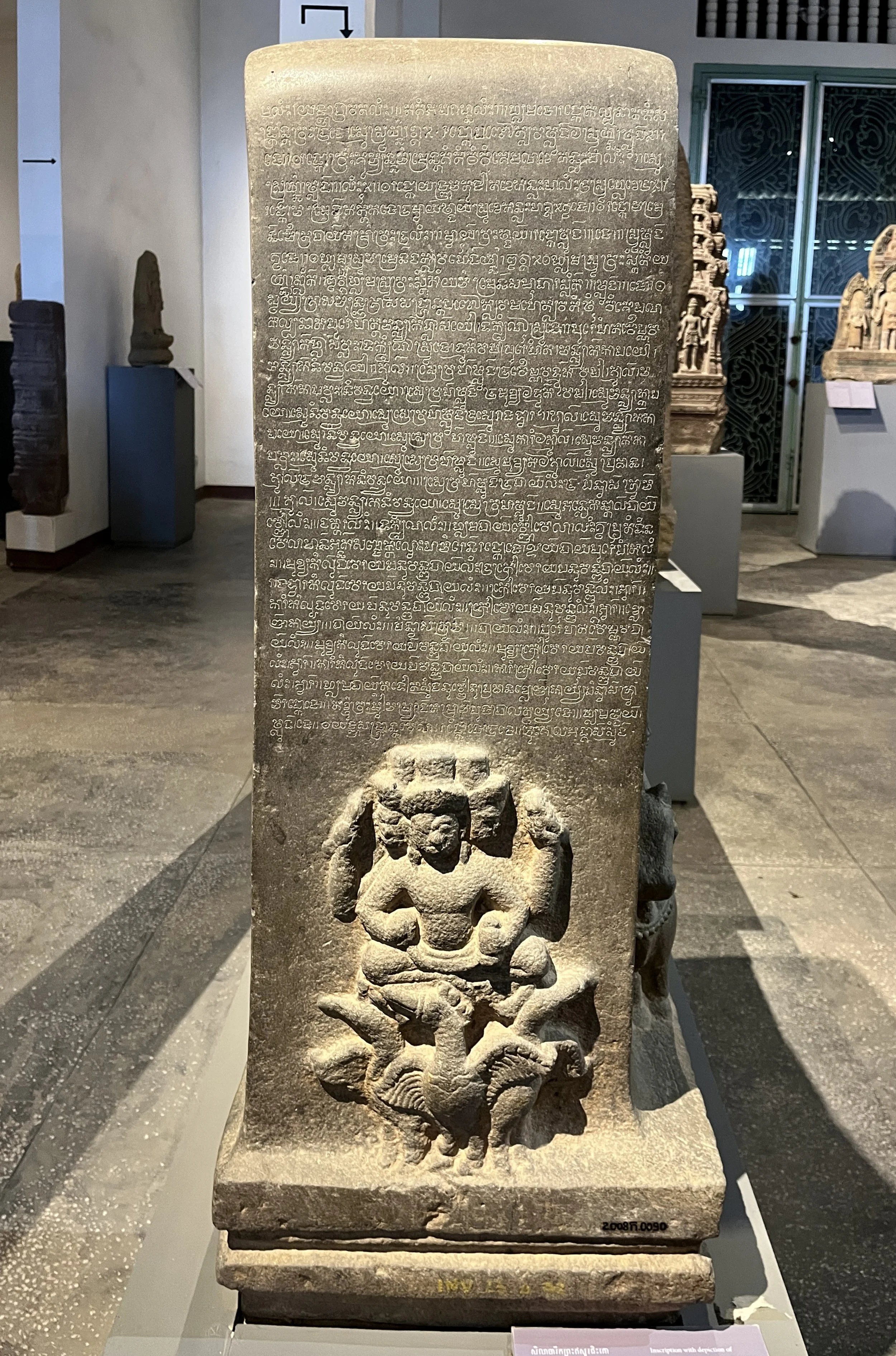
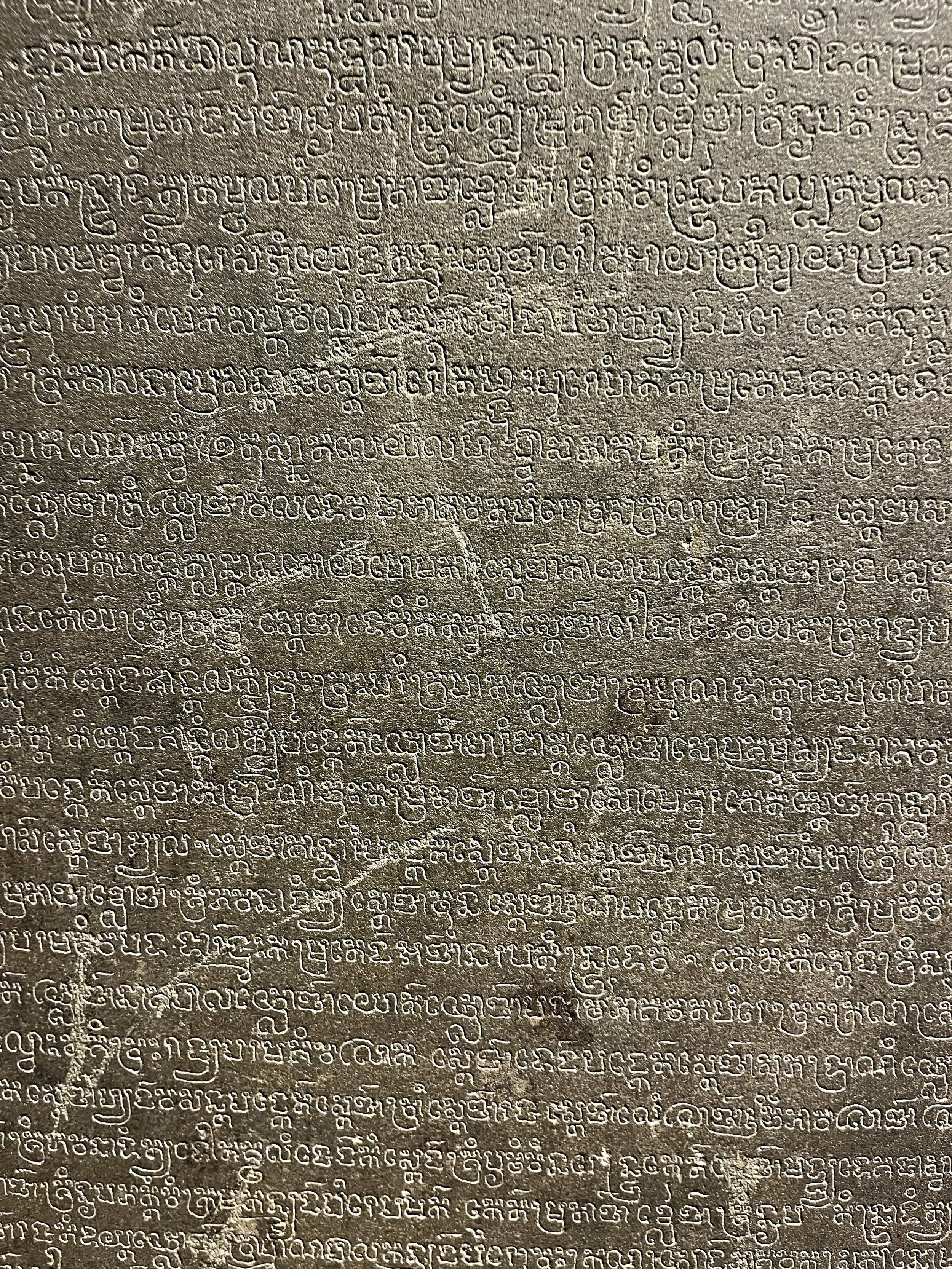
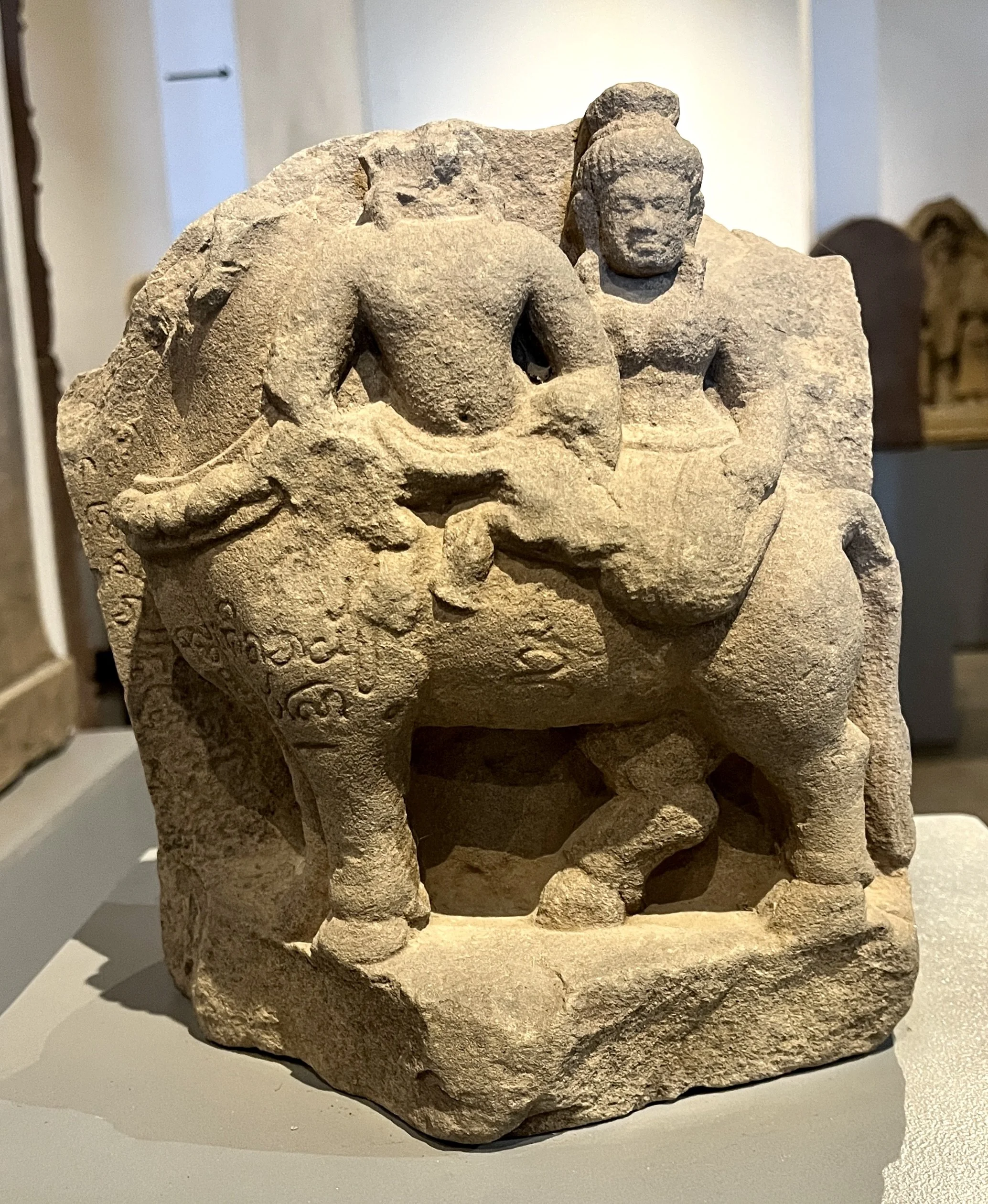
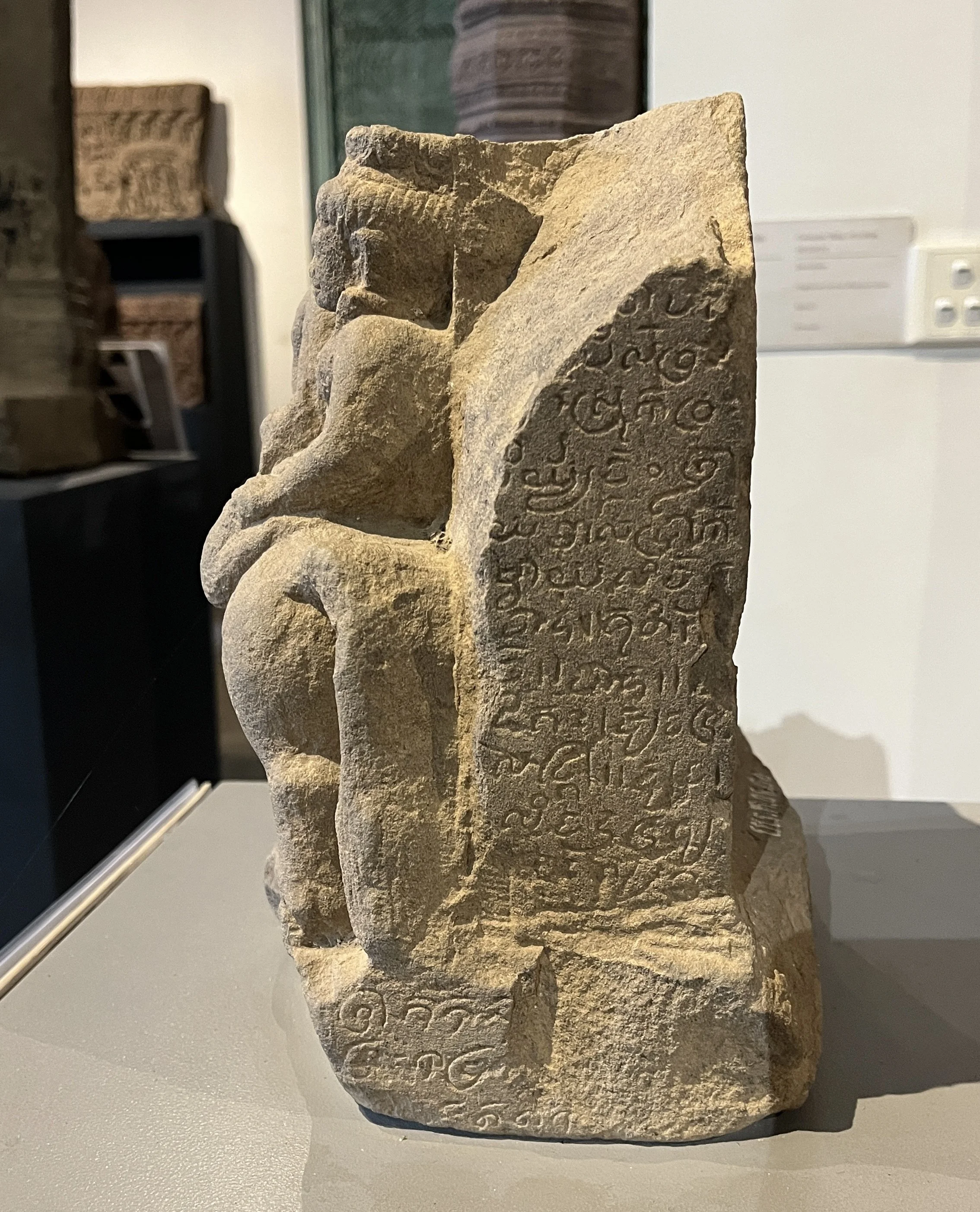
Inscription with Shiva and Uma riding bull
Sandstone, Angkorian period,
End of 10th-11th century (?)
Baset temple
An inscription is engraved on all sides of this stone featuring a depiction of Shiva and his spouse, Uma, riding a bull on one side. It is written in two languages, Sanskrit and old Khmer, an "Um" sign is visible on the bull's belly and on its neck is written a name of a priest called Shivacar who donated offerings to the god. On the left side, there is a list of daily donations given by the priest to the temple. On the right side, which is similar to the left one, is a list of daily utensils offered to the temple such as silver bowls, copper spittoons, etc. On the back side is writing in both languages, Sanskrit and old Khmer, but some is illegible. The text mentions a ceremony being conducted annually, and other offerings the priest had offered to the god at Lingapura.
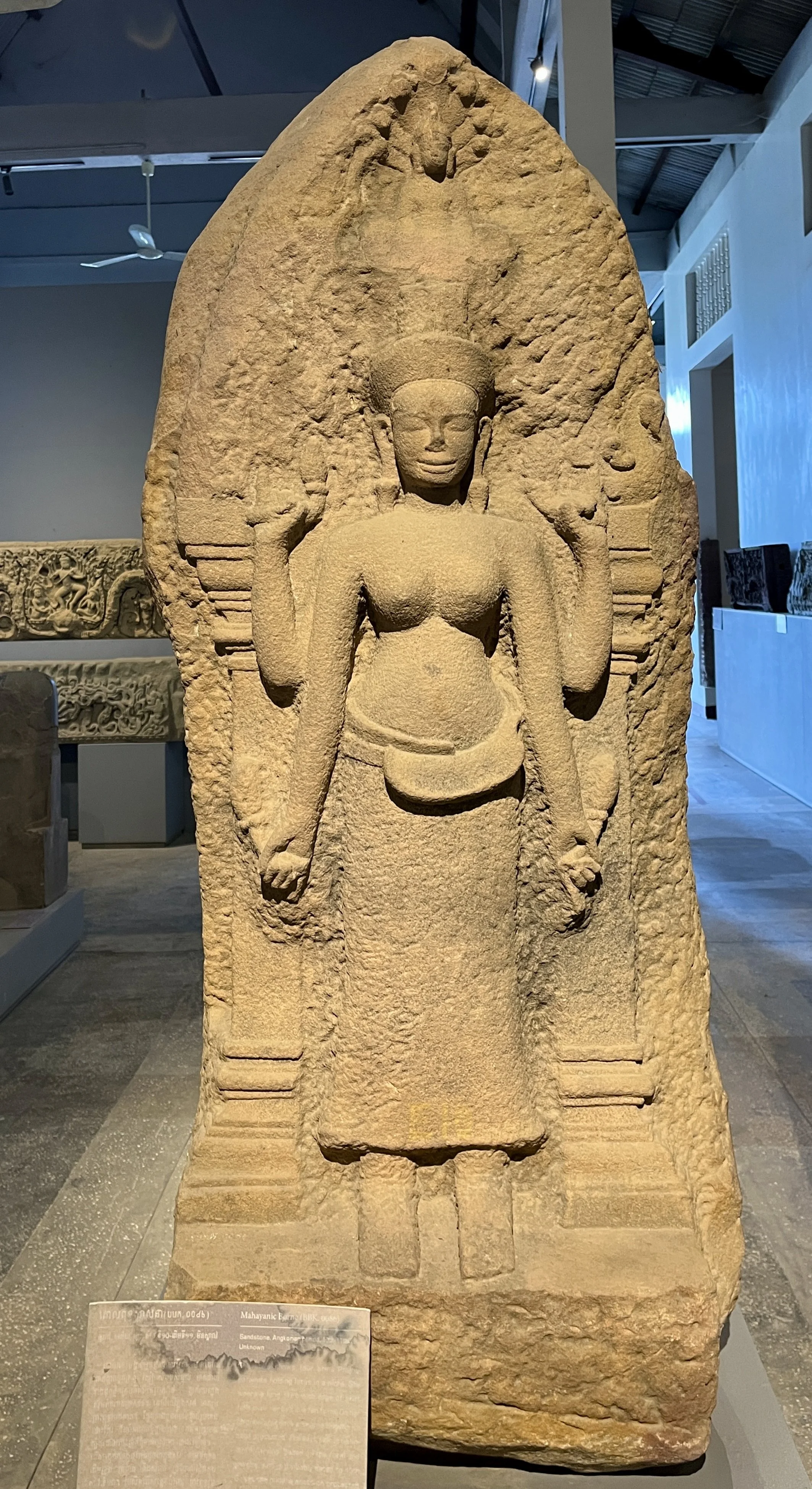
Mahayanic Borne
Sandstone, Angkorian period, 10th-11th c.
The stele shows a four armed Prainaparamita holding a lotus in a niche. She wears a lang skirt; the edge of the skirt falls over her belt in a tent form. On her chignon is a seated Buddha, protected by a naga. The backside is uninscribed carving. Based on her figure and jewelry, this probably dates to the 10th century, though perhaps later as the seated Buddha protected by Naga is typically 11th century.
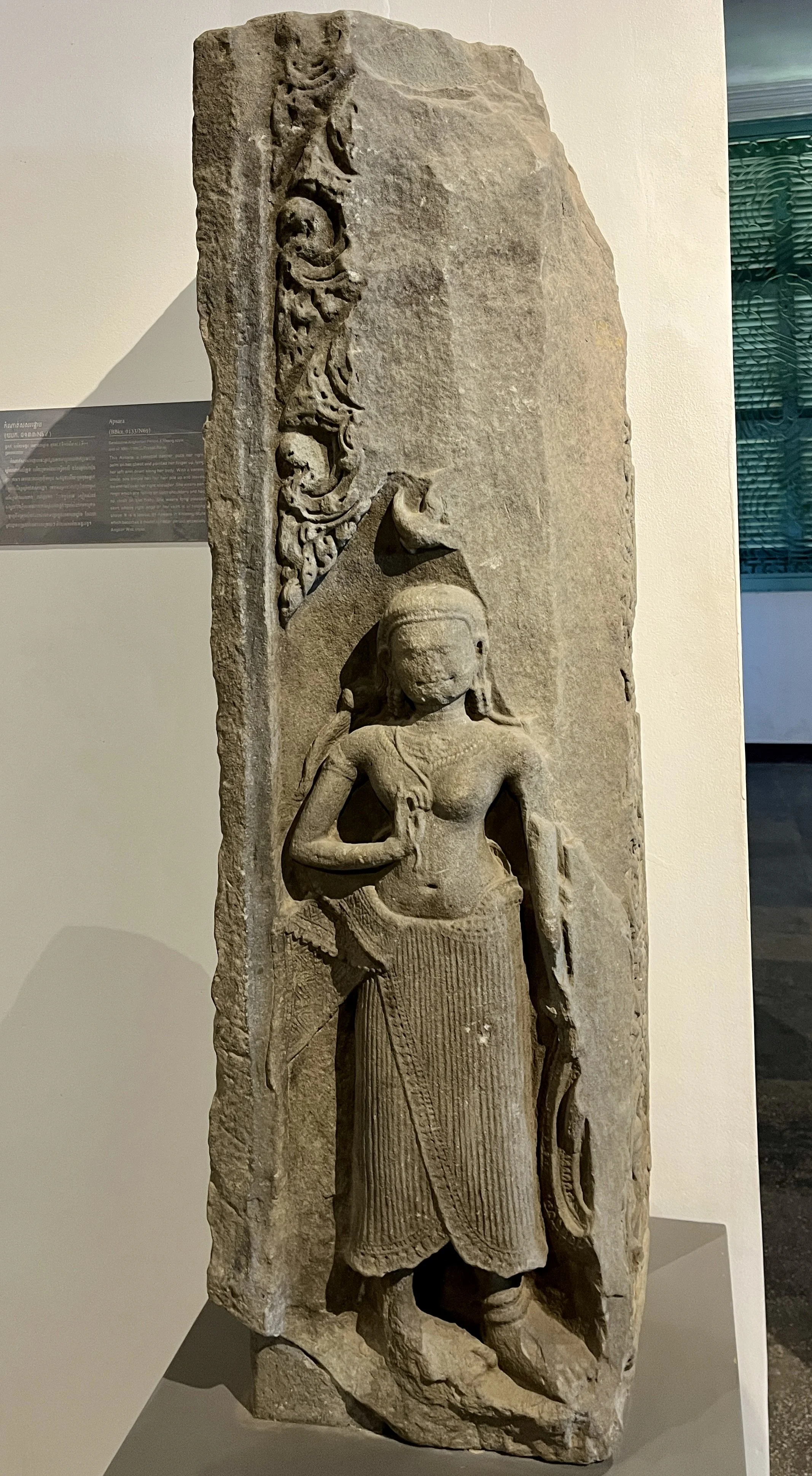
Apsara
Sandstone, Angkorian Period, Khleang style, end of 10th -11th c., Prasat Bavet.
This Apsara, a celestial dancer, puts her right palm on her chest and points her finger up, lying her left arm down along her body. With a serene smile, she simply has her hair piledd up and lets its ends fall over her right shoulder (editor’s note: what? are we even looking at the same statue? this is clearly an intricate and symmetrical hairstyle, perhaps even a wig. Whoever wrote these absolutely meaningless descriptions focusing on their own phenotypical preferences is really annoying me). She wears earrings which are falling on both shoulders and has no cloth on the upper body. She wears a long pleated skirt, folded at her right hip. It is a typical Apsara in the Khleang style, which becomes a model in later periods, especially Angkor Wat style.
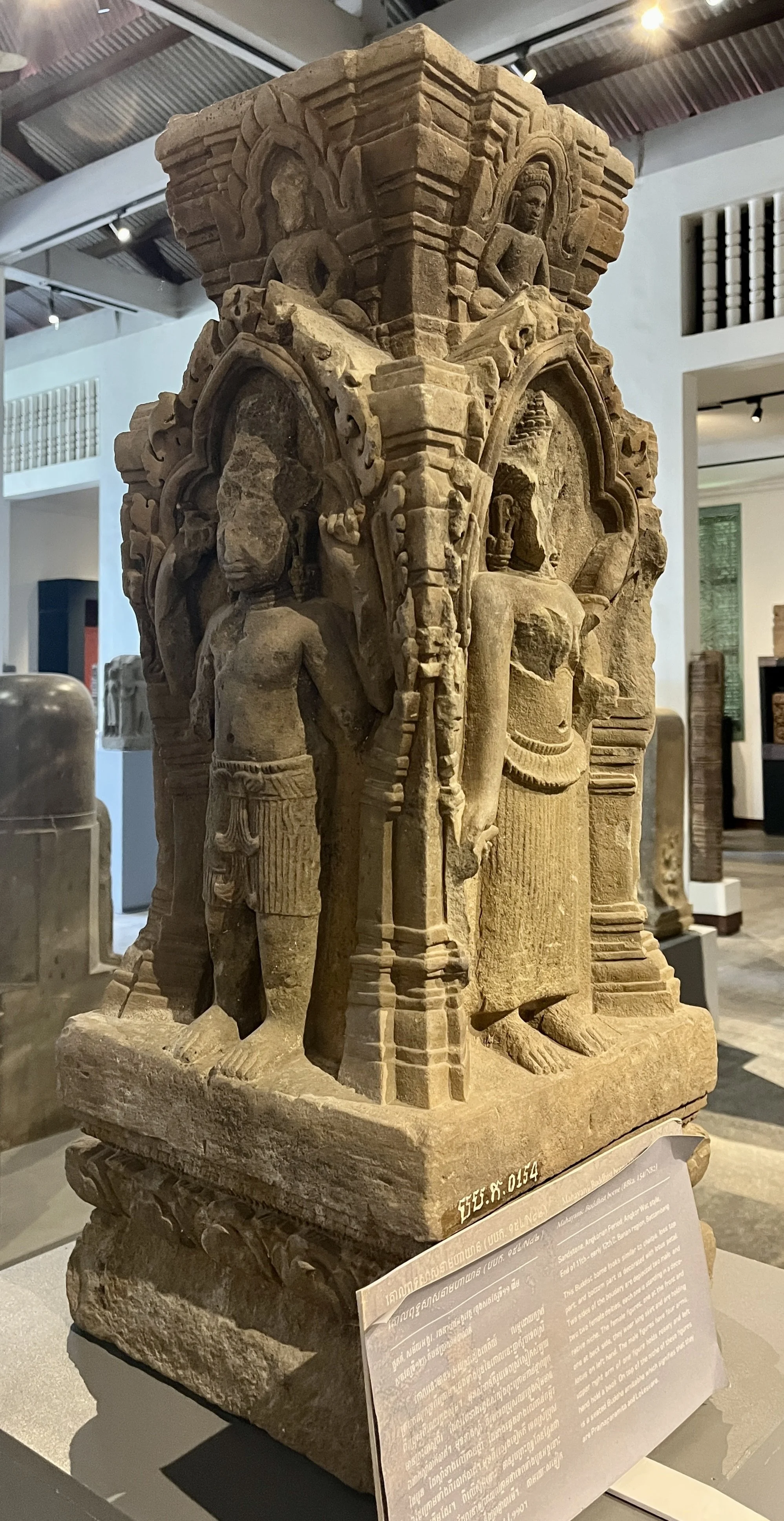
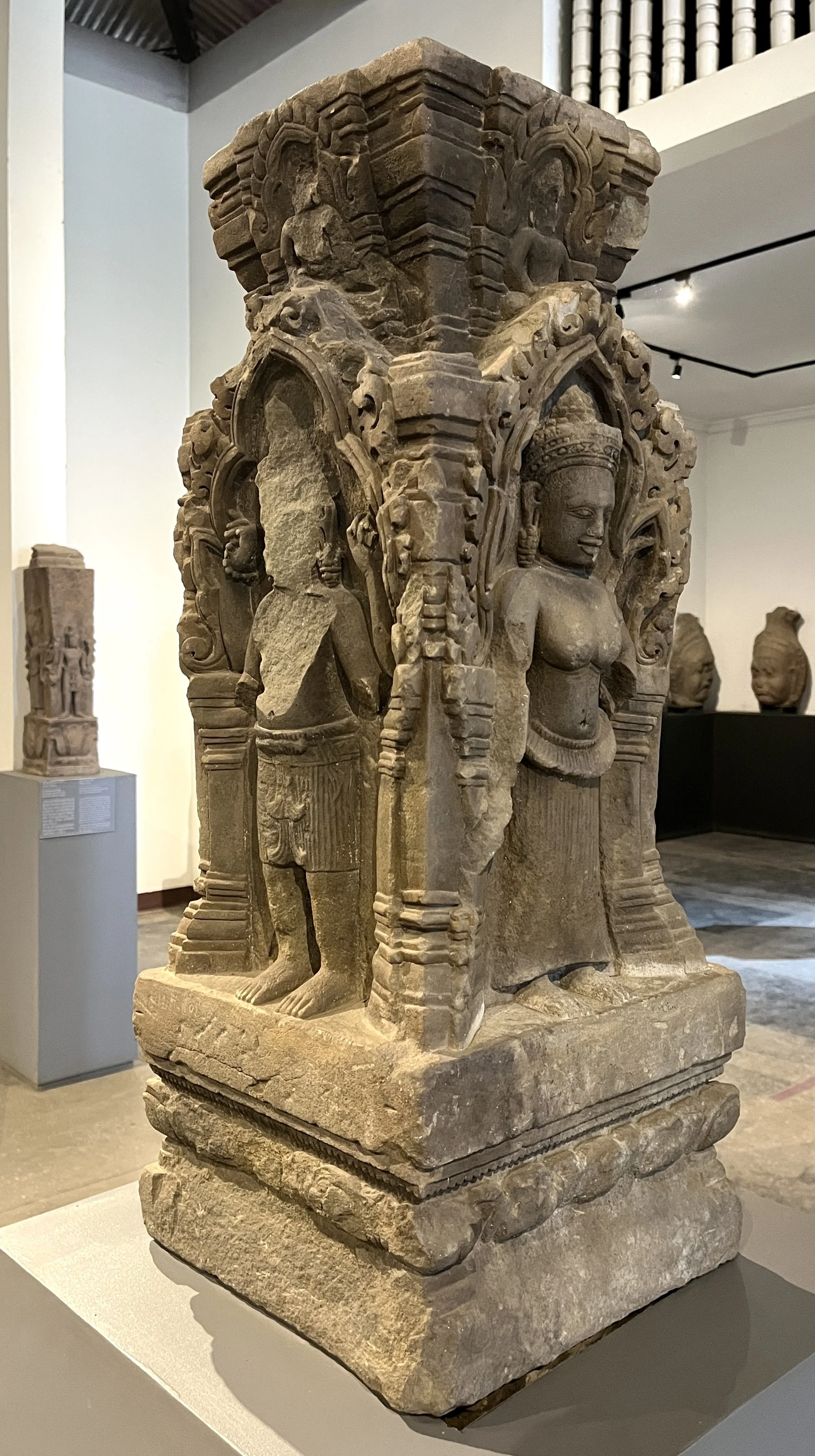
Mahayanic Buddhist borne
Sandstone, Angkorian Period, Angkor Wat style,
End of 11th - early 12th c. Banan region, Battambang
This Buddhist borne looks similar to chaitya, with losses on the faces, and the bottom part is decorated with lotus petals.
The sides of the boundary marker depict two male and two two female deities, each one standing in a decorative niche. The female figures, one at the front and one at back side, wear long skirts and are holding lotus flowers in their left hands. The male figures have four arms; the upper right arm of one figure holds a rosary and the left hand holds a book. On top of the niches is a seated Buddha Amitabha which signifies that they are Prajnaparamita and Lokesvara.
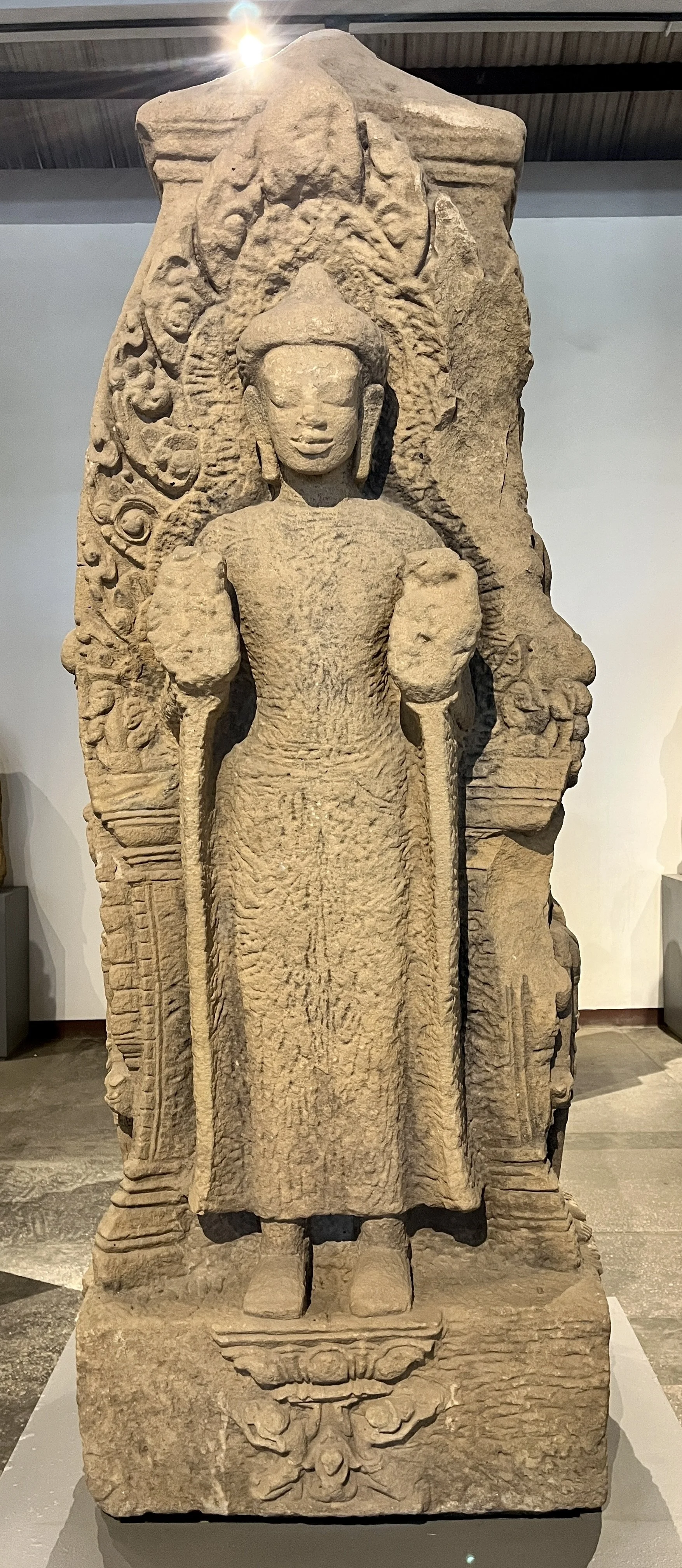
Mahayanic stele
Sandstone, Angkorian period,
Khleang style, Early 11th c.
Prasat Pongteouk, Banteay Chmar,
Thmar Puok district
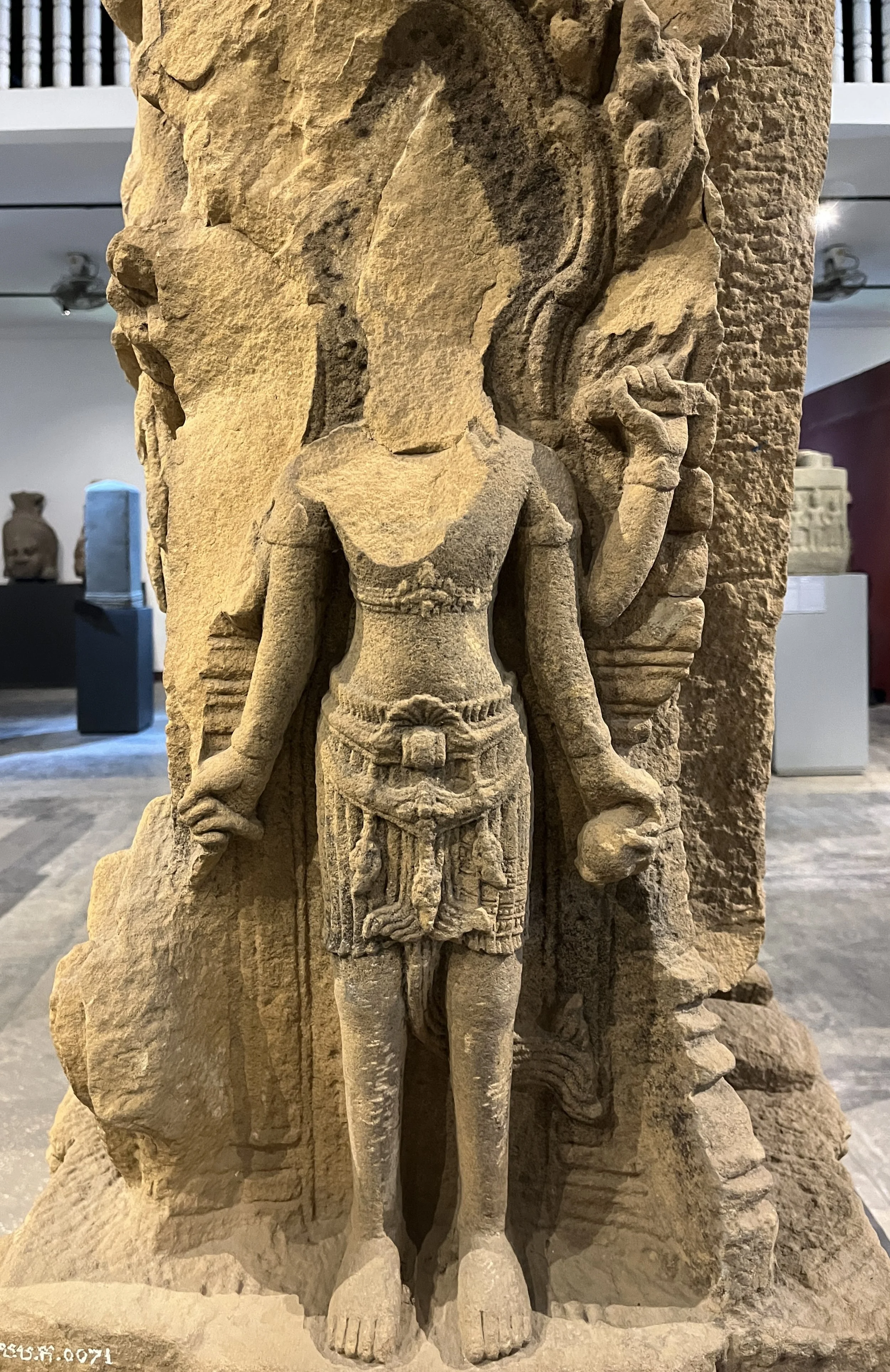
This stele was acquired by the museum on 13 April 1965. It has four faces and each side is carved with a different Buddhist deity. One is an eight armed standing female deity, probably Vajrapani, wearing a long skirt. Each of her hands is holding a different attribute; the original left hand is holding a Vajra bell.
This figure wears heavy jewelry such as necklace, armband, bracelet, torso band, waist band and lower waist band, with pendant motifs covering her thigh. The figure stands on a lotus pedestal, and in front of the pedestal are three lions flanked by two females holding hands. To the right, a four armed Lokesvara is standing in a niche on a lotus pedestal with two female dancing figures.
Above the niche of Lokesvara figure is a seated Buddha. Buddha amitabha normally appears in front of Lokesvrara's chignon. To the left of the female figure is one quite similar to the Lokesvara on the right, but at the front of the pedestal is Kala's head. The last is a Buddha figure standing on a lotus pedestal in abhayamudra inside a niche.
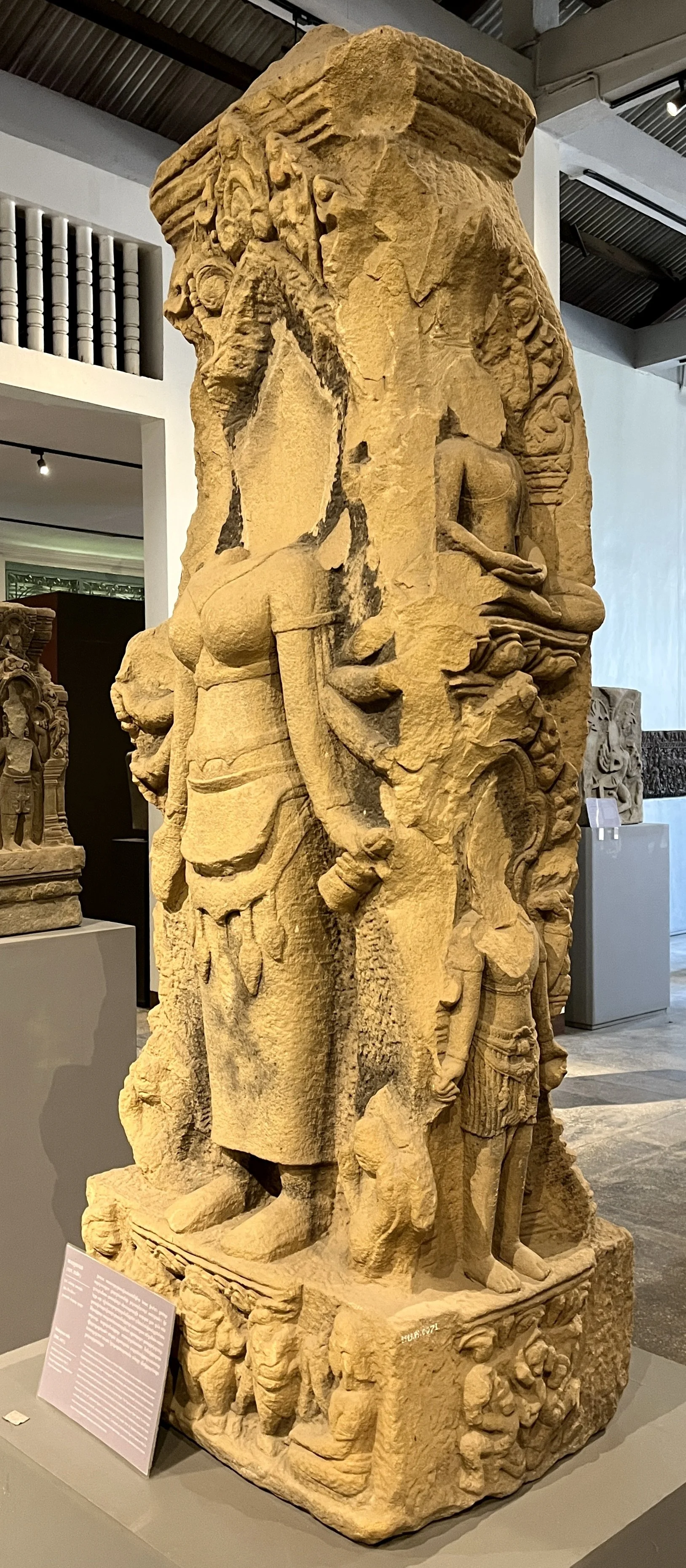
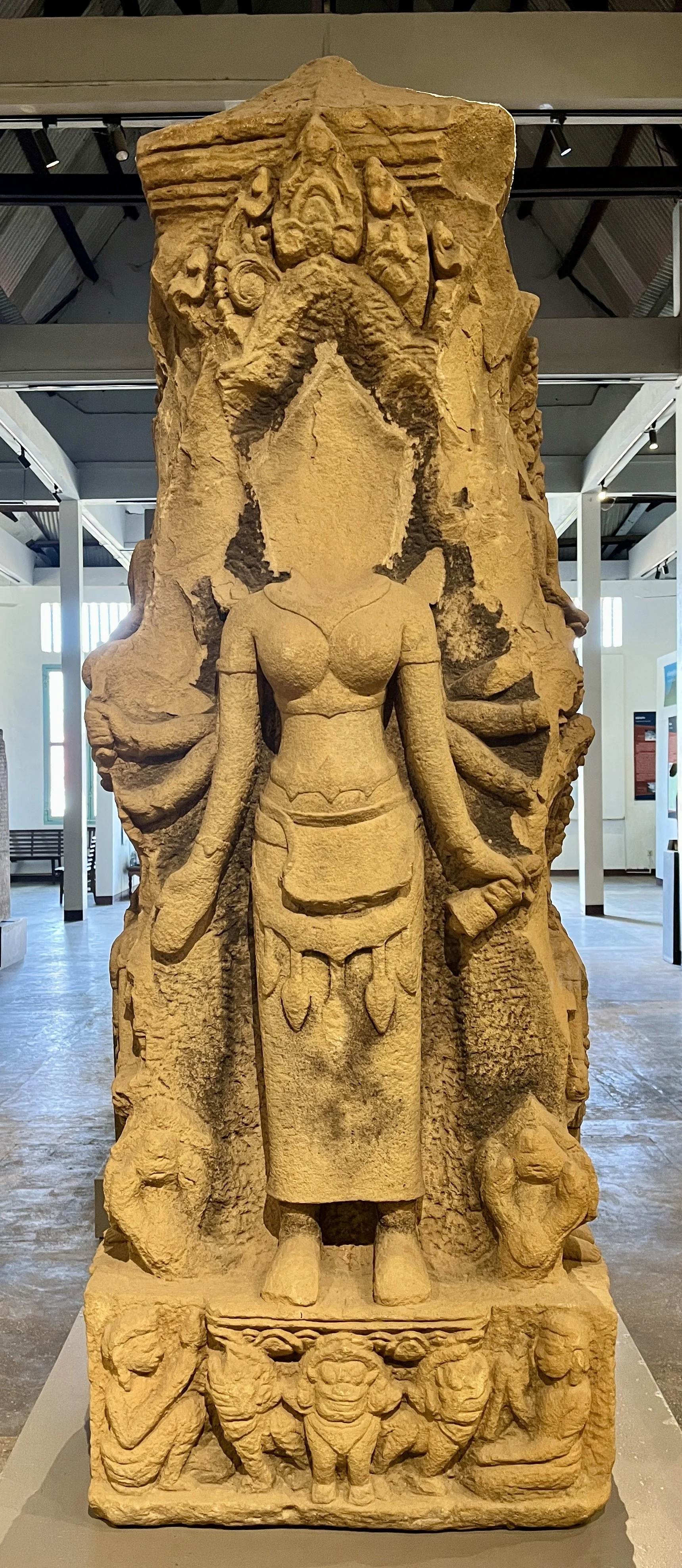
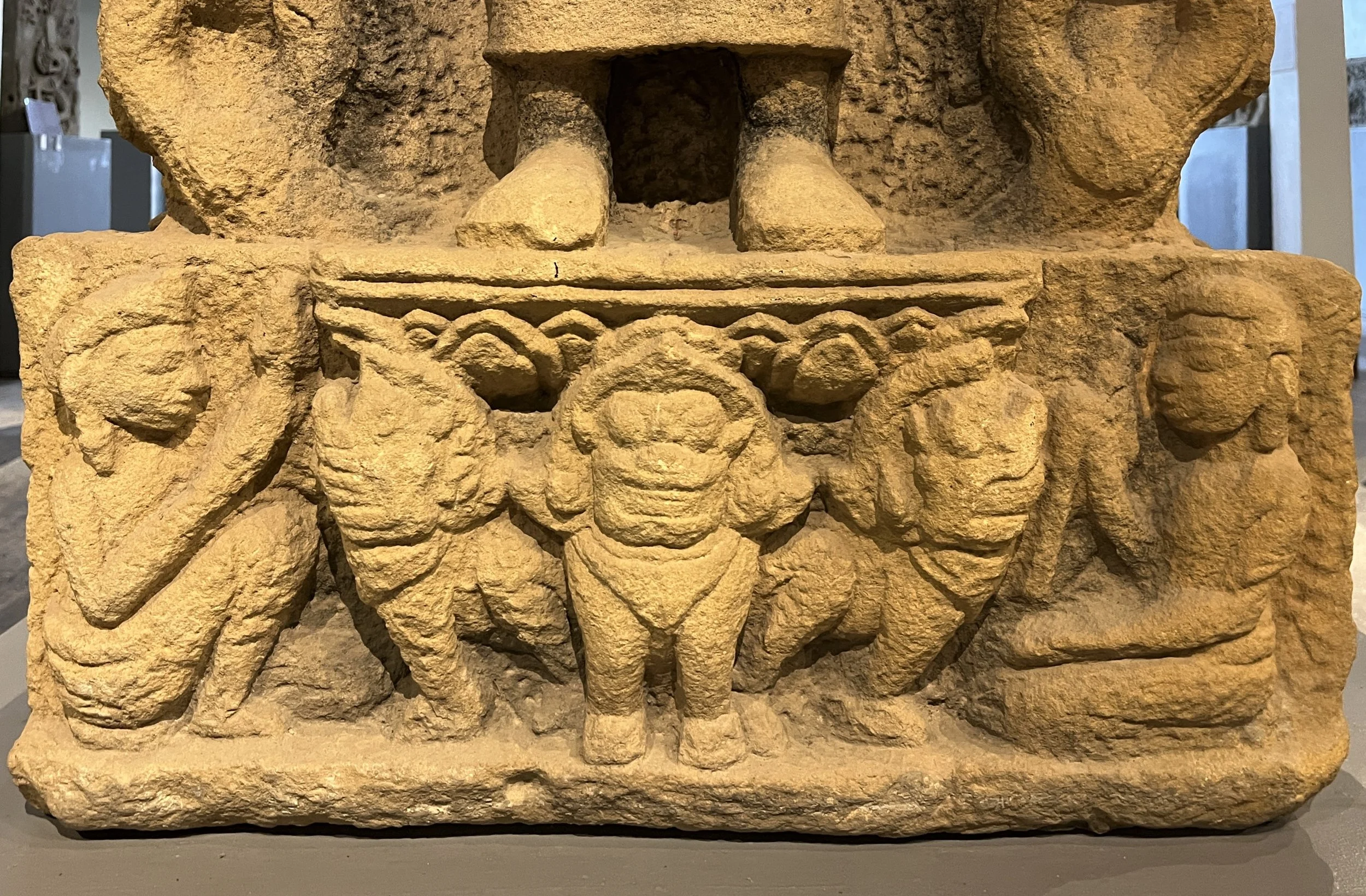
Mahayanic stele
Sandstone, Angkorian period, Angkor Wat style,
End of 11th c., Unknown
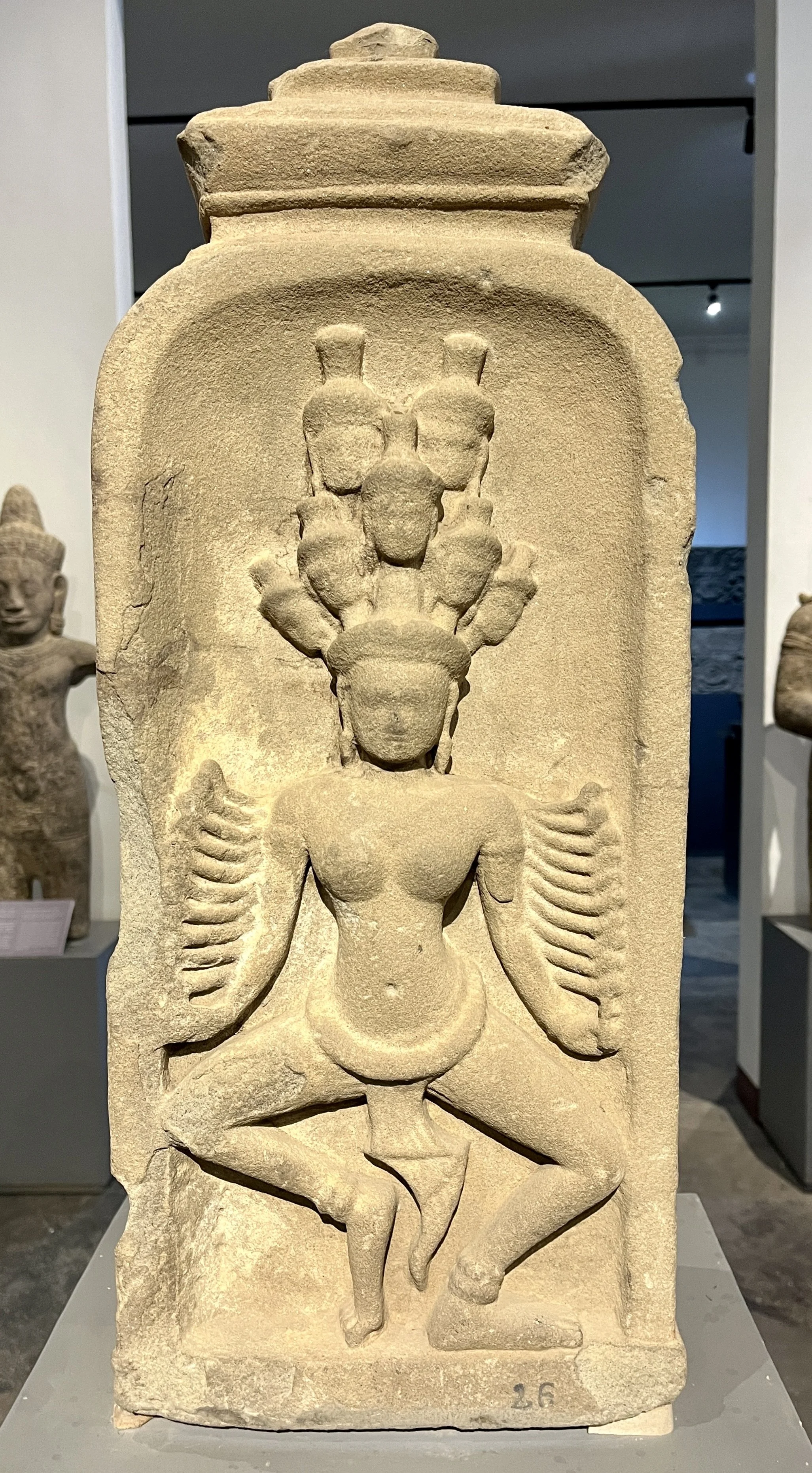
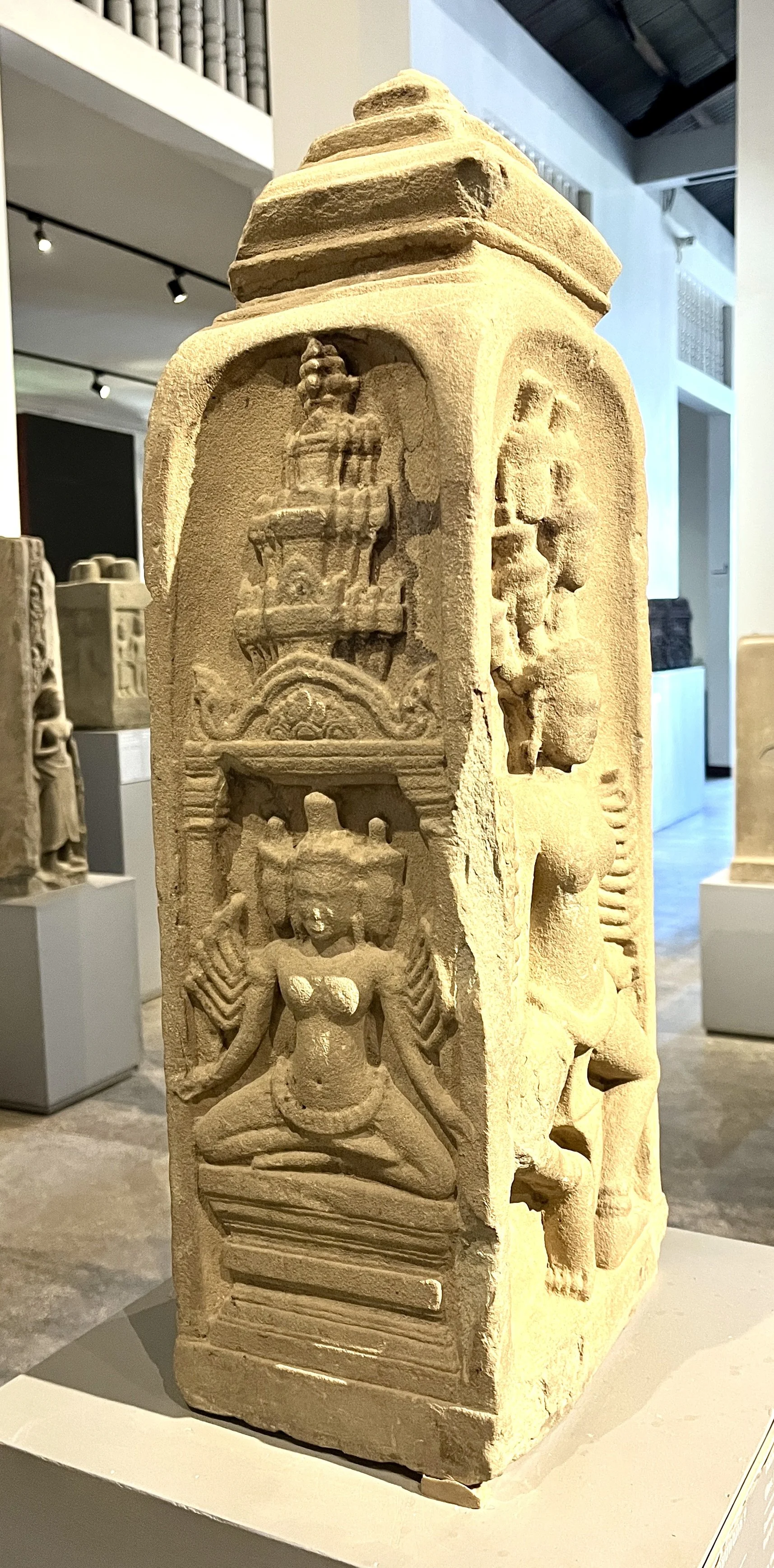
This slender Mahayanic stele has three carved faces; each face depicts different gestures of the Buddhist deity, Prajnaparamita. The first one is a depiction of a dancing female deity Prajnaparamita which has 8 heads and 20 arms. This posture is similar to dancing Shiva whose right leg is pulling up and left leg is leaning to the front.
The figure has multiple heads and arms, with Buddha Amitabha appearing on her original head.
Such Prajnaparamita depictions with multiple heads and arms are rare in the history of Khmer art. However, there is one kept at Gimet museum in Paris, MG14098. On the left hand side, there is a seated female deity inside a temple. She has four faces and seven arms. The last one, on the right, is a standing four armed Prajnaparamita.
Based on its decoration and deity cloth, one could date this stele to the Angkor style.
Brahmanic stele, four faced with inscription
Sandstone, Angkorian period, about 989 A.D
Vat Thmar Puok, Svay Chek commune, Thmar Puok district
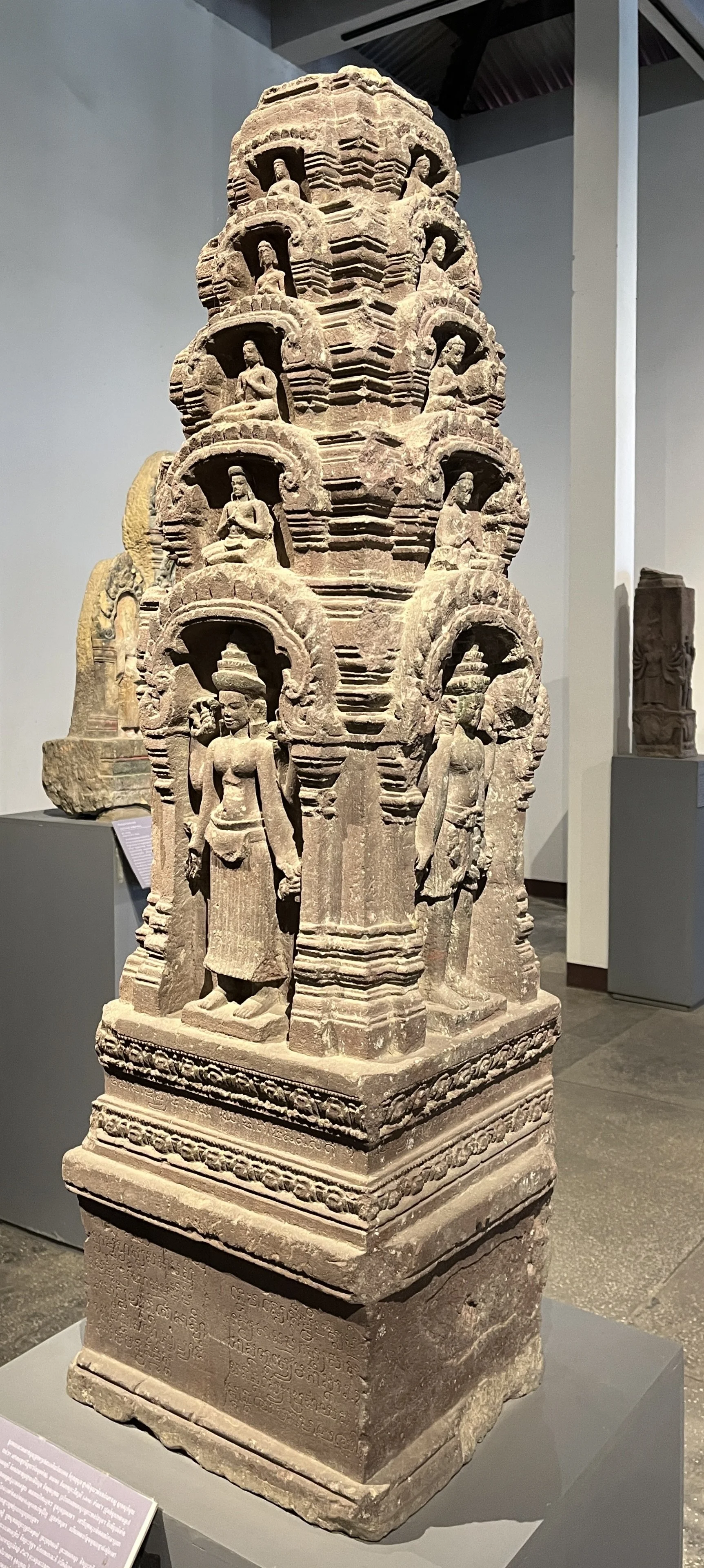
This four-faced stele has a form like a pointed-top stupa. Each tier likely represents each tier of heaven. On each tier of the four faces are figures representing the five Jina.
Three faces of the stele are carved with Prajnaparimata, and the last one might be the figure of Lokesvara because it has four arms. Above the four main figures are gods with different gestures sitting in niches. Below the main figures of all four faces are 14 lines of Sanskrit inscription. There is an additional line of inscription between the bud's decoration of all corners.
The inscription is a prayer to Prajnaparamita, Lokesvara and Vajrin (known as Vajra-pani), Buddha and Indra. This inscription also mentions King Jayavarman V (passed away in 890 Saka, or 968 A.D.) He is the king who believed in Mahayana Buddhism, and his posthumous name is Prahbotamavirojna. The last paragraph of the inscription gives the date 911 Saka, which is 989 A.D.; it cites a prayer to six gods in Buddhism, in a similar form to the prayer above.
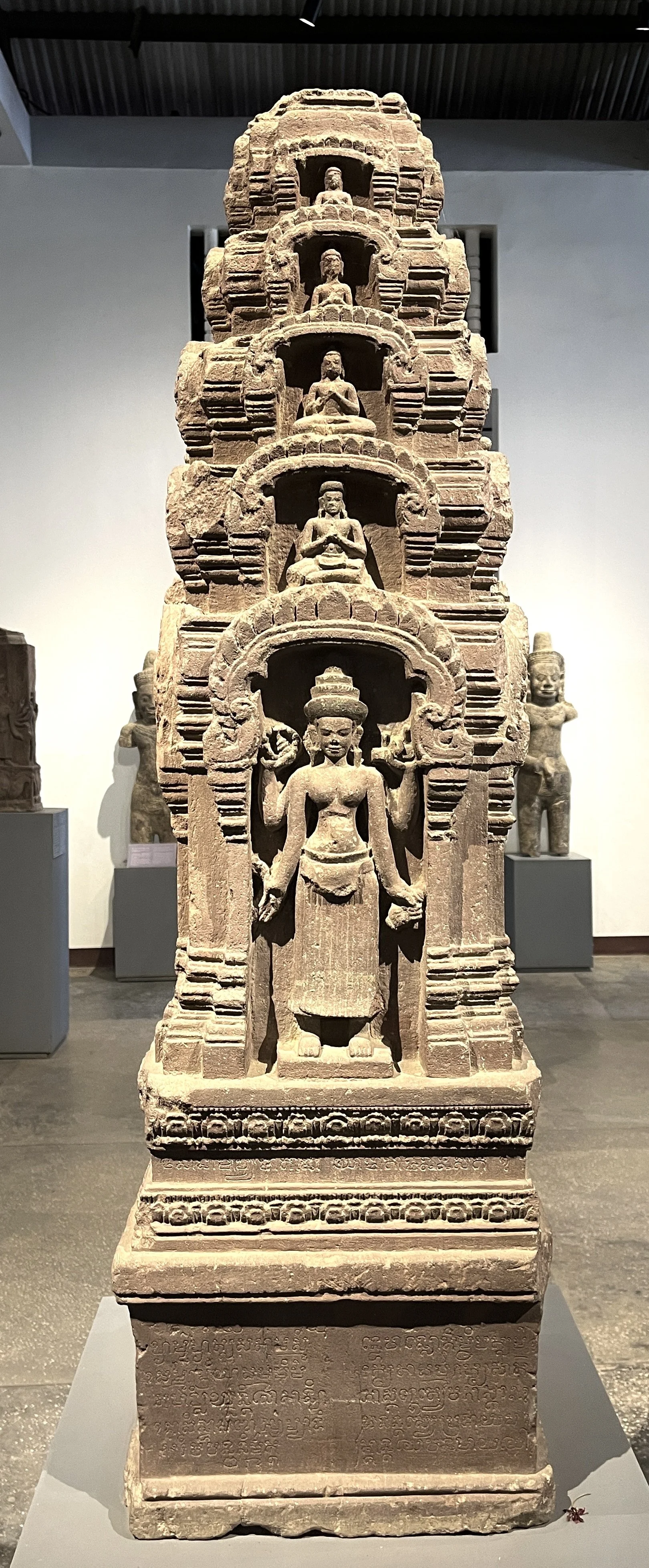
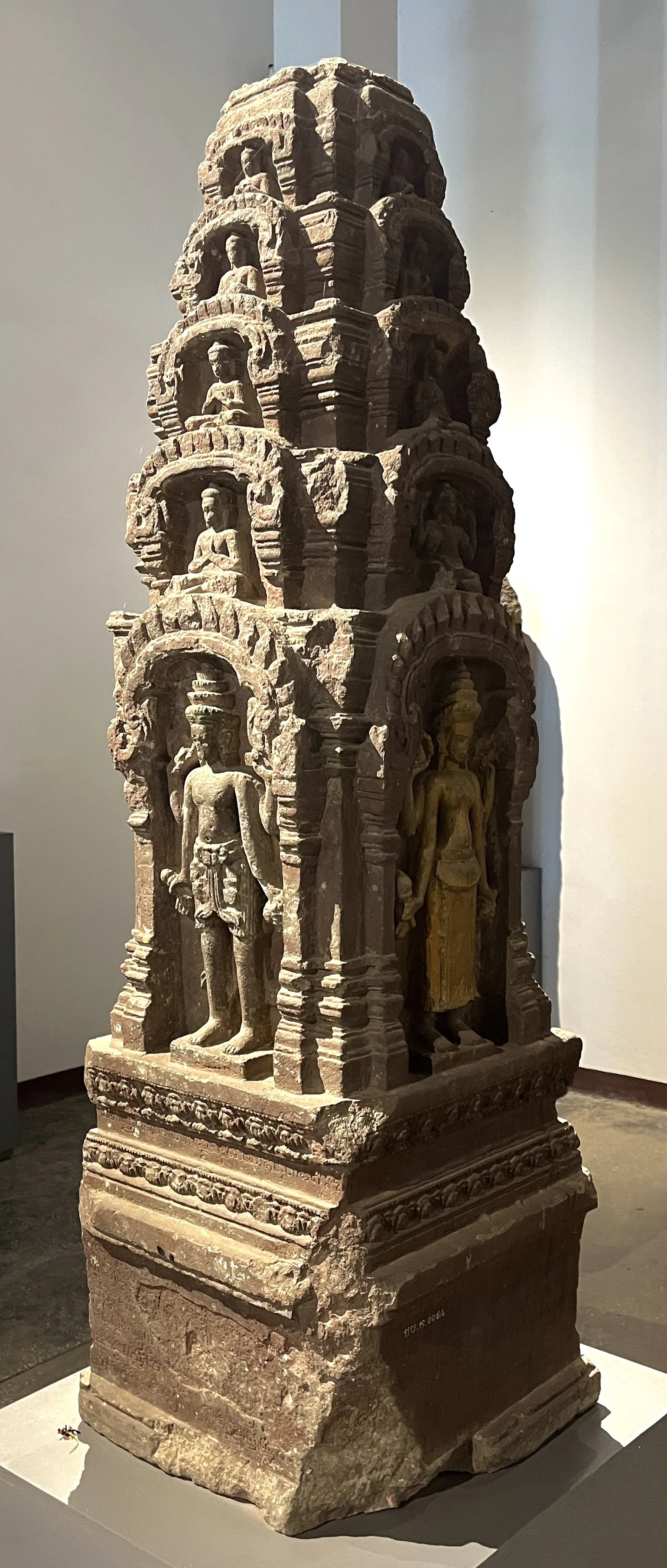
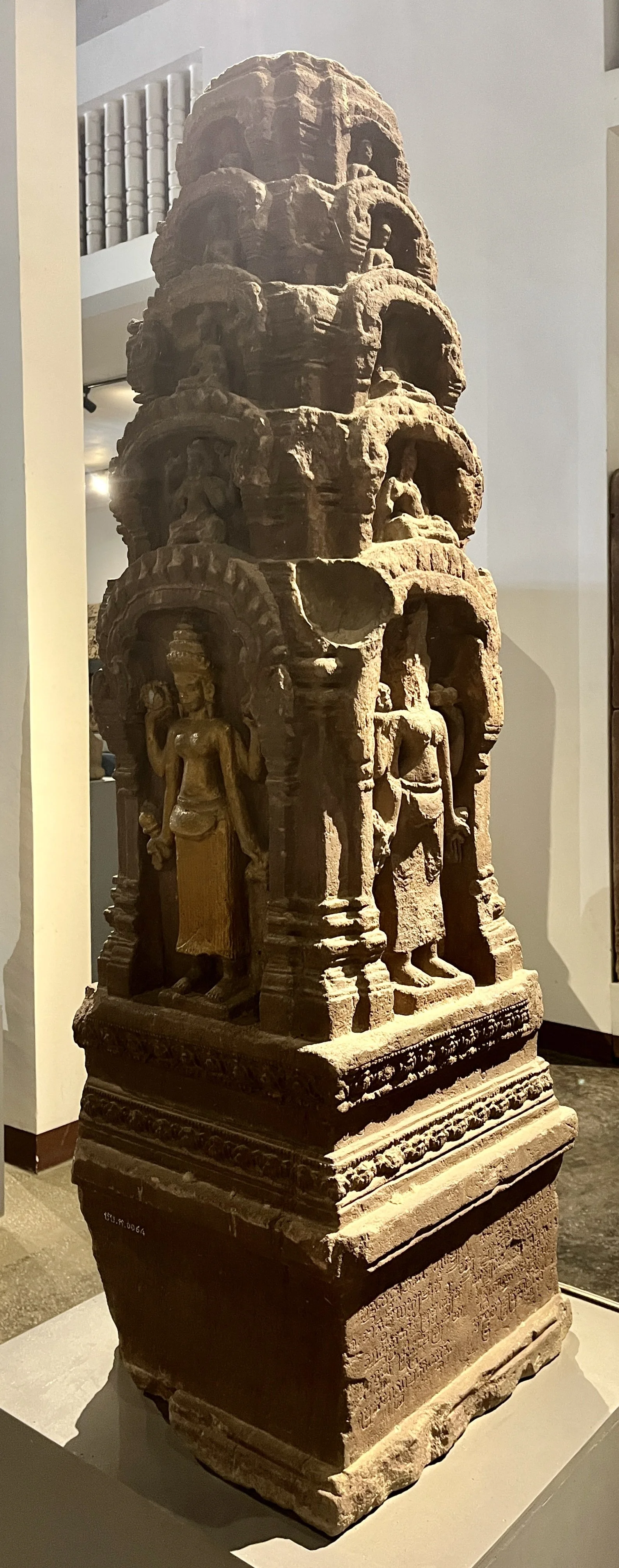
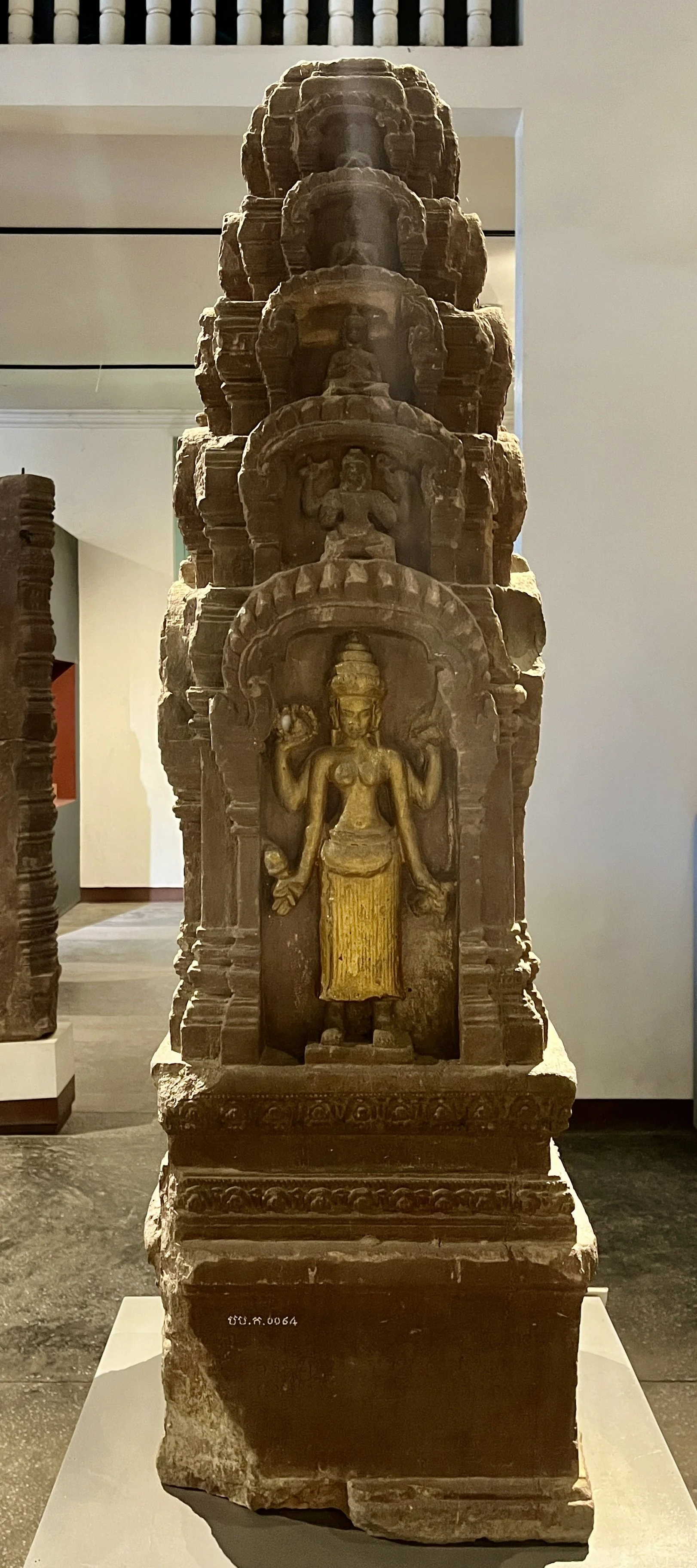
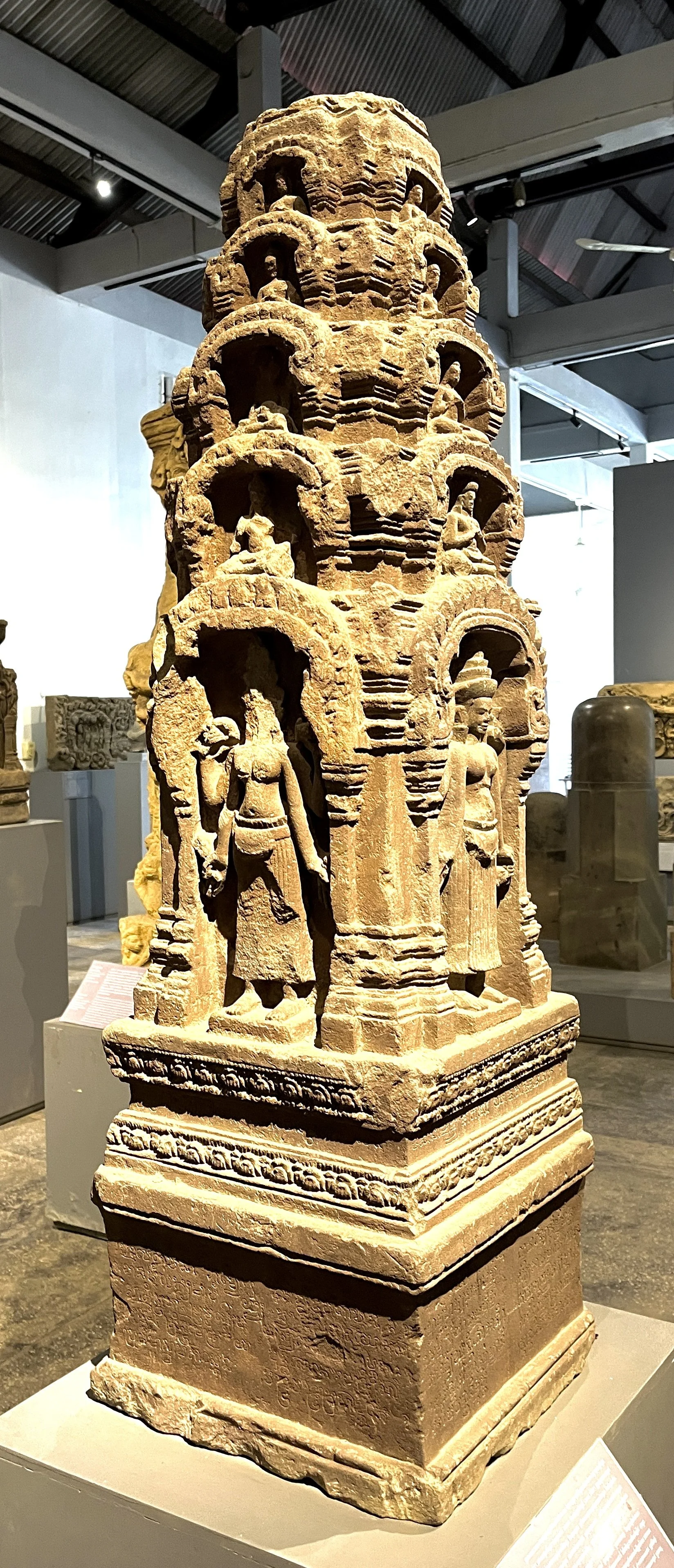
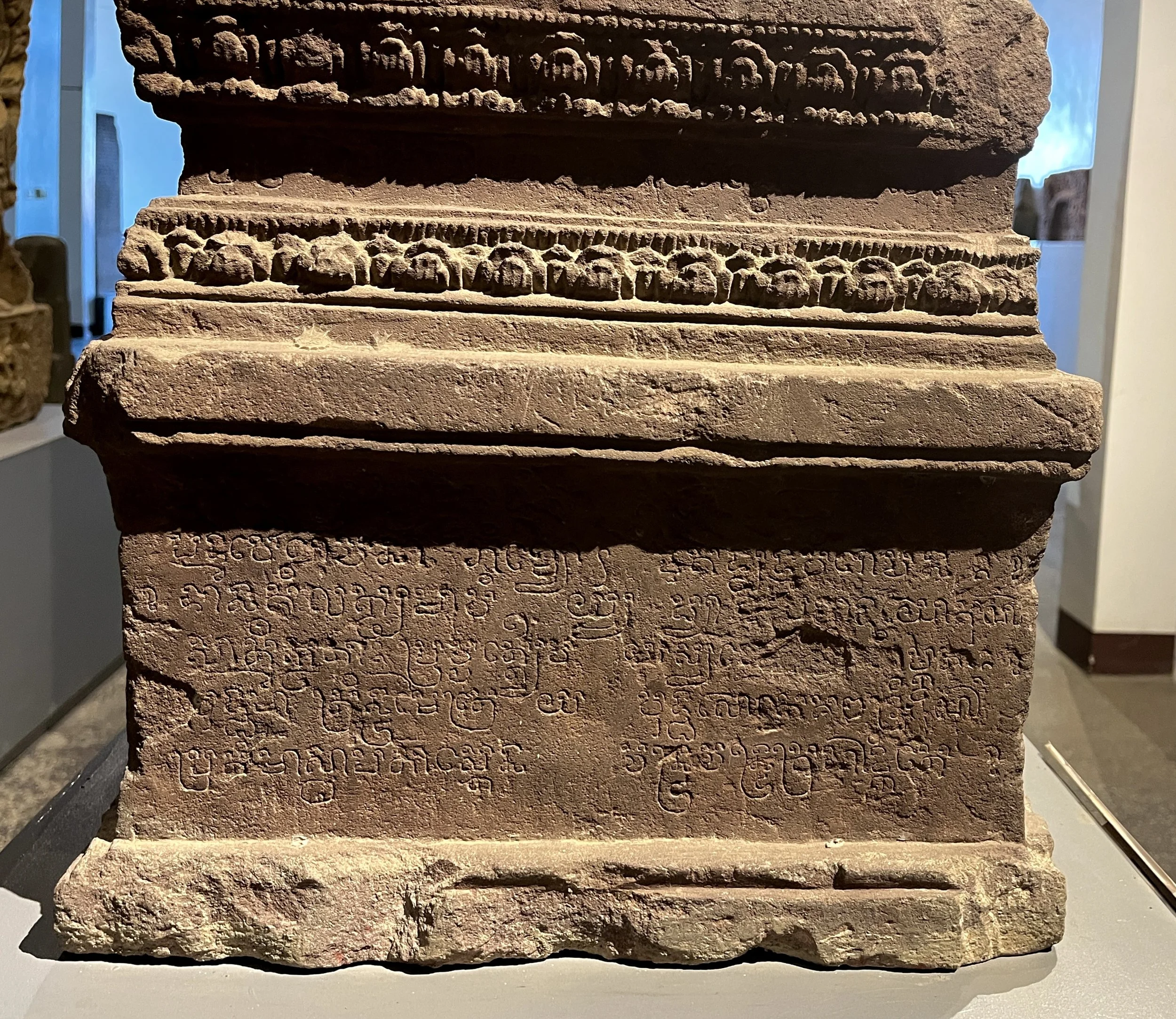
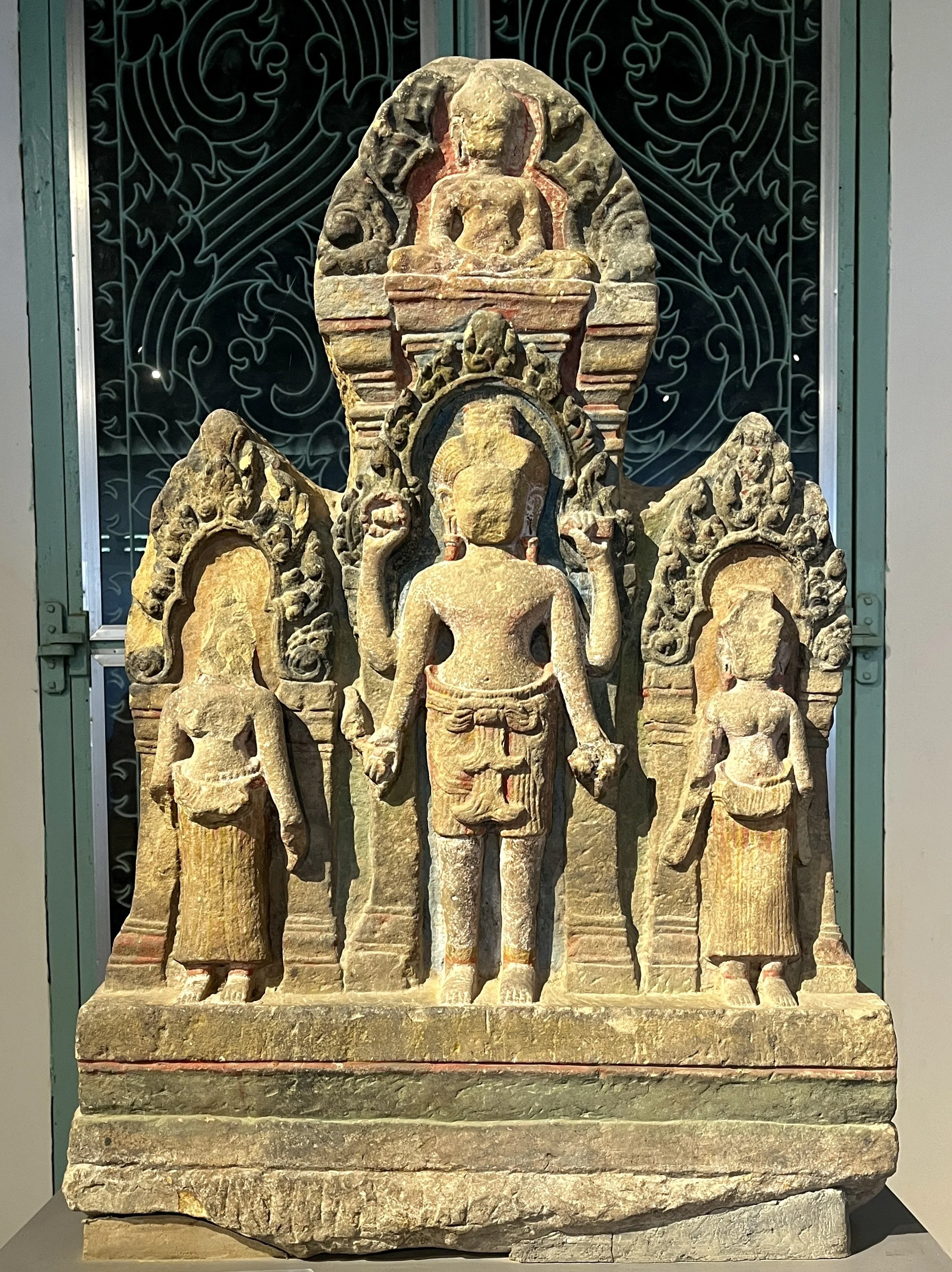
Buddhist boundary stone
Sandstone, Angkorian Period,
10th c., Unknown
This boundary stone carved only the front side depicts three figures; Lokesvara flanked by two Prajnaparamitas standing inside decorative niches. Lokesvara has four arms; each one holds a different attribute. This figure has a strongly built body, and wears a short pleated skirt; the upper edge of the skirt falls over the belt in a fan shape, and a double central pleat in a fish tail shape is visible below. He is decorated with a large headdress and cylindrical chignon. Above his niche is a seated Buddha amitabha. The Buddha amitabha usually appears on the chignon. The Prajnaparamitas are wearing the same long pleated skirt, a large fan shape or oyster shape is visible at the upper front of their waists. According to the body shape, jewelry, and dressing style of the figures, it is believed that the boundary dates to the mid-10th century AD.
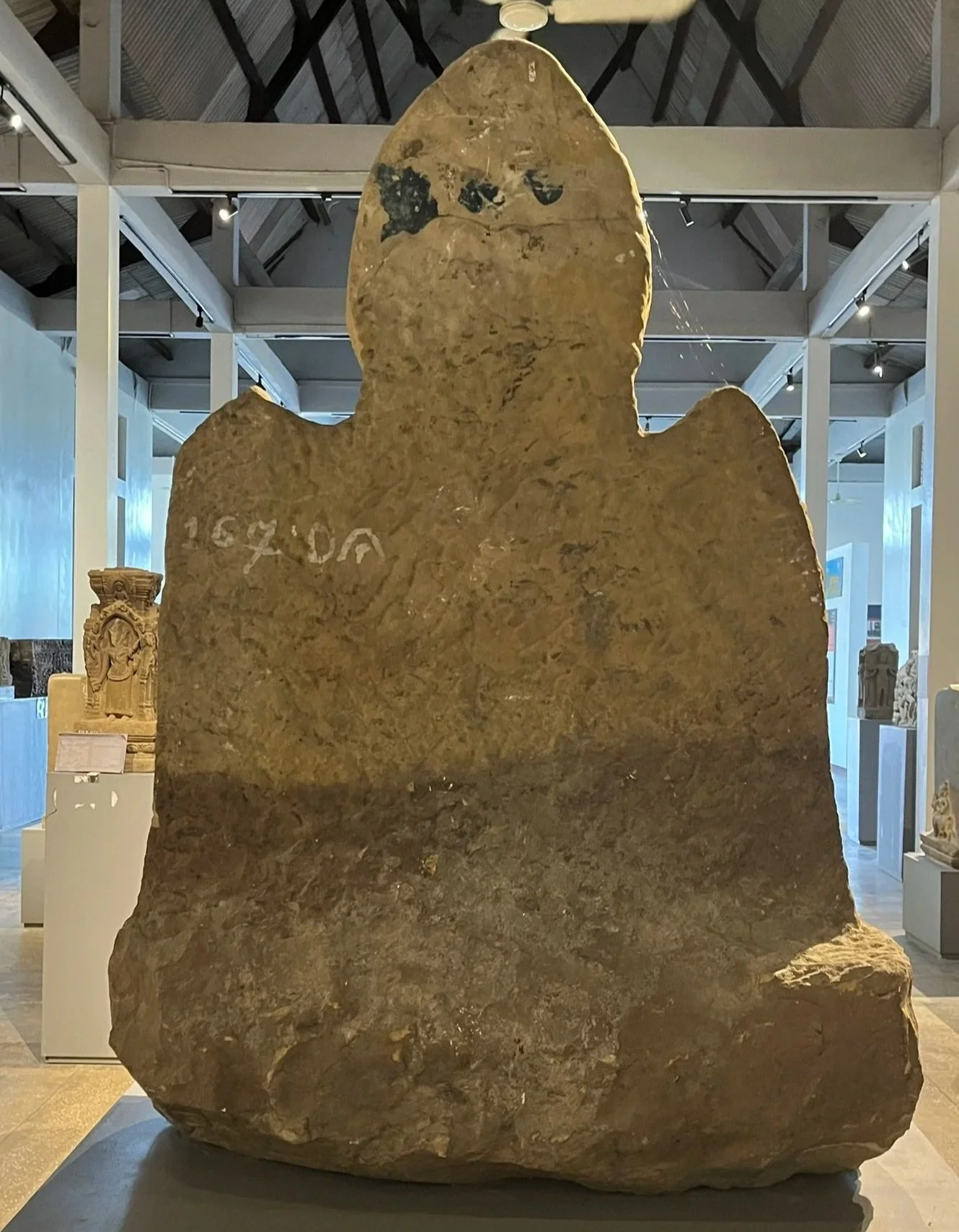
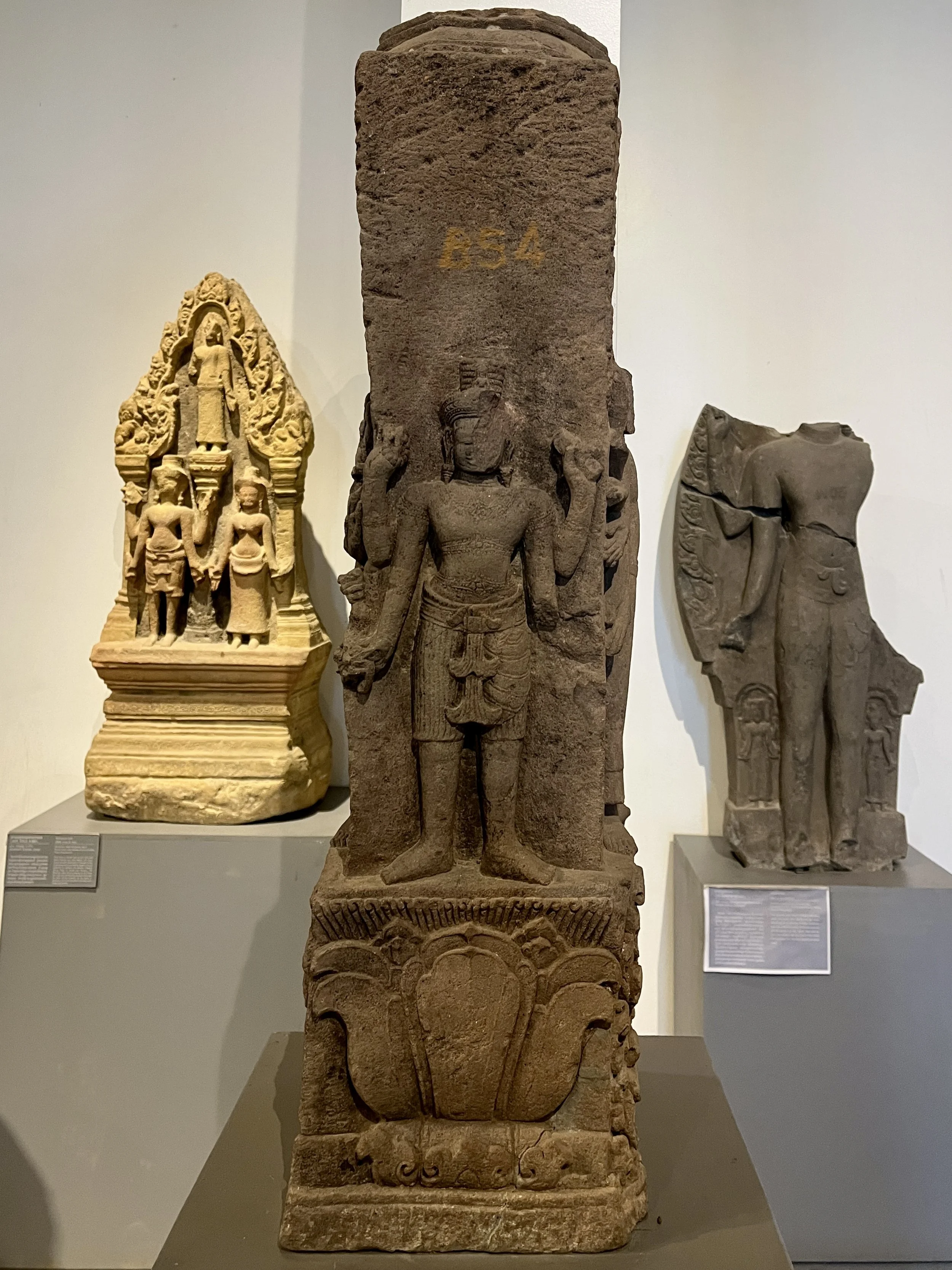
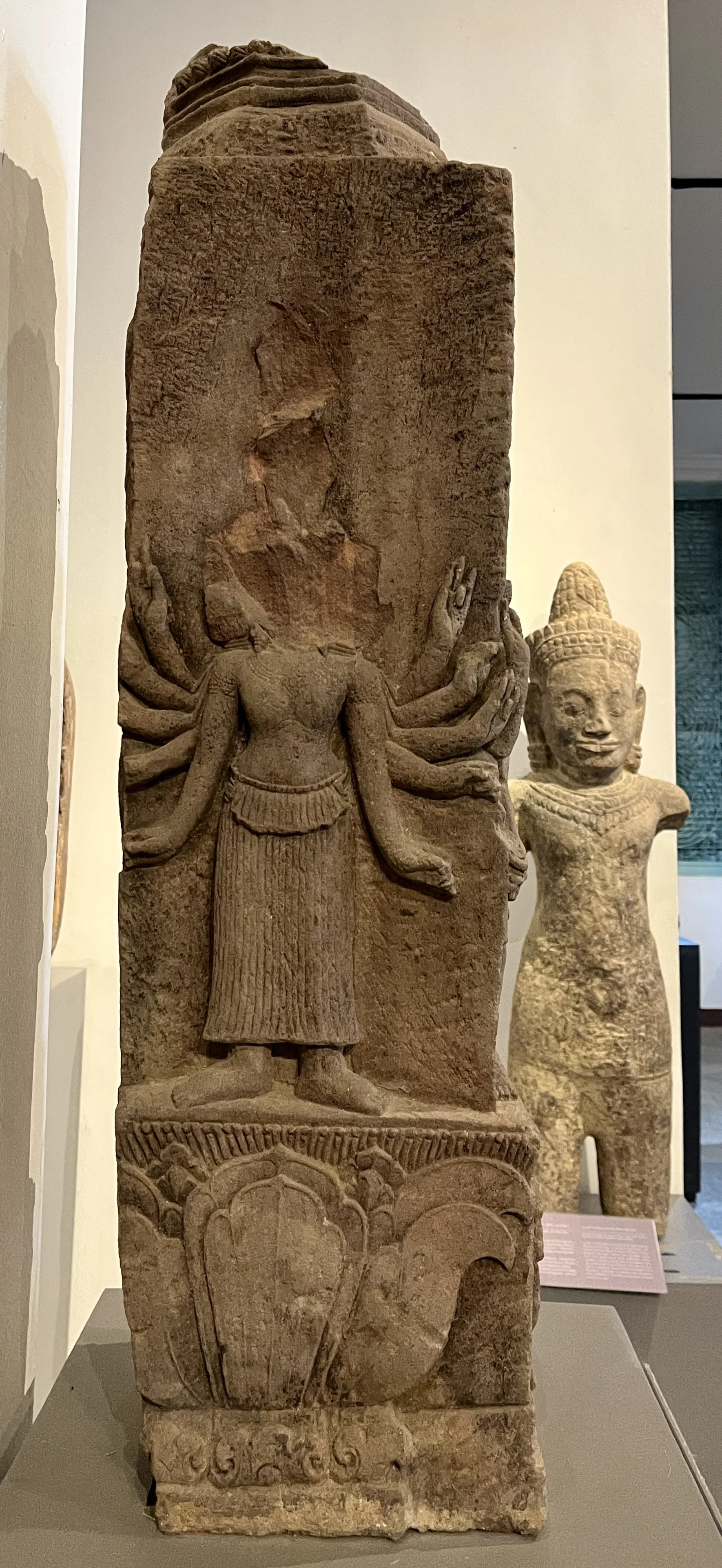
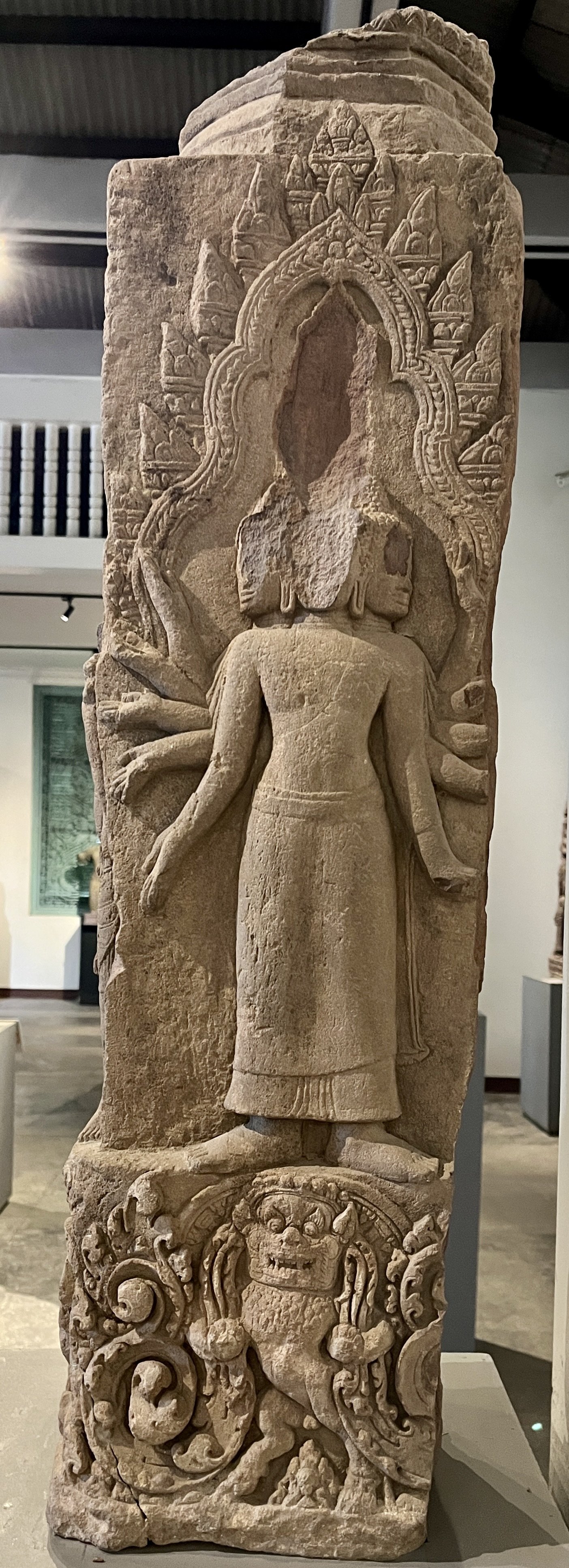
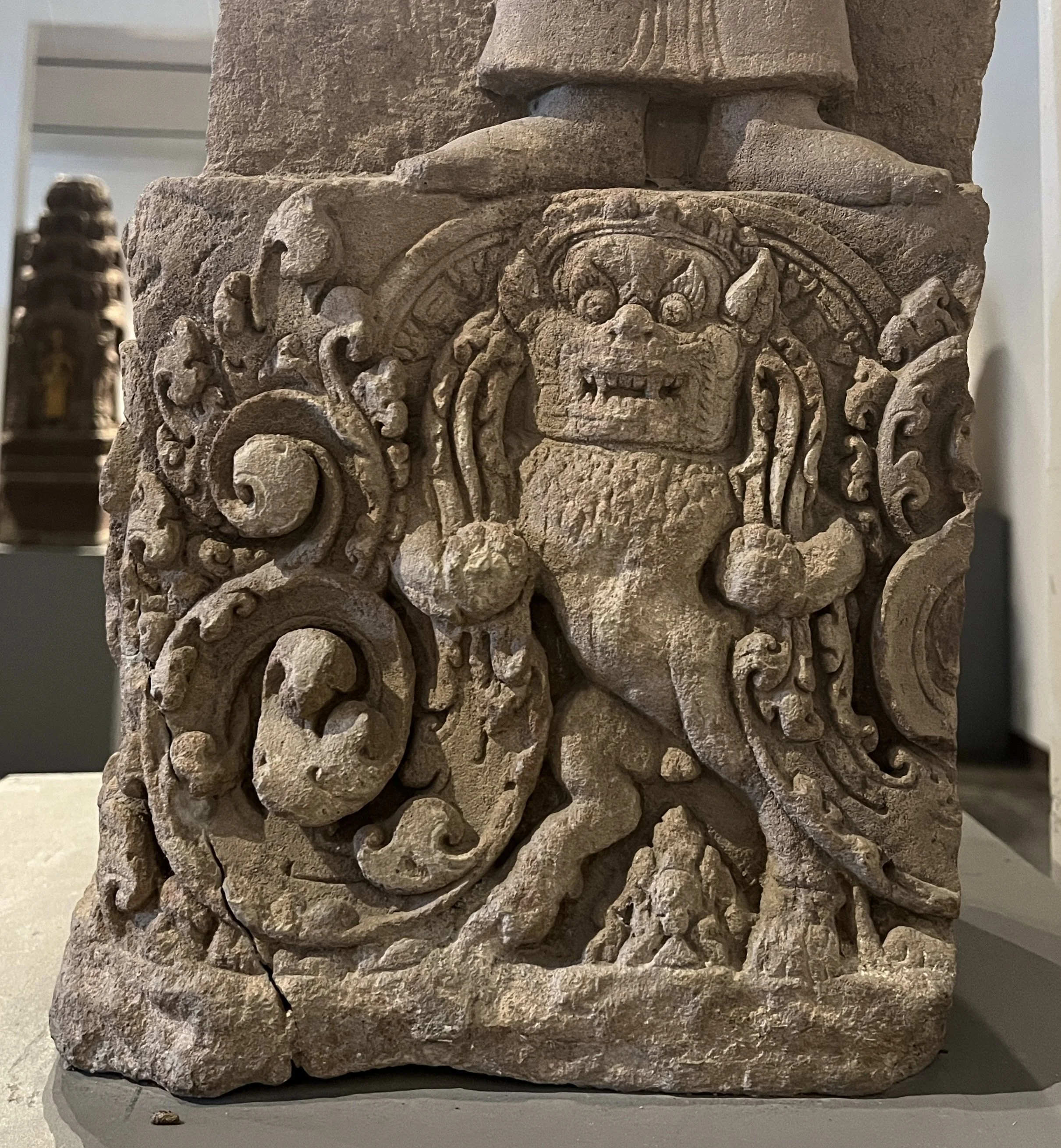
Bhramanic stele
Sandstone, Angkorian period,
late 10th -11th c. Prasat Samre, Namtaov, Phnom Srok, Banteay Meanchey
The top of the stele is broken, leaving three carved faces, each depicting a different Buddhist deity. The first shows a female figure, probably Prajnaparamita, with multiple heads and ten arms, standing on a lotus pedestal. Unfortunately, the heads are broken. The second one is a four-armed Lokesvara stands on a lotus base, and the last one is a Buddha who has multiple heads and arms. He stands on a decorative lion throne inside an elaborated niche. The presentation of such a Buddha is rare in the history of Khmer art.
Based on its form and the decoration of the cloth and jewelry they wear, one could suggest that this stele was produced at the end of 10th -11th century.
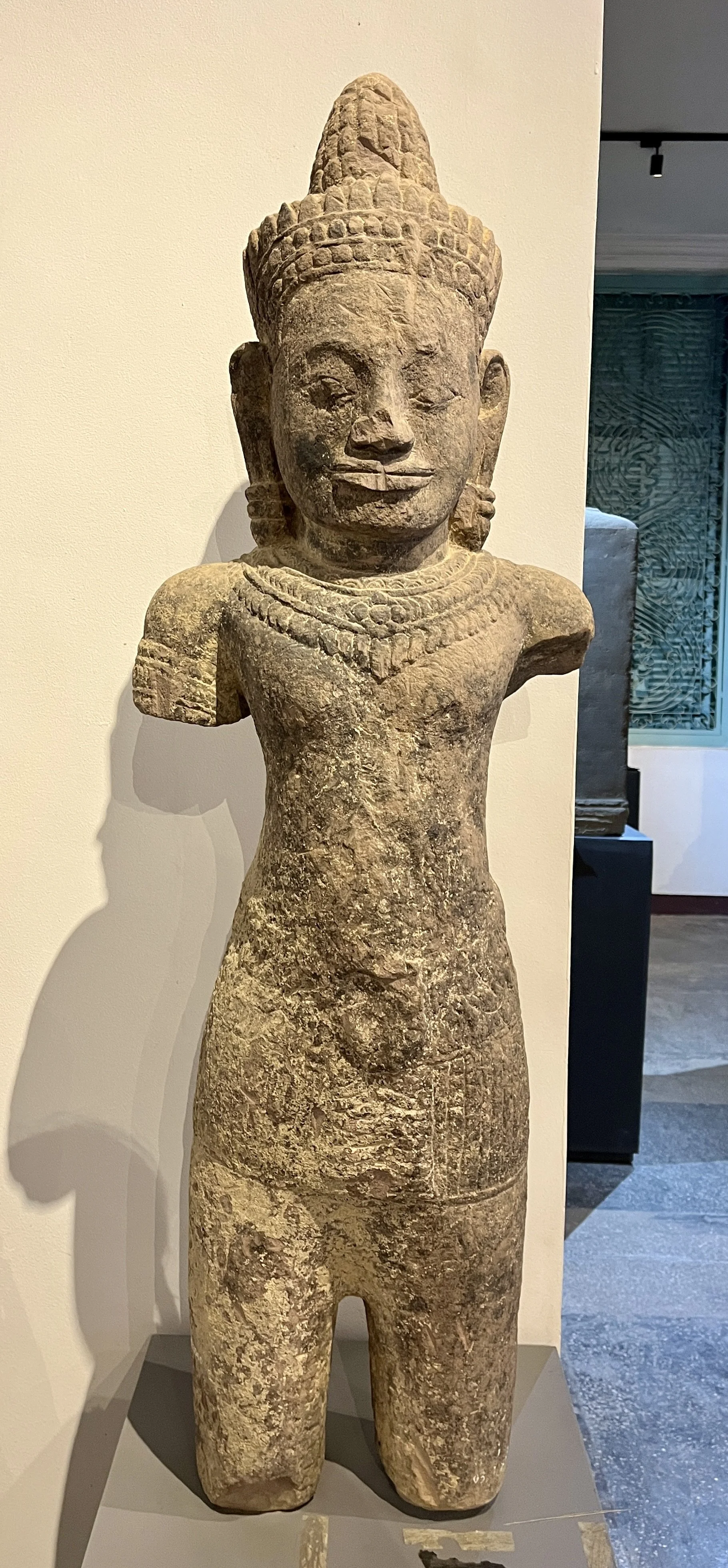
Guardians
Sandstone, Angkorian period, Bayon style, 12th - 13th c.
Prasat Tuol Preah Theat Bavil, Battambang
This pair of Dvarapala (guardians stationed at the door of a tower or gate) are similar in proportion and style, suggesting that both objects probably come from the same place. Both guardians stand straight, with lost hands that probably held a club at stomach level. This posture is a mark of vigilance. They are heavily decorated with bracelets, armbands, a necklace, ear pendants, and a headdress. Their skirts are short and tied with a scarf or belt.
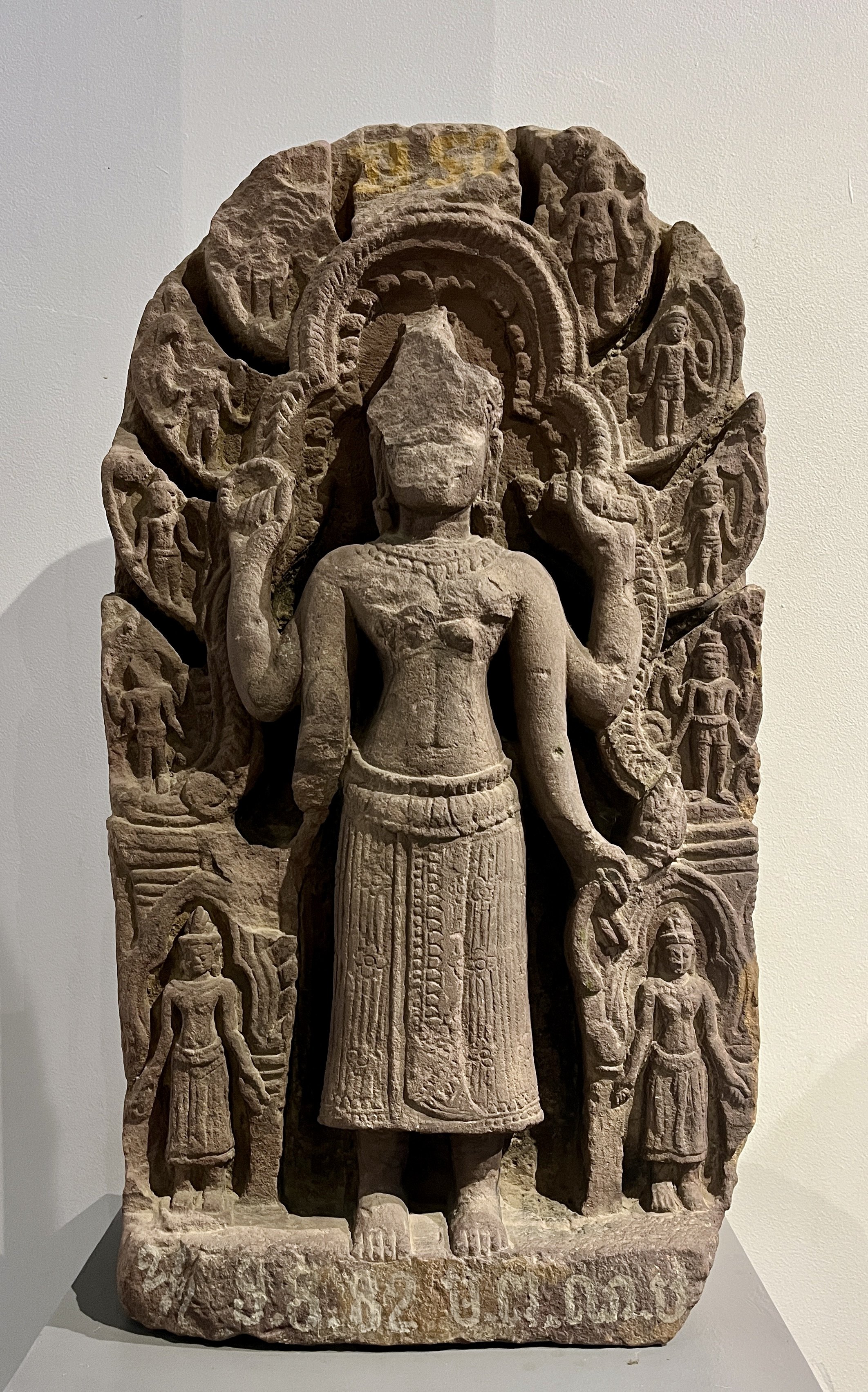
Mahayanic stele
Sandstone, Angkorian period, Khleang style, frist half of 11th c., Unknown
Similar to a Sima stone, this stele is carved with a larger four-armed Prajnaparamita standing in a decorative niche and flanked by two smaller prajaparamita. Behind the niches, above the column, there are nine floral motifs; each has a four-armed Lokesvara standing inside.
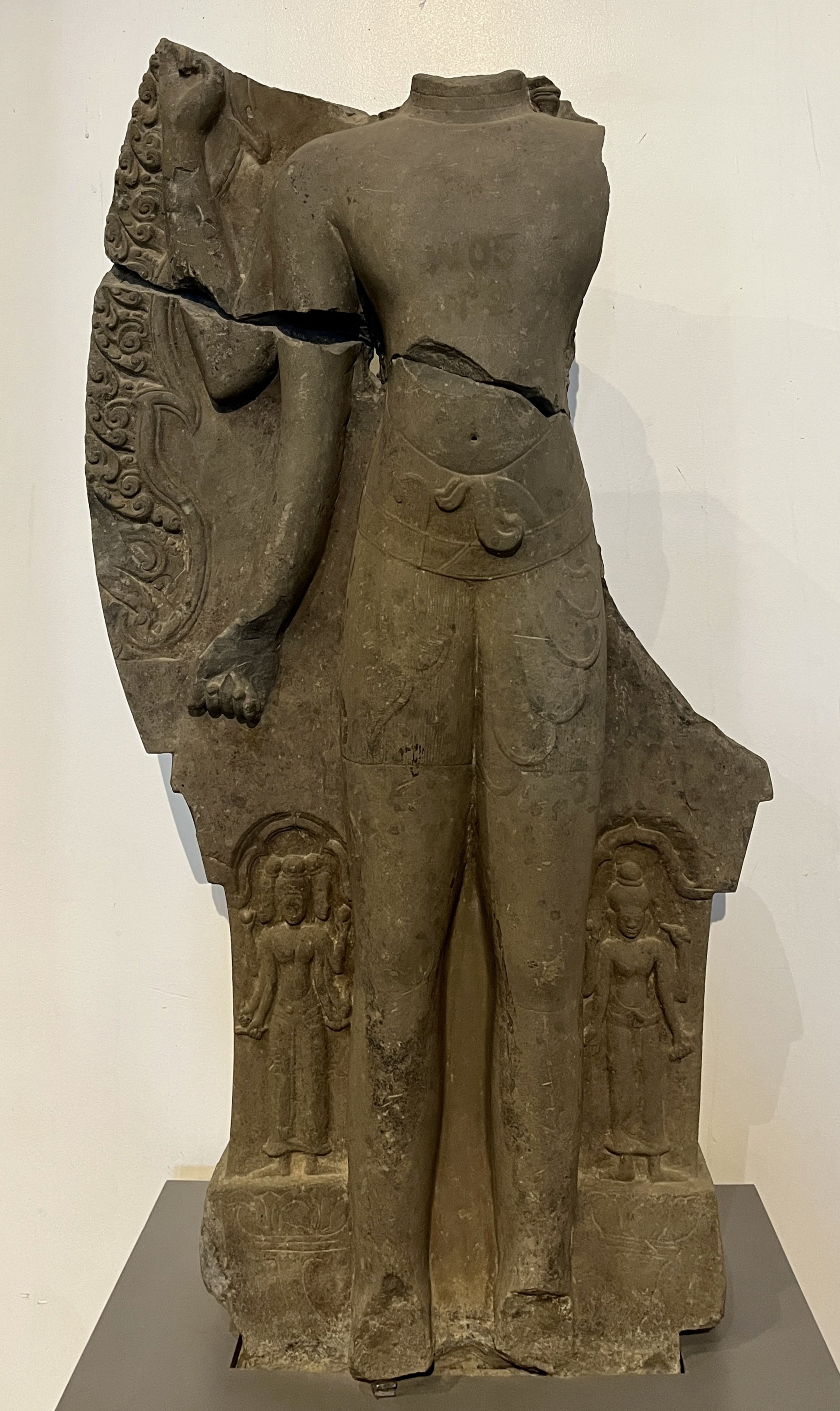
Buddhist Stele
Sandstone, Angkorian period, Baphuon style, second half of 11th c., Kuk Wat Chas, Samrong, Ta Meun, Thmar Kol, Battambang
This amazing stele depicts a standing male deity inside a decorative arch flanked by two small female figures on either side of his legs. The figures wear typical Baphuon dress. The female figure on the left appears to have three heads and six arms; the other has four arms. Their hands hold attributes, but only a lotus can be recognized.
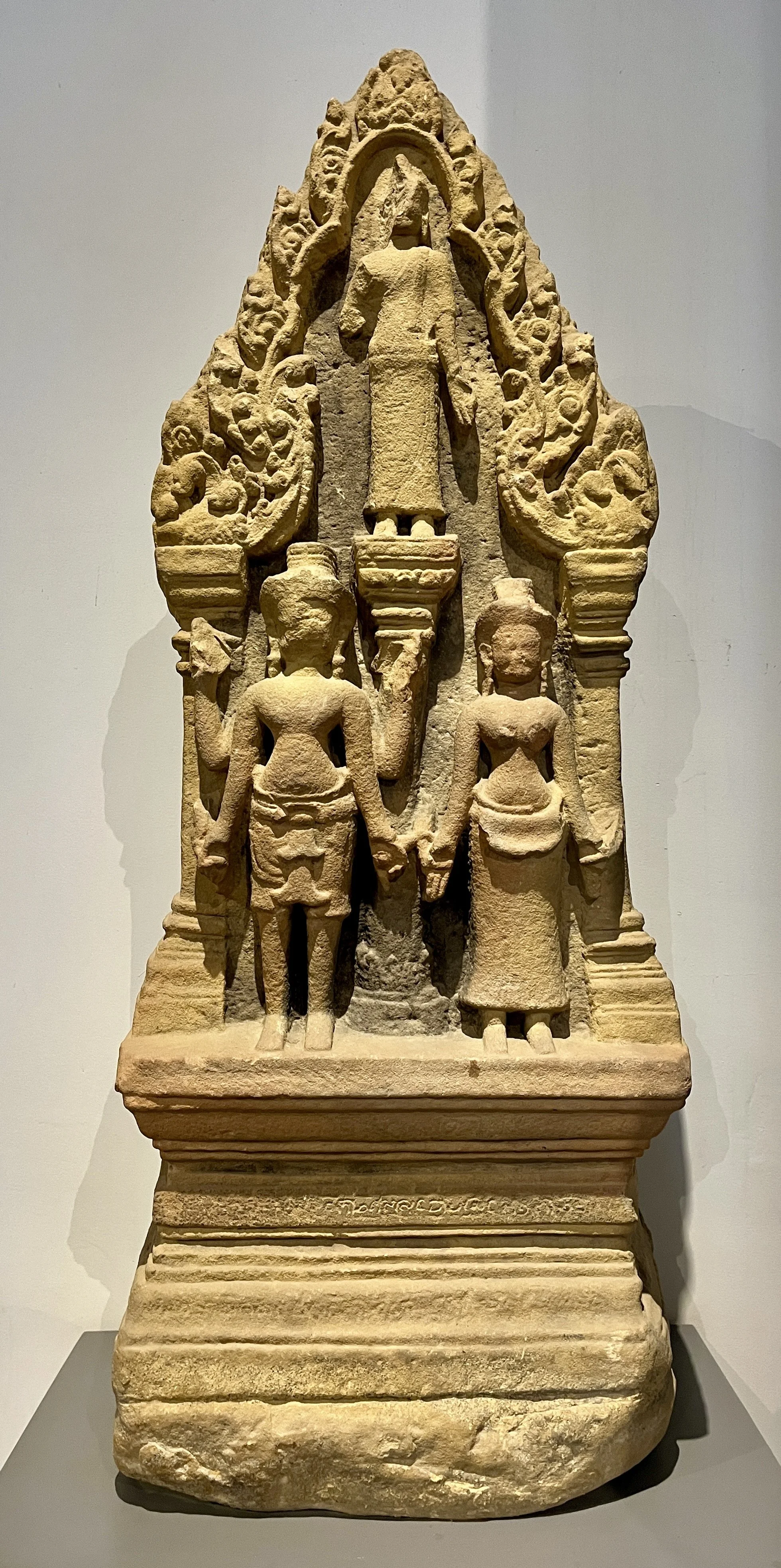
Mahayanic stele
Sandstone, Angkorian period, 10th c.
Prasat Kbal Krabei, Banteay Chmar commune,
Thmar Puok district
This stele is carved only on the front and depicts two main deities, a four-armed Lokesvara and an attending Prajanaparamita.
In between these two deities appears a lotus pedestal supporting a Buddha standing above their heads. The Buddha's right hand is placed on his shoulder, while his left lays along his body with palm facing outward. At the base of the pedestal, there are two lines of writing from the Angkorian period.
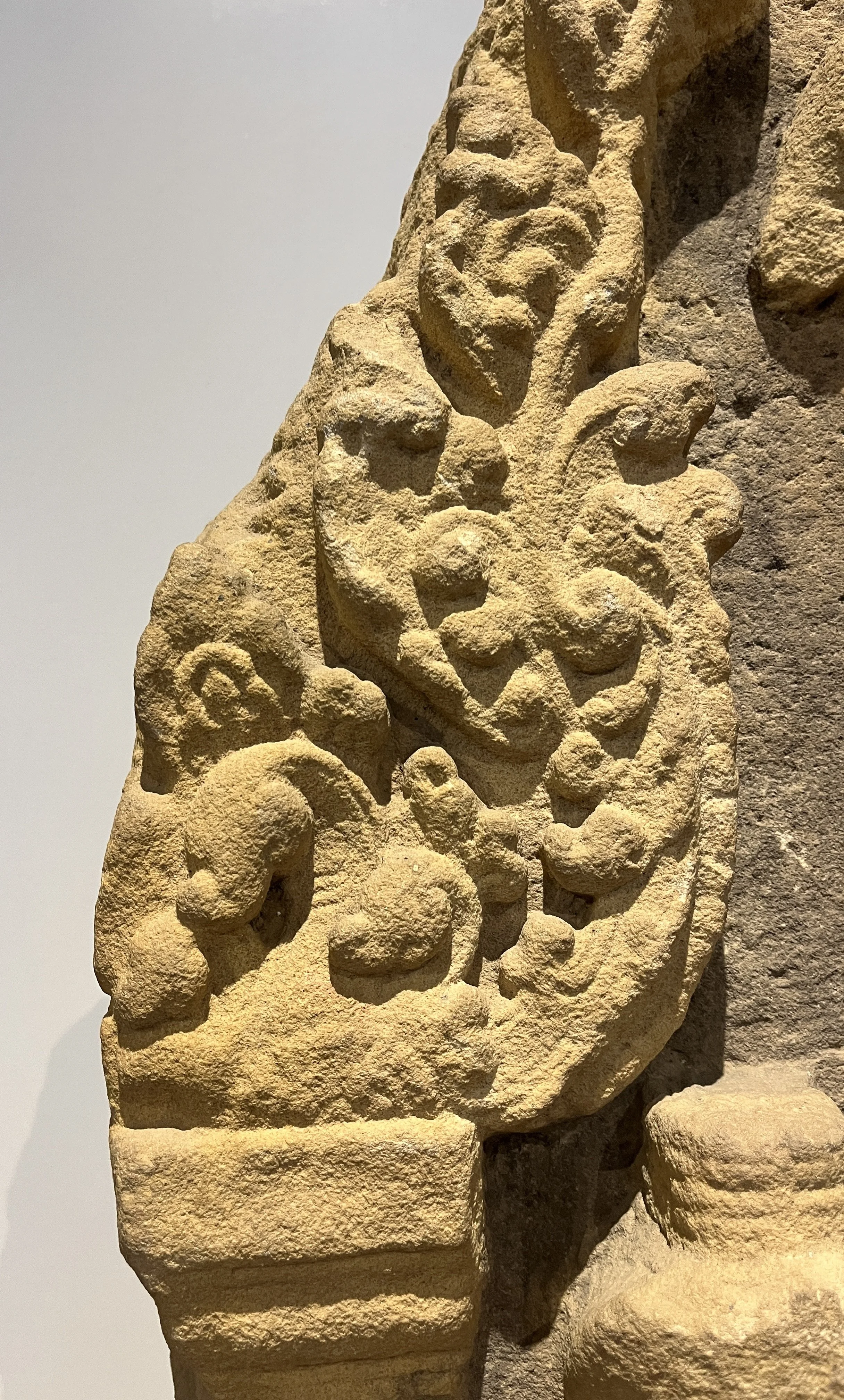
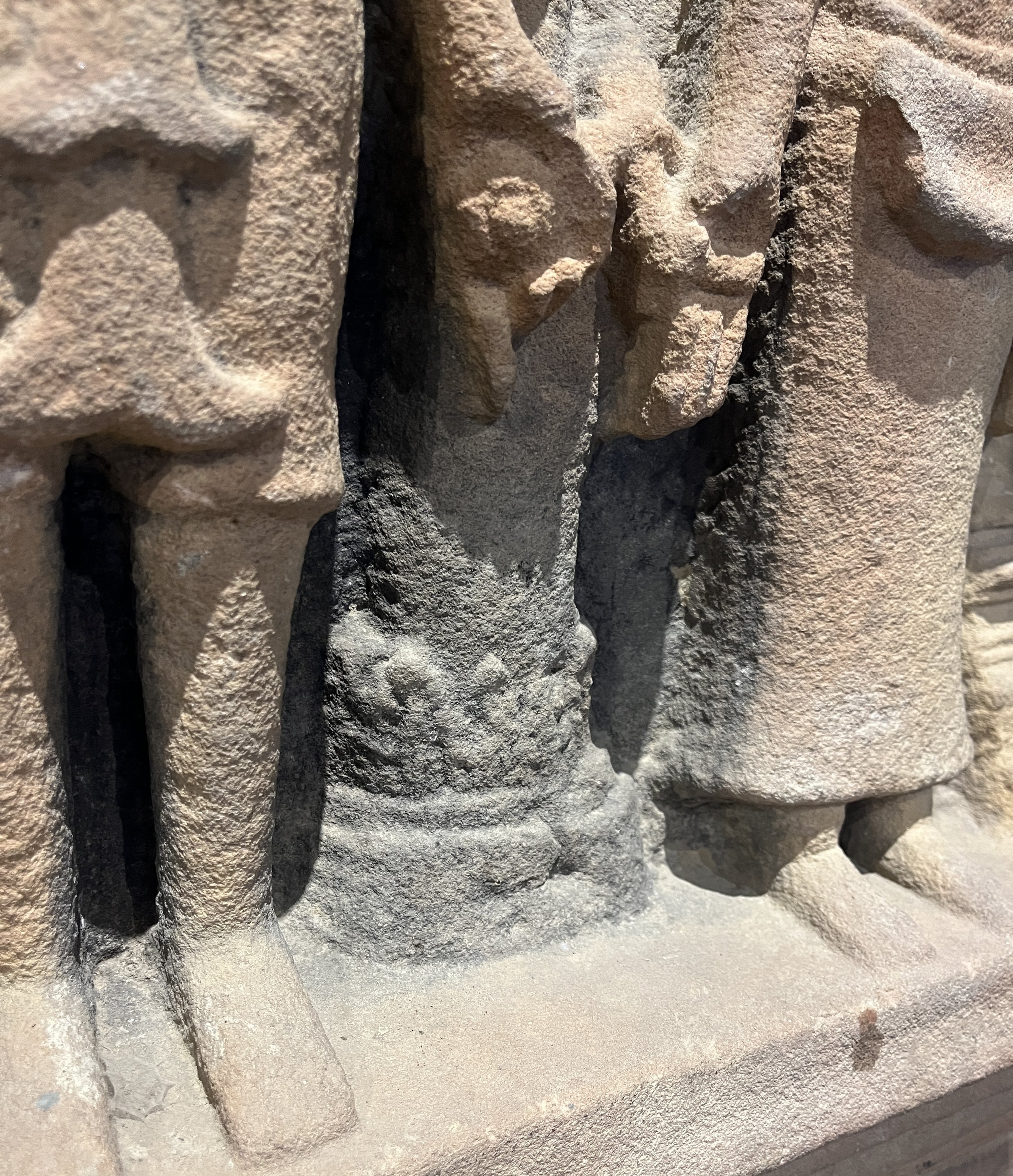
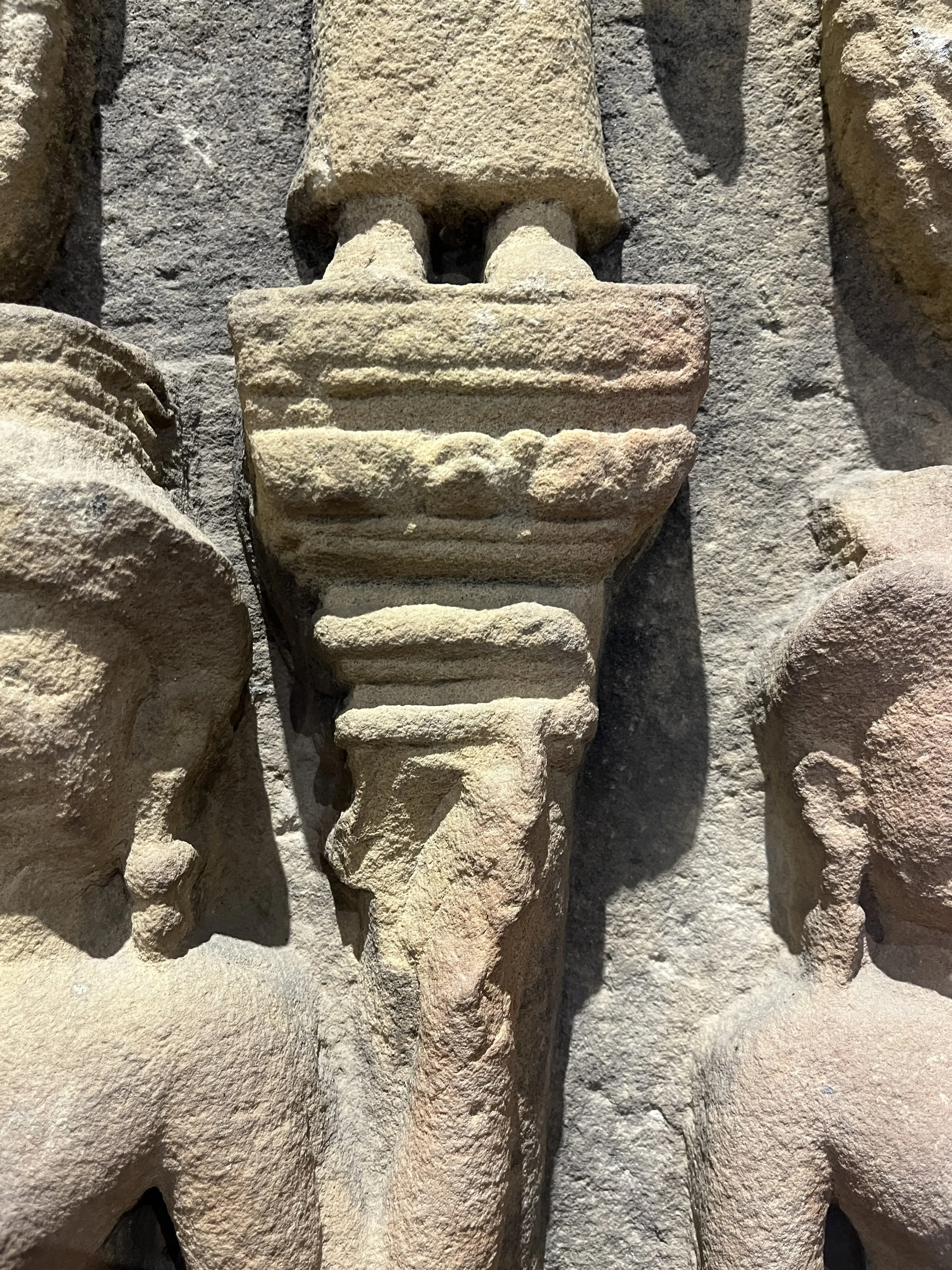
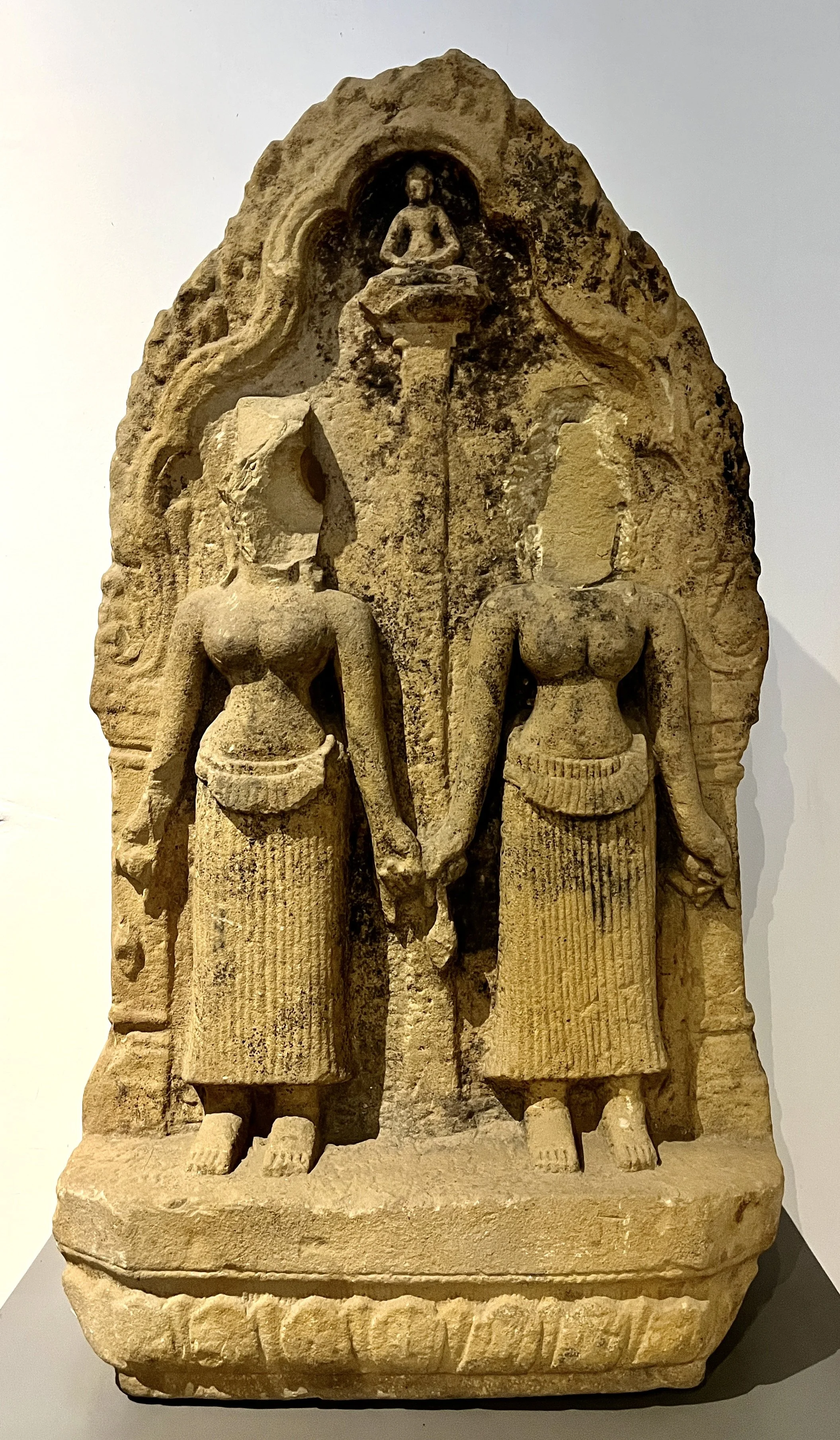
Prajnaparamita stele
Sandstone, Angkorian Period, mid 10th C.
Prasat Kou, Toeuk Chum, Thmar Puok, Banteay Meanchey
In a Sima form, this Buddhist stele depicts twin female deities standing on a lotus petal inside a niche, with hands at their sides holding lotuses.
The faces of these figures are lost; they wear long pleated skirts fastened with belts, with the outer part of their upper edges falling in an oyster shell form and the inner standing straight up and clinging to the abdomen. In between these figures appears a large lotus stem growing up above their heads with Buddha amitabha seated on it. It is believed that the two female figures are prajnaparami-ta. This presentation is similar to two other Buddhist boundary stones in this section, Bbka. 0136, Bbka. 0140, .
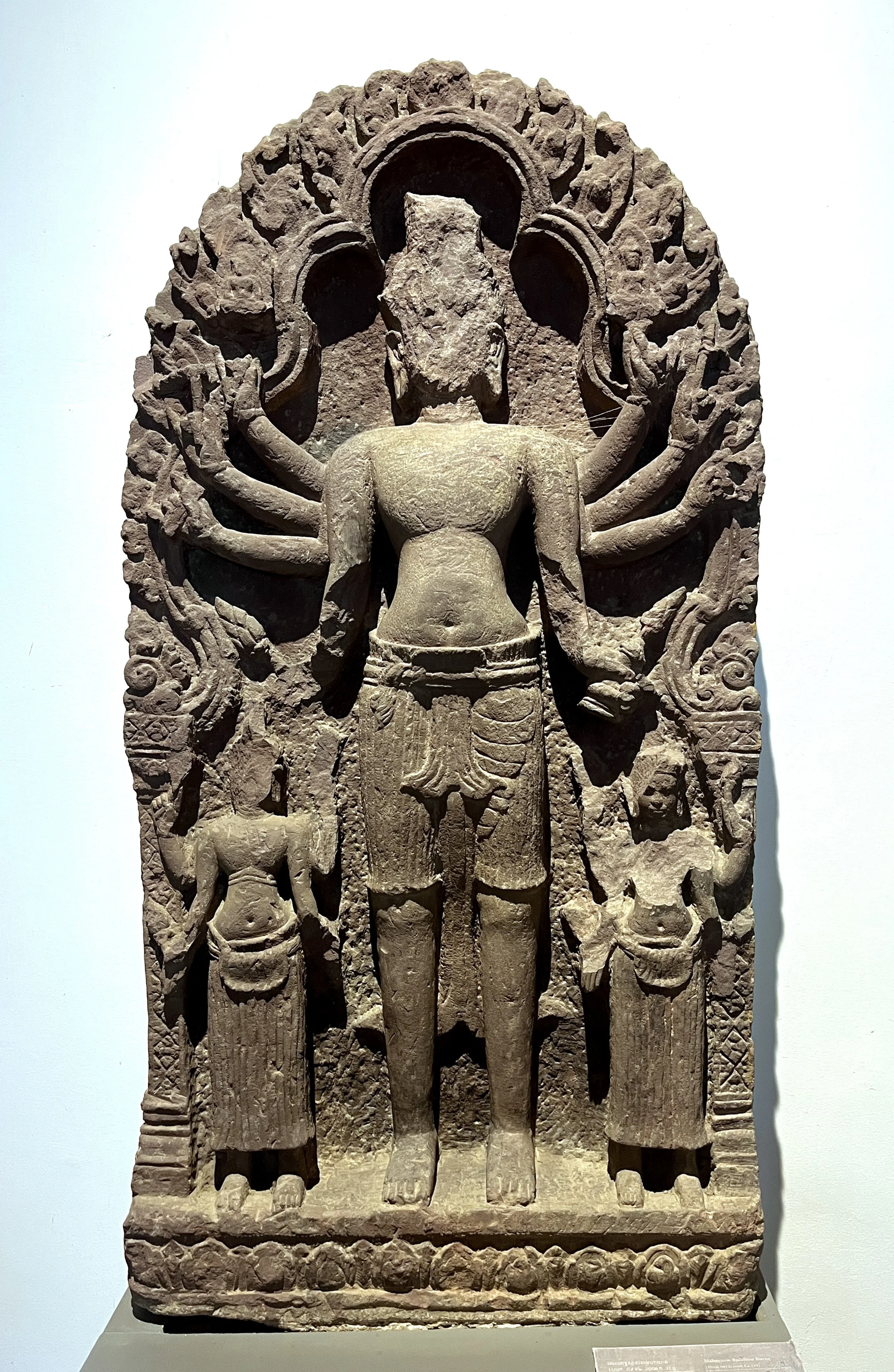
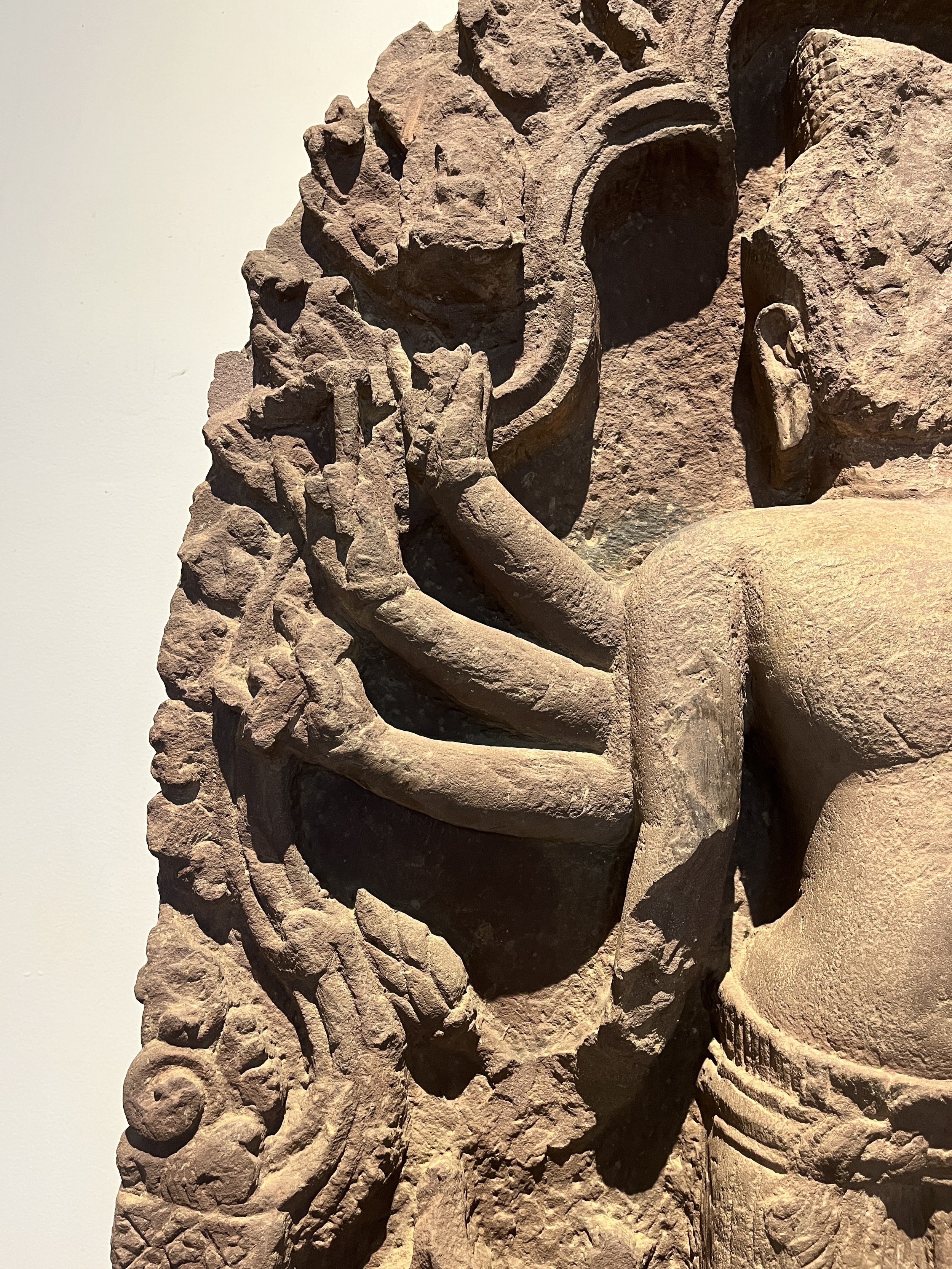
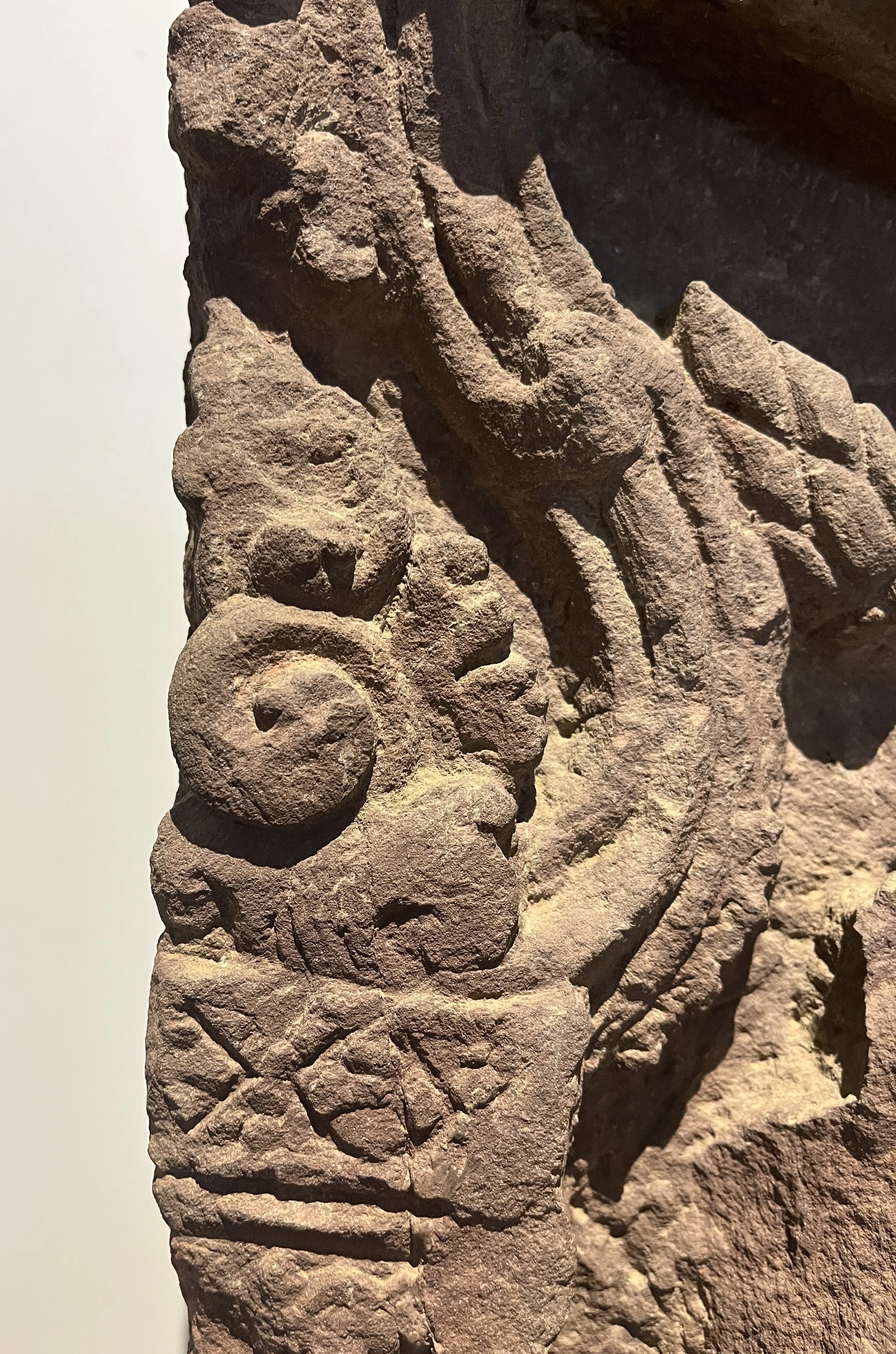
Mahayanic Buddhist Borne
Sandstone
Angkoran period
11th c.
Arak Bak Kor Temple
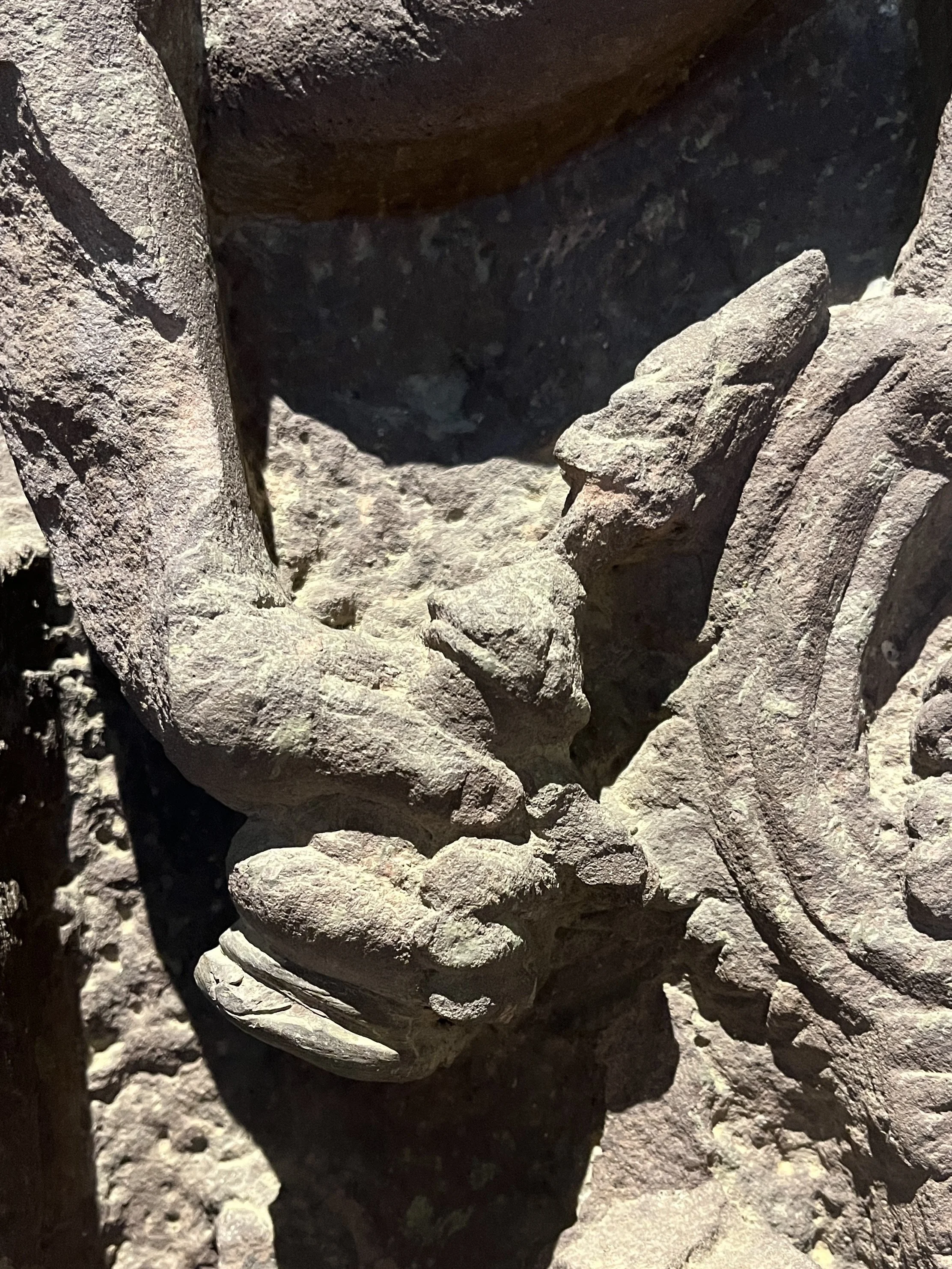
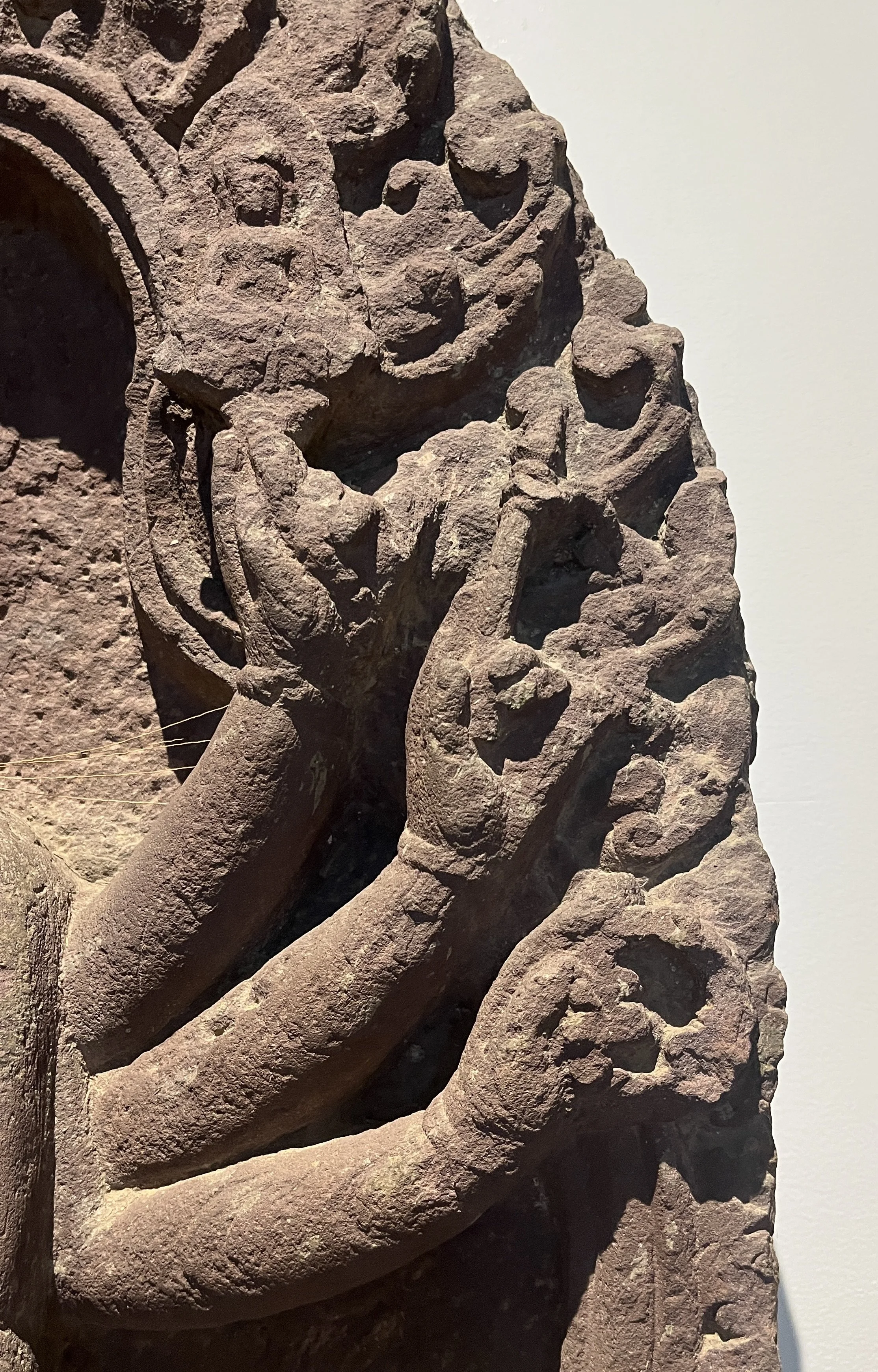
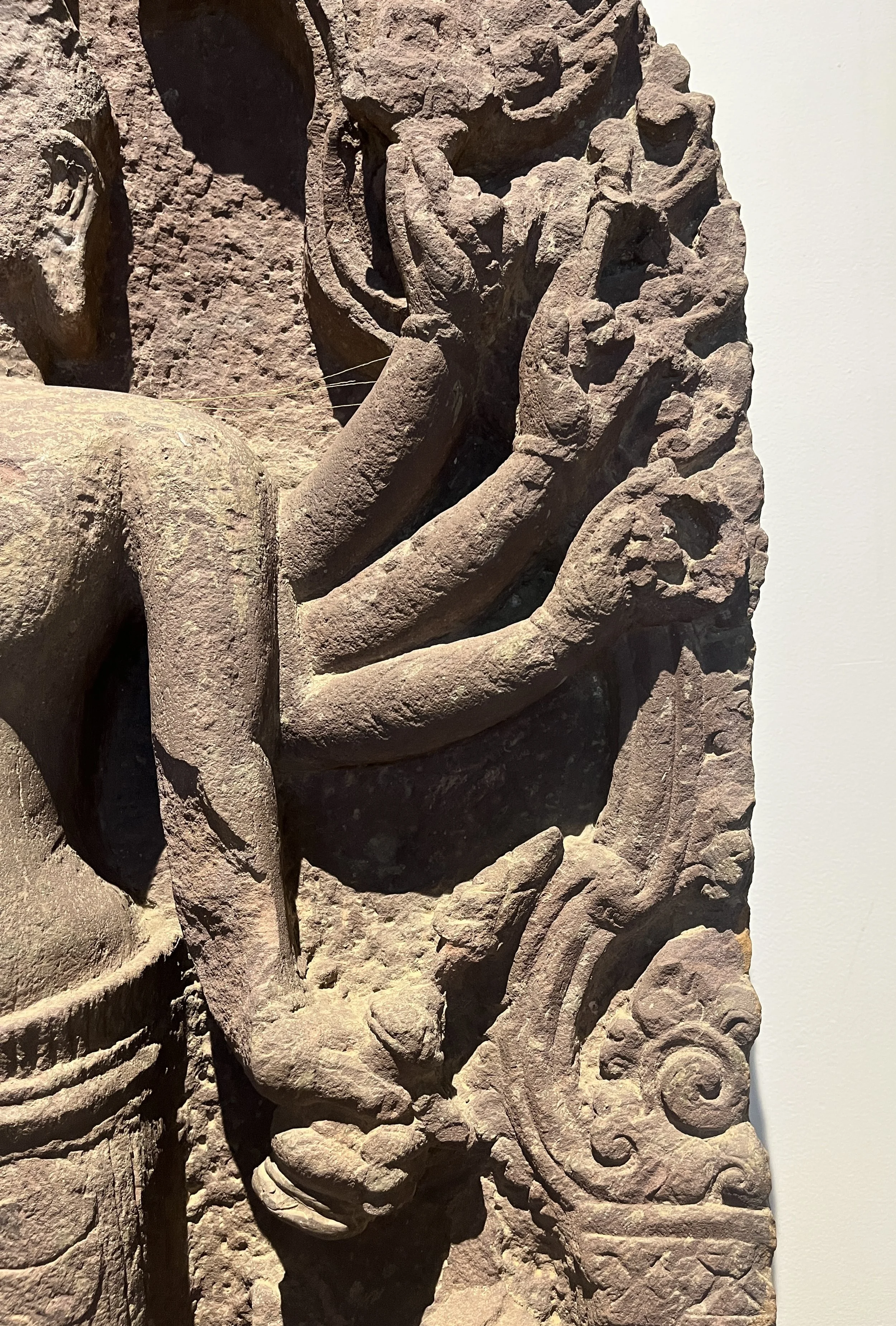
Buddhist borne
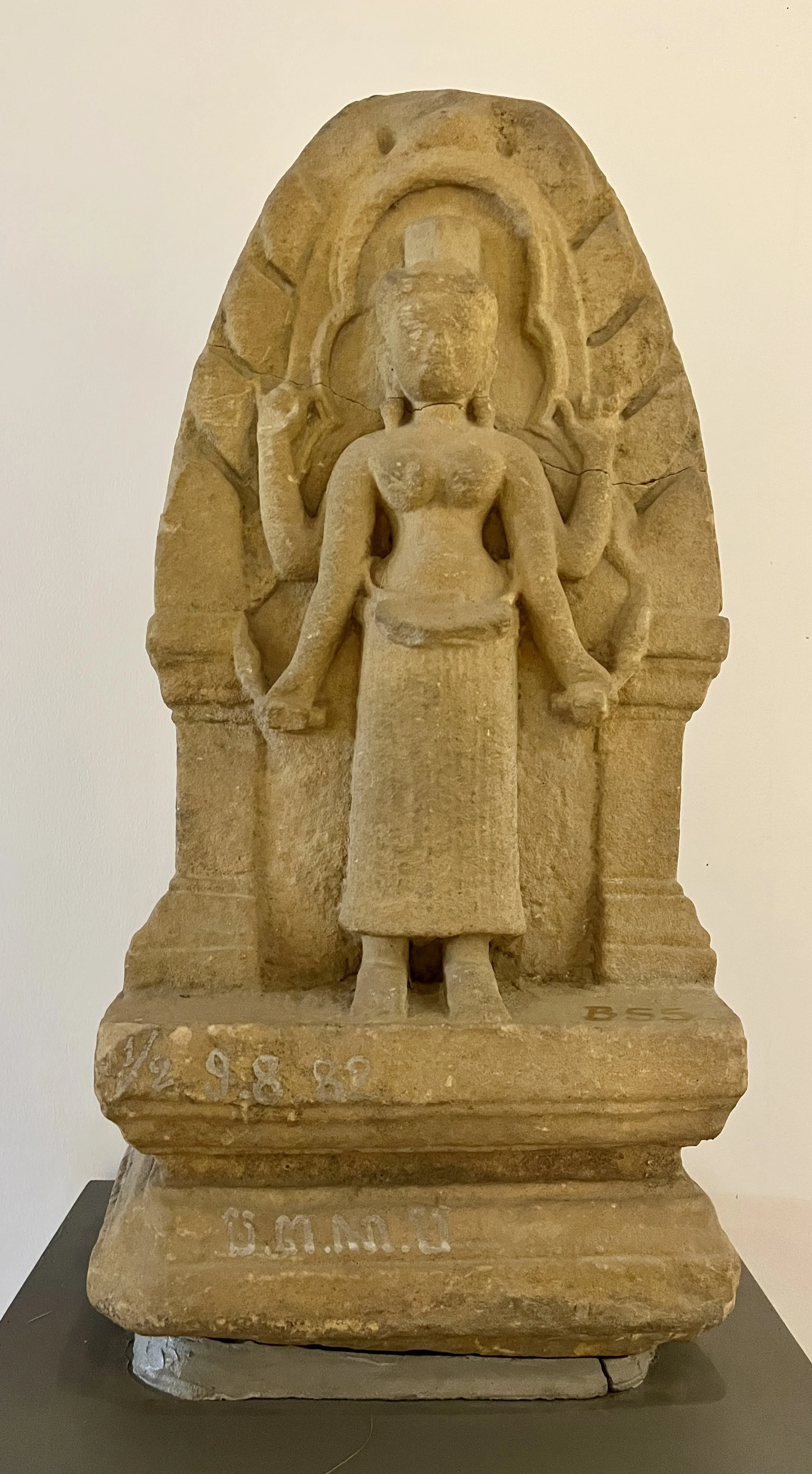
Sandstone, Angkorian Period, 10th c., Unknown
This stele depicts a four-armed female divinity holding a lotus fiower in both of her lowered hands, while the upper two hands are probably holding books.
She stands in a decorative niche. The figure has a strongly built body and a seated Buddha amitabha is visible on her chignon, signifying she is Prajnaparamita ("the Perfection of Wisdom" or "Transcendental Knowledge" in Mahāyāna Buddhism). She wears a long pleated skirt; the upper edge of her cloth falls over her belt in a fan shape at her waist.
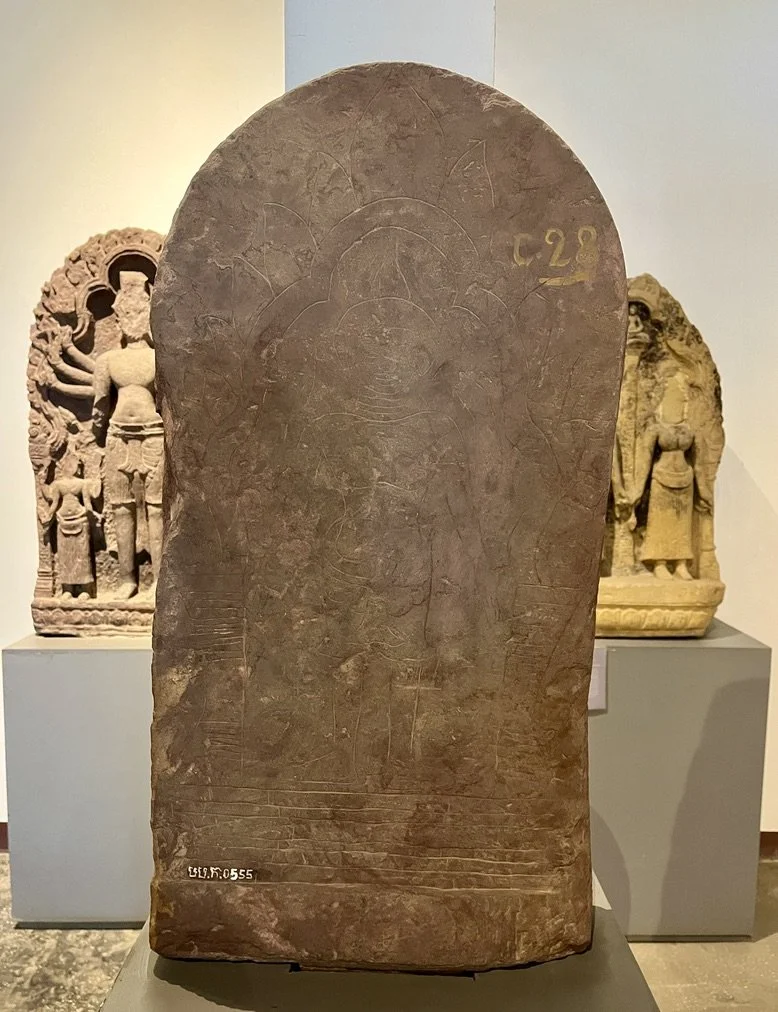
late 10th c. unfinished stele
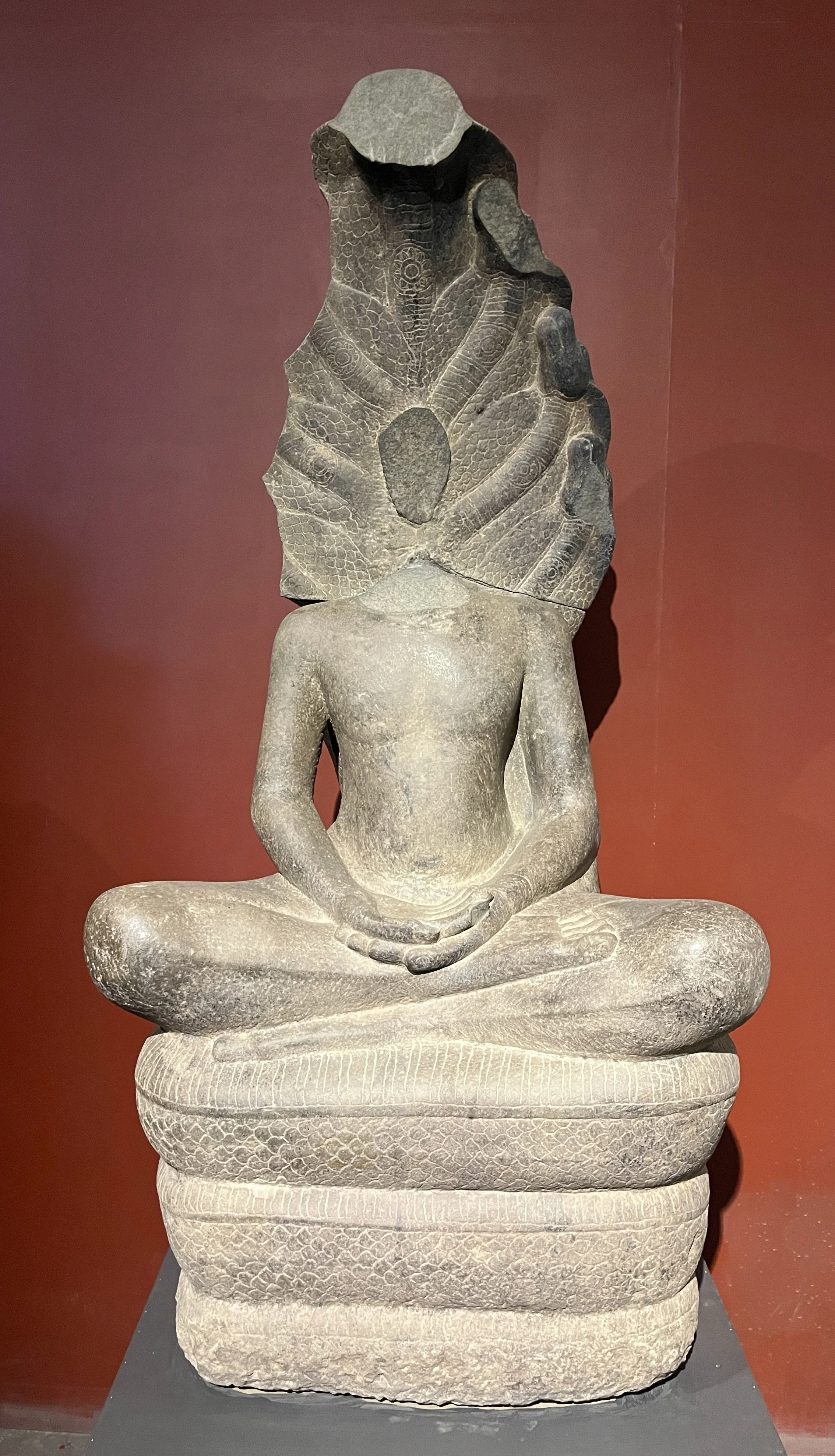
Dhyana Buddha
Sandstone,
Angkorian period
Baphuon style
second half of 11th C.,
Unknown
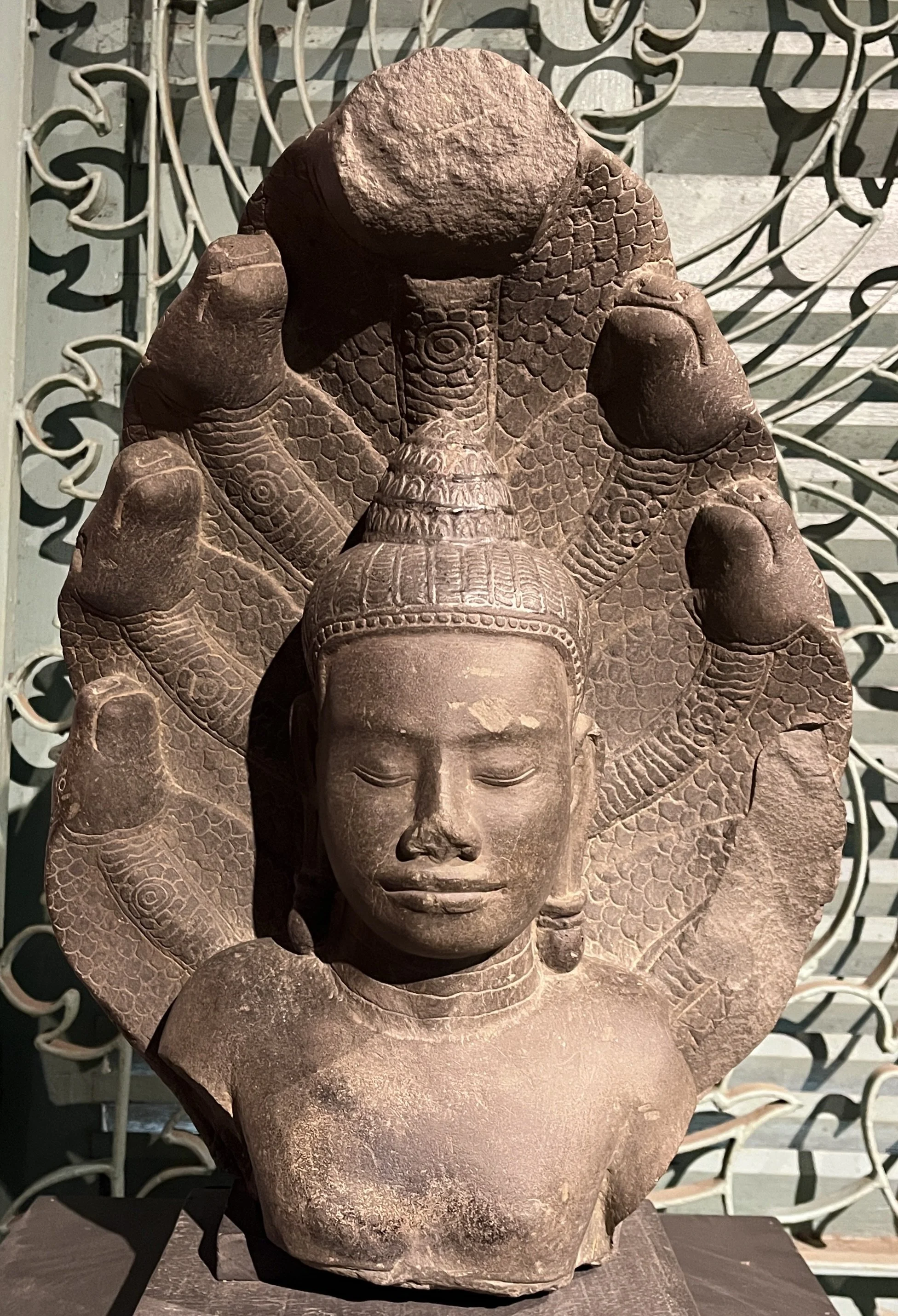
Buddha protected by Naga
Sandstone
Angkorian period, Bayon style,
late 12th to early 13th C.
Unknown
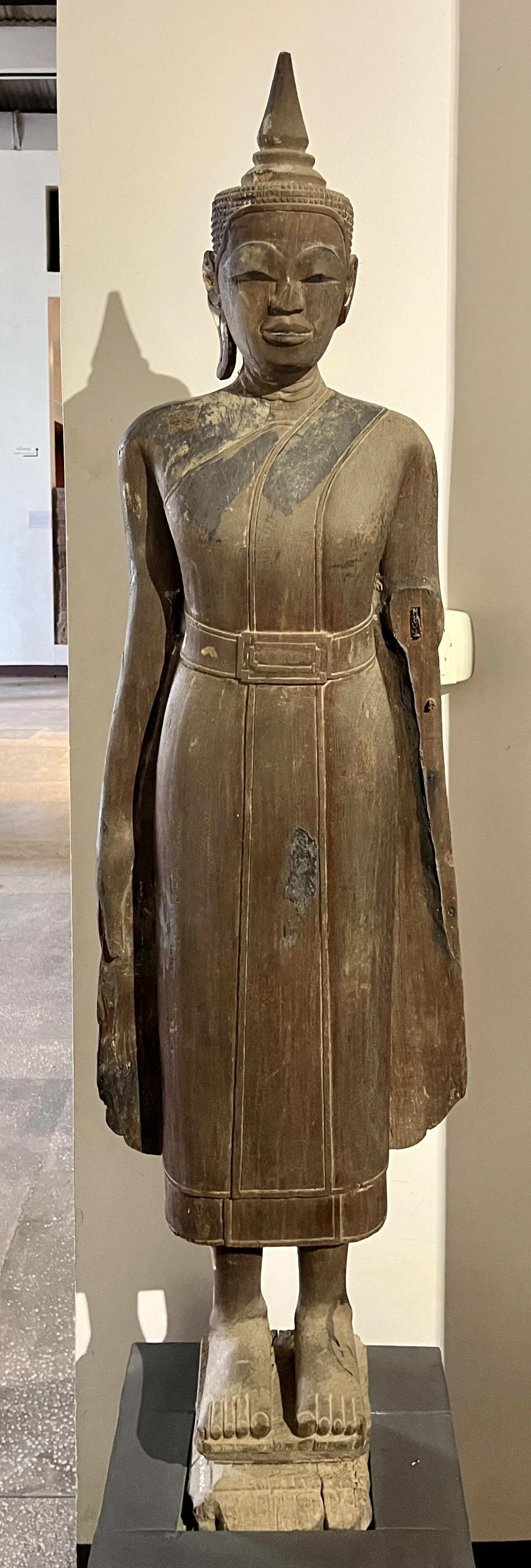
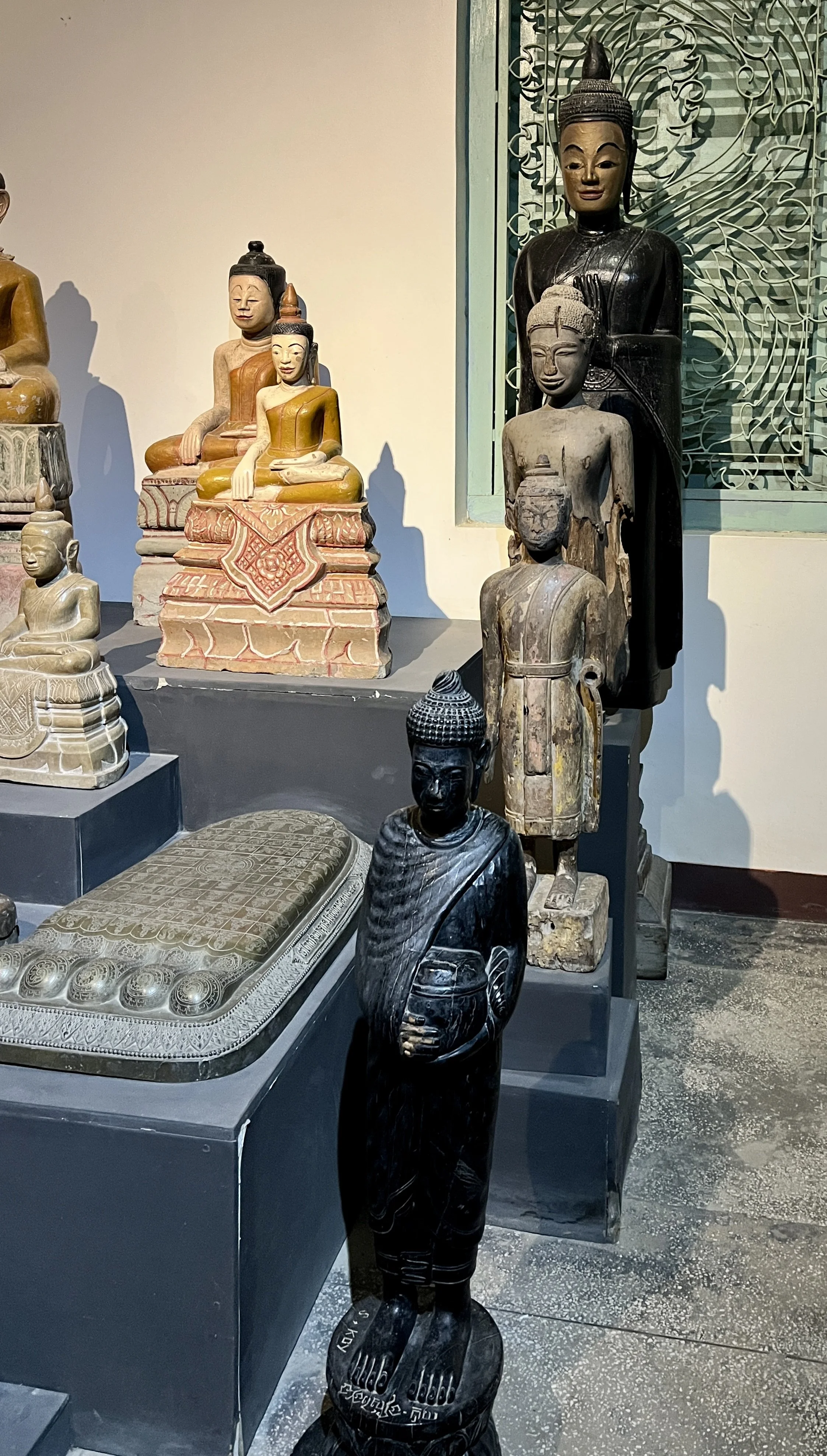
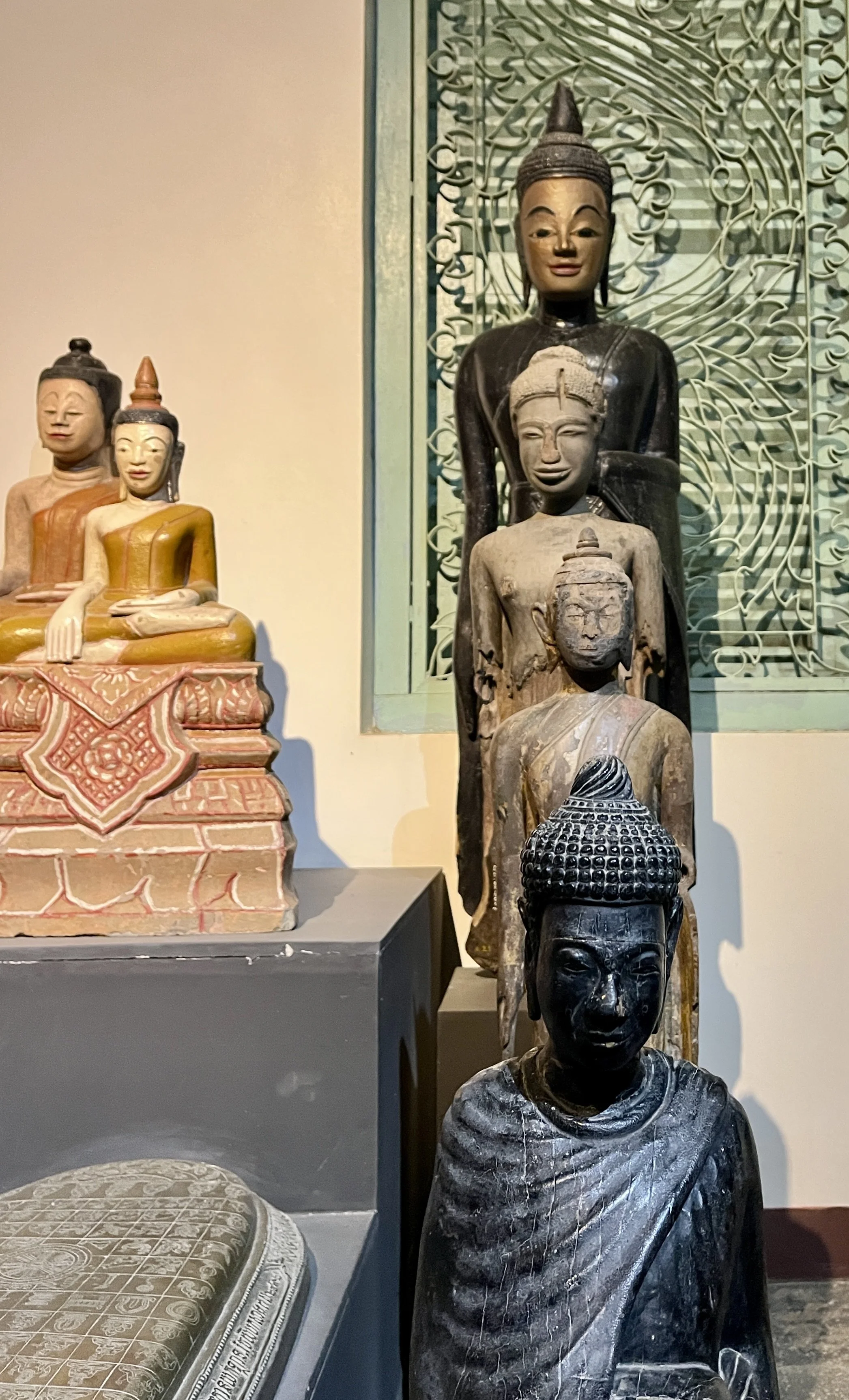
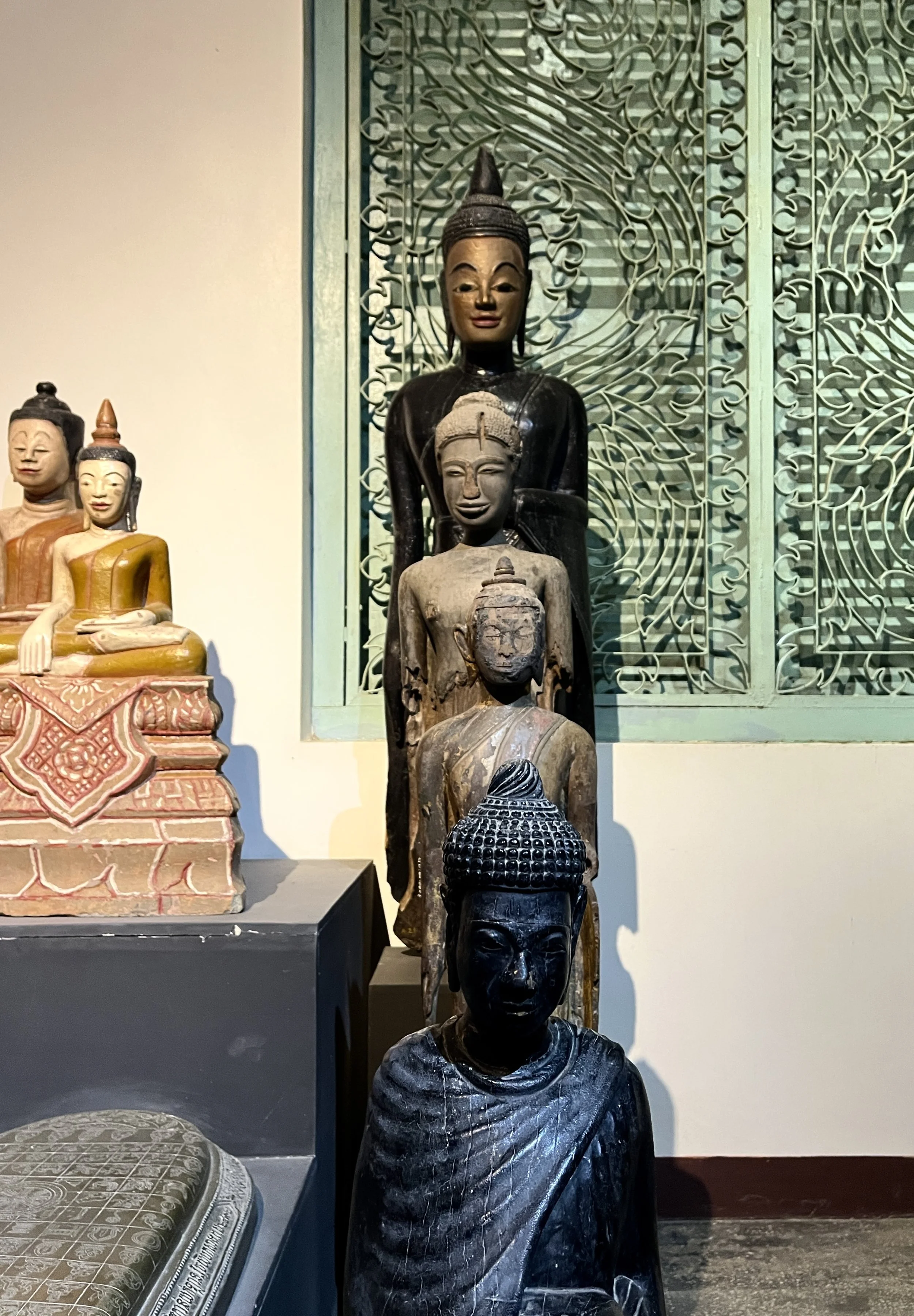
Standing Buddha
Wood
Post-Angkorian period
18th to 19th C
Wat Dountri, Mong Reusey
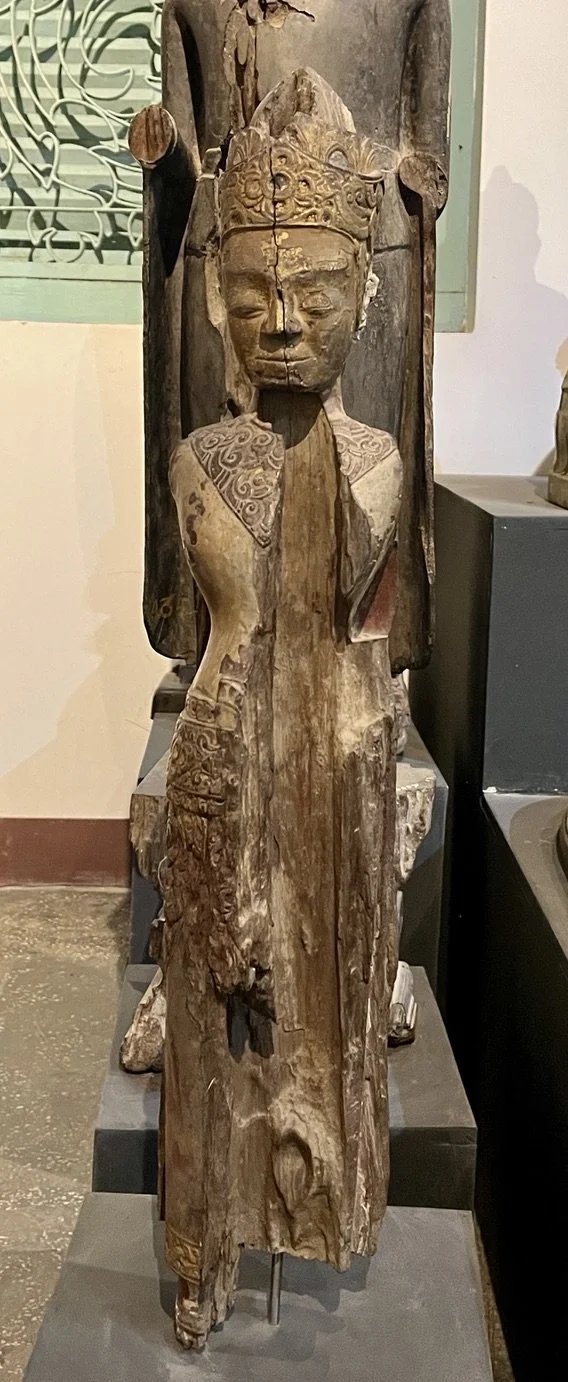
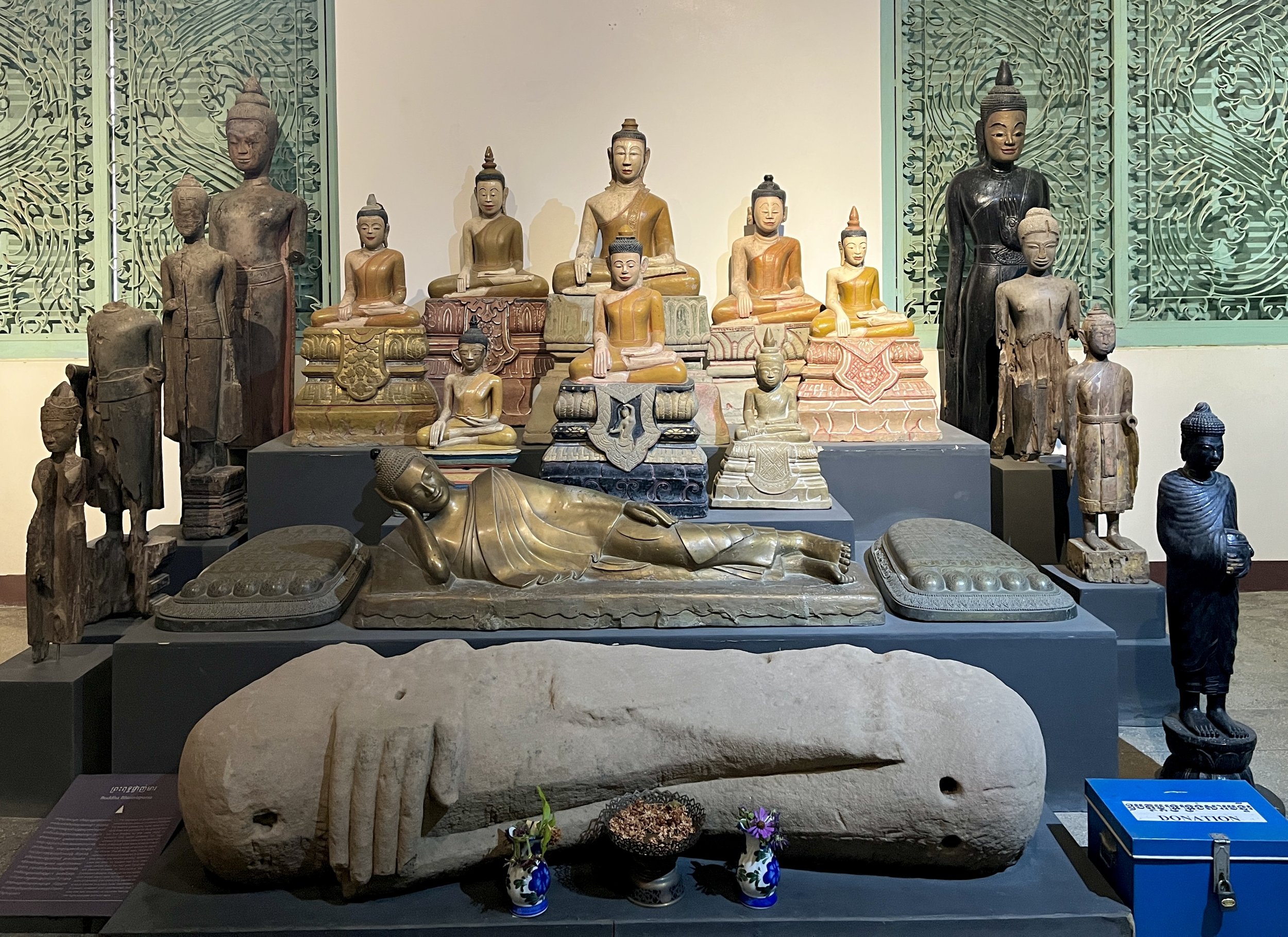
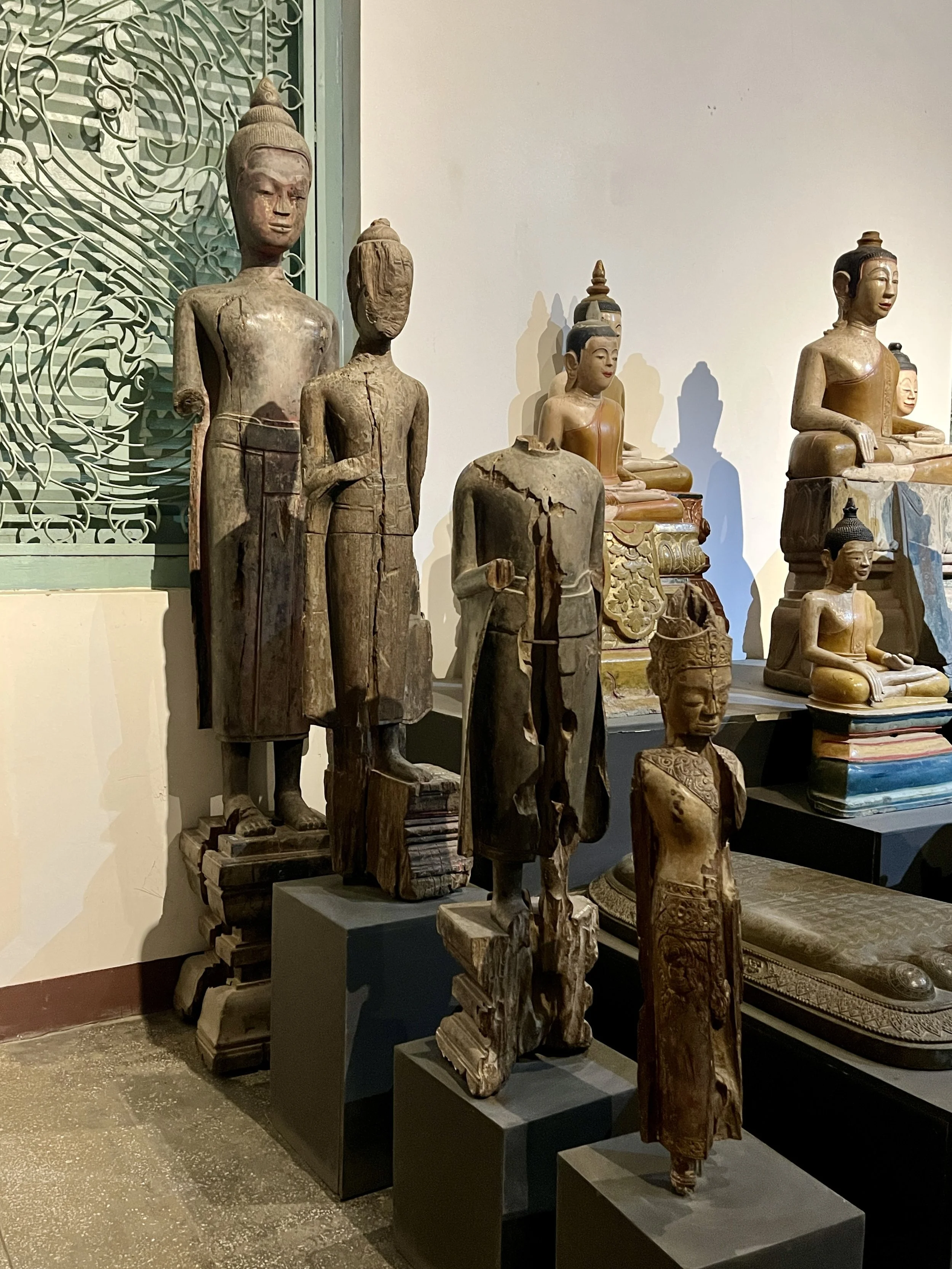
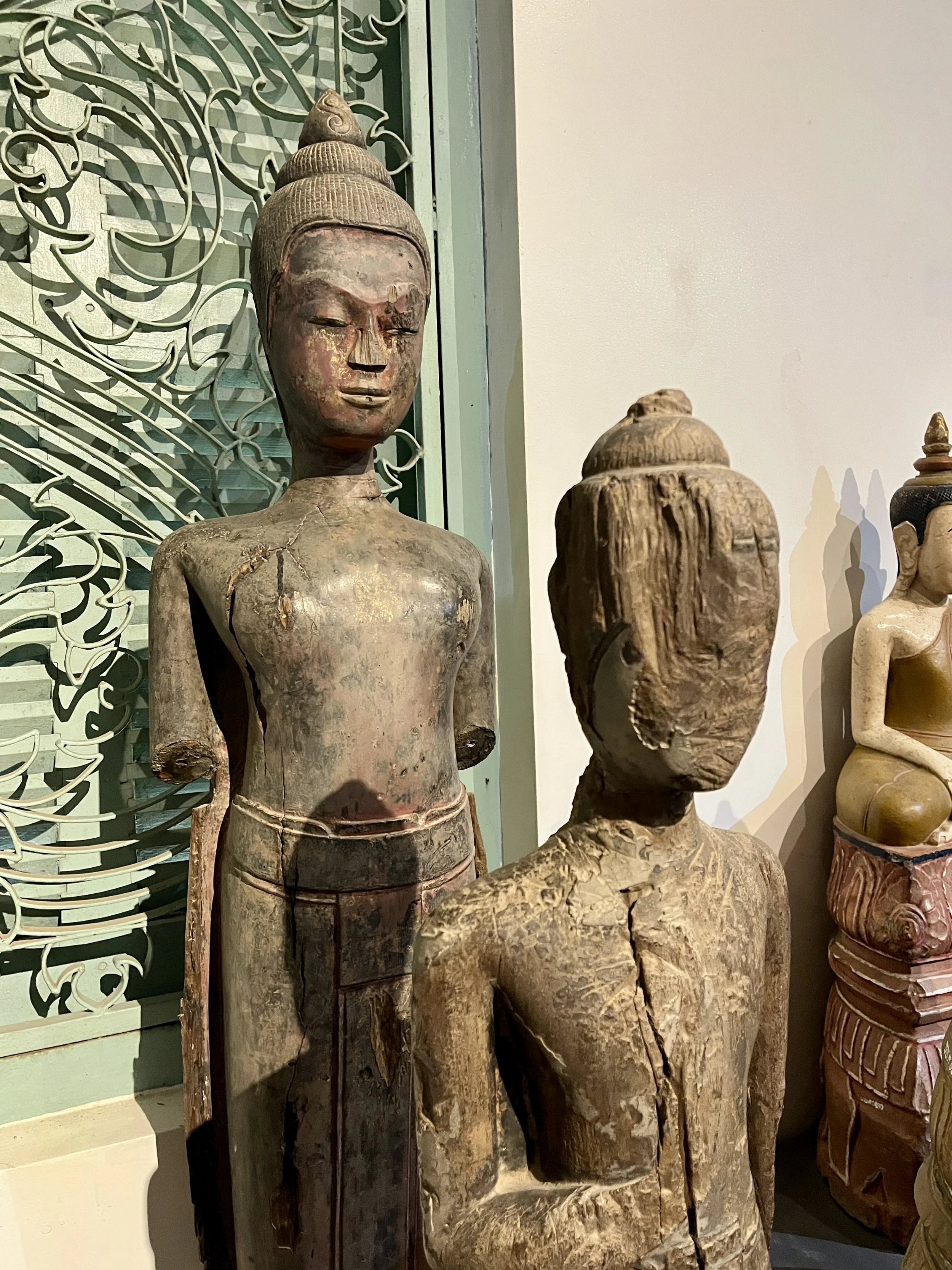
Not long after the end of Jayavarman VIl's reign, with the wide-spread conversion to Theravada Buddhism (CE. 15th onward), wood became the primary material used for Buddhist temple construction and to carve Buddha sculptures, though a number of stone sculptures were also made during that period.
These standing Buddha sculptures are made of different kind of wood, many of which are painted with natural resin such as black and red lacquer, gilded, or inlaid.
Although many of these statues have lost their hands, making it challenging to confirm their gestures, one can presume that they are in the Abhaya mudra, the gesture of reassurance and safety. Four postures can be identified among these sculptures.
First posture, both hands of the Buddha are held upright (Bbgha.0005). Second posture, the Buddha's left hand is palm upright facing outward instead (Bb-gha.0006, 0004, 0008). Third posture, the Buddha put his left hand on his chest (Bbgha.0720, 0002). Fourth posture, the Buddha's right hand is palm upright to show the Abhaya mudra, a gesture of fearlessness (B-bgha.0007).
The Buddha images of this period could be either covered in a plain robe, strictly following the orthodox Buddhist tradition of depicting the Buddha in his human form without worldly attachments, or adorned with ornaments and a crown, depicting Buddha as a prince, king, or superhuman (Bbgha. 0003).
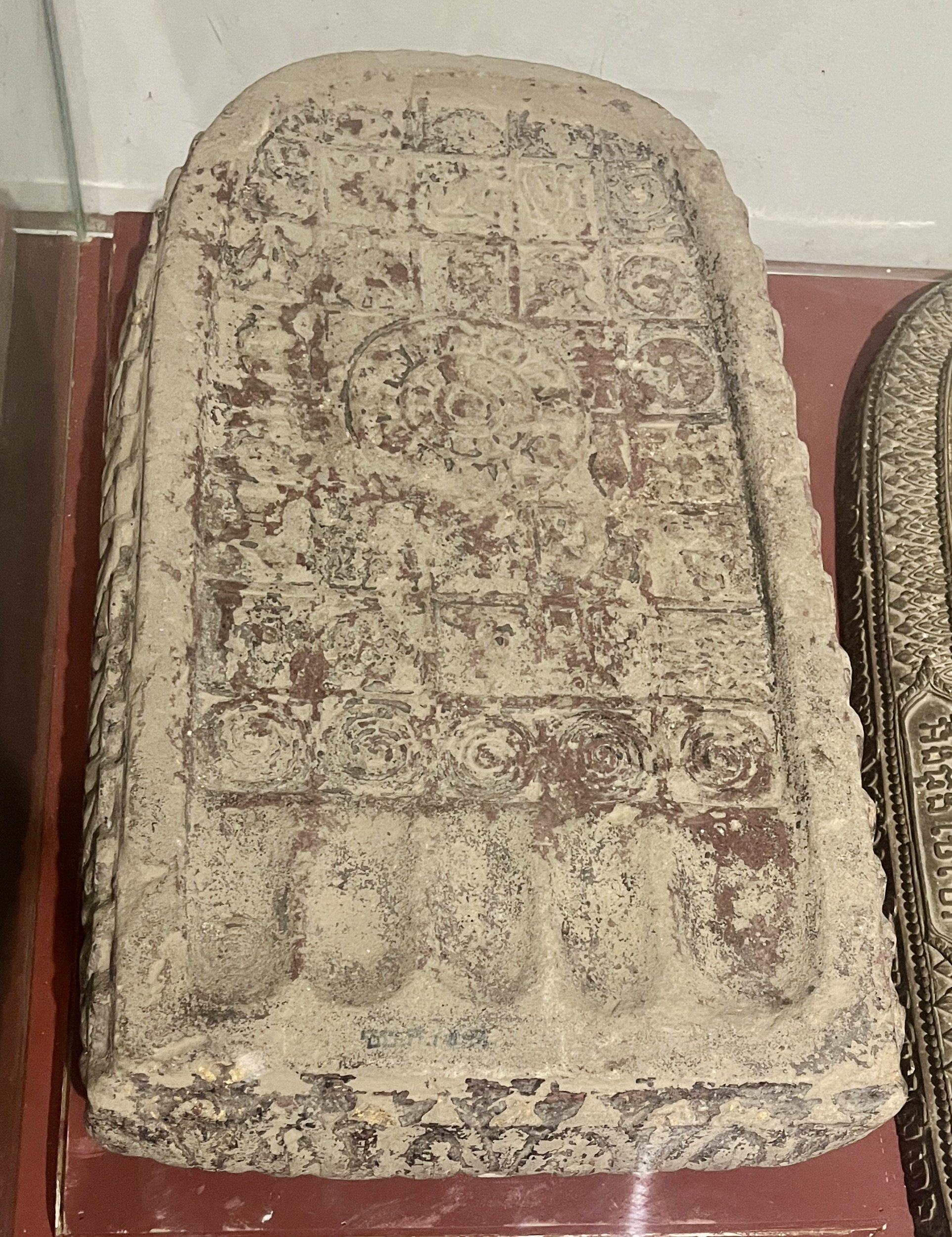
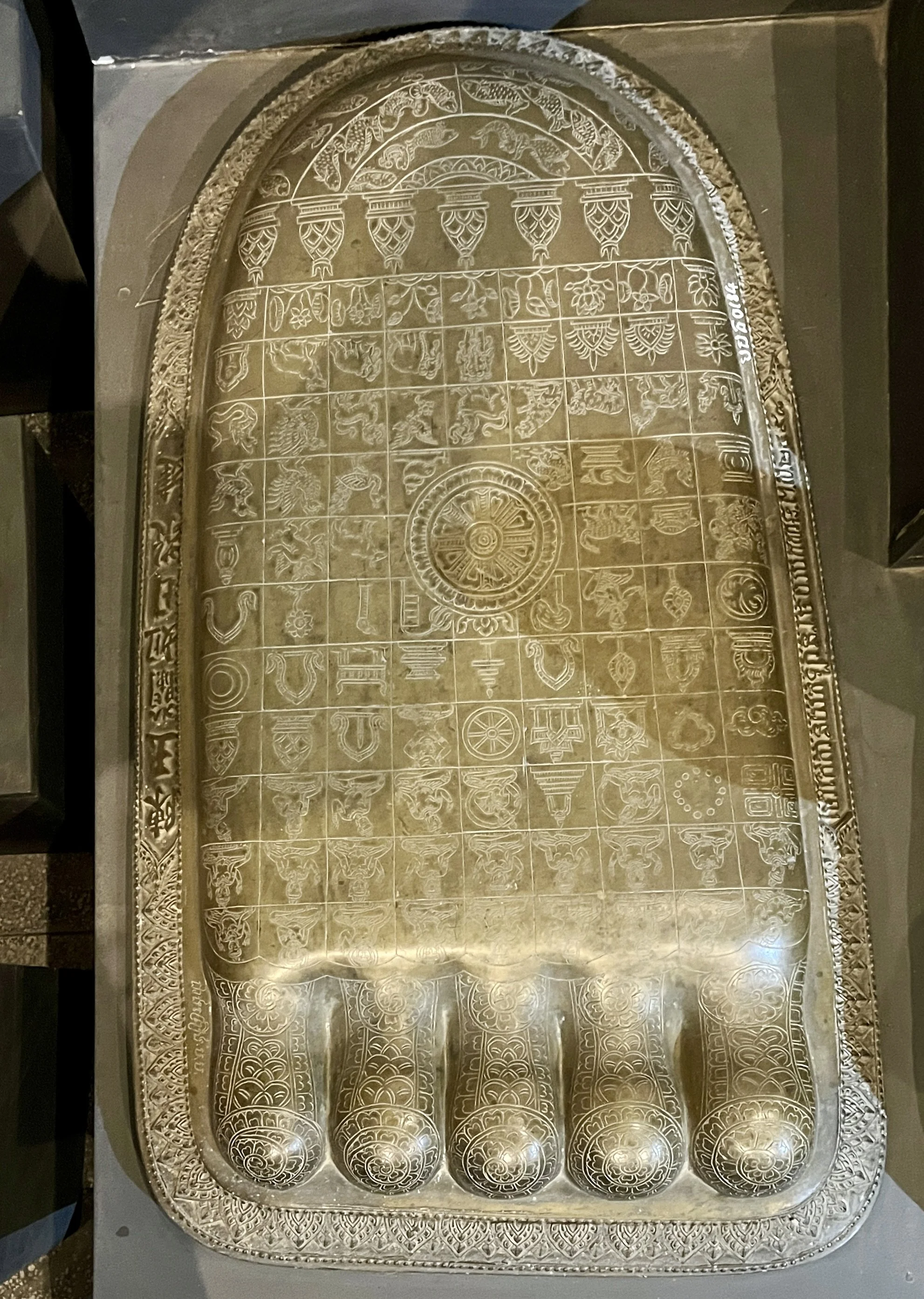
Buddha Foot Print
In the early period of Buddhism, the footprint of Buddha was an iconic representation of his selfless form.
At a later period when anthropomorphic images of Buddha were introduced, the meaning of the footprint of Buddha changed. It became a reminder to his followers that the Buddha was once present on earth and left a path for them.
These are 4 modern footprints, three in cast metal and one in stone painted with black lacquer over cinnabar. They were commissioned by individual Buddhists, presumably as a gift to a monastery. The names of the donors and the date of their creation are imprinted on the objects. Similar iconography is depicted on each. In the center is the depiction of Dharmachakra, surrounded by various signs.
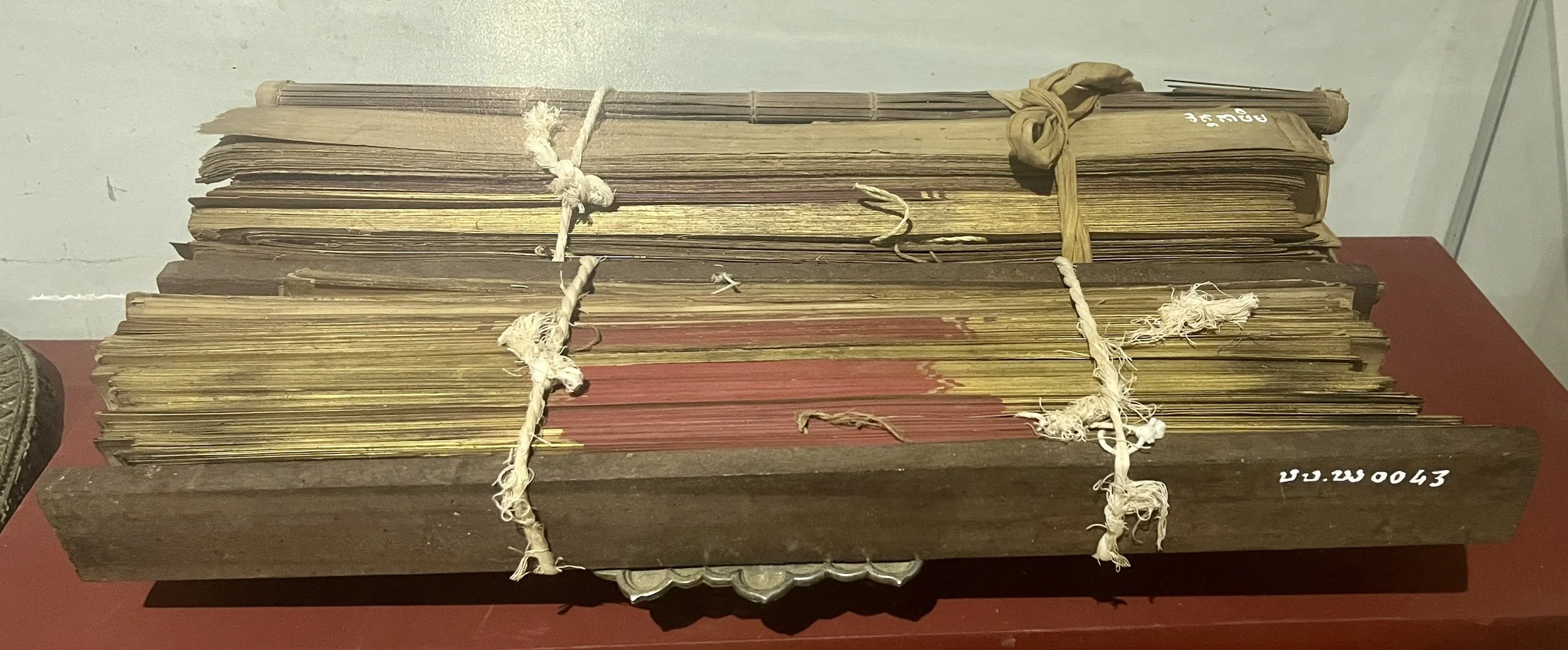
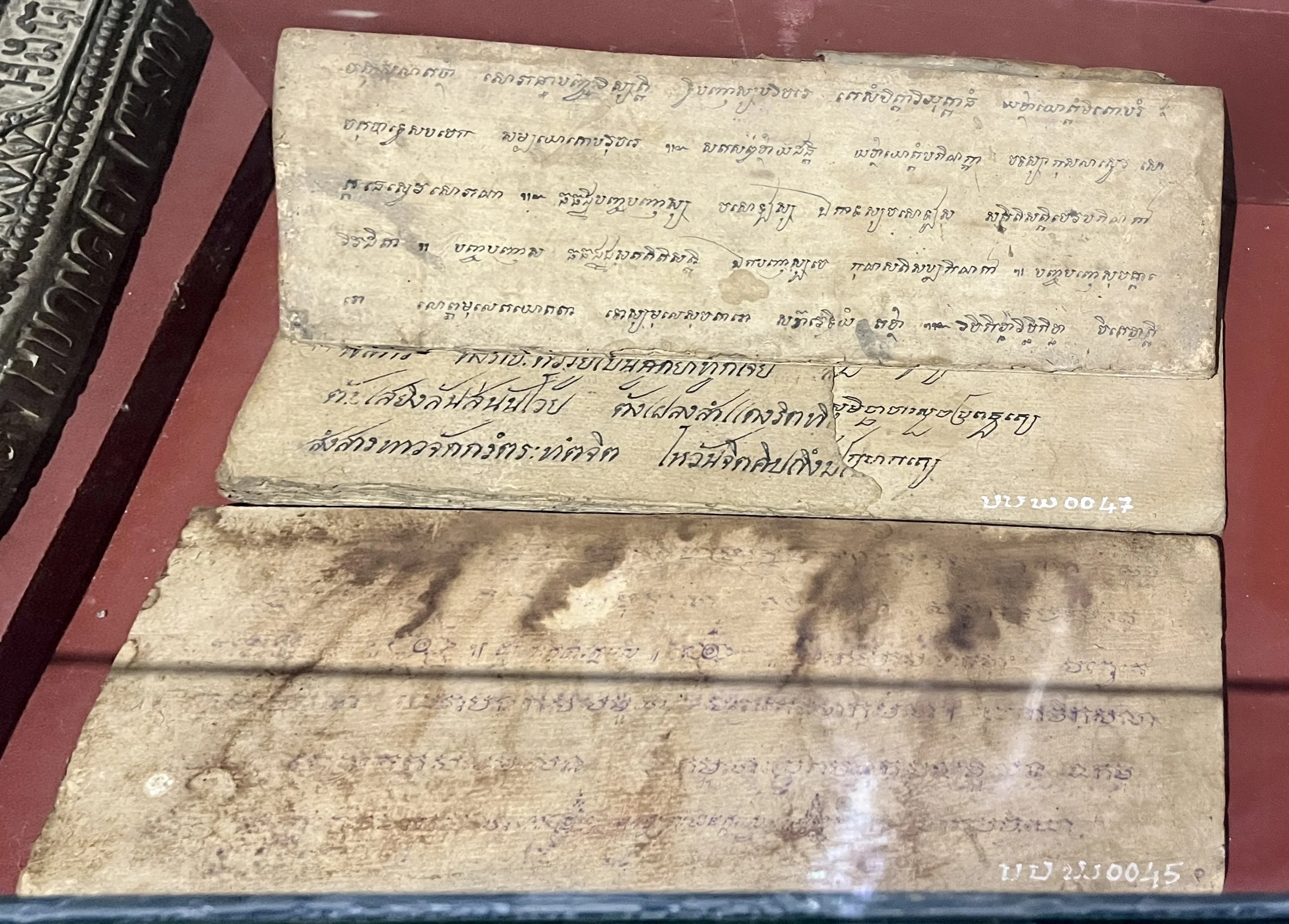
Manuscript
Palm leaf
Moden period,
19th-20th c.
Wat Samrong Knong,
Ek Phnom, Battambang
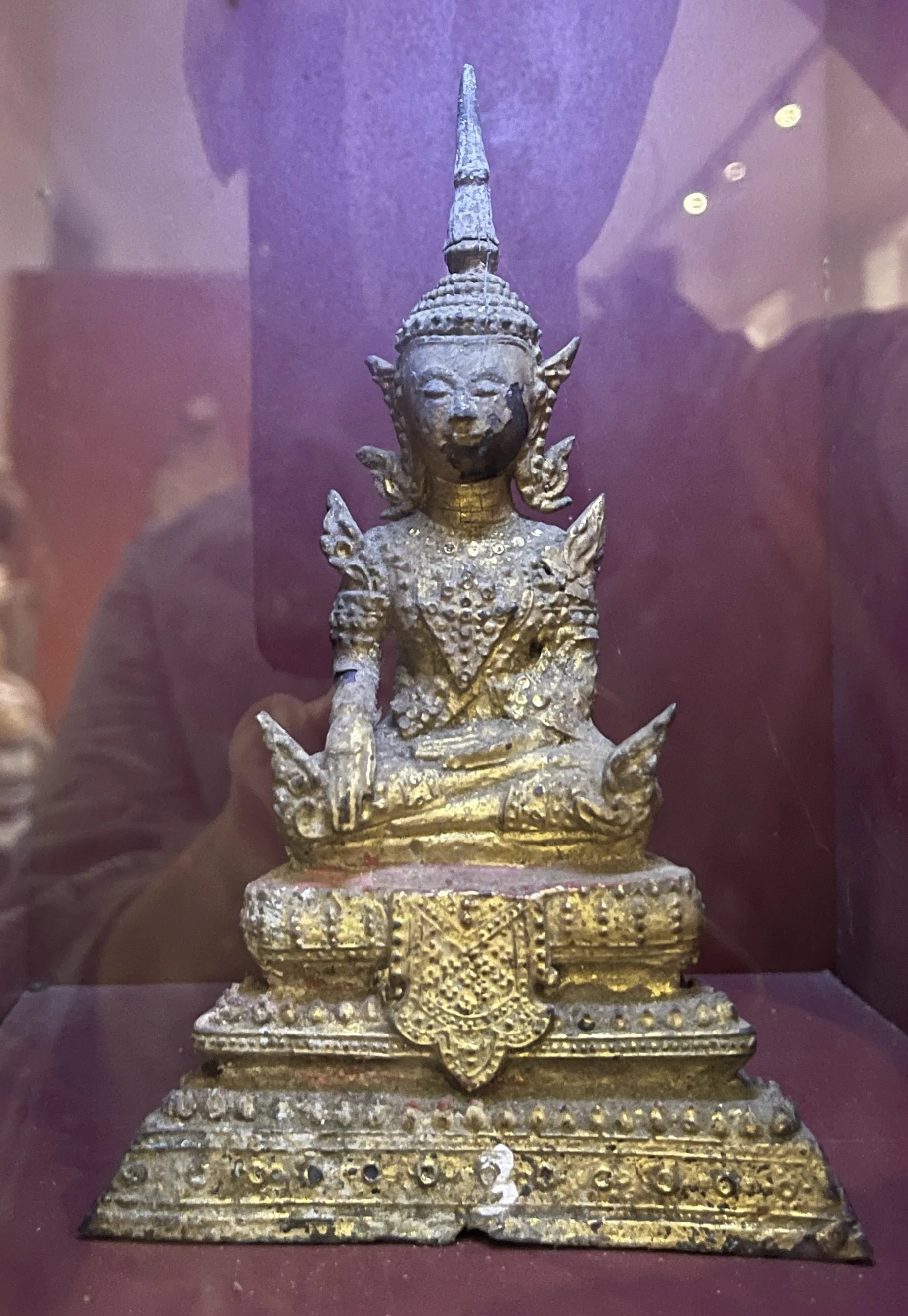
mid 20th c.
The collection of Wat Khdang Ngea consists of forty-five small seated Buddhas, which are made from a variety of metals, namely copper alloys, brass, silver and gold. They are depicted wearing either a normal Buddhist robe or heavily adorned. Within the collection, the Buddhas make three gestures:
Bhumisparshamudra: the most common gesture, in which the Buddha extends his five right fingers to touch the ground, calling the earth goddess to witness his enlightenment.
Dhyanamudra: a gesture which, in Cambodia, commonly shows both of the Buddha’s hands held at stomach level. This mudra symbolizes Buddha's meditation under the Bodhi tree before attaining the enlightenment.
Buddha hold alms bowl: Generally, this posture shows Buddha standing or seated; one hand holds his alms bowl either outside or inside his robe.
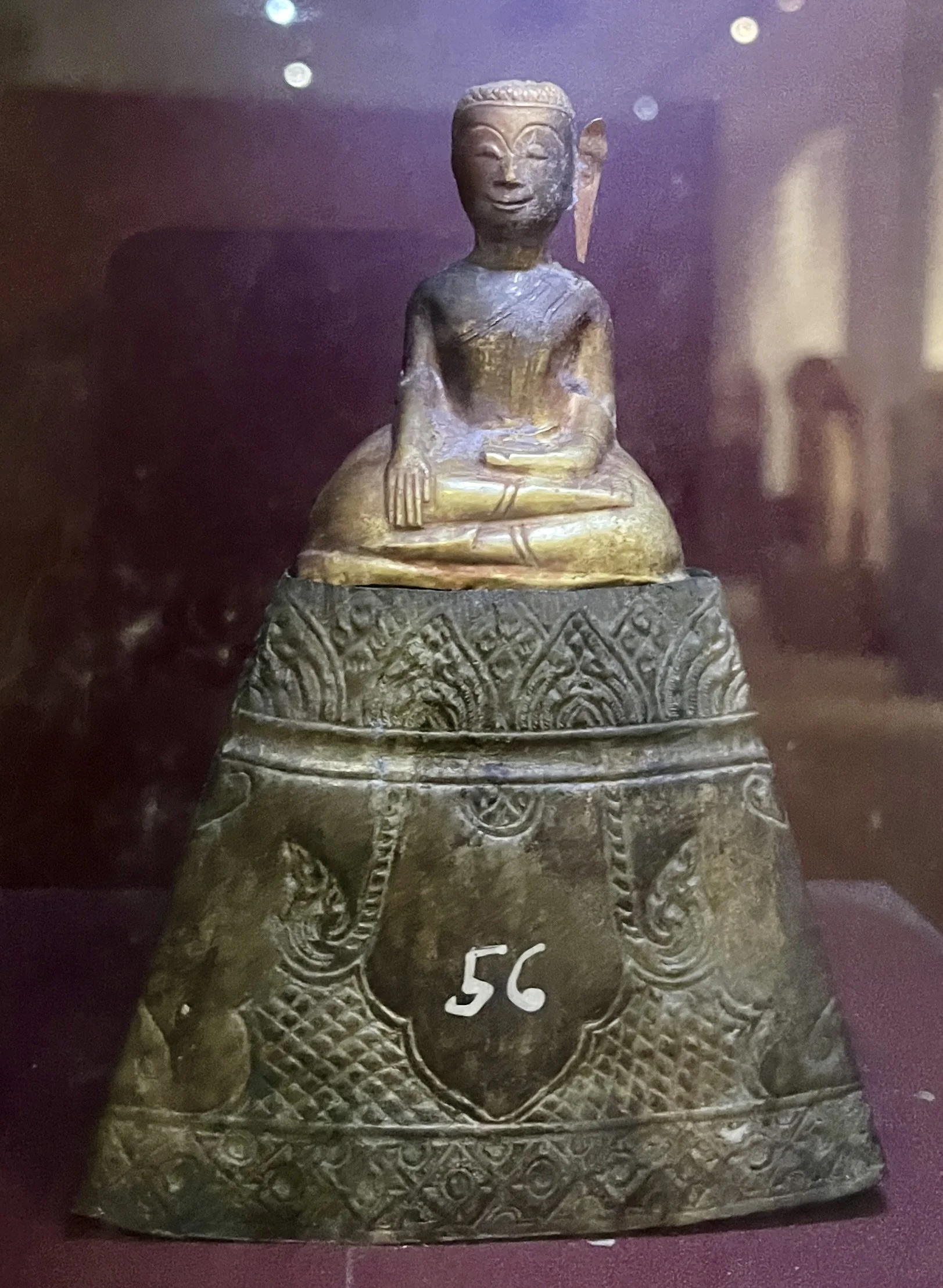
Idha Bhumisparsa
The depiction of Buddha in Bhumisparsamudra is very popular in modern Cambodia.
The Buddha places his right hand on his right knee and points to the ground with the five fingers of his right hand to summon the earth goddess to bear witness to his attainment of enlightenment. It is believed that mara tried to frighten him with the armies of demons claiming his throne. The Buddha, at that point, reaches his right hand to touch the earth. It is believed that Bhumi, the earth goddess, answers and appears. She uses her palm to squeeze her wet hair; the water from her hair floods the evil demons of mara. In this mudra, the Cambodian Buddha image can wear either a plain robe or be highly adorned with ornaments, and is commonly seated on a lotus throne. In a plain robe, the Buddha is usually wrapped with uttarasanga, but only the left shoulder is covered, leaving the right shoulder and arm bare.
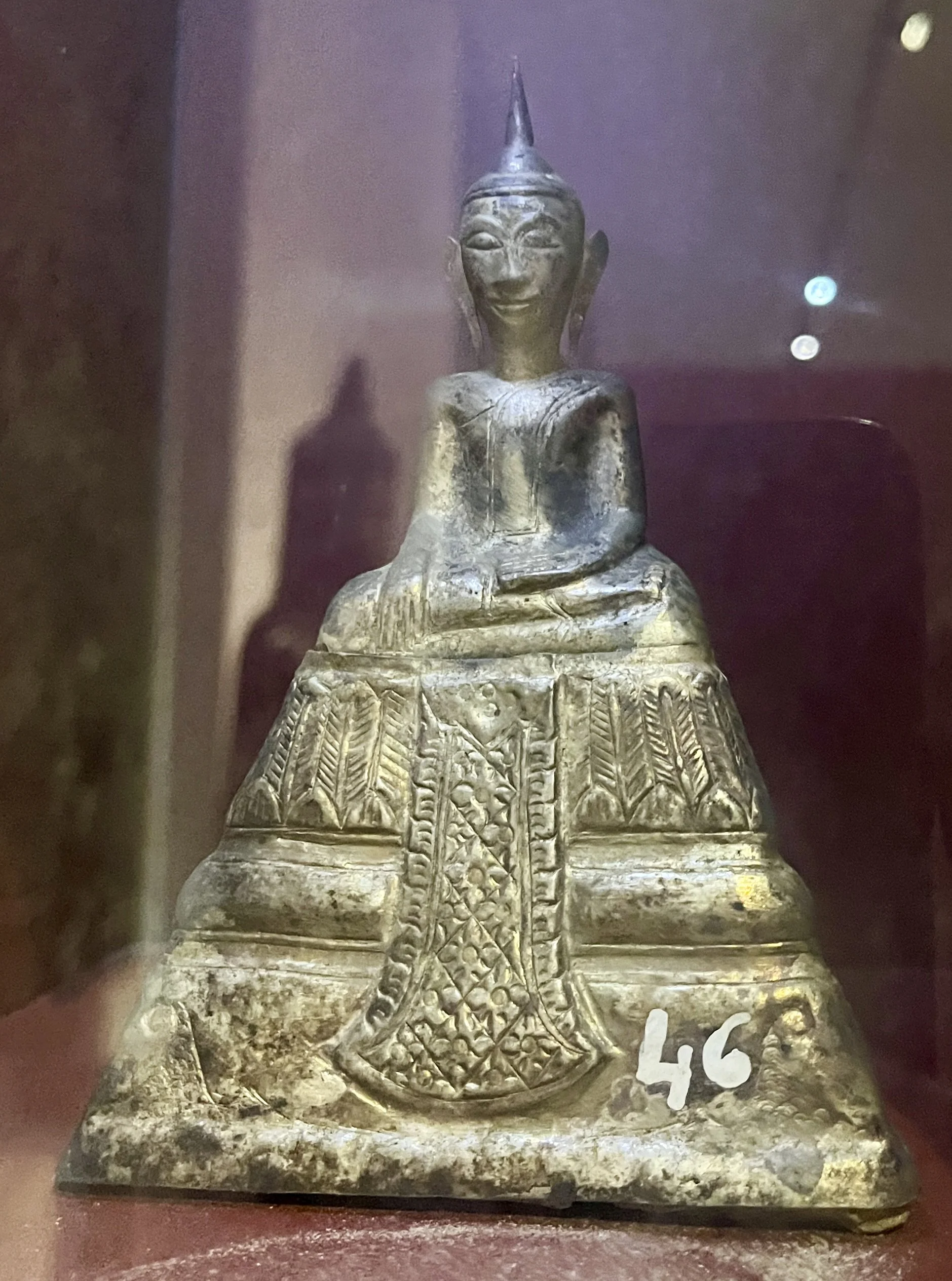
Strangely, the final case of artifacts on display are just common wares dating from between the 17th and 20th centuries. I guess they showed up when an old abbot’s personal belongings were delivered to Wat Po Veal, and somehow they made it onto the floor at the Battambang Museum to teach us . . . something? about local production and trade.
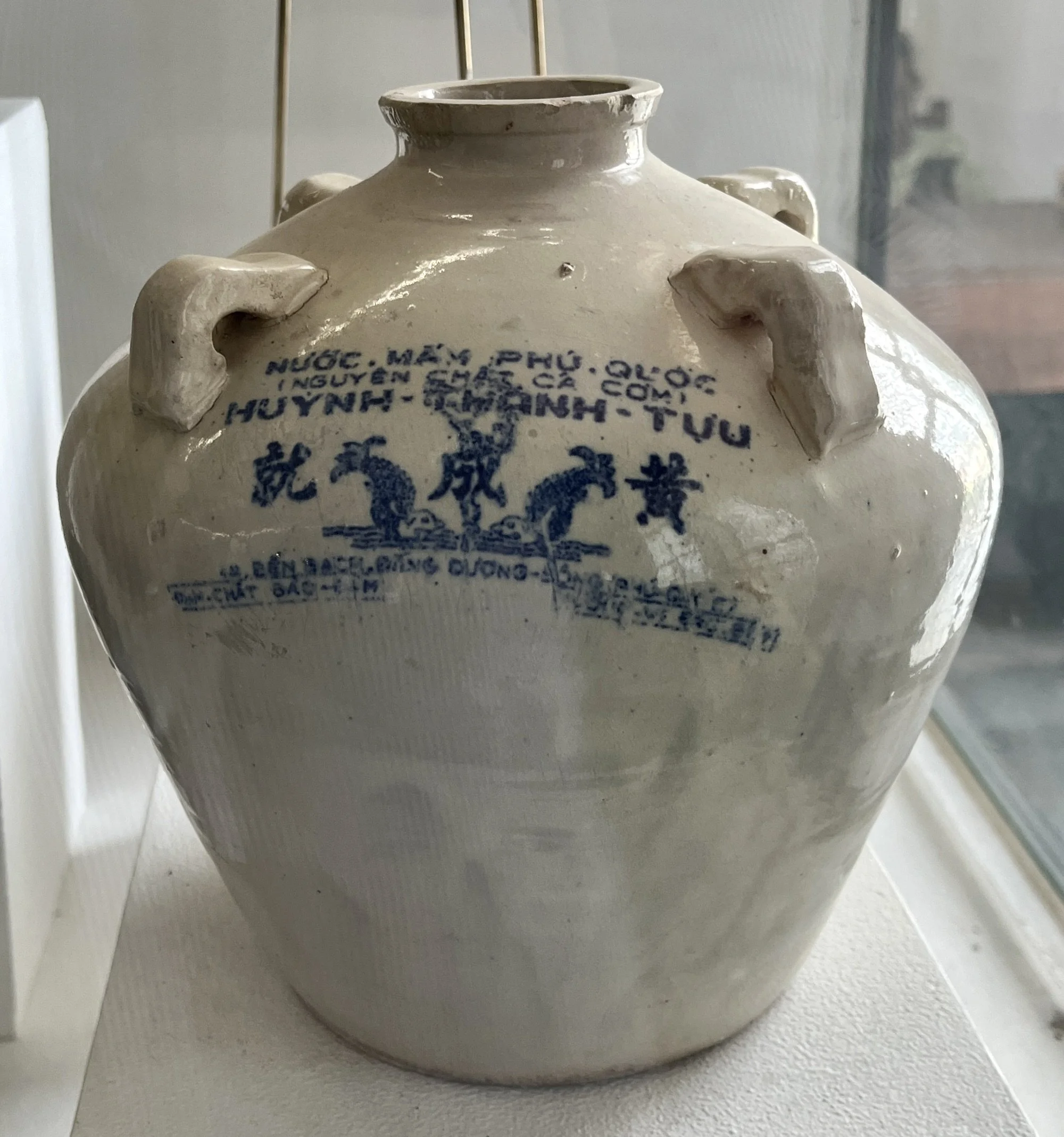
Bottle With four ears
Earthenware
18th - 19th c.
I’ve probably bought a modern bottle of fish sauce from this factory . . .
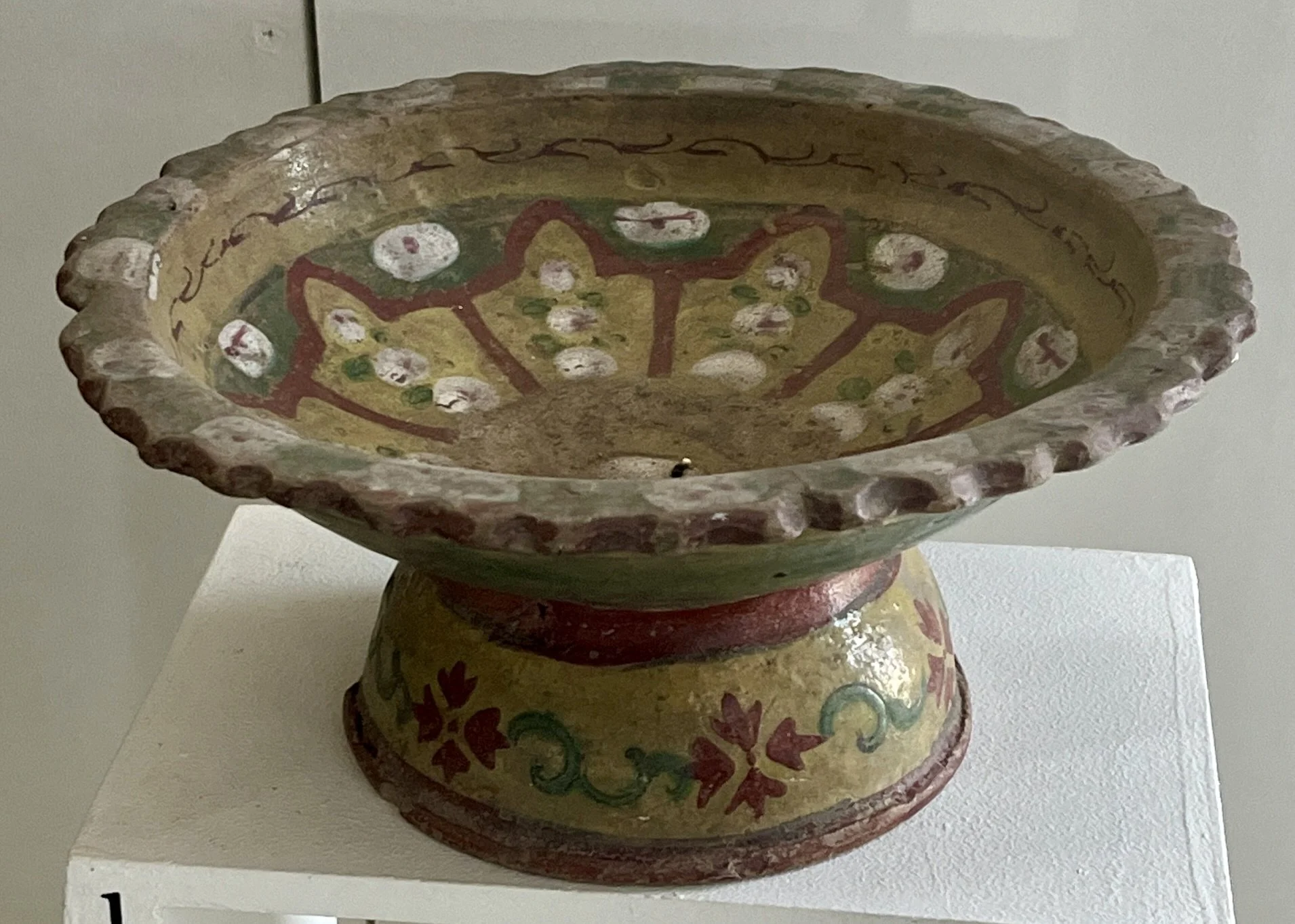
Pedestal bowl
Earthenware
17th-18th c.
Wat Damrei sa, Svay Po, Svay Po, Battambang
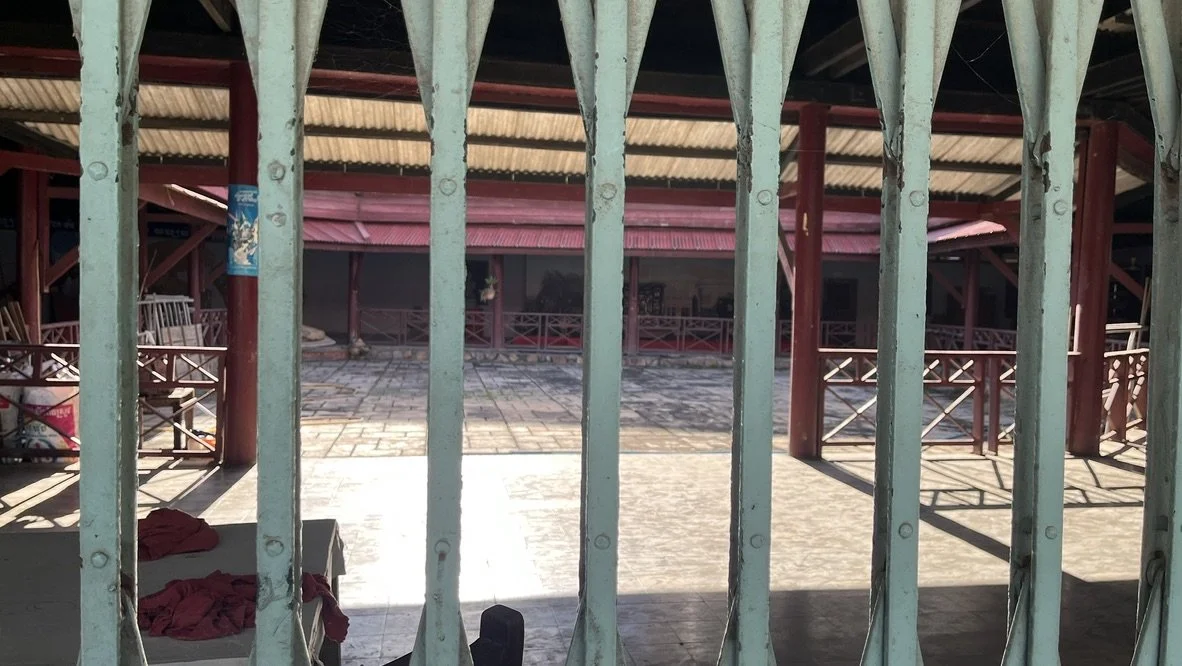
The mystery staging area